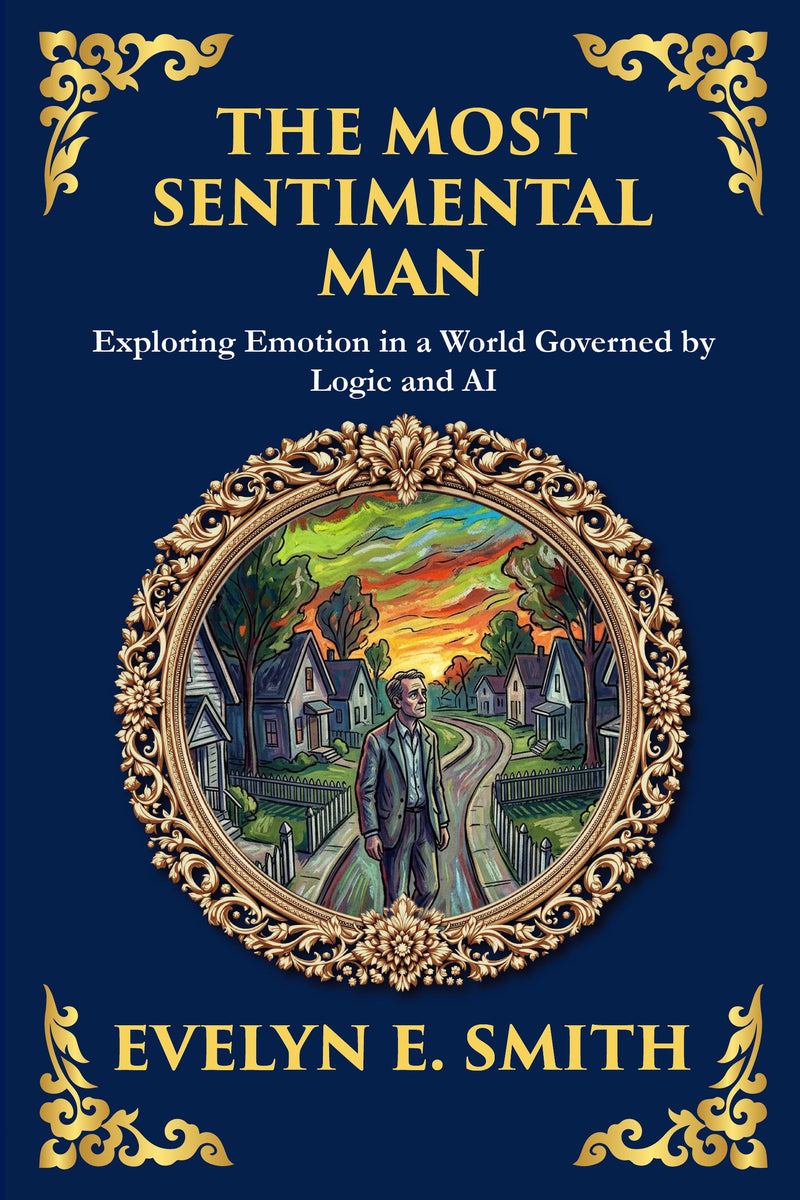
The Most Sentimental Man
In a future ruled by logic, efficiency, and the cold governance of machines, one man dares to feel. But is sentiment a gift—or a curse?
or free app
10,000+ hrs library
30-day guarantee
The complete The Most Sentimental Man appears in modern English through Library of Alexandria Press, available online with audiobook narration included for members.
Have you ever wondered why emotions might be the most dangerous force in a logical world? Evelyn E. Smith, a master of satirical science fiction, delivers a sharp yet tender exploration of humanity’s greatest paradox: our ability to feel. In The Most Sentimental Man, the future has been entrusted to machines and logic-driven governance, where efficiency rules every aspect of life.
In this rigid order, emotions are seen as irrational, inconvenient, and dangerous to progress. But one man, stubbornly sentimental, cannot abandon the pull of love, compassion, and sorrow. While society dismisses him as a relic, his very capacity for feeling might prove to be the key to saving humankind from its own sterile perfection.
With wit, irony, and a deep understanding of the human heart, Evelyn E. Smith presents a story that is both humorous satire and poignant reflection.
What you’ll discover in this modern edition
- Emotion vs. Logic – A clash between human sentiment and the cold order of artificial intelligence.
- Evelyn E. Smith’s Signature Satire – Witty, ironic storytelling that reveals the absurdities of hyper-rational society.
- The Value of Compassion – A reminder of why feelings are humanity’s greatest strength, not its flaw.
- A Timeless Reflection – A story that resonates today, in an age increasingly guided by algorithms and automation.
- A Celebration of Humanity – Proof that what sets us apart is not logic, but our capacity for empathy and love. A biting satire with a tender heart, The Most Sentimental Man stands as one of Evelyn E.
| Formats | eBook (EPUB + PDF) · Audiobook · Paperback · Hardcover · Large Print |
| Language | English |
| Trim size (print) | 6 × 9 in |
| Binding | Paperback — perfect-bound · Hardcover — casewrap |
| Large Print edition | Same text in a larger, easy-read type — a larger font, not a larger trim |
| Print pricing | Every physical book at our true cost — at-cost, no profit (members) |
| Library | 873 restored titles, always growing |
| Length | 7,371 words · ~29 min reading |
| Reading level | Grade 10 · a comfortable read (this modern-English edition) |
| Edition | Modern English translation · 2026 |
Member reviews for this edition are collected as readers finish it — be the first. Across the library: 12,000+ books shipped, every plan covered by a 365-day print guarantee.
About this edition
A faithful, unabridged modern-English edition by The Library of Alexandria — carefully rendered for today's reader and verified paragraph-by-paragraph against the public-domain source. Available as eBook, audiobook, paperback, hardcover, and large print.
- Complete & unabridgedVerified paragraph by paragraph against the source — never a scan, never abridged.
- Modern English, faithfulReadable today, with the author’s meaning kept intact. Readable — not simplified.
- Every format, one membershipRead in your browser or the free app, or listen to the full audiobook.
Included free with your membership
Cancel anytime, one click · 30-day money-back guarantee
Edition last updated July 2026
What’s inside
The Most Sentimental Man — complete and unabridged, included in full with membership, plus the full audiobook.
Begin reading The Most Sentimental Man
In clear modern English — the complete text is included with membership.
Introduction
There are stories that entertain us, and there are stories that quietly rearrange the furniture of our minds. The Most Sentimental Man belongs unmistakably to the second category. On the surface, it is a brief and deceptively simple piece of speculative fiction—a snapshot of a future world rendered in clean, economical prose. But beneath that surface lies one of the most provocative meditations on what it means to be human that the genre has ever produced. Evelyn E. Smith, writing in the mid-twentieth century, possessed a rare gift: the ability to pack an entire philosophical argument into a story you can read in a single sitting, and to do so without ever lecturing, without ever raising her voice. She trusted her readers. She trusted that if she showed us a world stripped of something essential, we would feel its absence in our bones long before we could name it.
This modern translation and adaptation has been prepared with a single, governing purpose: to allow the contemporary reader to encounter Smith’s vision with the same immediacy and force that her original audience experienced—and perhaps, given the world we now inhabit, with even greater resonance. The language has been carefully refreshed where the passage of decades had introduced friction, where idioms had aged into obscurity or where the rhythms of older prose might slow the modern eye. What has not been touched is the soul of the thing: the ideas, the emotional architecture, the haunting central question that gives the story its enduring power. You are about to read a work that feels, in many ways, as though it were written for our moment rather than for the one in which it first appeared.
To appreciate fully what you hold in your hands, it helps to understand something of the woman who created it and the literary landscape in which she worked. Evelyn E. Smith emerged during what is often called the Golden Age of science fiction—a period dominated, it must be said, by a particular kind of storytelling. Much of the fiction of that era was preoccupied with hardware: with rockets and ray guns, with the mechanics of interstellar travel, with the triumph of human ingenuity over the indifferent vastness of space. It was a literature of solutions, of conquest, of problems solved by clever engineers and steely-jawed captains.
Smith was interested in something altogether different. While her contemporaries gazed outward toward the stars, she turned her attention inward, toward the strange and tender territory of the human interior. She wrote science fiction the way a poet might write it—attentive to mood, to texture, to the quiet ache of feeling. Her stories frequently asked not “What can we build?” but “What might we lose in the building?” This made her, in retrospect, a writer of remarkable prescience. The questions she raised in stories like this one were not the urgent questions of her own day. They were the urgent questions of ours.
Consider the world we now occupy. We live surrounded by systems designed to optimize, to streamline, to eliminate inefficiency and error. We carry in our pockets devices that can answer nearly any factual question instantly, that can predict our preferences, that can complete our sentences before we have finished thinking them. We have built artificial intelligences capable of composing music, painting pictures, writing prose, and holding conversations so fluent they sometimes pass for human. And alongside this extraordinary progress, a quiet anxiety has begun to take root in the cultural imagination. We find ourselves asking, with increasing frequency: In a world that prizes logic, calculation, and efficiency above all else, what becomes of the parts of us that are not logical at all? What becomes of sentiment, of grief, of love, of the irrational tenderness that makes us cry at weddings and funerals, that makes us keep useless mementos, that makes us mourn?
This is precisely the question Smith placed at the center of her story, decades before the technologies that now provoke it were anything more than the stuff of imagination. She understood, with the clarity of a true visionary, that the danger of a perfectly rational world was not that it would be cruel or violent. The danger was subtler and more insidious than that. The danger was that it might be comfortable. That it might be efficient, peaceful, and well-ordered—and that in achieving all of this, it might quietly extinguish the very flame that makes existence worth the trouble.
Smith’s body of work was substantial and varied. She wrote across genres, contributing not only to science fiction but to mystery and other forms of popular literature. She was prolific, professional, and possessed of a wit that flashes through even her most somber pieces. Yet it is in her speculative fiction that her deepest concerns find their fullest expression. She used the imaginative freedom of the genre—its license to construct entire societies, to alter the rules of human existence, to follow a single “what if” to its furthest implications—as a kind of laboratory for examining the human heart. She would build a world, change one fundamental thing about it, and then watch, with unflinching attention, what happened to the people inside.
What is perhaps most striking about her approach is its restraint. Smith never overwhelms the reader with spectacle. She does not need to. Her futures are often understated, even quiet, and this quietness is itself a kind of artistry. By refusing the easy thrills of catastrophe, she forces us to sit with the deeper unease—the recognition that the most profound losses are often the ones that arrive without alarm, without protest, accepted by everyone as simple common sense. This is the territory she explores here, and she explores it with a precision that borders on the surgical.
It is worth pausing, too, on the fact that Smith was a woman writing in a field that was, in her era, overwhelmingly dominated by men. This shaped her perspective in ways that repay attention. Where the prevailing tradition often treated emotion as a weakness to be overcome, a distraction from the serious business of conquest and discovery, Smith treated emotion as the very heart of the matter—not a flaw in the human design but its defining feature, perhaps even its highest achievement. There is something quietly radical in this reorientation. She insisted, against the grain of her time, that what makes us human is not our capacity to reason but our capacity to feel, and that any future which forgets this is no future worth having. Read in this light, her work takes on the character of a gentle but firm act of resistance—a defense of the irrational, the sentimental, the tender, against a culture increasingly inclined to dismiss such things as childish or obsolete.
What gives this story its extraordinary staying power—what allows it to lodge in the reader’s memory and refuse to leave—is the elegance with which it isolates a single, devastating idea. Smith does not clutter her narrative with subplots or distractions. She has one question to ask, and she asks it with the focused intensity of a laser. The result is a story that operates almost like a parable, or a thought experiment given flesh and breath. You will finish it quickly. You may then find yourself thinking about it for days, or weeks, or longer.
The premise hinges on a contrast that has only grown more relevant with time: the contrast between a world organized around logic and a world that makes room for feeling. We have all, at some point, encountered the seductive promise of pure rationality. It whispers to us constantly in the modern age. Be reasonable. Be efficient. Don’t let your emotions cloud your judgment. Optimize. Calculate. Decide based on the data. There is genuine wisdom in some of this, of course; reason is one of humanity’s great gifts, and a world governed entirely by impulse and passion would be a nightmare of a different kind. But Smith pushes us to consider the opposite extreme, and in doing so she reveals something we rarely allow ourselves to confront directly: that a world of pure logic, however peaceful and orderly it might appear, would be a world drained of meaning.
For meaning, Smith suggests, does not arise from logic. It arises from feeling. We do not love our families because it is rational to do so; in strictly logical terms, love is an enormous and unreasonable expenditure of energy and vulnerability. We do not grieve our losses because grief serves some useful function; grief is, by any rational accounting, simply pain that accomplishes nothing. We do not weep at beauty, or laugh at absurdity, or ache with longing for things we cannot have, because any of these responses make sense. We do them because we are human, and to be human is to be the kind of creature for whom things matter—matter beyond all reason, beyond all calculation, beyond all usefulness.
It is this insight that the story circles, with a quiet relentlessness. Smith imagines what happens when a society decides, collectively and sensibly, that all this messy feeling is more trouble than it is worth. That sentiment is inefficient. That the great storms of human emotion—the loves and hatreds and griefs and joys that have driven all our art and all our wars and all our most reckless, beautiful acts—are simply problems to be solved, bugs in the human system to be patched and eliminated. And she asks us to consider what such a world would feel like to live in. Or rather, since feeling is precisely the thing that has been engineered away, what it would be like to exist in such a world without truly living in it at all.
The brilliance of her execution lies in the fact that she does not present this as a dystopia in the conventional sense. There are no jackbooted enforcers, no surveillance states, no overt oppression. The world she describes is, by its own lights, a success. It works. People are content, in their way. The trains run on time, metaphorically and perhaps literally. And this is what makes the story so unsettling, so much more disturbing than any tale of obvious tyranny could be. The loss it describes is one that has been freely chosen, embraced, and ratified by everyone. The horror, such as it is, is a horror that no one in the story can even perceive—except, perhaps, for one solitary figure whose discovery this introduction will not spoil for you.
I want to dwell for a moment on the title itself, because it rewards reflection. The Most Sentimental Man. In our everyday speech, to call someone sentimental is rarely a compliment. The word carries a faint odor of weakness, of indulgence, of emotional excess. We say that a film is “merely sentimental” when we mean that it has manipulated us cheaply. We accuse one another of being “too sentimental” when we cling to the past, when we refuse to be sensible, when we let our hearts overrule our heads. The word has been thoroughly devalued in the marketplace of modern attitudes.
Smith’s title invites us to reconsider all of this. What if sentiment, far from being a weakness, were in fact the rarest and most precious of human capacities? What if, in a world that had successfully purged itself of feeling, the sentimental man would not be a fool or a relic but something closer to a hero—or a prophet, or the last keeper of a sacred flame? The title functions as a kind of quiet provocation, a challenge to the reader’s assumptions before the story has even begun. By the time you reach the final pages, you may find that the word “sentimental” has been transformed in your mind, reclaimed, restored to a dignity it has not enjoyed in a very long time.
There is a further layer to all of this that the contemporary reader is uniquely positioned to appreciate, and it concerns the role of artificial intelligence in our lives. When Smith wrote, the notion of machines that could think, calculate, and govern was largely theoretical. Today it is our daily reality. We increasingly delegate our decisions to algorithms. We trust the recommendation engine, the navigation system, the predictive model. There is a growing temptation to believe that the machine, being free of emotion and bias and the distortions of feeling, is therefore wiser than we are—that the logical choice, the optimized outcome, the data-driven decision is by definition the better one.
Cancel anytime, one click · 30-day money-back guarantee
Founding annual rate available now — your price locks for life when you join.
Not ready? Get this free chapter by email — read it anytime.
✓ Sent — check your inbox for The Most Sentimental Man.
Questions about The Most Sentimental Man
What is The Most Sentimental Man about?
In a future ruled by logic, efficiency, and the cold governance of machines, one man dares to feel. But is sentiment a gift—or a curse? In The Most Sentimental Man, Evelyn E. Smith crafts a witty and thought-provoking tale that explores the value of human emotion in a society where sentiment is seen as weakness.
Who wrote The Most Sentimental Man?
The Most Sentimental Man was written by Evelyn E. Smith. This edition presents the complete work in clear modern English, faithfully rendered from the public-domain original by Library of Alexandria Press.
Is The Most Sentimental Man free to read?
The opening chapter is free to read on this page. Members read and listen to the complete work — and the entire library — free, and can order any physical book at our true print cost.
How long is The Most Sentimental Man?
2 chapters (~7,371 words) — about 29 min of reading in this modern-English edition.
Is this an abridged version of The Most Sentimental Man?
No. This is the complete, unabridged The Most Sentimental Man, carefully rendered into clear modern English and verified paragraph-by-paragraph against the public-domain source — nothing is cut or summarised.
What formats does The Most Sentimental Man come in?
The Most Sentimental Man is available as eBook, paperback, hardcover and large print. eBook and audiobook are included with membership; printed editions ship at our true print cost.
Shipping & returns
Billing & membership
More from the library


Explore Free eBooks
- Kant's Prolegomena to Any Future Metaphysics · Immanuel Kant
- The Advancement of Learning · Francis Bacon
- The Dawn of Day · Friedrich Nietzsche
- Meditations · Marcus Aurelius
- The Confessions of St. Augustine · Saint Augustine of Hippo
- Resurrection · Leo Tolstoy
- Dialogues Concerning Natural Religion · David Hume
- As You Like It · William Shakespeare
- Jack and Jill · Louisa May Alcott
- Dream Psychology: Psychoanalysis for Beginners · Sigmund Freud
- The Raven · Edgar Allan Poe
- Considerations on Representative Government · John Stuart Mill
- The Will to Power: An Attempted Transvaluation of All Values. Book III and IV · Friedrich Nietzsche
- Tarzan of the Apes · Edgar Rice Burroughs
- Fundamental Principles of the Metaphysic of Morals · Immanuel Kant
- The Confessions of Jean Jacques Rousseau — Complete · Jean-Jacques Rousseau
- The Merchant of Venice · William Shakespeare
- Democracy in America — Volume 2 · Alexis de Tocqueville
- Ecce Homo · Friedrich Wilhelm Nietzsche
- Second Treatise of Government · John Locke
- The Wonderful Wizard of Oz · L. Frank Baum
- The Prince · Niccolò Machiavelli
- Anne of Green Gables · L. M. Montgomery
- De Profundis · Oscar Wilde
- Thus Spake Zarathustra: A Book for All and None · Friedrich Nietzsche
- Anna Karenina · Leo Tolstoy
- Great Expectations · Charles Dickens
- The Island of Doctor Moreau · H. G. Wells
- A Midsummer Night's Dream · William Shakespeare
- The Strange Case of Dr. Jekyll and Mr. Hyde · Robert Louis Stevenson
The Most Sentimental Man
The Most Sentimental Man
Exploring Emotion in a World Governed by Logic and AI
Evelyn E. Smith
Contents
- Introduction
- The Most Sentimental Man
Introduction
There are stories that entertain us, and there are stories that quietly rearrange the furniture of our minds. The Most Sentimental Man belongs unmistakably to the second category. On the surface, it is a brief and deceptively simple piece of speculative fiction—a snapshot of a future world rendered in clean, economical prose. But beneath that surface lies one of the most provocative meditations on what it means to be human that the genre has ever produced. Evelyn E. Smith, writing in the mid-twentieth century, possessed a rare gift: the ability to pack an entire philosophical argument into a story you can read in a single sitting, and to do so without ever lecturing, without ever raising her voice. She trusted her readers. She trusted that if she showed us a world stripped of something essential, we would feel its absence in our bones long before we could name it.
This modern translation and adaptation has been prepared with a single, governing purpose: to allow the contemporary reader to encounter Smith’s vision with the same immediacy and force that her original audience experienced—and perhaps, given the world we now inhabit, with even greater resonance. The language has been carefully refreshed where the passage of decades had introduced friction, where idioms had aged into obscurity or where the rhythms of older prose might slow the modern eye. What has not been touched is the soul of the thing: the ideas, the emotional architecture, the haunting central question that gives the story its enduring power. You are about to read a work that feels, in many ways, as though it were written for our moment rather than for the one in which it first appeared.
To appreciate fully what you hold in your hands, it helps to understand something of the woman who created it and the literary landscape in which she worked. Evelyn E. Smith emerged during what is often called the Golden Age of science fiction—a period dominated, it must be said, by a particular kind of storytelling. Much of the fiction of that era was preoccupied with hardware: with rockets and ray guns, with the mechanics of interstellar travel, with the triumph of human ingenuity over the indifferent vastness of space. It was a literature of solutions, of conquest, of problems solved by clever engineers and steely-jawed captains.
Smith was interested in something altogether different. While her contemporaries gazed outward toward the stars, she turned her attention inward, toward the strange and tender territory of the human interior. She wrote science fiction the way a poet might write it—attentive to mood, to texture, to the quiet ache of feeling. Her stories frequently asked not “What can we build?” but “What might we lose in the building?” This made her, in retrospect, a writer of remarkable prescience. The questions she raised in stories like this one were not the urgent questions of her own day. They were the urgent questions of ours.
Consider the world we now occupy. We live surrounded by systems designed to optimize, to streamline, to eliminate inefficiency and error. We carry in our pockets devices that can answer nearly any factual question instantly, that can predict our preferences, that can complete our sentences before we have finished thinking them. We have built artificial intelligences capable of composing music, painting pictures, writing prose, and holding conversations so fluent they sometimes pass for human. And alongside this extraordinary progress, a quiet anxiety has begun to take root in the cultural imagination. We find ourselves asking, with increasing frequency: In a world that prizes logic, calculation, and efficiency above all else, what becomes of the parts of us that are not logical at all? What becomes of sentiment, of grief, of love, of the irrational tenderness that makes us cry at weddings and funerals, that makes us keep useless mementos, that makes us mourn?
This is precisely the question Smith placed at the center of her story, decades before the technologies that now provoke it were anything more than the stuff of imagination. She understood, with the clarity of a true visionary, that the danger of a perfectly rational world was not that it would be cruel or violent. The danger was subtler and more insidious than that. The danger was that it might be comfortable. That it might be efficient, peaceful, and well-ordered—and that in achieving all of this, it might quietly extinguish the very flame that makes existence worth the trouble.
Smith’s body of work was substantial and varied. She wrote across genres, contributing not only to science fiction but to mystery and other forms of popular literature. She was prolific, professional, and possessed of a wit that flashes through even her most somber pieces. Yet it is in her speculative fiction that her deepest concerns find their fullest expression. She used the imaginative freedom of the genre—its license to construct entire societies, to alter the rules of human existence, to follow a single “what if” to its furthest implications—as a kind of laboratory for examining the human heart. She would build a world, change one fundamental thing about it, and then watch, with unflinching attention, what happened to the people inside.
What is perhaps most striking about her approach is its restraint. Smith never overwhelms the reader with spectacle. She does not need to. Her futures are often understated, even quiet, and this quietness is itself a kind of artistry. By refusing the easy thrills of catastrophe, she forces us to sit with the deeper unease—the recognition that the most profound losses are often the ones that arrive without alarm, without protest, accepted by everyone as simple common sense. This is the territory she explores here, and she explores it with a precision that borders on the surgical.
It is worth pausing, too, on the fact that Smith was a woman writing in a field that was, in her era, overwhelmingly dominated by men. This shaped her perspective in ways that repay attention. Where the prevailing tradition often treated emotion as a weakness to be overcome, a distraction from the serious business of conquest and discovery, Smith treated emotion as the very heart of the matter—not a flaw in the human design but its defining feature, perhaps even its highest achievement. There is something quietly radical in this reorientation. She insisted, against the grain of her time, that what makes us human is not our capacity to reason but our capacity to feel, and that any future which forgets this is no future worth having. Read in this light, her work takes on the character of a gentle but firm act of resistance—a defense of the irrational, the sentimental, the tender, against a culture increasingly inclined to dismiss such things as childish or obsolete.
What gives this story its extraordinary staying power—what allows it to lodge in the reader’s memory and refuse to leave—is the elegance with which it isolates a single, devastating idea. Smith does not clutter her narrative with subplots or distractions. She has one question to ask, and she asks it with the focused intensity of a laser. The result is a story that operates almost like a parable, or a thought experiment given flesh and breath. You will finish it quickly. You may then find yourself thinking about it for days, or weeks, or longer.
The premise hinges on a contrast that has only grown more relevant with time: the contrast between a world organized around logic and a world that makes room for feeling. We have all, at some point, encountered the seductive promise of pure rationality. It whispers to us constantly in the modern age. Be reasonable. Be efficient. Don’t let your emotions cloud your judgment. Optimize. Calculate. Decide based on the data. There is genuine wisdom in some of this, of course; reason is one of humanity’s great gifts, and a world governed entirely by impulse and passion would be a nightmare of a different kind. But Smith pushes us to consider the opposite extreme, and in doing so she reveals something we rarely allow ourselves to confront directly: that a world of pure logic, however peaceful and orderly it might appear, would be a world drained of meaning.
For meaning, Smith suggests, does not arise from logic. It arises from feeling. We do not love our families because it is rational to do so; in strictly logical terms, love is an enormous and unreasonable expenditure of energy and vulnerability. We do not grieve our losses because grief serves some useful function; grief is, by any rational accounting, simply pain that accomplishes nothing. We do not weep at beauty, or laugh at absurdity, or ache with longing for things we cannot have, because any of these responses make sense. We do them because we are human, and to be human is to be the kind of creature for whom things matter—matter beyond all reason, beyond all calculation, beyond all usefulness.
It is this insight that the story circles, with a quiet relentlessness. Smith imagines what happens when a society decides, collectively and sensibly, that all this messy feeling is more trouble than it is worth. That sentiment is inefficient. That the great storms of human emotion—the loves and hatreds and griefs and joys that have driven all our art and all our wars and all our most reckless, beautiful acts—are simply problems to be solved, bugs in the human system to be patched and eliminated. And she asks us to consider what such a world would feel like to live in. Or rather, since feeling is precisely the thing that has been engineered away, what it would be like to exist in such a world without truly living in it at all.
The brilliance of her execution lies in the fact that she does not present this as a dystopia in the conventional sense. There are no jackbooted enforcers, no surveillance states, no overt oppression. The world she describes is, by its own lights, a success. It works. People are content, in their way. The trains run on time, metaphorically and perhaps literally. And this is what makes the story so unsettling, so much more disturbing than any tale of obvious tyranny could be. The loss it describes is one that has been freely chosen, embraced, and ratified by everyone. The horror, such as it is, is a horror that no one in the story can even perceive—except, perhaps, for one solitary figure whose discovery this introduction will not spoil for you.
I want to dwell for a moment on the title itself, because it rewards reflection. The Most Sentimental Man. In our everyday speech, to call someone sentimental is rarely a compliment. The word carries a faint odor of weakness, of indulgence, of emotional excess. We say that a film is “merely sentimental” when we mean that it has manipulated us cheaply. We accuse one another of being “too sentimental” when we cling to the past, when we refuse to be sensible, when we let our hearts overrule our heads. The word has been thoroughly devalued in the marketplace of modern attitudes.
Smith’s title invites us to reconsider all of this. What if sentiment, far from being a weakness, were in fact the rarest and most precious of human capacities? What if, in a world that had successfully purged itself of feeling, the sentimental man would not be a fool or a relic but something closer to a hero—or a prophet, or the last keeper of a sacred flame? The title functions as a kind of quiet provocation, a challenge to the reader’s assumptions before the story has even begun. By the time you reach the final pages, you may find that the word “sentimental” has been transformed in your mind, reclaimed, restored to a dignity it has not enjoyed in a very long time.
There is a further layer to all of this that the contemporary reader is uniquely positioned to appreciate, and it concerns the role of artificial intelligence in our lives. When Smith wrote, the notion of machines that could think, calculate, and govern was largely theoretical. Today it is our daily reality. We increasingly delegate our decisions to algorithms. We trust the recommendation engine, the navigation system, the predictive model. There is a growing temptation to believe that the machine, being free of emotion and bias and the distortions of feeling, is therefore wiser than we are—that the logical choice, the optimized outcome, the data-driven decision is by definition the better one.
Johnson went to see the others off at Idlewild. He knew they expected him to be there, and since it was the last social formality he would ever have to deal with, he figured he might as well just go along with their ideas of what was proper.
The climate had been warming for several centuries; now, even though it wasn’t June yet, the day was uncomfortably hot. The sun glinting off the ship’s bright metal sides dazzled him, and sweat made his shirt stick to his shoulder blades under the jacket he’d worn for the occasion. He wished Clifford would just hurry up and get the goodbyes over with.
But even though Clifford was clearly even more eager than he was to finish the ceremony and take off, he wasn’t the type of man to let his feelings override his behavior. “Are you sure you won’t change your mind and come with us?”
The young man looked at him, and a thin layer of politeness barely hid his hatred for how the older man was complicating what should have been a simple departure. Clifford was young because the authorities felt a junior officer was plenty for a trip with so little historical or practical importance. However, Clifford clearly believed he had earned the command through his own merit and took his responsibility very seriously.
“We have plenty of room on the ship,” he insisted. “There aren’t many people left to go. We could easily take you along.”
Johnson shook his head again. The sun beating down on him highlighted the grey hair that usually blended into his still-thick blond locks. He was past his prime, but he was far from old. “I’ve made my decision,” he said, reminding himself that getting angry now was pointless.
End of the free sample
Keep reading, free
Members read and listen to the complete book — and the entire library. Cancel anytime, one click · 30-day money-back guarantee.