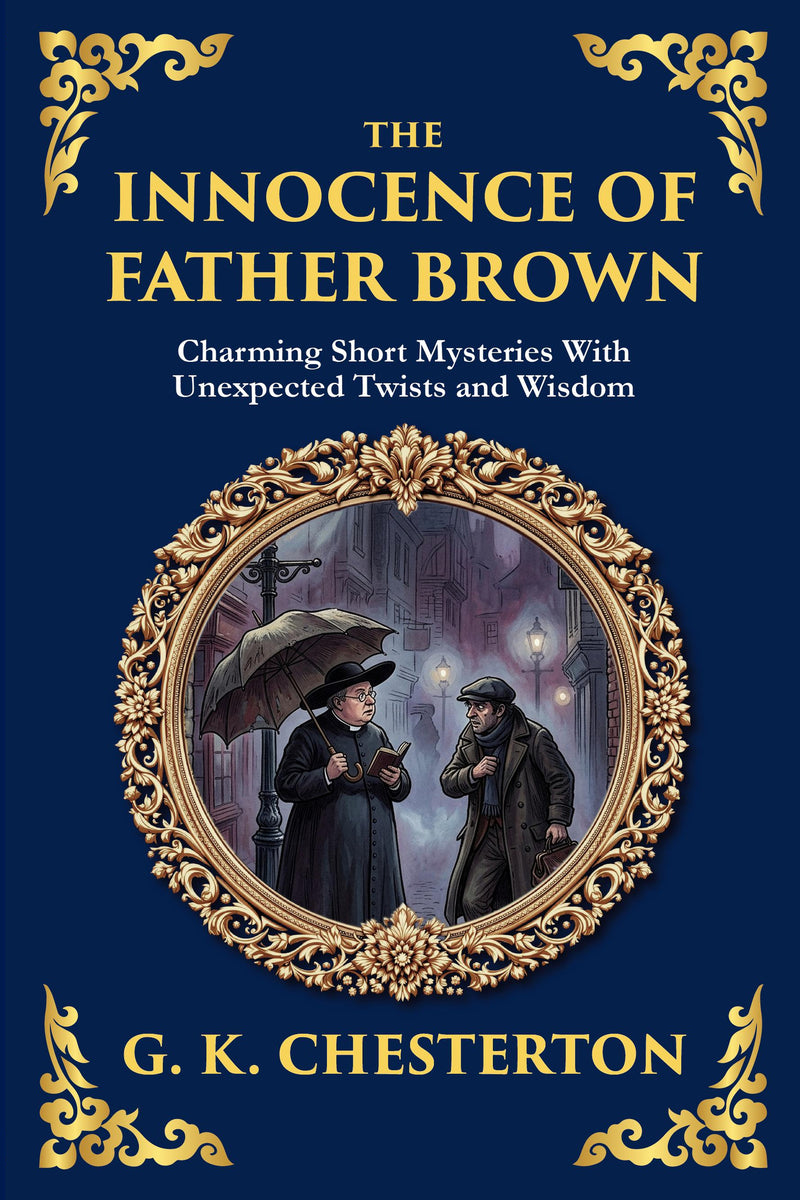
The Innocence of Father Brown — Large Print
Meet Father Brown—unassuming, soft-spoken, and deceptively simple. A priest with a sharp intellect and deep understanding of human nature, he sees what others miss.
or free app
10,000+ hrs library
30-day guarantee
The complete The Innocence of Father Brown appears in modern English through Library of Alexandria Press, available online with audiobook narration included for members.
Have you ever wondered why the most unlikely people make the best detectives? The Innocence of Father Brown introduces readers to one of the most enduring and beloved detectives in literary history. Far from the suave, pipe-smoking sleuths of his era, Father Brown is a quiet Catholic priest whose simple appearance conceals an extraordinary ability to solve mysteries through deep psychological and moral insight.
In this classic collection, G. K. Chesterton weaves twelve ingenious tales filled with murders, disappearances, and moral quandaries—each showcasing Father Brown’s uncanny knack for seeing what others overlook. He does not rely on science or deduction alone but on a profound empathy for human weakness and a spiritual understanding of guilt. With elegance, wit, and a touch of irony, Chesterton redefines the detective story.
These aren’t just whodunits—they are stories of human nature, philosophical inquiry, and redemptive wisdom.
What you’ll discover in this modern edition
- Twelve Iconic Short Mysteries – Including The Blue Cross, The Queer Feet, The Flying Stars, and The Invisible Man
| Formats | eBook (EPUB + PDF) · Audiobook · Paperback · Hardcover · Large Print |
| Language | English |
| Trim size (print) | 6 × 9 in |
| Binding | Paperback — perfect-bound · Hardcover — casewrap |
| Large Print edition | Same text in a larger, easy-read type — a larger font, not a larger trim |
| Print pricing | Every physical book at our true cost — at-cost, no profit (members) |
| Library | 873 restored titles, always growing |
| Length | 79,828 words · ~5 hr 19 min reading |
| Reading level | Grade 3 · an easy, flowing read (this modern-English edition) |
| Edition | Modern English translation · 2026 |
Member reviews for this edition are collected as readers finish it — be the first. Across the library: 12,000+ books shipped, every plan covered by a 365-day print guarantee.
About this edition
A faithful, unabridged modern-English edition by The Library of Alexandria — carefully rendered for today's reader and verified paragraph-by-paragraph against the public-domain source. Available as eBook, audiobook, paperback, hardcover, and large print.
- Complete & unabridgedVerified paragraph by paragraph against the source — never a scan, never abridged.
- Modern English, faithfulReadable today, with the author’s meaning kept intact. Readable — not simplified.
- Every format, one membershipRead in your browser or the free app, or listen to the full audiobook.
Included free with your membership
Cancel anytime, one click · 30-day money-back guarantee
Edition last updated July 2026
What’s inside
The Innocence of Father Brown — Large Print — complete and unabridged: all 8 sections included with membership, plus the full audiobook.
Begin reading The Innocence of Father Brown — Large Print
In clear modern English — the complete text is included with membership.
Introduction
There is a particular kind of pleasure that comes from being outwitted by a book—the moment when a story you thought you understood quietly turns itself inside out, and you realize that the author saw you coming all along. Few writers have mastered that pleasure as completely as G. K. Chesterton, and few characters embody it as perfectly as the small, mild, umbrella-clutching priest who first appeared in the stories collected here. To open this volume is to enter a world where appearances are forever deceiving, where the obvious is almost always wrong, and where the most ordinary-looking man in any room turns out to understand the human heart more thoroughly than anyone else present.
These detective tales arrived at a fascinating moment in the history of mystery fiction. The reading public had fallen deeply in love with the figure of the brilliant investigator—the cold, logical reasoning machine who solved crimes through superhuman observation and deduction. Sherlock Holmes had become a household name, and dozens of imitators followed in his wake, each promising a sleuth more dazzlingly clever than the last. Chesterton, who admired Arthur Conan Doyle’s creation but found something incomplete in the model, set out to do something genuinely different. Instead of a hawk-eyed scientist who reads the world like a chemical formula, he gave us a Catholic priest from Essex—shabby, clumsy, easily overlooked, his face described as round and dull as a Norfolk dumpling, his eyes as empty as the North Sea. And yet this unassuming clergyman consistently sees what the experts miss, not because he possesses superior eyesight or a vast catalogue of facts, but because he understands sin, sorrow, temptation, and the strange logic of the soul.
This collection introduces that priest to the world, and the stories within remain among the most beloved and frequently reprinted detective fiction ever written. They are short, sharp, and endlessly rereadable, each one constructed around a puzzle that seems impossible until the moment it suddenly seems inevitable. But they are also something more than puzzles. Beneath the surface entertainment runs a current of genuine moral seriousness, a philosophy of human nature expressed not through lectures but through the quiet observations of a man whose profession has brought him face to face with every variety of human weakness. That combination—the delight of the trick and the depth of the insight—is what has kept these tales alive for more than a century, and it is what you are about to experience for yourself.
This edition presents these classic stories in a modern translation, carefully adapted for the contemporary reader. Chesterton wrote in a richly ornamented prose style typical of the early twentieth century, dense with period references, elaborate sentence structures, and turns of phrase that can sometimes slow a modern reader or send them reaching for a dictionary or an encyclopedia. The aim of this adaptation is to preserve everything essential—the wit, the atmosphere, the cleverness of the plotting, the warmth and shrewdness of the central character—while smoothing the path so that nothing stands between you and the pure pleasure of the storytelling. The goal has never been to replace Chesterton’s voice, but to let it reach you clearly, the way it reached readers in its own day, before a century of changing language put distance between author and audience.
To understand why these stories work as well as they do, it helps to understand the philosophy hidden inside them. Chesterton’s great innovation was to make his detective an expert not in fingerprints or footprints, but in human beings. The priest at the center of these tales spends his working life listening to people confess their failings, their fears, their secret cruelties and small dishonesties. He is a man who has heard everything, who has sat across from the desperate and the deceitful, and who has learned, through that endless intimate exposure, to recognize the shapes that wickedness takes. When he solves a crime, he does not do it by measuring the angle of a bullet wound. He does it by asking himself what kind of person would do such a thing, and why, and what that person would need to feel or believe in order to act. He understands criminals because, as he memorably explains in one story, he has imagined himself into the mind of every kind of sinner—he has, in a sense, committed every crime in his own heart, and so he knows the inside of evil the way no outside observer ever could.
This is a radically different idea of detection from the one made famous by his contemporaries. The scientific detective stands above the criminal, gazing down with detached superiority, treating the crime as an interesting problem to be solved. Chesterton’s priest stands beside the criminal, level with him, full of pity even as he exposes the deed. There is no triumph in his unmasking of the guilty, no smug satisfaction in having outsmarted a lesser mind. There is instead a profound sadness, a recognition that the criminal is a human being who has gone wrong, and very often a hope that the criminal might still be saved. This compassion is not a sentimental add-on to the mysteries; it is the engine that drives them. Because the priest sees people as souls rather than suspects, he notices things that the police, with their checklists and their categories, walk right past.
The genius of the construction is that this moral and spiritual insight is never allowed to become a sermon. Chesterton was far too skilled a craftsman, and far too entertaining a writer, to let his stories sag under the weight of their own seriousness. The philosophy is always wrapped inside a thoroughly satisfying puzzle. You will find yourself, as you read, genuinely baffled by the mysteries—a man who seems to vanish into thin air, a crime that appears to have no possible explanation, a murder committed in circumstances that seem to rule out every suspect. And then, at the crucial moment, the priest will offer an explanation so simple, so obvious in retrospect, that you will wonder how you ever failed to see it. The solutions almost always depend on a single overlooked fact about human behavior or human perception—the way we ignore certain kinds of people, the assumptions we make without realizing we are making them, the things we are conditioned not to notice. In this sense, every one of these stories is a small lesson in seeing the world more clearly, dressed up as a delightful entertainment.
One of the recurring pleasures of these tales is the way they expose the gap between cleverness and wisdom. The world is full of brilliant people in these stories—scientists, criminals, men of great learning and sharp intelligence—and again and again, their cleverness leads them astray. They are too clever by half; they overthink, they construct elaborate theories, they are dazzled by their own sophistication. The priest, by contrast, succeeds through a kind of humble common sense, a refusal to be impressed by surface complexity. He keeps his eyes on the simple human truth at the center of every situation. This theme runs like a golden thread through the whole collection, and it gives the stories a satisfying moral shape: the proud are humbled, the overconfident are caught out, and the quiet, watchful, unpretentious man sees furthest of all because he is not blinded by vanity.
It is worth saying a word, too, about the priest’s great counterpart in these pages—a master criminal of enormous charm and intelligence, a man whose ongoing relationship with the priest provides some of the collection’s most memorable moments. Without giving anything away, the dynamic between these two figures forms one of the deepest pleasures of the book, a kind of long conversation between two very different ways of understanding the world. The criminal is everything the priest is not—dashing, theatrical, worldly, magnificent in his audacity—and yet the two are bound together by a strange mutual recognition, each understanding the other more fully than anyone else does. The way their relationship develops across these stories adds an emotional richness that lifts the collection above mere puzzle-solving and gives it the resonance of genuine literature.
Beyond the cleverness of the plots and the depth of the central character, these stories offer something that has only grown more precious with the passage of time: a vivid, atmospheric portrait of a world. Chesterton was a writer of extraordinary visual imagination, and his settings are rendered with a painter’s eye for color, light, and shadow. He had begun his career as an art student, and that training never left him. His descriptions are full of arresting images—a snowy garden under a strange green sunset, a row of houses standing like a wall against the twilight, the gleam of a sword, the flicker of a candle in a dark room. He understood that a mystery is half made of mood, and he set his crimes against backdrops that linger in the memory long after the solution has been revealed.
The world of these stories is the England and Europe of the early twentieth century—a world of gaslight and fog, of grand restaurants and quiet country lanes, of seaside towns and ancient houses, of dinner parties and garden walls and the offices of important men. It is a world that no longer exists, and part of the pleasure of reading these tales now is the pleasure of time travel, of being transported into an era when telephones were a novelty and the motorcar was still a slightly alarming intruder on the roads. But it would be a mistake to think of these stories as merely quaint period pieces. The human truths they explore are timeless. The vanity, the greed, the fear, the love, the self-deception that drive Chesterton’s characters are exactly the same forces that drive people today. The settings may be old-fashioned, but the insights are perennial.
There is also a wonderful streak of paradox and surprise running through everything Chesterton wrote, and it is fully present here. He loved to turn conventional wisdom on its head, to show that the thing everyone believes is often precisely the thing that is false, and that the truth is frequently the exact opposite of what common sense suggests. His detective is forever pointing out that the most suspicious-looking person is innocent, or that the most innocent-looking circumstance conceals a crime, or that the explanation everyone has dismissed as impossible is in fact the only possible one. This delight in paradox is not mere cleverness for its own sake; it reflects Chesterton’s deep conviction that reality is stranger and richer than our tidy theories about it, and that wisdom begins with the willingness to be surprised. Reading these stories trains the mind to expect the unexpected, to question the obvious, to look twice at everything—which is, when you think about it, an excellent way to move through the world.
The adaptation you are about to read has been prepared with great care to ensure that all of this comes through with maximum clarity and force. Where Chesterton’s original prose occasionally piles clause upon clause in long, winding sentences that can lose a modern reader along the way, this version untangles the syntax while keeping the rhythm and the meaning intact. Where he uses words that have fallen out of common usage, or references that would have been instantly understood by his original audience but now require footnotes, the language has been gently updated so that the flow of reading is never interrupted. The witty exchanges, the startling images, the careful planting of clues, and above all the moments of revelation have all been preserved with scrupulous attention. The intention throughout has been to give you the experience that Chesterton’s first readers had—the experience of being swept along by a master storyteller, laughing at his jokes, marveling at his cleverness, and turning the pages as fast as you can to discover how each mystery resolves.
Cancel anytime, one click · 30-day money-back guarantee
Founding annual rate available now — your price locks for life when you join.
Not ready? Get this free chapter by email — read it anytime.
✓ Sent — check your inbox for The Innocence of Father Brown — Large Print.
Questions about The Innocence of Father Brown — Large Print
What is The Innocence of Father Brown about?
Meet Father Brown—unassuming, soft-spoken, and deceptively simple. A priest with a sharp intellect and deep understanding of human nature, he sees what others miss. Beneath his mild manners lies one of the sharpest minds in detective fiction.
Who wrote The Innocence of Father Brown?
The Innocence of Father Brown was written by G. K. Chesterton. This edition presents the complete work in clear modern English, faithfully rendered from the public-domain original by Library of Alexandria Press.
Is The Innocence of Father Brown free to read?
The opening chapter is free to read on this page. Members read and listen to the complete work — and the entire library — free, and can order any physical book at our true print cost.
How long is The Innocence of Father Brown?
8 chapters (~79,828 words) — about 5 hr 19 min of reading in this modern-English edition.
Is this an abridged version of The Innocence of Father Brown?
No. This is the complete, unabridged The Innocence of Father Brown, carefully rendered into clear modern English and verified paragraph-by-paragraph against the public-domain source — nothing is cut or summarised.
What formats does The Innocence of Father Brown come in?
The Innocence of Father Brown is available as eBook, paperback, hardcover and large print. eBook and audiobook are included with membership; printed editions ship at our true print cost.
Shipping & returns
Billing & membership
More from the library


Explore Mystery & Crime
- Resurrection · Leo Tolstoy
- Crime and Punishment · Fyodor Dostoyevsky
- The Strange Case of Dr. Jekyll and Mr. Hyde · Robert Louis Stevenson
- The Riddle of the Sands · Erskine Childers
- The Wisdom of Father Brown · G. K. Chesterton
- The Cask of Amontillado · Edgar Allan Poe
- The Tomb of Ts’in · Edgar Wallace
- Ghost Stories of an Antiquary · M. R. James
- The Hunniwell Boys and the Platinum Mystery · L. P. Wyman
- The Seven Dials Mystery · Agatha Christie
- The Thirty-Nine Steps · John Buchan
- The Hand in the Dark · Arthur J. Rees
- Lady Audley’s Secret · M. E. Braddon
- The Mystery of the Blue Train · Agatha Christie
- The Secret Adversary · Agatha Christie
- The Call of Cthulhu · H. P. Lovecraft
- The Adventures of Heine · Edgar Wallace
- The Valley of Fear · Arthur Conan Doyle
- The Innocence of Father Brown · G. K. Chesterton
- McTeague: A Story of San Francisco · Frank Norris
- Tess of the d’Urbervilles: A Pure Woman · Thomas Hardy
- The Big Fix · George O. Smith
- The Ambulance Made Two Trips · Murray Leinster
- Time Crime · H. Beam Piper
- The Misplaced Battleship · Harry Harrison
- Supermind · Randall Garrett and Laurence M....
- Lone Star Planet · H. Beam Piper and John J. McGuire
- Dracula · Bram Stoker
- The Murder on the Links · Agatha Christie
- The Hound of the Baskervilles · Arthur Conan Doyle
The Innocence of Father Brown — Large Print
The Innocence of Father Brown — Large Print
Delightful Short Mysteries With Surprising Twists and Insight
G. K. Chesterton
Contents
- Introduction
- Chapter 1
- Chapter 2
- Chapter 3
- Chapter 4
- Chapter 5
- Chapter 6
- Chapter 7
Introduction
There is a particular kind of pleasure that comes from being outwitted by a book—the moment when a story you thought you understood quietly turns itself inside out, and you realize that the author saw you coming all along. Few writers have mastered that pleasure as completely as G. K. Chesterton, and few characters embody it as perfectly as the small, mild, umbrella-clutching priest who first appeared in the stories collected here. To open this volume is to enter a world where appearances are forever deceiving, where the obvious is almost always wrong, and where the most ordinary-looking man in any room turns out to understand the human heart more thoroughly than anyone else present.
These detective tales arrived at a fascinating moment in the history of mystery fiction. The reading public had fallen deeply in love with the figure of the brilliant investigator—the cold, logical reasoning machine who solved crimes through superhuman observation and deduction. Sherlock Holmes had become a household name, and dozens of imitators followed in his wake, each promising a sleuth more dazzlingly clever than the last. Chesterton, who admired Arthur Conan Doyle’s creation but found something incomplete in the model, set out to do something genuinely different. Instead of a hawk-eyed scientist who reads the world like a chemical formula, he gave us a Catholic priest from Essex—shabby, clumsy, easily overlooked, his face described as round and dull as a Norfolk dumpling, his eyes as empty as the North Sea. And yet this unassuming clergyman consistently sees what the experts miss, not because he possesses superior eyesight or a vast catalogue of facts, but because he understands sin, sorrow, temptation, and the strange logic of the soul.
This collection introduces that priest to the world, and the stories within remain among the most beloved and frequently reprinted detective fiction ever written. They are short, sharp, and endlessly rereadable, each one constructed around a puzzle that seems impossible until the moment it suddenly seems inevitable. But they are also something more than puzzles. Beneath the surface entertainment runs a current of genuine moral seriousness, a philosophy of human nature expressed not through lectures but through the quiet observations of a man whose profession has brought him face to face with every variety of human weakness. That combination—the delight of the trick and the depth of the insight—is what has kept these tales alive for more than a century, and it is what you are about to experience for yourself.
This edition presents these classic stories in a modern translation, carefully adapted for the contemporary reader. Chesterton wrote in a richly ornamented prose style typical of the early twentieth century, dense with period references, elaborate sentence structures, and turns of phrase that can sometimes slow a modern reader or send them reaching for a dictionary or an encyclopedia. The aim of this adaptation is to preserve everything essential—the wit, the atmosphere, the cleverness of the plotting, the warmth and shrewdness of the central character—while smoothing the path so that nothing stands between you and the pure pleasure of the storytelling. The goal has never been to replace Chesterton’s voice, but to let it reach you clearly, the way it reached readers in its own day, before a century of changing language put distance between author and audience.
To understand why these stories work as well as they do, it helps to understand the philosophy hidden inside them. Chesterton’s great innovation was to make his detective an expert not in fingerprints or footprints, but in human beings. The priest at the center of these tales spends his working life listening to people confess their failings, their fears, their secret cruelties and small dishonesties. He is a man who has heard everything, who has sat across from the desperate and the deceitful, and who has learned, through that endless intimate exposure, to recognize the shapes that wickedness takes. When he solves a crime, he does not do it by measuring the angle of a bullet wound. He does it by asking himself what kind of person would do such a thing, and why, and what that person would need to feel or believe in order to act. He understands criminals because, as he memorably explains in one story, he has imagined himself into the mind of every kind of sinner—he has, in a sense, committed every crime in his own heart, and so he knows the inside of evil the way no outside observer ever could.
This is a radically different idea of detection from the one made famous by his contemporaries. The scientific detective stands above the criminal, gazing down with detached superiority, treating the crime as an interesting problem to be solved. Chesterton’s priest stands beside the criminal, level with him, full of pity even as he exposes the deed. There is no triumph in his unmasking of the guilty, no smug satisfaction in having outsmarted a lesser mind. There is instead a profound sadness, a recognition that the criminal is a human being who has gone wrong, and very often a hope that the criminal might still be saved. This compassion is not a sentimental add-on to the mysteries; it is the engine that drives them. Because the priest sees people as souls rather than suspects, he notices things that the police, with their checklists and their categories, walk right past.
The genius of the construction is that this moral and spiritual insight is never allowed to become a sermon. Chesterton was far too skilled a craftsman, and far too entertaining a writer, to let his stories sag under the weight of their own seriousness. The philosophy is always wrapped inside a thoroughly satisfying puzzle. You will find yourself, as you read, genuinely baffled by the mysteries—a man who seems to vanish into thin air, a crime that appears to have no possible explanation, a murder committed in circumstances that seem to rule out every suspect. And then, at the crucial moment, the priest will offer an explanation so simple, so obvious in retrospect, that you will wonder how you ever failed to see it. The solutions almost always depend on a single overlooked fact about human behavior or human perception—the way we ignore certain kinds of people, the assumptions we make without realizing we are making them, the things we are conditioned not to notice. In this sense, every one of these stories is a small lesson in seeing the world more clearly, dressed up as a delightful entertainment.
One of the recurring pleasures of these tales is the way they expose the gap between cleverness and wisdom. The world is full of brilliant people in these stories—scientists, criminals, men of great learning and sharp intelligence—and again and again, their cleverness leads them astray. They are too clever by half; they overthink, they construct elaborate theories, they are dazzled by their own sophistication. The priest, by contrast, succeeds through a kind of humble common sense, a refusal to be impressed by surface complexity. He keeps his eyes on the simple human truth at the center of every situation. This theme runs like a golden thread through the whole collection, and it gives the stories a satisfying moral shape: the proud are humbled, the overconfident are caught out, and the quiet, watchful, unpretentious man sees furthest of all because he is not blinded by vanity.
It is worth saying a word, too, about the priest’s great counterpart in these pages—a master criminal of enormous charm and intelligence, a man whose ongoing relationship with the priest provides some of the collection’s most memorable moments. Without giving anything away, the dynamic between these two figures forms one of the deepest pleasures of the book, a kind of long conversation between two very different ways of understanding the world. The criminal is everything the priest is not—dashing, theatrical, worldly, magnificent in his audacity—and yet the two are bound together by a strange mutual recognition, each understanding the other more fully than anyone else does. The way their relationship develops across these stories adds an emotional richness that lifts the collection above mere puzzle-solving and gives it the resonance of genuine literature.
Beyond the cleverness of the plots and the depth of the central character, these stories offer something that has only grown more precious with the passage of time: a vivid, atmospheric portrait of a world. Chesterton was a writer of extraordinary visual imagination, and his settings are rendered with a painter’s eye for color, light, and shadow. He had begun his career as an art student, and that training never left him. His descriptions are full of arresting images—a snowy garden under a strange green sunset, a row of houses standing like a wall against the twilight, the gleam of a sword, the flicker of a candle in a dark room. He understood that a mystery is half made of mood, and he set his crimes against backdrops that linger in the memory long after the solution has been revealed.
The world of these stories is the England and Europe of the early twentieth century—a world of gaslight and fog, of grand restaurants and quiet country lanes, of seaside towns and ancient houses, of dinner parties and garden walls and the offices of important men. It is a world that no longer exists, and part of the pleasure of reading these tales now is the pleasure of time travel, of being transported into an era when telephones were a novelty and the motorcar was still a slightly alarming intruder on the roads. But it would be a mistake to think of these stories as merely quaint period pieces. The human truths they explore are timeless. The vanity, the greed, the fear, the love, the self-deception that drive Chesterton’s characters are exactly the same forces that drive people today. The settings may be old-fashioned, but the insights are perennial.
There is also a wonderful streak of paradox and surprise running through everything Chesterton wrote, and it is fully present here. He loved to turn conventional wisdom on its head, to show that the thing everyone believes is often precisely the thing that is false, and that the truth is frequently the exact opposite of what common sense suggests. His detective is forever pointing out that the most suspicious-looking person is innocent, or that the most innocent-looking circumstance conceals a crime, or that the explanation everyone has dismissed as impossible is in fact the only possible one. This delight in paradox is not mere cleverness for its own sake; it reflects Chesterton’s deep conviction that reality is stranger and richer than our tidy theories about it, and that wisdom begins with the willingness to be surprised. Reading these stories trains the mind to expect the unexpected, to question the obvious, to look twice at everything—which is, when you think about it, an excellent way to move through the world.
The adaptation you are about to read has been prepared with great care to ensure that all of this comes through with maximum clarity and force. Where Chesterton’s original prose occasionally piles clause upon clause in long, winding sentences that can lose a modern reader along the way, this version untangles the syntax while keeping the rhythm and the meaning intact. Where he uses words that have fallen out of common usage, or references that would have been instantly understood by his original audience but now require footnotes, the language has been gently updated so that the flow of reading is never interrupted. The witty exchanges, the startling images, the careful planting of clues, and above all the moments of revelation have all been preserved with scrupulous attention. The intention throughout has been to give you the experience that Chesterton’s first readers had—the experience of being swept along by a master storyteller, laughing at his jokes, marveling at his cleverness, and turning the pages as fast as you can to discover how each mystery resolves.
Between the silver light of dawn and the sparkling green of the sea, a boat docked at Harwich and released a crowd of people like a swarm of flies. Among them, the man we are following did not stand out—nor did he want to. There was nothing remarkable about him, except for the slight contrast between his festive holiday clothes and the stern, official look on his face. He wore a light, pale grey jacket, a white waistcoat, and a silver straw hat with a grey-blue ribbon. His thin face looked dark by comparison, ending in a short black beard that looked Spanish and reminded one of an Elizabethan collar. He smoked a cigarette with the focused intensity of someone who had nothing to do. Nothing about his appearance suggested that the grey jacket hid a loaded revolver, the white waistcoat concealed a police badge, or the straw hat covered one of the most brilliant minds in Europe. This was Valentin, the head of the Paris police and the world’s most famous detective; he was traveling from Brussels to London to make the most significant arrest of the century.
Flambeau was in England. Police from three different countries had finally tracked the master criminal from Ghent to Brussels, and from Brussels to the Hook of Holland. They guessed he would take advantage of the crowds and confusion surrounding the Eucharistic Congress currently happening in London. He would likely travel disguised as a low-level clerk or secretary associated with the event; however, Valentin couldn’t be sure. No one could ever be completely sure about Flambeau.
Many years have passed since this giant of crime suddenly stopped throwing the world into chaos; and when he stopped, as people said after the death of Roland, a great silence fell over the earth. But in his prime (meaning his most criminal days), Flambeau was as imposing and internationally known as the Kaiser. Almost every morning, the newspapers reported that he had escaped the consequences of one incredible crime by committing another. He was a Gascon of massive size and physical bravery; wild stories circulated about his athletic pranks, such as how he once flipped an investigating judge upside down and held him on his head “to clear his mind,” or how he once sprinted down the Rue de Rivoli with a policeman tucked under each arm. To his credit, his fantastic strength was usually used for these bloodless, if undignified, stunts; his actual crimes were mostly clever, large-scale robberies. Yet each theft was almost a new kind of sin and could be a story on its own. He was the one who ran the great Tyrolean Dairy Company in London—a business with no dairies, no cows, no carts, and no milk, but with thousands of subscribers. He served them by simply moving milk cans from the doors of people who didn’t subscribe to the doors of those who did. He also maintained a secret correspondence with a young woman whose mail was being intercepted, using the ingenious trick of photographing his messages so small they could only be seen through a microscope. However, many of his schemes were strikingly simple. It is said that he once repainted every house number on a street in the middle of the night just to lure one traveler into a trap. He definitely invented a portable mailbox, which he placed on quiet suburban corners hoping strangers would drop money orders into it. Finally, he was a surprising acrobat; despite his huge frame, he could jump like a grasshopper and vanish into treetops like a monkey. Therefore, when Valentin set out to find Flambeau, he knew very well that his troubles would not end simply by locating him.
End of the free sample
Keep reading, free
Members read and listen to the complete book — and the entire library. Cancel anytime, one click · 30-day money-back guarantee.