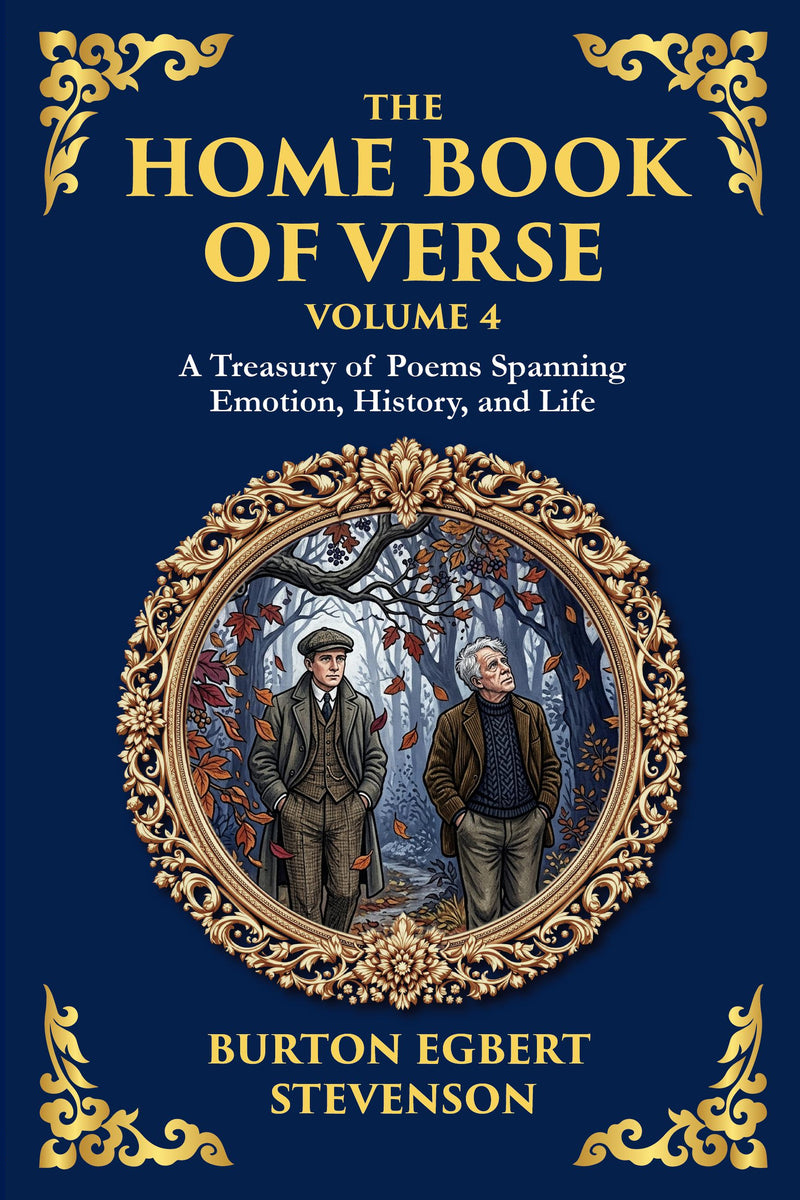
The Home Book of Verse — Volume 4 — Large Print
Edgar Allan Poe In this timeless volume, The Home Book of Verse – Volume 4 gathers together the finest poetic expressions of human experience—grief and glory, love and longing, seasons and struggles.
or free app
10,000+ hrs library
30-day guarantee
The complete The Home Book of Verse — Volume appears in modern English through Library of Alexandria Press, available online with audiobook narration included for members.
Have you ever wondered why a single poem can echo through centuries and still speak to the soul? The Home Book of Verse – Volume 4: A Treasury of Poems Spanning Emotion, History, and Life is the culminating triumph in Burton Egbert Stevenson’s celebrated anthology series—a monumental collection designed to preserve and celebrate the poetic tradition of the English- speaking world. In this volume, Stevenson presents hundreds of poems that transcend time, from the stirring chants of battle to the tender reflections of lost love, from tributes to nature’s quiet majesty to meditations on death, hope, and the divine.
Whether familiar or freshly discovered, each poem is chosen for its power to move the reader and to reflect the shared contours of human experience. This carefully arranged treasury is ideal for lovers of poetry both casual and scholarly. It’s a companion for rainy afternoons, fireside readings, classroom discussions, or personal inspiration.
It bridges generations—reminding us of the beauty, pain, and wonder that language can hold.
What you’ll discover in this modern edition
- The Great Voices of English Verse – Features works from Shakespeare, Tennyson, Longfellow, Whitman, Burns, Keats, and more.
- Themes That Transcend Time – Organized around love, grief, patriotism, childhood, faith, nature, and the human spirit.
- A Curated Collection from the Heart – Every poem hand-selected for emotional resonance, poetic merit, and enduring relevance.
- A Window into Cultural and Literary History – Reflects the values, voices, and visions of poets across centuries and continents.
- An Invaluable Family Heirloom – The perfect literary keepsake to revisit again and again, across generations.
| Formats | eBook (EPUB + PDF) · Audiobook · Paperback · Hardcover · Large Print |
| Language | English |
| Trim size (print) | 6 × 9 in |
| Binding | Paperback — perfect-bound · Hardcover — casewrap |
| Large Print edition | Same text in a larger, easy-read type — a larger font, not a larger trim |
| Print pricing | Every physical book at our true cost — at-cost, no profit (members) |
| Library | 873 restored titles, always growing |
| Length | 61,929 words · ~4 hr 8 min reading |
| Reading level | Grade 3 · an easy, flowing read (this modern-English edition) |
| Edition | Modern English translation · 2026 |
Member reviews for this edition are collected as readers finish it — be the first. Across the library: 12,000+ books shipped, every plan covered by a 365-day print guarantee.
About this edition
A faithful, unabridged modern-English edition by The Library of Alexandria — carefully rendered for today's reader and verified paragraph-by-paragraph against the public-domain source. Available as eBook, audiobook, paperback, hardcover, and large print.
- Complete & unabridgedVerified paragraph by paragraph against the source — never a scan, never abridged.
- Modern English, faithfulReadable today, with the author’s meaning kept intact. Readable — not simplified.
- Every format, one membershipRead in your browser or the free app, or listen to the full audiobook.
Included free with your membership
Cancel anytime, one click · 30-day money-back guarantee
Edition last updated July 2026
What’s inside
The Home Book of Verse — Volume 4 — Large Print — complete and unabridged: all 8 sections included with membership, plus the full audiobook.
Begin reading The Home Book of Verse — Volume 4 — Large Print
In clear modern English — the complete text is included with membership.
Introduction
There is a particular kind of book that does not ask to be read in a single sitting, nor does it demand that you begin at the beginning and march dutifully to the end. Instead, it invites you to wander. It opens its doors and lets you roam its many rooms, pausing wherever something catches your eye, lingering where the light falls just so, returning again and again to the corners that feel most like home. The volume you now hold is exactly that sort of companion—a gathering of voices spanning centuries, drawn together not by a single argument or narrative but by the conviction that poetry, in all its variety, has something essential to say about what it means to be alive.
This fourth volume of Burton Egbert Stevenson’s celebrated anthology continues a project that, in its time, became one of the most beloved collections of verse in the English-speaking world. Stevenson was not a poet himself in the conventional sense, but he possessed a gift arguably rarer and more useful to readers: the instinct of the great curator. He understood that an anthology is not merely a pile of poems but an architecture, a designed experience, a way of moving the reader through moods and meanings so that the whole becomes greater than the sum of its parts. He read voraciously, sifted tirelessly, and assembled with extraordinary care. The result was a body of work that introduced generations of readers to poems they would carry with them for the rest of their lives—lines memorized in childhood, stanzas recited at weddings and funerals, fragments that surfaced unbidden in moments of joy or grief.
What you are about to encounter is a modern adaptation of that achievement, prepared with the contemporary reader in mind. The aim of this edition is not to replace the original but to extend its reach—to remove some of the small obstacles that time inevitably places between a reader and a text written in an older idiom, while preserving the music, the imagery, and the emotional truth that make these poems worth reading in the first place. Before you begin to wander through these pages, it is worth taking a moment to understand what this collection is, where it comes from, and how you might read it to gain the fullest possible pleasure from the experience.
To appreciate this volume, it helps to understand the ambition of the larger work from which it comes. When Burton Egbert Stevenson set out to compile his anthology, he was not interested in producing a textbook or a scholarly survey designed to impress academics. His purpose was warmer and more democratic than that. He wanted to create a book for the household—a book that a family might keep within reach, that a reader might turn to in idle hours or in moments of need, that would serve as both entertainment and consolation across the whole arc of a human life. The very phrase “home book” signals this intention. This was poetry meant to live alongside its readers, not to be admired from a distance.
Stevenson worked in an era when poetry occupied a far more central place in everyday life than it often does today. People memorized verse as a matter of course. They read aloud to one another in the evenings. Poems were printed in newspapers, recited at public gatherings, copied into commonplace books, and exchanged between friends and lovers as expressions of feeling that ordinary prose could not quite reach. Stevenson’s anthology both reflected and nourished this culture. It gathered the poems people actually loved and used—not only the canonical masterpieces but also the smaller, humbler verses that touched the heart, that made a person laugh or weep, that captured a passing season or a fleeting mood with unexpected precision.
This generous, inclusive spirit is what distinguishes the collection from many other anthologies. Stevenson did not confine himself to the safe and the famous. He was as willing to include a tender lullaby as a thunderous ode, a comic trifle as a solemn elegy. He cast his net wide across time and place, drawing from the deep wells of English and American verse and reaching back through the centuries to capture the enduring voices that shaped the tradition. The effect is a kind of conversation across generations, in which poets who never met and never could have met find themselves placed side by side, speaking to the same fundamental human concerns in their own distinct accents.
The organizing principle of the larger anthology was thematic rather than chronological or alphabetical. Stevenson grouped poems by subject and feeling, so that a reader interested in a particular experience—the wonder of nature, the ache of love, the passage of time, the call of patriotism, the mystery of death—could find a wealth of responses gathered in one place. This arrangement reflects a deep understanding of how readers actually approach poetry. We rarely come to a poem in search of a particular poet; far more often, we come in search of words that match our condition. We are mourning, and we want a poem that mourns. We are in love, and we want a poem that loves. We are stirred by a sunset or a storm or a memory, and we want the company of others who have felt the same. By organizing his collection around these recurring themes of emotion, history, and life, Stevenson made his anthology not just a reference work but a kind of map of the human heart.
This fourth volume carries that vision forward. Within these pages you will find poems that address the great subjects in turn—the experiences that bind all of us together regardless of the century in which we happen to live. You will encounter verse that celebrates and verse that grieves, verse that praises and verse that questions, verse that paints the natural world in glowing colors and verse that turns inward to explore the landscapes of the soul. You will meet the famous alongside the forgotten, the grand alongside the intimate. And throughout, you will sense the guiding hand of an editor who loved these poems and wanted, more than anything, for you to love them too.
It is worth pausing on the significance of the three threads named in the subtitle: emotion, history, and life. These are not arbitrary categories. They represent three of the great functions that poetry has always served. Emotion is poetry’s most immediate gift—its power to give shape and voice to feelings that would otherwise remain inchoate and overwhelming. When we are too moved to speak for ourselves, a poem speaks for us. History is poetry’s role as memory and witness—its capacity to preserve the deeds and disasters, the triumphs and tragedies of the human past, and to keep alive the names and moments that might otherwise fade. And life, in its broadest sense, is poetry’s domain of ordinary experience: the small observations, the daily wonders, the passing seasons, the quiet truths that the rush of living so often obscures. A poem can stop time, hold a single moment up to the light, and reveal in it something we had never noticed before. Across these three dimensions, the collection offers a remarkably complete portrait of what poetry can do and why it has endured.
One of the great pleasures—and occasionally one of the small challenges—of an anthology like this is the sheer span of time it covers. The poems gathered here were written across many generations, by men and women who lived in worlds very different from our own and from each other. The language of poetry has changed over the centuries, sometimes subtly and sometimes dramatically. Conventions of spelling, grammar, vocabulary, and even punctuation have shifted. Words have fallen out of use or changed their meanings. Allusions that would have been instantly recognizable to a reader of an earlier age may now require a moment’s reflection.
This is where the present edition seeks to be of service. In adapting these poems for the contemporary reader, the goal has been to ease the path without erasing the journey. Some archaic spellings have been modernized where doing so removes a needless distraction without altering the sound or sense of a line. Certain antique constructions have been gently clarified. Where a poem’s meaning might have been obscured by the accumulated dust of time, care has been taken to let its essential light shine through. The intention throughout has been to honor the original while making it more readily accessible—to act, as it were, as a friendly guide who walks beside you and occasionally points out the way, rather than an officious one who insists on explaining everything.
It is important to be honest about what this kind of adaptation can and cannot do. Poetry is, by its nature, a form in which the precise arrangement of words matters enormously. The sound of a line, its rhythm, its rhymes, the particular flavor of a chosen word—these are not incidental decorations but the very substance of the art. A responsible adaptation therefore treads carefully. It does not rewrite poems wholesale or flatten their distinctive voices into a bland uniformity. It does not strip away the music in the name of clarity. Instead, it makes only those changes that genuinely help, and it leaves intact everything that gives a poem its life. The reader who approaches these pages should expect to encounter the authentic spirit of the originals—their beauty, their strangeness, their power—rendered in a form that flows more easily for a modern eye and ear.
You may notice, as you read, that some poems feel more immediately approachable than others. This is entirely natural and entirely as it should be. Part of the richness of reading across centuries is that not every poem will speak to you with equal force on first acquaintance. Some will strike home at once, their meaning and feeling clear and immediate. Others will require a little patience, a little willingness to dwell with them until they yield their treasures. Still others may simply not be for you—at least not yet. One of the wisest things any reader of poetry can learn is that there is no shame in moving on from a poem that does not engage you, and no virtue in forcing yourself to admire what leaves you cold. The anthology is large and varied precisely so that every reader can find within it the poems that are meant for them.
Indeed, this brings us to one of the most valuable habits a reader of this volume can cultivate: the habit of rereading. Poetry is almost never fully revealed on a single pass. A poem that seems slight or obscure today may, on a second or third reading—or after a span of years and a change in your own circumstances—open up into something profound. The poems in this collection have survived precisely because they reward return visits. They have layers. They have depths that disclose themselves gradually. A line you skimmed past in your youth may rise up to meet you decades later with sudden, startling relevance, because life has finally taught you what it means. This is among the great gifts of keeping such a book close at hand throughout a lifetime. It grows with you. It is never the same book twice, because you are never quite the same reader twice.
Reading across the centuries also offers a quieter, deeper pleasure: the recognition of our common humanity. When you read a poem written hundreds of years ago and find in it a feeling you experienced only this morning—a flash of grief, a surge of love, a pang of longing, a moment of wonder at the turning of the year—you are reminded that the essential conditions of human life have not changed nearly as much as the surface of our world might suggest. The poet who watched the same moon rise that you watch now, who loved and lost and grew old and feared death and marveled at a flower exactly as you do, reaches across the gulf of time and takes your hand. This is the great consolation of poetry: it tells us that we are not alone, that others have walked this road before us and have left behind, in carefully chosen words, the record of their passage. In an age that often feels fragmented and hurried, the slow companionship of these voices is a balm.
Cancel anytime, one click · 30-day money-back guarantee
Founding annual rate available now — your price locks for life when you join.
Not ready? Get this free chapter by email — read it anytime.
✓ Sent — check your inbox for The Home Book of Verse — Volume 4 — Large Print.
Questions about The Home Book of Verse — Volume 4 — Large Print
What is The Home Book of Verse — Volume about?
Edgar Allan Poe In this timeless volume, The Home Book of Verse – Volume 4 gathers together the finest poetic expressions of human experience—grief and glory, love and longing, seasons and struggles. Curated by Burton Egbert Stevenson, this sweeping anthology captures the universal threads that bind us all, offering a rich tapestry of English-language verse from the familiar to the forgotten. This collection is more than literature—it is a lyrical journey through the soul of humanity, with poems selected to comfort
Who wrote The Home Book of Verse — Volume?
The Home Book of Verse — Volume was written by Burton Egbert Stevenson. This edition presents the complete work in clear modern English, faithfully rendered from the public-domain original by Library of Alexandria Press.
Is The Home Book of Verse — Volume free to read?
The opening chapter is free to read on this page. Members read and listen to the complete work — and the entire library — free, and can order any physical book at our true print cost.
How long is The Home Book of Verse — Volume?
8 chapters (~61,929 words) — about 4 hr 8 min of reading in this modern-English edition.
Is this an abridged version of The Home Book of Verse — Volume?
No. This is the complete, unabridged The Home Book of Verse — Volume, carefully rendered into clear modern English and verified paragraph-by-paragraph against the public-domain source — nothing is cut or summarised.
What formats does The Home Book of Verse — Volume come in?
The Home Book of Verse — Volume is available as eBook, paperback, hardcover and large print. eBook and audiobook are included with membership; printed editions ship at our true print cost.
Shipping & returns
Billing & membership
More from the library


Explore Children's Classics
- Peter and Wendy · J. M. Barrie
- Jack and Jill · Louisa May Alcott
- The Wonderful Wizard of Oz · L. Frank Baum
- Anne of Green Gables · L. M. Montgomery
- The Secret Garden · Frances Hodgson Burnett
- The Tale of Peter Rabbit · Beatrix Potter
- Peter Pan · J. M. Barrie
- The Prince and the Pauper · Mark Twain
- The Red Fairy Book · Andrew Lang
- Old Christmas: from the Sketch Book of Washington Irving · Washington Irving
- A Houseful of Girls · Sarah Tytler
- In the hollow of His hand · Hesba Stretton
- Miss Primrose · Agnes Giberne
- Five Little Peppers and How They Grew · Margaret Sidney
- The Loss of the Swansea: A Story of the Florida Coast · W. L. Alden
- Sky Island · L. Frank Baum
- The Book of Dragons · E. Nesbit
- Wild Animals I Have Known · Ernest Thompson Seton
- Skinny McCord · Percy Keese Fitzhugh
- The Hunniwell Boys and the Platinum Mystery · L. P. Wyman
- Rainbow Valley · L. M. Montgomery
- "Us and Our Donkey" · Amy Le Feuvre
- Dorothy and the Wizard in Oz · L. Frank Baum
- The Home Book of Verse — Volume 4 · Burton Egbert Stevenson
- The Story of Doctor Dolittle · Hugh Lofting
- The Tale of Benjamin Bunny · Beatrix Potter
- Fifty Famous Stories Retold · James Baldwin
- Rilla of Ingleside · L. M. Montgomery
- The House at Pooh Corner · A. A. Milne
- Rich and Humble: A Story for Young People · Oliver Optic
The Home Book of Verse — Volume 4 — Large Print
The Home Book of Verse — Volume 4 — Large Print
A collection of poems covering emotion, history, and life
Burton Egbert Stevenson
Contents
- Introduction
- Part 4
- Chapter 1
- Chapter 2
- Chapter 3
- Chapter 4
- Part 1
- Part 2
Introduction
There is a particular kind of book that does not ask to be read in a single sitting, nor does it demand that you begin at the beginning and march dutifully to the end. Instead, it invites you to wander. It opens its doors and lets you roam its many rooms, pausing wherever something catches your eye, lingering where the light falls just so, returning again and again to the corners that feel most like home. The volume you now hold is exactly that sort of companion—a gathering of voices spanning centuries, drawn together not by a single argument or narrative but by the conviction that poetry, in all its variety, has something essential to say about what it means to be alive.
This fourth volume of Burton Egbert Stevenson’s celebrated anthology continues a project that, in its time, became one of the most beloved collections of verse in the English-speaking world. Stevenson was not a poet himself in the conventional sense, but he possessed a gift arguably rarer and more useful to readers: the instinct of the great curator. He understood that an anthology is not merely a pile of poems but an architecture, a designed experience, a way of moving the reader through moods and meanings so that the whole becomes greater than the sum of its parts. He read voraciously, sifted tirelessly, and assembled with extraordinary care. The result was a body of work that introduced generations of readers to poems they would carry with them for the rest of their lives—lines memorized in childhood, stanzas recited at weddings and funerals, fragments that surfaced unbidden in moments of joy or grief.
What you are about to encounter is a modern adaptation of that achievement, prepared with the contemporary reader in mind. The aim of this edition is not to replace the original but to extend its reach—to remove some of the small obstacles that time inevitably places between a reader and a text written in an older idiom, while preserving the music, the imagery, and the emotional truth that make these poems worth reading in the first place. Before you begin to wander through these pages, it is worth taking a moment to understand what this collection is, where it comes from, and how you might read it to gain the fullest possible pleasure from the experience.
To appreciate this volume, it helps to understand the ambition of the larger work from which it comes. When Burton Egbert Stevenson set out to compile his anthology, he was not interested in producing a textbook or a scholarly survey designed to impress academics. His purpose was warmer and more democratic than that. He wanted to create a book for the household—a book that a family might keep within reach, that a reader might turn to in idle hours or in moments of need, that would serve as both entertainment and consolation across the whole arc of a human life. The very phrase “home book” signals this intention. This was poetry meant to live alongside its readers, not to be admired from a distance.
Stevenson worked in an era when poetry occupied a far more central place in everyday life than it often does today. People memorized verse as a matter of course. They read aloud to one another in the evenings. Poems were printed in newspapers, recited at public gatherings, copied into commonplace books, and exchanged between friends and lovers as expressions of feeling that ordinary prose could not quite reach. Stevenson’s anthology both reflected and nourished this culture. It gathered the poems people actually loved and used—not only the canonical masterpieces but also the smaller, humbler verses that touched the heart, that made a person laugh or weep, that captured a passing season or a fleeting mood with unexpected precision.
This generous, inclusive spirit is what distinguishes the collection from many other anthologies. Stevenson did not confine himself to the safe and the famous. He was as willing to include a tender lullaby as a thunderous ode, a comic trifle as a solemn elegy. He cast his net wide across time and place, drawing from the deep wells of English and American verse and reaching back through the centuries to capture the enduring voices that shaped the tradition. The effect is a kind of conversation across generations, in which poets who never met and never could have met find themselves placed side by side, speaking to the same fundamental human concerns in their own distinct accents.
The organizing principle of the larger anthology was thematic rather than chronological or alphabetical. Stevenson grouped poems by subject and feeling, so that a reader interested in a particular experience—the wonder of nature, the ache of love, the passage of time, the call of patriotism, the mystery of death—could find a wealth of responses gathered in one place. This arrangement reflects a deep understanding of how readers actually approach poetry. We rarely come to a poem in search of a particular poet; far more often, we come in search of words that match our condition. We are mourning, and we want a poem that mourns. We are in love, and we want a poem that loves. We are stirred by a sunset or a storm or a memory, and we want the company of others who have felt the same. By organizing his collection around these recurring themes of emotion, history, and life, Stevenson made his anthology not just a reference work but a kind of map of the human heart.
This fourth volume carries that vision forward. Within these pages you will find poems that address the great subjects in turn—the experiences that bind all of us together regardless of the century in which we happen to live. You will encounter verse that celebrates and verse that grieves, verse that praises and verse that questions, verse that paints the natural world in glowing colors and verse that turns inward to explore the landscapes of the soul. You will meet the famous alongside the forgotten, the grand alongside the intimate. And throughout, you will sense the guiding hand of an editor who loved these poems and wanted, more than anything, for you to love them too.
It is worth pausing on the significance of the three threads named in the subtitle: emotion, history, and life. These are not arbitrary categories. They represent three of the great functions that poetry has always served. Emotion is poetry’s most immediate gift—its power to give shape and voice to feelings that would otherwise remain inchoate and overwhelming. When we are too moved to speak for ourselves, a poem speaks for us. History is poetry’s role as memory and witness—its capacity to preserve the deeds and disasters, the triumphs and tragedies of the human past, and to keep alive the names and moments that might otherwise fade. And life, in its broadest sense, is poetry’s domain of ordinary experience: the small observations, the daily wonders, the passing seasons, the quiet truths that the rush of living so often obscures. A poem can stop time, hold a single moment up to the light, and reveal in it something we had never noticed before. Across these three dimensions, the collection offers a remarkably complete portrait of what poetry can do and why it has endured.
One of the great pleasures—and occasionally one of the small challenges—of an anthology like this is the sheer span of time it covers. The poems gathered here were written across many generations, by men and women who lived in worlds very different from our own and from each other. The language of poetry has changed over the centuries, sometimes subtly and sometimes dramatically. Conventions of spelling, grammar, vocabulary, and even punctuation have shifted. Words have fallen out of use or changed their meanings. Allusions that would have been instantly recognizable to a reader of an earlier age may now require a moment’s reflection.
This is where the present edition seeks to be of service. In adapting these poems for the contemporary reader, the goal has been to ease the path without erasing the journey. Some archaic spellings have been modernized where doing so removes a needless distraction without altering the sound or sense of a line. Certain antique constructions have been gently clarified. Where a poem’s meaning might have been obscured by the accumulated dust of time, care has been taken to let its essential light shine through. The intention throughout has been to honor the original while making it more readily accessible—to act, as it were, as a friendly guide who walks beside you and occasionally points out the way, rather than an officious one who insists on explaining everything.
It is important to be honest about what this kind of adaptation can and cannot do. Poetry is, by its nature, a form in which the precise arrangement of words matters enormously. The sound of a line, its rhythm, its rhymes, the particular flavor of a chosen word—these are not incidental decorations but the very substance of the art. A responsible adaptation therefore treads carefully. It does not rewrite poems wholesale or flatten their distinctive voices into a bland uniformity. It does not strip away the music in the name of clarity. Instead, it makes only those changes that genuinely help, and it leaves intact everything that gives a poem its life. The reader who approaches these pages should expect to encounter the authentic spirit of the originals—their beauty, their strangeness, their power—rendered in a form that flows more easily for a modern eye and ear.
You may notice, as you read, that some poems feel more immediately approachable than others. This is entirely natural and entirely as it should be. Part of the richness of reading across centuries is that not every poem will speak to you with equal force on first acquaintance. Some will strike home at once, their meaning and feeling clear and immediate. Others will require a little patience, a little willingness to dwell with them until they yield their treasures. Still others may simply not be for you—at least not yet. One of the wisest things any reader of poetry can learn is that there is no shame in moving on from a poem that does not engage you, and no virtue in forcing yourself to admire what leaves you cold. The anthology is large and varied precisely so that every reader can find within it the poems that are meant for them.
Indeed, this brings us to one of the most valuable habits a reader of this volume can cultivate: the habit of rereading. Poetry is almost never fully revealed on a single pass. A poem that seems slight or obscure today may, on a second or third reading—or after a span of years and a change in your own circumstances—open up into something profound. The poems in this collection have survived precisely because they reward return visits. They have layers. They have depths that disclose themselves gradually. A line you skimmed past in your youth may rise up to meet you decades later with sudden, startling relevance, because life has finally taught you what it means. This is among the great gifts of keeping such a book close at hand throughout a lifetime. It grows with you. It is never the same book twice, because you are never quite the same reader twice.
Reading across the centuries also offers a quieter, deeper pleasure: the recognition of our common humanity. When you read a poem written hundreds of years ago and find in it a feeling you experienced only this morning—a flash of grief, a surge of love, a pang of longing, a moment of wonder at the turning of the year—you are reminded that the essential conditions of human life have not changed nearly as much as the surface of our world might suggest. The poet who watched the same moon rise that you watch now, who loved and lost and grew old and feared death and marveled at a flower exactly as you do, reaches across the gulf of time and takes your hand. This is the great consolation of poetry: it tells us that we are not alone, that others have walked this road before us and have left behind, in carefully chosen words, the record of their passage. In an age that often feels fragmented and hurried, the slow companionship of these voices is a balm.
Yes, I still write poetry every now and then, but my writing has become dull and lifeless. Young men no longer describe my work as clever. My eyes are failing me in my final years, which you can tell just by looking at them. Isn’t it time for me to be realistic? It’s now or never.
You are the most beautiful woman since the beginning of time! While life gives me this brief moment, just look at me. Would you believe that I was once a lover? I can no longer jump over the fence with ease; instead, I have to test the wood first, climb up stiffly, catch my breath, and slowly roll over to the other side.
I can no longer dance the gallopade through the blooming flowers of youth. I can’t bring myself to say those sweet, romantic things, whether they are true or not. I’m starting to think that the girls whose waists are held by mischievous boys during a dizzying waltz aren’t actually that divine.
I’m bothered by the way that arm rests on that shoulder. I wish those young people were more mature, serious, and older. I’d prefer them to be calmer, and even a bit colder, and not so out of breath. People weren’t nearly this wild in the old days, back when the brave Queen Elizabeth I smiled primly from her high-heeled shoes in Essex.
A couple had been sitting under the linden trees, just the two of them, talking; I wondered what they were doing there under the lindens.
I saw four eyes and four lips meet, and I heard them say, “How sweet! how sweet!” Had the Fairies provided a treat under the lindens?
I thought about it for a long time and couldn’t figure out what delicate thing pleased them both so much. Was it the honey-wine you made, bees, beneath the linden trees?
End of the free sample
Keep reading, free
Members read and listen to the complete book — and the entire library. Cancel anytime, one click · 30-day money-back guarantee.