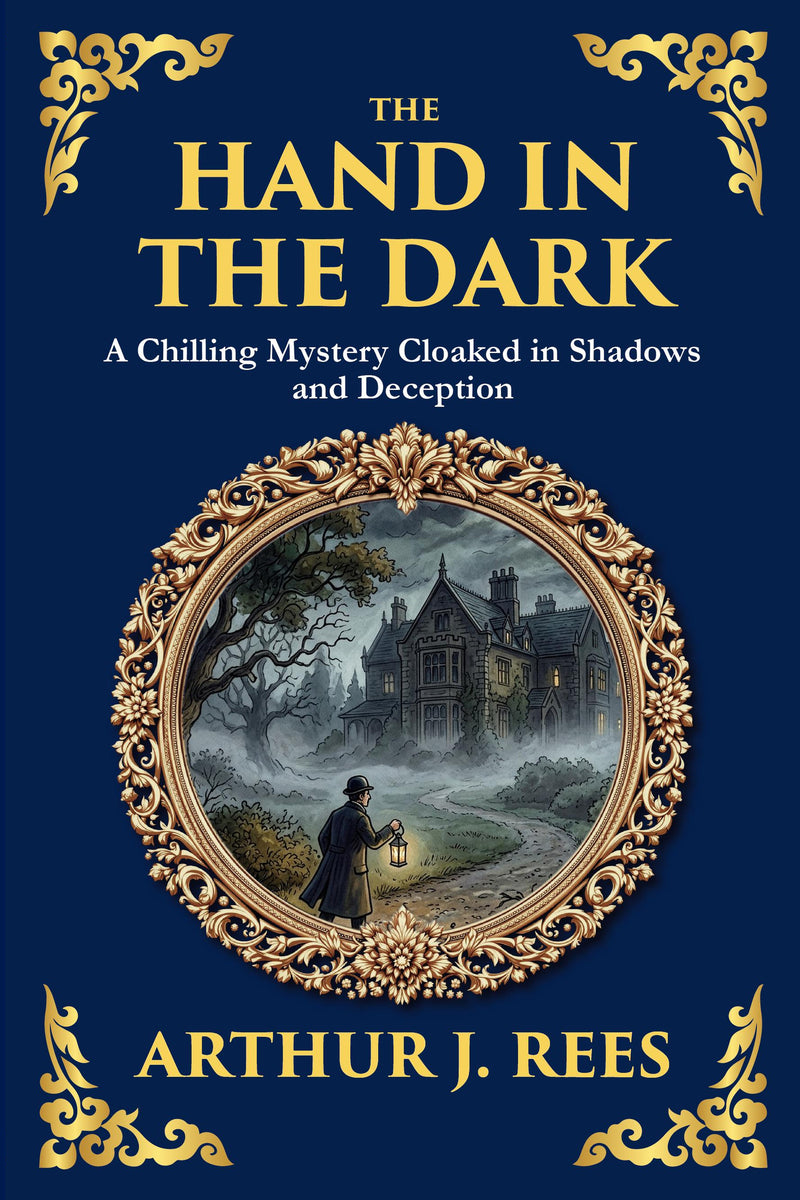
The Hand in the Dark — Large Print
A quiet English estate is shattered by a brutal murder, leaving behind no witnesses, no clear motive—only a single, chilling clue: a mysterious hand in the dark.
or free app
10,000+ hrs library
30-day guarantee
The complete The Hand in the Dark appears in modern English through Library of Alexandria Press, available online with audiobook narration included for members.
Have you ever wondered why the quietest places often hide the darkest secrets? In The Hand in the Dark: A Chilling Mystery Cloaked in Shadows and Deception, Arthur J. Rees crafts a spellbinding murder mystery set in the idyllic yet secret-laden English countryside. When a respected magistrate is found murdered inside his locked library, the discovery of a lone handprint—smudged in soot and fear—ushers in a whirlwind of suspicion, deception, and dread.
As investigators begin to untangle the intricate web of motives, they uncover a household steeped in old grudges, repressed truths, and whispered betrayals. Each revelation seems to lead further from the truth—and closer to danger. At the center of it all stands the enigmatic clue that gives the novel its name: an unseen hand reaching from the darkness.
More than a murder mystery, this is a study in psychological suspense—where appearances mislead, and even the most innocent may be guilty of terrible things.
What you’ll discover in this modern edition
- An Atmospheric Locked-Room Murder – A seemingly impossible crime on a fog- shrouded estate sets the stage for a masterful mystery.
- A Cast of Richly Drawn Suspects – Every character hides something—from the grieving widow to the watchful butler.
- Twists That Will Keep You Guessing – The story masterfully balances misdirection, suspense, and surprise.
- A Signature of Golden Age Mystery – Fans of classic British detective stories will feel right at home in Rees’ immersive world.
- A Dark Exploration of Motive and Morality – What drives someone to murder in cold blood? And what does justice truly mean?
| Formats | eBook (EPUB + PDF) · Audiobook · Paperback · Hardcover · Large Print |
| Language | English |
| Trim size (print) | 6 × 9 in |
| Binding | Paperback — perfect-bound · Hardcover — casewrap |
| Large Print edition | Same text in a larger, easy-read type — a larger font, not a larger trim |
| Print pricing | Every physical book at our true cost — at-cost, no profit (members) |
| Library | 873 restored titles, always growing |
| Length | 101,459 words · ~6 hr 46 min reading |
| Reading level | Grade 8 · an easy, flowing read (this modern-English edition) |
| Edition | Modern English translation · 2026 |
Member reviews for this edition are collected as readers finish it — be the first. Across the library: 12,000+ books shipped, every plan covered by a 365-day print guarantee.
About this edition
A faithful, unabridged modern-English edition by The Library of Alexandria — carefully rendered for today's reader and verified paragraph-by-paragraph against the public-domain source. Available as eBook, audiobook, paperback, hardcover, and large print.
- Complete & unabridgedVerified paragraph by paragraph against the source — never a scan, never abridged.
- Modern English, faithfulReadable today, with the author’s meaning kept intact. Readable — not simplified.
- Every format, one membershipRead in your browser or the free app, or listen to the full audiobook.
Included free with your membership
Cancel anytime, one click · 30-day money-back guarantee
Edition last updated July 2026
What’s inside
The Hand in the Dark — Large Print — complete and unabridged: all 29 sections included with membership, plus the full audiobook.
Begin reading The Hand in the Dark — Large Print
In clear modern English — the complete text is included with membership.
Introduction
There is a particular kind of pleasure that belongs only to the classic detective novel — a pleasure that has nothing to do with speed, with explosions, or with the relentless forward momentum that defines so much of modern entertainment. It is, instead, the pleasure of being invited into a sealed and ordered world, of being handed a lantern and told that somewhere within these walls, among these people, behind these carefully composed faces, the truth is waiting. It is the pleasure of patience rewarded, of attention honored, of the slow and deliberate peeling away of appearances until something raw and human is finally laid bare. The novel you now hold in your hands belongs wholeheartedly to that tradition. It is a book that does not merely ask you to watch a mystery unfold; it asks you to lean in, to listen closely, and to become, for a few hundred pages, a detective yourself.
Arthur J. Rees wrote during what many readers and scholars consider the early flowering of the modern mystery — a period that lay between the gaslit melodramas of the Victorian sensation novel and the elegant, puzzle-driven detective fiction that would later be called the Golden Age. His work carries the fingerprints of both worlds. From the Victorians he inherited a taste for atmosphere, for brooding houses and the weight of family secrets, for the sense that the past is never truly dead but only waiting in the corners of old rooms. From the emerging detective tradition he took a fascination with method, with evidence, with the cold logic that could cut through superstition and panic to arrive at fact. The result is a story that feels both richly textured and rigorously constructed — a mystery you can sink into like a deep armchair, and one you can also try, if you wish, to solve.
This particular edition has been prepared as a modern translation, carefully adapted for the contemporary reader, and it is worth pausing to explain exactly what that means and why it matters. The aim of this work has not been to alter the story, to simplify its intelligence, or to strip away the distinctive voice of its author. The aim has been to remove the small but cumulative obstacles that can stand between a modern reader and a century-old text — the archaic turns of phrase, the obsolete idioms, the occasional sentence so densely constructed that its meaning is lost in a thicket of subordinate clauses. What remains is the book as it was meant to be experienced: tense, intelligent, and absorbing, with every shadow intact and every clue in its proper place. You will lose none of the period charm, none of the careful pacing, none of the cleverness that made readers of an earlier generation turn the pages by candlelight. You will simply find it easier to give yourself over completely to the experience.
The World of Arthur J. Rees and the Art of the Country-House Mystery
To understand what Rees is doing in these pages, it helps to understand the kind of story he is working within. The country-house mystery is one of the most enduring forms in all of crime fiction, and for good reason. There is something deeply satisfying about a tale confined to a single great house and its grounds, populated by a finite cast of characters, each of whom may be hiding something. The walls of such a house become the walls of the puzzle itself. The suspects cannot simply vanish into a crowded city; they are gathered together, trapped by circumstance and by the conventions of hospitality, forced to remain within range of one another’s suspicion. Every meal becomes a tense negotiation, every conversation a possible confession or a possible lie. The reader, like the detective, is given a closed system to examine — a clockwork of human relationships in which one piece has gone terribly, fatally wrong.
Rees understood this form intimately, and he brought to it a particular sensibility. He was an author who took seriously the idea that a mystery should be more than a parlor game. His best work is rooted in a genuine interest in psychology, in the way that fear and guilt and desire distort the human face and the human story. His characters are not merely chess pieces to be moved about a board until the murderer is revealed; they are people, with histories and motives and contradictions, and the slow revelation of those inner lives is as much a part of the pleasure of his books as the eventual unmasking of the guilty party.
There is also, in Rees, a profound feeling for atmosphere. He came of age as a writer at a time when the English landscape — its lonely moors, its ancient houses, its sea-battered coasts — was understood to be a character in its own right. A house in a Rees novel is never merely a setting. It breathes. It remembers. Its corridors hold echoes, its rooms hold the residue of old emotions, and the darkness that gathers in its corners is never entirely empty. The very title of this book gestures toward that quality — toward the moment when the safe and familiar world dissolves, and something reaches out of the blackness, something that should not be there, something that changes everything in an instant. That image, of a hand emerging from shadow, is the perfect emblem of the kind of dread Rees is so skilled at evoking: the terror not of the monstrous and supernatural, but of the human and the hidden. The hand belongs to someone. The shadow conceals a face we may know. And the lies that follow are spoken, perhaps, by people sitting calmly at the same table as ourselves.
This was an author writing in an era when readers were hungry for exactly this kind of story. The detective novel was coming into its own as a respectable and beloved form, no longer dismissed as mere sensationalism but increasingly admired as a kind of intellectual sport — a contest between the writer, who concealed the truth, and the reader, who tried to find it. Rees played this game fairly and with considerable skill. He believed in laying his clues before the reader honestly, in giving you the materials you need to arrive at the solution yourself, even as he employed every legitimate trick of misdirection to keep you from doing so until the moment of revelation. To read him well is to read attentively, to notice the small detail dropped almost casually into a scene, to weigh the testimony of each character against the testimony of the physical evidence, and to remember always that in a story of this kind, nothing is ever included by accident.
It is worth saying, too, that Rees occupies an interesting and somewhat underappreciated place in the lineage of the genre. He was a contemporary of writers whose names have remained more famous, but who learned, in part, from the same sources and worked the same fertile ground. The early decades of the twentieth century saw an extraordinary refinement of the detective story, and Rees was among those who helped to establish the conventions and the standards that later masters would inherit and perfect. Reading him now offers a double pleasure: the immediate enjoyment of a well-told tale, and the deeper satisfaction of seeing a beloved form in one of its formative stages, full of energy and invention and the confidence of a writer who knew exactly what he wanted to achieve.
Now, a word of caution and a word of promise. The caution is this: I will not tell you what happens in this book. To do so would be a betrayal of the very thing that makes it worth reading. A mystery is a contract between the author and the reader, and the most important clause of that contract is that the reader must be allowed to discover the truth in the order and at the pace the author intended. To spoil even a single major revelation would be to rob you of an experience that cannot be recovered. So you will find here no summary of the plot, no list of suspects, no hints about who might or might not be guilty. What I offer instead is a sense of the texture of the experience — of what it feels like to read this book — so that you may know what kind of journey you are about to begin.
Expect, first of all, atmosphere. From the opening pages, Rees works to establish a mood of unease, a sense that beneath the surface of ordinary life something is deeply wrong. He is a patient writer, and he understands that fear is most effective when it is allowed to build slowly. He will take his time setting the scene, introducing you to the house and its inhabitants, drawing the social web in which the drama will unfold. Do not be impatient with this. The careful establishment of normality is precisely what makes its violation so shocking. When the darkness finally closes in, you will feel it all the more keenly for having first been shown the warmth and order it threatens to destroy.
Expect, too, a genuine puzzle. This is a book that respects your intelligence. The central mystery is constructed with care, and the solution, when it comes, is meant to be both surprising and satisfying — the kind of ending that makes you want to flip back through the earlier chapters to find the clues you missed. Rees does not cheat. The answer is there, woven into the fabric of the story, waiting for the sufficiently attentive reader to find it. Whether you choose to play the detective actively, weighing each piece of evidence and forming your own theories, or whether you prefer to sit back and let the story carry you toward its conclusion, you will find that the resolution rewards the journey.
Expect characters who feel real. One of the pleasures of Rees’s writing is the human dimension of his work. The people who move through this story are not mere functions of the plot; they have inner lives, fears, secrets, and desires that make them feel like flesh and blood. Part of the suspense of the book lies precisely in this — in the fact that the people you come to know and perhaps to like may not be what they seem, and that the truth, when it arrives, will reframe much of what you thought you understood about them. This is the deeper craft of the mystery novel: not merely to conceal a fact, but to teach you to read people, and then to show you how badly you have misread them.
Expect, finally, a particular kind of intelligence about human nature. Underneath the machinery of the mystery, Rees is interested in why people do terrible things, and in how ordinary, respectable individuals can be driven by circumstance and emotion into acts that would once have been unthinkable to them. He understands that the most frightening crimes are not committed by monsters but by people not so very different from ourselves, pushed past some invisible breaking point. There is a moral seriousness beneath the entertainment, a recognition that behind every mystery lies a tragedy, and behind every crime, a human soul gone wrong. This gives the book a weight and a resonance that lift it above the level of mere puzzle-solving and into the realm of genuine literature.
A note on how best to read this book. The classic detective novel rewards a particular kind of attention, and you will get the most out of it if you approach it in the right spirit. Read it slowly, if you can. Resist the temptation to race ahead to the ending. Let yourself dwell in each scene, noticing the details, listening to the conversations, observing the behavior of the characters. Pay attention to what people say and, more importantly, to what they do not say — to the silences, the evasions, the small inconsistencies that may turn out to matter a great deal. If you find yourself forming a theory about what has happened, hold onto it lightly; the pleasure of a good mystery lies as much in being proven wrong as in being proven right. And when you reach the end, consider going back to the beginning and reading the opening chapters again with the knowledge you now possess. You will be astonished, I think, at how much was hiding in plain sight.
This is also a book best read in a certain kind of setting, if you can arrange it. There is something to be said for reading a mystery like this one on a dark evening, with the rain against the windows and the rest of the house quiet, when the shadows in your own room seem to lengthen and the imagination is at its most receptive. Rees wrote for readers who wanted to be a little frightened, who relished the delicious shiver of suspense, and the book repays an atmosphere of solitude and concentration. Let yourself be drawn in. Let the world fall away. Allow the house in these pages to become, for a few hours, more real than the one you are sitting in.
Cancel anytime, one click · 30-day money-back guarantee
Founding annual rate available now — your price locks for life when you join.
Not ready? Get this free chapter by email — read it anytime.
✓ Sent — check your inbox for The Hand in the Dark — Large Print.
Questions about The Hand in the Dark — Large Print
What is The Hand in the Dark about?
A quiet English estate is shattered by a brutal murder, leaving behind no witnesses, no clear motive—only a single, chilling clue: a mysterious hand in the dark. As suspicion spreads like fog across the manor, and secrets long buried rise to the surface, only one thing is certain— someone is hiding something deadly. The Hand in the Dark is a classic locked-room mystery by master of detective fiction Arthur J. Rees.
Who wrote The Hand in the Dark?
The Hand in the Dark was written by Arthur J. Rees. This edition presents the complete work in clear modern English, faithfully rendered from the public-domain original by Library of Alexandria Press.
Is The Hand in the Dark free to read?
The opening chapter is free to read on this page. Members read and listen to the complete work — and the entire library — free, and can order any physical book at our true print cost.
How long is The Hand in the Dark?
29 chapters (~101,459 words) — about 6 hr 46 min of reading in this modern-English edition.
Is this an abridged version of The Hand in the Dark?
No. This is the complete, unabridged The Hand in the Dark, carefully rendered into clear modern English and verified paragraph-by-paragraph against the public-domain source — nothing is cut or summarised.
What formats does The Hand in the Dark come in?
The Hand in the Dark is available as eBook, paperback, hardcover and large print. eBook and audiobook are included with membership; printed editions ship at our true print cost.
Shipping & returns
Billing & membership
More from the library


Explore Mystery & Crime
- Resurrection · Leo Tolstoy
- Crime and Punishment · Fyodor Dostoyevsky
- The Strange Case of Dr. Jekyll and Mr. Hyde · Robert Louis Stevenson
- The Riddle of the Sands · Erskine Childers
- The Wisdom of Father Brown · G. K. Chesterton
- The Cask of Amontillado · Edgar Allan Poe
- The Tomb of Ts’in · Edgar Wallace
- Ghost Stories of an Antiquary · M. R. James
- The Hunniwell Boys and the Platinum Mystery · L. P. Wyman
- The Seven Dials Mystery · Agatha Christie
- The Thirty-Nine Steps · John Buchan
- The Hand in the Dark · Arthur J. Rees
- Lady Audley’s Secret · M. E. Braddon
- The Mystery of the Blue Train · Agatha Christie
- The Secret Adversary · Agatha Christie
- The Call of Cthulhu · H. P. Lovecraft
- The Adventures of Heine · Edgar Wallace
- The Valley of Fear · Arthur Conan Doyle
- The Innocence of Father Brown · G. K. Chesterton
- McTeague: A Story of San Francisco · Frank Norris
- Tess of the d’Urbervilles: A Pure Woman · Thomas Hardy
- The Big Fix · George O. Smith
- The Ambulance Made Two Trips · Murray Leinster
- Time Crime · H. Beam Piper
- The Misplaced Battleship · Harry Harrison
- Supermind · Randall Garrett and Laurence M....
- Lone Star Planet · H. Beam Piper and John J. McGuire
- Dracula · Bram Stoker
- The Murder on the Links · Agatha Christie
- The Hound of the Baskervilles · Arthur Conan Doyle
The Hand in the Dark — Large Print
The Hand in the Dark — Large Print
A terrifying mystery hidden by shadows and lies
Arthur J. Rees
Contents
- Introduction
- Chapter 1
- Chapter 2
- Chapter 3
- Chapter 4
- Chapter 5
- Chapter 6
- Chapter 7
- Chapter 8
- Chapter 9
- Chapter 10
- Chapter 11
- Chapter 12
- Chapter 13
- Chapter 14
- Chapter 15
- Chapter 16
- Chapter 17
- Chapter 18
- Chapter 19
- Chapter 20
- Chapter 21
- Chapter 22
- Chapter 23
- Chapter 24
- Chapter 25
- Chapter 26
- Chapter 27
- Chapter 28
Introduction
There is a particular kind of pleasure that belongs only to the classic detective novel — a pleasure that has nothing to do with speed, with explosions, or with the relentless forward momentum that defines so much of modern entertainment. It is, instead, the pleasure of being invited into a sealed and ordered world, of being handed a lantern and told that somewhere within these walls, among these people, behind these carefully composed faces, the truth is waiting. It is the pleasure of patience rewarded, of attention honored, of the slow and deliberate peeling away of appearances until something raw and human is finally laid bare. The novel you now hold in your hands belongs wholeheartedly to that tradition. It is a book that does not merely ask you to watch a mystery unfold; it asks you to lean in, to listen closely, and to become, for a few hundred pages, a detective yourself.
Arthur J. Rees wrote during what many readers and scholars consider the early flowering of the modern mystery — a period that lay between the gaslit melodramas of the Victorian sensation novel and the elegant, puzzle-driven detective fiction that would later be called the Golden Age. His work carries the fingerprints of both worlds. From the Victorians he inherited a taste for atmosphere, for brooding houses and the weight of family secrets, for the sense that the past is never truly dead but only waiting in the corners of old rooms. From the emerging detective tradition he took a fascination with method, with evidence, with the cold logic that could cut through superstition and panic to arrive at fact. The result is a story that feels both richly textured and rigorously constructed — a mystery you can sink into like a deep armchair, and one you can also try, if you wish, to solve.
This particular edition has been prepared as a modern translation, carefully adapted for the contemporary reader, and it is worth pausing to explain exactly what that means and why it matters. The aim of this work has not been to alter the story, to simplify its intelligence, or to strip away the distinctive voice of its author. The aim has been to remove the small but cumulative obstacles that can stand between a modern reader and a century-old text — the archaic turns of phrase, the obsolete idioms, the occasional sentence so densely constructed that its meaning is lost in a thicket of subordinate clauses. What remains is the book as it was meant to be experienced: tense, intelligent, and absorbing, with every shadow intact and every clue in its proper place. You will lose none of the period charm, none of the careful pacing, none of the cleverness that made readers of an earlier generation turn the pages by candlelight. You will simply find it easier to give yourself over completely to the experience.
The World of Arthur J. Rees and the Art of the Country-House Mystery
To understand what Rees is doing in these pages, it helps to understand the kind of story he is working within. The country-house mystery is one of the most enduring forms in all of crime fiction, and for good reason. There is something deeply satisfying about a tale confined to a single great house and its grounds, populated by a finite cast of characters, each of whom may be hiding something. The walls of such a house become the walls of the puzzle itself. The suspects cannot simply vanish into a crowded city; they are gathered together, trapped by circumstance and by the conventions of hospitality, forced to remain within range of one another’s suspicion. Every meal becomes a tense negotiation, every conversation a possible confession or a possible lie. The reader, like the detective, is given a closed system to examine — a clockwork of human relationships in which one piece has gone terribly, fatally wrong.
Rees understood this form intimately, and he brought to it a particular sensibility. He was an author who took seriously the idea that a mystery should be more than a parlor game. His best work is rooted in a genuine interest in psychology, in the way that fear and guilt and desire distort the human face and the human story. His characters are not merely chess pieces to be moved about a board until the murderer is revealed; they are people, with histories and motives and contradictions, and the slow revelation of those inner lives is as much a part of the pleasure of his books as the eventual unmasking of the guilty party.
There is also, in Rees, a profound feeling for atmosphere. He came of age as a writer at a time when the English landscape — its lonely moors, its ancient houses, its sea-battered coasts — was understood to be a character in its own right. A house in a Rees novel is never merely a setting. It breathes. It remembers. Its corridors hold echoes, its rooms hold the residue of old emotions, and the darkness that gathers in its corners is never entirely empty. The very title of this book gestures toward that quality — toward the moment when the safe and familiar world dissolves, and something reaches out of the blackness, something that should not be there, something that changes everything in an instant. That image, of a hand emerging from shadow, is the perfect emblem of the kind of dread Rees is so skilled at evoking: the terror not of the monstrous and supernatural, but of the human and the hidden. The hand belongs to someone. The shadow conceals a face we may know. And the lies that follow are spoken, perhaps, by people sitting calmly at the same table as ourselves.
This was an author writing in an era when readers were hungry for exactly this kind of story. The detective novel was coming into its own as a respectable and beloved form, no longer dismissed as mere sensationalism but increasingly admired as a kind of intellectual sport — a contest between the writer, who concealed the truth, and the reader, who tried to find it. Rees played this game fairly and with considerable skill. He believed in laying his clues before the reader honestly, in giving you the materials you need to arrive at the solution yourself, even as he employed every legitimate trick of misdirection to keep you from doing so until the moment of revelation. To read him well is to read attentively, to notice the small detail dropped almost casually into a scene, to weigh the testimony of each character against the testimony of the physical evidence, and to remember always that in a story of this kind, nothing is ever included by accident.
It is worth saying, too, that Rees occupies an interesting and somewhat underappreciated place in the lineage of the genre. He was a contemporary of writers whose names have remained more famous, but who learned, in part, from the same sources and worked the same fertile ground. The early decades of the twentieth century saw an extraordinary refinement of the detective story, and Rees was among those who helped to establish the conventions and the standards that later masters would inherit and perfect. Reading him now offers a double pleasure: the immediate enjoyment of a well-told tale, and the deeper satisfaction of seeing a beloved form in one of its formative stages, full of energy and invention and the confidence of a writer who knew exactly what he wanted to achieve.
Now, a word of caution and a word of promise. The caution is this: I will not tell you what happens in this book. To do so would be a betrayal of the very thing that makes it worth reading. A mystery is a contract between the author and the reader, and the most important clause of that contract is that the reader must be allowed to discover the truth in the order and at the pace the author intended. To spoil even a single major revelation would be to rob you of an experience that cannot be recovered. So you will find here no summary of the plot, no list of suspects, no hints about who might or might not be guilty. What I offer instead is a sense of the texture of the experience — of what it feels like to read this book — so that you may know what kind of journey you are about to begin.
Expect, first of all, atmosphere. From the opening pages, Rees works to establish a mood of unease, a sense that beneath the surface of ordinary life something is deeply wrong. He is a patient writer, and he understands that fear is most effective when it is allowed to build slowly. He will take his time setting the scene, introducing you to the house and its inhabitants, drawing the social web in which the drama will unfold. Do not be impatient with this. The careful establishment of normality is precisely what makes its violation so shocking. When the darkness finally closes in, you will feel it all the more keenly for having first been shown the warmth and order it threatens to destroy.
Expect, too, a genuine puzzle. This is a book that respects your intelligence. The central mystery is constructed with care, and the solution, when it comes, is meant to be both surprising and satisfying — the kind of ending that makes you want to flip back through the earlier chapters to find the clues you missed. Rees does not cheat. The answer is there, woven into the fabric of the story, waiting for the sufficiently attentive reader to find it. Whether you choose to play the detective actively, weighing each piece of evidence and forming your own theories, or whether you prefer to sit back and let the story carry you toward its conclusion, you will find that the resolution rewards the journey.
Expect characters who feel real. One of the pleasures of Rees’s writing is the human dimension of his work. The people who move through this story are not mere functions of the plot; they have inner lives, fears, secrets, and desires that make them feel like flesh and blood. Part of the suspense of the book lies precisely in this — in the fact that the people you come to know and perhaps to like may not be what they seem, and that the truth, when it arrives, will reframe much of what you thought you understood about them. This is the deeper craft of the mystery novel: not merely to conceal a fact, but to teach you to read people, and then to show you how badly you have misread them.
Expect, finally, a particular kind of intelligence about human nature. Underneath the machinery of the mystery, Rees is interested in why people do terrible things, and in how ordinary, respectable individuals can be driven by circumstance and emotion into acts that would once have been unthinkable to them. He understands that the most frightening crimes are not committed by monsters but by people not so very different from ourselves, pushed past some invisible breaking point. There is a moral seriousness beneath the entertainment, a recognition that behind every mystery lies a tragedy, and behind every crime, a human soul gone wrong. This gives the book a weight and a resonance that lift it above the level of mere puzzle-solving and into the realm of genuine literature.
A note on how best to read this book. The classic detective novel rewards a particular kind of attention, and you will get the most out of it if you approach it in the right spirit. Read it slowly, if you can. Resist the temptation to race ahead to the ending. Let yourself dwell in each scene, noticing the details, listening to the conversations, observing the behavior of the characters. Pay attention to what people say and, more importantly, to what they do not say — to the silences, the evasions, the small inconsistencies that may turn out to matter a great deal. If you find yourself forming a theory about what has happened, hold onto it lightly; the pleasure of a good mystery lies as much in being proven wrong as in being proven right. And when you reach the end, consider going back to the beginning and reading the opening chapters again with the knowledge you now possess. You will be astonished, I think, at how much was hiding in plain sight.
This is also a book best read in a certain kind of setting, if you can arrange it. There is something to be said for reading a mystery like this one on a dark evening, with the rain against the windows and the rest of the house quiet, when the shadows in your own room seem to lengthen and the imagination is at its most receptive. Rees wrote for readers who wanted to be a little frightened, who relished the delicious shiver of suspense, and the book repays an atmosphere of solitude and concentration. Let yourself be drawn in. Let the world fall away. Allow the house in these pages to become, for a few hours, more real than the one you are sitting in.
Viewed through the gloomy light of an English evening, the old moat-house seemed to rise out of the light mists covering the surrounding green fields. It looked like a home growing old, exhausted by centuries of existence. Buildings age just as humans do; the process is just as unavoidable, even if it happens more slowly. In both cases, decay is sped up by specific events as well as the simple passing of time.
The moat-house wasn’t as old as most English country homes, but it looked its age because of its dark past. The place had a strange and violent history, with records of murders, stabbings, and fights going back to the Saxon era. Back then, a castle stood on the site, and every inch of the flat land had been soaked in the blood of peasants fighting for a Saxon tyrant against a Norman tyrant, all in the name of the sacred idea of Liberty.
The winning Norman tyrant killed the Saxon, seized his castle, and oppressed the peasants for a short time, until the ultimate tyrant, Death, taught him his first and final lesson in humility. After he died, another usurper tore down the stolen castle and built a moat-house in its place. Over the next few hundred years, there was more fighting fueled by restless ambition, always involving the rise and fall of tyrants, until an English king was beheaded for the cause of Liberty, and the moat-house was burned down for that same noble principle.
The house was rebuilt by the pirate who had burned it down: a man named Philip Heredith. He was a descendant of Philip Here-Deith, whose name appears in the Domesday Book as one of the knights in Duke William’s army that gathered at Dives to conquer England. Philip Heredith, who was just as fierce a fighter as his Norman ancestor, secured his claim to the estate and avoided any legal battles by trapping the Royalist owner and his family inside the moat-house before setting it on fire. He later married and moved into the new house with his young wife. However, their honeymoon was interrupted by the ghost of the nobleman he had burned alive, who warned him that since his family line began in horror, it would end in horror, and the house he built would eventually crumble to the ground.
End of the free sample
Keep reading, free
Members read and listen to the complete book — and the entire library. Cancel anytime, one click · 30-day money-back guarantee.