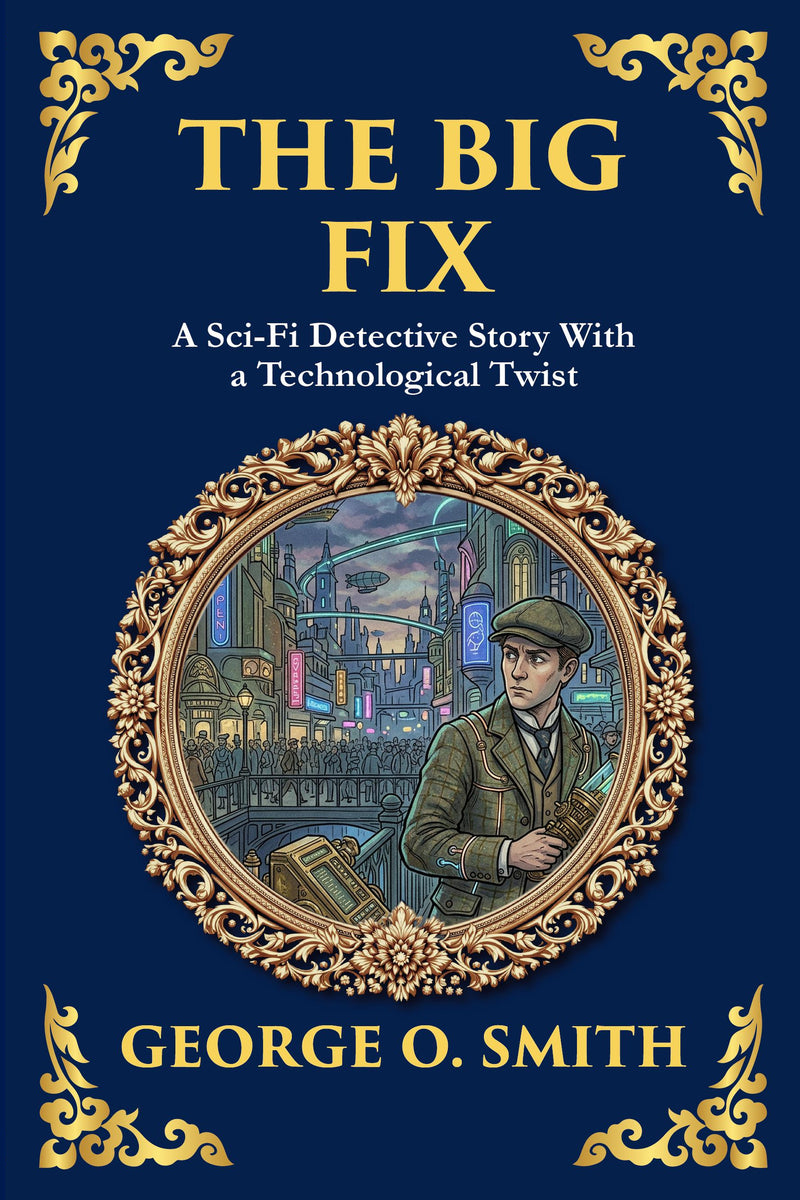
The Big Fix — Large Print
In a future driven by data, systems never lie. But someone has learned how to make them whisper only what they want heard.
or free app
10,000+ hrs library
30-day guarantee
The complete The Big Fix appears in modern English through Library of Alexandria Press, available online with audiobook narration included for members.
Have you ever wondered why, in a world of flawless machines, it's still the human error that makes everything dangerous? The Big Fix is a thrilling blend of sci-fi speculation and classic noir mystery. In this gritty tale from George O. Smith, technology doesn’t just drive society—it runs it.
Everything is automated. Everything is optimized. And everything can be manipulated.
Enter Vardon, a rogue investigator who doesn’t believe in easy answers. When he's called in to confirm a high-profile incident already deemed "solved" by system protocols, he starts noticing cracks—digital, procedural, and deeply human. Someone has rewritten reality.
And they're willing to kill to keep it that way. With every lead bringing him closer to a truth that threatens the very fabric of trust in a fully automated world, Vardon races to stop a cover-up far larger than he imagined. But how do you solve a crime that’s been buried not by lies—but by perfect code?
What you’ll discover in this modern edition
- A mind-bending fusion of hardboiled mystery and speculative technology
- A world where automation replaces accountability—and how that goes terribly wrong
| Formats | eBook (EPUB + PDF) · Audiobook · Paperback · Hardcover · Large Print |
| Language | English |
| Trim size (print) | 6 × 9 in |
| Binding | Paperback — perfect-bound · Hardcover — casewrap |
| Large Print edition | Same text in a larger, easy-read type — a larger font, not a larger trim |
| Print pricing | Every physical book at our true cost — at-cost, no profit (members) |
| Library | 873 restored titles, always growing |
| Length | 12,125 words · ~48 min reading |
| Reading level | Grade 10 · a comfortable read (this modern-English edition) |
| Edition | Modern English translation · 2026 |
Member reviews for this edition are collected as readers finish it — be the first. Across the library: 12,000+ books shipped, every plan covered by a 365-day print guarantee.
About this edition
A faithful, unabridged modern-English edition by The Library of Alexandria — carefully rendered for today's reader and verified paragraph-by-paragraph against the public-domain source. Available as eBook, audiobook, paperback, hardcover, and large print.
- Complete & unabridgedVerified paragraph by paragraph against the source — never a scan, never abridged.
- Modern English, faithfulReadable today, with the author’s meaning kept intact. Readable — not simplified.
- Every format, one membershipRead in your browser or the free app, or listen to the full audiobook.
Included free with your membership
Cancel anytime, one click · 30-day money-back guarantee
Edition last updated July 2026
What’s inside
The Big Fix — Large Print — complete and unabridged: all 10 sections included with membership, plus the full audiobook.
Begin reading The Big Fix — Large Print
In clear modern English — the complete text is included with membership.
Introduction
A Sci-Fi Detective Story With a Technological Twist – A Modern Translation – Adapted for the Contemporary Reader
There are certain works in the long lineage of speculative fiction that reward the reader not merely for the surface pleasure of their plotting, but for the way they quietly anticipate the moral and technological dilemmas of a world yet to come. The book you are about to read belongs to this rarer category. On its face, it presents itself as a detective story, a tale of cheating and corruption, of a contest rigged behind closed doors. Yet beneath that familiar architecture lies a question that has only grown more urgent with each passing decade: what happens to human society when the boundaries of privacy are abolished, when thought itself becomes a public commodity, and when the very faculties that allow us to deceive one another are stripped away? This is the territory George O. Smith mapped with characteristic precision and wit, and it is a territory that the modern reader will find startlingly, almost uncomfortably, relevant.
Before you begin, it is worth taking a moment to understand the man who wrote this story, the era that shaped it, and the peculiar genius of his approach to science fiction. To do so is not to spoil a single twist of the narrative ahead — the pleasures of the plot remain entirely intact and waiting for you — but rather to sharpen your appreciation for the craftsmanship at work, and to prepare you for a reading experience that operates on several levels at once. Smith was never a writer who asked his readers to switch off their intellects. On the contrary, he wrote for an audience that delighted in puzzles, that took satisfaction in working through the logical consequences of an unusual premise, and that expected its entertainment to come laced with genuine ideas. This modern translation and adaptation has been prepared with the express purpose of allowing today’s reader to enter that same pleasurable contract with the text, unencumbered by the dated phrasings and obscure references that can sometimes form a barrier between a vintage story and a contemporary mind.
George Oliver Smith, who published much of his work during the 1940s and 1950s under his own name and occasionally under pseudonyms to avoid crowding the contents page of a single magazine issue, occupies a distinctive niche in the history of American science fiction. He was, by training and by temperament, an engineer. He worked in electronics, in radio, and in the practical world of circuits and signals, and this background saturates everything he wrote. Where some of his contemporaries reached for the cosmic and the mystical, Smith reached for the schematic. His stories tend to be built the way a competent engineer builds a device: every component justified, every connection traceable, every effect arising plausibly from a cause. This is not to say his work is dry — far from it — but it does mean that his fiction carries an unusual authority. When a Smith character explains how something works, you believe him, because Smith himself clearly understood the principles, even when those principles were extrapolated into the realm of the speculative.
He came to prominence in the orbit of John W. Campbell’s Astounding Science Fiction, the magazine that, more than any other, defined what came to be called the Golden Age of science fiction. Campbell demanded stories in which the science mattered, in which the consequences of a technological premise were followed through rigorously, and in which the human characters had to grapple intelligently with the changes that technology imposed upon their world. Smith thrived in this environment. His most celebrated early work, the Venus Equilateral series, concerned the engineers and operators of a communications relay station positioned in space, and those stories are remembered today precisely because they treat the nuts and bolts of interplanetary communication as a genuine engineering challenge, full of failures, improvisations, and clever fixes. There is a reason the word “fix” appears so naturally in the title of the present volume; Smith was always, at heart, a man fascinated by the problem of how things break, and how a clever mind might set them right — or, in this case, how a clever mind might bend a system to its own corrupt purposes, and how another clever mind might catch it out.
What makes Smith especially worth reading now is the particular flavor of his imagination. He was not content to invent a single gadget and leave the rest of the world unchanged around it. Instead, he asked the deeper and more interesting question: if such a technology existed, how would it reshape the social fabric? How would it alter the law, the economy, the games people play, the lies they tell, the institutions they build? This is the mark of a truly thoughtful science fiction writer, and it is precisely the quality that elevates the story before you above the level of mere puzzle-plotting. Smith understood that a new technology is never merely a new tool; it is a new set of rules for the human game, and human beings are endlessly inventive in finding ways to exploit, evade, and subvert any new set of rules. The drama of his fiction often arises exactly at this fault line — in the gap between what a technology is supposed to do and what cunning people actually do with it.
It is also worth noting that Smith wrote with a lightness of touch that distinguishes him from some of the more ponderous voices of his generation. His prose moves briskly. His dialogue crackles. He had a sense of humor, often dry, occasionally sly, and he was not above poking gentle fun at the pretensions of bureaucracy, the vanity of officials, and the absurdities that arise when human nature collides with rigid systems. Readers who come to him expecting the solemnity sometimes associated with classic science fiction will be pleasantly surprised by his readability and by the genuine entertainment value of his work. He wanted, above all, to tell a good story, and he never lost sight of that obligation even when his ideas grew most ambitious.
The world in which Smith wrote was one of enormous technological optimism mingled with profound anxiety. The mid-twentieth century had witnessed the harnessing of the atom, the explosion of electronics, the dawn of computing, and the first stirrings of what we would now call the information age. There was a widespread sense that science was on the verge of transforming every aspect of human existence, and the question on every thoughtful person’s mind was whether that transformation would be a blessing or a curse. Science fiction became the great laboratory for testing these possibilities, a place where the consequences of new powers could be explored in safety before they arrived in reality. Smith was one of the most disciplined experimenters in that laboratory, and the story you are about to read is one of his most provocative experiments. It takes a particular extrapolation — one rooted in the very real scientific speculations of his day about the mind, about perception, about the manipulation of human faculties — and follows it to a conclusion that is at once logical, surprising, and deeply unsettling.
Without disclosing the particulars of the plot — for the unfolding of those particulars is precisely the pleasure that awaits you — it is fair and useful to say something about the conceptual ground on which this story stands. At its center is an idea about the relationship between the individual mind and the surrounding world, an idea concerning the limits of privacy, the possibility of perception beyond the ordinary senses, and the consequences that would follow if certain capacities, long imagined and long feared, were to become commonplace. Smith takes such a capacity as his starting point and asks, with his usual engineer’s rigor, what kind of society would result. What would happen to crime, to trust, to commerce, to the games we play and the contests we hold? What would happen to the very notion of getting away with something, when getting away with anything became extraordinarily difficult?
This is fertile ground for a detective story, and the marriage of the detective form to the science fiction premise is one of the most satisfying aspects of the book. The classic detective story depends upon concealment: a crime is committed, the truth is hidden, and the detective’s task is to peel away the layers of deception to expose what really happened. But what becomes of concealment in a world where deception itself has been rendered nearly impossible? This is the paradox that Smith sets spinning at the heart of his narrative, and it is a paradox of real ingenuity. For if the obvious forms of hiding the truth are no longer available, then any successful deception must be of an extraordinarily clever and unexpected kind — and the unraveling of that deception becomes a correspondingly greater intellectual feat. The “big fix” of the title is, in this sense, a crime that should not have been possible, and the story is the account of how it was nonetheless accomplished, and how it comes to light.
Readers who enjoy the fusion of genres will find this book a particularly rich example of the form. The detective story and the science fiction story share a deep structural kinship: both depend upon the careful establishment of rules, both reward the attentive reader who follows the logic, and both deliver their greatest pleasures in the moment when apparent chaos resolves into intelligible order. Smith was acutely aware of this kinship, and he exploited it with great skill. The pleasures of the mystery — the suspicion, the misdirection, the gradual accumulation of clues, the satisfying click of revelation — are all present and accounted for. But they are elevated and complicated by the science fictional premise, which forces both the characters and the reader to think in unfamiliar ways. You cannot simply apply the ordinary rules of the whodunit, because the ordinary rules no longer hold. You must learn the new rules of this transformed world, and then watch as the story tests them, bends them, and ultimately turns upon them.
There is, too, a thematic depth here that rewards reflection. Beneath the entertaining surface of the mystery lies a meditation on the nature of fairness, of competition, and of integrity in a world where the old safeguards have fallen away. Smith was interested in the ways human beings respond to radical changes in the conditions of their lives. Some adapt, some resist, some seek to exploit, and some are simply left bewildered. The characters in this story embody these various responses, and watching them navigate their transformed circumstances is part of the book’s enduring appeal. The questions Smith raises — about whether perfect transparency would make us better or worse, about whether the abolition of certain forms of deception would liberate us or imprison us, about how trust and competition can survive in a world stripped of secrecy — are not abstract philosophical exercises. They are questions that bear with increasing weight upon our own era, an era in which the technologies of surveillance, data collection, and the erosion of privacy have advanced to a degree that even Smith, for all his foresight, might have found astonishing.
Indeed, one of the great rewards of reading this book today is the uncanny way in which its concerns prefigure our own. Smith was writing decades before the digital revolution, before the rise of the networked society, before the moment when nearly every action a person takes leaves a recoverable trace. And yet the central anxiety of his story — the fear and the fascination of a world without hiding places — speaks directly to the condition in which we now find ourselves. We live in an age when our movements, our purchases, our communications, and even our idle curiosities are recorded, analyzed, and stored. We live in an age when the boundary between the private interior of the mind and the public exterior of the world grows thinner with each passing year. The technologies that accomplish this are not the ones Smith imagined, and yet the social and moral situation they produce bears a remarkable resemblance to the one he conjured. To read this book now is to encounter a thinker who, working with the materials of his own time, arrived at conclusions that ring with startling relevance for ours.
Cancel anytime, one click · 30-day money-back guarantee
Founding annual rate available now — your price locks for life when you join.
Not ready? Get this free chapter by email — read it anytime.
✓ Sent — check your inbox for The Big Fix — Large Print.
Questions about The Big Fix — Large Print
What is The Big Fix about?
In a future driven by data, systems never lie. But someone has learned how to make them whisper only what they want heard. In The Big Fix, acclaimed science fiction author George O. Smith fuses classic hardboiled detective fiction with futuristic innovation.
Who wrote The Big Fix?
The Big Fix was written by George O. Smith. This edition presents the complete work in clear modern English, faithfully rendered from the public-domain original by Library of Alexandria Press.
Is The Big Fix free to read?
The opening chapter is free to read on this page. Members read and listen to the complete work — and the entire library — free, and can order any physical book at our true print cost.
How long is The Big Fix?
10 chapters (~12,125 words) — about 48 min of reading in this modern-English edition.
Is this an abridged version of The Big Fix?
No. This is the complete, unabridged The Big Fix, carefully rendered into clear modern English and verified paragraph-by-paragraph against the public-domain source — nothing is cut or summarised.
What formats does The Big Fix come in?
The Big Fix is available as eBook, paperback, hardcover and large print. eBook and audiobook are included with membership; printed editions ship at our true print cost.
Shipping & returns
Billing & membership
More from the library


Explore Mystery & Crime
- Resurrection · Leo Tolstoy
- Crime and Punishment · Fyodor Dostoyevsky
- The Strange Case of Dr. Jekyll and Mr. Hyde · Robert Louis Stevenson
- The Riddle of the Sands · Erskine Childers
- The Wisdom of Father Brown · G. K. Chesterton
- The Cask of Amontillado · Edgar Allan Poe
- The Tomb of Ts’in · Edgar Wallace
- Ghost Stories of an Antiquary · M. R. James
- The Hunniwell Boys and the Platinum Mystery · L. P. Wyman
- The Seven Dials Mystery · Agatha Christie
- The Thirty-Nine Steps · John Buchan
- The Hand in the Dark · Arthur J. Rees
- Lady Audley’s Secret · M. E. Braddon
- The Mystery of the Blue Train · Agatha Christie
- The Secret Adversary · Agatha Christie
- The Call of Cthulhu · H. P. Lovecraft
- The Adventures of Heine · Edgar Wallace
- The Valley of Fear · Arthur Conan Doyle
- The Innocence of Father Brown · G. K. Chesterton
- McTeague: A Story of San Francisco · Frank Norris
- Tess of the d’Urbervilles: A Pure Woman · Thomas Hardy
- The Big Fix · George O. Smith
- The Ambulance Made Two Trips · Murray Leinster
- Time Crime · H. Beam Piper
- The Misplaced Battleship · Harry Harrison
- Supermind · Randall Garrett and Laurence M....
- Lone Star Planet · H. Beam Piper and John J. McGuire
- Dracula · Bram Stoker
- The Murder on the Links · Agatha Christie
- The Hound of the Baskervilles · Arthur Conan Doyle
The Big Fix — Large Print
The Big Fix — Large Print
A Sci-Fi Detective Story with a Technological Twist
George O. Smith
Contents
- Introduction
- Chapter 1
- Chapter 2
- Chapter 3
- Chapter 4
- Chapter 5
- Chapter 6
- Chapter 7
- Chapter 8
- Chapter 9
Introduction
A Sci-Fi Detective Story With a Technological Twist – A Modern Translation – Adapted for the Contemporary Reader
There are certain works in the long lineage of speculative fiction that reward the reader not merely for the surface pleasure of their plotting, but for the way they quietly anticipate the moral and technological dilemmas of a world yet to come. The book you are about to read belongs to this rarer category. On its face, it presents itself as a detective story, a tale of cheating and corruption, of a contest rigged behind closed doors. Yet beneath that familiar architecture lies a question that has only grown more urgent with each passing decade: what happens to human society when the boundaries of privacy are abolished, when thought itself becomes a public commodity, and when the very faculties that allow us to deceive one another are stripped away? This is the territory George O. Smith mapped with characteristic precision and wit, and it is a territory that the modern reader will find startlingly, almost uncomfortably, relevant.
Before you begin, it is worth taking a moment to understand the man who wrote this story, the era that shaped it, and the peculiar genius of his approach to science fiction. To do so is not to spoil a single twist of the narrative ahead — the pleasures of the plot remain entirely intact and waiting for you — but rather to sharpen your appreciation for the craftsmanship at work, and to prepare you for a reading experience that operates on several levels at once. Smith was never a writer who asked his readers to switch off their intellects. On the contrary, he wrote for an audience that delighted in puzzles, that took satisfaction in working through the logical consequences of an unusual premise, and that expected its entertainment to come laced with genuine ideas. This modern translation and adaptation has been prepared with the express purpose of allowing today’s reader to enter that same pleasurable contract with the text, unencumbered by the dated phrasings and obscure references that can sometimes form a barrier between a vintage story and a contemporary mind.
George Oliver Smith, who published much of his work during the 1940s and 1950s under his own name and occasionally under pseudonyms to avoid crowding the contents page of a single magazine issue, occupies a distinctive niche in the history of American science fiction. He was, by training and by temperament, an engineer. He worked in electronics, in radio, and in the practical world of circuits and signals, and this background saturates everything he wrote. Where some of his contemporaries reached for the cosmic and the mystical, Smith reached for the schematic. His stories tend to be built the way a competent engineer builds a device: every component justified, every connection traceable, every effect arising plausibly from a cause. This is not to say his work is dry — far from it — but it does mean that his fiction carries an unusual authority. When a Smith character explains how something works, you believe him, because Smith himself clearly understood the principles, even when those principles were extrapolated into the realm of the speculative.
He came to prominence in the orbit of John W. Campbell’s Astounding Science Fiction, the magazine that, more than any other, defined what came to be called the Golden Age of science fiction. Campbell demanded stories in which the science mattered, in which the consequences of a technological premise were followed through rigorously, and in which the human characters had to grapple intelligently with the changes that technology imposed upon their world. Smith thrived in this environment. His most celebrated early work, the Venus Equilateral series, concerned the engineers and operators of a communications relay station positioned in space, and those stories are remembered today precisely because they treat the nuts and bolts of interplanetary communication as a genuine engineering challenge, full of failures, improvisations, and clever fixes. There is a reason the word “fix” appears so naturally in the title of the present volume; Smith was always, at heart, a man fascinated by the problem of how things break, and how a clever mind might set them right — or, in this case, how a clever mind might bend a system to its own corrupt purposes, and how another clever mind might catch it out.
What makes Smith especially worth reading now is the particular flavor of his imagination. He was not content to invent a single gadget and leave the rest of the world unchanged around it. Instead, he asked the deeper and more interesting question: if such a technology existed, how would it reshape the social fabric? How would it alter the law, the economy, the games people play, the lies they tell, the institutions they build? This is the mark of a truly thoughtful science fiction writer, and it is precisely the quality that elevates the story before you above the level of mere puzzle-plotting. Smith understood that a new technology is never merely a new tool; it is a new set of rules for the human game, and human beings are endlessly inventive in finding ways to exploit, evade, and subvert any new set of rules. The drama of his fiction often arises exactly at this fault line — in the gap between what a technology is supposed to do and what cunning people actually do with it.
It is also worth noting that Smith wrote with a lightness of touch that distinguishes him from some of the more ponderous voices of his generation. His prose moves briskly. His dialogue crackles. He had a sense of humor, often dry, occasionally sly, and he was not above poking gentle fun at the pretensions of bureaucracy, the vanity of officials, and the absurdities that arise when human nature collides with rigid systems. Readers who come to him expecting the solemnity sometimes associated with classic science fiction will be pleasantly surprised by his readability and by the genuine entertainment value of his work. He wanted, above all, to tell a good story, and he never lost sight of that obligation even when his ideas grew most ambitious.
The world in which Smith wrote was one of enormous technological optimism mingled with profound anxiety. The mid-twentieth century had witnessed the harnessing of the atom, the explosion of electronics, the dawn of computing, and the first stirrings of what we would now call the information age. There was a widespread sense that science was on the verge of transforming every aspect of human existence, and the question on every thoughtful person’s mind was whether that transformation would be a blessing or a curse. Science fiction became the great laboratory for testing these possibilities, a place where the consequences of new powers could be explored in safety before they arrived in reality. Smith was one of the most disciplined experimenters in that laboratory, and the story you are about to read is one of his most provocative experiments. It takes a particular extrapolation — one rooted in the very real scientific speculations of his day about the mind, about perception, about the manipulation of human faculties — and follows it to a conclusion that is at once logical, surprising, and deeply unsettling.
Without disclosing the particulars of the plot — for the unfolding of those particulars is precisely the pleasure that awaits you — it is fair and useful to say something about the conceptual ground on which this story stands. At its center is an idea about the relationship between the individual mind and the surrounding world, an idea concerning the limits of privacy, the possibility of perception beyond the ordinary senses, and the consequences that would follow if certain capacities, long imagined and long feared, were to become commonplace. Smith takes such a capacity as his starting point and asks, with his usual engineer’s rigor, what kind of society would result. What would happen to crime, to trust, to commerce, to the games we play and the contests we hold? What would happen to the very notion of getting away with something, when getting away with anything became extraordinarily difficult?
This is fertile ground for a detective story, and the marriage of the detective form to the science fiction premise is one of the most satisfying aspects of the book. The classic detective story depends upon concealment: a crime is committed, the truth is hidden, and the detective’s task is to peel away the layers of deception to expose what really happened. But what becomes of concealment in a world where deception itself has been rendered nearly impossible? This is the paradox that Smith sets spinning at the heart of his narrative, and it is a paradox of real ingenuity. For if the obvious forms of hiding the truth are no longer available, then any successful deception must be of an extraordinarily clever and unexpected kind — and the unraveling of that deception becomes a correspondingly greater intellectual feat. The “big fix” of the title is, in this sense, a crime that should not have been possible, and the story is the account of how it was nonetheless accomplished, and how it comes to light.
Readers who enjoy the fusion of genres will find this book a particularly rich example of the form. The detective story and the science fiction story share a deep structural kinship: both depend upon the careful establishment of rules, both reward the attentive reader who follows the logic, and both deliver their greatest pleasures in the moment when apparent chaos resolves into intelligible order. Smith was acutely aware of this kinship, and he exploited it with great skill. The pleasures of the mystery — the suspicion, the misdirection, the gradual accumulation of clues, the satisfying click of revelation — are all present and accounted for. But they are elevated and complicated by the science fictional premise, which forces both the characters and the reader to think in unfamiliar ways. You cannot simply apply the ordinary rules of the whodunit, because the ordinary rules no longer hold. You must learn the new rules of this transformed world, and then watch as the story tests them, bends them, and ultimately turns upon them.
There is, too, a thematic depth here that rewards reflection. Beneath the entertaining surface of the mystery lies a meditation on the nature of fairness, of competition, and of integrity in a world where the old safeguards have fallen away. Smith was interested in the ways human beings respond to radical changes in the conditions of their lives. Some adapt, some resist, some seek to exploit, and some are simply left bewildered. The characters in this story embody these various responses, and watching them navigate their transformed circumstances is part of the book’s enduring appeal. The questions Smith raises — about whether perfect transparency would make us better or worse, about whether the abolition of certain forms of deception would liberate us or imprison us, about how trust and competition can survive in a world stripped of secrecy — are not abstract philosophical exercises. They are questions that bear with increasing weight upon our own era, an era in which the technologies of surveillance, data collection, and the erosion of privacy have advanced to a degree that even Smith, for all his foresight, might have found astonishing.
Indeed, one of the great rewards of reading this book today is the uncanny way in which its concerns prefigure our own. Smith was writing decades before the digital revolution, before the rise of the networked society, before the moment when nearly every action a person takes leaves a recoverable trace. And yet the central anxiety of his story — the fear and the fascination of a world without hiding places — speaks directly to the condition in which we now find ourselves. We live in an age when our movements, our purchases, our communications, and even our idle curiosities are recorded, analyzed, and stored. We live in an age when the boundary between the private interior of the mind and the public exterior of the world grows thinner with each passing year. The technologies that accomplish this are not the ones Smith imagined, and yet the social and moral situation they produce bears a remarkable resemblance to the one he conjured. To read this book now is to encounter a thinker who, working with the materials of his own time, arrived at conclusions that ring with startling relevance for ours.
Tomboy Taylor took out her cigar and said calmly, “Barcelona wants Flying Heels, Moonbeam, and Lady Grace to finish first, second, and third next month.”
After I finished gasping, I asked, “You mean Barcelona wants me to rig the Kentucky Derby?”
“Oh no,” she answered in a deep, husky voice that matched her curves and her expensive, simple outfit. “You don’t need to ‘rig’ anything. Just make sure Flying Heels, Moonbeam, and Lady Grace finish in that exact order. One, two, three. Is Barcelona’s request clear?”
I said, “Look, Tomboy, neither of those mediocre horses can even run that distance, let alone win the race.”
“Barcelona says they can, and they will.” She leaned forward and crushed out her cigar, and in that movement, she looked both stunning and wholesome. As she moved closer, she opened up her mind slightly, letting me sense that she found me physically attractive. I didn’t mind; in fact, it gave my ego a huge boost. Then, Tomboy Taylor intentionally dropped her mental guard, allowing me to see her full impression of me—which included the same vibe as the old saying, “...And doesn’t he look natural?”
“How,” I asked, stepping back mentally, “am I supposed to rig the Derby?”
“Barcelona says you understand the horse racing business better than any other major operator in Chicago,” she said smoothly. “Barcelona says he knows nothing about racing himself, but he has complete faith in you. Barcelona believes that if anyone can make Flying Heels, Moonbeam, and Lady Grace finish first, second, and third, Wally Wilson is the man for the job. In fact, Barcelona will be very disappointed if you fail.”
End of the free sample
Keep reading, free
Members read and listen to the complete book — and the entire library. Cancel anytime, one click · 30-day money-back guarantee.