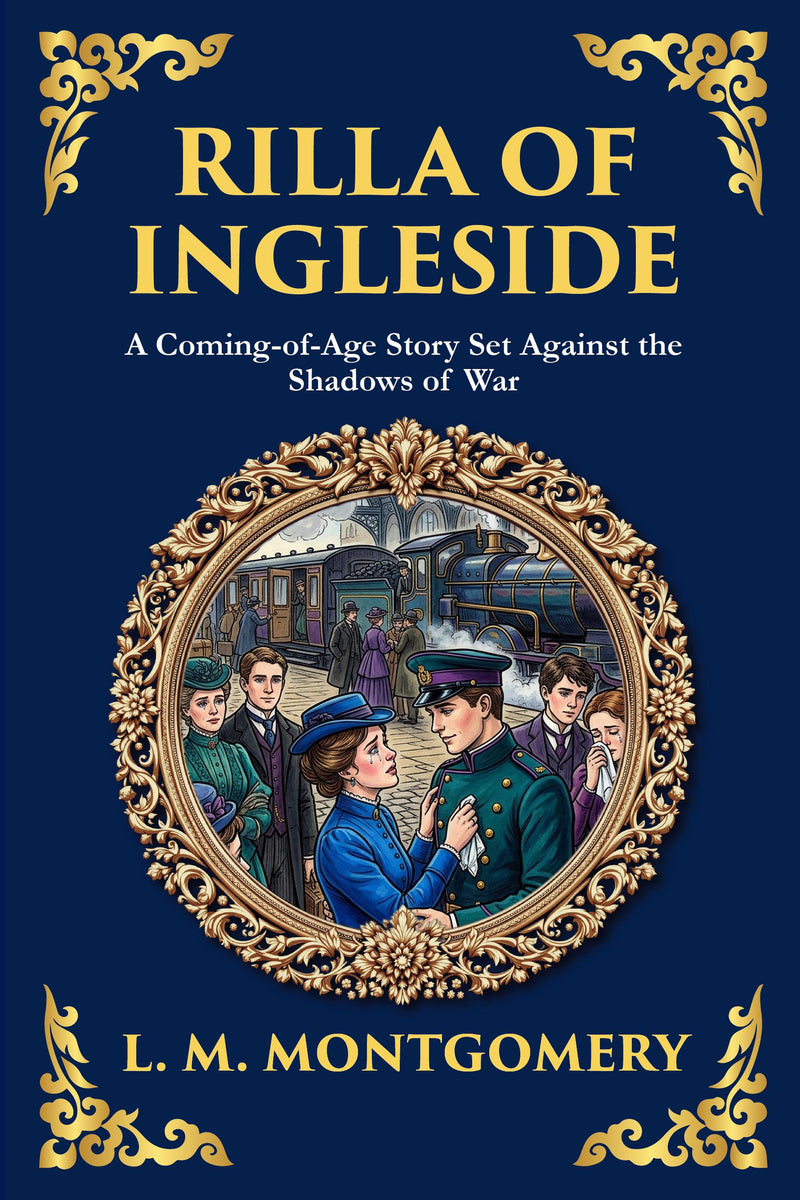
Rilla of Ingleside — Large Print
In the peaceful village of Glen St. Mary, the Great War looms on the horizon—forever changing the lives of those who once believed themselves untouched by history.
or free app
10,000+ hrs library
30-day guarantee
The complete Rilla of Ingleside appears in modern English through Library of Alexandria Press, available online with audiobook narration included for members.
Have you ever wondered why adversity shapes us into who we’re meant to become? In Rilla of Ingleside, L. M. Montgomery masterfully blends personal growth and historical reality into a story as intimate as it is epic. Set during World War I, this novel continues the beloved Anne of Green Gables saga through the eyes of Anne's youngest daughter, Rilla Blythe—a spirited sixteen-year-old who dreams only of parties and pretty gowns until the world turns upside down.
As her brothers enlist and the tides of war reach even the quiet shores of Prince Edward Island, Rilla must face challenges she never expected. Left behind to tend to her family and village, she discovers that heroism doesn’t always wear a uniform. Sometimes, it takes the form of compassion, persistence, and emotional resilience.
Through heartbreak, responsibility, and her own awakening, Rilla's journey becomes a deeply human account of what it means to grow up while the world is at war. L. M. Montgomery’s timeless storytelling gently guides readers through the emotions of loss and love, pride and fear, all within the vivid beauty of the Canadian home front.
What you’ll discover in this modern edition
- A Coming-of-Age Story Like No Other Follow Rilla’s transformation from girlhood to womanhood against the backdrop of global upheaval.
- A Wartime Novel From a Woman’s Perspective See how Montgomery gives voice to the emotional and domestic impact of war often left untold.
- Themes of Duty, Love, and Growth Discover how responsibility and compassion can forge a deeper kind of bravery.
- A Continuation of the Anne of Green Gables Legacy Featuring familiar faces from Ingleside and introducing unforgettable new characters.
- A Poignant Portrait of the Canadian Home Front Experience the subtle and seismic shifts that shaped communities during World War I.
| Formats | eBook (EPUB + PDF) · Audiobook · Paperback · Hardcover · Large Print |
| Language | English |
| Trim size (print) | 6 × 9 in |
| Binding | Paperback — perfect-bound · Hardcover — casewrap |
| Large Print edition | Same text in a larger, easy-read type — a larger font, not a larger trim |
| Print pricing | Every physical book at our true cost — at-cost, no profit (members) |
| Library | 873 restored titles, always growing |
| Length | 105,718 words · ~7 hr 3 min reading |
| Reading level | Grade 7 · an easy, flowing read (this modern-English edition) |
| Edition | Modern English translation · 2026 |
Member reviews for this edition are collected as readers finish it — be the first. Across the library: 12,000+ books shipped, every plan covered by a 365-day print guarantee.
About this edition
A faithful, unabridged modern-English edition by The Library of Alexandria — carefully rendered for today's reader and verified paragraph-by-paragraph against the public-domain source. Available as eBook, audiobook, paperback, hardcover, and large print.
- Complete & unabridgedVerified paragraph by paragraph against the source — never a scan, never abridged.
- Modern English, faithfulReadable today, with the author’s meaning kept intact. Readable — not simplified.
- Every format, one membershipRead in your browser or the free app, or listen to the full audiobook.
Included free with your membership
Cancel anytime, one click · 30-day money-back guarantee
Edition last updated July 2026
What’s inside
Rilla of Ingleside — Large Print — complete and unabridged: all 36 sections included with membership, plus the full audiobook.
Begin reading Rilla of Ingleside — Large Print
In clear modern English — the complete text is included with membership.
Introduction
There are books that entertain us, books that instruct us, and a rare few that seem to grow alongside us, revealing new depths each time we return to them. The novel you are about to read belongs to that rarest category. First published in 1921, it arrived in the immediate aftermath of a conflict that had reshaped the world, and it carries within its pages something that few works of fiction from that era managed to capture so honestly: the texture of how ordinary lives are altered, quietly and irrevocably, by events far beyond their control. This is a story about a young woman on the threshold of adulthood, about a family weathering a storm that touches every corner of their household, and about a small, beloved community discovering reserves of courage it never knew it possessed.
For readers who have followed the beloved chronicles of a certain red-haired girl who once arrived by mistake at a farmhouse on Prince Edward Island, this book offers a poignant and powerful conclusion to a saga that has enchanted generations. But for newcomers, there is no cause for hesitation. While this novel stands as the final installment in a celebrated series, it is also a complete and self-contained work, fully capable of being read and treasured on its own terms. The author’s gift was always for the universal—the small joys and aches of family life, the bittersweet passage from childhood into maturity, the way love and loss are woven inseparably together. Those themes need no prior introduction to land with full force.
What you hold in your hands is a modern translation, an adaptation prepared with great care for the contemporary reader. Before we explore what makes this story so enduring, it is worth pausing to consider what that phrase means and why such a project matters.
When a book has lived for more than a century, it accumulates a certain patina. The language of 1921 was, in many respects, the language of a world that no longer exists. Sentence rhythms were slower and more ornate. Vocabulary that was common in everyday conversation has since faded from use. References to fashions, household objects, social customs, and turns of phrase that the original audience absorbed without a second thought can now bring a modern reader up short, requiring a mental footnote or a moment of puzzlement that interrupts the spell of the story.
This edition has been thoughtfully adapted to smooth those obstacles away while preserving everything that makes the work itself irreplaceable. The aim of a good modern adaptation is never to “improve” upon a master or to impose a contemporary sensibility where it does not belong. Rather, it is to act as a clear pane of glass between the reader and the author’s vision—to remove the accumulated dust of a century so that the story can be seen as vividly as the day it was written. Archaic constructions have been gently updated. Sentences that once meandered for the pleasure of meandering have been clarified. Words that have shifted their meaning over the decades, or vanished entirely, have been rendered in language that today’s reader will understand intuitively.
What has not changed is the heart of the thing. The emotional truth of every scene, the distinct voice of every character, the wit and warmth and quiet sorrow that pulse beneath the surface—these remain wholly intact. The author was a writer of extraordinary sensitivity, capable of making a reader laugh aloud on one page and weep on the next, and that power survives this careful transition undiminished. If anything, by clearing away the barriers of dated phrasing, the adaptation allows the emotional currents of the book to flow more freely, reaching the reader with the same immediacy they would have possessed for an audience a hundred years ago.
There is a particular reason this matters for the book before you. Unlike the lighter, sunnier installments that came earlier in the series—stories full of childhood mischief, schoolgirl scrapes, romantic misunderstandings, and the gentle comedy of small-town life—this is a work of unusual gravity. It was written by an author processing, in real time, the consequences of a global catastrophe. Its emotional stakes are higher, its sorrows more profound, its triumphs more hard-won. To read it as the author intended is to feel the full weight of those stakes. A modern translation ensures that nothing dilutes that experience; that the reader is not held at arm’s length by unfamiliar idioms but is instead drawn fully into the lives of the characters, sharing their hopes and fears as if they were one’s own family.
It is also worth noting that this novel occupies a unique place in the history of literature about the period it depicts. It is widely regarded as one of the very few contemporary accounts—written by a woman, from the perspective of the home front—to grapple seriously with the human cost of the era on the lives of those who waited and watched and worked while the world held its breath. So much of the literature of that time was written from the trenches, from the perspective of those who fought. This book turns its gaze instead upon the kitchens and gardens, the parlors and sewing circles, the front porches and the bedrooms where mothers and sisters and sweethearts kept vigil. It gives voice to an experience that history has too often overlooked: the war fought not with weapons but with patience, sacrifice, and an almost unbearable endurance. That perspective makes the book not merely a charming piece of fiction but a genuinely important historical and emotional document—and the modern adaptation helps deliver that significance to readers who might otherwise find the original’s period style a barrier to entry.
A Heroine for the Ages and the World She Inhabits
At the center of this story stands a young woman just stepping out of girlhood. When we first meet her, she is fifteen years old—vain in the harmless way of the young, a little spoiled, more interested in parties and pretty dresses and the attentions of admiring boys than in anything resembling responsibility. She has never been to school in the conventional sense, has never had to work for anything, and dreams chiefly of having a wonderful time. She is, in short, exactly the sort of heroine who has the furthest possible distance to travel—and watching her travel it is one of the great pleasures of this book.
The genius of the author’s characterization lies in how completely believable this transformation is. There is nothing forced or preachy about the heroine’s growth. She does not wake up one morning suddenly wise and selfless. Instead, life happens to her, as it happens to all of us, and she rises to meet it in fits and starts, with stumbles and setbacks and moments of pure, unguarded humanity. She makes mistakes. She feels sorry for herself. She wants things she cannot have and grieves for things she cannot keep. And through it all, almost without realizing it, she becomes something extraordinary: a woman of substance, capable of carrying burdens she could never have imagined, capable of love and sacrifice on a scale that would have seemed impossible to the carefree girl we met at the start.
This is, at its core, a coming-of-age story—perhaps one of the finest ever written. The events that unfold over the course of the narrative compress years of growth into an intense, transformative period. We watch as the heroine learns to manage a household, to comfort the grieving, to keep faith in the face of dreadful uncertainty, and to find purpose in the small daily acts of caring for others. One of the most charming and unexpected threads in the entire book involves her taking on a responsibility she never sought and cannot refuse—a domestic, deeply human commitment that becomes a kind of running counterpoint to the larger drama, grounding the story in the immediate and the tangible even as the wider world seems to spin out of control. Without revealing the particulars, suffice it to say that this thread provides some of the book’s most tender, funny, and ultimately moving passages, and it serves as a perfect mirror for the heroine’s own journey from carelessness to devotion.
Surrounding her is a richly drawn cast of family and neighbors, each rendered with the affectionate precision that was the author’s hallmark. There is the mother whose grace under pressure becomes a quiet model of dignity. There are the brothers and sisters, each facing the demands of the moment in their own way—some with eagerness, some with reluctance, all with a courage that reveals itself differently in each. There are the wise and humorous elders of the household whose tart commentary and steadfast presence provide both comic relief and emotional ballast. And there is the wider community of the village and its surroundings, a tapestry of personalities both endearing and exasperating, whose collective response to the crisis at hand forms a kind of chorus throughout the narrative.
Special mention must be made of one figure in particular—a household servant of fierce loyalty and even fiercer opinions, whose pronouncements on the state of the world, delivered with absolute conviction and a complete disregard for fact or fashion, provide some of the most delicious humor in all of literature from this period. In a book that contains so much sorrow, the presence of such characters is no accident. The author understood, with deep wisdom, that human beings do not stop being funny, petty, proud, or absurd simply because terrible things are happening around them. Indeed, it is precisely in the darkest times that the small comedies of daily life take on their greatest poignancy. Laughter and tears live side by side on every page of this book, just as they do in real life, and the result is a portrait of human experience that feels astonishingly true.
The setting itself deserves attention, for it is very nearly a character in its own right. The landscape of the island—its red roads and green fields, its harbors and woods, its gardens heavy with flowers and its skies that seem to stretch on forever—is rendered with such loving detail that the reader comes to feel as though they have lived there too. This is a place of deep beauty and deep roots, where families have known one another for generations, where the rhythms of the seasons and the church bell and the harvest still order the days. Against this backdrop of timeless peace, the intrusion of distant, world-shaking events feels all the more shocking and all the more sorrowful. The contrast between the lush, gentle world of the island and the dark machinery of conflict half a world away is one of the book’s most powerful effects, and it gives the story much of its emotional charge.
It is this combination—a beloved, idyllic place; a vivid, fully realized family; a heroine of immense charm and growing depth; and the slow encroachment of forces that will test them all—that makes the novel so unforgettable. We care about these people. We want them to be safe and happy. And because the author has made us care so deeply, every development in their fortunes lands with real weight. This is storytelling of the highest order, the kind that does not merely pass the time but stays with the reader long after the final page is turned.
How to Read This Book, and What It Offers
A few words of guidance may help you get the most from the experience that awaits you.
First, allow yourself to settle into the world slowly. The opening chapters move at the leisurely pace of a summer afternoon, introducing the family and the community, establishing the rhythms of life as they have always been. Some modern readers, accustomed to stories that open with a bang, may be tempted to rush through these early pages. Resist that temptation. The author is doing essential work here, building the foundation upon which everything else will rest. The more fully you come to know and love this world in its untroubled state, the more profoundly you will feel everything that follows. The gentle comedy of these opening sections—the gossip, the romances, the rivalries, the parties—is not filler; it is the establishment of a happiness that makes its later disruption so meaningful.
Cancel anytime, one click · 30-day money-back guarantee
Founding annual rate available now — your price locks for life when you join.
Not ready? Get this free chapter by email — read it anytime.
✓ Sent — check your inbox for Rilla of Ingleside — Large Print.
Questions about Rilla of Ingleside — Large Print
What is Rilla of Ingleside about?
In the peaceful village of Glen St. Mary, the Great War looms on the horizon—forever changing the lives of those who once believed themselves untouched by history. Rilla of Ingleside follows the youngest daughter of Anne Shirley as she blossoms from a carefree girl into a resilient young woman amidst the trials of World War I. When her brothers go off to battle, Rilla is left behind—not just to wait, but to rise.
Who wrote Rilla of Ingleside?
Rilla of Ingleside was written by L. M. Montgomery. This edition presents the complete work in clear modern English, faithfully rendered from the public-domain original by Library of Alexandria Press.
Is Rilla of Ingleside free to read?
The opening chapter is free to read on this page. Members read and listen to the complete work — and the entire library — free, and can order any physical book at our true print cost.
How long is Rilla of Ingleside?
36 chapters (~105,718 words) — about 7 hr 3 min of reading in this modern-English edition.
Is this an abridged version of Rilla of Ingleside?
No. This is the complete, unabridged Rilla of Ingleside, carefully rendered into clear modern English and verified paragraph-by-paragraph against the public-domain source — nothing is cut or summarised.
What formats does Rilla of Ingleside come in?
Rilla of Ingleside is available as eBook, paperback, hardcover and large print. eBook and audiobook are included with membership; printed editions ship at our true print cost.
Shipping & returns
Billing & membership
More from the library


Explore Children's Classics
- Peter and Wendy · J. M. Barrie
- Jack and Jill · Louisa May Alcott
- The Wonderful Wizard of Oz · L. Frank Baum
- Anne of Green Gables · L. M. Montgomery
- The Secret Garden · Frances Hodgson Burnett
- The Tale of Peter Rabbit · Beatrix Potter
- Peter Pan · J. M. Barrie
- The Prince and the Pauper · Mark Twain
- The Red Fairy Book · Andrew Lang
- Old Christmas: from the Sketch Book of Washington Irving · Washington Irving
- A Houseful of Girls · Sarah Tytler
- In the hollow of His hand · Hesba Stretton
- Miss Primrose · Agnes Giberne
- Five Little Peppers and How They Grew · Margaret Sidney
- The Loss of the Swansea: A Story of the Florida Coast · W. L. Alden
- Sky Island · L. Frank Baum
- The Book of Dragons · E. Nesbit
- Wild Animals I Have Known · Ernest Thompson Seton
- Skinny McCord · Percy Keese Fitzhugh
- The Hunniwell Boys and the Platinum Mystery · L. P. Wyman
- Rainbow Valley · L. M. Montgomery
- "Us and Our Donkey" · Amy Le Feuvre
- Dorothy and the Wizard in Oz · L. Frank Baum
- The Home Book of Verse — Volume 4 · Burton Egbert Stevenson
- The Story of Doctor Dolittle · Hugh Lofting
- The Tale of Benjamin Bunny · Beatrix Potter
- Fifty Famous Stories Retold · James Baldwin
- Rilla of Ingleside · L. M. Montgomery
- The House at Pooh Corner · A. A. Milne
- Rich and Humble: A Story for Young People · Oliver Optic
Rilla of Ingleside — Large Print
Rilla of Ingleside — Large Print
A Coming-of-Age Story Set Against the Shadows of War
L. M. Montgomery
Contents
- Introduction
- Chapter 1
- Chapter 2
- Chapter 3
- Chapter 4
- Chapter 5
- Chapter 6
- Chapter 7
- Chapter 8
- Chapter 9
- Chapter 10
- Chapter 11
- Chapter 12
- Chapter 13
- Chapter 14
- Chapter 15
- Chapter 16
- Chapter 17
- Chapter 18
- Chapter 19
- Chapter 20
- Chapter 21
- Chapter 22
- Chapter 23
- Chapter 24
- Chapter 25
- Chapter 26
- Chapter 27
- Chapter 28
- Chapter 29
- Chapter 30
- Chapter 31
- Chapter 32
- Chapter 33
- Chapter 34
- Chapter 35
Introduction
There are books that entertain us, books that instruct us, and a rare few that seem to grow alongside us, revealing new depths each time we return to them. The novel you are about to read belongs to that rarest category. First published in 1921, it arrived in the immediate aftermath of a conflict that had reshaped the world, and it carries within its pages something that few works of fiction from that era managed to capture so honestly: the texture of how ordinary lives are altered, quietly and irrevocably, by events far beyond their control. This is a story about a young woman on the threshold of adulthood, about a family weathering a storm that touches every corner of their household, and about a small, beloved community discovering reserves of courage it never knew it possessed.
For readers who have followed the beloved chronicles of a certain red-haired girl who once arrived by mistake at a farmhouse on Prince Edward Island, this book offers a poignant and powerful conclusion to a saga that has enchanted generations. But for newcomers, there is no cause for hesitation. While this novel stands as the final installment in a celebrated series, it is also a complete and self-contained work, fully capable of being read and treasured on its own terms. The author’s gift was always for the universal—the small joys and aches of family life, the bittersweet passage from childhood into maturity, the way love and loss are woven inseparably together. Those themes need no prior introduction to land with full force.
What you hold in your hands is a modern translation, an adaptation prepared with great care for the contemporary reader. Before we explore what makes this story so enduring, it is worth pausing to consider what that phrase means and why such a project matters.
When a book has lived for more than a century, it accumulates a certain patina. The language of 1921 was, in many respects, the language of a world that no longer exists. Sentence rhythms were slower and more ornate. Vocabulary that was common in everyday conversation has since faded from use. References to fashions, household objects, social customs, and turns of phrase that the original audience absorbed without a second thought can now bring a modern reader up short, requiring a mental footnote or a moment of puzzlement that interrupts the spell of the story.
This edition has been thoughtfully adapted to smooth those obstacles away while preserving everything that makes the work itself irreplaceable. The aim of a good modern adaptation is never to “improve” upon a master or to impose a contemporary sensibility where it does not belong. Rather, it is to act as a clear pane of glass between the reader and the author’s vision—to remove the accumulated dust of a century so that the story can be seen as vividly as the day it was written. Archaic constructions have been gently updated. Sentences that once meandered for the pleasure of meandering have been clarified. Words that have shifted their meaning over the decades, or vanished entirely, have been rendered in language that today’s reader will understand intuitively.
What has not changed is the heart of the thing. The emotional truth of every scene, the distinct voice of every character, the wit and warmth and quiet sorrow that pulse beneath the surface—these remain wholly intact. The author was a writer of extraordinary sensitivity, capable of making a reader laugh aloud on one page and weep on the next, and that power survives this careful transition undiminished. If anything, by clearing away the barriers of dated phrasing, the adaptation allows the emotional currents of the book to flow more freely, reaching the reader with the same immediacy they would have possessed for an audience a hundred years ago.
There is a particular reason this matters for the book before you. Unlike the lighter, sunnier installments that came earlier in the series—stories full of childhood mischief, schoolgirl scrapes, romantic misunderstandings, and the gentle comedy of small-town life—this is a work of unusual gravity. It was written by an author processing, in real time, the consequences of a global catastrophe. Its emotional stakes are higher, its sorrows more profound, its triumphs more hard-won. To read it as the author intended is to feel the full weight of those stakes. A modern translation ensures that nothing dilutes that experience; that the reader is not held at arm’s length by unfamiliar idioms but is instead drawn fully into the lives of the characters, sharing their hopes and fears as if they were one’s own family.
It is also worth noting that this novel occupies a unique place in the history of literature about the period it depicts. It is widely regarded as one of the very few contemporary accounts—written by a woman, from the perspective of the home front—to grapple seriously with the human cost of the era on the lives of those who waited and watched and worked while the world held its breath. So much of the literature of that time was written from the trenches, from the perspective of those who fought. This book turns its gaze instead upon the kitchens and gardens, the parlors and sewing circles, the front porches and the bedrooms where mothers and sisters and sweethearts kept vigil. It gives voice to an experience that history has too often overlooked: the war fought not with weapons but with patience, sacrifice, and an almost unbearable endurance. That perspective makes the book not merely a charming piece of fiction but a genuinely important historical and emotional document—and the modern adaptation helps deliver that significance to readers who might otherwise find the original’s period style a barrier to entry.
A Heroine for the Ages and the World She Inhabits
At the center of this story stands a young woman just stepping out of girlhood. When we first meet her, she is fifteen years old—vain in the harmless way of the young, a little spoiled, more interested in parties and pretty dresses and the attentions of admiring boys than in anything resembling responsibility. She has never been to school in the conventional sense, has never had to work for anything, and dreams chiefly of having a wonderful time. She is, in short, exactly the sort of heroine who has the furthest possible distance to travel—and watching her travel it is one of the great pleasures of this book.
The genius of the author’s characterization lies in how completely believable this transformation is. There is nothing forced or preachy about the heroine’s growth. She does not wake up one morning suddenly wise and selfless. Instead, life happens to her, as it happens to all of us, and she rises to meet it in fits and starts, with stumbles and setbacks and moments of pure, unguarded humanity. She makes mistakes. She feels sorry for herself. She wants things she cannot have and grieves for things she cannot keep. And through it all, almost without realizing it, she becomes something extraordinary: a woman of substance, capable of carrying burdens she could never have imagined, capable of love and sacrifice on a scale that would have seemed impossible to the carefree girl we met at the start.
This is, at its core, a coming-of-age story—perhaps one of the finest ever written. The events that unfold over the course of the narrative compress years of growth into an intense, transformative period. We watch as the heroine learns to manage a household, to comfort the grieving, to keep faith in the face of dreadful uncertainty, and to find purpose in the small daily acts of caring for others. One of the most charming and unexpected threads in the entire book involves her taking on a responsibility she never sought and cannot refuse—a domestic, deeply human commitment that becomes a kind of running counterpoint to the larger drama, grounding the story in the immediate and the tangible even as the wider world seems to spin out of control. Without revealing the particulars, suffice it to say that this thread provides some of the book’s most tender, funny, and ultimately moving passages, and it serves as a perfect mirror for the heroine’s own journey from carelessness to devotion.
Surrounding her is a richly drawn cast of family and neighbors, each rendered with the affectionate precision that was the author’s hallmark. There is the mother whose grace under pressure becomes a quiet model of dignity. There are the brothers and sisters, each facing the demands of the moment in their own way—some with eagerness, some with reluctance, all with a courage that reveals itself differently in each. There are the wise and humorous elders of the household whose tart commentary and steadfast presence provide both comic relief and emotional ballast. And there is the wider community of the village and its surroundings, a tapestry of personalities both endearing and exasperating, whose collective response to the crisis at hand forms a kind of chorus throughout the narrative.
Special mention must be made of one figure in particular—a household servant of fierce loyalty and even fiercer opinions, whose pronouncements on the state of the world, delivered with absolute conviction and a complete disregard for fact or fashion, provide some of the most delicious humor in all of literature from this period. In a book that contains so much sorrow, the presence of such characters is no accident. The author understood, with deep wisdom, that human beings do not stop being funny, petty, proud, or absurd simply because terrible things are happening around them. Indeed, it is precisely in the darkest times that the small comedies of daily life take on their greatest poignancy. Laughter and tears live side by side on every page of this book, just as they do in real life, and the result is a portrait of human experience that feels astonishingly true.
The setting itself deserves attention, for it is very nearly a character in its own right. The landscape of the island—its red roads and green fields, its harbors and woods, its gardens heavy with flowers and its skies that seem to stretch on forever—is rendered with such loving detail that the reader comes to feel as though they have lived there too. This is a place of deep beauty and deep roots, where families have known one another for generations, where the rhythms of the seasons and the church bell and the harvest still order the days. Against this backdrop of timeless peace, the intrusion of distant, world-shaking events feels all the more shocking and all the more sorrowful. The contrast between the lush, gentle world of the island and the dark machinery of conflict half a world away is one of the book’s most powerful effects, and it gives the story much of its emotional charge.
It is this combination—a beloved, idyllic place; a vivid, fully realized family; a heroine of immense charm and growing depth; and the slow encroachment of forces that will test them all—that makes the novel so unforgettable. We care about these people. We want them to be safe and happy. And because the author has made us care so deeply, every development in their fortunes lands with real weight. This is storytelling of the highest order, the kind that does not merely pass the time but stays with the reader long after the final page is turned.
How to Read This Book, and What It Offers
A few words of guidance may help you get the most from the experience that awaits you.
First, allow yourself to settle into the world slowly. The opening chapters move at the leisurely pace of a summer afternoon, introducing the family and the community, establishing the rhythms of life as they have always been. Some modern readers, accustomed to stories that open with a bang, may be tempted to rush through these early pages. Resist that temptation. The author is doing essential work here, building the foundation upon which everything else will rest. The more fully you come to know and love this world in its untroubled state, the more profoundly you will feel everything that follows. The gentle comedy of these opening sections—the gossip, the romances, the rivalries, the parties—is not filler; it is the establishment of a happiness that makes its later disruption so meaningful.
It was a warm, sunny afternoon with golden clouds and a lovely feel. In the large living room at Ingleside, Susan Baker sat down with a sense of grim satisfaction surrounding her. It was four o’clock, and Susan, who had worked without stopping since six that morning, felt she had truly earned an hour to relax and chat. At that moment, Susan was completely happy; everything in the kitchen had gone surprisingly well that day. Dr. Jekyll had not turned into Mr. Hyde, so he hadn’t gotten on her nerves. From her seat, she could see the pride of her life—the bed of peonies she had planted and tended herself. They bloomed more beautifully than any other peony plot in Glen St. Mary ever had or could, with flowers in deep crimson, silvery pink, and a white as pure as winter snow.
Susan was wearing a new black silk blouse, just as fancy as anything Mrs. Marshall Elliott wore, and a white starched apron trimmed with complex crocheted lace five inches wide, along with matching inserts. Because of this, Susan felt the comfortable confidence of a well-dressed woman as she opened her copy of the Daily Enterprise. She prepared to read the Glen “Notes” which, as Miss Cornelia had just told her, took up half a column and mentioned almost everyone at Ingleside. There was a large, black headline on the front page of the Enterprise stating that some Archduke Ferdinand had been assassinated in a place with the strange name of Sarajevo, but Susan didn’t waste time on boring, irrelevant news like that; she was looking for something truly important. Oh, there it was—“Jottings from Glen St. Mary.” Susan settled in eagerly, reading each note aloud to get as much enjoyment from them as possible.
End of the free sample
Keep reading, free
Members read and listen to the complete book — and the entire library. Cancel anytime, one click · 30-day money-back guarantee.