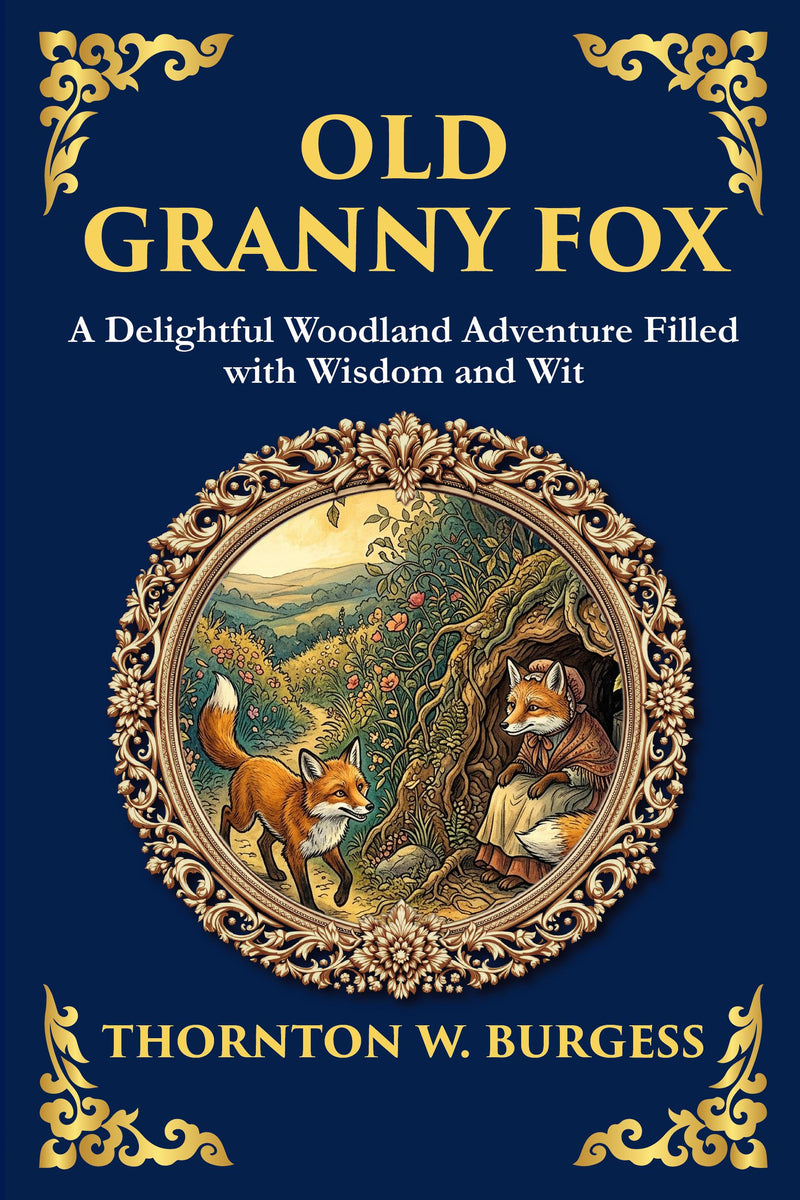
Old Granny Fox
What happens when winter steals the forest's warmth and food becomes scarce? In Old Granny Fox, Thornton W. Burgess weaves a charming yet wise tale of survival, cleverness, and the passing down of life’s lessons.
or free app
10,000+ hrs library
30-day guarantee
The complete Old Granny Fox appears in modern English through Library of Alexandria Press, available online with audiobook narration included for members.
Have you ever wondered why the cleverest creatures are often the ones who’ve lived the longest? First published in 1918, Old Granny Fox remains one of Thornton W. Burgess’s most beloved animal tales—an enchanting story filled with charm, heart, and timeless wisdom. This delightful book introduces young readers to the forest's elder trickster, Old Granny Fox, and her eager but impulsive grandson, Reddy Fox.
When a sudden snowstorm turns the forest into a frozen wasteland, food becomes scarce, and danger lurks around every tree. Reddy, full of bravado and bad habits, wants quick results—but Old Granny knows better. Her years of experience have taught her that cunning, not speed, is what keeps a fox alive in hard times.
Together, the pair must navigate the trials of winter and confront the consequences of pride and impatience. Burgess's style is gentle yet purposeful, lacing every chapter with life lessons, friendship, and joy. With animal characters that reflect real human traits and morals, Old Granny Fox is more than a simple tale—it’s a guidebook for growing up, wrapped in the cozy fur of woodland storytelling.
What you’ll discover in this modern edition
- Old Granny Fox’s Forest Wisdom – Life lessons on patience, planning, and humility told through clever and humorous animal dialogue.
- The Adventures of Reddy Fox – Watch a young fox grow from arrogance to understanding through experience and guidance.
- A World of Talking Animals – Featuring Peter Rabbit, Farmer Brown’s Boy, and other beloved creatures of the Green Meadows.
- Timeless Moral Lessons for All Ages – Burgess masterfully blends entertainment and ethics in every page.
- An Accessible Modern Edition – Lightly updated for today’s young readers while preserving the original charm and illustrations.
| Formats | eBook (EPUB + PDF) · Audiobook · Paperback · Hardcover · Large Print |
| Language | English |
| Trim size (print) | 6 × 9 in |
| Binding | Paperback — perfect-bound · Hardcover — casewrap |
| Large Print edition | Same text in a larger, easy-read type — a larger font, not a larger trim |
| Print pricing | Every physical book at our true cost — at-cost, no profit (members) |
| Library | 873 restored titles, always growing |
| Length | 23,517 words · ~1 hr 34 min reading |
| Reading level | Grade 7 · an easy, flowing read (this modern-English edition) |
| Edition | Modern English translation · 2026 |
Member reviews for this edition are collected as readers finish it — be the first. Across the library: 12,000+ books shipped, every plan covered by a 365-day print guarantee.
About this edition
A faithful, unabridged modern-English edition by The Library of Alexandria — carefully rendered for today's reader and verified paragraph-by-paragraph against the public-domain source. Available as eBook, audiobook, paperback, hardcover, and large print.
- Complete & unabridgedVerified paragraph by paragraph against the source — never a scan, never abridged.
- Modern English, faithfulReadable today, with the author’s meaning kept intact. Readable — not simplified.
- Every format, one membershipRead in your browser or the free app, or listen to the full audiobook.
Included free with your membership
Cancel anytime, one click · 30-day money-back guarantee
Edition last updated July 2026
What’s inside
Old Granny Fox — complete and unabridged: all 30 sections included with membership, plus the full audiobook.
Begin reading Old Granny Fox
In clear modern English — the complete text is included with membership.
Introduction
There is a particular kind of magic that lives in the stories we encounter when we are young—stories that seem simple on their surface, yet leave a lasting imprint on the way we see the world, treat one another, and understand the rhythms of the natural life that surrounds us. The tale you are about to read belongs squarely within this enchanted tradition. It is a story of cleverness and patience, of cold winter days and the quiet drama that unfolds beneath snow-laden branches, and of the perennial contest between hunger and survival that has played out in the woodland and the meadow since long before any human stopped to watch it. More than that, it is a story that invites you to sit at the feet of one of nature’s wiliest and most experienced teachers, and to learn, alongside her young pupil, the lessons that only the wild can offer.
Thornton W. Burgess was a writer who understood, perhaps better than almost any other in the history of children’s literature, that animals make extraordinary storytellers’ companions. Born in 1874 in Sandwich, Massachusetts, on the gentle, marshy reaches of Cape Cod, Burgess grew up in a landscape that would shape the whole of his imaginative life. His father died when he was still an infant, and the family lived modestly, which meant that the young Thornton spent a great deal of his boyhood outdoors—wandering the meadows, exploring the edges of ponds, tracking the small wild creatures whose habits he would later transform into beloved characters. These were not the romanticized woods of fairy tales but real places, observed closely and lovingly, where rabbits really did dash for the safety of the briar patch and foxes really did slink along the edge of the Green Forest with their ears pricked for the slightest sound. This grounding in genuine observation is one of the great quiet strengths of everything Burgess wrote, and it is on full display in the pages that follow.
By the time Burgess began his long and prolific career, he had already worked as an editor and journalist, but it was his gift for spinning bedtime tales that would define his legacy. The story goes that he first began composing animal stories to entertain his young son after the death of the boy’s mother, and what began as a father’s loving improvisation soon blossomed into one of the most remarkable bodies of work in American children’s literature. Over the course of his life, Burgess wrote more than seventy books and an astonishing fifteen thousand or more stories, many of them appearing in a daily newspaper column called “Bedtime Stories” that ran for decades and reached countless homes across the country. Children grew up with his characters the way later generations would grow up with their favorite television friends—except that Burgess’s creatures carried with them an entire education in the workings of the natural world.
What set Burgess apart from so many other writers of animal tales was his refusal to treat nature as a mere backdrop for human-style melodrama. While his characters speak, scheme, worry, and triumph in ways that any reader can recognize and relate to, they never stop being authentically themselves. A fox in a Burgess story behaves like a fox. A rabbit’s fears are a rabbit’s fears, rooted in the genuine dangers of a rabbit’s life. When his animals hunt, hide, dig, sleep, and forage, they do so according to the real habits of their species. Burgess was, in his own gentle way, a conservationist and a naturalist long before such terms were common currency. He believed deeply that if children could come to know and love the wild creatures around them, they would grow into adults who wished to protect rather than destroy them. He even helped establish the practice of Conservation through his writing, and his work was honored by groups dedicated to the preservation of wildlife. To read one of his stories is to receive, almost without noticing, a lesson in ecology and animal behavior wrapped in the irresistible packaging of a good yarn.
This particular tale centers on one of the most enduring figures in the whole of Burgess’s woodland world: a fox of considerable years, considerable experience, and very considerable cunning. In the great tradition of folklore stretching back to Aesop and the medieval beast fables of Reynard, the fox has always been a symbol of intelligence, resourcefulness, and a certain sly self-interest. Burgess inherits all of this tradition but tempers it with warmth and a sense of moral instruction. His elderly fox is not merely clever for cleverness’s sake; she is a survivor, a creature who has lived long precisely because she has learned, through hard experience, how to read the world around her and turn every circumstance to her advantage. And crucially, she is a teacher. Throughout these pages she has a pupil at her side—a younger, more impulsive fox who must learn the patient, careful arts of the hunt and the equally important art of staying alive in a world full of dangers. The relationship between the seasoned elder and the eager young learner gives the story its heart, and it is through their interactions that Burgess weaves his gentle lessons about wisdom, patience, observation, and respect for the hard realities of nature.
The genius of this arrangement is that the reader, too, becomes a pupil. As you follow the older fox’s careful explanations of why she does what she does—why she approaches a meal so cautiously, why she studies the snow before making her move, why she never lets hunger override good judgment—you are absorbing the same knowledge her young companion is meant to absorb. You learn how a fox thinks. You learn what dangers a fox must guard against. You learn the difference between recklessness and calculated risk. And you do all of this while being thoroughly entertained, never lectured, never bored. This is the alchemy that made Burgess so beloved across so many generations: he could teach without ever seeming to teach, slipping real knowledge into your mind through the irresistible side door of a charming story.
The setting of this adventure deserves special mention as well, for the season in which it unfolds carries a particular weight and beauty. Winter in the world of these stories is no gentle thing. It is a time of scarcity, when food is hard to find and the cold presses in from every direction, when the snow records every footprint and the wind carries every scent. For the woodland creatures, winter is the great test, the season that separates the wise from the foolish and the prepared from the careless. Burgess renders this seasonal hardship with real feeling, helping young readers understand that the natural world is not always soft and forgiving, that survival requires effort and intelligence, and that even the most familiar landscape transforms into something challenging and even perilous when the weather turns harsh. There is a quiet honesty in this that respects the reader’s intelligence. Children, after all, are well aware that the world contains difficulty and danger; what they crave is a story that acknowledges these truths while still offering hope, guidance, and the reassurance that wits and courage can carry one through.
The book you hold is a modern translation, carefully adapted for the contemporary reader, and it is worth pausing to explain what this means and why it matters. Thornton Burgess wrote the bulk of his work in the early decades of the twentieth century, and while his prose has a timeless charm, the conventions of language, sentence structure, and certain turns of phrase have inevitably shifted over the more than one hundred years since these stories first appeared. Words that were once everyday have grown unfamiliar; sentence rhythms that once flowed naturally now occasionally feel ornate or roundabout to the modern ear. The purpose of this adaptation is not to replace or diminish Burgess’s voice—far from it. The goal has been to preserve everything that makes his storytelling delightful while gently smoothing the path for today’s readers, particularly the younger ones who are encountering these tales for the very first time.
In practice, this means that the warmth, the wit, the gentle humor, and the careful natural observation that define Burgess’s work remain entirely intact. The personalities of the characters are unchanged. The structure of the adventure, the suspense of the hunt, the satisfaction of clever solutions to difficult problems—all of these are exactly as Burgess intended. What has been refreshed is the surface texture of the language, so that nothing stands between the contemporary reader and the pleasure of the tale. A child reading aloud, or being read to, will find the words flow smoothly off the tongue. A parent sharing these stories at bedtime will not have to pause to explain archaic expressions or untangle convoluted phrasing. The aim throughout has been faithfulness to the spirit of the original combined with accessibility for the present moment—a balance that honors both the author and the audience.
It is also worth noting that Burgess’s stories were, in their original form, often serialized—appearing as a sequence of short, self-contained chapters, each one ending at a moment that left the reader eager for the next installment. This episodic structure makes the books wonderfully suited to being read in small doses, a chapter or two at a time, which is precisely how they were first enjoyed by children waiting for the next day’s newspaper. As you make your way through this adventure, you will notice this satisfying rhythm: each chapter delivers a complete small scene, a problem and its resolution or a moment of suspense and its release, while contributing to the larger arc of the whole. This makes the book ideal for shared reading, for bedtime, for those quiet moments before sleep when a child wants just one more chapter—and then just one more after that. The pacing is gentle but never slack; there is always something happening, always a small mystery to solve or a danger to evade or a clever trick to admire.
For the adult reader returning to Burgess after many years, or discovering him for the first time, there is a particular pleasure to be found in his unhurried, contemplative approach to storytelling. In an age of constant stimulation and breathless plotting, there is something deeply restorative about settling into a tale that takes its time, that pauses to notice the way snow lies on a branch or the way a hungry creature must weigh the risk of a meal against the danger of being seen. Burgess invites us to slow down, to observe, to pay attention to the small dramas that unfold all around us if only we have the patience to watch. In this sense, his stories carry a wisdom that extends far beyond their intended young audience. They remind us that the natural world is endlessly fascinating, that survival is an art, and that intelligence and patience are virtues worth cultivating in any circumstance.
One of the most charming aspects of Burgess’s craft is his use of recurring characters who populate an entire interconnected world. The fox at the center of this tale is part of a vast cast of woodland and meadow personalities who appear and reappear throughout his many books—a community of creatures each with their own distinct temperament, their own particular fears and ambitions, their own place in the great web of the wild. Some are predators, some are prey, and the relationships between them are governed by the same eternal laws that govern real nature. Yet Burgess never simplifies these relationships into a cartoonish battle of good against evil. The fox who hunts is not a villain; she is simply a fox, doing what foxes must do to live. The creatures she pursues are not merely victims; they have their own cleverness, their own strategies for survival, their own moments of triumph. This refusal to assign simple moral labels is one of the most sophisticated and valuable aspects of Burgess’s storytelling, and it teaches young readers a subtle but important truth: that the world is more complicated than a contest between heroes and villains, that every creature has its reasons, and that understanding those reasons is the beginning of real wisdom.
Cancel anytime, one click · 30-day money-back guarantee
Founding annual rate available now — your price locks for life when you join.
Not ready? Get this free chapter by email — read it anytime.
✓ Sent — check your inbox for Old Granny Fox.
Questions about Old Granny Fox
What is Old Granny Fox about?
What happens when winter steals the forest's warmth and food becomes scarce? In Old Granny Fox, Thornton W. Burgess weaves a charming yet wise tale of survival, cleverness, and the passing down of life’s lessons. When harsh snow blankets the Green Meadows, the cunning Old Granny Fox must outwit hunger and outsmart her enemies—not just for herself, but to teach Reddy Fox the importance of patience, planning, and humility.
Who wrote Old Granny Fox?
Old Granny Fox was written by Thornton W. Burgess. This edition presents the complete work in clear modern English, faithfully rendered from the public-domain original by Library of Alexandria Press.
Is Old Granny Fox free to read?
The opening chapter is free to read on this page. Members read and listen to the complete work — and the entire library — free, and can order any physical book at our true print cost.
How long is Old Granny Fox?
30 chapters (~23,517 words) — about 1 hr 34 min of reading in this modern-English edition.
Is this an abridged version of Old Granny Fox?
No. This is the complete, unabridged Old Granny Fox, carefully rendered into clear modern English and verified paragraph-by-paragraph against the public-domain source — nothing is cut or summarised.
What formats does Old Granny Fox come in?
Old Granny Fox is available as eBook, paperback, hardcover and large print. eBook and audiobook are included with membership; printed editions ship at our true print cost.
Shipping & returns
Billing & membership
More from the library


Explore Free eBooks
- Kant's Prolegomena to Any Future Metaphysics · Immanuel Kant
- The Advancement of Learning · Francis Bacon
- The Dawn of Day · Friedrich Nietzsche
- Meditations · Marcus Aurelius
- The Confessions of St. Augustine · Saint Augustine of Hippo
- Resurrection · Leo Tolstoy
- Dialogues Concerning Natural Religion · David Hume
- As You Like It · William Shakespeare
- Jack and Jill · Louisa May Alcott
- Dream Psychology: Psychoanalysis for Beginners · Sigmund Freud
- The Raven · Edgar Allan Poe
- Considerations on Representative Government · John Stuart Mill
- The Will to Power: An Attempted Transvaluation of All Values. Book III and IV · Friedrich Nietzsche
- Tarzan of the Apes · Edgar Rice Burroughs
- Fundamental Principles of the Metaphysic of Morals · Immanuel Kant
- The Confessions of Jean Jacques Rousseau — Complete · Jean-Jacques Rousseau
- The Merchant of Venice · William Shakespeare
- Democracy in America — Volume 2 · Alexis de Tocqueville
- Ecce Homo · Friedrich Wilhelm Nietzsche
- Second Treatise of Government · John Locke
- The Wonderful Wizard of Oz · L. Frank Baum
- The Prince · Niccolò Machiavelli
- Anne of Green Gables · L. M. Montgomery
- De Profundis · Oscar Wilde
- Thus Spake Zarathustra: A Book for All and None · Friedrich Nietzsche
- Anna Karenina · Leo Tolstoy
- Great Expectations · Charles Dickens
- The Island of Doctor Moreau · H. G. Wells
- A Midsummer Night's Dream · William Shakespeare
- The Strange Case of Dr. Jekyll and Mr. Hyde · Robert Louis Stevenson
Old Granny Fox
Old Granny Fox
A Delightful Woodland Adventure Filled with Wisdom and Wit
Thornton W. Burgess
Contents
- Introduction
- Chapter 1
- Chapter 2
- Chapter 3
- Chapter 4
- Chapter 5
- Chapter 6
- Chapter 7
- Chapter 8
- Chapter 9
- Chapter 10
- Chapter 11
- Chapter 12
- Chapter 13
- Chapter 14
- Chapter 15
- Chapter 16
- Chapter 17
- Chapter 18
- Chapter 19
- Chapter 20
- Chapter 21
- Chapter 22
- Chapter 23
- Chapter 24
- Chapter 25
- Chapter 26
- Chapter 27
- Chapter 28
- Chapter 29
Introduction
There is a particular kind of magic that lives in the stories we encounter when we are young—stories that seem simple on their surface, yet leave a lasting imprint on the way we see the world, treat one another, and understand the rhythms of the natural life that surrounds us. The tale you are about to read belongs squarely within this enchanted tradition. It is a story of cleverness and patience, of cold winter days and the quiet drama that unfolds beneath snow-laden branches, and of the perennial contest between hunger and survival that has played out in the woodland and the meadow since long before any human stopped to watch it. More than that, it is a story that invites you to sit at the feet of one of nature’s wiliest and most experienced teachers, and to learn, alongside her young pupil, the lessons that only the wild can offer.
Thornton W. Burgess was a writer who understood, perhaps better than almost any other in the history of children’s literature, that animals make extraordinary storytellers’ companions. Born in 1874 in Sandwich, Massachusetts, on the gentle, marshy reaches of Cape Cod, Burgess grew up in a landscape that would shape the whole of his imaginative life. His father died when he was still an infant, and the family lived modestly, which meant that the young Thornton spent a great deal of his boyhood outdoors—wandering the meadows, exploring the edges of ponds, tracking the small wild creatures whose habits he would later transform into beloved characters. These were not the romanticized woods of fairy tales but real places, observed closely and lovingly, where rabbits really did dash for the safety of the briar patch and foxes really did slink along the edge of the Green Forest with their ears pricked for the slightest sound. This grounding in genuine observation is one of the great quiet strengths of everything Burgess wrote, and it is on full display in the pages that follow.
By the time Burgess began his long and prolific career, he had already worked as an editor and journalist, but it was his gift for spinning bedtime tales that would define his legacy. The story goes that he first began composing animal stories to entertain his young son after the death of the boy’s mother, and what began as a father’s loving improvisation soon blossomed into one of the most remarkable bodies of work in American children’s literature. Over the course of his life, Burgess wrote more than seventy books and an astonishing fifteen thousand or more stories, many of them appearing in a daily newspaper column called “Bedtime Stories” that ran for decades and reached countless homes across the country. Children grew up with his characters the way later generations would grow up with their favorite television friends—except that Burgess’s creatures carried with them an entire education in the workings of the natural world.
What set Burgess apart from so many other writers of animal tales was his refusal to treat nature as a mere backdrop for human-style melodrama. While his characters speak, scheme, worry, and triumph in ways that any reader can recognize and relate to, they never stop being authentically themselves. A fox in a Burgess story behaves like a fox. A rabbit’s fears are a rabbit’s fears, rooted in the genuine dangers of a rabbit’s life. When his animals hunt, hide, dig, sleep, and forage, they do so according to the real habits of their species. Burgess was, in his own gentle way, a conservationist and a naturalist long before such terms were common currency. He believed deeply that if children could come to know and love the wild creatures around them, they would grow into adults who wished to protect rather than destroy them. He even helped establish the practice of Conservation through his writing, and his work was honored by groups dedicated to the preservation of wildlife. To read one of his stories is to receive, almost without noticing, a lesson in ecology and animal behavior wrapped in the irresistible packaging of a good yarn.
This particular tale centers on one of the most enduring figures in the whole of Burgess’s woodland world: a fox of considerable years, considerable experience, and very considerable cunning. In the great tradition of folklore stretching back to Aesop and the medieval beast fables of Reynard, the fox has always been a symbol of intelligence, resourcefulness, and a certain sly self-interest. Burgess inherits all of this tradition but tempers it with warmth and a sense of moral instruction. His elderly fox is not merely clever for cleverness’s sake; she is a survivor, a creature who has lived long precisely because she has learned, through hard experience, how to read the world around her and turn every circumstance to her advantage. And crucially, she is a teacher. Throughout these pages she has a pupil at her side—a younger, more impulsive fox who must learn the patient, careful arts of the hunt and the equally important art of staying alive in a world full of dangers. The relationship between the seasoned elder and the eager young learner gives the story its heart, and it is through their interactions that Burgess weaves his gentle lessons about wisdom, patience, observation, and respect for the hard realities of nature.
The genius of this arrangement is that the reader, too, becomes a pupil. As you follow the older fox’s careful explanations of why she does what she does—why she approaches a meal so cautiously, why she studies the snow before making her move, why she never lets hunger override good judgment—you are absorbing the same knowledge her young companion is meant to absorb. You learn how a fox thinks. You learn what dangers a fox must guard against. You learn the difference between recklessness and calculated risk. And you do all of this while being thoroughly entertained, never lectured, never bored. This is the alchemy that made Burgess so beloved across so many generations: he could teach without ever seeming to teach, slipping real knowledge into your mind through the irresistible side door of a charming story.
The setting of this adventure deserves special mention as well, for the season in which it unfolds carries a particular weight and beauty. Winter in the world of these stories is no gentle thing. It is a time of scarcity, when food is hard to find and the cold presses in from every direction, when the snow records every footprint and the wind carries every scent. For the woodland creatures, winter is the great test, the season that separates the wise from the foolish and the prepared from the careless. Burgess renders this seasonal hardship with real feeling, helping young readers understand that the natural world is not always soft and forgiving, that survival requires effort and intelligence, and that even the most familiar landscape transforms into something challenging and even perilous when the weather turns harsh. There is a quiet honesty in this that respects the reader’s intelligence. Children, after all, are well aware that the world contains difficulty and danger; what they crave is a story that acknowledges these truths while still offering hope, guidance, and the reassurance that wits and courage can carry one through.
The book you hold is a modern translation, carefully adapted for the contemporary reader, and it is worth pausing to explain what this means and why it matters. Thornton Burgess wrote the bulk of his work in the early decades of the twentieth century, and while his prose has a timeless charm, the conventions of language, sentence structure, and certain turns of phrase have inevitably shifted over the more than one hundred years since these stories first appeared. Words that were once everyday have grown unfamiliar; sentence rhythms that once flowed naturally now occasionally feel ornate or roundabout to the modern ear. The purpose of this adaptation is not to replace or diminish Burgess’s voice—far from it. The goal has been to preserve everything that makes his storytelling delightful while gently smoothing the path for today’s readers, particularly the younger ones who are encountering these tales for the very first time.
In practice, this means that the warmth, the wit, the gentle humor, and the careful natural observation that define Burgess’s work remain entirely intact. The personalities of the characters are unchanged. The structure of the adventure, the suspense of the hunt, the satisfaction of clever solutions to difficult problems—all of these are exactly as Burgess intended. What has been refreshed is the surface texture of the language, so that nothing stands between the contemporary reader and the pleasure of the tale. A child reading aloud, or being read to, will find the words flow smoothly off the tongue. A parent sharing these stories at bedtime will not have to pause to explain archaic expressions or untangle convoluted phrasing. The aim throughout has been faithfulness to the spirit of the original combined with accessibility for the present moment—a balance that honors both the author and the audience.
It is also worth noting that Burgess’s stories were, in their original form, often serialized—appearing as a sequence of short, self-contained chapters, each one ending at a moment that left the reader eager for the next installment. This episodic structure makes the books wonderfully suited to being read in small doses, a chapter or two at a time, which is precisely how they were first enjoyed by children waiting for the next day’s newspaper. As you make your way through this adventure, you will notice this satisfying rhythm: each chapter delivers a complete small scene, a problem and its resolution or a moment of suspense and its release, while contributing to the larger arc of the whole. This makes the book ideal for shared reading, for bedtime, for those quiet moments before sleep when a child wants just one more chapter—and then just one more after that. The pacing is gentle but never slack; there is always something happening, always a small mystery to solve or a danger to evade or a clever trick to admire.
For the adult reader returning to Burgess after many years, or discovering him for the first time, there is a particular pleasure to be found in his unhurried, contemplative approach to storytelling. In an age of constant stimulation and breathless plotting, there is something deeply restorative about settling into a tale that takes its time, that pauses to notice the way snow lies on a branch or the way a hungry creature must weigh the risk of a meal against the danger of being seen. Burgess invites us to slow down, to observe, to pay attention to the small dramas that unfold all around us if only we have the patience to watch. In this sense, his stories carry a wisdom that extends far beyond their intended young audience. They remind us that the natural world is endlessly fascinating, that survival is an art, and that intelligence and patience are virtues worth cultivating in any circumstance.
One of the most charming aspects of Burgess’s craft is his use of recurring characters who populate an entire interconnected world. The fox at the center of this tale is part of a vast cast of woodland and meadow personalities who appear and reappear throughout his many books—a community of creatures each with their own distinct temperament, their own particular fears and ambitions, their own place in the great web of the wild. Some are predators, some are prey, and the relationships between them are governed by the same eternal laws that govern real nature. Yet Burgess never simplifies these relationships into a cartoonish battle of good against evil. The fox who hunts is not a villain; she is simply a fox, doing what foxes must do to live. The creatures she pursues are not merely victims; they have their own cleverness, their own strategies for survival, their own moments of triumph. This refusal to assign simple moral labels is one of the most sophisticated and valuable aspects of Burgess’s storytelling, and it teaches young readers a subtle but important truth: that the world is more complicated than a contest between heroes and villains, that every creature has its reasons, and that understanding those reasons is the beginning of real wisdom.
Who would ever say no To someone bringing happy news? —Old Granny Fox.
Snow covered the Green Meadows and the Green Forest, and ice locked the Smiling Pool and the Laughing Brook. Reddy and Granny Fox were hungry most of the time. It was hard to find enough to eat these days, so they spent almost every waking minute hunting. Sometimes they hunted together, but usually they split up to increase their chances of finding something. If one of them found enough for both, they brought the food home if it was portable. If not, they told the other where to find it.
For several days, they had barely eaten anything. They were so hungry that they were willing to take almost any risk for a good meal. For two nights, they had visited Farmer Brown’s henhouse, hoping to find a way inside. But the hens had been locked up securely, and no matter how hard they tried, they couldn’t get in.
“It’s no use,” Granny said as they headed home after their second attempt. “We can’t hope to get one of those hens at night. If we’re going to get any at all, we’ll have to do it in broad daylight. It can be done—I’ve done it before—but I don’t like the idea. We’re more likely to be seen, and that means Bowser the Hound will be sent after us.”
“Pfft!” Reddy exclaimed. “So what? It’s easy enough to fool him.”
“You think so, do you?” Granny snapped. “I’ve never met a young fox who didn’t think he knew everything, and you’re just like the rest. When you’ve lived as long as I have, you’ll learn not to be so sure of yourself. I’ll admit that when there’s no snow on the ground, any fox with a bit of common sense can fool Bowser. But with snow everywhere, it’s a completely different story. If Bowser decides to follow your trail these days, you’ll have to be smarter than I think you are to trick him. The only way you’ll get away is by hiding in a hole, and if you do that, you’ll give away a secret that will cost us our peace. We’ll never know when Farmer Brown’s boy will decide to smoke us out. I’ve seen it happen. No, sir, we are not trying for those hens during the day unless we are literally starving.”
End of the free sample
Keep reading, free
Members read and listen to the complete book — and the entire library. Cancel anytime, one click · 30-day money-back guarantee.