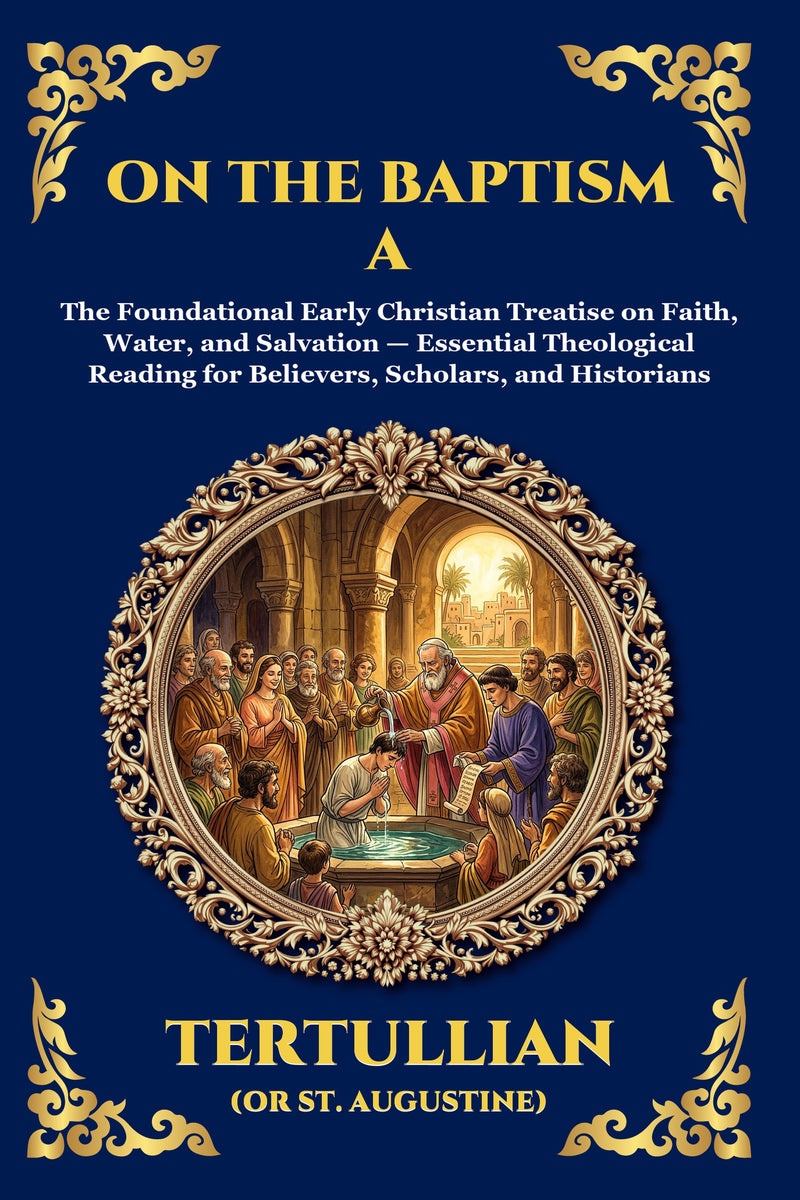
On the Baptism A — Large Print
Tertullian's On Baptism elevates water as a divine instrument of grace and spiritual rebirth, countering skeptics who dismissed physical elements of faith. This foundational treatise shaped early Christian theology, defining baptism as essential to salvation during a time when the church defended its core doctrines.
or free app
10,000+ hrs library
30-day guarantee
On the Baptism A by Tertullian of Carthage offers a complete modern-English translation available for online reading, with included audiobook narration accessible through membership.
What does a broken text reveal about water, faith, and the search for salvation?
On the Baptism A is a short, damaged teaching on baptism from the Nag Hammadi library. Its author is unknown. Scholars connect it with the Valentinian school, a Christian movement that links salvation with knowledge: a deep recognition of who a person is and where they come from.
The text survives in Coptic in a fourth-century papyrus codex found in Egypt. Alongside a Valentinian Exposition and companion pieces on anointing and the Eucharist, it offers a glimpse of a community's religious life. Read it to explore how this school understands baptism, while keeping the fragment's gaps and limits in view.
Inside this book
- Water and spiritual meaning – Explore baptism through a brief teaching concerned with what the rite means for a believer.
- A Valentinian perspective – Encounter a Christian school that connects salvation with knowledge of the self and its origins.
- A fragment's limits – Meet a short, broken text rather than a long argument with every step intact.
- A wider ritual setting – Consider baptism beside the companion teachings on anointing and the Eucharist in the same codex.
- Beyond the biblical canon – Explore a teaching outside Christian scripture, associated with a school opposed by some church leaders.
Perfect for readers curious about early Christian understandings of baptism and students of the Nag Hammadi books who welcome a brief, incomplete text.
Open the first page now and encounter this small surviving piece of early Christian thought.
| Formats | eBook (EPUB + PDF) · Audiobook · Paperback · Hardcover · Large Print |
| Language | English |
| Trim size (print) | 6 × 9 in |
| Binding | Paperback — perfect-bound · Hardcover — casewrap |
| Large Print edition | Same text in a larger, easy-read type — a larger font, not a larger trim |
| Print pricing | Every physical book at our true cost — at-cost, no profit (members) |
| Library | 873 restored titles, always growing |
| Composed | c. 200-206 AD |
| Original language | Latin |
| Source tradition | Latin manuscript tradition |
| Translation basis | Public-domain scholarly translation, rendered in clear modern English |
| Length | 3,800 words · ~15 min reading |
| Reading level | Grade 15 · rich, literary prose (this modern-English edition) |
| Edition | Modern English translation · 2026 |
Member reviews for this edition are collected as readers finish it — be the first. Across the library: 12,000+ books shipped, every plan covered by a 365-day print guarantee.
About this edition
The complete, unabridged text in clear modern English — faithful to the original, never simplified. Every paragraph is checked against the source, so nothing is cut, summarised, or paraphrased away. It reads cleanly for today while keeping the original meaning intact.
On Baptism survives through Latin manuscript tradition from late antiquity. This edition derives from the standard public-domain scholarly translation and renders it in clear modern English.
- Complete & unabridgedVerified paragraph by paragraph against the source — never a scan, never abridged.
- Modern English, faithfulReadable today, with the author’s meaning kept intact. Readable — not simplified.
- Every format, one membershipRead in your browser or the free app, or listen to the full audiobook.
Included free with your membership
Cancel anytime, one click · 30-day money-back guarantee
Edition last updated June 2026
What’s inside
On the Baptism A — Large Print — complete and unabridged, included in full with membership, plus the full audiobook.
Begin reading On the Baptism A — Large Print
In clear modern English — the complete text is included with membership.
On the Baptism A
Introduction
On the Baptism A
Introduction
There are moments in the history of human thought when a single document changes everything — not through the grandeur of its scope or the celebrity of its author, but through the sheer precision of its argument and the urgency of the questions it dares to ask. The treatise you are about to read is one of those documents. Written in the early centuries of the Christian era, it arrives from a world on fire with theological controversy, a world in which the most fundamental questions about what it meant to be a Christian were being hammered out not in comfortable seminar rooms but in crowded house churches, in the margins of persecuted communities, and in the minds of brilliant, passionate thinkers who understood that the stakes were nothing less than eternal. To read this text today is to step into that world — to feel the heat of its debates, to hear the voices of its participants, and to discover that the questions they were wrestling with have never entirely gone away.
At the heart of this work lies a deceptively simple subject: water. Specifically, the water of baptism — that ancient ritual act by which men and women were initiated into the Christian community, marked as belonging to a new order of existence, and declared to have passed from one kind of life into another. But as you will quickly discover, nothing about this subject is actually simple. Water, in the hands of the treatise's author, becomes a lens through which the entire architecture of Christian theology is examined and defended. Questions about the nature of salvation, the role of the Holy Spirit, the meaning of faith, the authority of the church, the interpretation of scripture, and the relationship between the physical and the spiritual are all brought to bear on this one act, this one moment of immersion or pouring, this one encounter between a human body and the elemental substance that covers most of our planet and sustains all of our lives.
To appreciate the full weight of what you are about to read, it helps to understand something of the world in which it was written. The early Christian movement was, from its very beginnings, a profoundly diverse phenomenon. Across the Mediterranean basin and beyond, communities of believers had formed around the proclamation of Jesus of Nazareth as the risen Lord, but they differed enormously in their practices, their interpretations, and their understandings of what that proclamation actually required of those who accepted it. By the second and third centuries, these differences had crystallized into genuine theological conflicts — conflicts that were not merely academic but intensely practical, because they bore directly on who could be considered a genuine Christian, who had the authority to perform the rites of initiation, and what those rites actually accomplished.
The particular controversy that animates this treatise is one that modern readers might initially find obscure but will quickly recognize as surprisingly contemporary. There were those in the early Christian world — loosely grouped under the broad and contested label of Gnostics — who argued that the physical act of baptism was essentially irrelevant to genuine spiritual transformation. What mattered, they insisted, was not the water but the knowledge, not the external ritual but the internal illumination. Water, after all, was a material substance, and for many of these thinkers, the material world was itself either fallen, corrupt, or simply inferior to the realm of pure spirit. Why would the God of all creation require his children to get wet in order to be saved? The very idea seemed to them not only philosophically unsophisticated but spiritually dangerous — a confusion of the physical and the spiritual that could only lead believers astray.
Against this position, the author of this treatise mounts a defense of baptism that is as philosophically sophisticated as anything produced by its opponents — and considerably more grounded in the lived experience of actual Christian communities. The argument is not simply that baptism is required because the church says so, or because certain scriptural texts seem to demand it. The argument is far more interesting than that. It is an argument about the nature of creation itself, about the relationship between matter and spirit, about the way in which God has always worked through physical realities to accomplish spiritual ends. It is, in other words, a deeply incarnational argument — one that takes seriously the claim that the God who made the world also entered it, and that this entry into matter sanctified matter in ways that have permanent and ongoing consequences for how we understand salvation.
The author's method is as impressive as the argument itself. Moving with remarkable fluency between the Hebrew scriptures and the emerging Christian writings, drawing on natural philosophy, engaging with the specific claims of rival teachers, and never losing sight of the pastoral concerns of ordinary believers, the treatise demonstrates a quality of mind that is at once rigorously analytical and deeply humane. This is not a writer who is interested only in winning arguments. This is a writer who is genuinely concerned about the spiritual welfare of the people who will read these words — who understands that theological error is not merely an intellectual failure but a spiritual danger, and who brings to the task of correction both the precision of a trained rhetorician and the warmth of a pastor who actually cares about his flock.
For modern readers coming to this text for the first time, there may be a temptation to approach it as a purely historical document — a fascinating artifact of an ancient world that has little direct relevance to contemporary concerns. This temptation should be resisted. The questions that animate this treatise are questions that continue to divide Christian communities today. The relationship between faith and practice, between internal conviction and external observance, between the individual's private spiritual experience and the communal life of the church — these are not settled questions. They are live questions, contested questions, questions that generate genuine disagreement among thoughtful and sincere believers across all the major Christian traditions. To read this ancient text is not to travel to a foreign country from which one returns unchanged. It is to discover that the country you thought was foreign is actually your own, seen from an unfamiliar angle that suddenly makes everything look different.
There is also, for those who approach this text from a scholarly rather than a devotional perspective, an extraordinary richness of historical and cultural material to engage with. The treatise offers a window into the liturgical practices of early Christian communities that is almost unparalleled in its specificity and detail. We learn about the timing of baptisms, the preparation required of candidates, the role of different ministers in the rite, the significance of different locations and types of water, and the relationship between baptism and other ritual acts. This material is invaluable for historians of early Christianity, for liturgical scholars, and for anyone interested in the concrete, embodied ways in which ancient people gave expression to their deepest convictions about the nature of reality and their place within it.
But perhaps the most remarkable thing about this treatise — and the thing that will strike most readers most forcefully as they work through its pages — is the sheer energy of its engagement with ideas. This is a text written by someone who finds theological questions genuinely exciting, who approaches the mysteries of faith not with the weary resignation of someone performing an obligatory duty but with the barely contained enthusiasm of someone who has discovered something wonderful and cannot wait to share it. That enthusiasm is contagious. It has been contagious for nearly two thousand years, across cultures and languages and theological traditions that the author could never have imagined. And it remains contagious today, in an age that often seems to have lost its capacity for the kind of serious, sustained engagement with ultimate questions that this text models so magnificently.
The World That Shaped This Text
To read any ancient text well, you need to know something about the world that produced it. In the case of this treatise, that world is one of the most fascinating and turbulent in the entire history of Western civilization. The second and third centuries of the Common Era were a period of extraordinary intellectual ferment across the Mediterranean basin. The old certainties of classical paganism were eroding under the pressure of philosophical skepticism, eastern mystery religions, and the growing influence of monotheistic traditions from the Middle East. Rome had conquered the world militarily, but the world was conquering Rome culturally, and the result was a civilization in the process of profound and sometimes violent self-transformation.
Into this world, the Christian movement had arrived with a message that was simultaneously deeply Jewish and radically new. The proclamation that the God of Israel had acted definitively in the life, death, and resurrection of a Galilean carpenter to inaugurate a new age of human history was a claim that required enormous intellectual work to articulate, defend, and develop. The early Christians were not, as they are sometimes caricatured, simple peasants who believed things without thinking about them. Many of them were highly educated, deeply familiar with the philosophical traditions of the Greek and Roman worlds, and entirely capable of engaging with the most sophisticated intellectual challenges of their day. The author of this treatise is a superb example of this type — someone who has clearly received a thorough education in rhetoric and philosophy and who brings those tools to bear on theological questions with impressive skill.
The specific intellectual context that matters most for understanding this text is the complex and contested phenomenon known as Gnosticism. This is a term that scholars have debated endlessly, and for good reason — it covers an enormous variety of movements, teachers, and texts that differ from one another in important ways. But at the risk of oversimplification, we can say that Gnostic thinkers generally shared a tendency to privilege spiritual knowledge over material practice, to view the material world with suspicion or outright hostility, and to interpret the Christian message in ways that minimized or eliminated the significance of physical realities like bodies, rituals, and history. For these thinkers, the true Christian was the one who possessed the secret knowledge — the gnosis — that revealed the divine spark hidden within the human soul and showed the way back to the realm of pure spirit from which it had fallen.
The appeal of this vision was considerable, and it would be a mistake to dismiss it as simply perverse or stupid. In a world full of suffering, in which the material realm seemed to offer little but pain, disease, oppression, and death, the idea that the true self was not really at home in matter — that there was a higher realm of pure light and knowledge to which the awakened soul could aspire — had genuine spiritual power. Many of the people who were attracted to Gnostic teachings were sincere seekers who found in those teachings a way of making sense of their experience and their longing for transcendence. The author of this treatise takes them seriously as opponents precisely because their position has real intellectual and spiritual force, and because a superficial dismissal would do nothing to help the believers who were genuinely confused by their arguments.
At the same time, the author sees clearly what is at stake in the Gnostic critique of baptism. If the physical act of immersion in water is spiritually irrelevant, then the entire sacramental life of the church is called into question. And if the sacramental life of the church is called into question, then the community itself — with its shared practices, its common worship, its structures of authority and mutual accountability — is in danger of dissolving into a collection of isolated individuals, each pursuing their own private spiritual illumination without reference to anyone else. The defense of baptism is therefore also, implicitly, a defense of the church as a genuine community of embodied human beings rather than a loose association of disembodied spiritual elites.
This ecclesiological dimension of the argument is one of the things that makes this treatise so interesting to read. The author is not simply defending a ritual practice in isolation. The author is defending a whole vision of what Christianity is and what it is for — a vision in which the physical and the spiritual are not opposed but intertwined, in which the community matters as much as the individual, and in which the ordinary, material stuff of human life is the very medium through which divine grace operates. This is a vision with profound implications for how we understand the relationship between religion and the world, between the sacred and the secular, between the life of the spirit and the life of the body.
The literary and rhetorical context of the treatise is also worth noting. The author writes in a tradition of early Christian apologetics and theological polemic that includes some of the most gifted writers of the ancient world. The techniques on display here — the careful marshaling of scriptural evidence, the use of typological interpretation to show how events in the Hebrew scriptures prefigure realities in the new covenant, the engagement with philosophical objections, the use of vivid illustration and analogy — are all characteristic of this tradition at its best. Readers familiar with other early Christian writers will recognize these techniques immediately. But even readers coming to this tradition for the first time will find the author's prose accessible and engaging, marked by a clarity and directness that stands in sharp contrast to the sometimes deliberately obscure style of the Gnostic texts against which it argues.
One of the most striking features of the historical context is the precariousness of the Christian community's situation in the Roman world. Persecution was a constant possibility, and the experience of martyrdom — of dying for one's faith — was not a remote abstraction but a lived reality for many of the people who would have read this text. This context gives a particular urgency and weight to the theological arguments being made. When the author insists on the importance of baptism as the foundational act of Christian initiation, this is not merely a matter of ecclesiastical tidiness. It is a matter of knowing who you are and why, of having the clarity of conviction that can sustain you when the cost of your faith becomes very high indeed. The theology in these pages was written for people who might be called upon to die for what they believed, and that fact gives it a gravity and a seriousness that academic theology sometimes lacks.
Cancel anytime, one click · 30-day money-back guarantee
Founding annual rate available now — your price locks for life when you join.
Not ready? Get this free chapter by email — read it anytime.
✓ Sent — check your inbox for On the Baptism A — Large Print.
Questions about On the Baptism A — Large Print
What is On the Baptism A?
It is a short, fragmentary Coptic text from Codex XI of the Nag Hammadi library. It is a brief teaching about baptism, probably from a Valentinian Christian community, and it appears with similar short pieces on anointing and the Eucharist.
Who wrote On the Baptism A?
The author is not known. Scholars link it to the Valentinians, followers of the Christian teacher Valentinus. The original was probably Greek, and what survives is a Coptic translation copied in the fourth century.
Why is On the Baptism A not in the Bible?
It was written within a particular school and was not among the books the churches came to accept as scripture. Church writers such as Irenaeus opposed Valentinian teaching, so most Christians did not preserve it.
What is On the Baptism B?
It is a further short piece on baptism in the same codex, Nag Hammadi Codex XI. Like A, it appears to be a brief note connected with Valentinian worship and teaching.
Shipping & returns
Billing & membership
More from the library


Explore All books
- Crime and Punishment · Fyodor Dostoyevsky
- Wuthering Heights · Emily Brontë
- Oliver Twist · Charles Dickens
- Pride and Prejudice · Jane Austen
- The Iliad · Homer
- Romeo and Juliet · William Shakespeare
- The Picture of Dorian Gray · Oscar Wilde
- Macbeth · William Shakespeare
- Alice's Adventures in Wonderland · Lewis Carroll
- The I Ching
- Frankenstein · Mary Shelley
- Grimms' Fairy Tales · Jacob Grimm; Wilhelm Grimm
- Max and Moritz: A Story of Seven Boyish Pranks · Wilhelm Busch
- A Christmas Carol · Charles Dickens
- The Odyssey · Homer
- Paradise Lost · John Milton
- Treasure Island · Robert Louis Stevenson
- The Romance of Tristan and Iseult · Joseph Bédier
- The Prince · Niccolò Machiavelli
- War and Peace · Leo Tolstoy
- The Miser · Molière
- The Aeneid · Virgil
- Rip Van Winkle · Washington Irving
- David Copperfield · Charles Dickens
- The Brothers Karamazov · Fyodor Dostoyevsky
- The Sorrows of Young Werther · Johann Wolfgang von Goethe
- The Great Gatsby · F. Scott Fitzgerald
- Night Pieces · E. T. A. Hoffmann
- The Count of Monte Cristo · Alexandre Dumas; Auguste Maquet
- Wisdom of Jesus ben Sirach · Attributed to Joshua ben Sira
On the Baptism A — Large Print
On the Baptism A
The Foundational Early Christian Treatise on Faith, Water, and Salvation — Essential Theological Reading for Believers, Scholars, and Historians
Library of Alexandria Press
On the Baptism A
© Copyright 2026 Library of Alexandria Press. All rights reserved.
Published by Library of Alexandria Press
Printed in the United States of America
It is not legal to copy, share, or send any part of this document in either digital or printed form without written permission from the publisher, except short quotes in a book review.
Table of Contents
On the Baptism A
On the Baptism A
Introduction
On the Baptism A
Introduction
There are moments in the history of human thought when a single document changes everything — not through the grandeur of its scope or the celebrity of its author, but through the sheer precision of its argument and the urgency of the questions it dares to ask. The treatise you are about to read is one of those documents. Written in the early centuries of the Christian era, it arrives from a world on fire with theological controversy, a world in which the most fundamental questions about what it meant to be a Christian were being hammered out not in comfortable seminar rooms but in crowded house churches, in the margins of persecuted communities, and in the minds of brilliant, passionate thinkers who understood that the stakes were nothing less than eternal. To read this text today is to step into that world — to feel the heat of its debates, to hear the voices of its participants, and to discover that the questions they were wrestling with have never entirely gone away.
At the heart of this work lies a deceptively simple subject: water. Specifically, the water of baptism — that ancient ritual act by which men and women were initiated into the Christian community, marked as belonging to a new order of existence, and declared to have passed from one kind of life into another. But as you will quickly discover, nothing about this subject is actually simple. Water, in the hands of the treatise's author, becomes a lens through which the entire architecture of Christian theology is examined and defended. Questions about the nature of salvation, the role of the Holy Spirit, the meaning of faith, the authority of the church, the interpretation of scripture, and the relationship between the physical and the spiritual are all brought to bear on this one act, this one moment of immersion or pouring, this one encounter between a human body and the elemental substance that covers most of our planet and sustains all of our lives.
To appreciate the full weight of what you are about to read, it helps to understand something of the world in which it was written. The early Christian movement was, from its very beginnings, a profoundly diverse phenomenon. Across the Mediterranean basin and beyond, communities of believers had formed around the proclamation of Jesus of Nazareth as the risen Lord, but they differed enormously in their practices, their interpretations, and their understandings of what that proclamation actually required of those who accepted it. By the second and third centuries, these differences had crystallized into genuine theological conflicts — conflicts that were not merely academic but intensely practical, because they bore directly on who could be considered a genuine Christian, who had the authority to perform the rites of initiation, and what those rites actually accomplished.
The particular controversy that animates this treatise is one that modern readers might initially find obscure but will quickly recognize as surprisingly contemporary. There were those in the early Christian world — loosely grouped under the broad and contested label of Gnostics — who argued that the physical act of baptism was essentially irrelevant to genuine spiritual transformation. What mattered, they insisted, was not the water but the knowledge, not the external ritual but the internal illumination. Water, after all, was a material substance, and for many of these thinkers, the material world was itself either fallen, corrupt, or simply inferior to the realm of pure spirit. Why would the God of all creation require his children to get wet in order to be saved? The very idea seemed to them not only philosophically unsophisticated but spiritually dangerous — a confusion of the physical and the spiritual that could only lead believers astray.
Against this position, the author of this treatise mounts a defense of baptism that is as philosophically sophisticated as anything produced by its opponents — and considerably more grounded in the lived experience of actual Christian communities. The argument is not simply that baptism is required because the church says so, or because certain scriptural texts seem to demand it. The argument is far more interesting than that. It is an argument about the nature of creation itself, about the relationship between matter and spirit, about the way in which God has always worked through physical realities to accomplish spiritual ends. It is, in other words, a deeply incarnational argument — one that takes seriously the claim that the God who made the world also entered it, and that this entry into matter sanctified matter in ways that have permanent and ongoing consequences for how we understand salvation.
The author's method is as impressive as the argument itself. Moving with remarkable fluency between the Hebrew scriptures and the emerging Christian writings, drawing on natural philosophy, engaging with the specific claims of rival teachers, and never losing sight of the pastoral concerns of ordinary believers, the treatise demonstrates a quality of mind that is at once rigorously analytical and deeply humane. This is not a writer who is interested only in winning arguments. This is a writer who is genuinely concerned about the spiritual welfare of the people who will read these words — who understands that theological error is not merely an intellectual failure but a spiritual danger, and who brings to the task of correction both the precision of a trained rhetorician and the warmth of a pastor who actually cares about his flock.
For modern readers coming to this text for the first time, there may be a temptation to approach it as a purely historical document — a fascinating artifact of an ancient world that has little direct relevance to contemporary concerns. This temptation should be resisted. The questions that animate this treatise are questions that continue to divide Christian communities today. The relationship between faith and practice, between internal conviction and external observance, between the individual's private spiritual experience and the communal life of the church — these are not settled questions. They are live questions, contested questions, questions that generate genuine disagreement among thoughtful and sincere believers across all the major Christian traditions. To read this ancient text is not to travel to a foreign country from which one returns unchanged. It is to discover that the country you thought was foreign is actually your own, seen from an unfamiliar angle that suddenly makes everything look different.
There is also, for those who approach this text from a scholarly rather than a devotional perspective, an extraordinary richness of historical and cultural material to engage with. The treatise offers a window into the liturgical practices of early Christian communities that is almost unparalleled in its specificity and detail. We learn about the timing of baptisms, the preparation required of candidates, the role of different ministers in the rite, the significance of different locations and types of water, and the relationship between baptism and other ritual acts. This material is invaluable for historians of early Christianity, for liturgical scholars, and for anyone interested in the concrete, embodied ways in which ancient people gave expression to their deepest convictions about the nature of reality and their place within it.
But perhaps the most remarkable thing about this treatise — and the thing that will strike most readers most forcefully as they work through its pages — is the sheer energy of its engagement with ideas. This is a text written by someone who finds theological questions genuinely exciting, who approaches the mysteries of faith not with the weary resignation of someone performing an obligatory duty but with the barely contained enthusiasm of someone who has discovered something wonderful and cannot wait to share it. That enthusiasm is contagious. It has been contagious for nearly two thousand years, across cultures and languages and theological traditions that the author could never have imagined. And it remains contagious today, in an age that often seems to have lost its capacity for the kind of serious, sustained engagement with ultimate questions that this text models so magnificently.
The World That Shaped This Text
To read any ancient text well, you need to know something about the world that produced it. In the case of this treatise, that world is one of the most fascinating and turbulent in the entire history of Western civilization. The second and third centuries of the Common Era were a period of extraordinary intellectual ferment across the Mediterranean basin. The old certainties of classical paganism were eroding under the pressure of philosophical skepticism, eastern mystery religions, and the growing influence of monotheistic traditions from the Middle East. Rome had conquered the world militarily, but the world was conquering Rome culturally, and the result was a civilization in the process of profound and sometimes violent self-transformation.
Into this world, the Christian movement had arrived with a message that was simultaneously deeply Jewish and radically new. The proclamation that the God of Israel had acted definitively in the life, death, and resurrection of a Galilean carpenter to inaugurate a new age of human history was a claim that required enormous intellectual work to articulate, defend, and develop. The early Christians were not, as they are sometimes caricatured, simple peasants who believed things without thinking about them. Many of them were highly educated, deeply familiar with the philosophical traditions of the Greek and Roman worlds, and entirely capable of engaging with the most sophisticated intellectual challenges of their day. The author of this treatise is a superb example of this type — someone who has clearly received a thorough education in rhetoric and philosophy and who brings those tools to bear on theological questions with impressive skill.
The specific intellectual context that matters most for understanding this text is the complex and contested phenomenon known as Gnosticism. This is a term that scholars have debated endlessly, and for good reason — it covers an enormous variety of movements, teachers, and texts that differ from one another in important ways. But at the risk of oversimplification, we can say that Gnostic thinkers generally shared a tendency to privilege spiritual knowledge over material practice, to view the material world with suspicion or outright hostility, and to interpret the Christian message in ways that minimized or eliminated the significance of physical realities like bodies, rituals, and history. For these thinkers, the true Christian was the one who possessed the secret knowledge — the gnosis — that revealed the divine spark hidden within the human soul and showed the way back to the realm of pure spirit from which it had fallen.
The appeal of this vision was considerable, and it would be a mistake to dismiss it as simply perverse or stupid. In a world full of suffering, in which the material realm seemed to offer little but pain, disease, oppression, and death, the idea that the true self was not really at home in matter — that there was a higher realm of pure light and knowledge to which the awakened soul could aspire — had genuine spiritual power. Many of the people who were attracted to Gnostic teachings were sincere seekers who found in those teachings a way of making sense of their experience and their longing for transcendence. The author of this treatise takes them seriously as opponents precisely because their position has real intellectual and spiritual force, and because a superficial dismissal would do nothing to help the believers who were genuinely confused by their arguments.
At the same time, the author sees clearly what is at stake in the Gnostic critique of baptism. If the physical act of immersion in water is spiritually irrelevant, then the entire sacramental life of the church is called into question. And if the sacramental life of the church is called into question, then the community itself — with its shared practices, its common worship, its structures of authority and mutual accountability — is in danger of dissolving into a collection of isolated individuals, each pursuing their own private spiritual illumination without reference to anyone else. The defense of baptism is therefore also, implicitly, a defense of the church as a genuine community of embodied human beings rather than a loose association of disembodied spiritual elites.
This ecclesiological dimension of the argument is one of the things that makes this treatise so interesting to read. The author is not simply defending a ritual practice in isolation. The author is defending a whole vision of what Christianity is and what it is for — a vision in which the physical and the spiritual are not opposed but intertwined, in which the community matters as much as the individual, and in which the ordinary, material stuff of human life is the very medium through which divine grace operates. This is a vision with profound implications for how we understand the relationship between religion and the world, between the sacred and the secular, between the life of the spirit and the life of the body.
The literary and rhetorical context of the treatise is also worth noting. The author writes in a tradition of early Christian apologetics and theological polemic that includes some of the most gifted writers of the ancient world. The techniques on display here — the careful marshaling of scriptural evidence, the use of typological interpretation to show how events in the Hebrew scriptures prefigure realities in the new covenant, the engagement with philosophical objections, the use of vivid illustration and analogy — are all characteristic of this tradition at its best. Readers familiar with other early Christian writers will recognize these techniques immediately. But even readers coming to this tradition for the first time will find the author's prose accessible and engaging, marked by a clarity and directness that stands in sharp contrast to the sometimes deliberately obscure style of the Gnostic texts against which it argues.
One of the most striking features of the historical context is the precariousness of the Christian community's situation in the Roman world. Persecution was a constant possibility, and the experience of martyrdom — of dying for one's faith — was not a remote abstraction but a lived reality for many of the people who would have read this text. This context gives a particular urgency and weight to the theological arguments being made. When the author insists on the importance of baptism as the foundational act of Christian initiation, this is not merely a matter of ecclesiastical tidiness. It is a matter of knowing who you are and why, of having the clarity of conviction that can sustain you when the cost of your faith becomes very high indeed. The theology in these pages was written for people who might be called upon to die for what they believed, and that fact gives it a gravity and a seriousness that academic theology sometimes lacks.
How to Read What Follows
Every great text rewards careful reading, but not every text rewards the same kind of careful reading. This treatise has its own particular demands and its own particular rewards, and it is worth saying something about both before you begin. The first thing to understand is that this is a polemical text — that is, it is written in explicit opposition to positions that the author considers dangerous and wrong. This means that you will sometimes need to reconstruct the opposing arguments from the author's responses to them, since those arguments are not presented directly but only through the lens of refutation. This is a common feature of ancient polemical writing, and it requires a certain kind of active, inferential reading that can be deeply satisfying once you get the hang of it.
The second thing to understand is that the author's use of scripture is central to the entire enterprise, and that this use may feel unfamiliar to modern readers accustomed to more historically minded approaches to biblical interpretation. The author reads the scriptures typologically — that is, as a vast network of correspondences and prefigurations in which earlier events and realities point forward to later ones, and in which the full meaning of any given passage is revealed only in the light of subsequent history. This approach was standard in early Christian interpretation, and it produces some of the most striking and imaginative passages in the treatise. When the author finds the significance of baptism prefigured in the waters of creation, in the flood of Noah, in the crossing of the Red Sea, in the healings performed at various pools and rivers in the Hebrew scriptures, the reader is invited into a way of reading the world that sees all of history as a single, coherent story moving toward a definite end.
Modern readers may find this approach initially strange, but it is worth engaging with it on its own terms rather than immediately translating it into something more familiar. The typological imagination is not simply a pre-critical naivety about the nature of texts. It is a sophisticated hermeneutical stance that takes seriously the claim that the God who inspired the scriptures is the same God who acts in history, and that therefore the patterns of divine action visible in the earlier texts will recur and deepen in the later ones. Whether or not you share this theological conviction, you can appreciate the intellectual elegance of the method and the remarkable creativity with which the author deploys it.
The third thing to understand — and perhaps the most important — is that this text is not merely an intellectual exercise. It is a pastoral document, written for real people facing real challenges to their faith, and it carries within it a genuine pastoral warmth that breaks through even in the midst of the most technical theological argument. The author cares about the people who will read these words. The author wants them to understand, to be strengthened, to be protected from error, and to be confirmed in the practices that give their common life its shape and meaning. Reading with attention to this pastoral dimension will enrich your experience of the text enormously, because it will remind you that theology at its best is never merely about ideas — it is always about people, about communities, about the concrete realities of human life as it is actually lived.
For those reading this text as part of a formal course of study — whether in theology, church history, classics, or religious studies — there is a rich body of secondary literature that can deepen your engagement with it. Scholars have written extensively about the historical context, the literary sources, the theological arguments, and the subsequent influence of this treatise, and consulting some of that literature will reward you handsomely. But it is important not to let the secondary literature substitute for engagement with the primary text itself. The treatise is more than capable of speaking for itself, and the best preparation for reading the scholarly commentary is a thorough firsthand encounter with the work being commented upon.
For those reading this text devotionally — as an aid to prayer, reflection, and spiritual growth — the invitation is simply to bring your whole self to the encounter. This is a text that has nourished the faith of Christians across many centuries and many traditions, and it can nourish yours. Do not be put off by the polemical tone or the technical theological vocabulary. Beneath the argument, there is a vision of grace — of the extraordinary generosity of a God who meets human beings in the most ordinary elements of their world, in water and in community and in the shared life of a people called to embody a new way of being human. That vision is as fresh and as challenging today as it was when these words were first written.
For those reading this text out of historical curiosity — drawn to the ancient world and to the extraordinary drama of early Christianity's emergence and development — you are in for a genuine treat. This treatise offers a remarkably intimate view of a community in the process of defining itself, working out what it believes and why, and defending those beliefs against serious and intelligent challenges. It is a document that rewards not just reading but rereading, because the more you know about the world that produced it, the richer and more complex it becomes. There are layers of allusion, debate, and implication here that repay extended engagement, and the pleasure of gradually uncovering those layers is one of the distinctive rewards of serious historical reading.
What all these different kinds of readers share, ultimately, is the experience of encountering a genuinely first-rate mind grappling with questions that matter — questions about the nature of reality, the meaning of human existence, the possibility of transformation, and the relationship between the visible and the invisible dimensions of life. That experience is rare and precious in any era, and it is one of the reasons why texts like this one have survived and continued to be read across the centuries. They survive not because they have been preserved in amber, protected from the erosion of time, but because they continue to do something — to provoke, to illuminate, to challenge, to comfort, to enlarge the reader's sense of what is possible and what is real.
As you turn the page and begin to read, you are joining a conversation that has been going on for nearly two millennia. You bring to it your own questions, your own doubts, your own convictions, and your own experience of the world. The author of this treatise will bring extraordinary intelligence, deep faith, formidable learning, and genuine pastoral concern. The conversation that results from that encounter is one that no one can predict in advance, because it will be shaped by who you are as much as by what the text says. But if the experience of countless readers across the centuries is any guide, it will be a conversation worth having — one that leaves you thinking differently, seeing differently, and perhaps living differently than you did before you began.
The water is ready. The question is whether you are willing to step in.
On the Baptism A
This is the fullness of the summary of knowledge, which was revealed to us by our Lord Jesus Christ, the Only-Begotten. These are the sure and necessary things so that we may walk in them, and they belong to the first baptism. Baptism is the forgiveness of sins, and it is a pattern of the Christ, made equal to him through Jesus. The first baptism, then, is the forgiveness of sins. We are brought from the right hand, that is, into the imperishability which is the Jordan. But that place belongs to the world. So we have been sent out of the world into the Aeon. For the interpretation of John is the Aeon, and the interpretation of the upward progression is our Exodus from the world into the Aeon.
End of the free sample
Keep reading, free
Members read and listen to the complete book — and the entire library. Cancel anytime, one click · 30-day money-back guarantee.