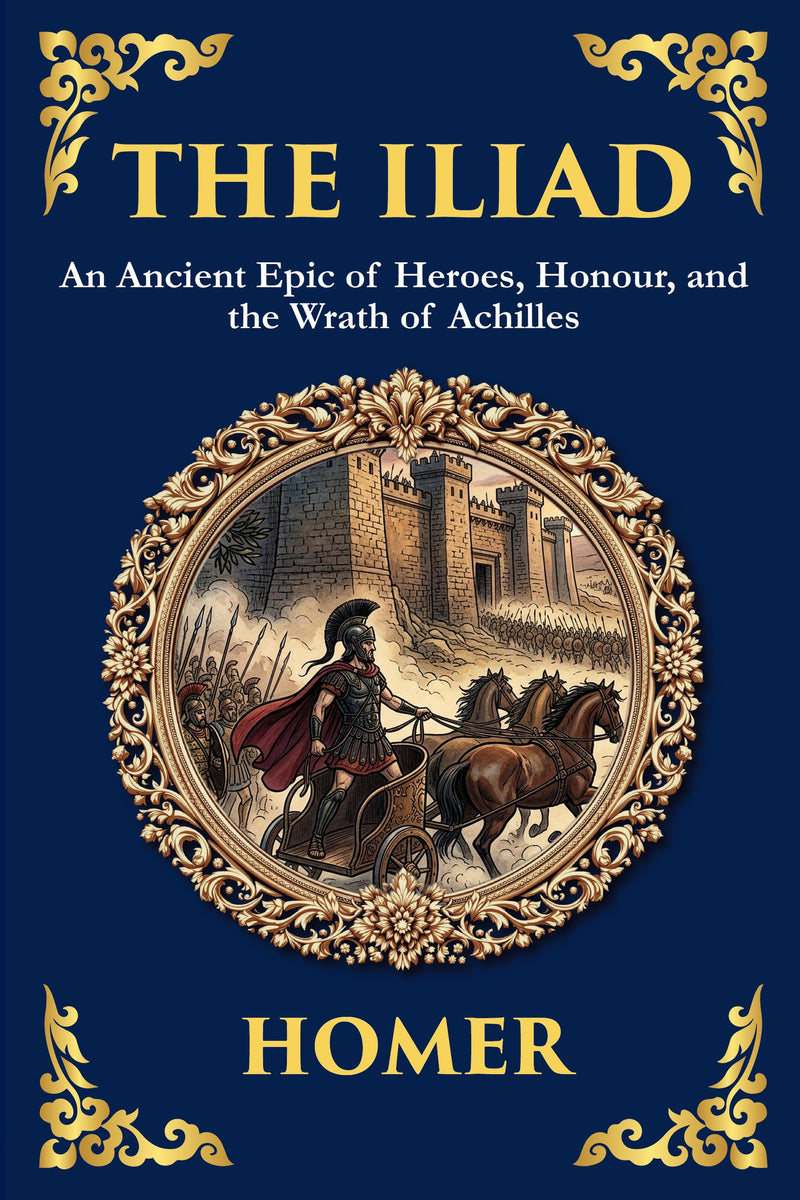
The Iliad
A war fought for honour. A hero consumed by rage. A legacy forged in blood. The Iliad stands as one of the greatest literary achievements of all time—an epic poem that captures the brutal glory and profound tragedy of the Trojan War.
or free app
10,000+ hrs library
30-day guarantee
The complete The Iliad appears in modern English through Library of Alexandria Press, available online with audiobook narration included for members.
Have you ever wondered why the greatest battles are not fought with swords alone? The Iliad is the ultimate epic of war, glory, and human passion. Attributed to Homer and composed in the 8th century BCE, this towering work of ancient Greek literature recounts the fierce clash between the Achaeans and the Trojans—but more than that, it delves deep into the hearts of its warriors.
At the center is Achilles, the greatest of all Greek heroes. His unrelenting anger after a personal insult sets off a chain of events that will cost lives, destroy alliances, and challenge the values of loyalty, pride, and honour. As the gods watch from Olympus and meddle in mortal affairs, kings and champions face their destinies on the blood-soaked plains of Troy.
In this modern translation, The Iliad’s majestic rhythm and emotional intensity are preserved, revealing a story that is as relevant today as it was over two thousand years ago.
What you’ll discover in this modern edition
- The Rage of Achilles Explore the devastating power of pride and fury through the tragic arc of a fallen hero.
- The Gods Among Men Discover a world where divine beings shape the fates of warriors and kingdoms alike.
- The Code of Honour and the Price of Glory Witness how valour, revenge, and sacrifice define the meaning of greatness—and the cost it demands.
- Timeless Themes of War and Humanity From grief and brotherhood to betrayal and fate, The Iliad lays bare the emotional truths behind mythic conflict.
- A Lyrical Modern Translation Read Homer’s verses as they were meant to be felt—vivid, immersive, and unforgettable.
| Formats | eBook (EPUB + PDF) · Audiobook · Paperback · Hardcover · Large Print |
| Language | English |
| Trim size (print) | 6 × 9 in |
| Binding | Paperback — perfect-bound · Hardcover — casewrap |
| Large Print edition | Same text in a larger, easy-read type — a larger font, not a larger trim |
| Print pricing | Every physical book at our true cost — at-cost, no profit (members) |
| Library | 873 restored titles, always growing |
| Length | 135,985 words · ~9 hr 4 min reading |
| Reading level | Grade 4 · an easy, flowing read (this modern-English edition) |
| Edition | Modern English translation · 2026 |
Member reviews for this edition are collected as readers finish it — be the first. Across the library: 12,000+ books shipped, every plan covered by a 365-day print guarantee.
About this edition
A faithful, unabridged modern-English edition by The Library of Alexandria — carefully rendered for today's reader and verified paragraph-by-paragraph against the public-domain source. Available as eBook, audiobook, paperback, hardcover, and large print.
- Complete & unabridgedVerified paragraph by paragraph against the source — never a scan, never abridged.
- Modern English, faithfulReadable today, with the author’s meaning kept intact. Readable — not simplified.
- Every format, one membershipRead in your browser or the free app, or listen to the full audiobook.
Included free with your membership
Cancel anytime, one click · 30-day money-back guarantee
Edition last updated July 2026
What’s inside
The Iliad — complete and unabridged: all 25 sections included with membership, plus the full audiobook.
Begin reading The Iliad
In clear modern English — the complete text is included with membership.
Introduction
There are books we read, and there are books that read us. The Iliad belongs to the second kind. For nearly three thousand years, this poem has been recited, copied, translated, memorized, argued over, and loved. It is one of the oldest works of literature in the Western tradition, and yet it has never grown old. Soldiers have carried it into battle. Philosophers have quarreled over its meaning. Children in ancient Greece learned to read by reciting its lines, and grown men wept over them. Alexander the Great is said to have slept with a copy beneath his pillow, annotated by his tutor Aristotle, dreaming perhaps of the glory it described. To open this book is to step into a current of human attention that has flowed unbroken across millennia.
And yet, for all its grandeur and antiquity, The Iliad is not a museum piece. It is alive. It pulses with rage and grief, with tenderness and terror, with the kind of raw emotional truth that does not fade with the passing of empires. Strip away the bronze armor and the chariots, the gods on their golden thrones and the ships drawn up on a foreign shore, and you will find something startlingly familiar: men and women caught in circumstances larger than themselves, struggling to decide what matters, what is worth dying for, and how to live with the choices they cannot unmake. The world Homer describes is remote in almost every external detail. The hearts beating inside it are very much our own.
This edition has been prepared with the contemporary reader in mind. The aim has been to preserve the power, dignity, and momentum of the original while removing the barriers that have, for too long, kept modern readers at arm’s length. You do not need a degree in classics to feel the force of this poem. You do not need to recognize every name or trace every genealogy. What you need is a willingness to be moved — to let the story carry you, as it has carried countless others before you, into a world that is at once utterly strange and achingly recognizable. The introduction that follows is meant to be a companion for that journey: a way of orienting yourself before you set out, so that you can read not as a student straining to keep up, but as a guest welcomed into a great and ancient hall.
To understand The Iliad, it helps to understand where it came from — not the precise historical details, which scholars still debate, but the deeper truth of how this poem came into being. Before it was ever written down, The Iliad was sung. It belonged to a tradition of oral poetry, performed by professional bards who could hold tens of thousands of lines in their memory and bring them to life before an audience gathered around a fire or in the hall of a king. These performers were not reciting from a fixed text. They were improvising within a vast inherited framework of stories, phrases, and rhythms, weaving the tale anew each time they told it, shaping it to the moment and the listeners before them.
This origin explains some of the features that may strike a new reader as unusual. You will notice, for instance, that certain phrases repeat: a character is described again and again by the same epithet — “swift-footed,” “bright-eyed,” “of the gleaming helmet.” The dawn appears with “rosy fingers” each morning; the sea is “wine-dark.” These are not signs of a poet running out of ideas. They are the load-bearing beams of an oral architecture, formulas that helped the bard sustain his rhythm and his memory while keeping the audience anchored in a familiar world. Far from being tedious, these repetitions create a kind of music, a steady heartbeat beneath the surging drama. They are the sound of a tradition speaking through a single voice.
Who was Homer? The honest answer is that we do not know, and perhaps we never will. The ancient Greeks themselves told stories about a blind poet who composed both The Iliad and The Odyssey, but they could not agree on where he was born or when he lived. Some modern scholars believe Homer was a single brilliant individual who gave final shape to centuries of accumulated tradition. Others suspect that “Homer” is a name we have attached to the work of many hands across many generations. For the purpose of reading and enjoying this poem, the mystery hardly matters. What matters is that out of the long collective labor of countless singers, there emerged a work of such coherence, such emotional depth, and such artistic control that it has stood unrivaled for thirty centuries. Whether the genius belonged to one person or to a tradition, genius it certainly was.
The events the poem describes are set in a still more distant past — a heroic age that the Greeks of Homer’s own time remembered with awe, an era of mighty kings and walled cities, of warriors larger and stronger than any living man. There may be a historical kernel buried somewhere beneath the legend; archaeologists have found the ruins of great Bronze Age citadels and a city that may have been the famous Troy itself. But The Iliad is not history, and we should not read it as such. It is something both smaller and infinitely larger: a meditation on what it means to be mortal, told through the story of a single, terrible quarrel.
For here is one of the most remarkable things about this poem. It is the great epic of the Trojan War, and yet it does not tell the whole war. It does not begin with the war’s famous cause, and it does not end with the war’s famous conclusion. Instead, the poet plunges us into a span of just a few weeks near the end of a long, grinding conflict, and within that narrow window he finds the entire universe of human experience. The opening word of the poem in the original Greek is menis — “rage,” “wrath.” Everything flows from that single word. This is, before it is anything else, the story of an anger: how it began, what it cost, and how, at last, it was transformed. By choosing to focus so tightly, Homer achieves something paradoxical. The smaller the frame, the larger the picture grows.
This editorial approach — a modern translation adapted for the contemporary reader — is built on the conviction that the poem’s greatness lies not in its difficulty but in its humanity, and that humanity deserves to be made accessible. Earlier translations, many of them beautiful, sometimes wrapped the poem in archaic language that put a glass wall between the reader and the feeling. Words like “thee” and “thou,” tangled sentences, and obscure references could make a living poem feel like a relic. The intention here has been different: to let Homer speak in language a reader today can absorb without friction, while never sacrificing the dignity and sweep that make the poem worth reading in the first place. The goal is not to dumb anything down. It is to clear the path, so that the full weight of the story can land where it always has — squarely in the human heart.
The World of Heroes and the Weight of Honor
To read The Iliad with understanding, it helps to grasp the values that govern the world it portrays — because that world runs on a moral logic both alien and oddly comprehensible to us. The men who fight at Troy are warriors in a society where a man’s worth is measured almost entirely by his deeds and his standing in the eyes of others. This is a culture of honor and shame, where reputation is not vanity but the very substance of a life well lived. To these heroes, glory — kleos, the fame that outlasts death — is the only form of immortality available to mortal men. They cannot live forever, and they know it. But they can be remembered forever, and so they pour themselves into deeds worthy of remembrance, hurling their bodies into danger so that the songs sung after them will keep their names alive.
This explains why the poem’s central conflict, which might seem trivial at first glance, is in fact a matter of life and death. When one man’s honor is publicly insulted — when something is taken from him that represents his standing among his peers — it is not a mere bruised ego at stake. It is the entire foundation of his identity. To be dishonored in this world is to be diminished as a human being, to have one’s very reason for living called into question. The fury that follows is not childish petulance. It is the eruption of a soul that feels its worth has been stripped away. Understanding this allows the modern reader to take seriously what might otherwise seem like an overreaction, and to feel the genuine tragedy in a dispute that spirals far beyond what anyone intended.
At the same time, The Iliad is far too wise to simply endorse the warrior code it depicts. One of the poem’s deepest achievements is the way it both honors heroism and questions it. We are shown the magnificence of these men in their strength and courage — and we are shown, with unflinching clarity, the cost of that magnificence. The poem does not glorify war. It renders war with a terrible honesty: the spear that finds the soft place beneath the jaw, the young man who will never return to the home and family briefly glimpsed before his death, the grief that ripples outward from every fallen body. Homer pauses, again and again, to tell us who these dying men were — their fathers, their towns, the wives they left behind, the small details of lives now ended. In doing so, he refuses to let us see them as mere casualties. Each death is a world extinguished.
This is the moral genius of the poem, and it is why it has never been mistaken for simple propaganda. The Iliad loves its heroes and mourns them in the same breath. It understands the intoxicating pull of glory and the unbearable weight of loss. It holds both truths at once, never collapsing into easy sentiment or easy cynicism. The result is a vision of human life that feels complete — that does not flinch from the worst we are capable of, yet never loses sight of the tenderness, loyalty, and love that make us worth saving.
And then there are the gods. To a modern reader, the constant intervention of divine beings — quarreling, scheming, taking sides, sometimes behaving worse than the mortals they oversee — can be one of the more puzzling features of the poem. It helps to remember that these gods are not the remote, perfect deity of later religious traditions. They are immortal, immensely powerful, and frequently petty. They embody the forces that shape human life — love, war, wisdom, the sea, the storm — and they often seem like exaggerated versions of human passions, free of the consequences that constrain mortal behavior. Crucially, the gods cannot die, and this is precisely what separates them from the heroes. Because the gods risk nothing, their conflicts, however dramatic, lack the gravity of human struggle. Achilles or Hector, by contrast, stake everything — their one and only life — on every choice. It is mortality that gives human action its meaning and its grandeur. The gods may be powerful, but the heroes are serious in a way the gods can never be. In this sense, the divine machinery of the poem is not a distraction from its human drama. It is a frame that throws that drama into sharper relief.
There is one more thing the new reader should know, and it shapes everything: the characters in The Iliad often know what is coming. This is not a story that depends on suspense in the ordinary sense. The heroes frequently foresee their own deaths or those of their friends; prophecies hang over the action; doom is woven into the fabric of the world. And yet they go forward anyway. They choose to act with courage even when they know the outcome. This is perhaps the most profound and moving thing about the poem. It is not about whether we can escape our fate — we cannot — but about how we meet it. The dignity of these characters lies not in winning, for many of them do not win, but in the way they carry themselves toward an end they cannot avoid. There is a kind of freedom in that, a freedom available to every mortal: not the freedom to choose our circumstances, but the freedom to choose who we will be within them.
Cancel anytime, one click · 30-day money-back guarantee
Founding annual rate available now — your price locks for life when you join.
Not ready? Get this free chapter by email — read it anytime.
✓ Sent — check your inbox for The Iliad.
Questions about The Iliad
What is The Iliad about?
A war fought for honour. A hero consumed by rage. A legacy forged in blood.
Who wrote The Iliad?
The Iliad was written by Homer. This edition presents the complete work in clear modern English, faithfully rendered from the public-domain original by Library of Alexandria Press.
Is The Iliad free to read?
The opening chapter is free to read on this page. Members read and listen to the complete work — and the entire library — free, and can order any physical book at our true print cost.
How long is The Iliad?
25 chapters (~135,985 words) — about 9 hr 4 min of reading in this modern-English edition.
Is this an abridged version of The Iliad?
No. This is the complete, unabridged The Iliad, carefully rendered into clear modern English and verified paragraph-by-paragraph against the public-domain source — nothing is cut or summarised.
What formats does The Iliad come in?
The Iliad is available as eBook, paperback, hardcover and large print. eBook and audiobook are included with membership; printed editions ship at our true print cost.
Shipping & returns
Billing & membership
More from the library


Explore Military & Strategy
- The War of the Worlds · H. G. Wells
- The Belle of Bowling Green · Amelia E. Barr
- Give Me Liberty or Give Me Death · Patrick Henry
- The Thirty-Nine Steps · John Buchan
- Julius Caesar · William Shakespeare
- Rilla of Ingleside · L. M. Montgomery
- Troilus and Criseyde · Geoffrey Chaucer
- The Adventures of Heine · Edgar Wallace
- The Declaration of Independence of the United States of America · Thomas Jefferson
- Armageddon—2419 A.D. · Philip Francis Nowlan
- The Variable Man · Philip K. Dick
- Arms and the Man · Bernard Shaw
- South Africa and the Transvaal War, Vol. 2 (of 8) · Louis Creswicke
- The Red Badge of Courage: An Episode of the American Civil War · Stephen Crane
- Second Variety · Philip K. Dick
- Lysistrata · Aristophanes
- A Matter of Proportion · Anne Walker
- This Side of Paradise · F. Scott Fitzgerald
The Iliad
The Iliad
An Ancient Epic of Heroes, Honor, and the Wrath of Achilles
Homer
Contents
- Introduction
- Book 1
- Book 2
- Book 3
- Book 4
- Book 5
- Book 6
- Book 7
- Book 8
- Book 9
- Book 10
- Book 11
- Book 12
- Book 13
- Book 14
- Book 15
- Book 16
- Book 17
- Book 18
- Book 19
- Book 20
- Book 21
- Book 22
- Book 23
- Book 24
Introduction
There are books we read, and there are books that read us. The Iliad belongs to the second kind. For nearly three thousand years, this poem has been recited, copied, translated, memorized, argued over, and loved. It is one of the oldest works of literature in the Western tradition, and yet it has never grown old. Soldiers have carried it into battle. Philosophers have quarreled over its meaning. Children in ancient Greece learned to read by reciting its lines, and grown men wept over them. Alexander the Great is said to have slept with a copy beneath his pillow, annotated by his tutor Aristotle, dreaming perhaps of the glory it described. To open this book is to step into a current of human attention that has flowed unbroken across millennia.
And yet, for all its grandeur and antiquity, The Iliad is not a museum piece. It is alive. It pulses with rage and grief, with tenderness and terror, with the kind of raw emotional truth that does not fade with the passing of empires. Strip away the bronze armor and the chariots, the gods on their golden thrones and the ships drawn up on a foreign shore, and you will find something startlingly familiar: men and women caught in circumstances larger than themselves, struggling to decide what matters, what is worth dying for, and how to live with the choices they cannot unmake. The world Homer describes is remote in almost every external detail. The hearts beating inside it are very much our own.
This edition has been prepared with the contemporary reader in mind. The aim has been to preserve the power, dignity, and momentum of the original while removing the barriers that have, for too long, kept modern readers at arm’s length. You do not need a degree in classics to feel the force of this poem. You do not need to recognize every name or trace every genealogy. What you need is a willingness to be moved — to let the story carry you, as it has carried countless others before you, into a world that is at once utterly strange and achingly recognizable. The introduction that follows is meant to be a companion for that journey: a way of orienting yourself before you set out, so that you can read not as a student straining to keep up, but as a guest welcomed into a great and ancient hall.
To understand The Iliad, it helps to understand where it came from — not the precise historical details, which scholars still debate, but the deeper truth of how this poem came into being. Before it was ever written down, The Iliad was sung. It belonged to a tradition of oral poetry, performed by professional bards who could hold tens of thousands of lines in their memory and bring them to life before an audience gathered around a fire or in the hall of a king. These performers were not reciting from a fixed text. They were improvising within a vast inherited framework of stories, phrases, and rhythms, weaving the tale anew each time they told it, shaping it to the moment and the listeners before them.
This origin explains some of the features that may strike a new reader as unusual. You will notice, for instance, that certain phrases repeat: a character is described again and again by the same epithet — “swift-footed,” “bright-eyed,” “of the gleaming helmet.” The dawn appears with “rosy fingers” each morning; the sea is “wine-dark.” These are not signs of a poet running out of ideas. They are the load-bearing beams of an oral architecture, formulas that helped the bard sustain his rhythm and his memory while keeping the audience anchored in a familiar world. Far from being tedious, these repetitions create a kind of music, a steady heartbeat beneath the surging drama. They are the sound of a tradition speaking through a single voice.
Who was Homer? The honest answer is that we do not know, and perhaps we never will. The ancient Greeks themselves told stories about a blind poet who composed both The Iliad and The Odyssey, but they could not agree on where he was born or when he lived. Some modern scholars believe Homer was a single brilliant individual who gave final shape to centuries of accumulated tradition. Others suspect that “Homer” is a name we have attached to the work of many hands across many generations. For the purpose of reading and enjoying this poem, the mystery hardly matters. What matters is that out of the long collective labor of countless singers, there emerged a work of such coherence, such emotional depth, and such artistic control that it has stood unrivaled for thirty centuries. Whether the genius belonged to one person or to a tradition, genius it certainly was.
The events the poem describes are set in a still more distant past — a heroic age that the Greeks of Homer’s own time remembered with awe, an era of mighty kings and walled cities, of warriors larger and stronger than any living man. There may be a historical kernel buried somewhere beneath the legend; archaeologists have found the ruins of great Bronze Age citadels and a city that may have been the famous Troy itself. But The Iliad is not history, and we should not read it as such. It is something both smaller and infinitely larger: a meditation on what it means to be mortal, told through the story of a single, terrible quarrel.
For here is one of the most remarkable things about this poem. It is the great epic of the Trojan War, and yet it does not tell the whole war. It does not begin with the war’s famous cause, and it does not end with the war’s famous conclusion. Instead, the poet plunges us into a span of just a few weeks near the end of a long, grinding conflict, and within that narrow window he finds the entire universe of human experience. The opening word of the poem in the original Greek is menis — “rage,” “wrath.” Everything flows from that single word. This is, before it is anything else, the story of an anger: how it began, what it cost, and how, at last, it was transformed. By choosing to focus so tightly, Homer achieves something paradoxical. The smaller the frame, the larger the picture grows.
This editorial approach — a modern translation adapted for the contemporary reader — is built on the conviction that the poem’s greatness lies not in its difficulty but in its humanity, and that humanity deserves to be made accessible. Earlier translations, many of them beautiful, sometimes wrapped the poem in archaic language that put a glass wall between the reader and the feeling. Words like “thee” and “thou,” tangled sentences, and obscure references could make a living poem feel like a relic. The intention here has been different: to let Homer speak in language a reader today can absorb without friction, while never sacrificing the dignity and sweep that make the poem worth reading in the first place. The goal is not to dumb anything down. It is to clear the path, so that the full weight of the story can land where it always has — squarely in the human heart.
The World of Heroes and the Weight of Honor
To read The Iliad with understanding, it helps to grasp the values that govern the world it portrays — because that world runs on a moral logic both alien and oddly comprehensible to us. The men who fight at Troy are warriors in a society where a man’s worth is measured almost entirely by his deeds and his standing in the eyes of others. This is a culture of honor and shame, where reputation is not vanity but the very substance of a life well lived. To these heroes, glory — kleos, the fame that outlasts death — is the only form of immortality available to mortal men. They cannot live forever, and they know it. But they can be remembered forever, and so they pour themselves into deeds worthy of remembrance, hurling their bodies into danger so that the songs sung after them will keep their names alive.
This explains why the poem’s central conflict, which might seem trivial at first glance, is in fact a matter of life and death. When one man’s honor is publicly insulted — when something is taken from him that represents his standing among his peers — it is not a mere bruised ego at stake. It is the entire foundation of his identity. To be dishonored in this world is to be diminished as a human being, to have one’s very reason for living called into question. The fury that follows is not childish petulance. It is the eruption of a soul that feels its worth has been stripped away. Understanding this allows the modern reader to take seriously what might otherwise seem like an overreaction, and to feel the genuine tragedy in a dispute that spirals far beyond what anyone intended.
At the same time, The Iliad is far too wise to simply endorse the warrior code it depicts. One of the poem’s deepest achievements is the way it both honors heroism and questions it. We are shown the magnificence of these men in their strength and courage — and we are shown, with unflinching clarity, the cost of that magnificence. The poem does not glorify war. It renders war with a terrible honesty: the spear that finds the soft place beneath the jaw, the young man who will never return to the home and family briefly glimpsed before his death, the grief that ripples outward from every fallen body. Homer pauses, again and again, to tell us who these dying men were — their fathers, their towns, the wives they left behind, the small details of lives now ended. In doing so, he refuses to let us see them as mere casualties. Each death is a world extinguished.
This is the moral genius of the poem, and it is why it has never been mistaken for simple propaganda. The Iliad loves its heroes and mourns them in the same breath. It understands the intoxicating pull of glory and the unbearable weight of loss. It holds both truths at once, never collapsing into easy sentiment or easy cynicism. The result is a vision of human life that feels complete — that does not flinch from the worst we are capable of, yet never loses sight of the tenderness, loyalty, and love that make us worth saving.
And then there are the gods. To a modern reader, the constant intervention of divine beings — quarreling, scheming, taking sides, sometimes behaving worse than the mortals they oversee — can be one of the more puzzling features of the poem. It helps to remember that these gods are not the remote, perfect deity of later religious traditions. They are immortal, immensely powerful, and frequently petty. They embody the forces that shape human life — love, war, wisdom, the sea, the storm — and they often seem like exaggerated versions of human passions, free of the consequences that constrain mortal behavior. Crucially, the gods cannot die, and this is precisely what separates them from the heroes. Because the gods risk nothing, their conflicts, however dramatic, lack the gravity of human struggle. Achilles or Hector, by contrast, stake everything — their one and only life — on every choice. It is mortality that gives human action its meaning and its grandeur. The gods may be powerful, but the heroes are serious in a way the gods can never be. In this sense, the divine machinery of the poem is not a distraction from its human drama. It is a frame that throws that drama into sharper relief.
There is one more thing the new reader should know, and it shapes everything: the characters in The Iliad often know what is coming. This is not a story that depends on suspense in the ordinary sense. The heroes frequently foresee their own deaths or those of their friends; prophecies hang over the action; doom is woven into the fabric of the world. And yet they go forward anyway. They choose to act with courage even when they know the outcome. This is perhaps the most profound and moving thing about the poem. It is not about whether we can escape our fate — we cannot — but about how we meet it. The dignity of these characters lies not in winning, for many of them do not win, but in the way they carry themselves toward an end they cannot avoid. There is a kind of freedom in that, a freedom available to every mortal: not the freedom to choose our circumstances, but the freedom to choose who we will be within them.
The quarrel between Agamemnon and Achilles—Achilles withdraws from the war and sends his mother, Thetis, to ask Zeus to help the Trojans—A scene between Zeus and Hera on Olympus.
Sing, goddess, of the rage of Achilles, son of Peleus, which brought endless misery upon the Greeks. It sent countless brave souls rushing down to the underworld and left many heroes as food for dogs and vultures. This was the will of Zeus, starting from the day when the son of Atreus, the king of men, and the great Achilles first clashed.
Which of the gods pushed them toward this conflict? It was the son of Zeus and Leto. He was angry with the king and sent a plague to devastate the army because the son of Atreus had dishonored his priest, Chryses. Chryses had come to the Greek ships to rescue his daughter, bringing a generous ransom. He carried Apollo’s scepter, adorned with a suppliant’s ribbon, and pleaded with the Greeks—especially the two sons of Atreus, who were their leaders.
“Sons of Atreus,” he cried, “and all you Greeks, may the gods of Olympus grant that you capture the city of Priam and return home safely. But please, release my daughter and accept this ransom for her, out of respect for Apollo, the son of Zeus.”
The other Greeks agreed immediately that they should respect the priest and take the ransom. But Agamemnon disagreed; he spoke harshly to the man and drove him away. “Old man,” he said, “don’t let me find you lingering around our ships, and don’t come back. Your divine scepter and ribbon won’t help you. I will not release her. She will grow old in my house at Argos, far from home, working at her loom and sharing my bed. Now leave, and do not provoke me, or things will only get worse for you.”
End of the free sample
Keep reading, free
Members read and listen to the complete book — and the entire library. Cancel anytime, one click · 30-day money-back guarantee.