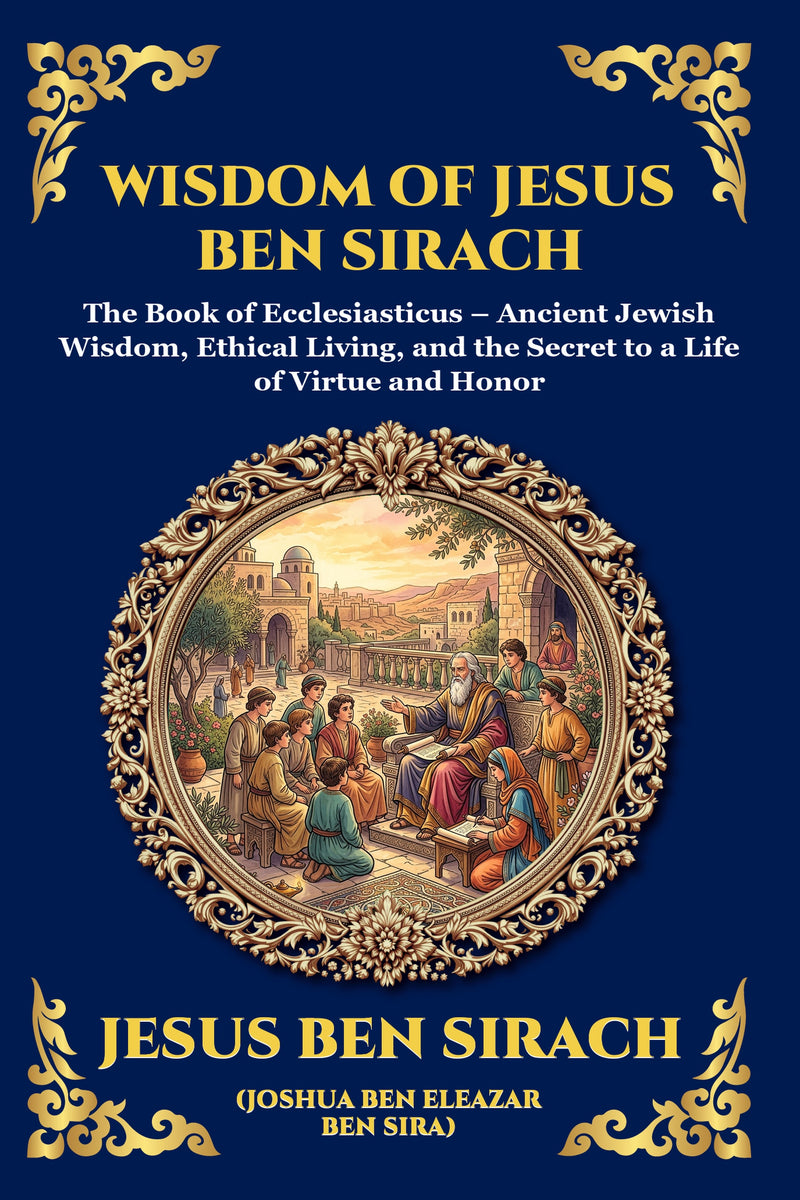
Wisdom of Jesus ben Sirach
Penned by a keen observer of human nature, the Wisdom of Jesus ben Sirach offers practical guidance on integrity and conduct that shaped moral thought for centuries. Excluded from the Hebrew Bible, it remains a vital resource for understanding the timeless principles that govern successful lives.
or free app
10,000+ hrs library
30-day guarantee
The Library of Alexandria edition presents the complete Wisdom of Jesus ben Sirach in modern English translation, accessible online with included audiobook narration for members.
The Wisdom of Jesus ben Sirach stands as the only complete book of ancient Jewish wisdom literature preserved in its original Hebrew after being lost for nearly a thousand years.
In The Wisdom of Jesus ben Sirach, you are invited to sit at the feet of one of the ancient world's most brilliant moral philosophers. Unlike the abstract musings of many philosophical texts, this work—often referred to as the "Book of Ecclesiasticus"—is a raw, practical, and deeply insightful manual for daily life. Written by Joshua ben Eleazar ben Sira, a scholar who traveled extensively and observed the rise and fall of men, this text was designed to prepare the young and the old alike for the challenges of a changing world.
The narrative of Ben Sira is unique because it bridges the gap between the sacred and the social. He doesn't just talk about prayer; he talks about how to choose your friends, how to manage your finances, how to treat your family, and how to conduct yourself in the presence of the powerful. He explores the "fear of the Lord" not as a terrifying dread, but as the beginning of a joyous and disciplined wisdom that leads to a long and honorable life. Through his sharp wit and poetic prose, Ben Sira reveals that true virtue is not found in isolation, but in the way we interact with our neighbors and the responsibilities we fulfill toward our community.
This modern edition restores the clarity and punch of Ben Sira’s original observations, making his ancient advice feel startlingly contemporary. Whether you are seeking a moral compass, a deeper understanding of biblical history, or a guide to personal excellence, this book provides an unparalleled journey into the heart of Jewish wisdom.
What You’ll Discover in This Modern Translation
- The Art of Ethical Living — Practical strategies for building a life of integrity, from the kitchen table to the royal court.
- The Secrets of True Friendship — Ancient insights on how to identify loyal companions and avoid those who would lead you astray.
- The Personification of Wisdom — Experience the beautiful "Praise of Wisdom," where Sophia recounts her origins and her dwelling place in the heart of the faithful.
- A Guide to Family and Household — Timeless principles on marriage, the upbringing of children, and the honoring of parents.
- The Roll Call of Heroes — A magnificent historical reflection on the great figures of the past, from Enoch and Noah to the high priests of the author's own day.
- Financial Wisdom and Self-Control — Hard-hitting advice on the dangers of greed, the proper use of wealth, and the necessity of moderation.
Whether you are exploring this work for its immense historical value, its poetic splendor, or its practical life lessons, The Wisdom of Jesus ben Sirach remains an essential manual for the soul.
Master the ancient secrets of a virtuous life. Get your copy today and begin your transformation.
| Formats | eBook (EPUB + PDF) · Audiobook · Paperback · Hardcover · Large Print |
| Language | English |
| Trim size (print) | 6 × 9 in |
| Binding | Paperback — perfect-bound · Hardcover — casewrap |
| Large Print edition | Same text in a larger, easy-read type — a larger font, not a larger trim |
| Print pricing | Every physical book at our true cost — at-cost, no profit (members) |
| Library | 873 restored titles, always growing |
| Composed | 2nd century BC |
| Original language | Hebrew, with Greek translation by the author's grandson |
| Source tradition | Greek manuscripts and Latin Vulgate tradition |
| Translation basis | Public-domain scholarly translation, rendered in clear modern English |
| Length | 34,298 words · ~2 hr 17 min reading |
| Reading level | Grade 8 · clear and comfortable (this modern-English edition) |
| Edition | Modern English translation · 2026 |
Member reviews for this edition are collected as readers finish it — be the first. Across the library: 12,000+ books shipped, every plan covered by a 365-day print guarantee.
About this edition
The complete, unabridged text in clear modern English — faithful to the original, never simplified. Every paragraph is checked against the source, so nothing is cut, summarised, or paraphrased away. It reads cleanly for today while keeping the original meaning intact.
This edition draws from Greek manuscripts and Latin Vulgate sources, following the standard scholarly translation tradition. The text is rendered in clear, accessible modern English while preserving the practical wisdom and moral instruction of the original.
- Complete & unabridgedVerified paragraph by paragraph against the source — never a scan, never abridged.
- Modern English, faithfulReadable today, with the author’s meaning kept intact. Readable — not simplified.
- Every format, one membershipRead in your browser or the free app, or listen to the full audiobook.
Included free with your membership
Cancel anytime, one click · 30-day money-back guarantee
Edition last updated June 2026
What’s inside
Wisdom of Jesus ben Sirach — complete and unabridged: all 120 sections included with membership, plus the full audiobook.
Begin reading Wisdom of Jesus ben Sirach
In clear modern English — the complete text is included with membership.
The Heart of Ancient Wisdom
To understand what ben Sirach is doing in this text, it helps to understand the tradition within which he was working. He belongs to a stream of ancient Israelite literature known as wisdom literature — a genre that includes the books of Proverbs, Job, Ecclesiastes, and several of the Psalms in the Hebrew Bible, as well as texts from neighboring cultures like Egypt and Mesopotamia. Wisdom literature is concerned not with the great dramatic events of sacred history — the Exodus, the giving of the Law at Sinai, the conquests and defeats of the Israelite kingdoms — but with the texture of ordinary life: how to speak and when to be silent, how to manage money, how to navigate relationships, how to cultivate virtue, how to face suffering and mortality. It is, in the most literal sense, practical philosophy.
What distinguishes Israelite wisdom literature from its Egyptian and Mesopotamian counterparts — and what is absolutely central to ben Sirach's vision — is the conviction that wisdom is not merely a human achievement but a divine gift, and that the foundation of all true wisdom is what the tradition calls 'the fear of the Lord.' This phrase, which appears repeatedly throughout the text, does not mean cowering terror before an arbitrary and capricious deity. It means, rather, a deep and reverent awe in the presence of the divine — a recognition that one stands before a reality infinitely greater than oneself, a reality that is the source of all order, all goodness, and all meaning. To fear the Lord, in this sense, is to be properly oriented toward reality. It is the opposite of the arrogance that places the self at the center of the universe and measures everything by personal advantage. It is, ben Sirach insists again and again, the beginning and the end of wisdom — the soil in which all genuine virtue grows.
This theological grounding distinguishes ben Sirach's work from purely secular ethical philosophy, even when the practical advice he offers sounds similar to what one might find in Stoic or Epicurean texts. He was writing in a world where Hellenistic culture was enormously influential, where educated Jews like himself were in constant conversation with Greek ideas, and where the temptation to abandon ancestral tradition in favor of cosmopolitan sophistication was real and pressing. His response to this challenge is subtle and interesting: he does not simply reject Greek thought, nor does he uncritically absorb it. Instead, he argues, implicitly and sometimes explicitly, that the wisdom tradition of Israel is itself a form of philosophy — indeed, the highest form — and that fidelity to the Torah and to the traditions of one's ancestors is not provincial narrowness but the deepest kind of insight into the nature of reality.
Wisdom, in ben Sirach's telling, is not an abstract principle or a set of logical propositions. She is — and the feminine personification is deliberate and theologically significant — a living presence who existed before creation, who was present at the fashioning of the world, who dwells in the heights of heaven and yet has chosen to make her home among the people of Israel, specifically in the Torah, the Law of Moses. This identification of wisdom with Torah is one of ben Sirach's most important theological moves, and it runs through the entire text like a golden thread. To seek wisdom is to seek God. To live wisely is to live in accordance with God's design for human beings. And the path to that life is not hidden or esoteric — it is available to anyone willing to study, to listen, to humble themselves before what is greater than themselves, and to practice what they learn.
The practical ethics that flow from this theological vision are remarkably comprehensive. Ben Sirach addresses nearly every domain of human life with the same combination of theological seriousness and worldly realism. His advice on friendship, for instance, is particularly striking in its psychological acuity. He distinguishes carefully between true friends and false ones, between those who stand by you in adversity and those who vanish when fortune turns, between the friend who tells you what you need to hear and the flatterer who tells you only what you want to hear. He understands that genuine friendship is one of the greatest goods available to human beings — 'a faithful friend is a sturdy shelter,' he writes, 'a faithful friend is beyond price' — and he is equally clear-eyed about how rare and precious such friendship is, and how easily it can be destroyed by careless words, by envy, by the revelation of secrets, or by the simple corrosive pressure of time and changing circumstances.
His treatment of wealth and poverty is similarly nuanced. He is not an ascetic who condemns material prosperity as inherently corrupting, nor is he a naive optimist who equates wealth with virtue. He has clearly observed both rich and poor with careful attention, and what he sees is complex. Wealth can provide security and opportunity; it can also breed arrogance, moral blindness, and the dangerous illusion of self-sufficiency. Poverty is genuinely hard — he does not romanticize it — but it can also be a school of patience, humility, and dependence on God. What matters, ultimately, is not how much one has but how one holds it: with open hands, willing to share with those in need, or with clenched fists, hoarding against every imagined future threat. His insistence on generosity toward the poor is one of the most consistent and passionate themes in the entire work, and it connects directly to his theological vision: to give to the poor is to honor the God who made them.
The theme of speech and silence deserves special mention because ben Sirach returns to it with a frequency that suggests he regarded it as one of the most critical arenas of moral life. He is fascinated — almost obsessed — with the power of words: their capacity to heal or wound, to build up or destroy, to forge bonds of trust or shatter them irreparably. He writes about the dangers of gossip, of slander, of the idle word spoken without thought that can ruin a reputation built over decades. He writes about the equal and opposite danger of the person who cannot speak when speech is needed — who withholds a word of comfort, a word of truth, a word of warning, out of cowardice or indifference. The wise person, in his vision, is one who has learned to govern the tongue — not to silence it entirely, but to deploy it with care, with intention, and with a deep awareness of the consequences that words carry in the world.
Why This Book Still Matters
It is one of the persistent temptations of modern readers to approach ancient texts with a kind of condescension — to read them as historical curiosities, interesting for what they reveal about their time and place but essentially superseded by the accumulated wisdom of the centuries that followed. This temptation is particularly strong with wisdom literature, because wisdom literature deals with precisely the domains — ethics, psychology, social relations, the art of living — where we tend to assume that modernity has made the most progress. We have, after all, developed sophisticated psychological theories, elaborate systems of social ethics, and a vast literature of self-help and personal development that would have been unimaginable to ben Sirach. What could a Jewish scribe from second-century Jerusalem possibly have to teach us that we have not already learned?
The honest answer, for anyone who reads this text with genuine attention, is: quite a lot. Not because ben Sirach was omniscient or infallible, but because the fundamental challenges of human life have not changed as much as we like to imagine. We still struggle with pride and the need for humility. We still find it difficult to distinguish true friends from false ones. We still wrestle with the relationship between wealth and happiness, between ambition and contentment, between the desire for recognition and the deeper need for integrity. We still face the reality of death and must find some way to live meaningfully in its shadow. We still must decide how to treat those who are weaker or poorer than ourselves, and what our obligations are to the communities — families, neighborhoods, nations — that shaped us. These are not problems that modernity has solved. They are the permanent problems of human existence, and any text that addresses them with honesty and depth deserves to be read.
There is also something to be said for the particular form in which ben Sirach's wisdom comes to us. We live in an age of information abundance — an age in which we are surrounded by advice, analysis, opinion, and data at every moment, accessible at the touch of a finger. And yet many people feel, paradoxically, more confused and less guided than ever. The sheer volume of competing voices makes it difficult to hear any single voice clearly, and the relentless pace of modern life leaves little room for the kind of slow, reflective reading that wisdom literature demands and rewards. Reading ben Sirach is, among other things, an exercise in a different kind of attention — the kind that pauses, that lingers, that allows a single image or a single sentence to resonate before moving on. He writes in verse, and even in translation the rhythms of his poetry create a kind of breathing space that prose does not. To read him well is to slow down, and slowing down is itself a form of wisdom that our culture desperately needs.
The 'Praise of the Fathers' — that extended hymn to the great figures of Israelite history that occupies the latter portion of the book — deserves special attention as a document of cultural memory and identity. Ben Sirach moves through the heroes of the Hebrew scriptures — Enoch, Noah, Abraham, Moses, Aaron, Phinehas, Joshua, the judges, the kings, the prophets — celebrating each one for the particular quality that made them great, the particular contribution they made to the ongoing story of the people of God. It is, in its way, a meditation on what it means to be part of a tradition, to inherit a story larger than oneself, and to understand one's own life as a continuation of something that began long before one was born and will continue long after one is gone. In an age of radical individualism, in which many people feel cut off from any tradition or community larger than themselves, this vision of embedded, storied identity has a particular poignancy and power.
The figure of wisdom herself — personified, luminous, calling out to human beings from the heights and the crossroads and the city gates — is one of the most beautiful and theologically rich images in all of ancient literature. Ben Sirach did not invent her; she appears already in the book of Proverbs, and she will appear again, transformed and deepened, in the New Testament's reflection on the person of Christ. But in these pages, she receives one of her fullest and most sustained treatments. She is at once transcendent and intimate, cosmic and domestic, ancient beyond imagining and urgently present. She is the order that underlies the apparent chaos of existence, the meaning that makes suffering bearable, the beauty that makes life worth living. To seek her is the highest human aspiration; to find her — or rather, to be found by her — is the greatest human joy. Whatever one makes of the theological claims embedded in this vision, it is impossible to read ben Sirach's hymns to wisdom without feeling that one is in the presence of something genuinely profound.
It is worth pausing, too, on the humanity of the author himself — on the fact that this is not a disembodied collection of maxims but the work of a specific person, with a specific life, writing in a specific moment of historical crisis. Ben Sirach lived and wrote at a time when the Jewish community in Jerusalem was under enormous cultural pressure from Hellenistic rulers and from the allure of Greek culture, when some of his contemporaries were abandoning the traditions of their ancestors in pursuit of social advancement and cosmopolitan sophistication. He was, in this sense, a conservative — not in the narrow political sense, but in the deeper sense of someone who understood that what is inherited is not simply old but is the accumulated wisdom of generations, tested by experience and refined by suffering, and that to discard it carelessly is to impoverish oneself in ways that may not be immediately apparent. His passion for the tradition he inherited is palpable on every page, and it gives his writing an urgency that mere academic instruction could never achieve.
And yet he is not a fearful or defensive conservative, retreating into the past because the present is frightening. He engages with the world of his time with confidence and curiosity, drawing on the best of what his culture has to offer while remaining rooted in the convictions that give his life its shape and meaning. He is, in this sense, a model for a kind of engaged, reflective traditionalism that has much to teach any age — including our own, in which the tension between inherited wisdom and contemporary innovation is as live and urgent as it has ever been.
Cancel anytime, one click · 30-day money-back guarantee
Founding annual rate available now — your price locks for life when you join.
Not ready? Get this free chapter by email — read it anytime.
✓ Sent — check your inbox for Wisdom of Jesus ben Sirach.
Questions about Wisdom of Jesus ben Sirach
Why isn't the Wisdom of Jesus ben Sirach in most Bibles today?
The Wisdom of Jesus ben Sirach was excluded from the Hebrew Bible canon but remains in Catholic and Orthodox Bibles as deuterocanonical scripture. Protestant traditions classify it among the Apocrypha—valuable for instruction but not canonical.
Who was Jesus ben Sirach and what does this book contain?
Jesus ben Sirach (Joshua ben Sira) was a Jewish scribe and teacher in Jerusalem around 200 BC. His work contains practical wisdom on ethics, relationships, social conduct, and religious devotion, similar to Proverbs but more systematic.
Is it safe for Christians to read the Wisdom of Jesus ben Sirach?
The Wisdom of Jesus ben Sirach has been valued by Christians for centuries for its moral instruction and practical guidance. While not canonical in Protestant traditions, it contains no doctrinal conflicts and offers timeless wisdom on righteous living.
Is Wisdom of Jesus ben Sirach free to read?
The opening of the text is free to read below. Members read and listen to the complete work — and the entire Lost & Forbidden Library — free.
What is Wisdom of Jesus ben Sirach?
Have you ever wondered why the most successful people throughout history seem to follow a hidden code of conduct and integrity?
How long is Wisdom of Jesus ben Sirach?
123 chapters (~31,889 words) in this restored edition.
Shipping & returns
Billing & membership
More from the library


Explore The Lost & Forbidden Library
- 1 Enoch · Attributed to Enoch
- 1–4 Maccabees · Various Jewish authors
- 2 Baruch · Attributed to Baruch
- 2 Enoch · Attributed to Enoch
- 2 Esdras · Attributed to the prophet Ezra
- 3 Baruch · Attributed to Baruch ben Neriah
- 4 Baruch · Attributed to Baruch ben Neriah
- A Valentinian Exposition · Attributed to a follower of Val...
- Acta Archelai · Attributed to Hegemonius
- Acts of Andrew · Anonymous (Early Christian Apoc...
- Acts of Andrew and Matthias in the City of the Cannibals · Attributed to early Christian a...
- Acts of Barnabas · Attributed to John Mark
- Acts of Bartholomew
- Acts of John · Anonymous (Early Christian Apoc...
- Acts of Matthias · Anonymous early Christian writers
- Acts of Paul · Attributed to an unknown early ...
- Acts of Paul and Thecla · Attributed to Onesiphorus
- Acts of Peter
- Acts of Peter and Andrew · Attributed to various early Chr...
- Acts of Peter and Paul · Attributed to Leucius Charinus
- Acts of Peter and Simon · Attributed to Leucius Charinus
- Acts of Peter and the Twelve Apostles · Attributed to early Christian a...
- Acts of Philip · Anonymous (Early Christian Apoc...
- Acts of Pilate (Gospel of Nicodemus) · Attributed to various early Chr...
- Acts of Saturninus
- Acts of Thaddaeus · Attributed to Thaddaeus the Apo...
- Acts of Thomas
- Acts of Titus · Anonymous early Christian writer
- Acts of Xanthippe, Polyxena, and Rebecca
- Allogenes · Anonymous (Early Gnostic Mystic)
Wisdom of Jesus ben Sirach
Wisdom of Jesus ben Sirach
The Book of Ecclesiasticus – Ancient Jewish Wisdom, Ethical Living, and the Secret to a Life of Virtue and Honor
Library of Alexandria Press
Wisdom of Jesus ben Sirach
© Copyright 2026 Library of Alexandria Press. All rights reserved.
Published by Library of Alexandria Press
Printed in the United States of America
It is not legal to copy, share, or send any part of this document in either digital or printed form without written permission from the publisher, except short quotes in a book review.
Table of Contents
Introduction
The Heart of Ancient Wisdom
Why This Book Still Matters
All Wisdom Comes from God
Trust in God Through Trials
Honor Your Parents
The Blessings of Wisdom
Shame and Shamelessness
Caution in Friendship
Prudence in Speech and Conduct
Trust in God Through Trials
Honour Your Parents
Humility and Avoiding Vain Curiosity
Mercy to the Poor and the Love of Wisdom
Wisdom's Discipline and Its Rewards
On Honesty, Courage, and Right Speech
Against Presumption and Recklessness
On Steadfastness and Wise Speech
On False and True Friendship
The Pursuit of Wisdom
On Receiving Wisdom and Learning from the Wise
On Avoiding Evil and Living Uprightly
On Duties to Neighbors, Family, and God
On Prudence in Dealings with Others
On Caution Regarding Women and Dangerous Company
Caution Toward Women and Dangerous Companions
On Friendship, Envy, and Dangerous Associates
On Rulers, Pride, and the Fear of God
Humility, Moderation, and Trusting in God
On Caution, Wealth, and Divine Providence
On Dangerous Companions and Deceitful Guests
On Giving Wisely and Knowing Your Enemies
On the Dangers of Unequal Companionship
The Rich and the Poor
Against Avarice; Do Good While You Can
The Pursuit of Wisdom
Wisdom and the Fear of God
The Justice and Mercy of God
The Order of Creation
The Creation and Dignity of Man
An Exhortation to Repentance
The Greatness of God's Works
God's Greatness and Human Smallness
On Giving and Speaking Well
Preparing Yourself Before Acting
Against Following Lusts and Reckless Living
Warnings Against Vice and Foolishness
On Reproof and Friendship
True Wisdom and False Wisdom
On Reproof and Restraint
On Silence, Speech, and Wisdom
On Sin and Its Consequences
The Wise and the Foolish Contrasted
On Laziness, Foolish Children, and Shameless Behavior
On Fools and Foolishness
On Steadfastness and Friendship
Prayer for Self-Control
On the Discipline of Speech
On Lust and Hidden Sin
On Adultery and Its Consequences
Wisdom Praises Herself
Wisdom on Various Matters
On Blessings and the Fear of God
On the Wickedness of a Bad Woman
On the Blessing of a Good Wife
On Things That Cause Fear and Grief
On the Beauty and Worth of a Good Woman
On Difficult Callings and the Danger of Sin
On the Dangers of Seeking Wealth and the Trials of Life
On Justice, Truth, and Wisdom
On Betraying Secrets and Deceit
On Forgiveness and the Evils of the Tongue
On Lending, Almsgiving, and Standing Surety
On Lending, Suretyship, and Simple Living
On the Discipline of Children, and the Value of Health and Cheerfulness
On the Dangers of Wealth and the Virtue of Moderation at Table
On Wine and Feasting
On Conduct at Gatherings
On Fearing God and Seeking Counsel
On God's Ordering of All Things
The Author's Own Work
On Keeping Authority in Your Own Hands
On Distributing an Inheritance and Treating Servants
On the Vanity of Dreams and the Value of Experience
On Acceptable and Unacceptable Sacrifice
On Sacrifices That Please God
A Prayer for God's People and Praise of a Good Wife
On the Choice of Friends and Counsellors
On Physicians, Sickness, Mourning, and the Trades
On Medicine and Physicians
On Mourning the Dead
On the Learned Man and the Craftsman
The Wise Man's Calling
A Hymn to God's Works
The Burdens of Human Life and the Goodness of God's Creation
The Hardships of Human Life
Justice, Mercy, and True Blessings
On Death and the Value of a Good Name
On Proper Shame and Discretion
Things Not to Be Ashamed Of; Cautions About Women
The Works and Greatness of God
A Hymn to the Creator
The Greatness of God Beyond All Praise
Praise of the Famous Fathers
The Praise of Moses
The Praise of Aaron
The Praise of Phinehas
The Praise of Joshua and Caleb
The Praise of Samuel
The Praise of Nathan and David
The Praise and Fall of Solomon
The Praise of Elijah
The Glory of Elijah and Elisha
The Remnant and the Kings of Judah
Josiah and the Later Prophets
Zerubbabel, Nehemiah, and the Patriarchs
The Praise of Simon the High Priest
Simon the High Priest at Worship
Prayer for Israel
The Author's Conclusion
A Prayer of Praise and Thanksgiving
The Pursuit of Wisdom
An Invitation to Seek Wisdom
Introduction
There are books that instruct, and there are books that transform. Occasionally, across the long and winding corridor of human history, a text emerges that does both — that teaches not merely with the cold authority of law or the distant voice of prophecy, but with the warm, lived-in wisdom of a person who has walked the earth, studied its people, felt its joys and sorrows, and distilled everything they learned into words that still ring true thousands of years later. The work you are about to read is one of those rare texts. It is ancient in origin, profound in scope, and startlingly modern in its concerns. It speaks of friendship and betrayal, of pride and humility, of how to treat the poor, how to govern one's tongue, how to choose a spouse, how to honor one's parents, and how to face death without despair. It is, in the fullest sense of the phrase, a guide to living well.
The author was a Jewish sage named Jesus ben Sirach — Joshua, son of Eleazar, son of Sirach — a scribe and teacher who lived and worked in Jerusalem during the early second century BCE, most likely between 200 and 175 BCE. He was a man of considerable learning, deeply immersed in the Hebrew scriptures, the traditions of his ancestors, and the broader intellectual currents of the Hellenistic world that surrounded him. He ran what appears to have been a kind of school or house of study — what he himself calls a 'house of instruction' — where he taught young men the art of wise living. The book we now hold is, in many ways, the written record of that teaching: a lifetime of observation, reflection, and instruction gathered into a single magnificent volume.
Ben Sirach wrote in Hebrew, and his original text was read and treasured by Jewish communities for generations. It was his grandson who, having emigrated to Egypt around 132 BCE, translated the work into Greek so that Jews living in the Greek-speaking Diaspora could benefit from his grandfather's wisdom. This grandson's preface, which survives in many editions of the text, is itself a touching document — a young man's tribute to an elder he clearly revered, apologizing in advance for any imperfections in translation and urging readers to approach the work with generosity and patience. The act of translation was, for him, an act of love and cultural preservation.
The text occupies a fascinating and somewhat complicated place in the history of sacred literature. For much of Western history, it was included in the Christian Old Testament — particularly in Catholic and Orthodox traditions, where it is considered deuterocanonical, meaning it belongs to a second tier of scriptural canon that is nonetheless regarded as inspired and authoritative. Protestant traditions, following the lead of the Reformers who adhered more strictly to the Hebrew canon, generally classify it as apocryphal — valuable and edifying, but not scripture in the strictest sense. Jewish tradition, for its part, does not include it in the Hebrew Bible, though the work was clearly composed by a devout and learned Jew, and its influence on Jewish thought has been substantial. These complicated boundaries of canonicity have meant that the text has sometimes been overlooked or undervalued — a casualty of theological boundary-drawing. That is a genuine loss, because whatever one's religious commitments, the wisdom contained in these pages is of extraordinary depth and breadth.
For much of the medieval and early modern period, the original Hebrew text of ben Sirach was considered lost. Scholars and readers knew the work primarily through the Greek translation and various Latin versions derived from it. Then, in the late nineteenth and early twentieth centuries, remarkable manuscript discoveries — first in the Cairo Geniza, a treasure trove of old Jewish manuscripts found in a synagogue storeroom in Egypt, and later among the Dead Sea Scrolls at Masada — revealed substantial portions of the original Hebrew. These discoveries electrified the scholarly world and gave readers a new, more direct connection to the voice of the original author. The Hebrew text, where it survives, has a vigor and concreteness that confirms ben Sirach as not merely a compiler of received wisdom but a genuine literary artist, a man with a distinctive voice and a sharp eye for the telling detail.
What makes this work so enduringly compelling is the personality that animates it. Ben Sirach is not an abstract philosopher spinning theories in a vacuum. He is a man who has clearly seen a great deal of life — who has dined at the tables of the powerful and observed their vanity, who has watched friendships dissolve under the pressure of adversity, who has seen the proud brought low and the humble vindicated, who has felt the pull of sensual pleasure and understood its dangers, who has sat with the dying and contemplated what remains when a life is over. He writes with the authority of experience, and that authority gives his words a weight that purely theoretical wisdom cannot match. When he warns you about a false friend, you sense that he has had one. When he praises the beauty of a sunrise or the wonder of a physician's art, you feel that he has paused, genuinely, to be grateful for these things.
He is also, it must be said, a man of his time and place, and readers approaching this text for the first time should do so with open eyes. Some of his attitudes — particularly regarding women and social hierarchy — reflect the assumptions of a patriarchal ancient society in ways that modern readers will find troubling or even offensive. It would be dishonest to pretend otherwise, and it would do a disservice to readers to smooth over these difficulties. At the same time, it would be equally dishonest to reduce the entire work to its most problematic passages and dismiss the rest. The challenge — and the reward — of reading ancient wisdom literature is precisely the act of engaging with a mind shaped by very different circumstances than our own, sifting what is timelessly true from what is historically conditioned, and allowing that process of discernment to sharpen our own moral thinking. Ben Sirach himself, in his way, invites this kind of active, engaged reading. He is not handing down commandments from on high; he is sharing hard-won insights and inviting his students to think.
The structure of the book is worth noting briefly. Unlike a narrative text with a beginning, middle, and end, this is a collection of wisdom poems and meditations organized loosely by theme, though the organization is not always immediately apparent. There are extended reflections on major topics — the nature of wisdom, the fear of the Lord, friendship, wealth and poverty, death and mourning, the duties of children toward parents, the responsibilities of rulers — interspersed with shorter, more aphoristic passages that read almost like proverbs. There are hymns of praise to the God of Israel and, toward the end of the book, a magnificent extended poem celebrating the great figures of Israelite history — the 'Praise of the Fathers,' as it is sometimes called — which reads as a kind of poetic summary of the Hebrew scriptures as ben Sirach understood them. This variety of form keeps the reading experience fresh and prevents the text from becoming monotonous, even as the underlying concerns remain consistent throughout.
All Wisdom Comes from God
All wisdom is from the Lord God, and has been always with him, and is before all time. Who has numbered the sand of the sea, and the drops of rain, and the days of the world? Who has measured the height of heaven, and the breadth of the earth, and the depth of the abyss? Who has searched out the wisdom of God that goes before all things? Wisdom was created before all things, and the understanding of prudence from everlasting. The word of God on high is the fountain of wisdom, and her ways are everlasting commandments. To whom has the root of wisdom been revealed, and who has known her wise counsels? To whom has the discipline of wisdom been revealed and made manifest, and who has understood the multiplicity of her steps?
There is one most high Creator Almighty, a powerful king, greatly to be feared, who sits upon his throne and is the God of dominion. He created wisdom in the Holy Spirit, and saw her, and numbered her, and measured her. He poured her out upon all his works, and upon all flesh according to his gift, and has given her to those who love him.
The fear of the Lord is honor, and glory, and gladness, and a crown of joy. The fear of the Lord shall delight the heart and shall give joy and gladness and length of days. With the one who fears the Lord, it shall go well in the latter end, and in the day of his death he shall be blessed. The love of God is honorable wisdom, and those to whom she shows herself love her by the sight and by the knowledge of her great works.
The fear of the Lord is the beginning of wisdom, and was created with the faithful in the womb; it walks with chosen women and is known with the just and faithful. The fear of the Lord is the religiousness of knowledge. Religiousness shall keep and justify the heart and shall give joy and gladness. It shall go well with the one who fears the Lord, and in the days of his end he shall be blessed.
To fear God is the fullness of wisdom, and fullness is from the fruits thereof. She shall fill all her house with her increase and the storehouses with her treasures. The fear of the Lord is a crown of wisdom, filling up peace and the fruit of salvation, and both are the gifts of God. Wisdom shall distribute knowledge and understanding of prudence, and exalts the glory of those who hold her. The root of wisdom is to fear the Lord, and her branches are long-lived. In the treasures of wisdom is understanding and religiousness of knowledge, but to sinners wisdom is an abomination.
The fear of the Lord drives out sin, for the one who is without fear cannot be justified, and the wrath of his high spirits is his ruin. A patient man shall bear for a time, and afterwards joy shall be restored to him. A good understanding will hide his words for a time, and the lips of many shall declare his wisdom. In the treasures of wisdom is the signification of discipline, but the worship of God is an abomination to a sinner.
Son, if you desire wisdom, keep justice, and God will give her to you. For the fear of the Lord is wisdom and discipline, and what is agreeable to him is faith and meekness, and he will fill up his treasures. Do not be incredulous toward the fear of the Lord, and do not come to him with a double heart. Do not be a hypocrite in the sight of men, and do not let your lips be a stumbling block to you. Watch over them, lest you fall and bring dishonor upon your soul, and God discover your secrets and cast you down in the midst of the congregation, because you came to the Lord wickedly and your heart is full of guile and deceit.
End of the free sample
Keep reading, free
Members read and listen to the complete book — and the entire library. Cancel anytime, one click · 30-day money-back guarantee.