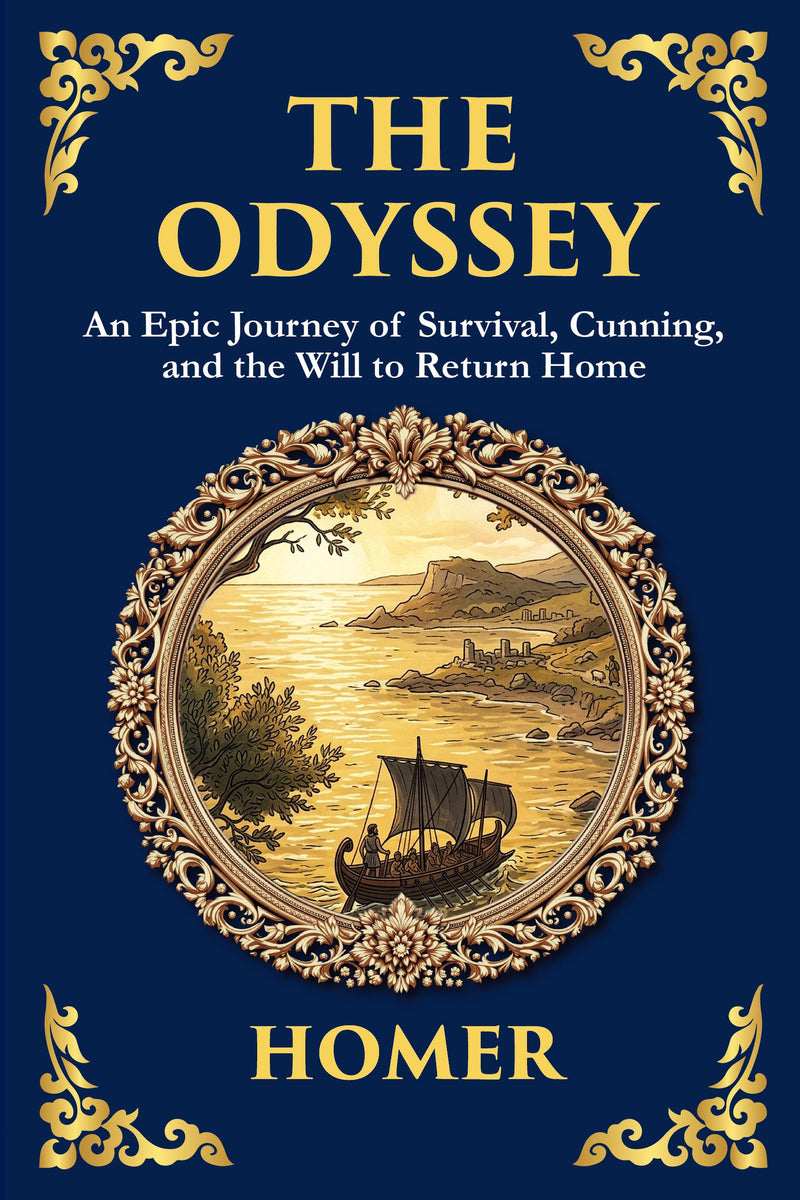
The Odyssey
The Odyssey is one of the greatest epics ever written—a timeless tale of survival, cunning, and the unbreakable human spirit.
or free app
10,000+ hrs library
30-day guarantee
The complete The Odyssey appears in modern English through Library of Alexandria Press, available online with audiobook narration included for members.
Have you ever wondered why The Odyssey remains one of the most celebrated stories of all time? Embark on a thrilling journey across the wine-dark sea as you follow Odysseus, a cunning warrior and king, who must overcome overwhelming odds to return home after the Trojan War. In this epic tale by Homer, the gods themselves take sides, mythical creatures threaten to destroy him, and his every decision tests the limits of his strength and wisdom.
This modern edition captures the poetic majesty and thrilling adventure of the original epic, making it accessible and captivating for today’s readers.
What you’ll discover in this modern edition
- The Heroic Journey of Odysseus – Witness his epic struggle against cyclopes, sirens, sea storms, and divine wrath.
- The Power of Cunning and Courage – Learn how intelligence and perseverance can triumph over brute strength and adversity.
- A Tale of Family and Loyalty – Follow Penelope’s clever resistance and Telemachus’s growth as they hold faith in Odysseus’s return.
- Timeless Lessons of Leadership and Honor – Explore themes of resilience, justice, and the consequences of hubris.
- A Vivid Window into Ancient Greek Culture – Experience the myths, traditions, and values of one of history’s most influential civilizations.
| Formats | eBook (EPUB + PDF) · Audiobook · Paperback · Hardcover · Large Print |
| Language | English |
| Trim size (print) | 6 × 9 in |
| Binding | Paperback — perfect-bound · Hardcover — casewrap |
| Large Print edition | Same text in a larger, easy-read type — a larger font, not a larger trim |
| Print pricing | Every physical book at our true cost — at-cost, no profit (members) |
| Library | 873 restored titles, always growing |
| Length | 105,370 words · ~7 hr 1 min reading |
| Reading level | Grade 7 · an easy, flowing read (this modern-English edition) |
| Edition | Modern English translation · 2026 |
Member reviews for this edition are collected as readers finish it — be the first. Across the library: 12,000+ books shipped, every plan covered by a 365-day print guarantee.
About this edition
A faithful, unabridged modern-English edition by The Library of Alexandria — carefully rendered for today's reader and verified paragraph-by-paragraph against the public-domain source. Available as eBook, audiobook, paperback, hardcover, and large print.
- Complete & unabridgedVerified paragraph by paragraph against the source — never a scan, never abridged.
- Modern English, faithfulReadable today, with the author’s meaning kept intact. Readable — not simplified.
- Every format, one membershipRead in your browser or the free app, or listen to the full audiobook.
Included free with your membership
Cancel anytime, one click · 30-day money-back guarantee
Edition last updated July 2026
What’s inside
The Odyssey — complete and unabridged: all 25 sections included with membership, plus the full audiobook.
Begin reading The Odyssey
In clear modern English — the complete text is included with membership.
Introduction
There are stories so old that they seem less like things written by human hands than like features of the natural world—mountains we have always lived beneath, rivers we have always crossed. The tale you are about to read is one of these. For nearly three thousand years it has been recited, sung, copied, memorized, translated, argued over, and loved. It has outlived the civilization that produced it, the language it was first composed in, and the very gods whose favor and fury drive its plot. Empires that came after it have risen and fallen. And still, when a weary traveler longs for home, when a clever person talks their way out of danger, when someone refuses to give up against impossible odds, we reach instinctively for the images and rhythms this poem first gave us. To open these pages is to step into one of the deepest currents of human imagination—a current that has carried readers and listeners along since before the foundations of Rome were laid.
What you hold is a modern translation, shaped for the contemporary reader. That phrase deserves a moment of explanation, because it tells you something important about the experience ahead. The original was not a book at all. It was a performance—a vast oral composition, sung aloud by a bard to the accompaniment of a stringed instrument, before audiences who could neither read nor write but who knew the great stories of their people the way we know the melodies of songs we have heard since childhood. The language was a poetic dialect of ancient Greek, woven out of fixed phrases and rolling meter, designed to be heard rather than studied in silence. A faithful word-for-word rendering into English can be a daunting thing for a newcomer, dense with unfamiliar names, repeated formulas, and the assumptions of a world long vanished. This edition takes a different path. It aims to give you the swiftness, the suspense, the humor, and the heartbreak of the tale in language that moves naturally for a reader today, so that nothing stands between you and the story itself. The goal is not to simplify but to clarify—to let the ancient fire burn brightly through a modern window.
To understand why this work feels so alive even now, it helps to know a little about where it came from. The author is named Homer, and yet almost everything about him is uncertain. We do not know with confidence when he lived, where he was born, or even whether he was a single person at all. The Greeks themselves, looking back at this poet from their own classical age, regarded him as the fountainhead of all literature, the teacher of Greece, and yet they too disagreed about the details of his life. Several cities claimed him as their own. Some traditions held that he was blind. Modern scholars have spent generations debating whether the great poems attributed to him were the work of one extraordinary mind or the crystallization of a long tradition of oral storytelling, refined over centuries by many singers and finally set down in writing somewhere around the eighth or seventh century before the common era.
What seems likeliest is something in between, and something rather wonderful. For untold generations before any of these verses were committed to writing, professional singers traveled the Greek-speaking world, performing tales of gods and heroes. They did not memorize fixed texts. Instead, they had mastered a living technique—a storehouse of stock phrases, recurring scenes, and metrical building blocks that let them compose anew with each performance, shaping ancient material to the mood of the moment and the audience before them. A storm at sea, a feast in a great hall, the arming of a warrior, the welcoming of a guest: these were patterns the singer could summon and vary at will, like a jazz musician improvising on familiar themes. Out of this tradition, at some pivotal moment, a poet of supreme genius—or perhaps a poet working at the very threshold where oral performance met the new technology of writing—gave shape to the masterwork before you.
This origin explains many of the qualities you will notice as you read. You may find certain phrases returning again and again, certain descriptions attached like permanent labels to particular characters or times of day. These are the fingerprints of the oral tradition, and far from being flaws, they are part of the poem’s particular music. They create a sense of ritual, of a world governed by deep and steady rhythms, where the dawn arrives with the same hands each morning and the sea wears the same color each time the ships are launched upon it. In the rendering you are about to read, these patterns have been handled with care—preserved where they lend beauty and weight, eased where they might slow a modern reader’s pace—so that you can feel their presence without being held back by them.
It is worth pausing, too, on the sheer improbability that this poem survived at all. Composed in an age when writing was rare and precious, copied by hand across centuries, transmitted through the collapse of the ancient world and the long medieval silence, it reached us through a fragile chain of devoted scribes and scholars. When you turn these pages, you are the latest link in a chain of listeners and readers stretching back nearly a hundred generations. There is something humbling in that thought. The same words that stirred audiences in the marketplaces of the ancient Mediterranean, that schoolchildren in classical Athens learned by heart, that Roman aristocrats read in their villas and Renaissance poets devoured by candlelight, are now arriving in your hands. Few experiences a reader can have are quite so direct a touch across the abyss of time.
The world the poem describes is older still than the world that produced it. The events it recounts belong to a legendary past that the ancient Greeks already regarded as remote and heroic—an age of mighty kings and great deeds, set generations before the poet’s own lifetime. This gives the work a peculiar double depth. It is an old story about an even older world, told by a culture looking back with longing and wonder at what it imagined to be a grander, more vivid age. That sense of golden distance, of greatness glimpsed across the gulf of time, is woven into the texture of the tale and is part of what gives it its haunting beauty.
Without revealing what unfolds, it is fair to say what this poem is about, in the largest sense, because knowing this will deepen everything you encounter. At its core, this is a story about coming home. That single word—home—carries within it nearly everything the poem cares for: the longing for a place where one belongs, the loyalty of those who wait, the identity that home confers and that exile strips away, and the question of whether a person can ever truly return to a life left behind, or whether too much has changed in the years of absence.
It is also a story about survival, and about the particular kind of intelligence required to survive. The hero at its center is not primarily a man of brute strength, though he can fight when fighting is needed. He is, above all, a man of cunning—a thinker, a planner, a deceiver, a master of disguise and persuasion. Where other heroic tales celebrate raw might and battlefield glory, this one celebrates the supple mind: the ability to read a situation, to improvise, to endure humiliation in service of a larger goal, to wait when waiting is wiser than acting, and to act decisively when the moment finally comes. This is a profoundly human kind of heroism. Most of us will never face the dangers this hero faces, but all of us must navigate by our wits, must endure setbacks, must keep our deeper purposes hidden when the world is hostile. In this sense, the poem speaks to the everyday struggle of ordinary life as much as to the grand adventures of legend.
You will encounter a story rich in variety and texture. There are perils that have entered the bedrock of Western imagination—encounters with monstrous beings, enchantments and temptations, dangerous waters and treacherous shores. There are also quieter passages of extraordinary tenderness: scenes of hospitality and homecoming, of family bonds tested by long separation, of a faithful dog, an old nurse, a patient wife, a son growing into manhood. The poem moves between the supernatural and the intimately domestic with remarkable ease, and this range is one of its great glories. One moment you may be in the presence of gods and goddesses who meddle in human affairs with all the jealousy and favoritism of a quarrelsome family; the next you may be at a humble hearth, watching a simple meal prepared with loving attention to every detail.
This blending of registers points to something essential about the worldview the poem embodies. The ancient imagination did not draw a sharp line between the divine and the everyday. The gods are everywhere in these pages—aiding, obstructing, disguising themselves, taking offense, granting favor—and yet they are intensely personal, with their own loves and grudges. The relationship between mortals and immortals here is not one of distant worship but of constant, often fraught, interaction. Human beings are caught in the crosscurrents of divine will, and much of the drama arises from the tension between what the gods intend and what mortals desire, between fate and effort, between the limits set upon us and the room we have to act within them. To watch the hero strive against these forces—neither wholly free nor wholly bound—is to watch one of literature’s earliest and most profound meditations on the human condition.
You will also notice how the poem is built. It does not march in a simple straight line from beginning to end. It opens, daringly, in the middle of things, with its central figure still far from home and his household in crisis. Much of the early movement follows not the hero himself but those who await and search for him, building a sense of absence and yearning before the hero fully enters the stage. And when his own adventures are recounted, they come to us through his own voice, told in retrospect at a critical moment—a story within the story, a flashback that lets the man narrate his own legend. This sophisticated structure, with its shifts of viewpoint and its interweaving of timelines, may surprise readers who expect ancient literature to be primitive or crude. In truth, the architecture of this poem is the work of a master, and its techniques of suspense, delay, and revelation feel startlingly modern. The poet knew exactly how to withhold and disclose, how to make us ache for a reunion long before it arrives, how to let dramatic irony hum beneath the surface as we, the audience, know things the characters do not.
A few words of gentle guidance will help you settle into the experience. First, do not be intimidated by the names. The world of the poem is populated by many figures—gods, kings, companions, hosts, and adversaries—and their names may at first seem unfamiliar. You will find that the truly important characters announce themselves clearly through their actions and reappear often enough to become familiar friends. Let the lesser names wash over you; the story will carry you regardless. Second, allow yourself to enjoy the poem’s love of detail. The ancient audience delighted in descriptions of objects, meals, garments, ships, and rituals, and these passages are not filler but pleasures in themselves—windows into a way of life, and sources of the poem’s vivid, sensory richness. Third, read for the feeling as much as the facts. This is a work that rewards emotional surrender. Its deepest moments are not its monsters or its marvels but its human truths: the pain of separation, the joy of return, the courage to keep going.
It is also worth knowing that the values of this ancient world will sometimes differ sharply from our own. The poem comes to us from a society with its own assumptions about honor, hospitality, justice, vengeance, the roles of men and women, and the treatment of strangers and enemies. Some of these you will recognize and admire; others may strike you as alien or troubling. This is part of what makes reading across such a vast distance of time so valuable. The poem does not ask you to adopt its world’s every belief; it invites you to enter that world fully enough to understand it, and in understanding it, to see your own world more clearly by contrast. The sacred duty of hospitality—the obligation to welcome a stranger, feed and shelter them, and ask their name only after they have been cared for—runs through the entire poem as a kind of moral measuring stick. Watch how characters treat the strangers who arrive at their gates, for in this world a person’s whole character can be read in that single test. It is one of many ways the poem quietly teaches even as it entertains.
Cancel anytime, one click · 30-day money-back guarantee
Founding annual rate available now — your price locks for life when you join.
Not ready? Get this free chapter by email — read it anytime.
✓ Sent — check your inbox for The Odyssey.
Questions about The Odyssey
What is The Odyssey about?
The Odyssey is one of the greatest epics ever written—a timeless tale of survival, cunning, and the unbreakable human spirit. After the fall of Troy, the hero Odysseus embarks on a perilous journey home, facing terrifying monsters, vengeful gods, and dangerous temptations along the way. His wife, Penelope, and son, Telemachus, wait in Ithaca, besieged by suitors who seek to claim Odysseus’s throne.
Who wrote The Odyssey?
The Odyssey was written by Homer. This edition presents the complete work in clear modern English, faithfully rendered from the public-domain original by Library of Alexandria Press.
Is The Odyssey free to read?
The opening chapter is free to read on this page. Members read and listen to the complete work — and the entire library — free, and can order any physical book at our true print cost.
How long is The Odyssey?
25 chapters (~105,370 words) — about 7 hr 1 min of reading in this modern-English edition.
Is this an abridged version of The Odyssey?
No. This is the complete, unabridged The Odyssey, carefully rendered into clear modern English and verified paragraph-by-paragraph against the public-domain source — nothing is cut or summarised.
What formats does The Odyssey come in?
The Odyssey is available as eBook, paperback, hardcover and large print. eBook and audiobook are included with membership; printed editions ship at our true print cost.
Shipping & returns
Billing & membership
More from the library


Explore Myths & Legends
- The Red Fairy Book · Andrew Lang
- Vikram and the Vampire: Classic Hindu Tales of Adventure, Magic, and Romance · Unknown
- The Initiates of the Flame · Manly P. Hall
- Gawayne and the Green Knight: A Fairy Tale · Charlton M. Lewis
- The Nibelungenlied · G. H. Needler
- The Aeneid of Virgil · Virgil
- Fifty Famous Stories Retold · James Baldwin
- West African Folk-Tales
- Lamia · John Keats
- The Three Bears · A. E. Kennedy
- The Ballad of the White Horse · G. K. Chesterton
- The Danish History, Books I–IX · Saxo Grammaticus
- Andersen’s Fairy Tales · H. C. Andersen
- Folk-Tales of Bengal · Lal Behari Day
- The Birth of the War-God: A Poem by Kalidasa · Kálidása
- Omens and Superstitions of Southern India · Edgar Thurston
- The Legend of Sleepy Hollow · Washington Irving
- The Hyborian Age · Robert E. Howard
- Grimms’ Fairy Tales · Jacob Grimm and Wilhelm Grimm
- Just So Stories · Rudyard Kipling
- Aeschylus’ Prometheus Bound and the Seven Against Thebes · Aeschylus
- The Iliad · Homer
The Odyssey
The Odyssey
An Epic Journey of Survival, Cunning, and the Will to Return Home
Homer
Contents
- Introduction
- Book 1
- Book 2
- Book 3
- Book 4
- Book 5
- Book 6
- Book 7
- Book 8
- Book 9
- Book 10
- Book 11
- Book 12
- Book 13
- Book 14
- Book 15
- Book 16
- Book 17
- Book 18
- Book 19
- Book 20
- Book 21
- Book 22
- Book 23
- Book 24
Introduction
There are stories so old that they seem less like things written by human hands than like features of the natural world—mountains we have always lived beneath, rivers we have always crossed. The tale you are about to read is one of these. For nearly three thousand years it has been recited, sung, copied, memorized, translated, argued over, and loved. It has outlived the civilization that produced it, the language it was first composed in, and the very gods whose favor and fury drive its plot. Empires that came after it have risen and fallen. And still, when a weary traveler longs for home, when a clever person talks their way out of danger, when someone refuses to give up against impossible odds, we reach instinctively for the images and rhythms this poem first gave us. To open these pages is to step into one of the deepest currents of human imagination—a current that has carried readers and listeners along since before the foundations of Rome were laid.
What you hold is a modern translation, shaped for the contemporary reader. That phrase deserves a moment of explanation, because it tells you something important about the experience ahead. The original was not a book at all. It was a performance—a vast oral composition, sung aloud by a bard to the accompaniment of a stringed instrument, before audiences who could neither read nor write but who knew the great stories of their people the way we know the melodies of songs we have heard since childhood. The language was a poetic dialect of ancient Greek, woven out of fixed phrases and rolling meter, designed to be heard rather than studied in silence. A faithful word-for-word rendering into English can be a daunting thing for a newcomer, dense with unfamiliar names, repeated formulas, and the assumptions of a world long vanished. This edition takes a different path. It aims to give you the swiftness, the suspense, the humor, and the heartbreak of the tale in language that moves naturally for a reader today, so that nothing stands between you and the story itself. The goal is not to simplify but to clarify—to let the ancient fire burn brightly through a modern window.
To understand why this work feels so alive even now, it helps to know a little about where it came from. The author is named Homer, and yet almost everything about him is uncertain. We do not know with confidence when he lived, where he was born, or even whether he was a single person at all. The Greeks themselves, looking back at this poet from their own classical age, regarded him as the fountainhead of all literature, the teacher of Greece, and yet they too disagreed about the details of his life. Several cities claimed him as their own. Some traditions held that he was blind. Modern scholars have spent generations debating whether the great poems attributed to him were the work of one extraordinary mind or the crystallization of a long tradition of oral storytelling, refined over centuries by many singers and finally set down in writing somewhere around the eighth or seventh century before the common era.
What seems likeliest is something in between, and something rather wonderful. For untold generations before any of these verses were committed to writing, professional singers traveled the Greek-speaking world, performing tales of gods and heroes. They did not memorize fixed texts. Instead, they had mastered a living technique—a storehouse of stock phrases, recurring scenes, and metrical building blocks that let them compose anew with each performance, shaping ancient material to the mood of the moment and the audience before them. A storm at sea, a feast in a great hall, the arming of a warrior, the welcoming of a guest: these were patterns the singer could summon and vary at will, like a jazz musician improvising on familiar themes. Out of this tradition, at some pivotal moment, a poet of supreme genius—or perhaps a poet working at the very threshold where oral performance met the new technology of writing—gave shape to the masterwork before you.
This origin explains many of the qualities you will notice as you read. You may find certain phrases returning again and again, certain descriptions attached like permanent labels to particular characters or times of day. These are the fingerprints of the oral tradition, and far from being flaws, they are part of the poem’s particular music. They create a sense of ritual, of a world governed by deep and steady rhythms, where the dawn arrives with the same hands each morning and the sea wears the same color each time the ships are launched upon it. In the rendering you are about to read, these patterns have been handled with care—preserved where they lend beauty and weight, eased where they might slow a modern reader’s pace—so that you can feel their presence without being held back by them.
It is worth pausing, too, on the sheer improbability that this poem survived at all. Composed in an age when writing was rare and precious, copied by hand across centuries, transmitted through the collapse of the ancient world and the long medieval silence, it reached us through a fragile chain of devoted scribes and scholars. When you turn these pages, you are the latest link in a chain of listeners and readers stretching back nearly a hundred generations. There is something humbling in that thought. The same words that stirred audiences in the marketplaces of the ancient Mediterranean, that schoolchildren in classical Athens learned by heart, that Roman aristocrats read in their villas and Renaissance poets devoured by candlelight, are now arriving in your hands. Few experiences a reader can have are quite so direct a touch across the abyss of time.
The world the poem describes is older still than the world that produced it. The events it recounts belong to a legendary past that the ancient Greeks already regarded as remote and heroic—an age of mighty kings and great deeds, set generations before the poet’s own lifetime. This gives the work a peculiar double depth. It is an old story about an even older world, told by a culture looking back with longing and wonder at what it imagined to be a grander, more vivid age. That sense of golden distance, of greatness glimpsed across the gulf of time, is woven into the texture of the tale and is part of what gives it its haunting beauty.
Without revealing what unfolds, it is fair to say what this poem is about, in the largest sense, because knowing this will deepen everything you encounter. At its core, this is a story about coming home. That single word—home—carries within it nearly everything the poem cares for: the longing for a place where one belongs, the loyalty of those who wait, the identity that home confers and that exile strips away, and the question of whether a person can ever truly return to a life left behind, or whether too much has changed in the years of absence.
It is also a story about survival, and about the particular kind of intelligence required to survive. The hero at its center is not primarily a man of brute strength, though he can fight when fighting is needed. He is, above all, a man of cunning—a thinker, a planner, a deceiver, a master of disguise and persuasion. Where other heroic tales celebrate raw might and battlefield glory, this one celebrates the supple mind: the ability to read a situation, to improvise, to endure humiliation in service of a larger goal, to wait when waiting is wiser than acting, and to act decisively when the moment finally comes. This is a profoundly human kind of heroism. Most of us will never face the dangers this hero faces, but all of us must navigate by our wits, must endure setbacks, must keep our deeper purposes hidden when the world is hostile. In this sense, the poem speaks to the everyday struggle of ordinary life as much as to the grand adventures of legend.
You will encounter a story rich in variety and texture. There are perils that have entered the bedrock of Western imagination—encounters with monstrous beings, enchantments and temptations, dangerous waters and treacherous shores. There are also quieter passages of extraordinary tenderness: scenes of hospitality and homecoming, of family bonds tested by long separation, of a faithful dog, an old nurse, a patient wife, a son growing into manhood. The poem moves between the supernatural and the intimately domestic with remarkable ease, and this range is one of its great glories. One moment you may be in the presence of gods and goddesses who meddle in human affairs with all the jealousy and favoritism of a quarrelsome family; the next you may be at a humble hearth, watching a simple meal prepared with loving attention to every detail.
This blending of registers points to something essential about the worldview the poem embodies. The ancient imagination did not draw a sharp line between the divine and the everyday. The gods are everywhere in these pages—aiding, obstructing, disguising themselves, taking offense, granting favor—and yet they are intensely personal, with their own loves and grudges. The relationship between mortals and immortals here is not one of distant worship but of constant, often fraught, interaction. Human beings are caught in the crosscurrents of divine will, and much of the drama arises from the tension between what the gods intend and what mortals desire, between fate and effort, between the limits set upon us and the room we have to act within them. To watch the hero strive against these forces—neither wholly free nor wholly bound—is to watch one of literature’s earliest and most profound meditations on the human condition.
You will also notice how the poem is built. It does not march in a simple straight line from beginning to end. It opens, daringly, in the middle of things, with its central figure still far from home and his household in crisis. Much of the early movement follows not the hero himself but those who await and search for him, building a sense of absence and yearning before the hero fully enters the stage. And when his own adventures are recounted, they come to us through his own voice, told in retrospect at a critical moment—a story within the story, a flashback that lets the man narrate his own legend. This sophisticated structure, with its shifts of viewpoint and its interweaving of timelines, may surprise readers who expect ancient literature to be primitive or crude. In truth, the architecture of this poem is the work of a master, and its techniques of suspense, delay, and revelation feel startlingly modern. The poet knew exactly how to withhold and disclose, how to make us ache for a reunion long before it arrives, how to let dramatic irony hum beneath the surface as we, the audience, know things the characters do not.
A few words of gentle guidance will help you settle into the experience. First, do not be intimidated by the names. The world of the poem is populated by many figures—gods, kings, companions, hosts, and adversaries—and their names may at first seem unfamiliar. You will find that the truly important characters announce themselves clearly through their actions and reappear often enough to become familiar friends. Let the lesser names wash over you; the story will carry you regardless. Second, allow yourself to enjoy the poem’s love of detail. The ancient audience delighted in descriptions of objects, meals, garments, ships, and rituals, and these passages are not filler but pleasures in themselves—windows into a way of life, and sources of the poem’s vivid, sensory richness. Third, read for the feeling as much as the facts. This is a work that rewards emotional surrender. Its deepest moments are not its monsters or its marvels but its human truths: the pain of separation, the joy of return, the courage to keep going.
It is also worth knowing that the values of this ancient world will sometimes differ sharply from our own. The poem comes to us from a society with its own assumptions about honor, hospitality, justice, vengeance, the roles of men and women, and the treatment of strangers and enemies. Some of these you will recognize and admire; others may strike you as alien or troubling. This is part of what makes reading across such a vast distance of time so valuable. The poem does not ask you to adopt its world’s every belief; it invites you to enter that world fully enough to understand it, and in understanding it, to see your own world more clearly by contrast. The sacred duty of hospitality—the obligation to welcome a stranger, feed and shelter them, and ask their name only after they have been cared for—runs through the entire poem as a kind of moral measuring stick. Watch how characters treat the strangers who arrive at their gates, for in this world a person’s whole character can be read in that single test. It is one of many ways the poem quietly teaches even as it entertains.
Tell me, O Muse, about that clever hero who traveled far and wide after he destroyed the famous city of Troy. He visited many cities and learned the customs and ways of many different people. He suffered greatly at sea while trying to survive and bring his men home safely. However, despite his best efforts, he could not save his crew; they died because of their own foolishness when they ate the cattle of the Sun-god, Hyperion. Because of this, the god prevented them from ever returning home. Tell me all about these events, daughter of Jove, from whatever source you know them.
By now, everyone who survived the war or the shipwrecks had returned home safely except for Ulysses. Although he longed to return to his wife and his country, he was held captive by the goddess Calypso, who kept him in a large cave and wanted to marry him. As the years passed, the gods finally decided it was time for him to return to Ithaca. Even then, however, his troubles didn’t end once he reached his own people. All the gods had begun to pity him except for Neptune, who continued to harass him relentlessly and blocked his way home.
Neptune had traveled to the Ethiopians at the edge of the world, a land split into two halves, one facing west and the other east. He had gone there to accept a massive sacrifice of sheep and oxen and was enjoying the festivities. Meanwhile, the other gods gathered at the home of Zeus, the father of gods and men, who spoke first. At that moment, Zeus was thinking about Aegisthus, who had been killed by Agamemnon’s son, Orestes. He addressed the other gods:
“Look at how humans blame us gods for things that are actually caused by their own stupidity. Take Aegisthus, for example. He felt he had to have an affair with Agamemnon’s wife and then murder Agamemnon, even though he knew it would lead to his own death. I sent Mercury to warn him not to do either, because Orestes would certainly seek revenge once he grew up and returned home. Mercury gave him this warning out of genuine kindness, but he refused to listen. Now, he has paid the full price for his actions.”
End of the free sample
Keep reading, free
Members read and listen to the complete book — and the entire library. Cancel anytime, one click · 30-day money-back guarantee.