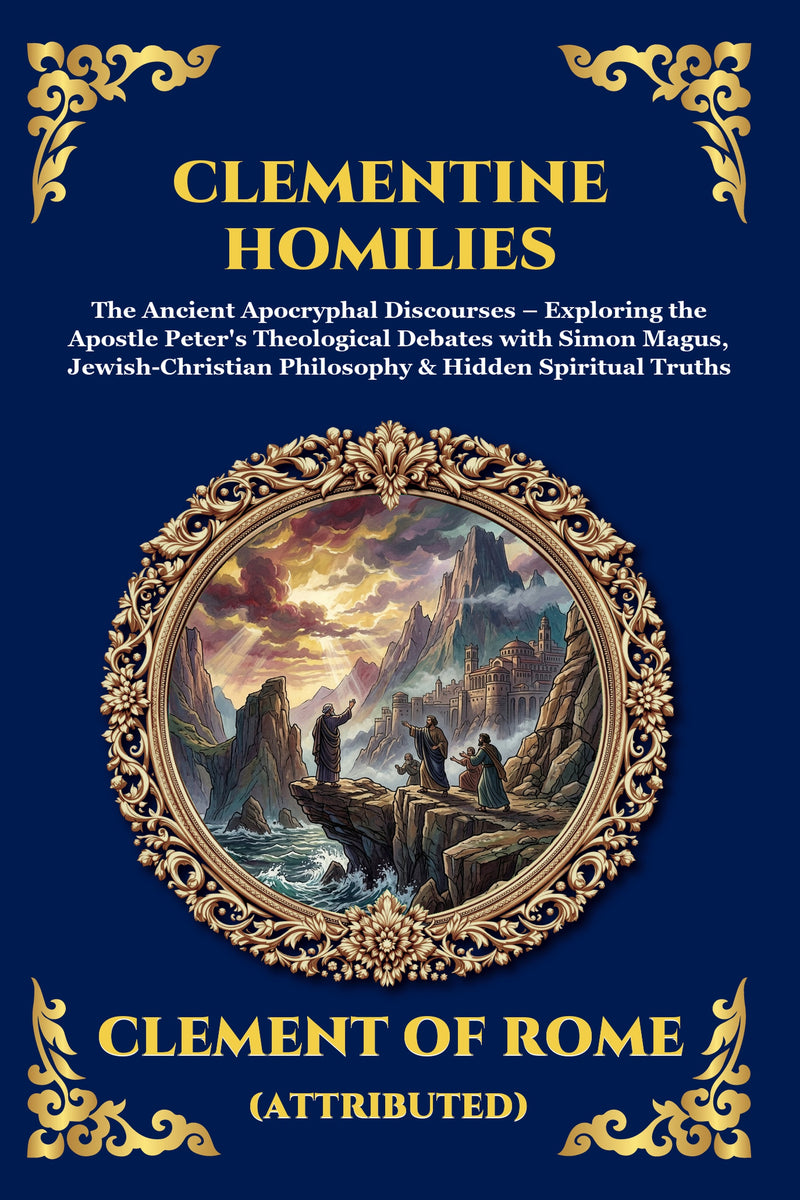
The Clementine Homilies — Large Print
The Clementine Homilies captures the intense intellectual clashes of early Christianity, spotlighting the ideological rivalry between the Apostle Peter and Simon Magus, a self-proclaimed sorcerer. Excluded from the Bible, these twenty discourses attributed to Clement of Rome reveal the fierce theological debates that shaped the nascent church.
or free app
10,000+ hrs library
30-day guarantee
The Clementine Homilies presents the complete twenty homilies in clear modern English translation, available to read online with included audiobook narration through Library of Alexandria Press membership.
What if your search for answers about death leads to a journey through fierce debates over truth?
In The Clementine Homilies, Clement is a young man from Rome troubled by questions about death and the soul. He meets the apostle Peter and travels with him along the eastern Mediterranean. His search for truth unfolds beside the story of his scattered family, giving the long discussions a deeply personal thread.
This anonymous early Christian work, traditionally attributed to Clement of Rome, combines adventure with twenty sections of teaching. In its public debates, Peter confronts Simon Magus, a magician who claims divine power. Their arguments explore evil, human freedom, prophecy, and the relationship between Jewish law and the teachings of Jesus.
Inside this book
- Clement’s restless search – Follow a young man whose questions about death and the soul lead him far from Rome.
- On the road with Peter – Travel from city to city as the narrative brings teaching and argument into the open.
- The clash with Simon – Enter public disputes where claims of divine power meet Peter’s challenges over truth and human freedom.
- The True Prophet – Explore the text’s teaching that one divine teacher appears across different ages.
- Faith, reason, and freedom – Consider arguments about suffering and destiny within a distinctive strand of Jewish Christian thought.
Perfect for readers curious about early Christianity, Jewish Christian ideas, and ancient storytelling, especially those who enjoy a travel tale with searching arguments.
Open the first page and join Clement as his questions set him on the road with Peter.
| Formats | eBook (EPUB + PDF) · Audiobook · Paperback · Hardcover · Large Print |
| Language | English |
| Trim size (print) | 6 × 9 in |
| Binding | Paperback — perfect-bound · Hardcover — casewrap |
| Large Print edition | Same text in a larger, easy-read type — a larger font, not a larger trim |
| Print pricing | Every physical book at our true cost — at-cost, no profit (members) |
| Library | 873 restored titles, always growing |
| Composed | 4th century AD |
| Original language | Greek |
| Source tradition | Greek manuscript tradition with Latin translations |
| Translation basis | Public-domain scholarly translation, rendered in clear modern English |
| Length | 100,741 words · ~6 hr 43 min reading |
| Reading level | Grade 11 · a confident, adult read (this modern-English edition) |
| Edition | Modern English translation · 2026 |
Member reviews for this edition are collected as readers finish it — be the first. Across the library: 12,000+ books shipped, every plan covered by a 365-day print guarantee.
About this edition
The complete, unabridged text in clear modern English — faithful to the original, never simplified. Every paragraph is checked against the source, so nothing is cut, summarised, or paraphrased away. It reads cleanly for today while keeping the original meaning intact.
The Clementine Homilies survives primarily through Greek manuscripts and Latin translations from the medieval period. This edition derives from the standard public-domain scholarly translation and renders it in clear modern English.
- Complete & unabridgedVerified paragraph by paragraph against the source — never a scan, never abridged.
- Modern English, faithfulReadable today, with the author’s meaning kept intact. Readable — not simplified.
- Every format, one membershipRead in your browser or the free app, or listen to the full audiobook.
Included free with your membership
Cancel anytime, one click · 30-day money-back guarantee
Edition last updated June 2026
What’s inside
The Clementine Homilies — Large Print — complete and unabridged: all 120 sections included with membership, plus the full audiobook.
Begin reading The Clementine Homilies — Large Print
In clear modern English — the complete text is included with membership.
Chapter 1
The elders were seized with terror at James's words. Seeing how frightened they were, James said: Listen to me, brothers and fellow servants. If we were to give these books to everyone indiscriminately, and bold or unscrupulous men were to corrupt them or twist them through false interpretation — as you have already heard some have done — then even those who sincerely seek the truth will be left wandering in error forever. It is far better that the books remain with us, and that we share them with all the care already described, giving them only to those who wish to live righteously and to help others do the same. But if anyone, after taking this solemn oath, acts otherwise, he will justly bring eternal punishment upon himself. For why should the one who causes the destruction of others escape destruction himself? The elders were pleased with what James had said, and cried out: Blessed be He who, foreseeing all things, has graciously appointed you as our bishop. When they had said this, we all rose and prayed to the Father and God of all, to whom be glory forever. Amen.
The Epistle of Peter to James
Clement to James, the lord and bishop of bishops, who rules Jerusalem, the holy church of the Hebrews, and the churches everywhere so excellently founded by the providence of God — together with the elders and deacons and the rest of the brethren: peace be with you always.
Chapter I: Peter's Martyrdom
Know this, my lord: Simon — who for the sake of the true faith and the most sure foundation of his teaching was set apart to be the foundation of the Church, and to that end was named Peter by Jesus himself with his own truthful lips; the first-fruits of our Lord, the first of the apostles; the one to whom the Father first revealed the Son; whom Christ with good reason called blessed; the called and chosen companion at table and on the road with Christ; the excellent and proven disciple who, being fittest of all, was commissioned to bring light to the darker part of the world, namely the West, and was enabled to accomplish it — but why do I lengthen my account, reluctant as I am to tell what is sorrowful, yet compelled by necessity to tell it? He himself, driven by his immense love for humanity, came all the way to Rome, and there bore clear and public witness against the wicked one who opposed him, proclaiming that a good King is to reign over all the world. While he was saving men through his God-inspired teaching, he himself was taken by violence and exchanged this present life for life eternal.
Chapter II: The Ordination of Clement
Around that time, when he was about to die, the brethren had gathered together, and he suddenly seized my hand, rose up, and said in the presence of the whole church: Hear me, brothers and fellow servants. Since, as my Lord and Teacher Jesus Christ, whose apostle I am, has taught me, the day of my death is drawing near, I lay my hands upon this Clement as your bishop. To him I entrust my chair of teaching — to him who has traveled with me from beginning to end and has therefore heard all my homilies; who, having shared in all my trials, has been found steadfast in the faith; whom I have found, above all others, to be devout, humane, pure, learned, chaste, good, upright, generous of heart, and willing to bear patiently the ingratitude of some among the catechumens. I therefore give him the power of binding and loosing, so that whatever he ordains on earth shall be decreed in heaven. For he shall bind what ought to be bound and loose what ought to be loosed, as one who knows the rule of the Church. Hear him, then, knowing that whoever grieves the president of the truth sins against Christ and offends the Father of all. Such a person shall not live. And it is fitting that the one who presides should hold the place of a physician, and not give way to the rage of an unreasoning beast.
Chapter III: Nolo Episcopari
While he was still speaking, I knelt before him and begged him to excuse me, declining the honor and authority of the chair. But he answered: Do not ask me about this matter, for it has seemed good to me that it should be so — and all the more because you are reluctant. This chair has no need of a presumptuous man who is eager to occupy it, but of one who is devout in conduct and deeply skilled in the word of God. Show me someone better than yourself — someone who has traveled more with me, heard more of my discourses, and learned the regulations of the Church more thoroughly — and I will not force you to do good against your will. But you will not be able to show me your superior, for you are the choicest first-fruits of the multitudes saved through me. Consider this as well: if you refuse to take up the administration of the Church out of fear of the danger of sin, you may be certain that you sin far more by failing to help the godly who are, as it were, at sea and in peril, when it is within your power to do so — looking only to your own interest rather than to the common good of all. You understand well enough that you must take on this danger, and I will not stop urging it upon you for the sake of all. The sooner you consent, the sooner you will relieve me of my anxiety.
Chapter IV: The Recompense of the Reward
I myself know, O Clement, the griefs and anxieties, the dangers and reproaches that await you from the untaught multitudes. These you will be able to bear nobly, keeping your eyes fixed on the great reward of patience that God bestows upon you. Consider this fairly with me as well: when does Christ have need of your help? Now, while the wicked one has declared war against his bride? Or in the time to come, when Christ shall reign victorious and need no further aid? Is it not plain to anyone with even the least understanding that it is now? Therefore hasten with all good will, in this time of present necessity, to do battle on the side of this good King, whose nature it is to give great rewards after victory. Take up the oversight gladly, and all the more readily because you have learned from me how the Church is to be administered, for the safety of the brothers and sisters who have taken refuge with us.
Peter wished to remind everyone present of the duties belonging to the administration of the church.
You must live blamelessly, and with the greatest earnestness shake off all the cares of secular life. Do not stand surety for anyone, do not act as an advocate, and do not entangle yourself in any other worldly business. Christ does not appoint you to be a judge, an arbitrator, or a broker in the affairs of this present life. If you were confined to the everyday concerns of men, you would have no leisure to use the word of truth to separate the good from the bad. Let the disciples perform these offices for one another, and let them not draw you away from the discourses that have power to save. Just as it would be wrong for you to take on secular burdens and neglect what you have been commanded to do, so it is a sin for every layman if he does not stand by his brothers even in their worldly necessities. If people do not yet understand that they must arrange things so that you are free from such concerns, let them learn it from the deacons — so that you may give your full attention to the care of the church, both governing it well and proclaiming the words of truth.
If you were occupied with secular cares, you would deceive both yourself and those who listen to you. Being too busy to point out what is truly advantageous, you would be punished for failing to teach what was profitable, and your hearers, having never learned, would perish through ignorance. Preside over them, therefore, free from such distractions, so that you may send forth in due season the words that have power to save them. Let them listen to you, knowing that whatever the ambassador of truth binds on earth is bound also in heaven, and whatever he looses is loosed. You shall bind what ought to be bound and loose what ought to be loosed. These, and matters like them, are the things that belong to you as president of the church.
Concerning the presbyters, take these instructions. Above all, see to it that young people are joined in marriage early, before the entanglements of youthful lust take hold of them. Do not neglect the marriage of those who are already old either, for lust is vigorous even in some older men. Take precautions, therefore, and keep watch, lest fornication find a place among you and bring a pestilence upon the community, and lest the fire of adultery be secretly kindled in your midst. Adultery is a terrible thing; it holds second place in respect of punishment, the first being reserved for those who are in error, even if they are otherwise chaste. As elders of the church, train the bride of Christ in chastity. If she is found chaste by her royal Bridegroom, she will receive the greatest honor, and you, as the friends of the bridegroom, will receive great commendation. But if she is found to have sinned, she herself will be cast out, and you will suffer punishment if her sin was in any way the result of your negligence.
Above all things be careful about chastity, for fornication has been marked out as a bitter thing in the sight of God. There are many forms of fornication, as Clement himself will explain to you. The first is adultery — that a man should not be content with his own wife alone, or a woman with her own husband alone. Whoever is chaste is also capable of being generous toward others, and on account of that generosity he will obtain eternal mercy. For as adultery is a great evil, so generosity toward others is the greatest good. Love all your brothers and sisters with a grave and compassionate spirit: be as parents to orphans, as husbands to widows, providing for them with all kindness; arrange marriages for those who are of marriageable age; find honest employment for those who have no trade; give work to the craftsman and alms to those who are unable to work.
I know that you will do all these things if you fix love firmly in your hearts, and the one sure means of letting love enter is the sharing of a common meal. See to it, therefore, that you are frequently guests at one another's tables, as often as you are able, so that this love may never fail you. It is the cause of well-doing, and well-doing is the cause of salvation. Present your provisions in common to all your brothers and sisters in God, knowing that in giving temporal things you will receive eternal ones. Above all, feed the hungry, give drink to the thirsty, clothe the naked, visit the sick, go to those who are in prison and help them as you are able, and receive strangers into your homes with all readiness. In short, without going into every detail, love for others will teach you to do everything that is good, just as hatred of others suggests every kind of evil to those who will not be saved.
Let brothers who have disputes to settle not bring them before the secular authorities, but let them by all means be reconciled through the elders of the church, yielding ready obedience to their judgment. Flee avarice as well, since it is capable of depriving you of eternal blessings under the pretense of temporal gain. Keep your scales, your measures, your weights, and everything connected with your trade scrupulously honest. Be faithful in all that is entrusted to you. You will persevere in doing these things and others like them to the very end, if you carry in your hearts an indelible remembrance of the judgment that comes from God. For who would sin, if he were truly persuaded that at the close of life a judgment has been appointed by the righteous God — who is patient and good for now, so that the good may hereafter enjoy unspeakable blessings forever, while sinners, being found evil, will receive an eternity of unspeakable punishment? One might reasonably doubt that these things are so, were it not that the Prophet of truth has declared and sworn that they shall be.
Why, being disciples of the true Prophet, lay aside all double-mindedness, from which ill-doing springs, and eagerly pursue what is good. But if any of you has doubts about the things I have spoken of as yet to come, let him confess it without shame — if he truly cares for his own soul — and the president will satisfy his questions. But if he has believed rightly, let him live with confidence, as one fleeing from the great fire of condemnation and entering into the eternal and blessed kingdom of God.
Cancel anytime, one click · 30-day money-back guarantee
Founding annual rate available now — your price locks for life when you join.
Not ready? Get this free chapter by email — read it anytime.
✓ Sent — check your inbox for The Clementine Homilies — Large Print.
Questions about The Clementine Homilies — Large Print
What are the Clementine Homilies about?
They tell how Clement, a young Roman, searches for truth, meets the apostle Peter and travels with him. The work includes Peter's debates with Simon Magus, teaching on the True Prophet, and a thread about Clement's family.
Who wrote the Clementine Homilies and when?
The author is unknown. The text was linked in tradition to Clement of Rome, but scholars place the Homilies mostly in the fourth century, drawing on an earlier source from about the third. Exact dates are debated.
What is the difference between the Homilies and the Recognitions?
They are two forms of the same story. The Homilies survives in Greek in twenty sections. The Recognitions is known mainly through a Latin translation by Rufinus and in Syriac. Both likely use an earlier lost source.
Who is Simon Magus in the Clementine Homilies?
Simon Magus is a magician who claims divine power and opposes Peter. He first appears in the Acts of the Apostles. In this work he is Peter's chief rival, and some scholars think he also stands for Paul.
Shipping & returns
Billing & membership
More from the library


Explore All books
- Crime and Punishment · Fyodor Dostoyevsky
- Wuthering Heights · Emily Brontë
- Oliver Twist · Charles Dickens
- Pride and Prejudice · Jane Austen
- The Iliad · Homer
- Romeo and Juliet · William Shakespeare
- The Picture of Dorian Gray · Oscar Wilde
- Macbeth · William Shakespeare
- Alice's Adventures in Wonderland · Lewis Carroll
- The I Ching
- Frankenstein · Mary Shelley
- Grimms' Fairy Tales · Jacob Grimm; Wilhelm Grimm
- Max and Moritz: A Story of Seven Boyish Pranks · Wilhelm Busch
- A Christmas Carol · Charles Dickens
- The Odyssey · Homer
- Paradise Lost · John Milton
- Treasure Island · Robert Louis Stevenson
- The Romance of Tristan and Iseult · Joseph Bédier
- The Prince · Niccolò Machiavelli
- War and Peace · Leo Tolstoy
- The Miser · Molière
- The Aeneid · Virgil
- Rip Van Winkle · Washington Irving
- David Copperfield · Charles Dickens
- The Brothers Karamazov · Fyodor Dostoyevsky
- The Sorrows of Young Werther · Johann Wolfgang von Goethe
- The Great Gatsby · F. Scott Fitzgerald
- Night Pieces · E. T. A. Hoffmann
- The Count of Monte Cristo · Alexandre Dumas; Auguste Maquet
- Wisdom of Jesus ben Sirach · Attributed to Joshua ben Sira
The Clementine Homilies — Large Print
The Clementine Homilies
The Pseudo-Clementine Romance — The Twenty Homilies of Clement of Rome: His Travels with the Apostle Peter, the Great Disputations Against Simon Magus, the Doctrine of the True Prophet, and the Recognition of His Long-Lost Family
Library of Alexandria Press
The Clementine Homilies
© Copyright 2026 Library of Alexandria Press. All rights reserved.
Published by Library of Alexandria Press
Printed in the United States of America
It is not legal to copy, share, or send any part of this document in either digital or printed form without written permission from the publisher, except short quotes in a book review.
Table of Contents
Introduction
Chapter 1
Chapter I
Chapter II
Chapter III
Chapter IV
Chapter 2
Chapter 3
Chapter XVII
Chapter XVIII
Chapter XIX
Chapter XX
Chapter XXI
Chapter XXII
Chapter XXIII
Chapter XXIV
Chapter XXV
Chapter XXVI
Chapter XXVII
Chapter XXVIII
Chapter XXIX
Chapter 4
Chapter 56
Chapter 57
Chapter 58
Chapter 59
Chapter 60
Chapter 61
Chapter 62
Chapter 63
Chapter 5
Chapter I
Chapter II
Chapter III
Chapter IV
Chapter V
Chapter VI
Chapter VII
Chapter VIII
Chapter 6
Chapter XIV
Chapter XV
Chapter XVI
Chapter XVII
Chapter XVIII
Chapter XIX
Chapter XX
Chapter XXI
Chapter XXII
Chapter XXIII
Chapter XXIV
Chapter XXV
Chapter XXVI
Chapter XXVII
Chapter XXVIII
Chapter XXIX
Chapter 7
Chapter I
Chapter II
Chapter III
Chapter IV
Chapter 8
Chapter 9
Chapter I
Chapter II
Chapter III
Chapter IV
Chapter V
Chapter VI
Chapter VII
Chapter 10
Chapter 11
Chapter XXIII
Chapter XXIV
Chapter XXV
Chapter XXVI
Chapter 12
Chapter I
Chapter II
Chapter III
Chapter IV
Chapter V
Chapter VI
Chapter VII
Chapter XVIII
Chapter XIX
Chapter XX
Chapter XXI
Chapter XXII
Chapter XXIII
Chapter XXIV
Chapter XXXII
Chapter XXXIII
Chapter XXXIV
Chapter XXXV
Chapter XXXVI
Chapter 13
Chapter I
Chapter II
Chapter III
Chapter IV
Chapter V
Chapter VI
Chapter VII
Chapter VIII
Chapter IX
Chapter X
Chapter XI
Chapter XII
Chapter XIII
Chapter 14
Chapter I
Chapter II
Chapter III
Chapter IV
Chapter V
Chapter XIX
Chapter XX
Chapter XXI
Chapter 15
Chapter I
Chapter II
Chapter III
Chapter IV
Chapter V
Chapter 16
Chapter 17
Chapter 18
Chapter I
Chapter II
Chapter III
Chapter IV
Chapter V
Chapter 19
Chapter 20
Chapter 21
Chapter I
Chapter II
Chapter III
Chapter IV
Chapter VIII
Chapter IX
Chapter X
Chapter XI
Chapter XII
Introduction
There are books that sit quietly at the edges of history, neither fully forgotten nor fully remembered, waiting for the right moment and the right reader to draw them back into the light. The text you are about to encounter is one of those rare and remarkable documents — a sprawling, intellectually ferocious, spiritually provocative work that was composed sometime in the third or fourth century of the Common Era, yet contains within it traditions, arguments, and theological controversies that stretch back to the very earliest days of the Christian movement. It is a work that has fascinated scholars, mystics, heresiologists, and philosophers for centuries, and yet it remains almost entirely unknown to the general reading public. That is a profound injustice, because few ancient texts offer so rich, so strange, and so genuinely exciting a window into the world of early Christianity — a world far more diverse, contentious, and intellectually alive than most of us have been led to believe.
To understand why this text matters, you first need to understand something about the world in which it was written and the world it describes. The earliest centuries of Christianity were not a period of serene doctrinal unity. They were a period of fierce, often bitter debate about the most fundamental questions imaginable: Who is God? What is the nature of evil? How should human beings live? What authority do the scriptures carry, and how should they be interpreted? Is the God of the Hebrew Bible the same as the God proclaimed by Jesus? What role does ritual observance play in salvation? These were not abstract academic questions — they were questions that communities lived and died by, questions that split families and cities, questions that generated an extraordinary outpouring of literary creativity as different factions attempted to articulate, defend, and propagate their visions of truth.
Into this turbulent world steps the narrative you are about to read. It takes the form of a kind of ancient novel — a genre that was enormously popular in the Greco-Roman world — combined with theological dialogue, philosophical disputation, and what we might today call adventure storytelling. The central figure is Clement, a young Roman aristocrat of searching intelligence and deep spiritual hunger, who finds himself drawn into the orbit of the Apostle Peter and becomes his devoted companion, student, and ultimately the recorder of his teachings. Through Clement's eyes, we witness Peter's extraordinary journeys through the cities and towns of the ancient Near East — Caesarea, Tyre, Sidon, Tripolis, Antioch — as he preaches, heals, debates, and confronts his great antagonist, the enigmatic and dangerous figure known as Simon Magus.
Simon Magus is one of the most fascinating and underappreciated figures in all of early Christian literature. He appears briefly in the canonical Acts of the Apostles, where he is depicted as a Samaritan sorcerer who attempts to purchase the power of the Holy Spirit from Peter and is sharply rebuked. But in the imagination of the early Christian world, Simon grew into something far larger and more threatening — a kind of archetypal false prophet, the father of all heresies, a man of genuine and terrifying supernatural power who sets himself up as a rival to the true message of Christ. In the text before you, he is not a cardboard villain but a genuinely formidable intellectual opponent, a man who argues with skill and passion for positions that challenge Peter at every turn. The debates between Peter and Simon are not mere theatrical exercises — they are genuine philosophical confrontations that force both characters, and the reader, to grapple with some of the deepest questions in religious thought.
What makes these confrontations so remarkable is the level of intellectual seriousness with which they are conducted. The author or authors of this text — and the question of authorship is itself a fascinating scholarly puzzle — were clearly people of considerable learning, steeped not only in Jewish and Christian scripture but in Greek philosophy, particularly the traditions of Stoicism, Platonism, and Pythagoreanism. The arguments that Simon advances, and that Peter must counter, draw on a sophisticated understanding of Greek metaphysics, cosmology, and epistemology. Peter's responses, in turn, reveal a distinctive theological vision — one that is deeply rooted in Jewish monotheism, profoundly suspicious of Greek philosophical speculation, and committed to a particular understanding of prophecy, scripture, and the nature of the true prophet. This vision is not the theology of the later Catholic Church, nor is it quite what most modern readers would recognize as mainstream Christianity. It is something older, stranger, and in many ways more interesting.
The theological world of this text is one in which the boundaries between Judaism and Christianity are far more fluid than they would later become. Peter, as he appears here, is emphatically a Jewish teacher — a man who observes dietary laws, practices ritual purity, and insists on the continuing validity of the Mosaic law. His Christianity is not a replacement of Judaism but a fulfillment of it, and his understanding of Jesus is shaped by categories drawn from Jewish prophetic and wisdom traditions rather than from the later Greek philosophical theology that would come to dominate Christian thought. This has led many scholars to identify the theological perspective of this text with a movement known as Jewish Christianity — a form of early Christian belief that maintained close ties to Jewish practice and thought and that was eventually marginalized and largely suppressed as Gentile Christianity came to dominate the movement. In this sense, the text you are reading is not merely a theological curiosity — it is a precious survival from a lost world, a window into a form of Christian thought that might have been, but was not allowed to be.
There is another dimension to this text that deserves special attention from the outset, and that is its relationship to what scholars call the Pseudo-Clementine literature — a broader body of texts that includes not only the Homilies but also a related work known as the Recognitions, as well as various shorter documents and epistles. The relationship between these texts is extraordinarily complex, and it has generated a vast scholarly literature attempting to reconstruct the sources, redactions, and historical layers that lie behind the surviving documents. At the heart of this scholarly puzzle is a hypothetical source text, sometimes called the Basic Writing or the Grundschrift, which is thought to underlie both the Homilies and the Recognitions. Reconstructing this source — and through it, the even earlier traditions it incorporated — has been one of the great detective stories of New Testament scholarship, involving figures like Johann Carl Ludwig Gieseler, Adolf Hilgenfeld, Adolf von Harnack, and more recently scholars like F. Stanley Jones and Annette Yoshiko Reed. You do not need to be familiar with any of this scholarship to enjoy and profit from reading the text itself, but knowing that it exists gives you some sense of the depth of the historical and literary questions that this work raises.
One of the most intriguing of those questions concerns the relationship between the Pseudo-Clementine literature and the historical controversies of the earliest Christian generation. Several passages in the text contain what appear to be thinly veiled attacks on the Apostle Paul — attacks conducted under the guise of criticizing Simon Magus. Paul, in this reading, is the great enemy of the Petrine tradition, the man who claimed a private revelation on the road to Damascus and used it to overturn the teachings of those who had actually known Jesus in the flesh. This interpretation, first seriously advanced in the nineteenth century by the Tübingen School of Ferdinand Christian Baur, remains controversial, but it points to something real and important: the text is not a neutral theological exercise but a partisan document, written from a particular standpoint within the disputes of early Christianity, and reading it with an awareness of those disputes enormously enriches the experience.
Yet for all its historical and scholarly interest, it would be a mistake to approach this text primarily as a document for specialists. It is, first and foremost, a story — and a genuinely compelling one. The narrative of Clement's spiritual journey, his separation from his family, his gradual discovery of the truth, and his eventual reunion with those he has lost has the structure and emotional power of a Greek romance novel. The debates between Peter and Simon crackle with intellectual energy and occasional dark humor. The descriptions of the ancient cities through which the characters move — their markets, their temples, their philosophical schools, their diverse and jostling populations — give the text a vivid sense of place and time. And running through everything is a genuine spiritual seriousness, a sense that the questions being debated are not merely academic but existential, that the answers matter in the most profound possible way.
A World of Hidden Truths
One of the most distinctive features of the theological vision embedded in this text is its understanding of truth as something hidden, layered, and accessible only to those who are properly prepared to receive it. This is not, it should be emphasized, a gnostic text in the technical sense — it does not teach that the material world is the creation of an evil or ignorant deity, and it does not posit a radical dualism between spirit and matter. But it does share with Gnostic thought a conviction that the scriptures contain hidden meanings that are not accessible to ordinary reading, that the true prophet communicates in ways that require interpretation, and that there is an inner circle of understanding available to those who have undergone the appropriate preparation.
Peter, as he appears in these pages, is the guardian of a secret teaching — what the text calls the 'true prophet' tradition. According to this tradition, the divine truth has been communicated through a series of prophetic figures throughout human history, each of whom has proclaimed the same essential message in terms appropriate to their time and place. This teaching has been preserved, transmitted, and in some cases deliberately obscured — both to protect it from those who are not ready to receive it and because the scriptures themselves contain passages that are not the genuine word of God but later additions or distortions that must be identified and set aside. Peter's task, as he understands it, is not merely to preach a new religion but to recover and transmit the original, pure teaching that has been overlaid by centuries of error and distortion.
This understanding of scripture and tradition is one of the most intellectually fascinating aspects of the text, and it remains genuinely provocative today. The idea that the biblical text is not uniformly authoritative — that it contains both genuine divine communication and human error, and that the task of the true interpreter is to distinguish between them — is one that modern critical scholarship has approached from a very different direction but with surprisingly similar conclusions. Reading Peter's arguments about the 'false pericopes' in scripture — the passages that attribute unworthy actions to God or to the patriarchs — alongside the work of modern biblical scholars creates a strange and illuminating resonance across the centuries.
Simon Magus, for his part, represents a different kind of hidden truth — or rather, a counterfeit of it. He too claims access to secret knowledge, he too performs signs and wonders that convince many of his divine authority, and he too offers a sophisticated theoretical account of the nature of reality and the divine. The text is careful to make Simon genuinely impressive — not a mere charlatan but a man of real intellectual power and, apparently, real supernatural ability. This makes the confrontation between him and Peter genuinely dramatic, because the reader cannot simply dismiss Simon as an obvious fraud. The question of how to distinguish true prophetic authority from false, genuine divine power from demonic imitation, is one that the text takes with complete seriousness, and it is a question that has lost none of its urgency in the intervening centuries.
The cosmological and metaphysical debates that Peter and Simon conduct range across an extraordinary breadth of territory. They argue about the nature of God — whether the divine is singular or multiple, transcendent or immanent, knowable or unknowable. They debate the origin of evil and whether a truly good God could have created a world containing suffering and injustice. They dispute the nature of the soul, the reality of fate and free will, the significance of astrological influences, and the proper relationship between reason and revelation. These are not debates that were resolved in the third or fourth century, and they are not debates that have been resolved since. Reading them now, one is struck not by their antiquity but by their freshness — by the sense that these are living questions, not museum pieces.
The text's treatment of fate and free will deserves particular attention, because it represents one of the most sustained and sophisticated engagements with this question in all of early Christian literature. Simon, drawing on Stoic and astrological traditions, argues for a thoroughgoing determinism — the idea that human lives are shaped by cosmic forces beyond our control, that the stars at the moment of our birth determine the course of our existence, and that moral responsibility is therefore an illusion. Peter's counter-argument is not a simple assertion of free will but a complex and nuanced engagement with the philosophical tradition, one that attempts to preserve both the sovereignty of divine providence and the genuine freedom and responsibility of human beings. The arguments he deploys are in some respects more sophisticated than those found in the canonical New Testament, and they anticipate debates that would occupy Christian theologians for centuries to come.
Underlying all of these debates is a profound concern with the question of how human beings can know anything at all about the divine. The epistemological dimension of the text — its sustained reflection on the nature, sources, and limits of religious knowledge — is one of its most underappreciated features. Peter is deeply suspicious of the claims of unaided human reason to penetrate the mysteries of the divine. He is equally suspicious of visions, ecstasies, and private revelations — a suspicion that, as noted earlier, may be directed in part against Pauline Christianity. The only reliable guide to truth, in Peter's view, is the teaching of the true prophet, transmitted through an unbroken chain of legitimate authority. This is a position with obvious implications for questions of church authority and apostolic succession, and it is not difficult to see why later Christian thinkers found the text both useful and troubling.
For the modern reader, one of the most rewarding aspects of engaging with this material is the way it defamiliarizes what we think we know about early Christianity. We tend to think of the first centuries of the Christian movement as a period in which a clear, coherent message gradually spread outward from Jerusalem to the wider world, with heresies appearing as deviations from an original orthodoxy. The picture that emerges from this text — and from the broader field of early Christian studies — is almost the reverse: a period of extraordinary diversity in which many different versions of the Christian message competed for adherents, in which the boundaries between Christianity, Judaism, and various forms of philosophical religion were fluid and contested, and in which what we now call orthodoxy was the product of a long and often violent process of selection and suppression. Understanding this does not diminish the significance of the tradition that ultimately prevailed — but it does open our eyes to the richness of what was lost, and to the continuing relevance of the questions that were foreclosed.
Reading Across the Centuries
Approaching an ancient text like this one requires a certain kind of mental flexibility — a willingness to hold in mind simultaneously the world in which the text was written and the world in which we are reading it, to take seriously both the historical distance that separates us from its authors and the surprising continuities that connect us to them. The good news is that the text itself makes this relatively easy, because it is written with a clarity and narrative energy that transcends its historical moment. The author — or authors, since the question of single versus multiple authorship remains unresolved — was clearly a skilled storyteller who understood how to make theological argument dramatically compelling.
The narrative frame of the text — Clement's personal journey, his search for truth, his encounters with Peter and Simon and a cast of memorable secondary characters — gives the abstract theological debates a human dimension that keeps them anchored in lived experience. Clement is not a passive recorder but an active participant, a man who brings his own philosophical training and his own existential questions to the teachings he receives. His doubts, his moments of confusion, his gradual deepening of understanding — all of these are rendered with a psychological realism that feels surprisingly modern. In this sense, reading the text is not entirely unlike reading a Bildungsroman, a novel of education and formation, in which the protagonist's intellectual and spiritual development is the central drama.
The secondary characters who populate the narrative are equally vivid. Clement's family — his mother, his brothers, his father — appear and disappear through the story in ways that generate genuine narrative suspense and emotional investment. The various disciples and companions who travel with Peter each have their own personalities and their own relationships to the central debates. Even the minor characters — the innkeepers, the local officials, the curious bystanders who gather to watch the debates between Peter and Simon — contribute to the texture of a world that feels genuinely inhabited rather than merely described.
For readers with a background in philosophy, the text offers the additional pleasure of recognizing the philosophical traditions that are being engaged, challenged, and sometimes absorbed. The influence of Platonism is pervasive — in the text's understanding of the soul, in its conception of the divine as a unity beyond multiplicity, in its suspicion of the material world as a domain of illusion and error. But the text's relationship to Platonism is not one of simple adoption; it is one of critical engagement, in which Platonic ideas are appropriated where they are useful and rejected where they conflict with the core commitments of the Jewish-Christian tradition. The same is true of Stoicism, Pythagoreanism, and the various forms of astrological and magical thought that were widespread in the ancient world. The text is not a philosophical treatise, but it is philosophically sophisticated in a way that rewards careful attention.
For readers with a background in biblical studies or Christian theology, the text offers a different kind of reward — the opportunity to see familiar figures and familiar questions from an unfamiliar angle. The Peter who appears in these pages is not quite the Peter of the canonical Gospels, not quite the Peter of Catholic tradition, and not quite the Peter of Protestant imagination. He is something older and stranger — a Jewish teacher of immense authority and genuine warmth, a man who carries within him a tradition of prophetic wisdom that he is determined to transmit faithfully, a man who is simultaneously deeply conservative in his attachment to the Mosaic law and radically innovative in his understanding of what that law ultimately means. Encountering this Peter is one of the genuine intellectual pleasures that the text offers.
The question of what to make of Simon Magus is one that the text leaves more open than it might initially appear. On the surface, Simon is the villain of the piece — the false prophet, the deceiver, the man whose supernatural powers are real but whose source is demonic rather than divine. But the text gives him enough intelligence, enough genuine philosophical depth, and enough moments of what looks like authentic spiritual searching that the reader is not allowed to simply dismiss him. This ambiguity is, I think, deliberate. The author understands that the most dangerous form of error is not crude falsehood but sophisticated half-truth — the kind of teaching that contains enough genuine insight to be compelling, enough real power to be convincing, but that is ultimately oriented away from rather than toward the divine. Simon's tragedy, in this reading, is not that he is stupid or wicked but that he is brilliant and proud — a man who has genuine gifts but who has chosen to use them in the service of his own aggrandizement rather than the truth.
There is a lesson in this that extends well beyond the theological controversies of the ancient world. In every age, in every domain of human thought and action, there are figures who combine genuine ability with fundamental misdirection — who offer compelling visions that lead ultimately away from rather than toward human flourishing. The text's sustained meditation on how to distinguish true from false authority, genuine from counterfeit power, authentic from manipulative charisma, is as relevant today as it was in the third century. This is one of the reasons why reading ancient texts of this kind is not merely an act of historical curiosity but an act of genuine self-education.
As you prepare to enter this extraordinary world, a few practical suggestions may be helpful. Read slowly. The text rewards patience and re-reading in a way that few modern works do. When the debates become dense or difficult, resist the temptation to skim — the most challenging passages are often the most rewarding. Pay attention to the narrative frame as well as the theological content; the story of Clement and his family is not merely a vehicle for the theology but an integral part of the text's meaning. And bring your own questions — your own doubts, your own sense of what matters, your own experience of the perennial human struggle to understand the nature of reality and our place within it. This text was written by people who took those questions with complete seriousness, and it deserves readers who do the same.
The survival of this text across seventeen centuries is itself something of a miracle. It was preserved, copied, translated, and transmitted by people who found in it something worth keeping — something that spoke to their condition and their questions in ways that other texts did not. Some of those people were orthodox Christians who found in it a useful account of apostolic authority. Some were scholars who valued it as a historical source. Some were mystics and seekers who found in its hidden-truth theology a validation of their own spiritual intuitions. And some, no doubt, were simply readers who found it a compelling story, well told, about questions that matter. Whatever your reason for picking it up, you are joining a long and distinguished company of people who have found, in these ancient pages, something genuinely worth their time and attention.
The world of late antiquity in which this text was composed was in many respects very different from our own — its cities, its social structures, its assumptions about the nature of reality and the relationship between human beings and the divine were shaped by forces and experiences that we can only partially reconstruct. But in its deepest concerns — the search for truth in a world of competing claims, the struggle to live well in the face of uncertainty, the desire to understand the relationship between justice and power, knowledge and faith, tradition and innovation — it was a world remarkably like ours. The people who wrote and first read this text were asking the same questions that we ask, and they were doing so with an intelligence, a passion, and a seriousness that commands our respect across the centuries. To read their words is not to escape the present but to deepen our understanding of it — to see our own questions reflected in a mirror that is ancient but not dim, distant but not cold. Turn the page, and let the journey begin.
The Clementine Homilies
Chapter 1
The elders were seized with terror at James's words. Seeing how frightened they were, James said: Listen to me, brothers and fellow servants. If we were to give these books to everyone indiscriminately, and bold or unscrupulous men were to corrupt them or twist them through false interpretation — as you have already heard some have done — then even those who sincerely seek the truth will be left wandering in error forever. It is far better that the books remain with us, and that we share them with all the care already described, giving them only to those who wish to live righteously and to help others do the same. But if anyone, after taking this solemn oath, acts otherwise, he will justly bring eternal punishment upon himself. For why should the one who causes the destruction of others escape destruction himself? The elders were pleased with what James had said, and cried out: Blessed be He who, foreseeing all things, has graciously appointed you as our bishop. When they had said this, we all rose and prayed to the Father and God of all, to whom be glory forever. Amen.
The Epistle of Peter to James
Clement to James, the lord and bishop of bishops, who rules Jerusalem, the holy church of the Hebrews, and the churches everywhere so excellently founded by the providence of God — together with the elders and deacons and the rest of the brethren: peace be with you always.
End of the free sample
Keep reading, free
Members read and listen to the complete book — and the entire library. Cancel anytime, one click · 30-day money-back guarantee.