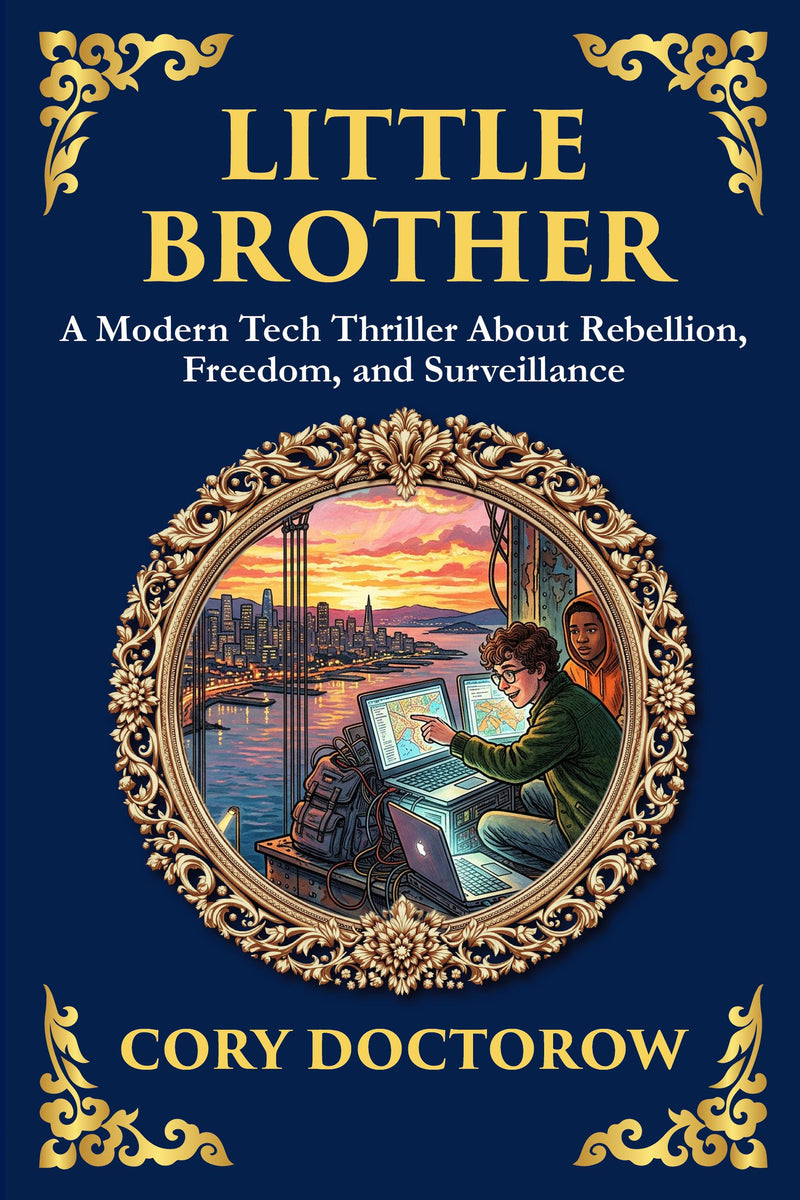
Little Brother
In the wake of a terrorist attack, San Francisco becomes a surveillance state—and Marcus Yallow, a tech-savvy teenager, becomes a threat to national security.
or free app
10,000+ hrs library
30-day guarantee
The complete Little Brother appears in modern English through Library of Alexandria Press, available online with audiobook narration included for members.
Have you ever wondered why those who watch us fear being watched themselves? Little Brother is a pulse-pounding, dystopian thriller for the digital age—a story that merges political urgency with cutting-edge technology to create an unforgettable reading experience. Seventeen-year-old Marcus Yallow knows how to game the system—he’s a master of networks, encryption, and hacking.
But when a massive terrorist attack strikes San Francisco, Marcus is swept up by the Department of Homeland Security and imprisoned without trial. Upon release, he returns to a city transformed by fear and surveillance. Determined to resist, Marcus uses every tool at his disposal—from tech tricks and underground networks to viral messaging and civil disobedience.
But fighting the system isn't just about hacking—it’s about trust, sacrifice, and knowing who you are when the world turns against you. Little Brother isn’t just fiction—it’s a wake-up call. With unflinching honesty and sharp insight, Doctorow explores how governments exploit fear to erode liberty, and how young people can take that power back.
What you’ll discover in this modern edition
- A Fast-Paced Story of Digital Resistance Join Marcus as he fights to reclaim privacy, dignity, and freedom in a city under surveillance.
- A Tech-Savvy Toolkit for Freedom Learn how real-world technologies like TOR, PGP, and keylogging play into the story’s high-stakes battle.
- A Bold Challenge to Authority Question what safety really means in a world where everyone is watched and no one is safe.
- A Coming-of-Age Rebellion Follow Marcus’s emotional journey from frightened teen to courageous leader of a modern-day revolution.
- A Novel as Relevant as Tomorrow’s Headlines Originally published in 2008, Little Brother predicted many of today’s digital privacy battles. This edition keeps it razor-sharp for today’s reader.
| Formats | eBook (EPUB + PDF) · Audiobook · Paperback · Hardcover · Large Print |
| Language | English |
| Trim size (print) | 6 × 9 in |
| Binding | Paperback — perfect-bound · Hardcover — casewrap |
| Large Print edition | Same text in a larger, easy-read type — a larger font, not a larger trim |
| Print pricing | Every physical book at our true cost — at-cost, no profit (members) |
| Library | 873 restored titles, always growing |
| Length | 103,476 words · ~6 hr 54 min reading |
| Reading level | Grade 4 · an easy, flowing read (this modern-English edition) |
| Edition | Modern English translation · 2026 |
Member reviews for this edition are collected as readers finish it — be the first. Across the library: 12,000+ books shipped, every plan covered by a 365-day print guarantee.
About this edition
A faithful, unabridged modern-English edition by The Library of Alexandria — carefully rendered for today's reader and verified paragraph-by-paragraph against the public-domain source. Available as eBook, audiobook, paperback, hardcover, and large print.
- Complete & unabridgedVerified paragraph by paragraph against the source — never a scan, never abridged.
- Modern English, faithfulReadable today, with the author’s meaning kept intact. Readable — not simplified.
- Every format, one membershipRead in your browser or the free app, or listen to the full audiobook.
Included free with your membership
Cancel anytime, one click · 30-day money-back guarantee
Edition last updated July 2026
What’s inside
Little Brother — complete and unabridged: all 25 sections included with membership, plus the full audiobook.
Begin reading Little Brother
In clear modern English — the complete text is included with membership.
Introduction
Imagine, for a moment, that you are seventeen years old. You are smart in the particular way that teenagers can be smart—quick with a comeback, faster with a keyboard, and absolutely certain that the adults running the world have not the faintest idea what they’re doing. You skip school not because you’re a delinquent but because you’ve engineered an elaborate, ingenious method of doing so, one that involves spoofing security cameras and outwitting the gait-recognition software that watches the hallways. You and your friends live half your lives online and half in the streets of a city you love, a city you assume will always be there, indifferent and enormous and free. And then, one ordinary afternoon, that city is attacked. In the chaos and the smoke and the panic, you find yourself swept up by men in uniforms who decide—on no evidence, on the basis of nothing more than where you happened to be standing—that you might be a threat. What happens to you next, and what you decide to do about it, is the engine that drives this remarkable novel.
That is the situation Cory Doctorow drops his young narrator into within the opening chapters, and it is worth pausing here, before you turn another page, to appreciate just how dangerous and how necessary a thing this book is. Published originally in 2008, it arrived during a particular moment in history when questions about security and liberty, about the powers a frightened government might claim for itself and the costs ordinary people might pay, were screaming through the public conversation. Those questions have not gone away. If anything, in the years since, they have grown louder, more urgent, and more intimate. We carry tracking devices in our pockets and call them phones. We narrate our lives to corporations that monetize every keystroke. We have grown accustomed, the way you grow accustomed to a sound you stop hearing, to being watched. This story refuses to let you stop hearing it. It grabs the reader by the collar and says: Pay attention. This is your world. These are your rights. What are you willing to do to keep them?
What makes the book so effective—and what has made it a touchstone for an entire generation of young readers who discovered it and never quite recovered—is that it never feels like a lecture, even though it is, in some deep sense, profoundly didactic. Doctorow wants to teach you things. He wants you to understand how encryption works, why a free press matters, how a population can be manipulated through fear, and what it actually means when someone tells you that you have “nothing to hide.” But he wraps all of this instruction inside a story so propulsive, so charged with the breathless momentum of a thriller, that you absorb the lessons almost without noticing. You think you’re reading about a kid trying to outsmart a security apparatus that has decided he’s an enemy. You are. But you’re also reading a manual for thinking clearly in an age designed to keep you confused and afraid.
This particular edition presents itself as a modern translation, adapted for the contemporary reader. That phrase deserves a word of explanation, because it speaks to something genuinely interesting about a book like this one. Most novels age the way wine ages, slowly and on a human timescale. A story about love or grief or ambition written fifty years ago still rings true because love and grief and ambition do not change. But a story rooted in technology ages the way milk ages—rapidly, and in ways you can smell. The gadgets that felt cutting-edge when the book first appeared have become museum pieces. The social platforms that loomed large have risen and fallen and been replaced. The specific anxieties of one decade have curdled into the different, sharper anxieties of the next. A faithful adaptation for the contemporary reader, then, is not a betrayal of the original—it is an act of preservation. It keeps the heart of the thing beating by giving it a body that can survive in the present. The ideas, the fire, the moral seriousness, and above all the breakneck story remain exactly what they were. What has been tended and refreshed is the surface texture, so that today’s reader can step inside the world without the constant friction of dated references pulling them back out.
And the ideas, mercifully, have not dated at all. That is both the genius and the tragedy of this novel. Doctorow built his story around questions that he hoped, I suspect, the world might eventually outgrow. We have not outgrown them. We have, if anything, grown more deeply entangled in them. The tension between safety and freedom, the seductive logic of mass surveillance, the way authority expands to fill whatever space fear opens up for it—these are not historical curiosities. They are the weather of our daily lives. When you read about a young man discovering that his movements, his purchases, and his associations are being silently logged and analyzed by a system that presumes his guilt, you are not reading science fiction. You are reading a slightly dramatized version of the world you woke up in this morning.
A Story That Trusts Its Reader to Be Brave
One of the most striking things about this book—and one of the reasons it has been embraced so fiercely by young readers, while also being treated with respect by adults—is the enormous faith it places in its audience. Doctorow does not write down to anyone. He assumes you are intelligent. He assumes you are curious. He assumes that if he explains a difficult concept clearly and with enthusiasm, you will not only follow it but enjoy following it. There is a particular pleasure in being trusted this way, in being handed real knowledge rather than a watered-down approximation of it. When the narrator walks you through the mechanics of how a particular technology works, or why a particular legal protection exists, or how a crowd can be turned into a mob, the author is not padding the story. He is arming you. He is operating on the conviction—an old and noble one—that an informed citizen is a free citizen, and that the surest defense against tyranny is a population that understands how it actually works.
This generosity extends to the moral texture of the book as well. It would have been easy, and lazy, to write a story in which the authorities are cartoonish villains twirling their mustaches, and the young rebels are flawless heroes. Doctorow is too honest a writer for that. His protagonist makes mistakes—serious ones, costly ones. He acts out of fear and anger as often as out of principle. He hurts people he loves. He underestimates consequences. He learns, painfully, that being right about something does not automatically make you wise about how to act on it. And the adults in his life are not uniformly his enemies; some of them are trying, in their own limited and frightened ways, to protect him, and the friction between the generations is rendered with real sympathy on both sides. The book understands that the people who build surveillance systems usually believe, sincerely, that they are keeping us safe. That is precisely what makes those systems so hard to resist. Evil that announces itself is easy to oppose. The far more dangerous thing is the reasonable-sounding erosion of liberty carried out by people who think they’re doing the right thing.
The reader will also notice, I hope, how skillfully the book handles the texture of being young. There is something heartbreakingly accurate in its portrayal of adolescence—the intensity of first love, the fierce tribal loyalty of friendship, the way every emotion arrives at maximum volume, the suffocating sense that the adult world is a conspiracy to misunderstand you. The narrator’s voice is one of the book’s great achievements: funny, brash, self-aware, occasionally insufferable in exactly the way that a brilliant seventeen-year-old is insufferable, and capable, in its quieter moments, of a real and disarming tenderness. You come to care about this kid not because he is a symbol or a mouthpiece but because he feels like someone you might have known, or might have been. His relationships—with his parents, with his friends, with a girl who becomes far more important to the story than he initially expects—give the political stakes their emotional weight. We do not fear for the abstraction of “freedom.” We fear for him, and for the people he loves, and through them we come to understand what freedom is actually for.
It is worth saying something, too, about the sheer momentum of the thing. For all its intellectual ambition, this is first and foremost a thriller, and it never forgets it. The plot moves like a thing on fire. Stakes escalate, traps spring, alliances form and shatter, and the question of what will happen next is genuinely, urgently gripping. There is a cat-and-mouse quality to the central conflict—a battle of wits between the young rebels and the apparatus arrayed against them—that gives the book the addictive, one-more-chapter quality of the best suspense fiction. You will want to read it quickly. You will want to know how it comes out. And that propulsive readability is not separate from the book’s serious purpose; it is the delivery mechanism for it. Doctorow understood that the way you change minds is not by boring people into agreement but by sweeping them up in a story so compelling they cannot look away, and then, while they’re caught, showing them something true.
There is a phrase that recurs in discussions of this novel, and it is worth holding onto as you read: the difference between security and the feeling of security. A great deal of what passes for protection in the modern world is theater—elaborate, expensive, intrusive performances designed not to make us safer but to make us feel that something is being done. The story dramatizes this with uncomfortable precision. It shows how a frightened public can be persuaded to surrender real liberties in exchange for symbolic reassurances, and how those surrendered liberties, once gone, are extraordinarily difficult to reclaim. It shows how fear is the most useful tool any authority possesses, because a frightened person will ask for the very chains that bind them. These are not comfortable ideas. The book does not want you to be comfortable. It wants you to be awake.
Why This Book Still Matters, Perhaps More Than Ever
When a work of fiction takes on the issues of its moment so directly, there is always a risk that it will become a period piece—a fascinating artifact of a particular anxiety that future readers regard with detached curiosity, the way we might regard old propaganda posters. This novel has escaped that fate, and the reason it has escaped it is worth contemplating. It is because the specific technology was never really the point. The point was always the human relationship to power, and that relationship is eternal. Strip away the gadgets and you are left with questions that Athenians argued about, that the framers of constitutions wrestled with, that every generation must answer anew because the answers do not stay answered: How much authority should we grant to those who promise to keep us safe? Where does legitimate security end and tyranny begin? Who watches the watchers? And when the people charged with protecting us begin instead to treat us as suspects, what is our right—and what is our responsibility—to resist?
These questions feel, if anything, more pressing now than when the book first appeared. We live in an era of unprecedented surveillance, much of it not even imposed by governments but volunteered, gleefully, by ourselves. We have invited the watchers into our homes and our pockets and our bedrooms. We have traded our privacy for convenience so completely that an entire generation has grown up without any clear sense that privacy was ever something a person could expect to have. The data we generate is harvested, packaged, sold, and weaponized in ways that the original architects of these systems could scarcely have imagined. And the fundamental dynamic the book identified—that fear is the lever by which freedom is pried loose—operates today with terrifying efficiency, amplified by technologies that can stoke and direct that fear at the speed of light.
Cancel anytime, one click · 30-day money-back guarantee
Founding annual rate available now — your price locks for life when you join.
Not ready? Get this free chapter by email — read it anytime.
✓ Sent — check your inbox for Little Brother.
Questions about Little Brother
What is Little Brother about?
In the wake of a terrorist attack, San Francisco becomes a surveillance state—and Marcus Yallow, a tech-savvy teenager, becomes a threat to national security. Caught in the wrong place at the wrong time, Marcus is detained and interrogated by a secretive government agency. When he's finally released, nothing is the same—not his city, not his friends, and certainly not his freedom.
Who wrote Little Brother?
Little Brother was written by Cory Doctorow. This edition presents the complete work in clear modern English, faithfully rendered from the public-domain original by Library of Alexandria Press.
Is Little Brother free to read?
The opening chapter is free to read on this page. Members read and listen to the complete work — and the entire library — free, and can order any physical book at our true print cost.
How long is Little Brother?
25 chapters (~103,476 words) — about 6 hr 54 min of reading in this modern-English edition.
Is this an abridged version of Little Brother?
No. This is the complete, unabridged Little Brother, carefully rendered into clear modern English and verified paragraph-by-paragraph against the public-domain source — nothing is cut or summarised.
What formats does Little Brother come in?
Little Brother is available as eBook, paperback, hardcover and large print. eBook and audiobook are included with membership; printed editions ship at our true print cost.
Shipping & returns
Billing & membership
More from the library


Explore Free eBooks
- Kant's Prolegomena to Any Future Metaphysics · Immanuel Kant
- The Advancement of Learning · Francis Bacon
- The Dawn of Day · Friedrich Nietzsche
- Meditations · Marcus Aurelius
- The Confessions of St. Augustine · Saint Augustine of Hippo
- Resurrection · Leo Tolstoy
- Dialogues Concerning Natural Religion · David Hume
- As You Like It · William Shakespeare
- Jack and Jill · Louisa May Alcott
- Dream Psychology: Psychoanalysis for Beginners · Sigmund Freud
- The Raven · Edgar Allan Poe
- Considerations on Representative Government · John Stuart Mill
- The Will to Power: An Attempted Transvaluation of All Values. Book III and IV · Friedrich Nietzsche
- Tarzan of the Apes · Edgar Rice Burroughs
- Fundamental Principles of the Metaphysic of Morals · Immanuel Kant
- The Confessions of Jean Jacques Rousseau — Complete · Jean-Jacques Rousseau
- The Merchant of Venice · William Shakespeare
- Democracy in America — Volume 2 · Alexis de Tocqueville
- Ecce Homo · Friedrich Wilhelm Nietzsche
- Second Treatise of Government · John Locke
- The Wonderful Wizard of Oz · L. Frank Baum
- The Prince · Niccolò Machiavelli
- Anne of Green Gables · L. M. Montgomery
- De Profundis · Oscar Wilde
- Thus Spake Zarathustra: A Book for All and None · Friedrich Nietzsche
- Anna Karenina · Leo Tolstoy
- Great Expectations · Charles Dickens
- The Island of Doctor Moreau · H. G. Wells
- A Midsummer Night's Dream · William Shakespeare
- The Strange Case of Dr. Jekyll and Mr. Hyde · Robert Louis Stevenson
Little Brother
Little Brother
A Modern Tech Thriller About Rebellion, Freedom, and Surveillance
Cory Doctorow
Contents
- Introduction
- Chapter 1
- Chapter 2
- Chapter 3
- Chapter 4
- Chapter 5
- Chapter 6
- Chapter 7
- Chapter 8
- Chapter 9
- Chapter 10
- Chapter 11
- Chapter 12
- Chapter 13
- Chapter 14
- Chapter 15
- Chapter 16
- Chapter 17
- Chapter 18
- Chapter 19
- Chapter 20
- Chapter 21
- Epilogue
- Chapter 22
- Chapter 23
Introduction
Imagine, for a moment, that you are seventeen years old. You are smart in the particular way that teenagers can be smart—quick with a comeback, faster with a keyboard, and absolutely certain that the adults running the world have not the faintest idea what they’re doing. You skip school not because you’re a delinquent but because you’ve engineered an elaborate, ingenious method of doing so, one that involves spoofing security cameras and outwitting the gait-recognition software that watches the hallways. You and your friends live half your lives online and half in the streets of a city you love, a city you assume will always be there, indifferent and enormous and free. And then, one ordinary afternoon, that city is attacked. In the chaos and the smoke and the panic, you find yourself swept up by men in uniforms who decide—on no evidence, on the basis of nothing more than where you happened to be standing—that you might be a threat. What happens to you next, and what you decide to do about it, is the engine that drives this remarkable novel.
That is the situation Cory Doctorow drops his young narrator into within the opening chapters, and it is worth pausing here, before you turn another page, to appreciate just how dangerous and how necessary a thing this book is. Published originally in 2008, it arrived during a particular moment in history when questions about security and liberty, about the powers a frightened government might claim for itself and the costs ordinary people might pay, were screaming through the public conversation. Those questions have not gone away. If anything, in the years since, they have grown louder, more urgent, and more intimate. We carry tracking devices in our pockets and call them phones. We narrate our lives to corporations that monetize every keystroke. We have grown accustomed, the way you grow accustomed to a sound you stop hearing, to being watched. This story refuses to let you stop hearing it. It grabs the reader by the collar and says: Pay attention. This is your world. These are your rights. What are you willing to do to keep them?
What makes the book so effective—and what has made it a touchstone for an entire generation of young readers who discovered it and never quite recovered—is that it never feels like a lecture, even though it is, in some deep sense, profoundly didactic. Doctorow wants to teach you things. He wants you to understand how encryption works, why a free press matters, how a population can be manipulated through fear, and what it actually means when someone tells you that you have “nothing to hide.” But he wraps all of this instruction inside a story so propulsive, so charged with the breathless momentum of a thriller, that you absorb the lessons almost without noticing. You think you’re reading about a kid trying to outsmart a security apparatus that has decided he’s an enemy. You are. But you’re also reading a manual for thinking clearly in an age designed to keep you confused and afraid.
This particular edition presents itself as a modern translation, adapted for the contemporary reader. That phrase deserves a word of explanation, because it speaks to something genuinely interesting about a book like this one. Most novels age the way wine ages, slowly and on a human timescale. A story about love or grief or ambition written fifty years ago still rings true because love and grief and ambition do not change. But a story rooted in technology ages the way milk ages—rapidly, and in ways you can smell. The gadgets that felt cutting-edge when the book first appeared have become museum pieces. The social platforms that loomed large have risen and fallen and been replaced. The specific anxieties of one decade have curdled into the different, sharper anxieties of the next. A faithful adaptation for the contemporary reader, then, is not a betrayal of the original—it is an act of preservation. It keeps the heart of the thing beating by giving it a body that can survive in the present. The ideas, the fire, the moral seriousness, and above all the breakneck story remain exactly what they were. What has been tended and refreshed is the surface texture, so that today’s reader can step inside the world without the constant friction of dated references pulling them back out.
And the ideas, mercifully, have not dated at all. That is both the genius and the tragedy of this novel. Doctorow built his story around questions that he hoped, I suspect, the world might eventually outgrow. We have not outgrown them. We have, if anything, grown more deeply entangled in them. The tension between safety and freedom, the seductive logic of mass surveillance, the way authority expands to fill whatever space fear opens up for it—these are not historical curiosities. They are the weather of our daily lives. When you read about a young man discovering that his movements, his purchases, and his associations are being silently logged and analyzed by a system that presumes his guilt, you are not reading science fiction. You are reading a slightly dramatized version of the world you woke up in this morning.
A Story That Trusts Its Reader to Be Brave
One of the most striking things about this book—and one of the reasons it has been embraced so fiercely by young readers, while also being treated with respect by adults—is the enormous faith it places in its audience. Doctorow does not write down to anyone. He assumes you are intelligent. He assumes you are curious. He assumes that if he explains a difficult concept clearly and with enthusiasm, you will not only follow it but enjoy following it. There is a particular pleasure in being trusted this way, in being handed real knowledge rather than a watered-down approximation of it. When the narrator walks you through the mechanics of how a particular technology works, or why a particular legal protection exists, or how a crowd can be turned into a mob, the author is not padding the story. He is arming you. He is operating on the conviction—an old and noble one—that an informed citizen is a free citizen, and that the surest defense against tyranny is a population that understands how it actually works.
This generosity extends to the moral texture of the book as well. It would have been easy, and lazy, to write a story in which the authorities are cartoonish villains twirling their mustaches, and the young rebels are flawless heroes. Doctorow is too honest a writer for that. His protagonist makes mistakes—serious ones, costly ones. He acts out of fear and anger as often as out of principle. He hurts people he loves. He underestimates consequences. He learns, painfully, that being right about something does not automatically make you wise about how to act on it. And the adults in his life are not uniformly his enemies; some of them are trying, in their own limited and frightened ways, to protect him, and the friction between the generations is rendered with real sympathy on both sides. The book understands that the people who build surveillance systems usually believe, sincerely, that they are keeping us safe. That is precisely what makes those systems so hard to resist. Evil that announces itself is easy to oppose. The far more dangerous thing is the reasonable-sounding erosion of liberty carried out by people who think they’re doing the right thing.
The reader will also notice, I hope, how skillfully the book handles the texture of being young. There is something heartbreakingly accurate in its portrayal of adolescence—the intensity of first love, the fierce tribal loyalty of friendship, the way every emotion arrives at maximum volume, the suffocating sense that the adult world is a conspiracy to misunderstand you. The narrator’s voice is one of the book’s great achievements: funny, brash, self-aware, occasionally insufferable in exactly the way that a brilliant seventeen-year-old is insufferable, and capable, in its quieter moments, of a real and disarming tenderness. You come to care about this kid not because he is a symbol or a mouthpiece but because he feels like someone you might have known, or might have been. His relationships—with his parents, with his friends, with a girl who becomes far more important to the story than he initially expects—give the political stakes their emotional weight. We do not fear for the abstraction of “freedom.” We fear for him, and for the people he loves, and through them we come to understand what freedom is actually for.
It is worth saying something, too, about the sheer momentum of the thing. For all its intellectual ambition, this is first and foremost a thriller, and it never forgets it. The plot moves like a thing on fire. Stakes escalate, traps spring, alliances form and shatter, and the question of what will happen next is genuinely, urgently gripping. There is a cat-and-mouse quality to the central conflict—a battle of wits between the young rebels and the apparatus arrayed against them—that gives the book the addictive, one-more-chapter quality of the best suspense fiction. You will want to read it quickly. You will want to know how it comes out. And that propulsive readability is not separate from the book’s serious purpose; it is the delivery mechanism for it. Doctorow understood that the way you change minds is not by boring people into agreement but by sweeping them up in a story so compelling they cannot look away, and then, while they’re caught, showing them something true.
There is a phrase that recurs in discussions of this novel, and it is worth holding onto as you read: the difference between security and the feeling of security. A great deal of what passes for protection in the modern world is theater—elaborate, expensive, intrusive performances designed not to make us safer but to make us feel that something is being done. The story dramatizes this with uncomfortable precision. It shows how a frightened public can be persuaded to surrender real liberties in exchange for symbolic reassurances, and how those surrendered liberties, once gone, are extraordinarily difficult to reclaim. It shows how fear is the most useful tool any authority possesses, because a frightened person will ask for the very chains that bind them. These are not comfortable ideas. The book does not want you to be comfortable. It wants you to be awake.
Why This Book Still Matters, Perhaps More Than Ever
When a work of fiction takes on the issues of its moment so directly, there is always a risk that it will become a period piece—a fascinating artifact of a particular anxiety that future readers regard with detached curiosity, the way we might regard old propaganda posters. This novel has escaped that fate, and the reason it has escaped it is worth contemplating. It is because the specific technology was never really the point. The point was always the human relationship to power, and that relationship is eternal. Strip away the gadgets and you are left with questions that Athenians argued about, that the framers of constitutions wrestled with, that every generation must answer anew because the answers do not stay answered: How much authority should we grant to those who promise to keep us safe? Where does legitimate security end and tyranny begin? Who watches the watchers? And when the people charged with protecting us begin instead to treat us as suspects, what is our right—and what is our responsibility—to resist?
These questions feel, if anything, more pressing now than when the book first appeared. We live in an era of unprecedented surveillance, much of it not even imposed by governments but volunteered, gleefully, by ourselves. We have invited the watchers into our homes and our pockets and our bedrooms. We have traded our privacy for convenience so completely that an entire generation has grown up without any clear sense that privacy was ever something a person could expect to have. The data we generate is harvested, packaged, sold, and weaponized in ways that the original architects of these systems could scarcely have imagined. And the fundamental dynamic the book identified—that fear is the lever by which freedom is pried loose—operates today with terrifying efficiency, amplified by technologies that can stoke and direct that fear at the speed of light.
I’m a senior at Cesar Chavez High in San Francisco’s sunny Mission district, which makes me one of the most surveilled people in the world. My name is Marcus Yallow, but when this story starts, I was going by w1n5t0n. Pronounced “Winston.”
Not pronounced “Double-you-one-enn-five-tee-zero-enn”—unless you’re a clueless disciplinary officer who’s so out of touch that you still call the internet “the information superhighway.”
I know exactly such a person: Fred Benson, one of the three vice-principals at Cesar Chavez. He’s a total disaster of a human being. But if you have to have a jailer, it’s better to have a clueless one than one who’s actually on top of things.
“Marcus Yallow,” he announced over the PA one Friday morning. The PA system is terrible to begin with, and when you add Benson’s constant mumbling, it sounds more like someone struggling to digest a bad burrito than a school announcement. But people are good at picking their own names out of audio chaos—it’s a survival instinct.
I grabbed my bag and closed my laptop most of the way—I didn’t want to interrupt my downloads—and braced myself for the inevitable.
“Report to the administration office immediately.”
My social studies teacher, Ms. Galvez, rolled her eyes at me, and I rolled mine back at her. The administration was always on my case, just because I breeze through school firewalls like they’re wet tissues, trick the gait-recognition software, and fry the tracking chips they use on us. Galvez is cool, though; she never holds it against me (especially since I help her with her webmail so she can talk to her brother stationed in Iraq).
End of the free sample
Keep reading, free
Members read and listen to the complete book — and the entire library. Cancel anytime, one click · 30-day money-back guarantee.