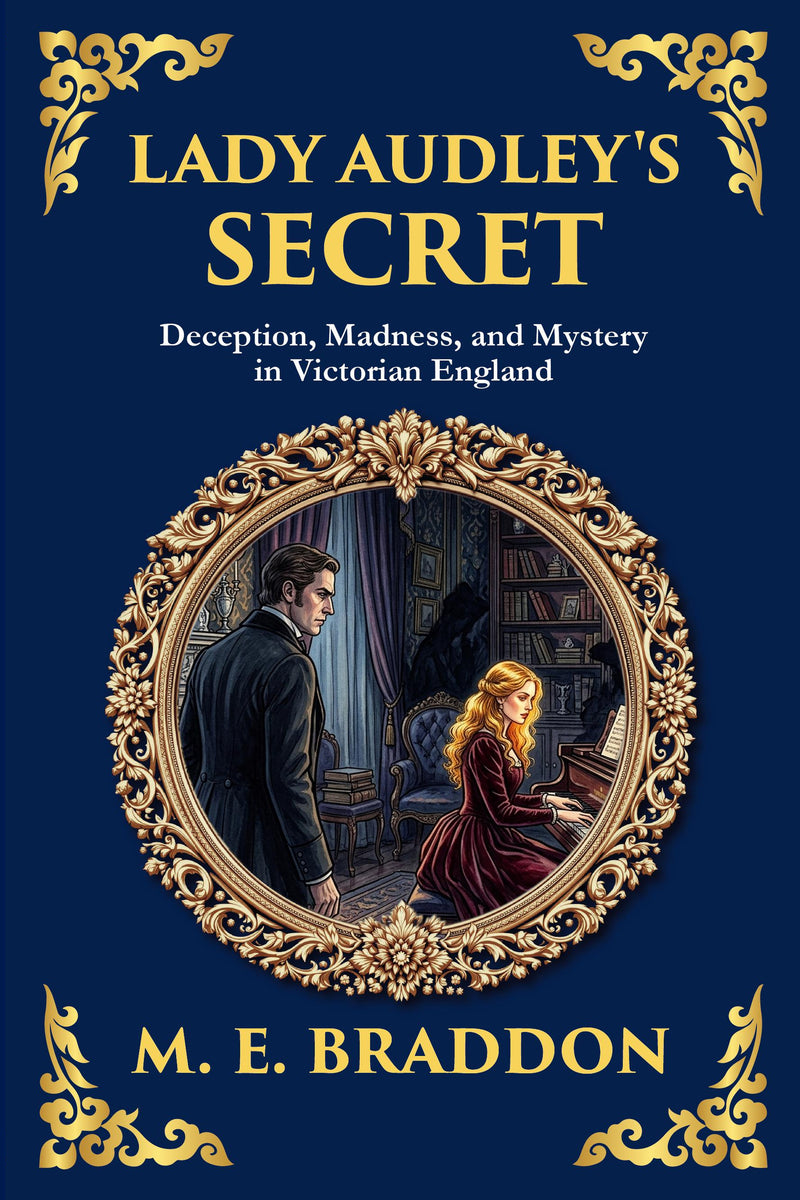
Lady Audley’s Secret — Large Print
In the grand halls of an English country estate, behind layers of charm and beauty, lies a secret that could destroy everything.
or free app
10,000+ hrs library
30-day guarantee
The complete Lady Audley's Secret appears in modern English through Library of Alexandria Press, available online with audiobook narration included for members.
Have you ever wondered why some secrets are more dangerous than the crimes themselves? M. E. Braddon’s Lady Audley’s Secret is one of the most influential and shocking novels of the Victorian era. Blending gothic melodrama with detective fiction, Braddon spins a tale of beauty and deceit that unsettled traditional views of femininity, marriage, and sanity.
At the center is Lady Audley—a picture of grace and innocence—who marries into wealth and status. But beneath her gentle exterior lies a deeply buried past. When a man from her former life vanishes under mysterious circumstances, suspicion spreads, and a young detective finds himself drawn into a case that will unravel class pretensions and expose the darkest recesses of the human mind.
What you’ll discover in this modern edition
- A Heroine Like No Other Lady Audley is charming, intelligent, and possibly murderous—a character who defies Victorian stereotypes of womanhood.
- A Chilling Mystery Disappearances, false identities, and a trail of clues that lead straight to the heart of the English upper class.
- Themes of Madness and Morality Is Lady Audley a villain—or a victim of the oppressive world around her?
- A Gothic Exploration of Power and Gender Examine how appearance, social status, and secrecy shape a woman's ability to survive.
- A Literary Milestone One of the defining texts of “sensation novels,” Lady Audley’s Secret helped pave the way for modern psychological thrillers.
| Formats | eBook (EPUB + PDF) · Audiobook · Paperback · Hardcover · Large Print |
| Language | English |
| Trim size (print) | 6 × 9 in |
| Binding | Paperback — perfect-bound · Hardcover — casewrap |
| Large Print edition | Same text in a larger, easy-read type — a larger font, not a larger trim |
| Print pricing | Every physical book at our true cost — at-cost, no profit (members) |
| Library | 873 restored titles, always growing |
| Length | 143,230 words · ~9 hr 33 min reading |
| Reading level | Grade 7 · an easy, flowing read (this modern-English edition) |
| Edition | Modern English translation · 2026 |
Member reviews for this edition are collected as readers finish it — be the first. Across the library: 12,000+ books shipped, every plan covered by a 365-day print guarantee.
About this edition
A faithful, unabridged modern-English edition by The Library of Alexandria — carefully rendered for today's reader and verified paragraph-by-paragraph against the public-domain source. Available as eBook, audiobook, paperback, hardcover, and large print.
- Complete & unabridgedVerified paragraph by paragraph against the source — never a scan, never abridged.
- Modern English, faithfulReadable today, with the author’s meaning kept intact. Readable — not simplified.
- Every format, one membershipRead in your browser or the free app, or listen to the full audiobook.
Included free with your membership
Cancel anytime, one click · 30-day money-back guarantee
Edition last updated July 2026
What’s inside
Lady Audley’s Secret — Large Print — complete and unabridged: all 42 sections included with membership, plus the full audiobook.
Begin reading Lady Audley’s Secret — Large Print
In clear modern English — the complete text is included with membership.
Introduction
There are novels that entertain, and there are novels that, upon their first appearance, seem to crack open something in the culture around them—exposing anxieties, desires, and fears that polite society would much rather keep hidden behind drawn curtains and well-tended garden hedges. Lady Audley’s Secret, first serialized in 1862, belongs unmistakably to the second category. It arrived in Victorian England like a stone hurled through a stained-glass window: glittering, sensational, impossible to ignore, and faintly scandalous in a way that made it irresistible. Readers devoured it. Critics scolded it even as they kept turning the pages. And the woman who wrote it, Mary Elizabeth Braddon, became, almost overnight, one of the most famous and most discussed authors in the English-speaking world.
To open this book is to step into a world of immaculate surfaces and shadowy undercurrents. It is a world of grand country estates, of lime-tree walks and ivy-covered wells, of fashionable drawing rooms and gentlemen’s clubs, of railway timetables and telegraphs and all the modern marvels that were reshaping the nineteenth century. And it is a world in which a beautiful, golden-haired young woman—charming, accomplished, adored by all who meet her—harbors a secret that threatens to bring an entire household crashing down. The genius of the novel lies in how it makes you complicit in the unraveling of that secret. You become a detective alongside its characters, sifting through clues, doubting your own conclusions, and feeling the slow, delicious dread of suspicion hardening into certainty.
This edition presents Braddon’s masterwork in a modern translation, carefully adapted for the contemporary reader. The aim is not to strip the novel of its period flavor—heaven forbid—but to remove the small frictions that can stand between a twenty-first-century reader and the headlong momentum of the original. The pleasures of Braddon’s storytelling were always meant to be immediate and visceral. She wrote to thrill, to unsettle, to keep you reading past the hour when sensible people put down their books and go to sleep. This adaptation honors that intention, smoothing archaic constructions and clarifying references that have grown obscure with the passage of more than a century and a half, while preserving the atmosphere, the wit, the moral complexity, and above all the gripping suspense that made the original a phenomenon.
Before you turn to the first chapter, it is worth lingering a moment over the remarkable circumstances that produced this novel, the literary movement it helped to launch, and the reasons it continues to grip readers long after the era that gave it birth has passed into history.
Mary Elizabeth Braddon was, in every sense, a self-made woman, and her own life was nearly as dramatic as any of her fictions. Born in London in 1835, she was raised in circumstances that grew precarious after her parents separated—a fact that placed an unusual financial burden on the family and gave the young Mary a sharp, early awareness of how vulnerable a woman’s position could be in a society that offered her so few legitimate paths to independence. That awareness would later infuse her novels with a startling sympathy for women who scheme, deceive, and grasp at security by whatever means they can find.
In an age when respectable women were expected to confine their ambitions to the domestic sphere, Braddon did something genuinely daring: she went on the stage. For several years she worked as an actress under a pseudonym, touring the provinces and earning a living in a profession that carried a distinct whiff of impropriety. This experience left its mark on everything she wrote. Braddon understood performance—the way a person can construct a public self, a mask of charm and respectability, and inhabit it so completely that the audience never suspects the calculation beneath. Her heroines and villains alike are often consummate performers, and the tension between the role a character plays and the truth they conceal lies at the very heart of Lady Audley’s Secret.
Eventually Braddon turned from acting to writing, encouraged and supported by the publisher John Maxwell, with whom she would form a lifelong personal and professional partnership. Their relationship was itself a quiet scandal of the period—Maxwell was already married, to a wife confined in an asylum in Ireland, and Braddon lived with him and raised a large family long before they were able to marry. It is impossible not to hear, in the novel’s preoccupation with marriage, madness, bigamy, and the suffocating constraints of Victorian respectability, the echoes of Braddon’s own complicated life. She wrote about women trapped by impossible circumstances because she understood, intimately, what such traps felt like.
Lady Audley’s Secret was the book that made her name. It appeared first in serial form, that quintessentially Victorian mode of publication in which novels were doled out chapter by chapter in magazines, each installment ending on a hook calculated to leave readers desperate for the next. This method shaped the very architecture of the book. Braddon was a master of pacing, of the cliffhanger, of the strategically withheld revelation. She knew exactly when to tighten the screws and when to release the pressure, when to dangle a clue and when to snatch it away. Modern readers raised on the rhythms of binge-worthy television will find the novel’s construction startlingly familiar; Braddon was, in effect, a showrunner working in prose, engineering suspense with the precision of a clockmaker.
The book’s commercial success was staggering. It went through edition after edition, was adapted for the stage almost immediately, and made Braddon one of the highest-paid and most prolific authors of her generation. Over the course of her long career she would write more than eighty novels, but it is this one—written when she was still in her twenties—that secured her place in literary history. She went on to enjoy decades of fame and considerable wealth, becoming a fixture of the literary establishment even as she continued to write the kind of fiction that high-minded critics regarded with suspicion. When she died in 1915, she left behind a body of work that influenced generations of writers and a single novel that has never gone out of print.
What makes Braddon so fascinating, and so modern, is the doubleness of her vision. On the surface, her novels appear to uphold conventional Victorian morality—wrongdoing is exposed, order is restored, the social fabric is mended. But beneath that surface runs a current of subversion. She invites us to understand, and even to sympathize with, characters who defy the rules. She exposes the hypocrisies of a society that idealized feminine purity while offering women almost no means of survival outside marriage. She suggests, with a sly and unsettling power, that the line between sanity and madness, between virtue and vice, between the angel of the house and something far more dangerous, might be thinner than anyone cared to admit. This tension—between the conventional and the radical, between the reassuring and the disturbing—is what gives her best work its lasting charge.
A New Kind of Novel and the Anatomy of Suspense
Lady Audley’s Secret did not appear in a vacuum. It was one of the defining works of a literary phenomenon that swept through the 1860s: the so-called “sensation novel.” This was a genre that scandalized the critics and electrified the public, and Braddon, along with writers like Wilkie Collins and Mrs. Henry Wood, stood at its very center.
To understand what made the sensation novel so shocking, one must understand what it did differently. The great novels of the early and mid-Victorian period—the works of Dickens, Thackeray, the Brontës—were often set against a broad social canvas, dealing with poverty, industry, class, and the sprawling drama of the city. Crime and mystery, when they appeared, tended to belong to the dark and distant world of the criminal underclass, safely separated from the respectable reader by class and geography. The sensation novel did something far more unsettling. It brought the crime home. It planted bigamy, fraud, blackmail, secret identities, and even murder squarely within the genteel English household—in the manor house, the rectory, the comfortable middle-class villa. The terrible secret was not lurking in some distant slum; it was sleeping in the next bedroom, smiling at the breakfast table, sitting demurely at the piano in the drawing room.
This was the source of the genre’s peculiar power and the anxiety it provoked. Critics fretted that these novels were dangerous precisely because they suggested that ordinary domestic life was a thin veneer over a seething pit of secrets and passions. One reviewer famously complained that sensation fiction was designed to “preach to the nerves,” to produce physical sensations of shock and excitement rather than to edify the soul. And that, of course, was exactly the point. Braddon understood that her readers wanted to be thrilled, to feel their pulses quicken and the hair rise on the backs of their necks. She gave them that experience with consummate skill, and she did it by exploiting the very respectability that her contemporaries held most sacred.
The figure at the center of Lady Audley’s Secret embodies this subversion completely. She is, on the surface, the perfect Victorian woman—lovely, gentle, accomplished, the very picture of feminine innocence and domestic grace. Her golden ringlets and childlike blue eyes are described again and again, becoming almost an obsession of the narrative. And it is precisely this image of angelic perfection that the novel sets out to interrogate. What if, Braddon asks, the angel of the house were not an angel at all? What if beneath that soft and yielding exterior lay a will of iron, a capacity for calculation, even a willingness to do terrible things in pursuit of survival and security? This question would have struck Victorian readers as deeply transgressive, because it suggested that the cultural ideal of womanhood might itself be a kind of mask—and that the most dangerous secrets might be hidden behind the most beautiful faces.
The novel’s machinery of suspense is built around a process of detection, and here Braddon makes another important contribution to literary history. The role of the amateur investigator, the ordinary person who becomes obsessed with uncovering a hidden truth, is central to the book. This figure—idle, somewhat aimless at first, gradually consumed by a private quest for the truth—anticipates the great detectives of later fiction. He pieces together fragmentary evidence: a half-finished letter, a misremembered date, a railway journey that does not quite add up, a portrait that reveals something its subject would prefer to keep hidden. Watching him assemble these clues, second-guess himself, retreat from his own conclusions, and then advance again with grim determination, the reader experiences the slow, mounting tension that has become the hallmark of all great mystery fiction. Braddon was writing decades before the detective story crystallized into a formal genre, and yet the essential pleasures of detection—the careful accumulation of evidence, the dawning horror of comprehension, the duel of wits between investigator and quarry—are all present here in their full, intoxicating force.
What elevates the novel above mere thriller is the moral and psychological complexity Braddon brings to her characters. The title speaks of a “secret,” but the book is interested in much more than the simple revelation of a hidden fact. It is interested in the conditions that produce concealment, in the desperation that drives people to deceive, in the question of how much we can ever truly know about another human being—or, for that matter, about ourselves. The novel’s exploration of insanity, signaled in this edition’s subtitle, raises questions that remain unresolved and unsettling to this day. Where does sanity end and madness begin? Is madness a genuine affliction, a convenient excuse, a social label applied to women who refuse to behave? Victorian society had a terrifying capacity to confine “difficult” or “inconvenient” women in asylums, and Braddon was acutely aware of this. The novel’s treatment of mental illness is shot through with ambiguity, and a discerning reader will find in it a quietly devastating critique of the way power, gender, and the very definition of sanity were entangled in nineteenth-century life.
Cancel anytime, one click · 30-day money-back guarantee
Founding annual rate available now — your price locks for life when you join.
Not ready? Get this free chapter by email — read it anytime.
✓ Sent — check your inbox for Lady Audley’s Secret — Large Print.
Questions about Lady Audley’s Secret — Large Print
What is Lady Audley's Secret about?
In the grand halls of an English country estate, behind layers of charm and beauty, lies a secret that could destroy everything. Lady Audley’s Secret is the sensational Victorian novel that shocked 19th-century readers with its tale of hidden identities, marital betrayal, and psychological suspense. When the sudden disappearance of a man triggers a web of investigations, all clues begin to point to one place: the alluring and enigmatic Lady Audley.
Who wrote Lady Audley's Secret?
Lady Audley's Secret was written by M. E. Braddon. This edition presents the complete work in clear modern English, faithfully rendered from the public-domain original by Library of Alexandria Press.
Is Lady Audley's Secret free to read?
The opening chapter is free to read on this page. Members read and listen to the complete work — and the entire library — free, and can order any physical book at our true print cost.
How long is Lady Audley's Secret?
42 chapters (~143,230 words) — about 9 hr 33 min of reading in this modern-English edition.
Is this an abridged version of Lady Audley's Secret?
No. This is the complete, unabridged Lady Audley's Secret, carefully rendered into clear modern English and verified paragraph-by-paragraph against the public-domain source — nothing is cut or summarised.
What formats does Lady Audley's Secret come in?
Lady Audley's Secret is available as eBook, paperback, hardcover and large print. eBook and audiobook are included with membership; printed editions ship at our true print cost.
Shipping & returns
Billing & membership
More from the library


Explore Mystery & Crime
- Resurrection · Leo Tolstoy
- Crime and Punishment · Fyodor Dostoyevsky
- The Strange Case of Dr. Jekyll and Mr. Hyde · Robert Louis Stevenson
- The Riddle of the Sands · Erskine Childers
- The Wisdom of Father Brown · G. K. Chesterton
- The Cask of Amontillado · Edgar Allan Poe
- The Tomb of Ts’in · Edgar Wallace
- Ghost Stories of an Antiquary · M. R. James
- The Hunniwell Boys and the Platinum Mystery · L. P. Wyman
- The Seven Dials Mystery · Agatha Christie
- The Thirty-Nine Steps · John Buchan
- The Hand in the Dark · Arthur J. Rees
- Lady Audley’s Secret · M. E. Braddon
- The Mystery of the Blue Train · Agatha Christie
- The Secret Adversary · Agatha Christie
- The Call of Cthulhu · H. P. Lovecraft
- The Adventures of Heine · Edgar Wallace
- The Valley of Fear · Arthur Conan Doyle
- The Innocence of Father Brown · G. K. Chesterton
- McTeague: A Story of San Francisco · Frank Norris
- Tess of the d’Urbervilles: A Pure Woman · Thomas Hardy
- The Big Fix · George O. Smith
- The Ambulance Made Two Trips · Murray Leinster
- Time Crime · H. Beam Piper
- The Misplaced Battleship · Harry Harrison
- Supermind · Randall Garrett and Laurence M....
- Lone Star Planet · H. Beam Piper and John J. McGuire
- Dracula · Bram Stoker
- The Murder on the Links · Agatha Christie
- The Hound of the Baskervilles · Arthur Conan Doyle
Lady Audley’s Secret — Large Print
Lady Audley’s Secret — Large Print
Deceit, Insanity, and Mystery in Victorian England
M. E. Braddon
Contents
- Introduction
- Chapter 1
- Chapter 2
- Chapter 3
- Chapter 4
- Chapter 5
- Chapter 6
- Chapter 7
- Chapter 8
- Chapter 9
- Chapter 10
- Chapter 11
- Chapter 12
- Chapter 13
- Chapter 14
- Chapter 15
- Chapter 16
- Chapter 17
- Chapter 18
- Chapter 19
- Chapter 20
- Chapter 21
- Chapter 22
- Chapter 23
- Chapter 24
- Chapter 25
- Chapter 26
- Chapter 27
- Chapter 28
- Chapter 29
- Chapter 30
- Chapter 31
- Chapter 32
- Chapter 33
- Chapter 34
- Chapter 35
- Chapter 36
- Chapter 37
- Chapter 38
- Chapter 39
- … and 2 more chapters
Introduction
There are novels that entertain, and there are novels that, upon their first appearance, seem to crack open something in the culture around them—exposing anxieties, desires, and fears that polite society would much rather keep hidden behind drawn curtains and well-tended garden hedges. Lady Audley’s Secret, first serialized in 1862, belongs unmistakably to the second category. It arrived in Victorian England like a stone hurled through a stained-glass window: glittering, sensational, impossible to ignore, and faintly scandalous in a way that made it irresistible. Readers devoured it. Critics scolded it even as they kept turning the pages. And the woman who wrote it, Mary Elizabeth Braddon, became, almost overnight, one of the most famous and most discussed authors in the English-speaking world.
To open this book is to step into a world of immaculate surfaces and shadowy undercurrents. It is a world of grand country estates, of lime-tree walks and ivy-covered wells, of fashionable drawing rooms and gentlemen’s clubs, of railway timetables and telegraphs and all the modern marvels that were reshaping the nineteenth century. And it is a world in which a beautiful, golden-haired young woman—charming, accomplished, adored by all who meet her—harbors a secret that threatens to bring an entire household crashing down. The genius of the novel lies in how it makes you complicit in the unraveling of that secret. You become a detective alongside its characters, sifting through clues, doubting your own conclusions, and feeling the slow, delicious dread of suspicion hardening into certainty.
This edition presents Braddon’s masterwork in a modern translation, carefully adapted for the contemporary reader. The aim is not to strip the novel of its period flavor—heaven forbid—but to remove the small frictions that can stand between a twenty-first-century reader and the headlong momentum of the original. The pleasures of Braddon’s storytelling were always meant to be immediate and visceral. She wrote to thrill, to unsettle, to keep you reading past the hour when sensible people put down their books and go to sleep. This adaptation honors that intention, smoothing archaic constructions and clarifying references that have grown obscure with the passage of more than a century and a half, while preserving the atmosphere, the wit, the moral complexity, and above all the gripping suspense that made the original a phenomenon.
Before you turn to the first chapter, it is worth lingering a moment over the remarkable circumstances that produced this novel, the literary movement it helped to launch, and the reasons it continues to grip readers long after the era that gave it birth has passed into history.
Mary Elizabeth Braddon was, in every sense, a self-made woman, and her own life was nearly as dramatic as any of her fictions. Born in London in 1835, she was raised in circumstances that grew precarious after her parents separated—a fact that placed an unusual financial burden on the family and gave the young Mary a sharp, early awareness of how vulnerable a woman’s position could be in a society that offered her so few legitimate paths to independence. That awareness would later infuse her novels with a startling sympathy for women who scheme, deceive, and grasp at security by whatever means they can find.
In an age when respectable women were expected to confine their ambitions to the domestic sphere, Braddon did something genuinely daring: she went on the stage. For several years she worked as an actress under a pseudonym, touring the provinces and earning a living in a profession that carried a distinct whiff of impropriety. This experience left its mark on everything she wrote. Braddon understood performance—the way a person can construct a public self, a mask of charm and respectability, and inhabit it so completely that the audience never suspects the calculation beneath. Her heroines and villains alike are often consummate performers, and the tension between the role a character plays and the truth they conceal lies at the very heart of Lady Audley’s Secret.
Eventually Braddon turned from acting to writing, encouraged and supported by the publisher John Maxwell, with whom she would form a lifelong personal and professional partnership. Their relationship was itself a quiet scandal of the period—Maxwell was already married, to a wife confined in an asylum in Ireland, and Braddon lived with him and raised a large family long before they were able to marry. It is impossible not to hear, in the novel’s preoccupation with marriage, madness, bigamy, and the suffocating constraints of Victorian respectability, the echoes of Braddon’s own complicated life. She wrote about women trapped by impossible circumstances because she understood, intimately, what such traps felt like.
Lady Audley’s Secret was the book that made her name. It appeared first in serial form, that quintessentially Victorian mode of publication in which novels were doled out chapter by chapter in magazines, each installment ending on a hook calculated to leave readers desperate for the next. This method shaped the very architecture of the book. Braddon was a master of pacing, of the cliffhanger, of the strategically withheld revelation. She knew exactly when to tighten the screws and when to release the pressure, when to dangle a clue and when to snatch it away. Modern readers raised on the rhythms of binge-worthy television will find the novel’s construction startlingly familiar; Braddon was, in effect, a showrunner working in prose, engineering suspense with the precision of a clockmaker.
The book’s commercial success was staggering. It went through edition after edition, was adapted for the stage almost immediately, and made Braddon one of the highest-paid and most prolific authors of her generation. Over the course of her long career she would write more than eighty novels, but it is this one—written when she was still in her twenties—that secured her place in literary history. She went on to enjoy decades of fame and considerable wealth, becoming a fixture of the literary establishment even as she continued to write the kind of fiction that high-minded critics regarded with suspicion. When she died in 1915, she left behind a body of work that influenced generations of writers and a single novel that has never gone out of print.
What makes Braddon so fascinating, and so modern, is the doubleness of her vision. On the surface, her novels appear to uphold conventional Victorian morality—wrongdoing is exposed, order is restored, the social fabric is mended. But beneath that surface runs a current of subversion. She invites us to understand, and even to sympathize with, characters who defy the rules. She exposes the hypocrisies of a society that idealized feminine purity while offering women almost no means of survival outside marriage. She suggests, with a sly and unsettling power, that the line between sanity and madness, between virtue and vice, between the angel of the house and something far more dangerous, might be thinner than anyone cared to admit. This tension—between the conventional and the radical, between the reassuring and the disturbing—is what gives her best work its lasting charge.
A New Kind of Novel and the Anatomy of Suspense
Lady Audley’s Secret did not appear in a vacuum. It was one of the defining works of a literary phenomenon that swept through the 1860s: the so-called “sensation novel.” This was a genre that scandalized the critics and electrified the public, and Braddon, along with writers like Wilkie Collins and Mrs. Henry Wood, stood at its very center.
To understand what made the sensation novel so shocking, one must understand what it did differently. The great novels of the early and mid-Victorian period—the works of Dickens, Thackeray, the Brontës—were often set against a broad social canvas, dealing with poverty, industry, class, and the sprawling drama of the city. Crime and mystery, when they appeared, tended to belong to the dark and distant world of the criminal underclass, safely separated from the respectable reader by class and geography. The sensation novel did something far more unsettling. It brought the crime home. It planted bigamy, fraud, blackmail, secret identities, and even murder squarely within the genteel English household—in the manor house, the rectory, the comfortable middle-class villa. The terrible secret was not lurking in some distant slum; it was sleeping in the next bedroom, smiling at the breakfast table, sitting demurely at the piano in the drawing room.
This was the source of the genre’s peculiar power and the anxiety it provoked. Critics fretted that these novels were dangerous precisely because they suggested that ordinary domestic life was a thin veneer over a seething pit of secrets and passions. One reviewer famously complained that sensation fiction was designed to “preach to the nerves,” to produce physical sensations of shock and excitement rather than to edify the soul. And that, of course, was exactly the point. Braddon understood that her readers wanted to be thrilled, to feel their pulses quicken and the hair rise on the backs of their necks. She gave them that experience with consummate skill, and she did it by exploiting the very respectability that her contemporaries held most sacred.
The figure at the center of Lady Audley’s Secret embodies this subversion completely. She is, on the surface, the perfect Victorian woman—lovely, gentle, accomplished, the very picture of feminine innocence and domestic grace. Her golden ringlets and childlike blue eyes are described again and again, becoming almost an obsession of the narrative. And it is precisely this image of angelic perfection that the novel sets out to interrogate. What if, Braddon asks, the angel of the house were not an angel at all? What if beneath that soft and yielding exterior lay a will of iron, a capacity for calculation, even a willingness to do terrible things in pursuit of survival and security? This question would have struck Victorian readers as deeply transgressive, because it suggested that the cultural ideal of womanhood might itself be a kind of mask—and that the most dangerous secrets might be hidden behind the most beautiful faces.
The novel’s machinery of suspense is built around a process of detection, and here Braddon makes another important contribution to literary history. The role of the amateur investigator, the ordinary person who becomes obsessed with uncovering a hidden truth, is central to the book. This figure—idle, somewhat aimless at first, gradually consumed by a private quest for the truth—anticipates the great detectives of later fiction. He pieces together fragmentary evidence: a half-finished letter, a misremembered date, a railway journey that does not quite add up, a portrait that reveals something its subject would prefer to keep hidden. Watching him assemble these clues, second-guess himself, retreat from his own conclusions, and then advance again with grim determination, the reader experiences the slow, mounting tension that has become the hallmark of all great mystery fiction. Braddon was writing decades before the detective story crystallized into a formal genre, and yet the essential pleasures of detection—the careful accumulation of evidence, the dawning horror of comprehension, the duel of wits between investigator and quarry—are all present here in their full, intoxicating force.
What elevates the novel above mere thriller is the moral and psychological complexity Braddon brings to her characters. The title speaks of a “secret,” but the book is interested in much more than the simple revelation of a hidden fact. It is interested in the conditions that produce concealment, in the desperation that drives people to deceive, in the question of how much we can ever truly know about another human being—or, for that matter, about ourselves. The novel’s exploration of insanity, signaled in this edition’s subtitle, raises questions that remain unresolved and unsettling to this day. Where does sanity end and madness begin? Is madness a genuine affliction, a convenient excuse, a social label applied to women who refuse to behave? Victorian society had a terrifying capacity to confine “difficult” or “inconvenient” women in asylums, and Braddon was acutely aware of this. The novel’s treatment of mental illness is shot through with ambiguity, and a discerning reader will find in it a quietly devastating critique of the way power, gender, and the very definition of sanity were entangled in nineteenth-century life.
The estate sat in a valley, filled with magnificent old trees and lush green pastures. You reached it by traveling down a road lined with lime trees and flanked by meadows. From atop the high hedges, cows watched you curiously as you passed, perhaps wondering why you were there; after all, it wasn’t a public road, and unless you were visiting the Court, you had no reason to be there.
At the end of this drive stood an old archway and a clock tower. The clock was confusing and clumsy, possessing only one hand that jumped abruptly from one hour to the next, meaning it was always wildly inaccurate. Passing through this arch led you directly into the gardens of Audley Court.
A smooth lawn stretched out in front of you, decorated with clusters of rhododendrons that grew more perfectly here than anywhere else in the region. To the right were the vegetable gardens, a fish pond, and an orchard surrounded by a dry moat. There was also a crumbling wall, which in some spots was thicker than it was tall and completely covered in climbing ivy, yellow stonecrop, and dark moss. To the left was a wide gravel path where, years ago, silent nuns had walked hand in hand when the property served as a convent. A wall lined with trained fruit trees and shaded by massive oaks blocked out the flat horizon, wrapping the house and gardens in a moody, protective embrace.
The house faced the archway and surrounded three sides of a courtyard. It was an ancient building, sprawling and uneven in its design. The windows were mismatched; some were tiny while others were large, some featuring heavy stone frames and ornate stained glass, while others had flimsy lattices that rattled in the wind. Some looked so new they might have been installed just yesterday. Massive clusters of chimneys rose behind pointed gables, appearing so worn by age and use that they would have collapsed if not for the wild ivy. This ivy crawled up the walls and trailed across the roof, wrapping around the chimneys to hold them up. The main entrance was tucked into the corner of a turret at one end of the house, as if it were hiding from dangerous guests and trying to remain a secret. Despite its location, it was a grand door made of old oak and studded with large, square-headed iron nails. It was so thick that the heavy iron knocker made a muffled sound, so visitors had to ring a clanging bell hanging in the ivy to ensure the noise reached inside the fortress.
End of the free sample
Keep reading, free
Members read and listen to the complete book — and the entire library. Cancel anytime, one click · 30-day money-back guarantee.