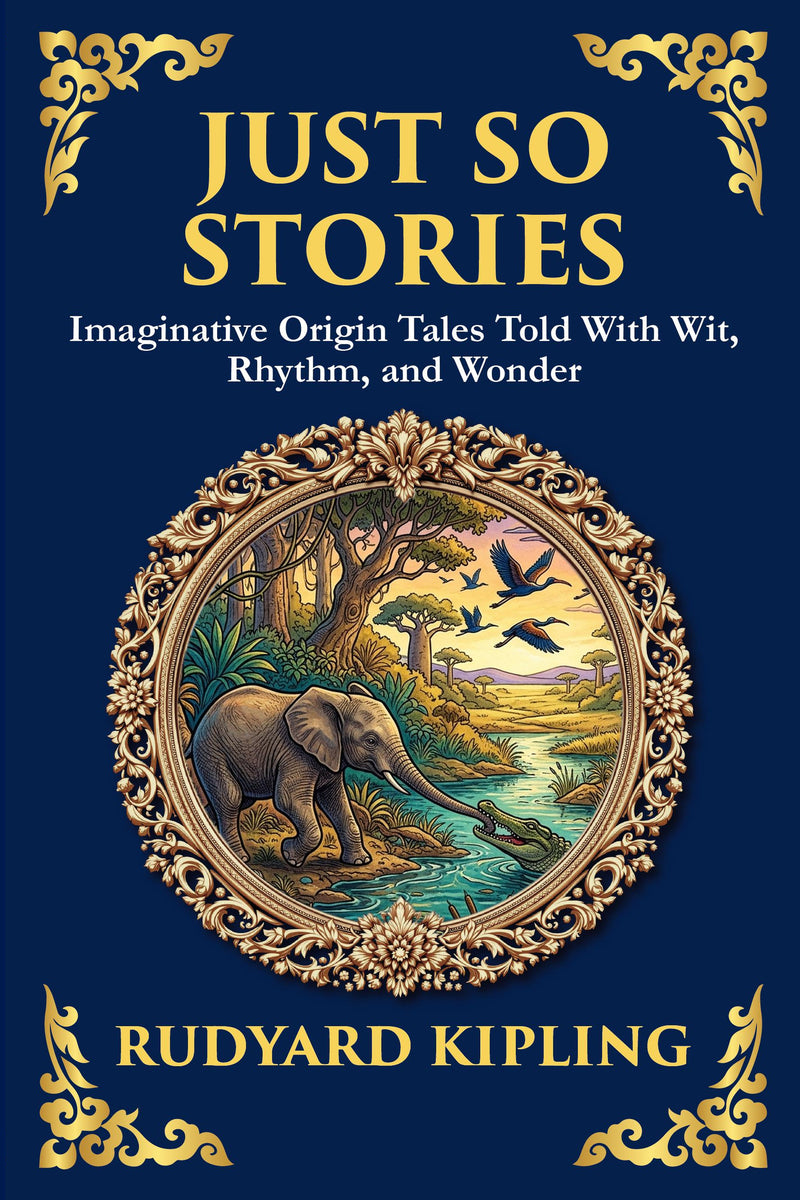
Just So Stories
How did the leopard get its spots? Why does the camel have a hump? What made the elephant’s nose so long? In this collection of whimsical fables, Rudyard Kipling offers fantastical answers to age-old questions through stories bursting with wit, rhythm, and imagination.
or free app
10,000+ hrs library
30-day guarantee
The complete Just So Stories appears in modern English through Library of Alexandria Press, available online with audiobook narration included for members.
Have you ever wondered why animals are the way they are? Step into a magical world where storytelling becomes the key to understanding the wonders of nature and the quirks of animals. In Just So Stories, Rudyard Kipling spins imaginative tales that explain how the world came to be in the most unexpected and enchanting ways.
With language that sings and characters that leap off the page, these origin tales transport you into jungles, deserts, rivers, and oceans, where you’ll meet unforgettable creatures—each with a tale as unique as their shape. Originally crafted for his daughter, Kipling’s stories blend gentle humor, poetic rhythms, and vivid imagery that children and adults alike will treasure. These stories are more than fanciful explanations—they are a celebration of curiosity, creativity, and the joy of asking “what if?” Every tale ends not with a lesson, but a sense of wonder and a smile.
What you’ll discover in this modern edition
- Magical Tales with Memorable Creatures From the clever crocodile to the independent cat, meet animals full of personality and purpose.
- Whimsical Origins and Playful Logic Learn how the rhinoceros lost its manners or how the kangaroo got its bounce—all through delightful make-believe.
- Timeless Language and Lyrical Prose Enjoy the poetic rhythm and repetition that make each tale ideal for reading aloud.
- Perfect for Families and Young Readers Captivate the imaginations of children while bringing a nostalgic smile to adult faces.
- A Classic of Children’s Literature A beloved work that continues to charm readers over a century after its publication.
| Formats | eBook (EPUB + PDF) · Audiobook · Paperback · Hardcover · Large Print |
| Language | English |
| Trim size (print) | 6 × 9 in |
| Binding | Paperback — perfect-bound · Hardcover — casewrap |
| Large Print edition | Same text in a larger, easy-read type — a larger font, not a larger trim |
| Print pricing | Every physical book at our true cost — at-cost, no profit (members) |
| Library | 873 restored titles, always growing |
| Length | 30,791 words · ~2 hr 3 min reading |
| Reading level | Grade 7 · an easy, flowing read (this modern-English edition) |
| Edition | Modern English translation · 2026 |
Member reviews for this edition are collected as readers finish it — be the first. Across the library: 12,000+ books shipped, every plan covered by a 365-day print guarantee.
About this edition
A faithful, unabridged modern-English edition by The Library of Alexandria — carefully rendered for today's reader and verified paragraph-by-paragraph against the public-domain source. Available as eBook, audiobook, paperback, hardcover, and large print.
- Complete & unabridgedVerified paragraph by paragraph against the source — never a scan, never abridged.
- Modern English, faithfulReadable today, with the author’s meaning kept intact. Readable — not simplified.
- Every format, one membershipRead in your browser or the free app, or listen to the full audiobook.
Included free with your membership
Cancel anytime, one click · 30-day money-back guarantee
Edition last updated July 2026
What’s inside
Just So Stories — complete and unabridged: all 13 sections included with membership, plus the full audiobook.
Begin reading Just So Stories
In clear modern English — the complete text is included with membership.
Introduction
There are books that we read, and there are books that read us — that seem to know, with uncanny precision, exactly what a child’s imagination craves, and exactly what the adult inside us has forgotten how to want. Rudyard Kipling’s collection of origin stories belongs to that rarer second category. It is a book that does not merely tell tales; it performs them, sings them, dances them across the page with such infectious delight that even the most reluctant reader finds the rhythm working its way into their bloodstream before the first story has finished. To open these pages is to be invited into a particular kind of magic — the magic of a voice speaking directly to you, leaning close, promising that what follows is a secret worth knowing.
These are stories about beginnings. How did the leopard get his spots? How did the camel acquire that strange hump on his back? Why does the elephant have such a long trunk, and how did the alphabet itself first come to be drawn? Kipling answers these questions not with the dry certainty of a textbook but with the gleeful confidence of a storyteller who has decided that the truth is far less interesting than a good story — and who suspects, deep down, that a good story might be the truest thing of all. The world he conjures is one in which everything has a reason, a history, a moment of transformation, and that moment is always charged with humor, consequence, and a sense that the universe is paying close attention.
The first thing any reader notices about these tales is the sound of them. Kipling wrote them, originally, to be spoken — read aloud at bedtime, the words tumbling and circling and repeating in patterns that a listening child could anticipate and savor. He had a particular cadence in mind, a rhythm that rises and falls like a tide, full of phrases that come back again and again like the chorus of a beloved song. Once you have heard a certain refrain repeated, you begin to wait for it, to lean toward it, to feel a small private triumph when it arrives exactly when you knew it would. This is the architecture of oral storytelling, and Kipling understood it as well as anyone who ever set pen to paper.
This rhythmic quality is not decoration. It is the very engine of the book. The repetitions, the rolling lists, the affectionate asides directed at the listener — all of these were crafted to be performed, to fill a room with sound, to make the reader and the listener into collaborators in a shared ritual. There is something almost incantatory about the prose, as if the words themselves were casting a gentle spell. And this is why these stories survive: they were built to be passed from voice to voice, from one generation to the next, carried on the warm current of someone reading to someone they love.
In preparing this modern adaptation, the greatest care has been taken to preserve that musicality while smoothing the passages that a contemporary reader might find unnecessarily knotted. Kipling wrote at the turn of the twentieth century, and some of his phrasing, charming as it is, can occasionally trip the modern tongue or send the reader hunting through a dictionary for words that have since fallen out of common use. The aim here has been to keep the song intact — its melody, its swing, its irresistible momentum — while ensuring that nothing comes between you and the pleasure of the telling. The refrains remain. The playful directness remains. The sense that the storyteller is right there beside you, delighting in every twist, remains entirely undimmed.
If you possibly can, read these stories aloud. Read them to a child, to a friend, to a pet, or simply to the empty room. They were made for the air, for the breath, for the human voice. Something happens to the prose when it is spoken that cannot quite happen on the silent page. The jokes land more squarely. The rhythms swing more freely. The strange, wonderful logic of the tales reveals itself more fully when you can hear the storyteller’s tongue planted firmly in his cheek. This is a book that wants to be heard, and rewards anyone who gives it that chance with a richness that silent reading can only hint at.
There is, too, a particular term of endearment that runs through these pages — a way the narrator has of addressing the listener that becomes, over the course of the book, one of its most beloved features. It is the sort of phrase a parent might use, full of affection and mock-seriousness, the kind of thing that makes a child feel both teased and treasured at the same time. Watch for it. It does more work than you might expect, knitting the reader into the fabric of the stories, making each one feel like a private communication, a confidence shared between two people who trust each other completely. By the end of the book, that little phrase feels less like a literary device and more like an old friend.
The humor, too, deserves a word of welcome. Kipling was funny in a way that children and adults can both appreciate, though often for different reasons. Children laugh at the immediate absurdities — the creatures behaving badly, the comeuppances, the silly sounds and the ridiculous predicaments. Adults catch the gentle satire underneath, the sly observations about pride and laziness and curiosity and the consequences of bad manners. There is a layer of wit in these tales that operates on the grown-up frequency, a knowing wink that never condescends to the younger listener but quietly rewards the older one. This double register is one of the secrets of the book’s enduring appeal. It is never merely a children’s book, and never merely a book for adults. It lives in the space between, where the best stories always live.
It would be easy to dismiss origin tales of this kind as mere whimsy — pleasant nonsense to amuse the young before sleep. But to read them this way is to miss the deeper machinery at work. Human beings have always told stories to explain the world. Long before science offered its careful, evidence-based accounts of how things came to be, our ancestors gathered around fires and asked the great questions: Why is the world the way it is? Why does this creature look like that? Why do we behave as we do? And the answers they gave were stories — stories that encoded wisdom, warning, comfort, and meaning in forms that could be remembered and retold.
Kipling, writing in an age when the scientific worldview was rapidly transforming how educated people understood nature, deliberately reached back toward this older, mythic mode of explanation. He knew perfectly well how a leopard really got his spots, in the dry terms of biology. But he understood that the child’s question — Why does the leopard have spots? — is not really a question about biology at all. It is a question about meaning, about story, about the satisfying sense that things happen for reasons and that the world is a place where actions have consequences and where transformation is always possible. His “answers” are not science; they are something both older and, in their own way, deeper. They are myth in miniature, crafted with a craftsman’s care.
What gives these explanations their peculiar charm is their internal logic. Within each story, the world operates according to consistent and surprisingly rigorous rules. Things happen because of what came before. A creature’s behavior leads, directly and inevitably, to its physical transformation. There is cause and effect, action and reaction, choice and consequence. This is not random invention; it is a carefully constructed universe in which everything fits together like the pieces of an elaborate puzzle. The pleasure of reading lies partly in watching how Kipling solves each puzzle, how he connects the question to its answer through a chain of events that feels, in the moment, absolutely inevitable — even as the rational mind knows it is all gloriously made up.
This is the genius of the form. The stories teach, without ever seeming to teach, a profound truth about narrative itself: that a satisfying story is one in which everything is connected, in which nothing happens by accident, in which the ending was somehow always implied by the beginning. Children absorb this lesson in story structure long before they could ever articulate it. They learn, through the simple act of listening, how a tale ought to move, how tension builds and releases, how a small decision can ripple outward into a great consequence. These stories are, among other things, an apprenticeship in the art of storytelling, offered so painlessly and so pleasurably that the student never realizes they are being taught.
There is also a moral dimension threaded through the collection, though Kipling is far too skilled to ever preach. The creatures in these tales are punished for their faults — for laziness, for greed, for excessive curiosity, for bad manners — and rewarded for their virtues. But the morality is never heavy-handed. It emerges naturally from the logic of the stories, a consequence rather than a lecture. A creature who behaves badly finds itself transformed in ways that fit the crime, and the reader nods with satisfaction at the rightness of it all. This is justice as a child understands justice: immediate, concrete, visible. The leopard’s spots and the camel’s hump are not arbitrary; they are the physical record of choices made and lessons learned. The body becomes a kind of moral biography, written in flesh and hide for all the world to read.
And yet, for all this underlying structure, the dominant mood of the book is not instruction but delight. Kipling clearly had enormous fun writing these stories, and that fun is contagious. He invents words when existing words will not do. He piles up adjectives in absurd and glorious heaps. He sends his characters on journeys to places with marvelous names, has them eat strange foods and make strange bargains and undergo strange transformations. The whole enterprise crackles with inventive energy, with the joyful sense of a mind set free to play. Reading these tales, one feels the presence of an author who loved words the way a musician loves notes — who delighted in their textures and sounds and surprising combinations, and who wanted nothing more than to share that delight with you.
The settings, too, deserve mention. These stories range across a vividly imagined world — deserts and rivers, jungles and seashores, the dawn of time itself. Kipling, who spent much of his early life in India and traveled widely, brought to his work a deep sensitivity to landscape and atmosphere. The places in these tales feel real even when they are utterly fantastical, rendered with sensory details that make them spring to life: the heat of the sun, the color of the earth, the smell of mud, the sound of water. This grounding in physical reality is part of what makes the fantastical elements so convincing. The magic feels possible because the world around it feels so solidly, palpably there.
One of the most remarkable things about this collection is its extraordinary range of appeal. It is, on its surface, a book for children — and indeed, generations of children have grown up with these stories, have memorized their refrains, have demanded them again and again at bedtime until the binding of the family copy grew soft and worn. There is no question that the young reader, or the young listener, is the book’s first and most cherished audience. The simplicity of the questions, the clarity of the storytelling, the satisfying patterns, the gentle humor — all of these are perfectly pitched to delight a child.
But to read these tales only as a child, or only as something to give to a child, is to encounter just a fraction of what they offer. There is a reason that adults return to this book throughout their lives, often with deeper appreciation than they could have managed in youth. The craftsmanship rewards re-reading. The wit reveals new dimensions. The structure, once you begin to see how it works, becomes a source of pleasure in its own right. And there is the matter of memory — for many readers, these stories are bound up with their earliest experiences of being read to, with the warmth and security of childhood, with the voice of a parent or grandparent. To return to them as an adult is to return, briefly, to that lost country, to feel again the particular safety of being a child held in the spell of a good story.
Cancel anytime, one click · 30-day money-back guarantee
Founding annual rate available now — your price locks for life when you join.
Not ready? Get this free chapter by email — read it anytime.
✓ Sent — check your inbox for Just So Stories.
Questions about Just So Stories
What is Just So Stories about?
How did the leopard get its spots? Why does the camel have a hump? What made the elephant’s nose so long?
Who wrote Just So Stories?
Just So Stories was written by Rudyard Kipling. This edition presents the complete work in clear modern English, faithfully rendered from the public-domain original by Library of Alexandria Press.
Is Just So Stories free to read?
The opening chapter is free to read on this page. Members read and listen to the complete work — and the entire library — free, and can order any physical book at our true print cost.
How long is Just So Stories?
13 chapters (~30,791 words) — about 2 hr 3 min of reading in this modern-English edition.
Is this an abridged version of Just So Stories?
No. This is the complete, unabridged Just So Stories, carefully rendered into clear modern English and verified paragraph-by-paragraph against the public-domain source — nothing is cut or summarised.
What formats does Just So Stories come in?
Just So Stories is available as eBook, paperback, hardcover and large print. eBook and audiobook are included with membership; printed editions ship at our true print cost.
Shipping & returns
Billing & membership
More from the library


Explore Children's Classics
- Peter and Wendy · J. M. Barrie
- Jack and Jill · Louisa May Alcott
- The Wonderful Wizard of Oz · L. Frank Baum
- Anne of Green Gables · L. M. Montgomery
- The Secret Garden · Frances Hodgson Burnett
- The Tale of Peter Rabbit · Beatrix Potter
- Peter Pan · J. M. Barrie
- The Prince and the Pauper · Mark Twain
- The Red Fairy Book · Andrew Lang
- Old Christmas: from the Sketch Book of Washington Irving · Washington Irving
- A Houseful of Girls · Sarah Tytler
- In the hollow of His hand · Hesba Stretton
- Miss Primrose · Agnes Giberne
- Five Little Peppers and How They Grew · Margaret Sidney
- The Loss of the Swansea: A Story of the Florida Coast · W. L. Alden
- Sky Island · L. Frank Baum
- The Book of Dragons · E. Nesbit
- Wild Animals I Have Known · Ernest Thompson Seton
- Skinny McCord · Percy Keese Fitzhugh
- The Hunniwell Boys and the Platinum Mystery · L. P. Wyman
- Rainbow Valley · L. M. Montgomery
- "Us and Our Donkey" · Amy Le Feuvre
- Dorothy and the Wizard in Oz · L. Frank Baum
- The Home Book of Verse — Volume 4 · Burton Egbert Stevenson
- The Story of Doctor Dolittle · Hugh Lofting
- The Tale of Benjamin Bunny · Beatrix Potter
- Fifty Famous Stories Retold · James Baldwin
- Rilla of Ingleside · L. M. Montgomery
- The House at Pooh Corner · A. A. Milne
- Rich and Humble: A Story for Young People · Oliver Optic
Just So Stories
Just So Stories
Imaginative Origin Tales Told With Wit, Rhythm, and Wonder
Rudyard Kipling
Contents
- Introduction
- Chapter 1
- Chapter 2
- Chapter 3
- Chapter 4
- Chapter 5
- Chapter 6
- Chapter 7
- Chapter 8
- Chapter 9
- Chapter 10
- Chapter 11
- Chapter 12
Introduction
There are books that we read, and there are books that read us — that seem to know, with uncanny precision, exactly what a child’s imagination craves, and exactly what the adult inside us has forgotten how to want. Rudyard Kipling’s collection of origin stories belongs to that rarer second category. It is a book that does not merely tell tales; it performs them, sings them, dances them across the page with such infectious delight that even the most reluctant reader finds the rhythm working its way into their bloodstream before the first story has finished. To open these pages is to be invited into a particular kind of magic — the magic of a voice speaking directly to you, leaning close, promising that what follows is a secret worth knowing.
These are stories about beginnings. How did the leopard get his spots? How did the camel acquire that strange hump on his back? Why does the elephant have such a long trunk, and how did the alphabet itself first come to be drawn? Kipling answers these questions not with the dry certainty of a textbook but with the gleeful confidence of a storyteller who has decided that the truth is far less interesting than a good story — and who suspects, deep down, that a good story might be the truest thing of all. The world he conjures is one in which everything has a reason, a history, a moment of transformation, and that moment is always charged with humor, consequence, and a sense that the universe is paying close attention.
The first thing any reader notices about these tales is the sound of them. Kipling wrote them, originally, to be spoken — read aloud at bedtime, the words tumbling and circling and repeating in patterns that a listening child could anticipate and savor. He had a particular cadence in mind, a rhythm that rises and falls like a tide, full of phrases that come back again and again like the chorus of a beloved song. Once you have heard a certain refrain repeated, you begin to wait for it, to lean toward it, to feel a small private triumph when it arrives exactly when you knew it would. This is the architecture of oral storytelling, and Kipling understood it as well as anyone who ever set pen to paper.
This rhythmic quality is not decoration. It is the very engine of the book. The repetitions, the rolling lists, the affectionate asides directed at the listener — all of these were crafted to be performed, to fill a room with sound, to make the reader and the listener into collaborators in a shared ritual. There is something almost incantatory about the prose, as if the words themselves were casting a gentle spell. And this is why these stories survive: they were built to be passed from voice to voice, from one generation to the next, carried on the warm current of someone reading to someone they love.
In preparing this modern adaptation, the greatest care has been taken to preserve that musicality while smoothing the passages that a contemporary reader might find unnecessarily knotted. Kipling wrote at the turn of the twentieth century, and some of his phrasing, charming as it is, can occasionally trip the modern tongue or send the reader hunting through a dictionary for words that have since fallen out of common use. The aim here has been to keep the song intact — its melody, its swing, its irresistible momentum — while ensuring that nothing comes between you and the pleasure of the telling. The refrains remain. The playful directness remains. The sense that the storyteller is right there beside you, delighting in every twist, remains entirely undimmed.
If you possibly can, read these stories aloud. Read them to a child, to a friend, to a pet, or simply to the empty room. They were made for the air, for the breath, for the human voice. Something happens to the prose when it is spoken that cannot quite happen on the silent page. The jokes land more squarely. The rhythms swing more freely. The strange, wonderful logic of the tales reveals itself more fully when you can hear the storyteller’s tongue planted firmly in his cheek. This is a book that wants to be heard, and rewards anyone who gives it that chance with a richness that silent reading can only hint at.
There is, too, a particular term of endearment that runs through these pages — a way the narrator has of addressing the listener that becomes, over the course of the book, one of its most beloved features. It is the sort of phrase a parent might use, full of affection and mock-seriousness, the kind of thing that makes a child feel both teased and treasured at the same time. Watch for it. It does more work than you might expect, knitting the reader into the fabric of the stories, making each one feel like a private communication, a confidence shared between two people who trust each other completely. By the end of the book, that little phrase feels less like a literary device and more like an old friend.
The humor, too, deserves a word of welcome. Kipling was funny in a way that children and adults can both appreciate, though often for different reasons. Children laugh at the immediate absurdities — the creatures behaving badly, the comeuppances, the silly sounds and the ridiculous predicaments. Adults catch the gentle satire underneath, the sly observations about pride and laziness and curiosity and the consequences of bad manners. There is a layer of wit in these tales that operates on the grown-up frequency, a knowing wink that never condescends to the younger listener but quietly rewards the older one. This double register is one of the secrets of the book’s enduring appeal. It is never merely a children’s book, and never merely a book for adults. It lives in the space between, where the best stories always live.
It would be easy to dismiss origin tales of this kind as mere whimsy — pleasant nonsense to amuse the young before sleep. But to read them this way is to miss the deeper machinery at work. Human beings have always told stories to explain the world. Long before science offered its careful, evidence-based accounts of how things came to be, our ancestors gathered around fires and asked the great questions: Why is the world the way it is? Why does this creature look like that? Why do we behave as we do? And the answers they gave were stories — stories that encoded wisdom, warning, comfort, and meaning in forms that could be remembered and retold.
Kipling, writing in an age when the scientific worldview was rapidly transforming how educated people understood nature, deliberately reached back toward this older, mythic mode of explanation. He knew perfectly well how a leopard really got his spots, in the dry terms of biology. But he understood that the child’s question — Why does the leopard have spots? — is not really a question about biology at all. It is a question about meaning, about story, about the satisfying sense that things happen for reasons and that the world is a place where actions have consequences and where transformation is always possible. His “answers” are not science; they are something both older and, in their own way, deeper. They are myth in miniature, crafted with a craftsman’s care.
What gives these explanations their peculiar charm is their internal logic. Within each story, the world operates according to consistent and surprisingly rigorous rules. Things happen because of what came before. A creature’s behavior leads, directly and inevitably, to its physical transformation. There is cause and effect, action and reaction, choice and consequence. This is not random invention; it is a carefully constructed universe in which everything fits together like the pieces of an elaborate puzzle. The pleasure of reading lies partly in watching how Kipling solves each puzzle, how he connects the question to its answer through a chain of events that feels, in the moment, absolutely inevitable — even as the rational mind knows it is all gloriously made up.
This is the genius of the form. The stories teach, without ever seeming to teach, a profound truth about narrative itself: that a satisfying story is one in which everything is connected, in which nothing happens by accident, in which the ending was somehow always implied by the beginning. Children absorb this lesson in story structure long before they could ever articulate it. They learn, through the simple act of listening, how a tale ought to move, how tension builds and releases, how a small decision can ripple outward into a great consequence. These stories are, among other things, an apprenticeship in the art of storytelling, offered so painlessly and so pleasurably that the student never realizes they are being taught.
There is also a moral dimension threaded through the collection, though Kipling is far too skilled to ever preach. The creatures in these tales are punished for their faults — for laziness, for greed, for excessive curiosity, for bad manners — and rewarded for their virtues. But the morality is never heavy-handed. It emerges naturally from the logic of the stories, a consequence rather than a lecture. A creature who behaves badly finds itself transformed in ways that fit the crime, and the reader nods with satisfaction at the rightness of it all. This is justice as a child understands justice: immediate, concrete, visible. The leopard’s spots and the camel’s hump are not arbitrary; they are the physical record of choices made and lessons learned. The body becomes a kind of moral biography, written in flesh and hide for all the world to read.
And yet, for all this underlying structure, the dominant mood of the book is not instruction but delight. Kipling clearly had enormous fun writing these stories, and that fun is contagious. He invents words when existing words will not do. He piles up adjectives in absurd and glorious heaps. He sends his characters on journeys to places with marvelous names, has them eat strange foods and make strange bargains and undergo strange transformations. The whole enterprise crackles with inventive energy, with the joyful sense of a mind set free to play. Reading these tales, one feels the presence of an author who loved words the way a musician loves notes — who delighted in their textures and sounds and surprising combinations, and who wanted nothing more than to share that delight with you.
The settings, too, deserve mention. These stories range across a vividly imagined world — deserts and rivers, jungles and seashores, the dawn of time itself. Kipling, who spent much of his early life in India and traveled widely, brought to his work a deep sensitivity to landscape and atmosphere. The places in these tales feel real even when they are utterly fantastical, rendered with sensory details that make them spring to life: the heat of the sun, the color of the earth, the smell of mud, the sound of water. This grounding in physical reality is part of what makes the fantastical elements so convincing. The magic feels possible because the world around it feels so solidly, palpably there.
One of the most remarkable things about this collection is its extraordinary range of appeal. It is, on its surface, a book for children — and indeed, generations of children have grown up with these stories, have memorized their refrains, have demanded them again and again at bedtime until the binding of the family copy grew soft and worn. There is no question that the young reader, or the young listener, is the book’s first and most cherished audience. The simplicity of the questions, the clarity of the storytelling, the satisfying patterns, the gentle humor — all of these are perfectly pitched to delight a child.
But to read these tales only as a child, or only as something to give to a child, is to encounter just a fraction of what they offer. There is a reason that adults return to this book throughout their lives, often with deeper appreciation than they could have managed in youth. The craftsmanship rewards re-reading. The wit reveals new dimensions. The structure, once you begin to see how it works, becomes a source of pleasure in its own right. And there is the matter of memory — for many readers, these stories are bound up with their earliest experiences of being read to, with the warmth and security of childhood, with the voice of a parent or grandparent. To return to them as an adult is to return, briefly, to that lost country, to feel again the particular safety of being a child held in the spell of a good story.
Once upon a time, my dear, there was a Whale in the sea who ate fish. He ate starfish and garfish, crabs and dabs, plaice and dace, skates and their mates, mackerel and pickerel, and even the truly twirly-whirly eel. He used his mouth to eat every fish he could find in the entire ocean—just like that! Eventually, only one small fish was left in the whole sea. He was a clever little fish, and he swam just behind the Whale’s right ear to stay safe. Then the Whale stood up on his tail and said, “I’m hungry.” In a clever little voice, the fish asked, “Noble and generous Whale, have you ever tasted a human?”
“No,” the Whale replied. “What do they taste like?”
“Nice,” the clever little fish said. “Nice, but a bit lumpy.”
“Then go get me some,” the Whale said, splashing the sea into a froth with his tail.
“One at a time is plenty,” the clever fish replied. “If you swim to 50 degrees North, 40 degrees West—which is a magic spot—you’ll find a shipwrecked sailor sitting on a raft in the middle of the ocean. He’s wearing nothing but blue canvas pants, a pair of suspenders—don’t forget the suspenders, my dear—and a pocketknife. I should warn you, he is a man of incredible resourcefulness and wisdom.”
So the Whale swam as fast as he could to 50 degrees North, 40 degrees West. There, in the middle of the sea, he found a single, lonely shipwrecked sailor trailing his toes in the water. The man was wearing nothing but blue canvas pants, a pair of suspenders—remember the suspenders, my dear—and a pocketknife. (He only dared to paddle because his mother had given him permission, since he was a man of incredible resourcefulness and wisdom.)
End of the free sample
Keep reading, free
Members read and listen to the complete book — and the entire library. Cancel anytime, one click · 30-day money-back guarantee.