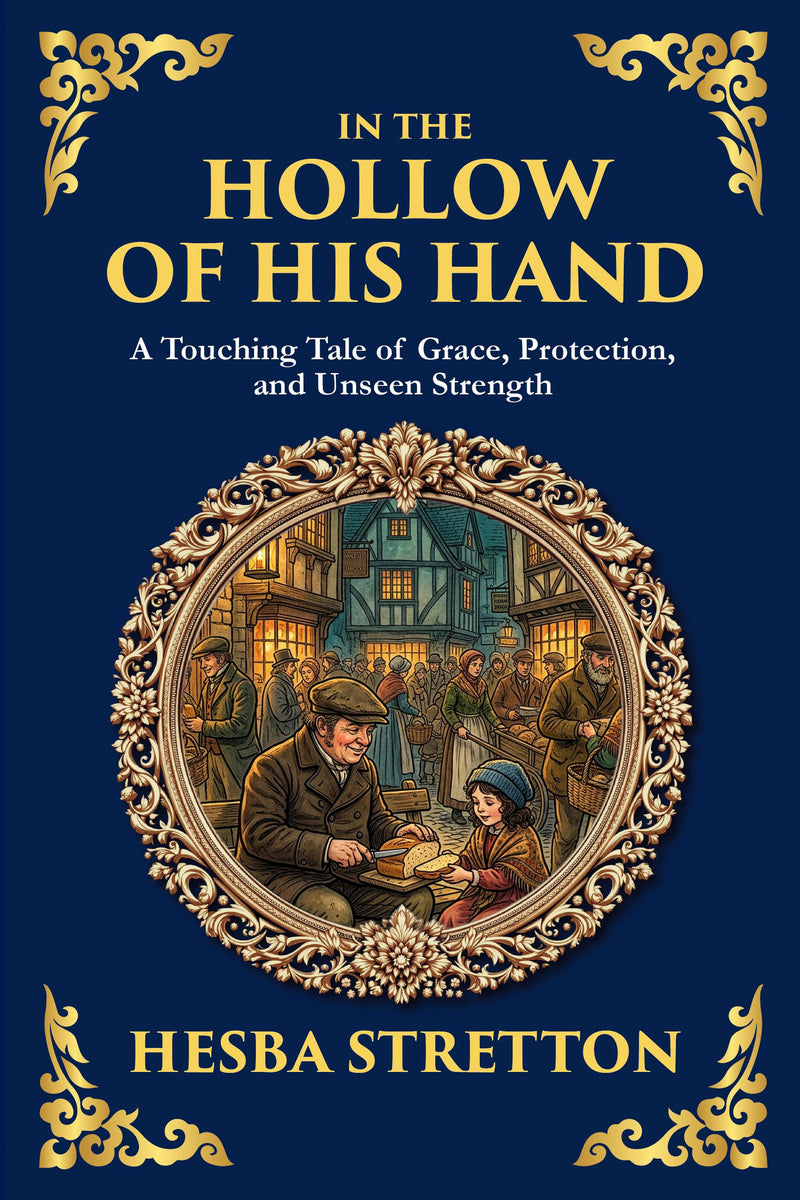
In the hollow of His hand — Large Print
From the beloved author of Jessica’s First Prayer comes another moving story of quiet courage and divine shelter. In the Hollow of His Hand is a heartfelt portrayal of vulnerability, faith, and the mysterious ways grace finds us—even in life’s darkest corners.
or free app
10,000+ hrs library
30-day guarantee
The complete In the Hollow of His Hand appears in modern English through Library of Alexandria Press, available online with audiobook narration included for members.
Have you ever wondered why some people remain unbroken, even when the world forgets them? In the Hollow of His Hand is Hesba Stretton’s quietly powerful novel about the divine protection that wraps itself around the most fragile of lives. A spiritual successor to Jessica’s First Prayer, this story reaches into the lives of the poor and struggling—those living on the edges of society —and shows how, even in abandonment, grace still holds firm.
Known for her deeply compassionate and faith-driven narratives, Stretton crafts a world where suffering is real, but so is unseen strength. The characters—flawed, wounded, and utterly human—are drawn with tenderness and realism. Each one carries a story that echoes the central theme: that we are never truly alone, even when life seems most cruel.
This modernized edition retains the full emotional and theological resonance of the original while making the language more accessible to today’s readers. Perfect for lovers of Christian classics, spiritual literature, and stories of redemptive love, In the Hollow of His Hand offers a message of reassurance, faith, and enduring grace.
What you’ll discover in this modern edition
- The Quiet Strength of the Forgotten – Follow the lives of characters who seem forsaken, yet are deeply held in the divine hand.
- Faith in the Midst of Suffering – Explore how even the most vulnerable can find hope and purpose through trust in God.
- A Beautiful, Soul-Healing Narrative – Written with simplicity, compassion, and deep emotional resonance.
- A Companion to Stretton’s Beloved Works – If you were touched by Jessica’s First Prayer, you will find equal power and solace here.
- Modernized and Accessible – This edition makes Stretton’s timeless message easier to embrace for today’s audience while preserving its original warmth.
| Formats | eBook (EPUB + PDF) · Audiobook · Paperback · Hardcover · Large Print |
| Language | English |
| Trim size (print) | 6 × 9 in |
| Binding | Paperback — perfect-bound · Hardcover — casewrap |
| Large Print edition | Same text in a larger, easy-read type — a larger font, not a larger trim |
| Print pricing | Every physical book at our true cost — at-cost, no profit (members) |
| Library | 873 restored titles, always growing |
| Length | 49,276 words · ~3 hr 17 min reading |
| Reading level | Grade 9 · a comfortable read (this modern-English edition) |
| Edition | Modern English translation · 2026 |
Member reviews for this edition are collected as readers finish it — be the first. Across the library: 12,000+ books shipped, every plan covered by a 365-day print guarantee.
About this edition
A faithful, unabridged modern-English edition by The Library of Alexandria — carefully rendered for today's reader and verified paragraph-by-paragraph against the public-domain source. Available as eBook, audiobook, paperback, hardcover, and large print.
- Complete & unabridgedVerified paragraph by paragraph against the source — never a scan, never abridged.
- Modern English, faithfulReadable today, with the author’s meaning kept intact. Readable — not simplified.
- Every format, one membershipRead in your browser or the free app, or listen to the full audiobook.
Included free with your membership
Cancel anytime, one click · 30-day money-back guarantee
Edition last updated July 2026
What’s inside
In the hollow of His hand — Large Print — complete and unabridged: all 35 sections included with membership, plus the full audiobook.
Begin reading In the hollow of His hand — Large Print
In clear modern English — the complete text is included with membership.
Introduction
There is a particular kind of novel that earns its place not through the machinery of plot alone but through the quality of its moral atmosphere — the sense that the world it describes is one in which human choices carry genuine weight, in which suffering is neither sentimentalized nor explained away, and in which the reader is invited to feel the full pressure of conscience alongside the characters on the page. The book you are about to read is exactly that kind of novel. It was written by one of the most widely read authors of the Victorian era, a woman whose work reached millions of readers across the English-speaking world and well beyond it, and yet whose name has faded from common knowledge in a way that her achievement does not deserve. To read this story now, in a freshly prepared edition, is to recover something that has been unjustly lost — not a period curiosity, not a relic of pious Victorian sentiment, but a genuinely gripping narrative about faith under pressure, about the love between parents and children, about what it costs a person to hold fast to what they believe when the world around them is determined to make that holding fast as painful as possible.
Hesba Stretton was the pen name of Sarah Smith, born in 1832 in Wellington, Shropshire, the daughter of a bookseller and printer. The pseudonym she chose — assembled from the initials of her siblings and the name of a local hamlet — became one of the most recognizable names in Victorian popular fiction, particularly in the genre of religious and social fiction aimed at readers of all ages. Her breakthrough came with Jessica’s First Prayer, published in 1867, a short tale about a starving street child who discovers Christianity through the kindness of a coffee-stall keeper. It sold in extraordinary numbers, was translated into dozens of languages, and established Stretton as a writer of unusual power in a crowded field. She followed it with a long series of novels and stories, many of them published by the Religious Tract Society, which brought out the book you now hold. She was also a committed social reformer, one of the founders of the London Society for the Prevention of Cruelty to Children, and her fiction consistently reflects a practical, unsentimental concern for the vulnerable — for children especially, but also for the poor, the persecuted, and those ground down by systems of power that have no interest in their welfare.
It would be a mistake, however, to approach this novel as though it were primarily a tract or a piece of religious propaganda. Stretton was a storyteller first, and the religious convictions that animate her work are expressed through character and situation rather than through authorial lecture. She understood, as the best writers of moral fiction always have, that a reader’s sympathies must be engaged before their conscience can be reached, and she was skilled at engaging sympathies. Her characters breathe. Her landscapes are rendered with a specificity that suggests genuine research and genuine imaginative investment. And her plots, while they move with the purposeful momentum of a writer who knows where she is going, are never mechanical — they surprise, they complicate, they refuse easy resolution.
The world this novel inhabits is one that most contemporary readers will encounter for the first time here, and it is worth pausing to understand it before you enter. The story moves between two very different settings: rural Scotland, with its deep memory of the Covenanters — those seventeenth-century Presbyterians who suffered imprisonment, exile, and death rather than submit to royal interference in the governance of their church — and the Russian countryside of the late nineteenth century, where a Protestant sect known as the Stundists were experiencing a period of intensifying persecution at the hands of both the Orthodox establishment and local civil authorities. The connection between these two worlds is not merely geographical or narrative convenience. It is thematic and deeply felt. Stretton is drawing a line across centuries and across the map of Europe to make a point about the persistence of a particular human experience: the experience of those who find themselves, through no desire for conflict, in a position where their faith and their conscience place them in direct opposition to the power of the state and the hostility of their neighbours.
The Stundists were a real movement. They emerged in southern Russia in the 1860s, influenced partly by German Protestant settlers and partly by a broader evangelical awakening, and they grew rapidly among the Ukrainian and Russian peasantry. Their name derived from the German Stunde, meaning hour, referring to their practice of gathering for Bible study. They rejected the authority of the Russian Orthodox Church, practiced adult baptism, and organized themselves in small, self-governing communities. The Tsarist government, which regarded the Orthodox Church as a pillar of social order, viewed them with deep suspicion, and from the 1870s onward they faced increasingly severe legal restrictions. By the time Stretton was writing, Stundists could be fined, imprisoned, exiled to Siberia, and stripped of their civil rights. Their children could be taken from them and placed in Orthodox institutions. The violence visited upon them was not always official — mob attacks, encouraged or at least tolerated by local priests and officials, were a feature of their experience in many villages.
Stretton was writing about this persecution at a moment when it was very much in the news. British evangelical and nonconformist organizations had taken a keen interest in the fate of Russian religious dissenters, and there was a steady flow of reports, pamphlets, and journalistic accounts reaching English readers throughout the 1880s and 1890s. Stretton drew on this material carefully, and the Russian world she depicts has a texture and specificity that goes well beyond the generic. The village of Knishi, the telega rattling across the steppe, the great stove that dominates the farmhouse interior, the particular social dynamics of a peasant community in which the Starosta — the village elder — holds enormous informal power over those he dislikes: these details are not decorative. They are the substance of a world in which the novel’s central drama will unfold, and they are rendered with enough precision to make that world feel real.
A word about how to approach what follows, because this is a novel that rewards a particular kind of attention and can be slightly misread if approached with the wrong expectations.
This is not a novel of suspense in the modern thriller sense, though it contains moments of genuine tension and danger. It is a novel of moral and spiritual endurance, and its pleasures are those of watching characters of real integrity navigate circumstances that are designed, by the logic of the world they inhabit, to break them. The pace is deliberate. Stretton takes time to establish her characters’ inner lives before she subjects those lives to pressure, and the reader who gives her that time will find the pressure, when it comes, far more affecting than it would be in a faster-moving narrative. Do not rush the early chapters. The scenes of domestic life, the conversations between parents and children, the small details of how these people live and what they value — all of this is preparation, and it is preparation that pays off.
It is also worth noting that this is a novel in which children are central, and in which the perspective of a child — or a young person on the threshold of adulthood — is given serious moral weight. Michael, the boy we meet in the opening pages, is not a simplified or idealized figure. He is brave and loving and principled, but he is also hot-tempered, impatient, and capable of the kind of passionate misjudgment that belongs to youth. Stretton does not condescend to him, and she does not ask us to. She asks us to take his experience seriously, to understand that the choices available to a boy in his position are genuinely difficult, and that the courage required to make the right ones is genuine courage, not the easy heroism of a story in which the right path is always obvious. The same is true of Velia, his younger sister, whose presence in the narrative carries a weight that becomes clearer as the story develops. These are children in a world that is not arranged for their protection, and the novel’s emotional power derives in large part from the reader’s awareness of their vulnerability.
The adult characters, too, deserve careful attention. Alexis Ivanoff, the father, is one of Stretton’s finest creations — a man of deep faith and genuine dignity who is also entirely human in his fears and his loves. The description of him standing at the railway station, waiting for his son, is one of those moments in Victorian fiction where a character steps off the page and becomes fully present: a tall, grave, handsome man with the bearing of a leader, seen suddenly through his son’s newly mature eyes. Stretton is very good at these moments of recognition, when a character sees another character — or themselves — clearly for the first time, and she uses them sparingly enough that they retain their force.
The novel’s religious dimension is genuine and pervasive, but it is not, in the end, sectarian. Stretton is not writing a polemic for any particular form of Protestant Christianity, though her sympathies are clearly with those who insist on the primacy of individual conscience over institutional authority. What she is writing about, at a deeper level, is the experience of trust — the experience of continuing to believe that one is held, that one’s life and the lives of those one loves are in hands larger and more reliable than the hands of any earthly power, even when the evidence available to the senses suggests otherwise. The title she chose for this novel is drawn from that tradition of thought and feeling, and it names the book’s central question as well as its central affirmation. The question is: what does it mean to live as though that were true? The affirmation is that people have lived that way, at great cost, and that their doing so has been neither delusion nor waste.
One of the most quietly powerful structural decisions Stretton made in writing this novel is the one that places its opening scenes in Scotland rather than Russia. We begin not in the world of the Stundists but in the world of the Covenanters — or rather, in the world of their descendants, a small Scottish farming community that carries the memory of seventeenth-century persecution in its very architecture. The farmhouse where Catherine Ivanoff lies dying contains a hidden closet behind the wainscot, four feet square, where godly men once concealed themselves from soldiers searching the building. The valley below the house was a place of secret worship when open worship was forbidden. The landscape is saturated with the memory of what it cost people, not so very long ago in historical terms, to hold fast to their convictions.
This is not accidental. Stretton is establishing, from the very first pages, a continuity of experience that spans centuries and crosses national boundaries. The Covenanters and the Stundists are, in her understanding, the same kind of people facing the same kind of opposition, and the Scottish setting allows her to make this connection visible before the narrative moves to Russia. When Michael, kneeling beside his dying mother’s bed, hears her speak of her Covenanting ancestors — people who suffered the loss of all things, who died for conscience’ sake — he is receiving an inheritance. He is being told who he is and where he comes from, not just in the genealogical sense but in the moral sense. The blood of people who chose suffering over compromise runs in his veins, and the novel will test whether that inheritance is real or merely sentimental.
Cancel anytime, one click · 30-day money-back guarantee
Founding annual rate available now — your price locks for life when you join.
Not ready? Get this free chapter by email — read it anytime.
✓ Sent — check your inbox for In the hollow of His hand — Large Print.
Questions about In the hollow of His hand — Large Print
What is In the Hollow of His Hand about?
From the beloved author of Jessica’s First Prayer comes another moving story of quiet courage and divine shelter. In the Hollow of His Hand is a heartfelt portrayal of vulnerability, faith, and the mysterious ways grace finds us—even in life’s darkest corners. Set in a world where hardship and heartache abound, this touching novella follows the lives of the downtrodden and forgotten, revealing how providence and unseen strength protect those the world overlooks.
Who wrote In the Hollow of His Hand?
In the Hollow of His Hand was written by Hesba Stretton. This edition presents the complete work in clear modern English, faithfully rendered from the public-domain original by Library of Alexandria Press.
Is In the Hollow of His Hand free to read?
The opening chapter is free to read on this page. Members read and listen to the complete work — and the entire library — free, and can order any physical book at our true print cost.
How long is In the Hollow of His Hand?
35 chapters (~49,276 words) — about 3 hr 17 min of reading in this modern-English edition.
Is this an abridged version of In the Hollow of His Hand?
No. This is the complete, unabridged In the Hollow of His Hand, carefully rendered into clear modern English and verified paragraph-by-paragraph against the public-domain source — nothing is cut or summarised.
What formats does In the Hollow of His Hand come in?
In the Hollow of His Hand is available as eBook, paperback, hardcover and large print. eBook and audiobook are included with membership; printed editions ship at our true print cost.
Shipping & returns
Billing & membership
More from the library


Explore Children's Classics
- Peter and Wendy · J. M. Barrie
- Jack and Jill · Louisa May Alcott
- The Wonderful Wizard of Oz · L. Frank Baum
- Anne of Green Gables · L. M. Montgomery
- The Secret Garden · Frances Hodgson Burnett
- The Tale of Peter Rabbit · Beatrix Potter
- Peter Pan · J. M. Barrie
- The Prince and the Pauper · Mark Twain
- The Red Fairy Book · Andrew Lang
- Old Christmas: from the Sketch Book of Washington Irving · Washington Irving
- A Houseful of Girls · Sarah Tytler
- In the hollow of His hand · Hesba Stretton
- Miss Primrose · Agnes Giberne
- Five Little Peppers and How They Grew · Margaret Sidney
- The Loss of the Swansea: A Story of the Florida Coast · W. L. Alden
- Sky Island · L. Frank Baum
- The Book of Dragons · E. Nesbit
- Wild Animals I Have Known · Ernest Thompson Seton
- Skinny McCord · Percy Keese Fitzhugh
- The Hunniwell Boys and the Platinum Mystery · L. P. Wyman
- Rainbow Valley · L. M. Montgomery
- "Us and Our Donkey" · Amy Le Feuvre
- Dorothy and the Wizard in Oz · L. Frank Baum
- The Home Book of Verse — Volume 4 · Burton Egbert Stevenson
- The Story of Doctor Dolittle · Hugh Lofting
- The Tale of Benjamin Bunny · Beatrix Potter
- Fifty Famous Stories Retold · James Baldwin
- Rilla of Ingleside · L. M. Montgomery
- The House at Pooh Corner · A. A. Milne
- Rich and Humble: A Story for Young People · Oliver Optic
In the hollow of His hand — Large Print
In the hollow of His hand — Large Print
A Modern Translation
Hesba Stretton
Contents
- Introduction
- Chapter 1
- Chapter 2
- Chapter 3
- Chapter 4
- Chapter 5
- Chapter 6
- Chapter 7
- Chapter 8
- Chapter 9
- Chapter 10
- Chapter 11
- Chapter 12
- Chapter 13
- Chapter 14
- Chapter 15
- Chapter 16
- Chapter 17
- Chapter 18
- Chapter 19
- Chapter 20
- Chapter 21
- Chapter 22
- Chapter 23
- Chapter 24
- Chapter 25
- Chapter 26
- Chapter 27
- Chapter 28
- Chapter 29
- Chapter 30
- Chapter 31
- Chapter 32
- Chapter 33
- Chapter 34
Introduction
There is a particular kind of novel that earns its place not through the machinery of plot alone but through the quality of its moral atmosphere — the sense that the world it describes is one in which human choices carry genuine weight, in which suffering is neither sentimentalized nor explained away, and in which the reader is invited to feel the full pressure of conscience alongside the characters on the page. The book you are about to read is exactly that kind of novel. It was written by one of the most widely read authors of the Victorian era, a woman whose work reached millions of readers across the English-speaking world and well beyond it, and yet whose name has faded from common knowledge in a way that her achievement does not deserve. To read this story now, in a freshly prepared edition, is to recover something that has been unjustly lost — not a period curiosity, not a relic of pious Victorian sentiment, but a genuinely gripping narrative about faith under pressure, about the love between parents and children, about what it costs a person to hold fast to what they believe when the world around them is determined to make that holding fast as painful as possible.
Hesba Stretton was the pen name of Sarah Smith, born in 1832 in Wellington, Shropshire, the daughter of a bookseller and printer. The pseudonym she chose — assembled from the initials of her siblings and the name of a local hamlet — became one of the most recognizable names in Victorian popular fiction, particularly in the genre of religious and social fiction aimed at readers of all ages. Her breakthrough came with Jessica’s First Prayer, published in 1867, a short tale about a starving street child who discovers Christianity through the kindness of a coffee-stall keeper. It sold in extraordinary numbers, was translated into dozens of languages, and established Stretton as a writer of unusual power in a crowded field. She followed it with a long series of novels and stories, many of them published by the Religious Tract Society, which brought out the book you now hold. She was also a committed social reformer, one of the founders of the London Society for the Prevention of Cruelty to Children, and her fiction consistently reflects a practical, unsentimental concern for the vulnerable — for children especially, but also for the poor, the persecuted, and those ground down by systems of power that have no interest in their welfare.
It would be a mistake, however, to approach this novel as though it were primarily a tract or a piece of religious propaganda. Stretton was a storyteller first, and the religious convictions that animate her work are expressed through character and situation rather than through authorial lecture. She understood, as the best writers of moral fiction always have, that a reader’s sympathies must be engaged before their conscience can be reached, and she was skilled at engaging sympathies. Her characters breathe. Her landscapes are rendered with a specificity that suggests genuine research and genuine imaginative investment. And her plots, while they move with the purposeful momentum of a writer who knows where she is going, are never mechanical — they surprise, they complicate, they refuse easy resolution.
The world this novel inhabits is one that most contemporary readers will encounter for the first time here, and it is worth pausing to understand it before you enter. The story moves between two very different settings: rural Scotland, with its deep memory of the Covenanters — those seventeenth-century Presbyterians who suffered imprisonment, exile, and death rather than submit to royal interference in the governance of their church — and the Russian countryside of the late nineteenth century, where a Protestant sect known as the Stundists were experiencing a period of intensifying persecution at the hands of both the Orthodox establishment and local civil authorities. The connection between these two worlds is not merely geographical or narrative convenience. It is thematic and deeply felt. Stretton is drawing a line across centuries and across the map of Europe to make a point about the persistence of a particular human experience: the experience of those who find themselves, through no desire for conflict, in a position where their faith and their conscience place them in direct opposition to the power of the state and the hostility of their neighbours.
The Stundists were a real movement. They emerged in southern Russia in the 1860s, influenced partly by German Protestant settlers and partly by a broader evangelical awakening, and they grew rapidly among the Ukrainian and Russian peasantry. Their name derived from the German Stunde, meaning hour, referring to their practice of gathering for Bible study. They rejected the authority of the Russian Orthodox Church, practiced adult baptism, and organized themselves in small, self-governing communities. The Tsarist government, which regarded the Orthodox Church as a pillar of social order, viewed them with deep suspicion, and from the 1870s onward they faced increasingly severe legal restrictions. By the time Stretton was writing, Stundists could be fined, imprisoned, exiled to Siberia, and stripped of their civil rights. Their children could be taken from them and placed in Orthodox institutions. The violence visited upon them was not always official — mob attacks, encouraged or at least tolerated by local priests and officials, were a feature of their experience in many villages.
Stretton was writing about this persecution at a moment when it was very much in the news. British evangelical and nonconformist organizations had taken a keen interest in the fate of Russian religious dissenters, and there was a steady flow of reports, pamphlets, and journalistic accounts reaching English readers throughout the 1880s and 1890s. Stretton drew on this material carefully, and the Russian world she depicts has a texture and specificity that goes well beyond the generic. The village of Knishi, the telega rattling across the steppe, the great stove that dominates the farmhouse interior, the particular social dynamics of a peasant community in which the Starosta — the village elder — holds enormous informal power over those he dislikes: these details are not decorative. They are the substance of a world in which the novel’s central drama will unfold, and they are rendered with enough precision to make that world feel real.
A word about how to approach what follows, because this is a novel that rewards a particular kind of attention and can be slightly misread if approached with the wrong expectations.
This is not a novel of suspense in the modern thriller sense, though it contains moments of genuine tension and danger. It is a novel of moral and spiritual endurance, and its pleasures are those of watching characters of real integrity navigate circumstances that are designed, by the logic of the world they inhabit, to break them. The pace is deliberate. Stretton takes time to establish her characters’ inner lives before she subjects those lives to pressure, and the reader who gives her that time will find the pressure, when it comes, far more affecting than it would be in a faster-moving narrative. Do not rush the early chapters. The scenes of domestic life, the conversations between parents and children, the small details of how these people live and what they value — all of this is preparation, and it is preparation that pays off.
It is also worth noting that this is a novel in which children are central, and in which the perspective of a child — or a young person on the threshold of adulthood — is given serious moral weight. Michael, the boy we meet in the opening pages, is not a simplified or idealized figure. He is brave and loving and principled, but he is also hot-tempered, impatient, and capable of the kind of passionate misjudgment that belongs to youth. Stretton does not condescend to him, and she does not ask us to. She asks us to take his experience seriously, to understand that the choices available to a boy in his position are genuinely difficult, and that the courage required to make the right ones is genuine courage, not the easy heroism of a story in which the right path is always obvious. The same is true of Velia, his younger sister, whose presence in the narrative carries a weight that becomes clearer as the story develops. These are children in a world that is not arranged for their protection, and the novel’s emotional power derives in large part from the reader’s awareness of their vulnerability.
The adult characters, too, deserve careful attention. Alexis Ivanoff, the father, is one of Stretton’s finest creations — a man of deep faith and genuine dignity who is also entirely human in his fears and his loves. The description of him standing at the railway station, waiting for his son, is one of those moments in Victorian fiction where a character steps off the page and becomes fully present: a tall, grave, handsome man with the bearing of a leader, seen suddenly through his son’s newly mature eyes. Stretton is very good at these moments of recognition, when a character sees another character — or themselves — clearly for the first time, and she uses them sparingly enough that they retain their force.
The novel’s religious dimension is genuine and pervasive, but it is not, in the end, sectarian. Stretton is not writing a polemic for any particular form of Protestant Christianity, though her sympathies are clearly with those who insist on the primacy of individual conscience over institutional authority. What she is writing about, at a deeper level, is the experience of trust — the experience of continuing to believe that one is held, that one’s life and the lives of those one loves are in hands larger and more reliable than the hands of any earthly power, even when the evidence available to the senses suggests otherwise. The title she chose for this novel is drawn from that tradition of thought and feeling, and it names the book’s central question as well as its central affirmation. The question is: what does it mean to live as though that were true? The affirmation is that people have lived that way, at great cost, and that their doing so has been neither delusion nor waste.
One of the most quietly powerful structural decisions Stretton made in writing this novel is the one that places its opening scenes in Scotland rather than Russia. We begin not in the world of the Stundists but in the world of the Covenanters — or rather, in the world of their descendants, a small Scottish farming community that carries the memory of seventeenth-century persecution in its very architecture. The farmhouse where Catherine Ivanoff lies dying contains a hidden closet behind the wainscot, four feet square, where godly men once concealed themselves from soldiers searching the building. The valley below the house was a place of secret worship when open worship was forbidden. The landscape is saturated with the memory of what it cost people, not so very long ago in historical terms, to hold fast to their convictions.
This is not accidental. Stretton is establishing, from the very first pages, a continuity of experience that spans centuries and crosses national boundaries. The Covenanters and the Stundists are, in her understanding, the same kind of people facing the same kind of opposition, and the Scottish setting allows her to make this connection visible before the narrative moves to Russia. When Michael, kneeling beside his dying mother’s bed, hears her speak of her Covenanting ancestors — people who suffered the loss of all things, who died for conscience’ sake — he is receiving an inheritance. He is being told who he is and where he comes from, not just in the genealogical sense but in the moral sense. The blood of people who chose suffering over compromise runs in his veins, and the novel will test whether that inheritance is real or merely sentimental.
“Look, I am sending you out like sheep among wolves; therefore be as shrewd as snakes and as innocent as doves.”
The boy, who was reading in a clear, low voice despite his foreign accent, felt his mother’s weak hands press against him and looked up at her pale, peaceful face. He was kneeling by her bed; she pushed back his thick brown curls and looked with deep tenderness into his honest, youthful face.
“That is true, my boy,” she said. “True for you, but not for me. He is calling me home, but He is sending you and your father out as sheep among wolves. Ah, the Lord Jesus knew then, and He knows now. Never think He is far away or indifferent to your troubles. You will return to your father once I have gone home—but not to Knishi, never again to Knishi. Oh, if I had only known, I would have gone to heaven straight from there!”
Her weak, gasping voice stopped for a minute or two, but her eyes remained fixed on her son with love and anxiety.
“And oh, Michael,” she said, “be wise! Do not provoke the neighbors more than necessary. You are still only a boy, and they will leave you alone if you stay quiet. Be ‘innocent as doves,’ as our Lord says.”
“But you wouldn’t want me to be a coward, mother,” the boy answered with some heat.
“Me, Michael? Me?” she cried, a faint flush appearing on her pale cheeks. “No, no! Were my own ancestors not among the Covenanters? On both my father’s and mother’s sides! Didn’t they lose everything—and die for the sake of their conscience? No, Michael, I would send you to your death, if necessary, for the truth. But it is hard to think of young children suffering cruelly because their parents must act according to their conscience. Oh, my Michael! And my little Velia!”
End of the free sample
Keep reading, free
Members read and listen to the complete book — and the entire library. Cancel anytime, one click · 30-day money-back guarantee.