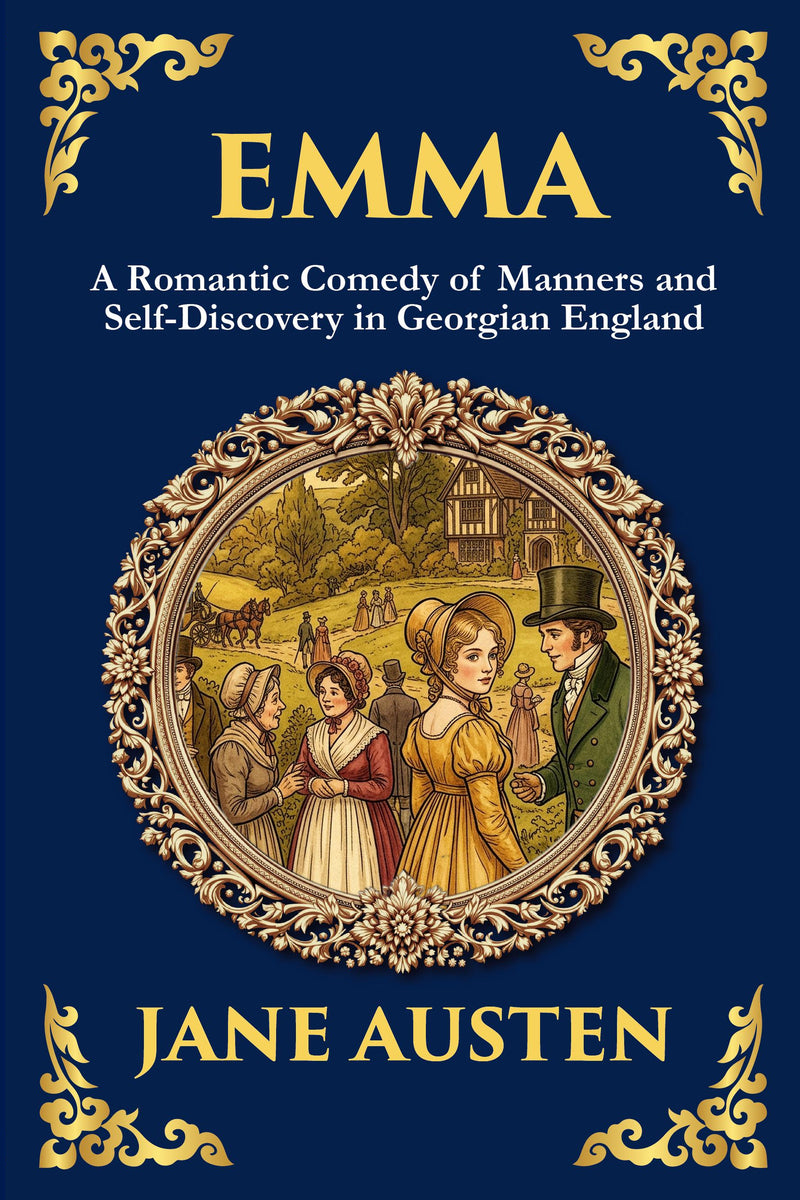
Emma — Large Print
Emma Woodhouse is clever, rich, and beautiful—yet her well-meaning schemes to match others in love often end in disaster.
or free app
10,000+ hrs library
30-day guarantee
The complete Emma appears in modern English through Library of Alexandria Press, available online with audiobook narration included for members.
Have you ever wondered why the path to love is often paved with mistakes, misunderstandings, and laughter? In Emma, Jane Austen delivers one of her most beloved comedies of manners, a brilliant exploration of romance, pride, and the search for self-knowledge. At the heart of the story is Emma Woodhouse, a spirited young woman whose attempts to orchestrate love affairs for others reveal more about her own blind spots than about the hearts she seeks to guide.
This modern edition brings Austen’s humor, insight, and keen observations of Georgian society vividly to life. Emma is both a romantic comedy and a thoughtful reflection on class, gender, and the importance of humility in matters of the heart.
What you’ll discover in this modern edition
- A Delightful Comedy of Errors – Follow Emma’s misguided matchmaking adventures and the humorous entanglements they create.
- A Journey of Self-Discovery – Witness how Emma’s pride and vanity give way to self- awareness, humility, and genuine love.
- A Portrait of Georgian Society – Experience the customs, manners, and intricate social dynamics of Austen’s world.
- One of Literature’s Most Beloved Romances – Relive the charming evolution of Emma’s relationship with Mr. Knightley, one of Austen’s most iconic heroes.
| Formats | eBook (EPUB + PDF) · Audiobook · Paperback · Hardcover · Large Print |
| Language | English |
| Trim size (print) | 6 × 9 in |
| Binding | Paperback — perfect-bound · Hardcover — casewrap |
| Large Print edition | Same text in a larger, easy-read type — a larger font, not a larger trim |
| Print pricing | Every physical book at our true cost — at-cost, no profit (members) |
| Library | 873 restored titles, always growing |
| Length | 150,229 words · ~10 hr 1 min reading |
| Reading level | Grade 7 · an easy, flowing read (this modern-English edition) |
| Edition | Modern English translation · 2026 |
Member reviews for this edition are collected as readers finish it — be the first. Across the library: 12,000+ books shipped, every plan covered by a 365-day print guarantee.
About this edition
A faithful, unabridged modern-English edition by The Library of Alexandria — carefully rendered for today's reader and verified paragraph-by-paragraph against the public-domain source. Available as eBook, audiobook, paperback, hardcover, and large print.
- Complete & unabridgedVerified paragraph by paragraph against the source — never a scan, never abridged.
- Modern English, faithfulReadable today, with the author’s meaning kept intact. Readable — not simplified.
- Every format, one membershipRead in your browser or the free app, or listen to the full audiobook.
Included free with your membership
Cancel anytime, one click · 30-day money-back guarantee
Edition last updated July 2026
What’s inside
Emma — Large Print — complete and unabridged: all 23 sections included with membership, plus the full audiobook.
Begin reading Emma — Large Print
In clear modern English — the complete text is included with membership.
Introduction
There is a particular kind of pleasure that comes from spending time in the company of someone who is brilliant, charming, generous, and almost entirely wrong about herself and everyone around her. It is the pleasure of watching a person of genuine quality stumble through a series of misjudgments so confident, so beautifully reasoned, and so spectacularly mistaken that we cannot help but love her even as we wince. This is the experience that awaits you in the pages ahead. The young woman at the center of this story is, by her own creator’s famous admission, a heroine “whom no one but myself will much like.” It is one of the most delightful misjudgments ever recorded, because readers have adored her for more than two centuries—not in spite of her flaws, but because of the dazzling, exasperating, deeply human way she carries them.
This novel, first published in 1815, arrives near the end of its author’s tragically short career, and it represents her art at its most assured and most playful. By the time she wrote it, Jane Austen had already given the world several beloved books, and she had refined her craft to a point of near-perfect control. What you hold in your hands is a comedy in the truest and oldest sense of the word: a story about misunderstanding and recognition, about the gap between how we see ourselves and how we truly are, and about the slow, surprising journey toward self-knowledge. It is a book about a small world—a quiet English village where very little seems to happen—and yet within that small world it contains nearly everything worth knowing about human nature, vanity, kindness, love, and the comedy of being alive among other people.
This edition has been carefully prepared as a modern translation, adapted for the contemporary reader. That phrase deserves a word of explanation, because it speaks directly to the reading experience you are about to have. Austen wrote in the elegant, intricate prose of the early nineteenth century, a style full of long, balanced sentences, subtle ironies, and turns of phrase that were perfectly clear to her first readers but can occasionally slow a modern reader down. The aim of this adaptation is to clear away those small obstacles—to smooth the path so that the wit lands cleanly, the emotional turns register fully, and the comedy moves with the brisk energy its author intended. What has not changed is the heart of the thing: the characters, their voices, their entanglements, and above all the sly, watchful intelligence that observes them all. This is still entirely Austen’s story, told with all of her humor and warmth, simply rendered in a way that lets you enjoy it without a glossary at your elbow.
One of the first things a new reader notices about this novel is how little, on the surface, actually occurs. There are no wars, no shipwrecks, no villains lurking in shadowy castles, no fortunes lost at sea. The setting is a modest country village, and the events that drive the plot are the small social rituals of a comfortable rural community: dinners, dances, walks, visits, the planning of parties, the exchange of letters, the careful management of who may call upon whom. Austen herself famously described her artistic territory as “the little bit (two inches wide) of ivory on which I work with so fine a brush.” It was a self-deprecating remark, but it was also a statement of profound confidence. She knew exactly how much she could accomplish within those modest boundaries, and the answer turns out to be: nearly everything.
The genius of this approach is that by narrowing her focus so tightly, Austen forces us to look closely. When the stakes are not life and death, the smallest gestures take on enormous weight. A misjudged remark at a party becomes a moral crisis. A misread glance can reshape a friendship. The seating arrangement at a dinner, the question of who is invited and who is left out, the precise tone of a compliment—these become matters of real consequence, because they reveal who people truly are. In Austen’s hands, the drawing room becomes a stage as charged with tension and revelation as any battlefield. And because the world is so small and so intimately observed, we come to know its inhabitants better than we know many of the people in our own lives.
This is a community in which everyone is watching everyone else, in which reputation and respectability are precious commodities, and in which a single false step can ripple outward for months. Understanding this gives the comedy its edge. Our heroine moves through this world with the unshakable assurance of someone who has always been at the top of it—the cleverest, the prettiest, the most important young woman in her circle, accustomed to having her opinions valued and her wishes obeyed. She is rich, she is well-born, she is admired, and she has never had any serious reason to question her own judgment. This is precisely her problem, and it is the engine of everything that follows. The novel is, at its core, a study of what happens when a person of real ability and real goodness has never been challenged, never been corrected, never been forced to see herself clearly. The result is a young woman who means well, who genuinely wants the best for the people she loves, and who creates a remarkable amount of chaos through her serene certainty that she knows best.
What makes this so satisfying to read is that Austen never lets us simply look down on her heroine. We are made complicit in her schemes. We see the world through her eyes, share her reasoning, and find ourselves nodding along with her clever deductions—right up to the moment when the floor gives way and we realize, often a beat or two before she does, just how badly she has misunderstood the situation. This is the special texture of the book’s irony: it operates on multiple levels at once. There is what the heroine believes, what is actually true, what the other characters perceive, and what we, the readers, gradually come to understand. The pleasure lies in holding all these layers in mind simultaneously, in being just slightly ahead of the protagonist, and in waiting—sometimes with delight, sometimes with genuine anxiety—for the moment of recognition to arrive.
The world of the novel is also, quietly, a world built on a precise and unforgiving social hierarchy. Everyone in it has a place, and much of the drama comes from people’s relationships to those places—who is rising, who is falling, who presumes too much, who is too humble, who must be patronized and who may be befriended. Our heroine’s mischief frequently springs from her attempts to rearrange these social positions according to her own romantic and benevolent designs. She decides who is worthy of whom, who ought to marry whom, and how the social map of her little world should be redrawn. That she has no real understanding of the people she is moving around like pieces on a board is the source of both the comedy and, eventually, the moral weight of her story. Austen is deeply interested in the question of how we treat those who have less power than we do, and some of the most quietly devastating moments in the book involve the heroine’s carelessness toward people who cannot afford to be treated carelessly.
If there is one theme that runs through every chapter of this novel like a golden thread, it is the difficulty of knowing oneself. The subtitle of this edition rightly calls it a story of self-discovery, and that is exactly what it is, though the discovery is hard-won and frequently embarrassing. The central irony of the book is that its heroine, who prides herself on her insight into other people—who fancies herself an astute reader of hearts and a skilled arranger of destinies—is in fact almost completely blind to the workings of her own. She can spin elaborate theories about everyone else’s feelings while remaining utterly ignorant of her own. She is forever explaining other people to themselves, and getting it wrong, while the most important truths about her own life sit in plain view, unrecognized.
This is one of the most universal and enduring observations in all of literature, and it is the reason the book feels so startlingly modern despite its early-nineteenth-century setting. We have all known someone who confidently diagnoses everyone else’s problems while remaining a mystery to themselves. Many of us, if we are honest, have been that someone. Austen understood, with a clarity that can feel almost uncomfortable, how skilled human beings are at constructing flattering stories about themselves and their motives, and how those stories can blind us to what is actually happening. The heroine of this novel believes she is acting out of pure kindness, out of friendship and good intentions, and to a real extent she is—but woven through that kindness are strands of vanity, of the desire to be important, to be needed, to be the cleverest person in the room and the architect of other people’s happiness. Watching her gradually untangle these motives, and confront the parts of herself she would rather not see, is one of the deep satisfactions of the reading experience.
What keeps all this from being heavy or moralizing is the lightness of Austen’s touch. She is, above all, funny. The comedy of this book is relentless and exquisitely calibrated, ranging from broad and immediately delightful character humor to the most delicate and almost subliminal ironies. There is a wonderful gallery of supporting characters, each rendered with a precision that makes them instantly recognizable: the fretful, fussy father who lives in perpetual terror of drafts and rich food and any kind of change whatsoever; the kindly, talkative neighbor who cannot complete a single sentence without wandering off into a dozen affectionate digressions; the pompous newcomer who is convinced of his own superiority; the various young people whose romantic prospects provide endless material for speculation and matchmaking. Each of these figures is a comic creation of the first order, but none of them is merely a caricature. Austen gives even her most absurd characters a fundamental humanity, a vulnerability that makes us care about them even as we laugh.
This balance—between comedy and feeling, between satire and sympathy—is the hardest thing for any writer to achieve, and Austen achieves it on nearly every page. She can make us laugh at a character in one paragraph and break our hearts on their behalf in the next. She can expose human vanity and foolishness with surgical precision while never losing sight of the fact that these foolish, vain people are also lonely, hopeful, frightened, and longing for connection, just as we all are. The result is a comedy that warms rather than wounds, a book that leaves you feeling more generous toward your fellow human beings rather than more cynical.
There is also a love story at the heart of the novel—indeed, there are several, woven together with the intricacy of a fine piece of needlework. But the central romance is one of the most quietly perfect in all of fiction, precisely because it is so unhurried and so deeply earned. It does not announce itself with thunderclaps. It grows slowly, almost invisibly, out of friendship and shared history and the kind of honest, sometimes prickly conversation that exists only between two people who truly know and respect each other. One of the great pleasures of the book is watching this relationship develop in the background, half-hidden even from the people involved in it, until at last it comes into focus with a clarity that feels both surprising and utterly inevitable. There is a particular character in this novel—an older friend of the heroine’s, one of the few people willing to tell her the truth and to challenge her when she is wrong—whose role in the story rewards close attention. The relationship between these two is one of the most intelligent and adult portrayals of love in English literature, built not on infatuation but on mutual understanding, honest criticism, and the kind of deep affection that can only grow over time.
Cancel anytime, one click · 30-day money-back guarantee
Founding annual rate available now — your price locks for life when you join.
Not ready? Get this free chapter by email — read it anytime.
✓ Sent — check your inbox for Emma — Large Print.
Questions about Emma — Large Print
What is Emma about?
Emma Woodhouse is clever, rich, and beautiful—yet her well-meaning schemes to match others in love often end in disaster. Blinded by her own pride and misunderstandings, Emma must navigate the delicate world of Georgian society, friendship, and romance. In this timeless tale of wit and self-discovery, Jane Austen reminds us that true love often appears when least expected.
Who wrote Emma?
Emma was written by Jane Austen. This edition presents the complete work in clear modern English, faithfully rendered from the public-domain original by Library of Alexandria Press.
Is Emma free to read?
The opening chapter is free to read on this page. Members read and listen to the complete work — and the entire library — free, and can order any physical book at our true print cost.
How long is Emma?
23 chapters (~150,229 words) — about 10 hr 1 min of reading in this modern-English edition.
Is this an abridged version of Emma?
No. This is the complete, unabridged Emma, carefully rendered into clear modern English and verified paragraph-by-paragraph against the public-domain source — nothing is cut or summarised.
What formats does Emma come in?
Emma is available as eBook, paperback, hardcover and large print. eBook and audiobook are included with membership; printed editions ship at our true print cost.
Shipping & returns
Billing & membership
More from the library


Explore Humour & Satire
- The Imaginary Invalid · Molière
- My Man Jeeves · P. G. Wodehouse
- Barry Lyndon · William Makepeace Thackeray
- The Man with Two Left Feet, and Other Stories · P. G. Wodehouse
- Carry On, Jeeves · P. G. Wodehouse
- The Confidence-Man: His Masquerade · Herman Melville
- Lucian’s True History · Lucian of Samosata
- Penrod · Booth Tarkington
- Status Quo · Mack Reynolds
- Herland · Charlotte Perkins Gilman
- Sartor Resartus: The Life and Opinions of Herr Teufelsdröckh · Thomas Carlyle
- The Satyricon of Petronius Arbiter · Petronius Arbiter
- Three Men in a Boat (To Say Nothing of the Dog) · Jerome K. Jerome
- A Connecticut Yankee in King Arthur’s Court · Mark Twain
- Northanger Abbey · Jane Austen
- Once Aboard the Lugger—The History of George and his Mary · A. S. M. Hutchinson
- Candide · Voltaire
- Gulliver’s Travels into Several Remote Regions of the World · Jonathan Swift
- Emma · Jane Austen
- A Room with a View · E. M. Forster
- The Eyes Have It · Philip K. Dick
- The Wind in the Willows · Kenneth Grahame
- Right Ho, Jeeves · P. G. Wodehouse
- The Mysterious Stranger and Other Stories · Mark Twain
- A Modest Proposal · Jonathan Swift
Emma — Large Print
Emma — Large Print
A Romantic Comedy of Manners and Self-Discovery in Georgian England
Jane Austen
Contents
- Introduction
- Volume 1
- Chapter 1
- Chapter 2
- Chapter 3
- Chapter 4
- Chapter 5
- Chapter 6
- Chapter 7
- Chapter 8
- Chapter 9
- Chapter 10
- Chapter 11
- Chapter 12
- Chapter 13
- Chapter 14
- Chapter 15
- Chapter 16
- Chapter 17
- Chapter 18
- Volume 2
- Volume 3
- Chapter 19
Introduction
There is a particular kind of pleasure that comes from spending time in the company of someone who is brilliant, charming, generous, and almost entirely wrong about herself and everyone around her. It is the pleasure of watching a person of genuine quality stumble through a series of misjudgments so confident, so beautifully reasoned, and so spectacularly mistaken that we cannot help but love her even as we wince. This is the experience that awaits you in the pages ahead. The young woman at the center of this story is, by her own creator’s famous admission, a heroine “whom no one but myself will much like.” It is one of the most delightful misjudgments ever recorded, because readers have adored her for more than two centuries—not in spite of her flaws, but because of the dazzling, exasperating, deeply human way she carries them.
This novel, first published in 1815, arrives near the end of its author’s tragically short career, and it represents her art at its most assured and most playful. By the time she wrote it, Jane Austen had already given the world several beloved books, and she had refined her craft to a point of near-perfect control. What you hold in your hands is a comedy in the truest and oldest sense of the word: a story about misunderstanding and recognition, about the gap between how we see ourselves and how we truly are, and about the slow, surprising journey toward self-knowledge. It is a book about a small world—a quiet English village where very little seems to happen—and yet within that small world it contains nearly everything worth knowing about human nature, vanity, kindness, love, and the comedy of being alive among other people.
This edition has been carefully prepared as a modern translation, adapted for the contemporary reader. That phrase deserves a word of explanation, because it speaks directly to the reading experience you are about to have. Austen wrote in the elegant, intricate prose of the early nineteenth century, a style full of long, balanced sentences, subtle ironies, and turns of phrase that were perfectly clear to her first readers but can occasionally slow a modern reader down. The aim of this adaptation is to clear away those small obstacles—to smooth the path so that the wit lands cleanly, the emotional turns register fully, and the comedy moves with the brisk energy its author intended. What has not changed is the heart of the thing: the characters, their voices, their entanglements, and above all the sly, watchful intelligence that observes them all. This is still entirely Austen’s story, told with all of her humor and warmth, simply rendered in a way that lets you enjoy it without a glossary at your elbow.
One of the first things a new reader notices about this novel is how little, on the surface, actually occurs. There are no wars, no shipwrecks, no villains lurking in shadowy castles, no fortunes lost at sea. The setting is a modest country village, and the events that drive the plot are the small social rituals of a comfortable rural community: dinners, dances, walks, visits, the planning of parties, the exchange of letters, the careful management of who may call upon whom. Austen herself famously described her artistic territory as “the little bit (two inches wide) of ivory on which I work with so fine a brush.” It was a self-deprecating remark, but it was also a statement of profound confidence. She knew exactly how much she could accomplish within those modest boundaries, and the answer turns out to be: nearly everything.
The genius of this approach is that by narrowing her focus so tightly, Austen forces us to look closely. When the stakes are not life and death, the smallest gestures take on enormous weight. A misjudged remark at a party becomes a moral crisis. A misread glance can reshape a friendship. The seating arrangement at a dinner, the question of who is invited and who is left out, the precise tone of a compliment—these become matters of real consequence, because they reveal who people truly are. In Austen’s hands, the drawing room becomes a stage as charged with tension and revelation as any battlefield. And because the world is so small and so intimately observed, we come to know its inhabitants better than we know many of the people in our own lives.
This is a community in which everyone is watching everyone else, in which reputation and respectability are precious commodities, and in which a single false step can ripple outward for months. Understanding this gives the comedy its edge. Our heroine moves through this world with the unshakable assurance of someone who has always been at the top of it—the cleverest, the prettiest, the most important young woman in her circle, accustomed to having her opinions valued and her wishes obeyed. She is rich, she is well-born, she is admired, and she has never had any serious reason to question her own judgment. This is precisely her problem, and it is the engine of everything that follows. The novel is, at its core, a study of what happens when a person of real ability and real goodness has never been challenged, never been corrected, never been forced to see herself clearly. The result is a young woman who means well, who genuinely wants the best for the people she loves, and who creates a remarkable amount of chaos through her serene certainty that she knows best.
What makes this so satisfying to read is that Austen never lets us simply look down on her heroine. We are made complicit in her schemes. We see the world through her eyes, share her reasoning, and find ourselves nodding along with her clever deductions—right up to the moment when the floor gives way and we realize, often a beat or two before she does, just how badly she has misunderstood the situation. This is the special texture of the book’s irony: it operates on multiple levels at once. There is what the heroine believes, what is actually true, what the other characters perceive, and what we, the readers, gradually come to understand. The pleasure lies in holding all these layers in mind simultaneously, in being just slightly ahead of the protagonist, and in waiting—sometimes with delight, sometimes with genuine anxiety—for the moment of recognition to arrive.
The world of the novel is also, quietly, a world built on a precise and unforgiving social hierarchy. Everyone in it has a place, and much of the drama comes from people’s relationships to those places—who is rising, who is falling, who presumes too much, who is too humble, who must be patronized and who may be befriended. Our heroine’s mischief frequently springs from her attempts to rearrange these social positions according to her own romantic and benevolent designs. She decides who is worthy of whom, who ought to marry whom, and how the social map of her little world should be redrawn. That she has no real understanding of the people she is moving around like pieces on a board is the source of both the comedy and, eventually, the moral weight of her story. Austen is deeply interested in the question of how we treat those who have less power than we do, and some of the most quietly devastating moments in the book involve the heroine’s carelessness toward people who cannot afford to be treated carelessly.
If there is one theme that runs through every chapter of this novel like a golden thread, it is the difficulty of knowing oneself. The subtitle of this edition rightly calls it a story of self-discovery, and that is exactly what it is, though the discovery is hard-won and frequently embarrassing. The central irony of the book is that its heroine, who prides herself on her insight into other people—who fancies herself an astute reader of hearts and a skilled arranger of destinies—is in fact almost completely blind to the workings of her own. She can spin elaborate theories about everyone else’s feelings while remaining utterly ignorant of her own. She is forever explaining other people to themselves, and getting it wrong, while the most important truths about her own life sit in plain view, unrecognized.
This is one of the most universal and enduring observations in all of literature, and it is the reason the book feels so startlingly modern despite its early-nineteenth-century setting. We have all known someone who confidently diagnoses everyone else’s problems while remaining a mystery to themselves. Many of us, if we are honest, have been that someone. Austen understood, with a clarity that can feel almost uncomfortable, how skilled human beings are at constructing flattering stories about themselves and their motives, and how those stories can blind us to what is actually happening. The heroine of this novel believes she is acting out of pure kindness, out of friendship and good intentions, and to a real extent she is—but woven through that kindness are strands of vanity, of the desire to be important, to be needed, to be the cleverest person in the room and the architect of other people’s happiness. Watching her gradually untangle these motives, and confront the parts of herself she would rather not see, is one of the deep satisfactions of the reading experience.
What keeps all this from being heavy or moralizing is the lightness of Austen’s touch. She is, above all, funny. The comedy of this book is relentless and exquisitely calibrated, ranging from broad and immediately delightful character humor to the most delicate and almost subliminal ironies. There is a wonderful gallery of supporting characters, each rendered with a precision that makes them instantly recognizable: the fretful, fussy father who lives in perpetual terror of drafts and rich food and any kind of change whatsoever; the kindly, talkative neighbor who cannot complete a single sentence without wandering off into a dozen affectionate digressions; the pompous newcomer who is convinced of his own superiority; the various young people whose romantic prospects provide endless material for speculation and matchmaking. Each of these figures is a comic creation of the first order, but none of them is merely a caricature. Austen gives even her most absurd characters a fundamental humanity, a vulnerability that makes us care about them even as we laugh.
This balance—between comedy and feeling, between satire and sympathy—is the hardest thing for any writer to achieve, and Austen achieves it on nearly every page. She can make us laugh at a character in one paragraph and break our hearts on their behalf in the next. She can expose human vanity and foolishness with surgical precision while never losing sight of the fact that these foolish, vain people are also lonely, hopeful, frightened, and longing for connection, just as we all are. The result is a comedy that warms rather than wounds, a book that leaves you feeling more generous toward your fellow human beings rather than more cynical.
There is also a love story at the heart of the novel—indeed, there are several, woven together with the intricacy of a fine piece of needlework. But the central romance is one of the most quietly perfect in all of fiction, precisely because it is so unhurried and so deeply earned. It does not announce itself with thunderclaps. It grows slowly, almost invisibly, out of friendship and shared history and the kind of honest, sometimes prickly conversation that exists only between two people who truly know and respect each other. One of the great pleasures of the book is watching this relationship develop in the background, half-hidden even from the people involved in it, until at last it comes into focus with a clarity that feels both surprising and utterly inevitable. There is a particular character in this novel—an older friend of the heroine’s, one of the few people willing to tell her the truth and to challenge her when she is wrong—whose role in the story rewards close attention. The relationship between these two is one of the most intelligent and adult portrayals of love in English literature, built not on infatuation but on mutual understanding, honest criticism, and the kind of deep affection that can only grow over time.
Emma Woodhouse was beautiful, smart, and wealthy. With a comfortable home and a cheerful personality, she seemed to have all the best advantages in life. For nearly twenty-one years, she had lived with very little to upset or worry her.
She was the youngest of two daughters born to a very loving and indulgent father. Because her sister had married, Emma had been the mistress of the house from a very young age. Her mother had died so long ago that Emma had only a vague memory of her affection; however, her place had been filled by an excellent governess who had been almost like a mother to her.
Miss Taylor had been part of the Woodhouse family for sixteen years, acting more as a friend than a governess. She was fond of both daughters, but especially of Emma. Their relationship was more like that of sisters. Even when Miss Taylor was still officially the governess, her gentle nature meant she rarely imposed any rules. Now that the pretense of authority was long gone, they lived as deeply attached friends. Emma did whatever she liked; while she highly valued Miss Taylor’s judgment, she was mostly guided by her own.
The real problems in Emma’s life were that she got her own way too often and tended to think a bit too highly of herself. These were the flaws that threatened to spoil her many joys. However, she was currently unaware of the danger, so she didn’t view these traits as misfortunes at all.
Then came a sorrow—a gentle one—though it didn’t stem from any guilty conscience. Miss Taylor got married. The loss of Miss Taylor was what first brought grief. It was on the wedding day of this beloved friend that Emma first spent a long time lost in mournful thought. Once the wedding ended and the bridal party left, Emma and her father were left to dine alone, with no one else to brighten the long evening. As usual, her father settled down for a nap after dinner, leaving Emma alone to dwell on what she had lost.
End of the free sample
Keep reading, free
Members read and listen to the complete book — and the entire library. Cancel anytime, one click · 30-day money-back guarantee.