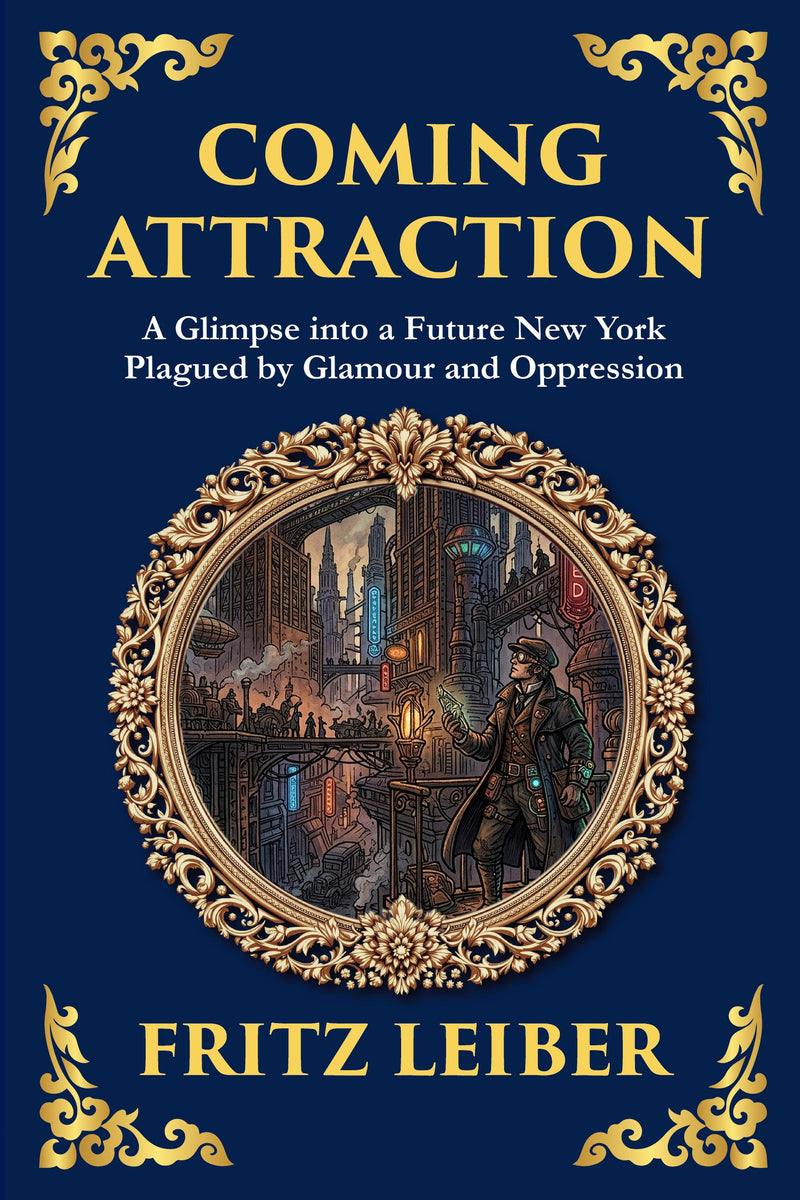
Coming Attraction
Set in a decaying future Manhattan cloaked in fog, neon, and menace, Coming Attraction presents a vision of America torn between beauty and brutality.
or free app
10,000+ hrs library
30-day guarantee
The complete Coming Attraction appears in modern English through Library of Alexandria Press, available online with audiobook narration included for members.
Have you ever wondered why a society obsessed with appearances often hides the most dangerous truths? Coming Attraction is Fritz Leiber’s haunting dive into a dystopian America where glitz conceals decay and love is just another form of control. In a bombed-out New York City where women wear seductive masks and men exude cold aggression, a visiting foreigner gets caught in the alluring web of a mysterious woman—only to discover that beneath the glamor lies something far darker.
This story, part noir thriller and part psychological parable, reveals a society addicted to spectacle and control. Leiber’s writing is sharp, stylish, and deeply disturbing—a window into a future that may feel uncomfortably close to our own.
What you’ll discover in this modern edition
- A Chilling Vision of Future America Experience a war-torn, glamorous Manhattan where beauty is weaponized and identity is hidden behind a mask.
| Formats | eBook (EPUB + PDF) · Audiobook · Paperback · Hardcover · Large Print |
| Language | English |
| Trim size (print) | 6 × 9 in |
| Binding | Paperback — perfect-bound · Hardcover — casewrap |
| Large Print edition | Same text in a larger, easy-read type — a larger font, not a larger trim |
| Print pricing | Every physical book at our true cost — at-cost, no profit (members) |
| Library | 873 restored titles, always growing |
| Length | 8,491 words · ~34 min reading |
| Reading level | Grade 7 · an easy, flowing read (this modern-English edition) |
| Edition | Modern English translation · 2026 |
Member reviews for this edition are collected as readers finish it — be the first. Across the library: 12,000+ books shipped, every plan covered by a 365-day print guarantee.
About this edition
A faithful, unabridged modern-English edition by The Library of Alexandria — carefully rendered for today's reader and verified paragraph-by-paragraph against the public-domain source. Available as eBook, audiobook, paperback, hardcover, and large print.
- Complete & unabridgedVerified paragraph by paragraph against the source — never a scan, never abridged.
- Modern English, faithfulReadable today, with the author’s meaning kept intact. Readable — not simplified.
- Every format, one membershipRead in your browser or the free app, or listen to the full audiobook.
Included free with your membership
Cancel anytime, one click · 30-day money-back guarantee
Edition last updated July 2026
What’s inside
Coming Attraction — complete and unabridged, included in full with membership, plus the full audiobook.
Begin reading Coming Attraction
In clear modern English — the complete text is included with membership.
Introduction
There are stories that simply describe a future, and then there are stories that warn us about one. “Coming Attraction” belongs firmly to the second category — a short, ferocious vision of a world that has gone wrong in ways both familiar and strange. First published in the early 1950s, when the dust of one war had barely settled and the shadow of nuclear annihilation hung over every dinner table and newspaper headline, this tale arrives at the reader like a flare fired into a darkened sky. It illuminates briefly, sharply, and unforgettably. And what it reveals is not a comfortable place to dwell, but a place we cannot quite look away from.
The author behind this work, Fritz Leiber, was a writer of remarkable range — a craftsman equally at home in the realms of swords and sorcery, supernatural horror, and the speculative futures of science fiction. He brought to all his work an unusual sensitivity to the textures of fear and desire, an understanding that the things which truly frighten us are rarely monsters in the conventional sense. More often, they are reflections: distortions of ourselves, our appetites, and the societies we build to contain or indulge them. In this particular story, Leiber turns his attention to a New York City that has survived catastrophe only to mutate into something grotesque, a metropolis of glittering luxury laid over a foundation of cruelty, paranoia, and spectacle. The result is a piece of fiction that, decades after its composition, continues to resonate with an uncomfortable accuracy.
This edition presents the work in a modern translation, adapted carefully for the contemporary reader. The language has been smoothed where the idioms of an earlier era might have caused confusion, the references clarified where time has dulled their immediacy, and the rhythm of the prose tuned to the ear of a present-day audience. None of this has been done to diminish the original’s force — quite the opposite. The intention has been to remove the small barriers that can accumulate between a mid-twentieth-century text and a twenty-first-century mind, so that the story’s genuine power can strike without interference. What you hold is meant to feel immediate, as though it were written for you, about a tomorrow that might still be coming.
To enter this story is to step into a city that feels at once seductive and sinister. The future imagined here is not the chrome-and-rocket utopia that so much science fiction of its time loved to celebrate. There are no benevolent scientists guiding humanity toward enlightenment, no gleaming domes of rational progress. Instead, the New York of this narrative is a place where wealth and want exist side by side, where the surface dazzles even as something rots beneath it. The streets are crowded with display, with consumption, with the constant churn of a society that has learned to entertain itself with increasingly elaborate distractions. And underneath that entertainment runs a current of violence so casual, so normalized, that the inhabitants barely seem to notice it anymore.
One of the most striking elements of the world Leiber constructs is the way it treats the human body — particularly the female body — as both an object of obsession and a site of concealment. There is a custom in this future society, a fashion that has hardened into something close to a moral code, in which faces are hidden behind masks. The implications of this single imaginative choice ripple outward through the entire story. A mask can be glamorous, alluring, an instrument of mystery and seduction. It can also be a cage, a shield, a symbol of a culture that has decided certain things must never be seen plainly. Leiber understood that the most disturbing aspects of any society are often the ones its members take entirely for granted, the practices so woven into daily life that no one questions them. The masks in this story function exactly this way. They are everywhere, accepted, even celebrated — and they are, the reader gradually comes to feel, profoundly wrong.
What elevates this vision above mere shock is the precision with which it is rendered. Leiber does not simply tell us that this future is corrupt; he shows us its corruption in a hundred small details. The advertisements, the public amusements, the ways people speak to and about one another, the things they find thrilling and the things they find dull — all of it builds a portrait of a civilization that has lost its moral bearings while retaining, perhaps even intensifying, its capacity for pleasure. This is a world that has confused sensation with meaning, and the confusion has curdled into something dangerous. The luxury named in the book’s subtitle is real, but it is the luxury of a society that has paid for its comforts with its soul. The oppression is equally real, and the most chilling thing about it is how comfortably the two coexist.
There is something almost prophetic in how the story anticipates concerns that would only grow more urgent in the decades following its publication. The blurring of violence and entertainment, the commodification of human appearance, the way public spectacle can both pacify and brutalize a population — these themes were sharp observations in their own time and have only grown sharper since. A reader encountering this work today may find themselves startled by how contemporary it feels, how many of its anxieties have become our own. The future it warns against is, in certain respects, a future we have partially inhabited. This is not to say the story has come true in any literal sense, but rather that its underlying insights about human nature and the seductions of a certain kind of culture have proven remarkably durable.
The setting itself deserves particular attention, because Leiber was a writer who understood place as more than mere backdrop. The city in this story breathes. It has moods, textures, a kind of personality that presses upon the characters and shapes their choices. The architecture of fear is everywhere — in the way people move through public spaces, in the unwritten rules that govern interaction, in the sense that one is always being watched, judged, and potentially preyed upon. This is a metropolis where danger is not an aberration but an ambient condition, something the inhabitants have learned to navigate the way earlier generations learned to navigate weather. And yet, crucially, the city is also alluring. There is a glamour to it, a forbidden excitement, that the prose captures with uncomfortable fidelity. We are meant to feel the pull of this place even as we recoil from it, and that tension — between attraction and revulsion — is one of the story’s most sophisticated achievements.
To fully appreciate what Leiber accomplishes here, it helps to understand the kind of writer he was. He came from a theatrical family — his parents were Shakespearean actors — and he himself spent time on the stage before turning fully to writing. This background is not incidental. There is a deeply theatrical quality to his fiction, an attentiveness to gesture, to the dramatic reveal, to the way a scene can be staged for maximum emotional impact. He knew how to control the reader’s attention the way a director controls an audience’s gaze, guiding the eye, building tension, releasing it at precisely calculated moments. In this story, that theatrical instinct serves him especially well. The narrative is structured almost like a series of scenes, each one ratcheting up the unease, each one pulling back a layer to reveal something more troubling beneath.
Leiber was also a writer of unusual intelligence and breadth. Across his long career, he won virtually every major award the fields of science fiction and fantasy could offer, and he did so writing in modes that ranged from the swashbuckling adventures of his celebrated rogue heroes to the quiet, creeping horror of his urban supernatural tales. He had a particular gift for what might be called the horror of the modern — the recognition that the ancient terrors of ghosts and demons had not vanished in the industrial age but had simply found new forms, new vessels, new ways to inhabit the cities and machines and social arrangements of contemporary life. His fiction frequently explores the idea that civilization itself can become a kind of haunted house, that the structures we build to protect ourselves can turn against us in ways we never anticipated.
In this story, that sensibility is on full display. The future it depicts is not frightening because of any external threat — no aliens invade, no monsters stalk the streets in any literal sense. The horror is internal, social, human. It emerges from the choices people make, the values they embrace, the appetites they indulge. Leiber understood that the most effective kind of dystopian fiction does not need fantastical menaces to be terrifying. It needs only to take recognizable human tendencies and extrapolate them to their logical, awful conclusions. The world of this story is one that human beings made, willingly, through a thousand small decisions, and that is precisely what makes it so disturbing. We can see the road that leads there, and it does not require us to become something inhuman. It requires only that we become more of what we already are.
The prose itself rewards close attention. Leiber wrote with a density and richness that distinguished him from many of his contemporaries in the pulp magazines where so much science fiction of the era first appeared. He cared about language, about rhythm, about the precise word and the telling image. There is a literary quality to his work that has earned him admiration far beyond the boundaries of genre fiction, and it is present here in abundance. The descriptions are vivid without being overwrought; the dialogue crackles with implication; the narrative voice maintains a control that keeps even the most lurid material from tipping into mere sensationalism. This is a writer who trusts his reader, who understands that suggestion is often more powerful than explicit statement, who knows when to show and when to withhold. The modern adaptation presented in this edition has worked carefully to preserve these qualities, to retain the muscularity and elegance of the original voice while making it accessible to readers who may be encountering this style for the first time.
It is worth noting, too, that Leiber was writing in a tradition of social criticism that has always run beneath the surface of the best speculative fiction. The greatest works in this mode have never been content merely to imagine technological marvels or exotic futures; they have used those imagined worlds as mirrors, as instruments for examining the present. When we read about a future society’s flaws, we are really being invited to examine our own. Leiber’s New York is a distorted reflection of the city and the culture he knew, and through that distortion he was able to say things about his own moment that a more straightforward realism might have struggled to articulate. The genre gave him a kind of license, a way to push his observations to their extremes, to make visible the tendencies that polite society preferred to keep hidden. This is one of the enduring functions of science fiction at its best, and few practitioners have understood it more clearly than Leiber.
There is also a thread of psychological insight running through the story that deserves mention. Leiber was deeply interested in the inner lives of his characters — their desires, their fears, their self-deceptions. The narrator of this tale, in particular, is a figure of considerable complexity, an outsider whose perspective allows us to see the strange world he moves through with a kind of double vision. He is both repelled and fascinated, both critical and complicit. Through his eyes, we experience the seductions and the horrors of this future society simultaneously, and we are never allowed the easy comfort of simple moral judgment. Leiber refuses to let us stand entirely outside the story, pointing and condemning. He implicates us, draws us in, makes us feel the pull of the very things we know we ought to resist. This is the mark of genuinely serious fiction, and it is what gives the story its lasting power.
Cancel anytime, one click · 30-day money-back guarantee
Founding annual rate available now — your price locks for life when you join.
Not ready? Get this free chapter by email — read it anytime.
✓ Sent — check your inbox for Coming Attraction.
Questions about Coming Attraction
What is Coming Attraction about?
Set in a decaying future Manhattan cloaked in fog, neon, and menace, Coming Attraction presents a vision of America torn between beauty and brutality. A visiting Englishman finds himself drawn into a twisted game of attraction, manipulation, and danger when he meets a masked woman trapped in a toxic relationship—one that mirrors the broken society around her. Fritz Leiber, a master of speculative fiction, weaves a chilling tale that explores gender dynamics, American decay, and the masks—literal and metaphorical—we
Who wrote Coming Attraction?
Coming Attraction was written by Fritz Leiber. This edition presents the complete work in clear modern English, faithfully rendered from the public-domain original by Library of Alexandria Press.
Is Coming Attraction free to read?
The opening chapter is free to read on this page. Members read and listen to the complete work — and the entire library — free, and can order any physical book at our true print cost.
How long is Coming Attraction?
2 chapters (~8,491 words) — about 34 min of reading in this modern-English edition.
Is this an abridged version of Coming Attraction?
No. This is the complete, unabridged Coming Attraction, carefully rendered into clear modern English and verified paragraph-by-paragraph against the public-domain source — nothing is cut or summarised.
What formats does Coming Attraction come in?
Coming Attraction is available as eBook, paperback, hardcover and large print. eBook and audiobook are included with membership; printed editions ship at our true print cost.
Shipping & returns
Billing & membership
More from the library


Explore Free eBooks
- Kant's Prolegomena to Any Future Metaphysics · Immanuel Kant
- The Advancement of Learning · Francis Bacon
- The Dawn of Day · Friedrich Nietzsche
- Meditations · Marcus Aurelius
- The Confessions of St. Augustine · Saint Augustine of Hippo
- Resurrection · Leo Tolstoy
- Dialogues Concerning Natural Religion · David Hume
- As You Like It · William Shakespeare
- Jack and Jill · Louisa May Alcott
- Dream Psychology: Psychoanalysis for Beginners · Sigmund Freud
- The Raven · Edgar Allan Poe
- Considerations on Representative Government · John Stuart Mill
- The Will to Power: An Attempted Transvaluation of All Values. Book III and IV · Friedrich Nietzsche
- Tarzan of the Apes · Edgar Rice Burroughs
- Fundamental Principles of the Metaphysic of Morals · Immanuel Kant
- The Confessions of Jean Jacques Rousseau — Complete · Jean-Jacques Rousseau
- The Merchant of Venice · William Shakespeare
- Democracy in America — Volume 2 · Alexis de Tocqueville
- Ecce Homo · Friedrich Wilhelm Nietzsche
- Second Treatise of Government · John Locke
- The Wonderful Wizard of Oz · L. Frank Baum
- The Prince · Niccolò Machiavelli
- Anne of Green Gables · L. M. Montgomery
- De Profundis · Oscar Wilde
- Thus Spake Zarathustra: A Book for All and None · Friedrich Nietzsche
- Anna Karenina · Leo Tolstoy
- Great Expectations · Charles Dickens
- The Island of Doctor Moreau · H. G. Wells
- A Midsummer Night's Dream · William Shakespeare
- The Strange Case of Dr. Jekyll and Mr. Hyde · Robert Louis Stevenson
Coming Attraction
Coming Attraction
A Look at a Future New York City Filled with Luxury and Oppression
Fritz Leiber
Contents
- Introduction
- Coming Attraction
Introduction
There are stories that simply describe a future, and then there are stories that warn us about one. “Coming Attraction” belongs firmly to the second category — a short, ferocious vision of a world that has gone wrong in ways both familiar and strange. First published in the early 1950s, when the dust of one war had barely settled and the shadow of nuclear annihilation hung over every dinner table and newspaper headline, this tale arrives at the reader like a flare fired into a darkened sky. It illuminates briefly, sharply, and unforgettably. And what it reveals is not a comfortable place to dwell, but a place we cannot quite look away from.
The author behind this work, Fritz Leiber, was a writer of remarkable range — a craftsman equally at home in the realms of swords and sorcery, supernatural horror, and the speculative futures of science fiction. He brought to all his work an unusual sensitivity to the textures of fear and desire, an understanding that the things which truly frighten us are rarely monsters in the conventional sense. More often, they are reflections: distortions of ourselves, our appetites, and the societies we build to contain or indulge them. In this particular story, Leiber turns his attention to a New York City that has survived catastrophe only to mutate into something grotesque, a metropolis of glittering luxury laid over a foundation of cruelty, paranoia, and spectacle. The result is a piece of fiction that, decades after its composition, continues to resonate with an uncomfortable accuracy.
This edition presents the work in a modern translation, adapted carefully for the contemporary reader. The language has been smoothed where the idioms of an earlier era might have caused confusion, the references clarified where time has dulled their immediacy, and the rhythm of the prose tuned to the ear of a present-day audience. None of this has been done to diminish the original’s force — quite the opposite. The intention has been to remove the small barriers that can accumulate between a mid-twentieth-century text and a twenty-first-century mind, so that the story’s genuine power can strike without interference. What you hold is meant to feel immediate, as though it were written for you, about a tomorrow that might still be coming.
To enter this story is to step into a city that feels at once seductive and sinister. The future imagined here is not the chrome-and-rocket utopia that so much science fiction of its time loved to celebrate. There are no benevolent scientists guiding humanity toward enlightenment, no gleaming domes of rational progress. Instead, the New York of this narrative is a place where wealth and want exist side by side, where the surface dazzles even as something rots beneath it. The streets are crowded with display, with consumption, with the constant churn of a society that has learned to entertain itself with increasingly elaborate distractions. And underneath that entertainment runs a current of violence so casual, so normalized, that the inhabitants barely seem to notice it anymore.
One of the most striking elements of the world Leiber constructs is the way it treats the human body — particularly the female body — as both an object of obsession and a site of concealment. There is a custom in this future society, a fashion that has hardened into something close to a moral code, in which faces are hidden behind masks. The implications of this single imaginative choice ripple outward through the entire story. A mask can be glamorous, alluring, an instrument of mystery and seduction. It can also be a cage, a shield, a symbol of a culture that has decided certain things must never be seen plainly. Leiber understood that the most disturbing aspects of any society are often the ones its members take entirely for granted, the practices so woven into daily life that no one questions them. The masks in this story function exactly this way. They are everywhere, accepted, even celebrated — and they are, the reader gradually comes to feel, profoundly wrong.
What elevates this vision above mere shock is the precision with which it is rendered. Leiber does not simply tell us that this future is corrupt; he shows us its corruption in a hundred small details. The advertisements, the public amusements, the ways people speak to and about one another, the things they find thrilling and the things they find dull — all of it builds a portrait of a civilization that has lost its moral bearings while retaining, perhaps even intensifying, its capacity for pleasure. This is a world that has confused sensation with meaning, and the confusion has curdled into something dangerous. The luxury named in the book’s subtitle is real, but it is the luxury of a society that has paid for its comforts with its soul. The oppression is equally real, and the most chilling thing about it is how comfortably the two coexist.
There is something almost prophetic in how the story anticipates concerns that would only grow more urgent in the decades following its publication. The blurring of violence and entertainment, the commodification of human appearance, the way public spectacle can both pacify and brutalize a population — these themes were sharp observations in their own time and have only grown sharper since. A reader encountering this work today may find themselves startled by how contemporary it feels, how many of its anxieties have become our own. The future it warns against is, in certain respects, a future we have partially inhabited. This is not to say the story has come true in any literal sense, but rather that its underlying insights about human nature and the seductions of a certain kind of culture have proven remarkably durable.
The setting itself deserves particular attention, because Leiber was a writer who understood place as more than mere backdrop. The city in this story breathes. It has moods, textures, a kind of personality that presses upon the characters and shapes their choices. The architecture of fear is everywhere — in the way people move through public spaces, in the unwritten rules that govern interaction, in the sense that one is always being watched, judged, and potentially preyed upon. This is a metropolis where danger is not an aberration but an ambient condition, something the inhabitants have learned to navigate the way earlier generations learned to navigate weather. And yet, crucially, the city is also alluring. There is a glamour to it, a forbidden excitement, that the prose captures with uncomfortable fidelity. We are meant to feel the pull of this place even as we recoil from it, and that tension — between attraction and revulsion — is one of the story’s most sophisticated achievements.
To fully appreciate what Leiber accomplishes here, it helps to understand the kind of writer he was. He came from a theatrical family — his parents were Shakespearean actors — and he himself spent time on the stage before turning fully to writing. This background is not incidental. There is a deeply theatrical quality to his fiction, an attentiveness to gesture, to the dramatic reveal, to the way a scene can be staged for maximum emotional impact. He knew how to control the reader’s attention the way a director controls an audience’s gaze, guiding the eye, building tension, releasing it at precisely calculated moments. In this story, that theatrical instinct serves him especially well. The narrative is structured almost like a series of scenes, each one ratcheting up the unease, each one pulling back a layer to reveal something more troubling beneath.
Leiber was also a writer of unusual intelligence and breadth. Across his long career, he won virtually every major award the fields of science fiction and fantasy could offer, and he did so writing in modes that ranged from the swashbuckling adventures of his celebrated rogue heroes to the quiet, creeping horror of his urban supernatural tales. He had a particular gift for what might be called the horror of the modern — the recognition that the ancient terrors of ghosts and demons had not vanished in the industrial age but had simply found new forms, new vessels, new ways to inhabit the cities and machines and social arrangements of contemporary life. His fiction frequently explores the idea that civilization itself can become a kind of haunted house, that the structures we build to protect ourselves can turn against us in ways we never anticipated.
In this story, that sensibility is on full display. The future it depicts is not frightening because of any external threat — no aliens invade, no monsters stalk the streets in any literal sense. The horror is internal, social, human. It emerges from the choices people make, the values they embrace, the appetites they indulge. Leiber understood that the most effective kind of dystopian fiction does not need fantastical menaces to be terrifying. It needs only to take recognizable human tendencies and extrapolate them to their logical, awful conclusions. The world of this story is one that human beings made, willingly, through a thousand small decisions, and that is precisely what makes it so disturbing. We can see the road that leads there, and it does not require us to become something inhuman. It requires only that we become more of what we already are.
The prose itself rewards close attention. Leiber wrote with a density and richness that distinguished him from many of his contemporaries in the pulp magazines where so much science fiction of the era first appeared. He cared about language, about rhythm, about the precise word and the telling image. There is a literary quality to his work that has earned him admiration far beyond the boundaries of genre fiction, and it is present here in abundance. The descriptions are vivid without being overwrought; the dialogue crackles with implication; the narrative voice maintains a control that keeps even the most lurid material from tipping into mere sensationalism. This is a writer who trusts his reader, who understands that suggestion is often more powerful than explicit statement, who knows when to show and when to withhold. The modern adaptation presented in this edition has worked carefully to preserve these qualities, to retain the muscularity and elegance of the original voice while making it accessible to readers who may be encountering this style for the first time.
It is worth noting, too, that Leiber was writing in a tradition of social criticism that has always run beneath the surface of the best speculative fiction. The greatest works in this mode have never been content merely to imagine technological marvels or exotic futures; they have used those imagined worlds as mirrors, as instruments for examining the present. When we read about a future society’s flaws, we are really being invited to examine our own. Leiber’s New York is a distorted reflection of the city and the culture he knew, and through that distortion he was able to say things about his own moment that a more straightforward realism might have struggled to articulate. The genre gave him a kind of license, a way to push his observations to their extremes, to make visible the tendencies that polite society preferred to keep hidden. This is one of the enduring functions of science fiction at its best, and few practitioners have understood it more clearly than Leiber.
There is also a thread of psychological insight running through the story that deserves mention. Leiber was deeply interested in the inner lives of his characters — their desires, their fears, their self-deceptions. The narrator of this tale, in particular, is a figure of considerable complexity, an outsider whose perspective allows us to see the strange world he moves through with a kind of double vision. He is both repelled and fascinated, both critical and complicit. Through his eyes, we experience the seductions and the horrors of this future society simultaneously, and we are never allowed the easy comfort of simple moral judgment. Leiber refuses to let us stand entirely outside the story, pointing and condemning. He implicates us, draws us in, makes us feel the pull of the very things we know we ought to resist. This is the mark of genuinely serious fiction, and it is what gives the story its lasting power.
The coupe, with fishhooks welded to the fender, lurched over the curb like something out of a nightmare. The girl in its path froze, her face likely paralyzed with fear behind her mask. For once, my reflexes were quick. I stepped toward her rapidly, grabbed her elbow, and yanked her back. Her black skirt flared out.
The large coupe zoomed past, its turbine humming. I caught a glimpse of three faces. Something ripped. I felt the heat of the exhaust on my ankles as the car swerved back into the road. A thick cloud, like a black flower, bloomed from its bouncing rear end, and a shimmering black rag flew off the fishhooks.
She turned around to see where the side of her skirt had been torn away. She was wearing nylon tights.
“The hooks didn’t touch me,” she said, her voice shaking. “I guess I’m lucky.”
“Those kids! What will they come up with next?”
“They’re a menace. They should be arrested.”
Sirens wailed louder and louder as two motorcycle cops, using their rocket-assist jets at full power, zoomed toward us in pursuit of the coupe. However, the black cloud had turned into a thick fog that blocked the entire street. The officers switched from rocket assists to rocket brakes and skidded to a stop near the smoke.
“Are you English?” the girl asked me. “You have an English accent.”
Her voice trembled behind the sleek black satin mask. I imagined her teeth were chattering. Eyes that might have been blue searched my face through the black gauze covering the mask’s eyeholes. I told her she was right. She stood close to me. “Will you come to my place tonight?” she asked quickly. “I can’t thank you properly now, and there is something you can help me with.”
End of the free sample
Keep reading, free
Members read and listen to the complete book — and the entire library. Cancel anytime, one click · 30-day money-back guarantee.