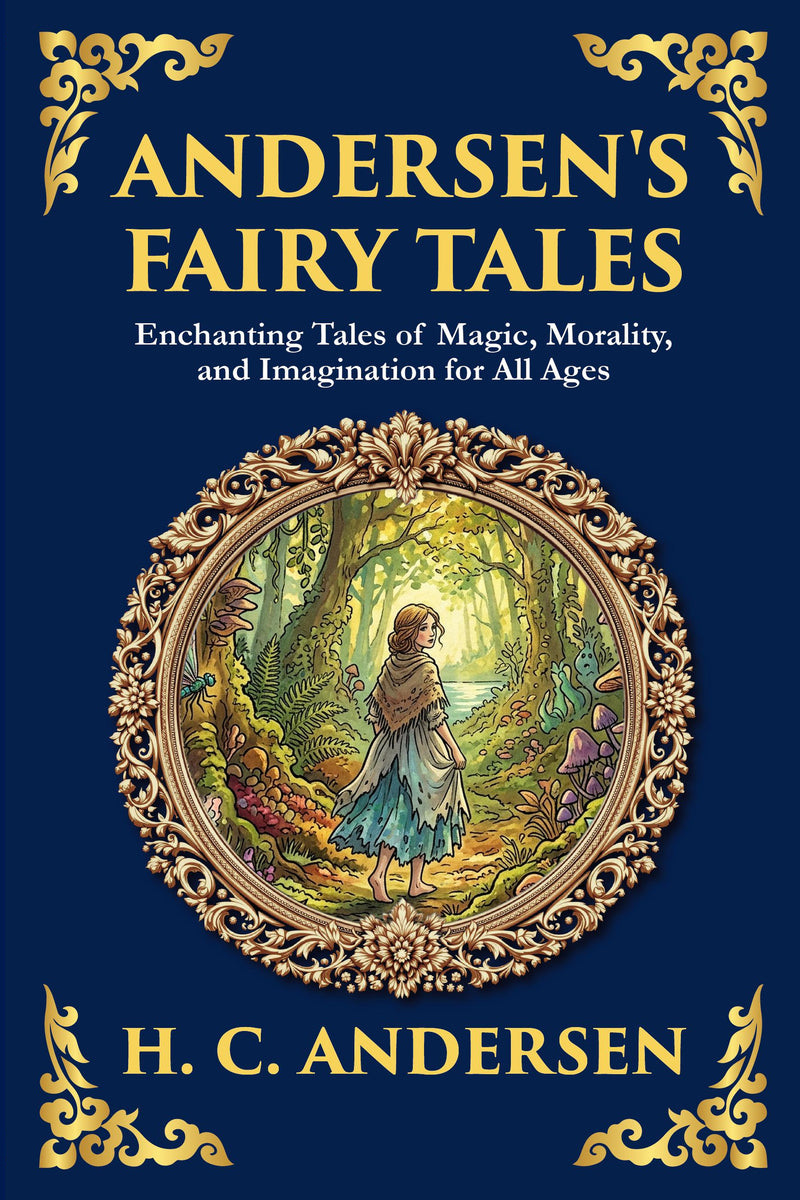
Andersen’s Fairy Tales — Large Print
Hans Christian Andersen Enter a world where mermaids dream of love, tin soldiers march with courage, and ugly ducklings become swans.
or free app
10,000+ hrs library
30-day guarantee
The complete Andersen's Fairy Tales appears in modern English through Library of Alexandria Press, available online with audiobook narration included for members.
Have you ever wondered why fairy tales can reveal more truth than reality? Andersen’s Fairy Tales is a masterwork of storytelling—woven with magic, morality, and myth— that continues to enchant readers across cultures and centuries. Hans Christian Andersen’s tales are more than children’s stories; they are allegories of life, beauty, sorrow, and redemption that speak to the soul.
This beautifully re-released edition features some of Andersen’s most enduring and iconic stories, including: The Little Mermaid – A heart-wrenching tale of love, sacrifice, and identity beneath the sea The Ugly Duckling – A timeless fable of growth, self-acceptance, and inner beauty The Emperor’s New Clothes – A biting satire on vanity, pride, and the power of truth The Snow Queen – An epic journey through darkness and ice to recover a lost friend The Princess and the Pea, Thumbelina, The Nightingale, The Red Shoes, and many more Translated into lyrical English, this collection brings Andersen’s haunting beauty and bittersweet lessons to new audiences. Each story blends fantasy with deeply human struggles—reflecting on hope, love, death, and the courage to be oneself in a world that often misunderstands.
What you’ll discover in this modern edition
- Universal Themes of Transformation and Truth – Perfect for readers of all ages
- Magical Characters and Worlds – Meet mermaids, queens, dreamers, and rebels
| Formats | eBook (EPUB + PDF) · Audiobook · Paperback · Hardcover · Large Print |
| Language | English |
| Trim size (print) | 6 × 9 in |
| Binding | Paperback — perfect-bound · Hardcover — casewrap |
| Large Print edition | Same text in a larger, easy-read type — a larger font, not a larger trim |
| Print pricing | Every physical book at our true cost — at-cost, no profit (members) |
| Library | 873 restored titles, always growing |
| Length | 55,142 words · ~3 hr 41 min reading |
| Reading level | Grade 3 · an easy, flowing read (this modern-English edition) |
| Edition | Modern English translation · 2026 |
Member reviews for this edition are collected as readers finish it — be the first. Across the library: 12,000+ books shipped, every plan covered by a 365-day print guarantee.
About this edition
A faithful, unabridged modern-English edition by The Library of Alexandria — carefully rendered for today's reader and verified paragraph-by-paragraph against the public-domain source. Available as eBook, audiobook, paperback, hardcover, and large print.
- Complete & unabridgedVerified paragraph by paragraph against the source — never a scan, never abridged.
- Modern English, faithfulReadable today, with the author’s meaning kept intact. Readable — not simplified.
- Every format, one membershipRead in your browser or the free app, or listen to the full audiobook.
Included free with your membership
Cancel anytime, one click · 30-day money-back guarantee
Edition last updated July 2026
What’s inside
Andersen’s Fairy Tales — Large Print — complete and unabridged: all 15 sections included with membership, plus the full audiobook.
Begin reading Andersen’s Fairy Tales — Large Print
In clear modern English — the complete text is included with membership.
Introduction
There are storytellers whose voices remain with us long after the page has been turned, long after childhood has receded into memory, long after we believe ourselves too worldly for tales of talking animals and enchanted objects. Hans Christian Andersen is one of these rare figures. His stories have been translated into more languages than almost any other body of literature on earth, recited in nurseries and analyzed in universities, adapted into ballets, operas, films, and animated spectacles. Yet for all this fame, the man and his work remain widely misunderstood—reduced too often to a handful of sanitized children’s bedtime tales, stripped of the strange, aching, and profoundly human qualities that made them immortal in the first place.
This collection invites you to encounter Andersen anew. Whether you are returning to these tales after many years or meeting them for the very first time, you hold in your hands stories that have shaped the moral and imaginative life of generations. They are deceptively simple in their surfaces and astonishingly deep in their interiors. A child may read them and find delight; an adult may read them and find sorrow, wisdom, irony, and unexpected consolation. Few writers have managed to speak so fluently to both audiences at once, and fewer still have done so without ever talking down to either.
What follows is an attempt to prepare you—gently, and without spoiling a single surprise—for the experience that awaits. Consider it a doorway, an entrance hall, a place to pause before stepping into rooms filled with wonder and shadow alike.
To understand the peculiar emotional texture of these stories, it helps to know something of the life that produced them. Hans Christian Andersen was born in 1805 in Odense, Denmark, into circumstances of genuine poverty. His father was a shoemaker who died when the boy was eleven; his mother worked as a washerwoman and struggled with hardship that would later echo, transmuted and tender, throughout his fiction. The family lived in a single cramped room. There were no silver spoons, no comfortable inheritances, no doors opened easily by birth. Andersen would spend much of his life acutely aware of the distance between the world of privilege and the world he came from, and this awareness left fingerprints on nearly everything he wrote.
He was, by every account including his own, an awkward and ungainly youth—tall, thin, with an oversized nose and large feet, prone to emotional outbursts and possessed of an almost desperate longing to be loved and admired. As a boy he sang, recited poetry, and staged little puppet plays, convinced that he was destined for greatness even as those around him saw only an odd, dreamy child with little practical prospect. At fourteen he left home for Copenhagen, carrying scarcely any money and an enormous, unshakable ambition. He hoped to become an actor, a singer, a dancer—anything that might lift him out of obscurity and into the light he craved.
Those early years in the capital were marked by humiliation and near-starvation. Doors were closed in his face. His voice broke and ruined his hopes of a singing career. His body proved too clumsy for the stage. And yet he persisted, eventually attracting the attention of benefactors who recognized something genuine beneath the rough exterior. One of these, a director at the Royal Theatre named Jonas Collin, arranged for the young man to receive a formal education—an experience that proved both salvation and torment. Andersen was placed in school with boys far younger than himself, subjected to a harsh and belittling headmaster, and made to feel his deficiencies daily. The wound of being an outsider, of being looked down upon, of not quite belonging anywhere, never fully healed. But it became the wellspring of his greatest art.
When you read these tales, you will frequently sense this undercurrent: the perspective of the overlooked, the misunderstood, the small and the strange. Andersen wrote with profound sympathy for those who are mocked, neglected, or cast aside—the duckling who does not resemble its siblings, the toy soldier with only one leg, the little match girl shivering in the cold. He understood these characters because, in some essential way, he had been them. His genius lay in transforming private pain into universal feeling, in taking the raw material of his own loneliness and shaping it into something that could comfort and illuminate the loneliness of millions.
It would be a mistake, however, to imagine Andersen as merely a sorrowful figure. He was also charming, witty, irrepressibly enthusiastic, and possessed of a buoyant sense of humor that sparkles throughout his work. He traveled extensively across Europe at a time when travel was difficult and expensive, befriending some of the most celebrated artists and intellectuals of his age. He was a keen observer of human folly and vanity, and many of his tales crackle with sly, affectionate satire of pretension, snobbery, and self-importance. He could be sharply critical of society’s cruelties and hypocrisies while never losing his fundamental tenderness toward the individual human heart.
Andersen achieved fame in his own lifetime—a rare and gratifying outcome for any writer, and especially for one who had risen from such depths. By the time of his death in 1875, he had become a national treasure in Denmark and a household name across the Western world. The poor shoemaker’s son had dined with kings, corresponded with celebrities, and earned a place in the permanent imagination of humanity. Yet even at the height of his renown, he carried within him the boy from Odense who had never quite been certain he was wanted. That tension—between triumph and vulnerability, between glory and the fear of being unloved—gives his work its enduring emotional resonance.
It is worth noting that while Andersen drew on older folk traditions, the vast majority of his most beloved tales were entirely his own invention. Unlike the Brothers Grimm, who collected and refined existing oral stories, Andersen frequently created original narratives from his own imagination, infusing them with his distinctive voice, his moral concerns, and his unmistakable blend of whimsy and melancholy. This is part of what makes his work feel so personal. These are not anonymous folk tales handed down through centuries; they are the deliberate creations of a singular artist with a singular vision, and to read them is to spend time in the company of a remarkable mind.
One might reasonably ask what it is about these stories—written nearly two centuries ago, in a small northern country, by a man whose anxieties and ambitions belong to a vanished world—that continues to captivate readers across cultures and generations. The answer lies in several qualities that, taken together, distinguish Andersen’s work from nearly all that came before and much that has come since.
The first is his extraordinary ability to invest the ordinary world with wonder. Andersen did not need to construct elaborate fantasy realms or summon vast armies of supernatural beings to achieve enchantment. He found magic in a darning needle, a collar, a teapot, a snowman, a paper boat floating down a gutter. In his hands, the humblest household objects acquire interior lives, longings, and tragedies of their own. A child reading these tales learns to look at the familiar world with fresh eyes, to imagine that the broken toy in the corner might have a story, that the falling snow might carry secrets, that everything around us pulses with hidden significance. This animating imagination—this conviction that the universe is alive with meaning and emotion—is perhaps Andersen’s most precious gift to his readers. It is a way of seeing that, once acquired, never entirely fades.
The second quality is the emotional honesty that runs beneath the whimsy. Andersen refused to pretend that life is simple or that happiness is guaranteed. Many of his most famous stories do not end the way we might wish them to. They acknowledge loss, disappointment, injustice, and death with a frankness that can startle readers accustomed to the relentless cheerfulness of much children’s literature. This is not cruelty on Andersen’s part; it is respect. He trusted his readers—young and old—to handle truth. He believed that stories which deny the existence of suffering ultimately fail to console, because they fail to acknowledge the reality of the lives they are meant to comfort. The bittersweet quality of so many Andersen tales is precisely what makes them feel true, and it is why they linger in the memory long after more saccharine fare has been forgotten.
And yet—and this is crucial—the tales are never merely bleak. Andersen balances his clear-eyed acknowledgment of hardship with an equally clear-eyed faith in goodness, beauty, kindness, and the possibility of redemption. His stories often contain a deep spiritual dimension, a sense that suffering is not the final word, that virtue and love possess a quiet power that worldly success cannot match. Whatever your own beliefs, you will find in these pages an abiding moral seriousness—a conviction that how we treat one another matters, that humility is more admirable than pride, that the heart’s true worth is invisible to the eyes of the vain and the powerful. This ethical core gives the collection a weight and dignity that elevate it far above mere entertainment.
The third quality is Andersen’s distinctive voice—conversational, intimate, full of asides and observations, as if a storyteller were sitting beside you and speaking directly to you. He breaks the conventions of formal narration, addressing the reader, commenting on his characters, drawing humor from incongruity, and weaving philosophical reflection into the fabric of the plot. This warmth and immediacy create a powerful sense of companionship. Reading Andersen, one does not feel lectured; one feels accompanied. The voice is generous, curious, and endlessly attentive to the textures of feeling. It is a voice that takes seriously the inner lives of children, of animals, of objects, of all the small and unregarded things of the world.
The fourth quality—often overlooked—is Andersen’s sophistication. Beneath the apparent simplicity of his style lies a remarkable subtlety of theme and structure. His tales operate on multiple levels simultaneously. A story that delights a six-year-old as a tale of transformation may strike an adult as a meditation on identity, belonging, and the painful process of becoming oneself. A story about vanity and clothing may reveal itself, on reflection, as a piercing satire of social conformity and the cowardice that prevents people from speaking obvious truths. Andersen layered his work so artfully that it rewards rereading at every stage of life. The tale you loved as a child will mean something entirely different—often something deeper and more poignant—when you return to it as an adult. This is the mark of literature in the truest sense.
This particular edition presents these timeless stories in a modern translation, adapted thoughtfully for the contemporary reader. This is no small matter, and it deserves a few words of explanation. Andersen wrote in Danish, and the earliest English translations of his work—many of which remain in circulation today—were frequently inaccurate, heavily abridged, or distorted by the sensibilities of the Victorian era. Translators of that period sometimes softened his irony, sentimentalized his endings, or stripped away the very qualities of voice and humor that make him so distinctive. They occasionally bowdlerized his content to suit prevailing notions of what children ought to read, flattening the rich ambiguity of the originals into something more conventional and less alive.
A modern translation seeks to recover what was lost—to render Andersen’s prose in language that is clear and accessible to today’s readers while remaining faithful to the spirit, tone, and texture of his work. The aim is to let you encounter these stories as their author intended: vivid, witty, emotionally direct, and unafraid of complexity. Adapting the tales for the contemporary reader does not mean dumbing them down or sanding away their edges. It means presenting them in prose that flows naturally for the modern ear, free of the stilted archaisms and translation errors that have, for too long, stood between English-speaking readers and the true Andersen. The result is a reading experience that honors both the original genius of the author and the needs of the present-day audience.
Cancel anytime, one click · 30-day money-back guarantee
Founding annual rate available now — your price locks for life when you join.
Not ready? Get this free chapter by email — read it anytime.
✓ Sent — check your inbox for Andersen’s Fairy Tales — Large Print.
Questions about Andersen’s Fairy Tales — Large Print
What is Andersen's Fairy Tales about?
Hans Christian Andersen Enter a world where mermaids dream of love, tin soldiers march with courage, and ugly ducklings become swans. Andersen's Fairy Tales has captured the hearts and imaginations of children and adults for generations, offering timeless stories filled with magic, mystery, and moral insight. These tales, both tender and profound, speak not only to the dreams of youth but to the enduring truths of the human condition.
Who wrote Andersen's Fairy Tales?
Andersen's Fairy Tales was written by H. C. Andersen. This edition presents the complete work in clear modern English, faithfully rendered from the public-domain original by Library of Alexandria Press.
Is Andersen's Fairy Tales free to read?
The opening chapter is free to read on this page. Members read and listen to the complete work — and the entire library — free, and can order any physical book at our true print cost.
How long is Andersen's Fairy Tales?
15 chapters (~55,142 words) — about 3 hr 41 min of reading in this modern-English edition.
Is this an abridged version of Andersen's Fairy Tales?
No. This is the complete, unabridged Andersen's Fairy Tales, carefully rendered into clear modern English and verified paragraph-by-paragraph against the public-domain source — nothing is cut or summarised.
What formats does Andersen's Fairy Tales come in?
Andersen's Fairy Tales is available as eBook, paperback, hardcover and large print. eBook and audiobook are included with membership; printed editions ship at our true print cost.
Shipping & returns
Billing & membership
More from the library


Explore Children's Classics
- Peter and Wendy · J. M. Barrie
- Jack and Jill · Louisa May Alcott
- The Wonderful Wizard of Oz · L. Frank Baum
- Anne of Green Gables · L. M. Montgomery
- The Secret Garden · Frances Hodgson Burnett
- The Tale of Peter Rabbit · Beatrix Potter
- Peter Pan · J. M. Barrie
- The Prince and the Pauper · Mark Twain
- The Red Fairy Book · Andrew Lang
- Old Christmas: from the Sketch Book of Washington Irving · Washington Irving
- A Houseful of Girls · Sarah Tytler
- In the hollow of His hand · Hesba Stretton
- Miss Primrose · Agnes Giberne
- Five Little Peppers and How They Grew · Margaret Sidney
- The Loss of the Swansea: A Story of the Florida Coast · W. L. Alden
- Sky Island · L. Frank Baum
- The Book of Dragons · E. Nesbit
- Wild Animals I Have Known · Ernest Thompson Seton
- Skinny McCord · Percy Keese Fitzhugh
- The Hunniwell Boys and the Platinum Mystery · L. P. Wyman
- Rainbow Valley · L. M. Montgomery
- "Us and Our Donkey" · Amy Le Feuvre
- Dorothy and the Wizard in Oz · L. Frank Baum
- The Home Book of Verse — Volume 4 · Burton Egbert Stevenson
- The Story of Doctor Dolittle · Hugh Lofting
- The Tale of Benjamin Bunny · Beatrix Potter
- Fifty Famous Stories Retold · James Baldwin
- Rilla of Ingleside · L. M. Montgomery
- The House at Pooh Corner · A. A. Milne
- Rich and Humble: A Story for Young People · Oliver Optic
Andersen’s Fairy Tales — Large Print
Andersen’s Fairy Tales — Large Print
Captivating Stories of Magic, Ethics, and Imagination for Everyone
H. C. Andersen
Contents
- Introduction
- Chapter 1
- Chapter 2
- Chapter 3
- Chapter 4
- Chapter 5
- Chapter 6
- Chapter 7
- Chapter 8
- Chapter 9
- Chapter 10
- Chapter 11
- Chapter 12
- Chapter 13
- Chapter 14
Introduction
There are storytellers whose voices remain with us long after the page has been turned, long after childhood has receded into memory, long after we believe ourselves too worldly for tales of talking animals and enchanted objects. Hans Christian Andersen is one of these rare figures. His stories have been translated into more languages than almost any other body of literature on earth, recited in nurseries and analyzed in universities, adapted into ballets, operas, films, and animated spectacles. Yet for all this fame, the man and his work remain widely misunderstood—reduced too often to a handful of sanitized children’s bedtime tales, stripped of the strange, aching, and profoundly human qualities that made them immortal in the first place.
This collection invites you to encounter Andersen anew. Whether you are returning to these tales after many years or meeting them for the very first time, you hold in your hands stories that have shaped the moral and imaginative life of generations. They are deceptively simple in their surfaces and astonishingly deep in their interiors. A child may read them and find delight; an adult may read them and find sorrow, wisdom, irony, and unexpected consolation. Few writers have managed to speak so fluently to both audiences at once, and fewer still have done so without ever talking down to either.
What follows is an attempt to prepare you—gently, and without spoiling a single surprise—for the experience that awaits. Consider it a doorway, an entrance hall, a place to pause before stepping into rooms filled with wonder and shadow alike.
To understand the peculiar emotional texture of these stories, it helps to know something of the life that produced them. Hans Christian Andersen was born in 1805 in Odense, Denmark, into circumstances of genuine poverty. His father was a shoemaker who died when the boy was eleven; his mother worked as a washerwoman and struggled with hardship that would later echo, transmuted and tender, throughout his fiction. The family lived in a single cramped room. There were no silver spoons, no comfortable inheritances, no doors opened easily by birth. Andersen would spend much of his life acutely aware of the distance between the world of privilege and the world he came from, and this awareness left fingerprints on nearly everything he wrote.
He was, by every account including his own, an awkward and ungainly youth—tall, thin, with an oversized nose and large feet, prone to emotional outbursts and possessed of an almost desperate longing to be loved and admired. As a boy he sang, recited poetry, and staged little puppet plays, convinced that he was destined for greatness even as those around him saw only an odd, dreamy child with little practical prospect. At fourteen he left home for Copenhagen, carrying scarcely any money and an enormous, unshakable ambition. He hoped to become an actor, a singer, a dancer—anything that might lift him out of obscurity and into the light he craved.
Those early years in the capital were marked by humiliation and near-starvation. Doors were closed in his face. His voice broke and ruined his hopes of a singing career. His body proved too clumsy for the stage. And yet he persisted, eventually attracting the attention of benefactors who recognized something genuine beneath the rough exterior. One of these, a director at the Royal Theatre named Jonas Collin, arranged for the young man to receive a formal education—an experience that proved both salvation and torment. Andersen was placed in school with boys far younger than himself, subjected to a harsh and belittling headmaster, and made to feel his deficiencies daily. The wound of being an outsider, of being looked down upon, of not quite belonging anywhere, never fully healed. But it became the wellspring of his greatest art.
When you read these tales, you will frequently sense this undercurrent: the perspective of the overlooked, the misunderstood, the small and the strange. Andersen wrote with profound sympathy for those who are mocked, neglected, or cast aside—the duckling who does not resemble its siblings, the toy soldier with only one leg, the little match girl shivering in the cold. He understood these characters because, in some essential way, he had been them. His genius lay in transforming private pain into universal feeling, in taking the raw material of his own loneliness and shaping it into something that could comfort and illuminate the loneliness of millions.
It would be a mistake, however, to imagine Andersen as merely a sorrowful figure. He was also charming, witty, irrepressibly enthusiastic, and possessed of a buoyant sense of humor that sparkles throughout his work. He traveled extensively across Europe at a time when travel was difficult and expensive, befriending some of the most celebrated artists and intellectuals of his age. He was a keen observer of human folly and vanity, and many of his tales crackle with sly, affectionate satire of pretension, snobbery, and self-importance. He could be sharply critical of society’s cruelties and hypocrisies while never losing his fundamental tenderness toward the individual human heart.
Andersen achieved fame in his own lifetime—a rare and gratifying outcome for any writer, and especially for one who had risen from such depths. By the time of his death in 1875, he had become a national treasure in Denmark and a household name across the Western world. The poor shoemaker’s son had dined with kings, corresponded with celebrities, and earned a place in the permanent imagination of humanity. Yet even at the height of his renown, he carried within him the boy from Odense who had never quite been certain he was wanted. That tension—between triumph and vulnerability, between glory and the fear of being unloved—gives his work its enduring emotional resonance.
It is worth noting that while Andersen drew on older folk traditions, the vast majority of his most beloved tales were entirely his own invention. Unlike the Brothers Grimm, who collected and refined existing oral stories, Andersen frequently created original narratives from his own imagination, infusing them with his distinctive voice, his moral concerns, and his unmistakable blend of whimsy and melancholy. This is part of what makes his work feel so personal. These are not anonymous folk tales handed down through centuries; they are the deliberate creations of a singular artist with a singular vision, and to read them is to spend time in the company of a remarkable mind.
One might reasonably ask what it is about these stories—written nearly two centuries ago, in a small northern country, by a man whose anxieties and ambitions belong to a vanished world—that continues to captivate readers across cultures and generations. The answer lies in several qualities that, taken together, distinguish Andersen’s work from nearly all that came before and much that has come since.
The first is his extraordinary ability to invest the ordinary world with wonder. Andersen did not need to construct elaborate fantasy realms or summon vast armies of supernatural beings to achieve enchantment. He found magic in a darning needle, a collar, a teapot, a snowman, a paper boat floating down a gutter. In his hands, the humblest household objects acquire interior lives, longings, and tragedies of their own. A child reading these tales learns to look at the familiar world with fresh eyes, to imagine that the broken toy in the corner might have a story, that the falling snow might carry secrets, that everything around us pulses with hidden significance. This animating imagination—this conviction that the universe is alive with meaning and emotion—is perhaps Andersen’s most precious gift to his readers. It is a way of seeing that, once acquired, never entirely fades.
The second quality is the emotional honesty that runs beneath the whimsy. Andersen refused to pretend that life is simple or that happiness is guaranteed. Many of his most famous stories do not end the way we might wish them to. They acknowledge loss, disappointment, injustice, and death with a frankness that can startle readers accustomed to the relentless cheerfulness of much children’s literature. This is not cruelty on Andersen’s part; it is respect. He trusted his readers—young and old—to handle truth. He believed that stories which deny the existence of suffering ultimately fail to console, because they fail to acknowledge the reality of the lives they are meant to comfort. The bittersweet quality of so many Andersen tales is precisely what makes them feel true, and it is why they linger in the memory long after more saccharine fare has been forgotten.
And yet—and this is crucial—the tales are never merely bleak. Andersen balances his clear-eyed acknowledgment of hardship with an equally clear-eyed faith in goodness, beauty, kindness, and the possibility of redemption. His stories often contain a deep spiritual dimension, a sense that suffering is not the final word, that virtue and love possess a quiet power that worldly success cannot match. Whatever your own beliefs, you will find in these pages an abiding moral seriousness—a conviction that how we treat one another matters, that humility is more admirable than pride, that the heart’s true worth is invisible to the eyes of the vain and the powerful. This ethical core gives the collection a weight and dignity that elevate it far above mere entertainment.
The third quality is Andersen’s distinctive voice—conversational, intimate, full of asides and observations, as if a storyteller were sitting beside you and speaking directly to you. He breaks the conventions of formal narration, addressing the reader, commenting on his characters, drawing humor from incongruity, and weaving philosophical reflection into the fabric of the plot. This warmth and immediacy create a powerful sense of companionship. Reading Andersen, one does not feel lectured; one feels accompanied. The voice is generous, curious, and endlessly attentive to the textures of feeling. It is a voice that takes seriously the inner lives of children, of animals, of objects, of all the small and unregarded things of the world.
The fourth quality—often overlooked—is Andersen’s sophistication. Beneath the apparent simplicity of his style lies a remarkable subtlety of theme and structure. His tales operate on multiple levels simultaneously. A story that delights a six-year-old as a tale of transformation may strike an adult as a meditation on identity, belonging, and the painful process of becoming oneself. A story about vanity and clothing may reveal itself, on reflection, as a piercing satire of social conformity and the cowardice that prevents people from speaking obvious truths. Andersen layered his work so artfully that it rewards rereading at every stage of life. The tale you loved as a child will mean something entirely different—often something deeper and more poignant—when you return to it as an adult. This is the mark of literature in the truest sense.
This particular edition presents these timeless stories in a modern translation, adapted thoughtfully for the contemporary reader. This is no small matter, and it deserves a few words of explanation. Andersen wrote in Danish, and the earliest English translations of his work—many of which remain in circulation today—were frequently inaccurate, heavily abridged, or distorted by the sensibilities of the Victorian era. Translators of that period sometimes softened his irony, sentimentalized his endings, or stripped away the very qualities of voice and humor that make him so distinctive. They occasionally bowdlerized his content to suit prevailing notions of what children ought to read, flattening the rich ambiguity of the originals into something more conventional and less alive.
A modern translation seeks to recover what was lost—to render Andersen’s prose in language that is clear and accessible to today’s readers while remaining faithful to the spirit, tone, and texture of his work. The aim is to let you encounter these stories as their author intended: vivid, witty, emotionally direct, and unafraid of complexity. Adapting the tales for the contemporary reader does not mean dumbing them down or sanding away their edges. It means presenting them in prose that flows naturally for the modern ear, free of the stilted archaisms and translation errors that have, for too long, stood between English-speaking readers and the true Andersen. The result is a reading experience that honors both the original genius of the author and the needs of the present-day audience.
Long ago, there was an Emperor who loved new clothes so much that he spent all his money on them. He didn’t care about his army at all, and he only went to the theater or hunting so he could show off his latest outfits. He had a different suit for every hour of the day. While people usually say of other kings or emperors that “he is holding court,” in this case, people always said, “The Emperor is in his dressing room.”
Life was cheerful in the large capital city, and visitors arrived at the court every day. One day, two scammers arrived, claiming to be weavers. They told everyone they could weave fabric with the most beautiful colors and complex patterns. They claimed this cloth had a magical quality: it was invisible to anyone who was incompetent in their job or exceptionally stupid.
“Those must be amazing clothes!” the Emperor thought. “If I had a suit like that, I could immediately see which officials in my kingdom are unfit for their positions, and I could tell the wise people apart from the fools! I must have this fabric woven for me right away.” He gave the two weavers a large amount of money so they could start working immediately.
The two fake weavers set up two looms and pretended to be very busy, though they weren’t actually doing anything. They asked for the finest silk and the purest gold thread, which they tucked away into their own bags. Then, they continued to pretend to work at the empty looms until late at night.
After a while, the Emperor said to himself, “I wonder how the weavers are doing with my cloth.” However, he felt a bit nervous remembering that anyone who was a fool or unfit for their job wouldn’t be able to see the fabric. He believed he had nothing to worry about personally, but he decided it would be better to send someone else to check on the weavers’ progress first. Everyone in the city had heard about the magical properties of the cloth, and everyone was eager to find out if their neighbors were wise or ignorant.
End of the free sample
Keep reading, free
Members read and listen to the complete book — and the entire library. Cancel anytime, one click · 30-day money-back guarantee.