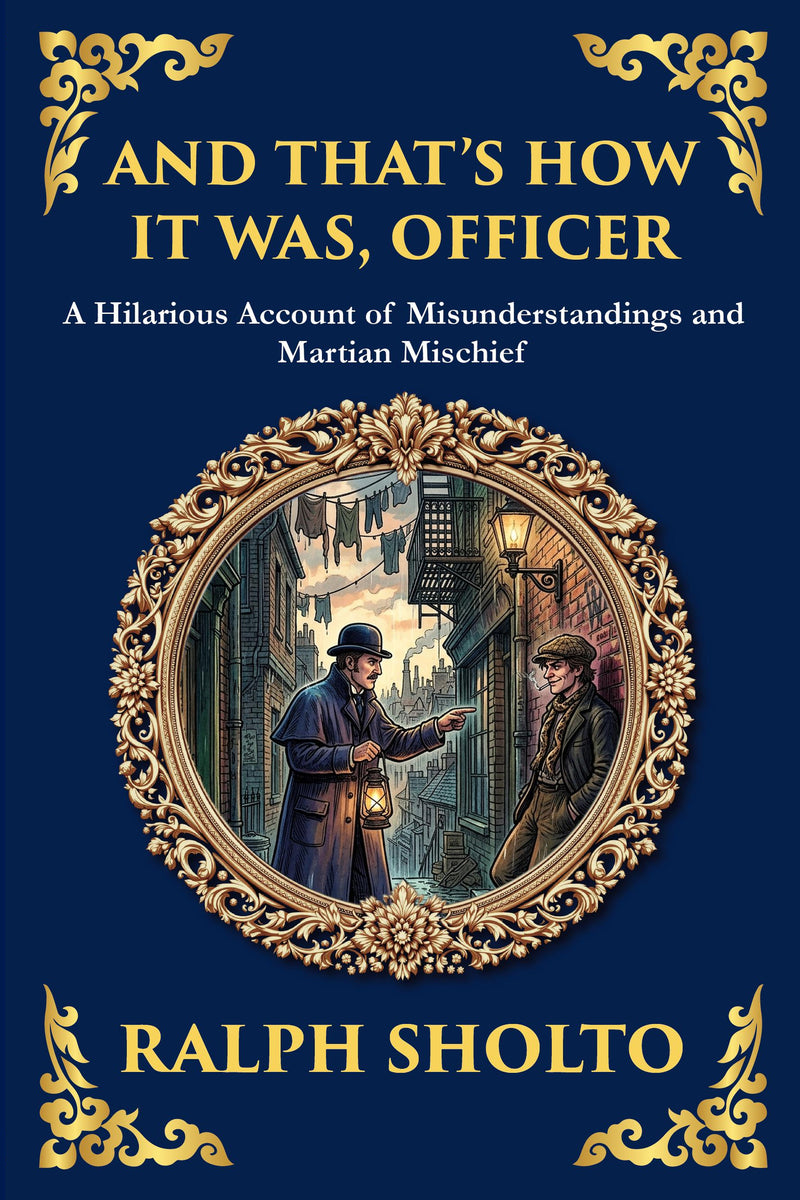
And That’s How It Was, Officer
What happens when an ordinary man gets tangled up with Martians, mayhem, and a string of laugh-out-loud misunderstandings?
or free app
10,000+ hrs library
30-day guarantee
The complete And That’s How It Was, Officer appears in modern English through Library of Alexandria Press, available online with audiobook narration included for members.
Have you ever wondered why the truth can sound more unbelievable than a lie? And That’s How It Was, Officer: A Hilarious Account of Misunderstandings and Martian Mischief is a delightful romp through comedy, chaos, and cosmic encounters. Ralph Sholto spins a tale where one man finds himself in the wrong place at the wrong time—with Martians—and has to recount his unbelievable adventures in the most deadpan way possible.
Blending classic science fiction with sharp humor, this story is a masterclass in comic timing. Sholto highlights the absurdity of human nature, the ridiculousness of bureaucracy, and the universal truth that laughter often thrives in the middle of chaos. Perfect for fans of lighthearted sci-fi, satire, and madcap storytelling.
What you’ll discover in this modern edition
- Martian Mischief – A comical encounter with visitors from another world who cause more confusion than conquest.
- The Art of Misunderstanding – Watch chaos unfold as every explanation only makes things worse.
- Humorous Science Fiction at Its Best – Enjoy Ralph Sholto’s timeless blend of satire and interplanetary absurdity.
- A Timeless Comedy of Errors – Laugh at a story where truth and nonsense walk hand in hand.
| Formats | eBook (EPUB + PDF) · Audiobook · Paperback · Hardcover · Large Print |
| Language | English |
| Trim size (print) | 6 × 9 in |
| Binding | Paperback — perfect-bound · Hardcover — casewrap |
| Large Print edition | Same text in a larger, easy-read type — a larger font, not a larger trim |
| Print pricing | Every physical book at our true cost — at-cost, no profit (members) |
| Library | 873 restored titles, always growing |
| Length | 13,769 words · ~55 min reading |
| Reading level | Grade 3 · an easy, flowing read (this modern-English edition) |
| Edition | Modern English translation · 2026 |
Member reviews for this edition are collected as readers finish it — be the first. Across the library: 12,000+ books shipped, every plan covered by a 365-day print guarantee.
About this edition
A faithful, unabridged modern-English edition by The Library of Alexandria — carefully rendered for today's reader and verified paragraph-by-paragraph against the public-domain source. Available as eBook, audiobook, paperback, hardcover, and large print.
- Complete & unabridgedVerified paragraph by paragraph against the source — never a scan, never abridged.
- Modern English, faithfulReadable today, with the author’s meaning kept intact. Readable — not simplified.
- Every format, one membershipRead in your browser or the free app, or listen to the full audiobook.
Included free with your membership
Cancel anytime, one click · 30-day money-back guarantee
Edition last updated July 2026
What’s inside
And That’s How It Was, Officer — complete and unabridged, included in full with membership, plus the full audiobook.
Begin reading And That’s How It Was, Officer
In clear modern English — the complete text is included with membership.
Introduction
There is a particular kind of pleasure that comes from a story which knows exactly what it is. It does not strain to be profound. It does not weigh itself down with grandeur or pretension. Instead, it sets out to delight, to surprise, and—above all—to make you laugh, and it accomplishes all three with the easy confidence of a tale told by someone who genuinely enjoys the telling. And That’s How It Was, Officer is precisely this sort of story. It belongs to that wonderful tradition of midcentury American humor in which the ordinary collides spectacularly with the extraordinary, and the result is a comedy of errors so cheerfully tangled that you find yourself grinning before you have even finished the first page.
Ralph Sholto, the author whose nimble wit animates these pages, was a writer of the pulp era, that gloriously prolific period in American publishing when magazines overflowed with science fiction, mystery, adventure, and whimsy of every imaginable variety. Writers of this period worked quickly and cleverly, producing stories meant to be devoured in a single sitting, stories that prized momentum, voice, and the well-placed punchline above all else. Sholto was a craftsman of exactly this kind—a writer who understood that the surest way to a reader’s heart was through laughter, and who had a gift for the kind of escalating absurdity that builds and builds until the reader is helpless against it. This particular tale is one of his most charming creations, a brief and buoyant romp that takes a simple premise and runs with it to wonderfully ridiculous places.
The title itself tells you almost everything you need to know about the spirit of the thing. And That’s How It Was, Officer has the unmistakable cadence of someone caught in the middle of an explanation that has long since spiraled out of their control. It is the phrase of a person standing amid the wreckage of a perfectly reasonable plan gone gloriously wrong, attempting to convince an authority figure that, truly, none of this was their fault, that events simply unfolded in this peculiar fashion, and that any sensible person would surely understand. We have all, at one time or another, found ourselves rehearsing such a speech—the desperate, half-comic account of how a small misjudgment became a large catastrophe through no real malice of our own. Sholto takes that universal experience of innocent bewilderment and amplifies it to its most delightful extreme, layering misunderstanding upon misunderstanding until the truth becomes a thing almost impossible to explain to anyone who wasn’t there to see it happen.
A Comedy of Earthly Confusion and Otherworldly Mischief
What gives this story its particular flavor is the way it weds the familiar to the fantastic. The subtitle promises “Misunderstandings and Martian Mischief,” and in that pairing lies the whole engine of the comedy. On one side, we have the entirely recognizable business of human beings misreading one another, jumping to conclusions, and tying themselves into knots over situations that a moment’s clear communication might have untangled. On the other, we have the irruption of the cosmic and the strange into the comfortably mundane—the suggestion that the universe is a far stranger and more populated place than the average person going about their daily affairs would ever suspect.
This is a combination with a long and beloved pedigree in popular fiction. The midcentury imagination was deeply taken with the idea of the alien among us, the visitor from another world who arrives not as a conquering menace but as a source of confusion, comedy, and gentle chaos. Where some writers used the figure of the extraterrestrial to provoke fear or to deliver solemn warnings about humanity’s hubris, Sholto belongs to the more cheerful camp—those who saw in the meeting of worlds an irresistible opportunity for farce. What happens, after all, when beings of utterly different assumptions and customs find themselves thrown together? What happens when the ordinary rules that govern human behavior collide with the entirely different logic of a visitor who does not share them? The answer, in Sholto’s hands, is comedy of the purest kind: the comedy of people talking past each other, of intentions misread, of small actions producing wildly disproportionate consequences.
The genius of this approach is that it allows the author to have it both ways. The story is grounded enough in the recognizable textures of ordinary life that we never lose our footing—we understand the characters, we recognize their reactions, we sympathize with their growing panic as things slip beyond their control. And yet it is fantastical enough to surprise us at every turn, to keep us guessing about where the next bit of mischief will come from. The reader is placed in the happy position of being slightly ahead of some characters and slightly behind others, watching the whole elaborate machinery of misunderstanding tick along toward its inevitable, glorious collision. It is the structure of the best farces, the comic clockwork that has delighted audiences since the earliest days of the stage, here dressed up in the bright costume of mid-twentieth-century science fiction.
There is, too, a certain warmth to it all. The humor here is never cruel. The characters who stumble through this story’s escalating predicaments are not fools to be mocked but ordinary people doing their best in extraordinary circumstances. We laugh with them as much as at them, and there is a generosity in the comedy that makes it endlessly easy to enjoy. Sholto does not look down on his creations; he sets them loose in an impossible situation and watches with evident affection as they flail their way toward some kind of resolution. This affection is contagious. By the time the dust settles, you find that you have grown rather fond of everyone involved, even—perhaps especially—the ones responsible for the most spectacular bits of chaos.
The pacing of the thing deserves mention as well, because it is here that Sholto’s craft as a pulp writer truly shows. There is not a wasted moment. Each scene propels you into the next; each complication arrives just as you have begun to adjust to the last. The story has the rhythm of a snowball rolling downhill, gathering size and speed with every turn, and the cumulative effect is irresistible. You will likely find, as many readers of this sort of tale do, that you intend to read just a little and end up reading the whole thing in one sitting, carried along by the sheer forward motion of the comedy. This is precisely the experience the story was designed to deliver, and it delivers it beautifully.
On This Modern Translation and the Pleasures of Rediscovery
This edition presents And That’s How It Was, Officer as a modern translation, adapted for the contemporary reader, and a word about what that means—and what it does not mean—will serve to set expectations and enhance the experience that follows.
The fiction of the pulp era, for all its delights, comes to us from a world that has in many respects vanished. The slang of the period, the rhythms of its dialogue, the casual references to the technology and customs of its day—these can occasionally form small barriers between a modern reader and the full enjoyment of a story. A joke that landed instantly for a reader in its own time may require a moment’s translation for a reader encountering it decades later. A turn of phrase that once felt fresh and contemporary may now read as quaint or, worse, as obscure. The work of a thoughtful modern adaptation is to gently smooth these small frictions—to bring the language and presentation into a register that today’s reader can absorb without effort, so that the comedy can do its work unimpeded.
What this emphatically does not mean is the flattening of the story’s character or the erasure of its period charm. The pleasure of a tale like this lies precisely in its voice, its sensibility, its particular way of looking at the world. A good adaptation preserves all of this. It is not a matter of rewriting the story but of clearing away the small obstacles that time inevitably places between a work and its later audience, so that the original spirit can shine through all the more clearly. Think of it as the careful cleaning of a painting—the removal of the accumulated grime of years so that the colors beneath can be seen as vividly as they were meant to be seen. The painting itself is unchanged; we simply see it better.
For the contemporary reader, this approach offers the best of both worlds. You get to enjoy the wit, the inventiveness, and the comic energy of a master of midcentury popular fiction, while encountering it in a form that feels accessible and immediate rather than dated or distant. The jokes still land. The pacing still races. The characters still leap off the page. But you are never pulled up short by a reference you cannot place or a phrase that has fallen out of use. The effect is to make the story feel timeless—as though it could have been written yesterday, even as it retains the unmistakable flavor of the era that produced it.
There is something deeply worthwhile about this kind of rediscovery. The popular fiction of the past is one of the great underexplored treasures of literary culture. We tend to remember the grand and serious works of any given era while allowing its lighter entertainments to slip quietly out of print and out of memory. Yet these lighter entertainments often tell us more about the actual texture of their times than the weightier works do. They capture what people found funny, what they feared, what they dreamed about in their idle hours. They preserve the popular imagination in its purest form. And, not incidentally, they are often a great deal more fun to read than the more self-consciously important literature that surrounds them. To bring such a story back into circulation, in a form that today’s readers can fully enjoy, is to perform a small act of cultural preservation—to keep alive a voice that might otherwise have been lost, and to extend the pleasure it was created to give to a whole new generation of readers.
It is worth dwelling for a moment on the particular fascination that the figure of Mars and the Martian held for the imagination of this period, because it provides a kind of cultural backdrop against which the comedy of this story plays out. For decades, Mars had loomed in the popular mind as the most likely home of intelligent life beyond our own world. Astronomers had speculated about its surface; novelists had populated it with civilizations grand and terrible; the public had been by turns thrilled and alarmed by the prospect of what might be living up there on the red planet. By the time Sholto was writing, the Martian had become a fixture of popular culture—a kind of all-purpose stand-in for the alien, the other, the visitor from beyond. This shared cultural understanding gave writers a wonderful shorthand. They could invoke Mars and Martians with confidence that their readers would arrive already equipped with a whole set of associations and expectations, and they could then play with those expectations—confirming some, subverting others, mining the gap between what the reader anticipated and what actually transpired for all the comic potential it was worth.
Sholto is a writer who clearly understood the comedic gold to be found in this gap. The contrast between the grandiose cultural image of the Martian and the actual, bumbling, all-too-relatable business of two parties trying and failing to understand one another is fertile ground for humor, and the story makes the most of it. There is a deflationary delight in taking something as cosmically significant as contact between worlds and rendering it as a series of escalating domestic mix-ups, the sort of thing that might end—as the title so wonderfully implies—with someone trying to explain the whole mess to a baffled officer of the law. The grand becomes the petty; the cosmic becomes the comic; the encounter that might, in another writer’s hands, have shaken the foundations of human civilization becomes instead a delightful muddle that everyone involved would very much like to put behind them.
Cancel anytime, one click · 30-day money-back guarantee
Founding annual rate available now — your price locks for life when you join.
Not ready? Get this free chapter by email — read it anytime.
✓ Sent — check your inbox for And That’s How It Was, Officer.
Questions about And That’s How It Was, Officer
What is And That’s How It Was, Officer about?
What happens when an ordinary man gets tangled up with Martians, mayhem, and a string of laugh-out-loud misunderstandings? In And That’s How It Was, Officer, Ralph Sholto delivers a witty and side-splitting tale of mistaken identities, interplanetary hijinks, and the hilarity of trying to explain the unexplainable. A classic gem of humorous science fiction, this story reminds us that sometimes the strangest events make the funniest confessions.
Who wrote And That’s How It Was, Officer?
And That’s How It Was, Officer was written by Ralph Sholto. This edition presents the complete work in clear modern English, faithfully rendered from the public-domain original by Library of Alexandria Press.
Is And That’s How It Was, Officer free to read?
The opening chapter is free to read on this page. Members read and listen to the complete work — and the entire library — free, and can order any physical book at our true print cost.
How long is And That’s How It Was, Officer?
2 chapters (~13,769 words) — about 55 min of reading in this modern-English edition.
Is this an abridged version of And That’s How It Was, Officer?
No. This is the complete, unabridged And That’s How It Was, Officer, carefully rendered into clear modern English and verified paragraph-by-paragraph against the public-domain source — nothing is cut or summarised.
What formats does And That’s How It Was, Officer come in?
And That’s How It Was, Officer is available as eBook, paperback, hardcover and large print. eBook and audiobook are included with membership; printed editions ship at our true print cost.
Shipping & returns
Billing & membership
More from the library


Explore Mystery & Crime
- Resurrection · Leo Tolstoy
- Crime and Punishment · Fyodor Dostoyevsky
- The Strange Case of Dr. Jekyll and Mr. Hyde · Robert Louis Stevenson
- The Riddle of the Sands · Erskine Childers
- The Wisdom of Father Brown · G. K. Chesterton
- The Cask of Amontillado · Edgar Allan Poe
- The Tomb of Ts’in · Edgar Wallace
- Ghost Stories of an Antiquary · M. R. James
- The Hunniwell Boys and the Platinum Mystery · L. P. Wyman
- The Seven Dials Mystery · Agatha Christie
- The Thirty-Nine Steps · John Buchan
- The Hand in the Dark · Arthur J. Rees
- Lady Audley’s Secret · M. E. Braddon
- The Mystery of the Blue Train · Agatha Christie
- The Secret Adversary · Agatha Christie
- The Call of Cthulhu · H. P. Lovecraft
- The Adventures of Heine · Edgar Wallace
- The Valley of Fear · Arthur Conan Doyle
- The Innocence of Father Brown · G. K. Chesterton
- McTeague: A Story of San Francisco · Frank Norris
- Tess of the d’Urbervilles: A Pure Woman · Thomas Hardy
- The Big Fix · George O. Smith
- The Ambulance Made Two Trips · Murray Leinster
- Time Crime · H. Beam Piper
- The Misplaced Battleship · Harry Harrison
- Supermind · Randall Garrett and Laurence M....
- Lone Star Planet · H. Beam Piper and John J. McGuire
- Dracula · Bram Stoker
- The Murder on the Links · Agatha Christie
- The Hound of the Baskervilles · Arthur Conan Doyle
And That’s How It Was, Officer
And That’s How It Was, Officer
A Hilarious Account of Misunderstandings and Martian Mischief
Ralph Sholto
Contents
- Introduction
- And That’s How It Was, Officer
Introduction
There is a particular kind of pleasure that comes from a story which knows exactly what it is. It does not strain to be profound. It does not weigh itself down with grandeur or pretension. Instead, it sets out to delight, to surprise, and—above all—to make you laugh, and it accomplishes all three with the easy confidence of a tale told by someone who genuinely enjoys the telling. And That’s How It Was, Officer is precisely this sort of story. It belongs to that wonderful tradition of midcentury American humor in which the ordinary collides spectacularly with the extraordinary, and the result is a comedy of errors so cheerfully tangled that you find yourself grinning before you have even finished the first page.
Ralph Sholto, the author whose nimble wit animates these pages, was a writer of the pulp era, that gloriously prolific period in American publishing when magazines overflowed with science fiction, mystery, adventure, and whimsy of every imaginable variety. Writers of this period worked quickly and cleverly, producing stories meant to be devoured in a single sitting, stories that prized momentum, voice, and the well-placed punchline above all else. Sholto was a craftsman of exactly this kind—a writer who understood that the surest way to a reader’s heart was through laughter, and who had a gift for the kind of escalating absurdity that builds and builds until the reader is helpless against it. This particular tale is one of his most charming creations, a brief and buoyant romp that takes a simple premise and runs with it to wonderfully ridiculous places.
The title itself tells you almost everything you need to know about the spirit of the thing. And That’s How It Was, Officer has the unmistakable cadence of someone caught in the middle of an explanation that has long since spiraled out of their control. It is the phrase of a person standing amid the wreckage of a perfectly reasonable plan gone gloriously wrong, attempting to convince an authority figure that, truly, none of this was their fault, that events simply unfolded in this peculiar fashion, and that any sensible person would surely understand. We have all, at one time or another, found ourselves rehearsing such a speech—the desperate, half-comic account of how a small misjudgment became a large catastrophe through no real malice of our own. Sholto takes that universal experience of innocent bewilderment and amplifies it to its most delightful extreme, layering misunderstanding upon misunderstanding until the truth becomes a thing almost impossible to explain to anyone who wasn’t there to see it happen.
A Comedy of Earthly Confusion and Otherworldly Mischief
What gives this story its particular flavor is the way it weds the familiar to the fantastic. The subtitle promises “Misunderstandings and Martian Mischief,” and in that pairing lies the whole engine of the comedy. On one side, we have the entirely recognizable business of human beings misreading one another, jumping to conclusions, and tying themselves into knots over situations that a moment’s clear communication might have untangled. On the other, we have the irruption of the cosmic and the strange into the comfortably mundane—the suggestion that the universe is a far stranger and more populated place than the average person going about their daily affairs would ever suspect.
This is a combination with a long and beloved pedigree in popular fiction. The midcentury imagination was deeply taken with the idea of the alien among us, the visitor from another world who arrives not as a conquering menace but as a source of confusion, comedy, and gentle chaos. Where some writers used the figure of the extraterrestrial to provoke fear or to deliver solemn warnings about humanity’s hubris, Sholto belongs to the more cheerful camp—those who saw in the meeting of worlds an irresistible opportunity for farce. What happens, after all, when beings of utterly different assumptions and customs find themselves thrown together? What happens when the ordinary rules that govern human behavior collide with the entirely different logic of a visitor who does not share them? The answer, in Sholto’s hands, is comedy of the purest kind: the comedy of people talking past each other, of intentions misread, of small actions producing wildly disproportionate consequences.
The genius of this approach is that it allows the author to have it both ways. The story is grounded enough in the recognizable textures of ordinary life that we never lose our footing—we understand the characters, we recognize their reactions, we sympathize with their growing panic as things slip beyond their control. And yet it is fantastical enough to surprise us at every turn, to keep us guessing about where the next bit of mischief will come from. The reader is placed in the happy position of being slightly ahead of some characters and slightly behind others, watching the whole elaborate machinery of misunderstanding tick along toward its inevitable, glorious collision. It is the structure of the best farces, the comic clockwork that has delighted audiences since the earliest days of the stage, here dressed up in the bright costume of mid-twentieth-century science fiction.
There is, too, a certain warmth to it all. The humor here is never cruel. The characters who stumble through this story’s escalating predicaments are not fools to be mocked but ordinary people doing their best in extraordinary circumstances. We laugh with them as much as at them, and there is a generosity in the comedy that makes it endlessly easy to enjoy. Sholto does not look down on his creations; he sets them loose in an impossible situation and watches with evident affection as they flail their way toward some kind of resolution. This affection is contagious. By the time the dust settles, you find that you have grown rather fond of everyone involved, even—perhaps especially—the ones responsible for the most spectacular bits of chaos.
The pacing of the thing deserves mention as well, because it is here that Sholto’s craft as a pulp writer truly shows. There is not a wasted moment. Each scene propels you into the next; each complication arrives just as you have begun to adjust to the last. The story has the rhythm of a snowball rolling downhill, gathering size and speed with every turn, and the cumulative effect is irresistible. You will likely find, as many readers of this sort of tale do, that you intend to read just a little and end up reading the whole thing in one sitting, carried along by the sheer forward motion of the comedy. This is precisely the experience the story was designed to deliver, and it delivers it beautifully.
On This Modern Translation and the Pleasures of Rediscovery
This edition presents And That’s How It Was, Officer as a modern translation, adapted for the contemporary reader, and a word about what that means—and what it does not mean—will serve to set expectations and enhance the experience that follows.
The fiction of the pulp era, for all its delights, comes to us from a world that has in many respects vanished. The slang of the period, the rhythms of its dialogue, the casual references to the technology and customs of its day—these can occasionally form small barriers between a modern reader and the full enjoyment of a story. A joke that landed instantly for a reader in its own time may require a moment’s translation for a reader encountering it decades later. A turn of phrase that once felt fresh and contemporary may now read as quaint or, worse, as obscure. The work of a thoughtful modern adaptation is to gently smooth these small frictions—to bring the language and presentation into a register that today’s reader can absorb without effort, so that the comedy can do its work unimpeded.
What this emphatically does not mean is the flattening of the story’s character or the erasure of its period charm. The pleasure of a tale like this lies precisely in its voice, its sensibility, its particular way of looking at the world. A good adaptation preserves all of this. It is not a matter of rewriting the story but of clearing away the small obstacles that time inevitably places between a work and its later audience, so that the original spirit can shine through all the more clearly. Think of it as the careful cleaning of a painting—the removal of the accumulated grime of years so that the colors beneath can be seen as vividly as they were meant to be seen. The painting itself is unchanged; we simply see it better.
For the contemporary reader, this approach offers the best of both worlds. You get to enjoy the wit, the inventiveness, and the comic energy of a master of midcentury popular fiction, while encountering it in a form that feels accessible and immediate rather than dated or distant. The jokes still land. The pacing still races. The characters still leap off the page. But you are never pulled up short by a reference you cannot place or a phrase that has fallen out of use. The effect is to make the story feel timeless—as though it could have been written yesterday, even as it retains the unmistakable flavor of the era that produced it.
There is something deeply worthwhile about this kind of rediscovery. The popular fiction of the past is one of the great underexplored treasures of literary culture. We tend to remember the grand and serious works of any given era while allowing its lighter entertainments to slip quietly out of print and out of memory. Yet these lighter entertainments often tell us more about the actual texture of their times than the weightier works do. They capture what people found funny, what they feared, what they dreamed about in their idle hours. They preserve the popular imagination in its purest form. And, not incidentally, they are often a great deal more fun to read than the more self-consciously important literature that surrounds them. To bring such a story back into circulation, in a form that today’s readers can fully enjoy, is to perform a small act of cultural preservation—to keep alive a voice that might otherwise have been lost, and to extend the pleasure it was created to give to a whole new generation of readers.
It is worth dwelling for a moment on the particular fascination that the figure of Mars and the Martian held for the imagination of this period, because it provides a kind of cultural backdrop against which the comedy of this story plays out. For decades, Mars had loomed in the popular mind as the most likely home of intelligent life beyond our own world. Astronomers had speculated about its surface; novelists had populated it with civilizations grand and terrible; the public had been by turns thrilled and alarmed by the prospect of what might be living up there on the red planet. By the time Sholto was writing, the Martian had become a fixture of popular culture—a kind of all-purpose stand-in for the alien, the other, the visitor from beyond. This shared cultural understanding gave writers a wonderful shorthand. They could invoke Mars and Martians with confidence that their readers would arrive already equipped with a whole set of associations and expectations, and they could then play with those expectations—confirming some, subverting others, mining the gap between what the reader anticipated and what actually transpired for all the comic potential it was worth.
Sholto is a writer who clearly understood the comedic gold to be found in this gap. The contrast between the grandiose cultural image of the Martian and the actual, bumbling, all-too-relatable business of two parties trying and failing to understand one another is fertile ground for humor, and the story makes the most of it. There is a deflationary delight in taking something as cosmically significant as contact between worlds and rendering it as a series of escalating domestic mix-ups, the sort of thing that might end—as the title so wonderfully implies—with someone trying to explain the whole mess to a baffled officer of the law. The grand becomes the petty; the cosmic becomes the comic; the encounter that might, in another writer’s hands, have shaken the foundations of human civilization becomes instead a delightful muddle that everyone involved would very much like to put behind them.
I’m sure you and your officers are completely baffled by now. You’ve probably all lost sleep wondering what’s been happening in Morton City—where all the gangsters went and why the criminal underworld vanished like a bubble.
Since you don’t know my uncle, Peter Nicholas, or Bag Ears Mulligan, or the gorgeous Joy Nicholas—my bride of less than twenty-four hours—or me, Homer Nicholas, you’ve obviously been out of the loop regarding the fast-moving events that just wrapped up.
As the police chief, you deserve to know what’s been going on in our city. That’s why I’m writing this. By the time you get this letter, Joy and I will be heading to Europe for a very private honeymoon. Uncle Peter will be on his way to Tibet to interview some very important people your department has never heard of. Bag Ears is probably off somewhere looking for his bells; I suggest you let him keep looking, because he isn’t exactly the brightest bulb.
Since a lot of good was achieved without costing the taxpayers a dime, I suggest you read this letter and then just forget the whole thing.
It all started yesterday morning when Joy and I finally got a meeting with Uncle Peter in his lab. You might find it strange that I had such a hard time getting a hold of my own close relative, but you don’t know Uncle Peter.
He’s a strange mix of a man of action and a dreamer—a genius and a child. Some parts of his brain never made it past third grade, while other parts could outsmart Einstein in a debate about nuclear physics, advanced math, or whatever else. He lives in a small bungalow on the edge of town with a laboratory in the basement. A steel door keeps the public out, and Joy and I spent three days pounding on that door to no avail. Finally, the door opened and Uncle Peter let us in.
End of the free sample
Keep reading, free
Members read and listen to the complete book — and the entire library. Cancel anytime, one click · 30-day money-back guarantee.