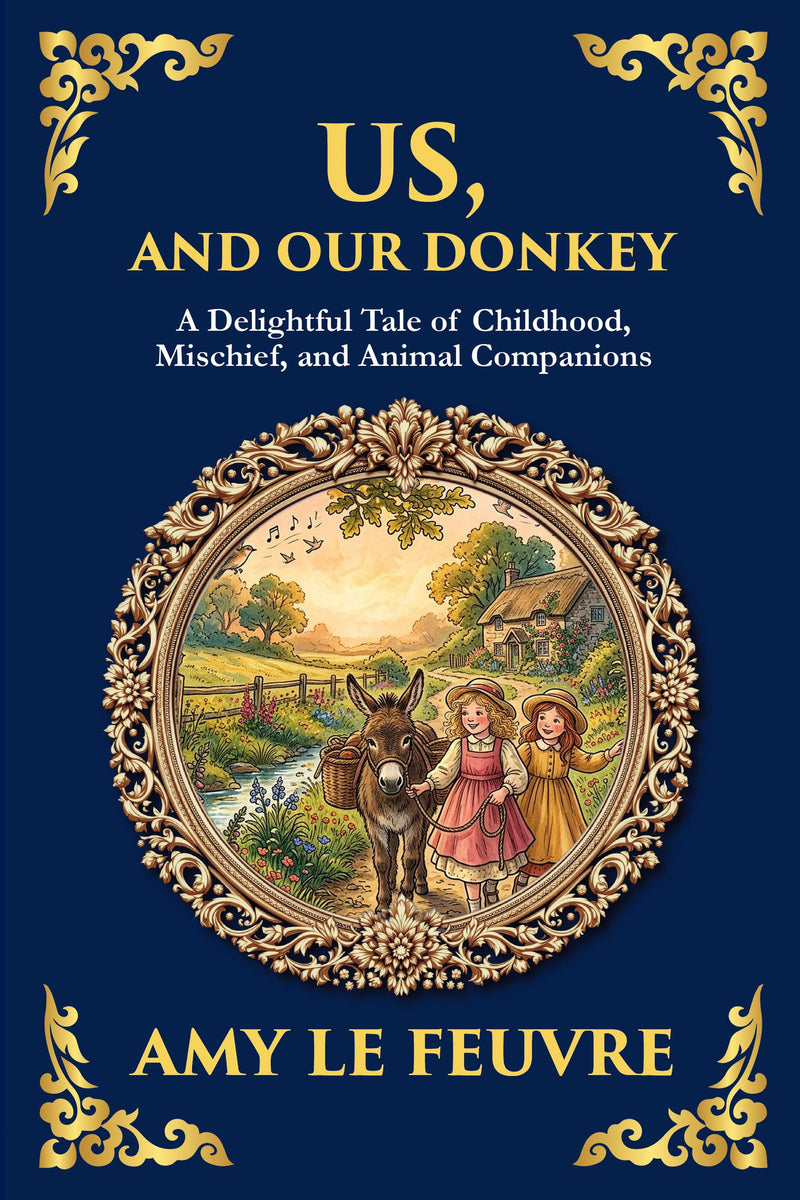
"Us and Our Donkey" — Large Print
In the golden haze of an English countryside summer, two spirited siblings and their utterly unpredictable donkey stumble from one misadventure to the next.
or free app
10,000+ hrs library
30-day guarantee
The complete Us, and Our Donkey appears in modern English through Library of Alexandria Press, available online with audiobook narration included for members.
Have you ever wondered why childhood adventures always seem to leave the biggest footprints on our hearts? In Us, and Our Donkey: A Delightful Tale of Childhood, Mischief, and Animal Companions, beloved author Amy Le Feuvre invites readers into a heartwarming world of muddy boots, mischievous plans, and wide-eyed wonder. When a pair of lively siblings unexpectedly inherit a donkey, they don’t realize they’re gaining more than just a mode of transport—they’re gaining a friend, a catalyst for chaos, and a spark for growing up.
What begins as a lighthearted pet project soon becomes a series of laugh-out- loud escapades involving runaway carts, village squabbles, and a whole lot of donkey drama. Yet beneath the antics lies a deeper story: about learning responsibility, understanding kindness, and discovering the unbreakable bond of love and loyalty.
What you’ll discover in this modern edition
- A Playful Coming-of-Age Tale – Join two young siblings as they navigate life, laughter, and learning through their escapades with a stubborn donkey.
- Delightful Village Adventures – Explore charming rural landscapes, quirky characters, and the warmth of community through the eyes of a child.
- Themes of Friendship and Growth – Witness how innocence and imagination can teach timeless life lessons.
- A Story for All Generations – Whether you're reading aloud to children or revisiting childhood favorites, this tale offers joy, heart, and reflection.
- Timeless English Countryside Charm – With vivid storytelling and gentle humor, Amy Le Feuvre captures a bygone era of simple joys and spirited youth.
| Formats | eBook (EPUB + PDF) · Audiobook · Paperback · Hardcover · Large Print |
| Language | English |
| Trim size (print) | 6 × 9 in |
| Binding | Paperback — perfect-bound · Hardcover — casewrap |
| Large Print edition | Same text in a larger, easy-read type — a larger font, not a larger trim |
| Print pricing | Every physical book at our true cost — at-cost, no profit (members) |
| Library | 873 restored titles, always growing |
| Length | 55,766 words · ~3 hr 43 min reading |
| Reading level | Grade 7 · an easy, flowing read (this modern-English edition) |
| Edition | Modern English translation · 2026 |
Member reviews for this edition are collected as readers finish it — be the first. Across the library: 12,000+ books shipped, every plan covered by a 365-day print guarantee.
About this edition
A faithful, unabridged modern-English edition by The Library of Alexandria — carefully rendered for today's reader and verified paragraph-by-paragraph against the public-domain source. Available as eBook, audiobook, paperback, hardcover, and large print.
- Complete & unabridgedVerified paragraph by paragraph against the source — never a scan, never abridged.
- Modern English, faithfulReadable today, with the author’s meaning kept intact. Readable — not simplified.
- Every format, one membershipRead in your browser or the free app, or listen to the full audiobook.
Included free with your membership
Cancel anytime, one click · 30-day money-back guarantee
Edition last updated July 2026
What’s inside
"Us and Our Donkey" — Large Print — complete and unabridged: all 18 sections included with membership, plus the full audiobook.
Begin reading "Us and Our Donkey" — Large Print
In clear modern English — the complete text is included with membership.
Introduction
There is a particular kind of magic that belongs to childhood and to childhood alone. It is the magic of seeing the world as enormous and full of possibility, of treating a hedge as a frontier and a garden wall as the edge of the known universe. It is the magic of forming solemn alliances with siblings against the bewildering and often unjust governance of grown-ups. It is the magic of believing, with total conviction, that an animal can be a confidant, a co-conspirator, and a member of the family in good standing. The book you are about to read is steeped in exactly this magic, and it has been preserved here, carefully and lovingly, for a new generation of readers to discover.
This story comes to us from the pen of Amy Le Feuvre, a writer who possessed an almost uncanny ability to slip inside the mind of a child and report back faithfully on what she found there. She did not write about children from the lofty distance of an adult observer who has long forgotten what it feels like to be small. Instead, she wrote as children think, as children feel, and as children speak. Her young characters do not exist to be admired or moralized over; they exist to be themselves, with all the contradictions, loyalties, mischief, and tenderness that real children carry within them. To open one of her books is to be handed a key to a world we all once inhabited and most of us have, sadly, locked away and lost the address to.
What you hold now is a modern translation, an edition adapted thoughtfully for the contemporary reader. This phrase deserves a moment of explanation, because it speaks to the very heart of what makes this volume special and why it exists at all. The original text was written in a language and idiom that, while beautiful, can present obstacles to readers today. Sentence structures of an earlier age tended to wind and meander; vocabulary that was once everyday currency has since fallen out of use; references and turns of phrase that needed no explanation to the book’s first audience can leave a present-day reader puzzled or, worse, disengaged. The work of this adaptation has been to clear away those obstacles without disturbing the treasures behind them. The voice remains. The humor remains. The warmth, the gentle wisdom, the playful spirit, and the deep affection for childhood all remain intact. What has changed is the ease with which you can reach them.
A Window Into a Vanished World — and a Mirror of Our Own
One of the first things you will notice as you begin to read is that this is a story rooted in a very particular time and place. The household it describes, the rhythms of the days, the expectations placed upon children, the manners and customs of the adults around them — all of these belong to an era that has slipped beyond living memory for most of us. There is a slowness to this world, a quality of unhurried attention, that can feel almost startling to readers accustomed to the relentless pace of modern life. Children in this story have time. They have time to wander, to invent games, to get into scrapes and out of them again, to observe the small dramas of the natural world, and to form the kind of intense, all-consuming attachments that fill the days of the young.
And yet, for all its period charm, the emotional landscape of the story is utterly familiar. This is the quiet miracle of Amy Le Feuvre’s writing and the reason her stories have survived long after the world that produced them has disappeared. Strip away the bonnets and the petticoats, the old-fashioned phrases and the unfamiliar routines, and what remains is something timeless: the experience of being a child trying to make sense of a world built by and for adults. The frustrations are familiar. The injustices, real and imagined, are familiar. The fierce sibling solidarity is familiar. The way a child can love something — a pet, a place, a secret hideaway — with their whole undivided heart is profoundly familiar. Readers who come to this book expecting a quaint museum piece will be pleasantly surprised to find instead a living, breathing portrait of childhood that speaks directly to their own memories and, if they are reading alongside children of their own, to the children sitting beside them.
The donkey of the title, who occupies such a central place in the affections of the young protagonists, is a perfect example of how the specific becomes universal in Le Feuvre’s hands. To these children, the donkey is not merely livestock or a beast of burden. The donkey is a personality, a companion, a creature with feelings and preferences and a dignity that must be respected. The relationship between children and animals is one of the great recurring themes in the literature of childhood, and for good reason. Animals offer children a kind of love and loyalty that is uncomplicated by the social hierarchies and confusing rules of the adult world. An animal does not scold, does not lecture, does not impose bedtimes or insist on clean hands. An animal simply is, and in its company a child can be entirely themselves. The bond at the center of this story will resonate with anyone who has ever loved a pet, and it carries with it a sweetness that is in no way diminished by the passing of more than a century since it was first set down on the page.
There is something else worth noting about the world this book opens onto, and that is its essential gentleness. This is not a story of high drama, peril, and danger. It is not built on cliffhangers or shocks. Its pleasures are quieter and, in many ways, more durable. They lie in the accumulation of small moments — a misunderstanding here, an adventure there, a moment of tenderness, a flash of mischief, a lesson learned not through lecture but through experience. In an age when so much of what we read and watch is engineered to keep our nerves jangling and our attention forcibly seized, there is real value in a story that invites us to slow down, to settle in, and to take pleasure in the unhurried unfolding of ordinary life seen through extraordinary eyes. Reading this book can feel a little like stepping out of the rush of modern existence and into a calmer, kindlier room, where the fire is lit and there is all the time in the world.
It is also worth preparing yourself for the particular flavor of humor that runs throughout. Le Feuvre understood that children are funny — not because they try to be, but because their logic, so perfectly internally consistent and so completely at odds with adult logic, produces situations of genuine comedy. The misadventures and the troublemaking promised by the subtitle are not the cruel or destructive kind. They are the well-meaning catastrophes that result when small people with big intentions set out to accomplish something they do not fully understand. The result is the kind of warm, affectionate humor that makes you smile rather than laugh out loud, the humor of recognition rather than of mockery. You will, more than once, find yourself nodding and thinking: yes, that is exactly what a child would do.
The Art of Adaptation, and the Author Behind the Story
A word now about the careful work that has gone into bringing this edition to you, because understanding it will, I hope, deepen your appreciation of what you are about to read. The phrase “modern translation” might at first seem curious when applied to a book originally written in English. We typically think of translation as the work of carrying a text from one language into another — from French into English, say, or from Japanese into Spanish. But there is a real and meaningful sense in which the English of more than a century ago is a different language from the English we speak today. It is not merely that some words have changed their meanings or fallen out of use, though that is certainly true. It is that the entire rhythm of written prose has shifted. The expectations readers bring to a sentence have shifted. The conventions of dialogue, of description, of pacing, have all moved on.
To adapt a beloved older work for the contemporary reader is therefore a delicate and demanding art. Do too little, and the modern reader stumbles over archaic constructions and loses the thread; the book becomes a chore rather than a pleasure, and the very qualities that make it worth reading are obscured behind a veil of unfamiliar language. Do too much, and you risk flattening the distinctive voice of the author, ironing out the texture and personality that give the work its soul, leaving behind something smooth but lifeless. The goal of this adaptation has been to walk the narrow path between these two dangers. The aim throughout has been faithfulness — not slavish, word-for-word reproduction, but faithfulness to the experience the author intended her readers to have. Where the original would have made her first readers laugh, this edition aims to make you laugh. Where it would have moved them, it aims to move you. Where it would have carried them effortlessly from one scene to the next, it aims to carry you just as effortlessly.
This means that some things have been gently modernized. Sentences that ran on at great length have, in places, been given room to breathe. Words that would send a modern reader reaching for a dictionary have, where appropriate, been replaced with their living equivalents. The occasional reference or assumption that belonged so completely to its own time as to be opaque today has been clarified or smoothed. But the bones of the story are untouched. The characters are who they always were. The events unfold as they always did. The heart of the book beats exactly as Amy Le Feuvre intended it to beat. Think of this edition not as a replacement for the original but as a faithful companion to it — a version that opens the door wide and welcomes you in, where the original, beautiful as it is, might have left that door a little stiff on its hinges.
It is a testament to the strength of the original writing that it survives this process so well. Lesser books, when adapted, reveal themselves to be little more than the sum of their period mannerisms; remove the antique flavor and nothing remains. But the best stories have something underneath the surface, something that does not depend on any particular era or idiom — a truth about human nature, a quality of feeling, a clarity of observation that translates across time as surely as it might across languages. This is one of those stories. Its endurance is not an accident of nostalgia. It endures because Amy Le Feuvre knew something true about children and was able to put that truth into words.
Who was she, this writer whose understanding of the young heart has proven so durable? Amy Le Feuvre was an English author active around the turn of the twentieth century, a period that produced an extraordinary flowering of children’s literature. She was prolific, writing a great many books over the course of her career, and she was beloved by readers in her own time. Her stories typically center on children — often spirited, imaginative children who get themselves into difficulties and who learn, in the course of their adventures, something about themselves and the world. Her work belongs to a tradition of warm, character-driven storytelling that prized gentleness and moral seriousness without ever becoming heavy-handed or preachy. She trusted her young readers, and she trusted her young characters, and that trust is felt on every page.
What distinguishes her from many of her contemporaries is the absence of condescension. A great deal of children’s literature from this period, however well-intentioned, addresses its young audience from above, instructing and improving and correcting. Le Feuvre’s touch is lighter. She allows her children to be genuinely childlike — not idealized little angels, nor cautionary monsters, but real children, with their tempers and their generosity, their stubbornness and their sudden surprising wisdom, their capacity for both maddening trouble and disarming sweetness, often within the space of a single afternoon. She does not flinch from showing children behaving badly, but she does so with an understanding eye, recognizing that mischief is rarely malice and that the path to growing up is paved with mistakes. There is, running quietly beneath the surface of her work, a deep affection for the messy, magnificent business of being young.
Cancel anytime, one click · 30-day money-back guarantee
Founding annual rate available now — your price locks for life when you join.
Not ready? Get this free chapter by email — read it anytime.
✓ Sent — check your inbox for "Us and Our Donkey" — Large Print.
Questions about "Us and Our Donkey" — Large Print
What is Us, and Our Donkey about?
In the golden haze of an English countryside summer, two spirited siblings and their utterly unpredictable donkey stumble from one misadventure to the next. Us, and Our Donkey is a charming story filled with laughter, life lessons, and the innocent mayhem only children and animals can create together. Through muddy roads, village antics, and heartfelt moments of growth, Amy Le Feuvre’s timeless classic brings to life the joys of youthful imagination, the meaning of friendship, and the bond between humans and their
Who wrote Us, and Our Donkey?
Us, and Our Donkey was written by Amy Le Feuvre. This edition presents the complete work in clear modern English, faithfully rendered from the public-domain original by Library of Alexandria Press.
Is Us, and Our Donkey free to read?
The opening chapter is free to read on this page. Members read and listen to the complete work — and the entire library — free, and can order any physical book at our true print cost.
How long is Us, and Our Donkey?
18 chapters (~55,766 words) — about 3 hr 43 min of reading in this modern-English edition.
Is this an abridged version of Us, and Our Donkey?
No. This is the complete, unabridged Us, and Our Donkey, carefully rendered into clear modern English and verified paragraph-by-paragraph against the public-domain source — nothing is cut or summarised.
What formats does Us, and Our Donkey come in?
Us, and Our Donkey is available as eBook, paperback, hardcover and large print. eBook and audiobook are included with membership; printed editions ship at our true print cost.
Shipping & returns
Billing & membership
More from the library


Explore Children's Classics
- Jack and Jill · Louisa May Alcott
- The Wonderful Wizard of Oz · L. Frank Baum
- Peter Pan · J. M. Barrie
- The Prince and the Pauper · Mark Twain
- The Red Fairy Book · Andrew Lang
- Old Christmas: from the Sketch Book of Washington Irving · Washington Irving
- A Houseful of Girls · Sarah Tytler
- In the hollow of His hand · Hesba Stretton
- Miss Primrose · Agnes Giberne
- Five Little Peppers and How They Grew · Margaret Sidney
- The Loss of the Swansea: A Story of the Florida Coast · W. L. Alden
- Sky Island · L. Frank Baum
- The Book of Dragons · E. Nesbit
- Wild Animals I Have Known · Ernest Thompson Seton
- Skinny McCord · Percy Keese Fitzhugh
- The Hunniwell Boys and the Platinum Mystery · L. P. Wyman
- Rainbow Valley · L. M. Montgomery
- "Us and Our Donkey" · Amy Le Feuvre
- Dorothy and the Wizard in Oz · L. Frank Baum
- The Home Book of Verse — Volume 4 · Burton Egbert Stevenson
- The Story of Doctor Dolittle · Hugh Lofting
- The Tale of Benjamin Bunny · Beatrix Potter
- Fifty Famous Stories Retold · James Baldwin
- Rilla of Ingleside · L. M. Montgomery
- The House at Pooh Corner · A. A. Milne
- Rich and Humble: A Story for Young People · Oliver Optic
- The Three Bears · A. E. Kennedy
- Peter and Wendy · J. M. Barrie
- The Marvelous Land of Oz · L. Frank Baum
- Andersen’s Fairy Tales · H. C. Andersen
"Us and Our Donkey" — Large Print
"Us and Our Donkey" — Large Print
A charming story about childhood, trouble-making, and animal friends
Amy Le Feuvre
Contents
- Introduction
- Chapter 1
- Chapter 2
- Chapter 3
- Chapter 4
- Chapter 5
- Chapter 6
- Chapter 7
- Chapter 8
- Chapter 9
- Chapter 10
- Chapter 11
- Chapter 12
- Chapter 13
- Chapter 14
- Chapter 15
- Chapter 16
- Chapter 17
Introduction
There is a particular kind of magic that belongs to childhood and to childhood alone. It is the magic of seeing the world as enormous and full of possibility, of treating a hedge as a frontier and a garden wall as the edge of the known universe. It is the magic of forming solemn alliances with siblings against the bewildering and often unjust governance of grown-ups. It is the magic of believing, with total conviction, that an animal can be a confidant, a co-conspirator, and a member of the family in good standing. The book you are about to read is steeped in exactly this magic, and it has been preserved here, carefully and lovingly, for a new generation of readers to discover.
This story comes to us from the pen of Amy Le Feuvre, a writer who possessed an almost uncanny ability to slip inside the mind of a child and report back faithfully on what she found there. She did not write about children from the lofty distance of an adult observer who has long forgotten what it feels like to be small. Instead, she wrote as children think, as children feel, and as children speak. Her young characters do not exist to be admired or moralized over; they exist to be themselves, with all the contradictions, loyalties, mischief, and tenderness that real children carry within them. To open one of her books is to be handed a key to a world we all once inhabited and most of us have, sadly, locked away and lost the address to.
What you hold now is a modern translation, an edition adapted thoughtfully for the contemporary reader. This phrase deserves a moment of explanation, because it speaks to the very heart of what makes this volume special and why it exists at all. The original text was written in a language and idiom that, while beautiful, can present obstacles to readers today. Sentence structures of an earlier age tended to wind and meander; vocabulary that was once everyday currency has since fallen out of use; references and turns of phrase that needed no explanation to the book’s first audience can leave a present-day reader puzzled or, worse, disengaged. The work of this adaptation has been to clear away those obstacles without disturbing the treasures behind them. The voice remains. The humor remains. The warmth, the gentle wisdom, the playful spirit, and the deep affection for childhood all remain intact. What has changed is the ease with which you can reach them.
A Window Into a Vanished World — and a Mirror of Our Own
One of the first things you will notice as you begin to read is that this is a story rooted in a very particular time and place. The household it describes, the rhythms of the days, the expectations placed upon children, the manners and customs of the adults around them — all of these belong to an era that has slipped beyond living memory for most of us. There is a slowness to this world, a quality of unhurried attention, that can feel almost startling to readers accustomed to the relentless pace of modern life. Children in this story have time. They have time to wander, to invent games, to get into scrapes and out of them again, to observe the small dramas of the natural world, and to form the kind of intense, all-consuming attachments that fill the days of the young.
And yet, for all its period charm, the emotional landscape of the story is utterly familiar. This is the quiet miracle of Amy Le Feuvre’s writing and the reason her stories have survived long after the world that produced them has disappeared. Strip away the bonnets and the petticoats, the old-fashioned phrases and the unfamiliar routines, and what remains is something timeless: the experience of being a child trying to make sense of a world built by and for adults. The frustrations are familiar. The injustices, real and imagined, are familiar. The fierce sibling solidarity is familiar. The way a child can love something — a pet, a place, a secret hideaway — with their whole undivided heart is profoundly familiar. Readers who come to this book expecting a quaint museum piece will be pleasantly surprised to find instead a living, breathing portrait of childhood that speaks directly to their own memories and, if they are reading alongside children of their own, to the children sitting beside them.
The donkey of the title, who occupies such a central place in the affections of the young protagonists, is a perfect example of how the specific becomes universal in Le Feuvre’s hands. To these children, the donkey is not merely livestock or a beast of burden. The donkey is a personality, a companion, a creature with feelings and preferences and a dignity that must be respected. The relationship between children and animals is one of the great recurring themes in the literature of childhood, and for good reason. Animals offer children a kind of love and loyalty that is uncomplicated by the social hierarchies and confusing rules of the adult world. An animal does not scold, does not lecture, does not impose bedtimes or insist on clean hands. An animal simply is, and in its company a child can be entirely themselves. The bond at the center of this story will resonate with anyone who has ever loved a pet, and it carries with it a sweetness that is in no way diminished by the passing of more than a century since it was first set down on the page.
There is something else worth noting about the world this book opens onto, and that is its essential gentleness. This is not a story of high drama, peril, and danger. It is not built on cliffhangers or shocks. Its pleasures are quieter and, in many ways, more durable. They lie in the accumulation of small moments — a misunderstanding here, an adventure there, a moment of tenderness, a flash of mischief, a lesson learned not through lecture but through experience. In an age when so much of what we read and watch is engineered to keep our nerves jangling and our attention forcibly seized, there is real value in a story that invites us to slow down, to settle in, and to take pleasure in the unhurried unfolding of ordinary life seen through extraordinary eyes. Reading this book can feel a little like stepping out of the rush of modern existence and into a calmer, kindlier room, where the fire is lit and there is all the time in the world.
It is also worth preparing yourself for the particular flavor of humor that runs throughout. Le Feuvre understood that children are funny — not because they try to be, but because their logic, so perfectly internally consistent and so completely at odds with adult logic, produces situations of genuine comedy. The misadventures and the troublemaking promised by the subtitle are not the cruel or destructive kind. They are the well-meaning catastrophes that result when small people with big intentions set out to accomplish something they do not fully understand. The result is the kind of warm, affectionate humor that makes you smile rather than laugh out loud, the humor of recognition rather than of mockery. You will, more than once, find yourself nodding and thinking: yes, that is exactly what a child would do.
The Art of Adaptation, and the Author Behind the Story
A word now about the careful work that has gone into bringing this edition to you, because understanding it will, I hope, deepen your appreciation of what you are about to read. The phrase “modern translation” might at first seem curious when applied to a book originally written in English. We typically think of translation as the work of carrying a text from one language into another — from French into English, say, or from Japanese into Spanish. But there is a real and meaningful sense in which the English of more than a century ago is a different language from the English we speak today. It is not merely that some words have changed their meanings or fallen out of use, though that is certainly true. It is that the entire rhythm of written prose has shifted. The expectations readers bring to a sentence have shifted. The conventions of dialogue, of description, of pacing, have all moved on.
To adapt a beloved older work for the contemporary reader is therefore a delicate and demanding art. Do too little, and the modern reader stumbles over archaic constructions and loses the thread; the book becomes a chore rather than a pleasure, and the very qualities that make it worth reading are obscured behind a veil of unfamiliar language. Do too much, and you risk flattening the distinctive voice of the author, ironing out the texture and personality that give the work its soul, leaving behind something smooth but lifeless. The goal of this adaptation has been to walk the narrow path between these two dangers. The aim throughout has been faithfulness — not slavish, word-for-word reproduction, but faithfulness to the experience the author intended her readers to have. Where the original would have made her first readers laugh, this edition aims to make you laugh. Where it would have moved them, it aims to move you. Where it would have carried them effortlessly from one scene to the next, it aims to carry you just as effortlessly.
This means that some things have been gently modernized. Sentences that ran on at great length have, in places, been given room to breathe. Words that would send a modern reader reaching for a dictionary have, where appropriate, been replaced with their living equivalents. The occasional reference or assumption that belonged so completely to its own time as to be opaque today has been clarified or smoothed. But the bones of the story are untouched. The characters are who they always were. The events unfold as they always did. The heart of the book beats exactly as Amy Le Feuvre intended it to beat. Think of this edition not as a replacement for the original but as a faithful companion to it — a version that opens the door wide and welcomes you in, where the original, beautiful as it is, might have left that door a little stiff on its hinges.
It is a testament to the strength of the original writing that it survives this process so well. Lesser books, when adapted, reveal themselves to be little more than the sum of their period mannerisms; remove the antique flavor and nothing remains. But the best stories have something underneath the surface, something that does not depend on any particular era or idiom — a truth about human nature, a quality of feeling, a clarity of observation that translates across time as surely as it might across languages. This is one of those stories. Its endurance is not an accident of nostalgia. It endures because Amy Le Feuvre knew something true about children and was able to put that truth into words.
Who was she, this writer whose understanding of the young heart has proven so durable? Amy Le Feuvre was an English author active around the turn of the twentieth century, a period that produced an extraordinary flowering of children’s literature. She was prolific, writing a great many books over the course of her career, and she was beloved by readers in her own time. Her stories typically center on children — often spirited, imaginative children who get themselves into difficulties and who learn, in the course of their adventures, something about themselves and the world. Her work belongs to a tradition of warm, character-driven storytelling that prized gentleness and moral seriousness without ever becoming heavy-handed or preachy. She trusted her young readers, and she trusted her young characters, and that trust is felt on every page.
What distinguishes her from many of her contemporaries is the absence of condescension. A great deal of children’s literature from this period, however well-intentioned, addresses its young audience from above, instructing and improving and correcting. Le Feuvre’s touch is lighter. She allows her children to be genuinely childlike — not idealized little angels, nor cautionary monsters, but real children, with their tempers and their generosity, their stubbornness and their sudden surprising wisdom, their capacity for both maddening trouble and disarming sweetness, often within the space of a single afternoon. She does not flinch from showing children behaving badly, but she does so with an understanding eye, recognizing that mischief is rarely malice and that the path to growing up is paved with mistakes. There is, running quietly beneath the surface of her work, a deep affection for the messy, magnificent business of being young.
Of course, the boys claim I won’t stick with this, but I insist that I will. You see, there is so much to talk about because we have arrived in a new village, and everything feels strange and fresh. Denys says that anyone who writes is a snob, and Aylwin says I’ll only write about myself, but I know I won’t do that, because I think the other people are much more interesting than I am. I don’t plan to record every single thing we say and do, either. There are plenty of other people living around here, and I’m sure they will be very interesting. Naturally, I might not always write as well as I should. I make a lot of promises to myself, but the hard part is actually following through. And, of course, I have to describe us a little. I always enjoy reading about what children are like in books.
So, I will start this chapter by saying that our father’s name is John Henry Marjoribanks, and he is a member of the clergy. Mother died just a year ago. I don’t like writing about it, but I feel I have to. It was such a terrible, awful time. We were very poor back then because father was only a curate, and mother couldn’t afford a thick winter coat. She cut hers down to make one for me—I hate even looking at it now—and then she went out one freezing night to visit a sick woman and came back shivering. Then she got—I really can’t spell it, but I know it starts with a silent ‘p’. It means inflammation of the lungs, and we had to hire a nurse, which cost a lot of money. None of us were allowed to see her until the final day, when she asked for us so she could say goodbye. I won’t write any more; it makes me cry; we loved mother so much. But she told me to try to take her place, since I was the oldest daughter. I feel like I never, ever will, because I’m so forgetful, I can’t sit still, and I hate sewing. Also, I laugh at the most serious things; anyone can make me laugh, and they know it.
End of the free sample
Keep reading, free
Members read and listen to the complete book — and the entire library. Cancel anytime, one click · 30-day money-back guarantee.