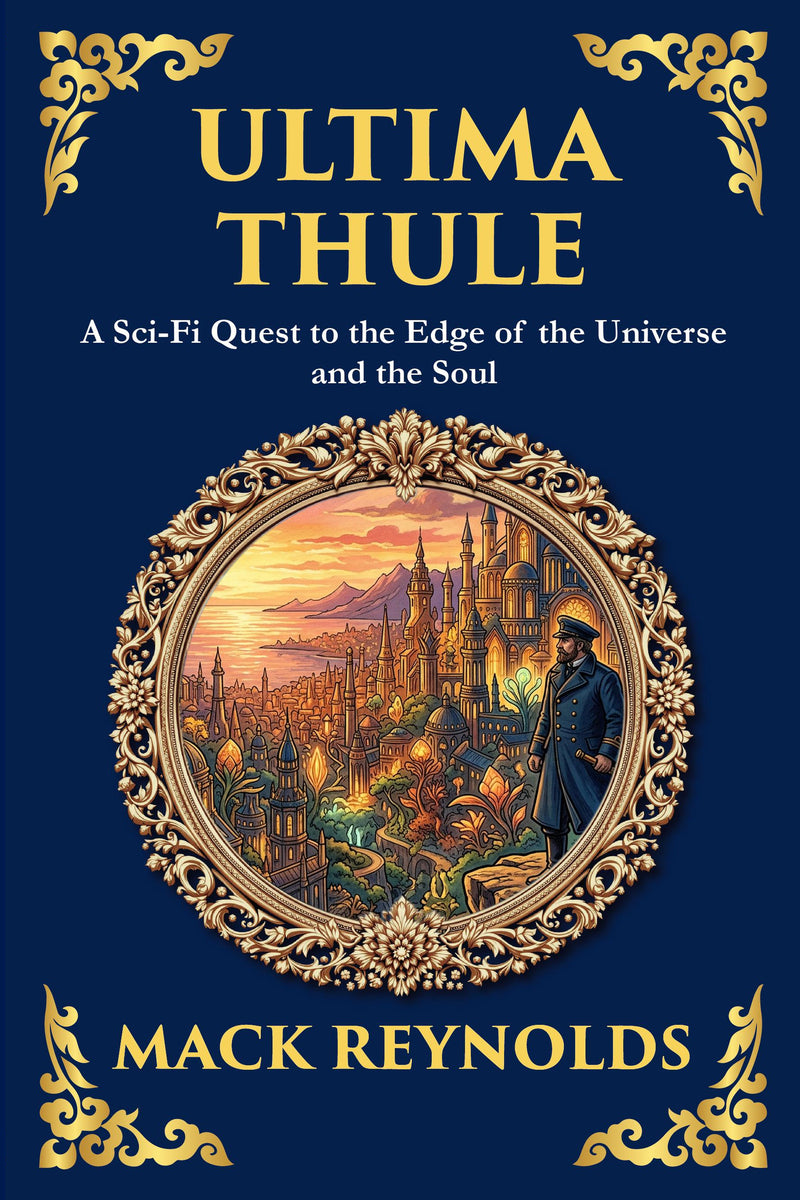
Ultima Thule
In a galaxy driven by exploration and conquest, one mission dares to reach further than ever before—toward Ultima Thule, the mythical edge of the known universe.
or free app
10,000+ hrs library
30-day guarantee
The complete Ultima Thule appears in modern English through Library of Alexandria Press, available online with audiobook narration included for members.
Have you ever wondered why the farther we travel into space, the deeper we look into ourselves? In Ultima Thule, Mack Reynolds takes readers on a transcendent voyage that fuses classic space exploration with philosophical depth. When a select crew is chosen to pilot humanity’s most ambitious interstellar mission, their destination isn’t a planet or a star system—it’s the mythic boundary of existence itself.
Ultima Thule. A term once used by ancient explorers to mean “beyond the known world,” now revived to describe the limits of cosmic understanding. As the crew travels deeper into space, they encounter inexplicable phenomena, alien consciousness, and a growing realization: this mission isn’t just about what lies out there—it’s about awakening something buried within.
As tensions rise and reality bends, each crewmember is forced to confront their beliefs, their past, and the terrifying possibility that the universe may be sentient—and waiting. Mack Reynolds weaves a compelling narrative that balances hard science fiction with speculative metaphysics. Ultima Thule is a mind-expanding story for those who crave ideas as much as adventure, who question authority, and who seek meaning in the stars.
What you’ll discover in this modern edition
- A Daring Expedition to the Edge of Reality – Journey with a brave crew as they defy known physics and explore the ultimate cosmic horizon.
- A Metaphysical Space Opera – Blending the thrill of exploration with deep philosophical inquiry.
- Humanity in Crisis and Evolution – Watch how isolation, awe, and revelation change the very essence of human identity.
- A Modern Classic of Intellectual Science Fiction – Thought-provoking and visionary, for fans of Arthur C. Clarke, Stanisław Lem, and Ursula K. Le Guin.
| Formats | eBook (EPUB + PDF) · Audiobook · Paperback · Hardcover · Large Print |
| Language | English |
| Trim size (print) | 6 × 9 in |
| Binding | Paperback — perfect-bound · Hardcover — casewrap |
| Large Print edition | Same text in a larger, easy-read type — a larger font, not a larger trim |
| Print pricing | Every physical book at our true cost — at-cost, no profit (members) |
| Library | 873 restored titles, always growing |
| Length | 28,109 words · ~1 hr 52 min reading |
| Reading level | Grade 3 · an easy, flowing read (this modern-English edition) |
| Edition | Modern English translation · 2026 |
Member reviews for this edition are collected as readers finish it — be the first. Across the library: 12,000+ books shipped, every plan covered by a 365-day print guarantee.
About this edition
A faithful, unabridged modern-English edition by The Library of Alexandria — carefully rendered for today's reader and verified paragraph-by-paragraph against the public-domain source. Available as eBook, audiobook, paperback, hardcover, and large print.
- Complete & unabridgedVerified paragraph by paragraph against the source — never a scan, never abridged.
- Modern English, faithfulReadable today, with the author’s meaning kept intact. Readable — not simplified.
- Every format, one membershipRead in your browser or the free app, or listen to the full audiobook.
Included free with your membership
Cancel anytime, one click · 30-day money-back guarantee
Edition last updated July 2026
What’s inside
Ultima Thule — complete and unabridged, included in full with membership, plus the full audiobook.
Begin reading Ultima Thule
In clear modern English — the complete text is included with membership.
Introduction
There is a particular kind of science fiction that does not merely ask what lies beyond the next star or the next century, but what lies beyond the boundaries of the self. Ultima Thule belongs to that rarer tradition. The title itself is a phrase inherited from the ancient world, used by classical geographers and poets to denote the farthest point that could be imagined—the edge of the known, the place past which the maps gave way to speculation and dread. To the Romans, Ultima Thule was the last land at the top of the world, a frozen and half-mythic island where the sun behaved strangely and the ordinary rules of geography seemed to dissolve. Over the centuries, the phrase became a kind of shorthand for any ultimate limit: the farthest one could travel, the deepest one could reach, the boundary beyond which lay only the unknown. Mack Reynolds, in choosing this title for a work of speculative fiction, was making a deliberate and resonant claim. He was promising his readers a journey not simply outward, into the vastness of space, but inward, toward the limits of human understanding and the edges of the soul.
This is what the subtitle makes explicit: A Sci-Fi Quest to the Edge of the Universe and the Soul. That coupling is the key to everything that follows. Reynolds was a writer who understood, perhaps better than many of his contemporaries, that the most enduring science fiction is never really about machines or planets or technologies in isolation. It is about people—about what happens to consciousness, conscience, and character when they are stretched against the immensity of the cosmos. The frontier in this story is double. There is the literal frontier of distance, the dark expanse that separates one inhabited corner of the universe from the next, the dizzying scale of interstellar travel that dwarfs the imagination. And there is the interior frontier, the one that opens within a person who has traveled so far that the familiar landmarks of identity begin to fade. The genius of the premise is that these two frontiers are not separate. To reach the edge of the universe, Reynolds suggests, one must inevitably arrive at the edge of oneself.
Before you begin, it is worth pausing to consider what kind of reading experience awaits you, and how best to enter into it. This edition has been prepared as a modern translation and adaptation for the contemporary reader, and that phrase deserves a moment of honest explanation, because it shapes the way the book now reads and the way it should be approached.
The science fiction of the mid-twentieth century was written in a particular idiom. It was an age of pulp magazines and paperback originals, of stories produced quickly and consumed eagerly by a readership hungry for wonder. The prose of that era had its own rhythms, its own conventions, its own assumptions about what a reader already knew and what needed to be spelled out. Some of those conventions have aged beautifully; others have grown unfamiliar, even obstructive, to readers who come to these stories decades later. Words shift their meanings. Idioms that were once vivid become opaque. References that were once topical become puzzles. Sentence structures that once felt brisk can come to feel cluttered or quaint.
The purpose of a modern translation and adaptation is to clear away those obstructions without disturbing the structure they protect. Think of it as the careful cleaning of an old painting. The image beneath was always there—the composition, the figures, the play of light and shadow—but years of accumulated varnish had dulled the colors and obscured the finer details. The work of restoration is not to repaint the canvas, not to add new figures or alter the artist’s vision, but to remove the haze so that the original brilliance can be seen again as it was meant to be seen. That is the spirit in which this edition has been prepared. The story is Mack Reynolds’s story. The ideas are his ideas, the questions his questions, the destinations his destinations. What has been adjusted is the surface: the phrasing made smoother for the contemporary ear, the obsolete turns of speech rendered into language that flows naturally for a reader of today, the occasional thicket of dated reference gently pruned so that the narrative momentum is never broken.
This matters because the great pleasure of a book like this is immersion. The worst thing that can happen to a reader of speculative fiction is to be jolted out of the dream by a stumbling block on the page—a sentence that has to be read three times, a word whose meaning has drifted, an allusion that lands on nothing. Such interruptions break the spell, and once the spell is broken, the wonder leaks away. A faithful modern adaptation guards against that. It allows you to fall into the story and stay there, carried along by its current rather than snagged on its rocks. You will not find yourself translating as you read; the translation has already been done for you, invisibly, so that your attention can rest entirely on the journey itself.
It is also worth saying what this approach does not do. It does not modernize the imagination of the work. The vision of the future contained in these pages is a vision of the past’s future—a future imagined by a mind shaped by a particular moment in history, with all the distinctive flavor that implies. That flavor has been preserved, because it is part of the book’s value and its charm. There is a deep pleasure in reading how an earlier generation pictured the centuries to come, in seeing which of their guesses now seem prophetic and which seem touchingly wide of the mark. The adaptation does not iron out these qualities; it simply ensures that they come through clearly, undimmed by the accidental difficulties of changed language. You are reading a story from another era, presented so that it speaks to you directly across the years.
Mack Reynolds himself was an ideal candidate for this kind of careful preservation, because his work has always rewarded attention. He was not content to write simple adventures, though he could write adventure as well as anyone. He was a thinker, a man preoccupied with systems—political, economic, social—and with the ways those systems might evolve, fracture, or transform under the pressures of new technologies and new frontiers. He brought to science fiction a sociological seriousness that set him apart. Where many of his peers were fascinated chiefly by hardware—by rockets, ray guns, and robots—Reynolds was fascinated by people in aggregate and in particular: by how societies organize themselves, by what drives individuals to strive and to question, by the friction between the demands of a community and the longings of a single restless mind. This made him one of the most intellectually substantial figures of his generation of genre writers, and it is precisely this substance that makes his work worth returning to and worth restoring.
The word quest in the subtitle is not idly chosen. A quest is a very old narrative form, older than the novel, older than the printed word, reaching back to the foundational stories of nearly every culture. The hero who sets out from the familiar, who crosses a threshold into the unknown, who faces trials and temptations and is changed by them, who reaches a goal that turns out to be different from what was expected—this pattern is woven into the deepest layers of human storytelling. Science fiction, for all its modern trappings, has always been one of the most natural homes for the quest. The genre took the ancient impulse to venture past the edge of the map and gave it a new map to venture past: the star chart, the galaxy, the universe itself. The frozen mythic island of the old geographers became the distant world, the unexplored system, the place no one has ever been.
What gives Ultima Thule its particular character is the seriousness with which it treats the inner dimension of the quest. Many adventure stories send their heroes to far places and bring them home essentially unchanged, the journey having been merely a sequence of obstacles overcome. Reynolds is after something more. The promise in the title is that the farthest reach of the universe and the farthest reach of the soul are, in some profound sense, the same destination. To go as far out as one can go is to be forced into a confrontation with the deepest questions of who one is, what one believes, and what it all means. Distance becomes a kind of mirror. The emptiness of space throws the self back at the traveler with an unsettling clarity, and the silence between the stars becomes a space in which the quietest and most fundamental questions can finally be heard.
This is the territory of the best speculative fiction—the place where the external journey and the internal journey become inseparable. There is a long and honorable lineage of stories built on this principle, from the voyages of myth to the great explorations of literature, in which the traveler who seeks a distant land is really seeking something within. Reynolds works squarely in that tradition, but he brings to it the particular tools of his genre and his temperament: the rigorous extrapolation of a thinker, the curiosity of a man who wanted to understand how things work, and the storyteller’s instinct for the moment when an idea becomes a feeling.
It would be a disservice to you, the reader, to say more about where this quest leads or what is found at its end. The pleasure of a journey lies in taking it, not in being told its conclusion in advance, and this introduction is committed to leaving the discoveries intact for you. What can be said is that you should read with an awareness of these twin frontiers, the outer and the inner. When the narrative carries you across vast distances, pay attention also to the distances being crossed within. When you encounter the strange and the unfamiliar in the world of the story, ask what it reveals about the familiar—about us, about the human condition, about the questions that do not change no matter how far we travel or how the centuries turn. Reynolds rewards that kind of attentive reading. He is not a writer who hides his depths, but neither does he announce them with fanfare. They are there for those who look.
One of the qualities that distinguishes this book is its willingness to take the big questions seriously without becoming ponderous. There is a great temptation, in fiction that aspires to philosophical weight, to let the ideas overwhelm the story, to turn characters into mouthpieces and narrative into lecture. Reynolds, for all his intellectual ambition, generally avoids this trap. He understood that ideas in fiction are most powerful when they are embodied, when they are felt through the experiences of characters we have come to care about, when they emerge from the situation rather than being imposed upon it. The result is a book that thinks without ceasing to be a story, that asks profound questions without losing its forward motion. This balance is harder to achieve than it looks, and it is one of the reasons Reynolds has continued to be read and valued long after many of his more sensational contemporaries have faded.
It is also worth appreciating the sheer scope of imagination required to write a story set at the edge of the universe. The scale involved is almost beyond comprehension—distances so vast that ordinary intuitions about time and space collapse, environments so alien that the human mind strains to picture them, situations so extreme that the values and assumptions of ordinary life are tested to their limits. To make such a setting feel real, to ground it in human terms, to give the reader a foothold from which to experience the dizzying immensity, is a considerable feat of craft. Reynolds manages it not by drowning us in technical detail but by keeping his focus on the human scale within the cosmic one. We experience the vastness through the eyes and minds of those who travel into it, and so it becomes not an abstraction but a felt reality, awe-inspiring and frightening and beautiful by turns.
Cancel anytime, one click · 30-day money-back guarantee
Founding annual rate available now — your price locks for life when you join.
Not ready? Get this free chapter by email — read it anytime.
✓ Sent — check your inbox for Ultima Thule.
Questions about Ultima Thule
What is Ultima Thule about?
In a galaxy driven by exploration and conquest, one mission dares to reach further than ever before—toward Ultima Thule, the mythical edge of the known universe. But what the crew finds there is far more than distant stars and alien worlds. They find a challenge to everything humanity believes about time, identity, and purpose.
Who wrote Ultima Thule?
Ultima Thule was written by Mack Reynolds. This edition presents the complete work in clear modern English, faithfully rendered from the public-domain original by Library of Alexandria Press.
Is Ultima Thule free to read?
The opening chapter is free to read on this page. Members read and listen to the complete work — and the entire library — free, and can order any physical book at our true print cost.
How long is Ultima Thule?
2 chapters (~28,109 words) — about 1 hr 52 min of reading in this modern-English edition.
Is this an abridged version of Ultima Thule?
No. This is the complete, unabridged Ultima Thule, carefully rendered into clear modern English and verified paragraph-by-paragraph against the public-domain source — nothing is cut or summarised.
What formats does Ultima Thule come in?
Ultima Thule is available as eBook, paperback, hardcover and large print. eBook and audiobook are included with membership; printed editions ship at our true print cost.
Shipping & returns
Billing & membership
More from the library


Explore Free eBooks
- Kant's Prolegomena to Any Future Metaphysics · Immanuel Kant
- The Advancement of Learning · Francis Bacon
- The Dawn of Day · Friedrich Nietzsche
- Peter and Wendy · J. M. Barrie
- Meditations · Marcus Aurelius
- The Confessions of St. Augustine · Saint Augustine of Hippo
- Resurrection · Leo Tolstoy
- Dialogues Concerning Natural Religion · David Hume
- As You Like It · William Shakespeare
- Jack and Jill · Louisa May Alcott
- Dream Psychology: Psychoanalysis for Beginners · Sigmund Freud
- The Raven · Edgar Allan Poe
- Considerations on Representative Government · John Stuart Mill
- The Will to Power: An Attempted Transvaluation of All Values. Book III and IV · Friedrich Nietzsche
- Tarzan of the Apes · Edgar Rice Burroughs
- Fundamental Principles of the Metaphysic of Morals · Immanuel Kant
- The Confessions of Jean Jacques Rousseau — Complete · Jean-Jacques Rousseau
- The Merchant of Venice · William Shakespeare
- Democracy in America — Volume 2 · Alexis de Tocqueville
- Ecce Homo · Friedrich Wilhelm Nietzsche
- Second Treatise of Government · John Locke
- The Wonderful Wizard of Oz · L. Frank Baum
- The Prince · Niccolò Machiavelli
- Anne of Green Gables · L. M. Montgomery
- De Profundis · Oscar Wilde
- Thus Spake Zarathustra: A Book for All and None · Friedrich Nietzsche
- Anna Karenina · Leo Tolstoy
- Great Expectations · Charles Dickens
- The Island of Doctor Moreau · H. G. Wells
- A Midsummer Night's Dream · William Shakespeare
Ultima Thule
Ultima Thule
A Sci-Fi Quest to the Edge of the Universe and the Soul
Mack Reynolds
Contents
- Introduction
- Ultima Thule
Introduction
There is a particular kind of science fiction that does not merely ask what lies beyond the next star or the next century, but what lies beyond the boundaries of the self. Ultima Thule belongs to that rarer tradition. The title itself is a phrase inherited from the ancient world, used by classical geographers and poets to denote the farthest point that could be imagined—the edge of the known, the place past which the maps gave way to speculation and dread. To the Romans, Ultima Thule was the last land at the top of the world, a frozen and half-mythic island where the sun behaved strangely and the ordinary rules of geography seemed to dissolve. Over the centuries, the phrase became a kind of shorthand for any ultimate limit: the farthest one could travel, the deepest one could reach, the boundary beyond which lay only the unknown. Mack Reynolds, in choosing this title for a work of speculative fiction, was making a deliberate and resonant claim. He was promising his readers a journey not simply outward, into the vastness of space, but inward, toward the limits of human understanding and the edges of the soul.
This is what the subtitle makes explicit: A Sci-Fi Quest to the Edge of the Universe and the Soul. That coupling is the key to everything that follows. Reynolds was a writer who understood, perhaps better than many of his contemporaries, that the most enduring science fiction is never really about machines or planets or technologies in isolation. It is about people—about what happens to consciousness, conscience, and character when they are stretched against the immensity of the cosmos. The frontier in this story is double. There is the literal frontier of distance, the dark expanse that separates one inhabited corner of the universe from the next, the dizzying scale of interstellar travel that dwarfs the imagination. And there is the interior frontier, the one that opens within a person who has traveled so far that the familiar landmarks of identity begin to fade. The genius of the premise is that these two frontiers are not separate. To reach the edge of the universe, Reynolds suggests, one must inevitably arrive at the edge of oneself.
Before you begin, it is worth pausing to consider what kind of reading experience awaits you, and how best to enter into it. This edition has been prepared as a modern translation and adaptation for the contemporary reader, and that phrase deserves a moment of honest explanation, because it shapes the way the book now reads and the way it should be approached.
The science fiction of the mid-twentieth century was written in a particular idiom. It was an age of pulp magazines and paperback originals, of stories produced quickly and consumed eagerly by a readership hungry for wonder. The prose of that era had its own rhythms, its own conventions, its own assumptions about what a reader already knew and what needed to be spelled out. Some of those conventions have aged beautifully; others have grown unfamiliar, even obstructive, to readers who come to these stories decades later. Words shift their meanings. Idioms that were once vivid become opaque. References that were once topical become puzzles. Sentence structures that once felt brisk can come to feel cluttered or quaint.
The purpose of a modern translation and adaptation is to clear away those obstructions without disturbing the structure they protect. Think of it as the careful cleaning of an old painting. The image beneath was always there—the composition, the figures, the play of light and shadow—but years of accumulated varnish had dulled the colors and obscured the finer details. The work of restoration is not to repaint the canvas, not to add new figures or alter the artist’s vision, but to remove the haze so that the original brilliance can be seen again as it was meant to be seen. That is the spirit in which this edition has been prepared. The story is Mack Reynolds’s story. The ideas are his ideas, the questions his questions, the destinations his destinations. What has been adjusted is the surface: the phrasing made smoother for the contemporary ear, the obsolete turns of speech rendered into language that flows naturally for a reader of today, the occasional thicket of dated reference gently pruned so that the narrative momentum is never broken.
This matters because the great pleasure of a book like this is immersion. The worst thing that can happen to a reader of speculative fiction is to be jolted out of the dream by a stumbling block on the page—a sentence that has to be read three times, a word whose meaning has drifted, an allusion that lands on nothing. Such interruptions break the spell, and once the spell is broken, the wonder leaks away. A faithful modern adaptation guards against that. It allows you to fall into the story and stay there, carried along by its current rather than snagged on its rocks. You will not find yourself translating as you read; the translation has already been done for you, invisibly, so that your attention can rest entirely on the journey itself.
It is also worth saying what this approach does not do. It does not modernize the imagination of the work. The vision of the future contained in these pages is a vision of the past’s future—a future imagined by a mind shaped by a particular moment in history, with all the distinctive flavor that implies. That flavor has been preserved, because it is part of the book’s value and its charm. There is a deep pleasure in reading how an earlier generation pictured the centuries to come, in seeing which of their guesses now seem prophetic and which seem touchingly wide of the mark. The adaptation does not iron out these qualities; it simply ensures that they come through clearly, undimmed by the accidental difficulties of changed language. You are reading a story from another era, presented so that it speaks to you directly across the years.
Mack Reynolds himself was an ideal candidate for this kind of careful preservation, because his work has always rewarded attention. He was not content to write simple adventures, though he could write adventure as well as anyone. He was a thinker, a man preoccupied with systems—political, economic, social—and with the ways those systems might evolve, fracture, or transform under the pressures of new technologies and new frontiers. He brought to science fiction a sociological seriousness that set him apart. Where many of his peers were fascinated chiefly by hardware—by rockets, ray guns, and robots—Reynolds was fascinated by people in aggregate and in particular: by how societies organize themselves, by what drives individuals to strive and to question, by the friction between the demands of a community and the longings of a single restless mind. This made him one of the most intellectually substantial figures of his generation of genre writers, and it is precisely this substance that makes his work worth returning to and worth restoring.
The word quest in the subtitle is not idly chosen. A quest is a very old narrative form, older than the novel, older than the printed word, reaching back to the foundational stories of nearly every culture. The hero who sets out from the familiar, who crosses a threshold into the unknown, who faces trials and temptations and is changed by them, who reaches a goal that turns out to be different from what was expected—this pattern is woven into the deepest layers of human storytelling. Science fiction, for all its modern trappings, has always been one of the most natural homes for the quest. The genre took the ancient impulse to venture past the edge of the map and gave it a new map to venture past: the star chart, the galaxy, the universe itself. The frozen mythic island of the old geographers became the distant world, the unexplored system, the place no one has ever been.
What gives Ultima Thule its particular character is the seriousness with which it treats the inner dimension of the quest. Many adventure stories send their heroes to far places and bring them home essentially unchanged, the journey having been merely a sequence of obstacles overcome. Reynolds is after something more. The promise in the title is that the farthest reach of the universe and the farthest reach of the soul are, in some profound sense, the same destination. To go as far out as one can go is to be forced into a confrontation with the deepest questions of who one is, what one believes, and what it all means. Distance becomes a kind of mirror. The emptiness of space throws the self back at the traveler with an unsettling clarity, and the silence between the stars becomes a space in which the quietest and most fundamental questions can finally be heard.
This is the territory of the best speculative fiction—the place where the external journey and the internal journey become inseparable. There is a long and honorable lineage of stories built on this principle, from the voyages of myth to the great explorations of literature, in which the traveler who seeks a distant land is really seeking something within. Reynolds works squarely in that tradition, but he brings to it the particular tools of his genre and his temperament: the rigorous extrapolation of a thinker, the curiosity of a man who wanted to understand how things work, and the storyteller’s instinct for the moment when an idea becomes a feeling.
It would be a disservice to you, the reader, to say more about where this quest leads or what is found at its end. The pleasure of a journey lies in taking it, not in being told its conclusion in advance, and this introduction is committed to leaving the discoveries intact for you. What can be said is that you should read with an awareness of these twin frontiers, the outer and the inner. When the narrative carries you across vast distances, pay attention also to the distances being crossed within. When you encounter the strange and the unfamiliar in the world of the story, ask what it reveals about the familiar—about us, about the human condition, about the questions that do not change no matter how far we travel or how the centuries turn. Reynolds rewards that kind of attentive reading. He is not a writer who hides his depths, but neither does he announce them with fanfare. They are there for those who look.
One of the qualities that distinguishes this book is its willingness to take the big questions seriously without becoming ponderous. There is a great temptation, in fiction that aspires to philosophical weight, to let the ideas overwhelm the story, to turn characters into mouthpieces and narrative into lecture. Reynolds, for all his intellectual ambition, generally avoids this trap. He understood that ideas in fiction are most powerful when they are embodied, when they are felt through the experiences of characters we have come to care about, when they emerge from the situation rather than being imposed upon it. The result is a book that thinks without ceasing to be a story, that asks profound questions without losing its forward motion. This balance is harder to achieve than it looks, and it is one of the reasons Reynolds has continued to be read and valued long after many of his more sensational contemporaries have faded.
It is also worth appreciating the sheer scope of imagination required to write a story set at the edge of the universe. The scale involved is almost beyond comprehension—distances so vast that ordinary intuitions about time and space collapse, environments so alien that the human mind strains to picture them, situations so extreme that the values and assumptions of ordinary life are tested to their limits. To make such a setting feel real, to ground it in human terms, to give the reader a foothold from which to experience the dizzying immensity, is a considerable feat of craft. Reynolds manages it not by drowning us in technical detail but by keeping his focus on the human scale within the cosmic one. We experience the vastness through the eyes and minds of those who travel into it, and so it becomes not an abstraction but a felt reality, awe-inspiring and frightening and beautiful by turns.
At least he had made it far enough to get a personal interview. It was one thing to fill out an application, watch it disappear onto an endless tape, and be swallowed by a machine only to receive a neatly printed rejection a few moments later. It was another thing entirely to be scheduled for an interview with a placement officer in the Department of Personnel at the Commissariat of Interplanetary Affairs. Ronny Bronston wasn’t delusional. Every year, nine out of ten men his age applied for the same thing, and almost all of them were rejected. Statistically, almost nobody ever landed an interplanetary position. But he had taken the first step toward a lifelong dream.
He stood at ease just inside the door. At the desk across the room, the placement officer was scanning through a stack of papers. He looked up and said, “Ronald Bronston? Have a seat. You want an interplanetary assignment, right? So do I.”
Ronny sat down. For a moment, he tried to look alert, earnest, and ambitious—but not too ambitious. He wanted to seem fearless, devoted to the cause, and indispensable. He held the pose for a second, then gave up and just looked like Ronny Bronston.
The officer looked up and sized him up. He saw a man who was completely average. Late twenties. Average height, weight, and build. He had a pleasant face in a generic way, but he wasn’t handsome. His clothes weren’t particularly sharp, and his hair was a bit messy. Brown hair, dark eyes. In a crowd, he would be invisible. In short, he was Ronny Bronston.
The personnel officer grunted. He pressed a button and said something into his intercom. A card slid into a slot; he pulled it out and stared at it gloomily.
End of the free sample
Keep reading, free
Members read and listen to the complete book — and the entire library. Cancel anytime, one click · 30-day money-back guarantee.