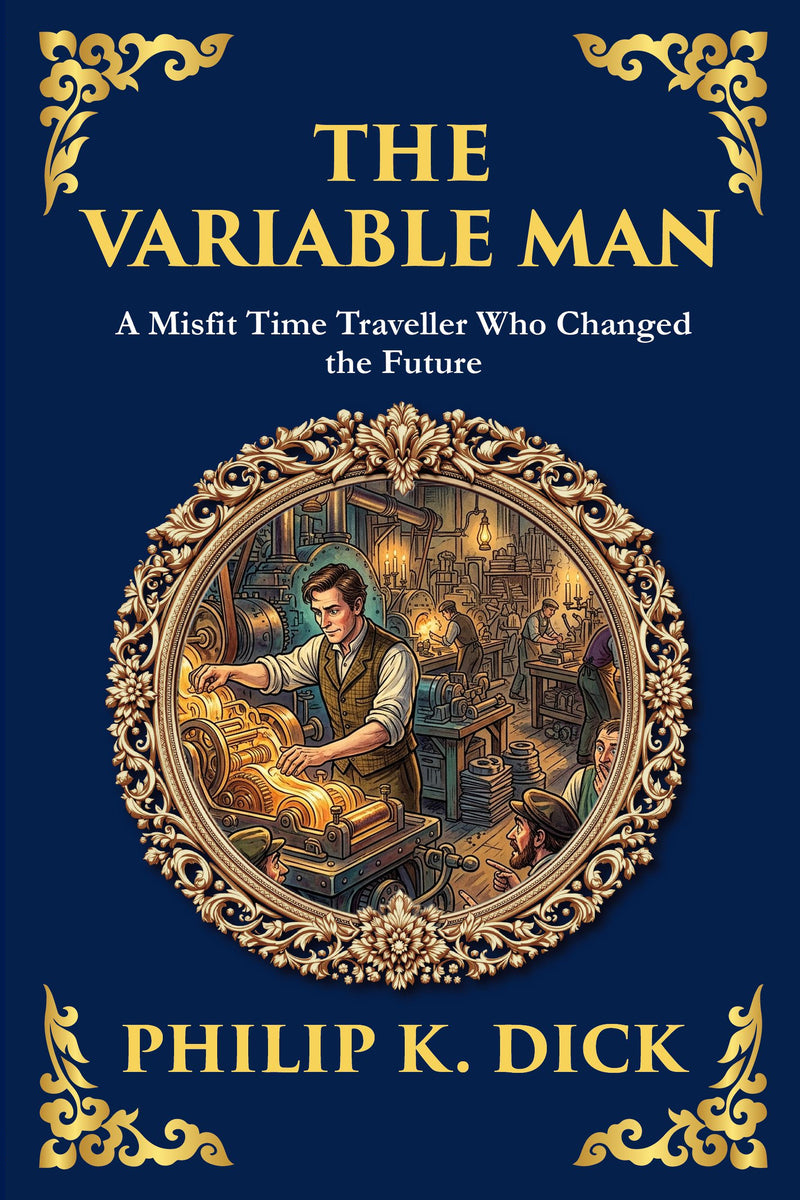
The Variable Man — Large Print
A man from the past is thrust into a future dominated by cold calculations and technological warfare. But when systems that predict every possible outcome encounter a wild card— someone outside their logic—the entire fate of the galaxy shifts.
or free app
10,000+ hrs library
30-day guarantee
The complete The Variable Man appears in modern English through Library of Alexandria Press, available online with audiobook narration included for members.
Have you ever wondered why one unpredictable person can change the course of history? The Variable Man is a thrilling novella from legendary science fiction writer Philip K. Dick, exploring the dangers of deterministic systems and the wild, untamable power of the human spirit. In a future society where wars are decided by probability equations and strategy computers predict every move, a man from the 20th century is accidentally pulled into the cold future of the 2130s.
Thomas Cole is a tinker, a fixer, an ordinary man by yesterday’s standards—but an anomaly in a future where nothing is left to chance. To the ruling technocrats, he is a threat. To the rebels, he is a secret weapon.
Because in a world that can predict everything—he’s the one thing they can’t. This edition features a faithful, modernized presentation of Dick’s original work, accessible to today’s readers while preserving the timeless edge of his vision.
What you’ll discover in this modern edition
- A Future Ruled by Cold Logic – A hyper-calculated world where emotions, humanity, and intuition have no place.
| Formats | eBook (EPUB + PDF) · Audiobook · Paperback · Hardcover · Large Print |
| Language | English |
| Trim size (print) | 6 × 9 in |
| Binding | Paperback — perfect-bound · Hardcover — casewrap |
| Large Print edition | Same text in a larger, easy-read type — a larger font, not a larger trim |
| Print pricing | Every physical book at our true cost — at-cost, no profit (members) |
| Library | 873 restored titles, always growing |
| Length | 28,280 words · ~1 hr 53 min reading |
| Reading level | Grade 3 · an easy, flowing read (this modern-English edition) |
| Edition | Modern English translation · 2026 |
Member reviews for this edition are collected as readers finish it — be the first. Across the library: 12,000+ books shipped, every plan covered by a 365-day print guarantee.
About this edition
A faithful, unabridged modern-English edition by The Library of Alexandria — carefully rendered for today's reader and verified paragraph-by-paragraph against the public-domain source. Available as eBook, audiobook, paperback, hardcover, and large print.
- Complete & unabridgedVerified paragraph by paragraph against the source — never a scan, never abridged.
- Modern English, faithfulReadable today, with the author’s meaning kept intact. Readable — not simplified.
- Every format, one membershipRead in your browser or the free app, or listen to the full audiobook.
Included free with your membership
Cancel anytime, one click · 30-day money-back guarantee
Edition last updated July 2026
What’s inside
The Variable Man — Large Print — complete and unabridged: all 5 sections included with membership, plus the full audiobook.
Begin reading The Variable Man — Large Print
In clear modern English — the complete text is included with membership.
Introduction
There are certain writers whose names become a kind of shorthand for a way of seeing the world, and Philip K. Dick belongs firmly in that company. To say something feels “very Philip K. Dick” is to invoke an entire emotional and intellectual atmosphere: a creeping uncertainty about what is real, a suspicion that the machinery of authority is grinding against the dignity of ordinary people, and an almost tender attention to the small, fragile human moments that survive amid technological and political chaos. The work you are about to read is one of the early sparks from which that enormous reputation would eventually catch fire. It is a story of war and time and machinery, but more importantly it is a story about the unexpected, about the way a single human being who does not fit the patterns laid out for him can become the most powerful variable in a system that prides itself on predicting everything.
This edition has been prepared as a modern translation and adaptation for the contemporary reader, which is to say that care has been taken to make the prose as inviting and frictionless as possible for someone encountering it today. The ideas at the heart of the narrative are timeless, but the idiom of mid-twentieth-century pulp science fiction can sometimes feel dated, with phrasings and rhythms that may slow a present-day reader without adding anything essential. The aim here has been to preserve everything that matters—the suspense, the moral weight, the philosophical undercurrents, the headlong pace—while smoothing the path so that the experience feels fresh and immediate. Nothing of the author’s vision has been diminished. If anything, the goal is to let that vision shine through more clearly, unobstructed by the incidental textures of an earlier publishing era.
Before you begin, it is worth taking a little time to understand the man who wrote this, the world that produced it, and the particular pleasures and provocations that await you. This is not a book that needs decoding to be enjoyed—it moves quickly and grips hard from its opening pages—but knowing something of its context can deepen your appreciation and let you notice the seeds of themes that the author would spend the rest of his career cultivating. What follows is meant to prepare you without spoiling you, to set the table without serving the meal.
Philip K. Dick was born in 1928 in Chicago, and his early life was marked by the kind of instability and quiet sorrow that seems, in retrospect, almost to have been training for the themes he would obsess over as a writer. He had a twin sister who died in infancy, a loss that haunted him throughout his life and that many readers and biographers have seen echoed in his recurring fascination with doubles, with the question of identity, and with the porous boundary between presence and absence. His parents divorced when he was young, and he grew up in California, where he would spend most of his life and where the sun-bleached suburban landscapes of the American West would seep into his fiction as a strange backdrop for the metaphysical storms he loved to conjure.
He came of age in the postwar era, a time when science fiction was exploding out of cheap magazines and into the wider culture, when the atom bomb had made the future feel simultaneously thrilling and terrifying, and when the Cold War had taught an entire generation to live with the constant low hum of existential dread. Dick began publishing short stories in the early 1950s, churning them out at a remarkable pace for the pulp magazines that paid by the word and demanded a steady stream of inventive plots. He was, in those years, a working writer in the most literal sense—hungry, prolific, and forced by economic necessity to produce constantly. This particular tale belongs to that fertile early period, and reading it you can feel both the raw energy of a young author flexing his imagination and the first stirrings of the deeper questions that would later make him one of the most influential voices in the genre.
It is one of the great ironies of literary history that Dick spent most of his working life in relative obscurity and financial hardship, scraping by on modest payments and never quite achieving the recognition his talent deserved while he was alive. He died in 1982, just months before the release of Blade Runner, the film adaptation of his novel Do Androids Dream of Electric Sheep? that would help launch a posthumous explosion of interest in his work. In the decades since, his influence has become almost impossible to overstate. Films like Total Recall, Minority Report, A Scanner Darkly, and The Adjustment Bureau all draw from his stories and novels, and the broader cultural imagination—our endless fascination with simulated realities, paranoid surveillance states, artificial intelligence, and the slipperiness of memory—owes an enormous debt to the territory he mapped out long before anyone else thought to explore it. When you read a tale like this one, you are reading the foundation of a tradition that now shapes a substantial portion of how we tell stories about technology and the human soul.
What set Dick apart from his contemporaries was never the hardware. He was not, fundamentally, a writer interested in the technical specifications of his rockets and machines. Many of his peers wrote with engineering precision about how their imagined devices might work, but Dick cared far more about how those devices made people feel, what they did to the human heart, and what they revealed about the structures of power that people lived inside. His science fiction is humane in the deepest sense. It is populated not by gleaming heroes but by ordinary, flawed, often anxious individuals trying to do the decent thing in worlds that seem designed to crush them. He had a profound sympathy for the underdog, the misfit, the person who does not belong, and that sympathy radiates through everything he wrote.
This is essential to understanding what you are about to read. The protagonist of this story is a man who does not fit—a person whose very nature defies the categories and calculations of the society he stumbles into. In a world obsessed with predicting outcomes, with reducing the future to probabilities and statistics, he represents the one thing that cannot be predicted: the genuinely free, genuinely unpredictable human being. There is a powerful argument running underneath the surface of this adventure, and it is an argument that Dick would return to again and again throughout his career. It is the insistence that human beings are not machines, that they cannot be fully calculated, and that this very unpredictability is not a flaw to be eliminated but the source of everything valuable and surprising about us. In an age that increasingly tries to reduce us to data points, to predict our behavior, to model our choices and sell them back to us, this argument feels more urgent now than it perhaps ever has.
Dick was also, by temperament and by the circumstances of his often-troubled life, deeply attuned to the experience of feeling out of step with the world around him. He struggled with anxiety, with relationships, with a sense that reality itself could not quite be trusted. These struggles, painful as they were for the man, became the raw material of an extraordinary body of work. He wrote about paranoia not as a clinical abstraction but as a lived condition, and he wrote about the longing for authenticity and meaning with a sincerity that can be genuinely moving. Even in his fastest, most plot-driven early stories—and this is very much a plot-driven story—you can sense that emotional honesty beating underneath. The chases and the conflicts are exciting, but they are never empty. They always carry weight, because the people caught up in them feel real, and because what is at stake is never merely survival but something more like the soul of a civilization.
The World of the Story and Why It Still Speaks to Us
The setting of this tale is a future society at war, and it is worth pausing to appreciate the particular flavor of the future that Dick imagined. This is not the gleaming utopia of optimistic science fiction, nor is it the grimy dystopia that would later become fashionable. It is something more unsettling and more interesting: a society that believes it has mastered the future. The central conceit—and this is one of those ideas that, once you understand it, illuminates the entire narrative—is that this civilization has developed the ability to compute the probable outcomes of its decisions with extraordinary precision. War, in this world, is not a chaotic plunge into the unknown but a carefully modeled enterprise, run by machines that calculate the odds and advise the leaders on whether and when to act.
There is something profoundly contemporary about this vision. We live now in an age of predictive analytics, of algorithms that claim to forecast everything from consumer behavior to criminal recidivism to the spread of disease. We are surrounded by systems that promise to take the uncertainty out of life, to model the future and let us act with confidence. Dick saw all of this coming, in his own imaginative idiom, and he understood its seductions and its dangers with remarkable clarity. The leaders in this story trust their machines. They have built an entire strategy, an entire war, around the assumption that the future can be known. And the drama of the narrative turns precisely on what happens when something enters that calculated world that the machines did not and could not account for.
The figure of the “variable man” of the title is, in this sense, a kind of saboteur of certainty—not a villain bent on destruction, but a presence whose very existence throws the whole apparatus of prediction into disarray. He is a man from a different time, displaced into this future, and he carries with him a set of skills and instincts that belong to no category the future society recognizes. He is, in the most literal terms, an anomaly, a wild card, a factor that cannot be plugged into any equation. And the genius of the story lies in the way Dick uses this single figure to ask enormous questions about freedom, fate, and the limits of control.
There is a particular kind of pleasure in watching a rigid, overconfident system encounter something it cannot handle, and Dick exploits that pleasure beautifully. But he is after something deeper than mere satisfaction. He is interested in what it means to be the kind of person who does not fit, who cannot be predicted, who throws sand into the gears of the great machine of prophecy. Is such a person a threat to be eliminated, as the authorities in the story tend to believe? Or is such a person, in fact, the one thing that can save a civilization that has trapped itself inside its own certainties? These are not easy questions, and the book does not offer easy answers, but it dramatizes them with a vividness and a momentum that will keep you turning pages.
The historical moment in which Dick wrote this is also worth keeping in mind, because it explains some of the urgency that pulses beneath the surface. The early 1950s were the height of the Cold War, a period defined by the constant possibility of catastrophic conflict between superpowers armed with weapons capable of ending civilization. The idea of war as a calculated, computed enterprise was not abstract for Dick’s first readers. They lived in a world where strategists and game theorists were genuinely attempting to model nuclear conflict, to calculate acceptable losses, to reduce the unthinkable to numbers on a page. Dick’s imagined future, with its war run by probability machines, was a heightened, fantastical version of anxieties that were entirely real. He took the cold logic of his era and pushed it to its extreme, and in doing so he exposed both its appeal and its terrifying limitations.
What makes the story endure, though, is that it transcends its moment. You do not need to know anything about the Cold War to feel the force of its central drama, because the questions it raises are perennial. How much of our future is fixed, and how much remains genuinely open? Can a single individual change the course of events, or are we all simply swept along by forces too large to resist? What is the value of the unpredictable, the spontaneous, the human, in a world that increasingly prizes efficiency and control? These are questions that every generation must answer for itself, and Dick’s framing of them remains as fresh and as provocative as ever. If anything, as our own technology grows ever more sophisticated in its attempts to predict and shape our behavior, the questions have only grown more pointed.
Cancel anytime, one click · 30-day money-back guarantee
Founding annual rate available now — your price locks for life when you join.
Not ready? Get this free chapter by email — read it anytime.
✓ Sent — check your inbox for The Variable Man — Large Print.
Questions about The Variable Man — Large Print
What is The Variable Man about?
A man from the past is thrust into a future dominated by cold calculations and technological warfare. But when systems that predict every possible outcome encounter a wild card— someone outside their logic—the entire fate of the galaxy shifts. The Variable Man doesn’t belong in this world.
Who wrote The Variable Man?
The Variable Man was written by Philip K. Dick. This edition presents the complete work in clear modern English, faithfully rendered from the public-domain original by Library of Alexandria Press.
Is The Variable Man free to read?
The opening chapter is free to read on this page. Members read and listen to the complete work — and the entire library — free, and can order any physical book at our true print cost.
How long is The Variable Man?
5 chapters (~28,280 words) — about 1 hr 53 min of reading in this modern-English edition.
Is this an abridged version of The Variable Man?
No. This is the complete, unabridged The Variable Man, carefully rendered into clear modern English and verified paragraph-by-paragraph against the public-domain source — nothing is cut or summarised.
What formats does The Variable Man come in?
The Variable Man is available as eBook, paperback, hardcover and large print. eBook and audiobook are included with membership; printed editions ship at our true print cost.
Shipping & returns
Billing & membership
More from the library


Explore Military & Strategy
- The War of the Worlds · H. G. Wells
- The Belle of Bowling Green · Amelia E. Barr
- Give Me Liberty or Give Me Death · Patrick Henry
- The Thirty-Nine Steps · John Buchan
- Julius Caesar · William Shakespeare
- Rilla of Ingleside · L. M. Montgomery
- Troilus and Criseyde · Geoffrey Chaucer
- The Adventures of Heine · Edgar Wallace
- The Declaration of Independence of the United States of America · Thomas Jefferson
- Armageddon—2419 A.D. · Philip Francis Nowlan
- The Variable Man · Philip K. Dick
- Arms and the Man · Bernard Shaw
- South Africa and the Transvaal War, Vol. 2 (of 8) · Louis Creswicke
- The Red Badge of Courage: An Episode of the American Civil War · Stephen Crane
- Second Variety · Philip K. Dick
- Lysistrata · Aristophanes
- The Iliad · Homer
- A Matter of Proportion · Anne Walker
- This Side of Paradise · F. Scott Fitzgerald
The Variable Man — Large Print
The Variable Man — Large Print
A Misfit Time Traveler Who Changed the Future
Philip K. Dick
Contents
- Introduction
- Chapter 1
- Chapter 2
- Chapter 3
- Chapter 4
Introduction
There are certain writers whose names become a kind of shorthand for a way of seeing the world, and Philip K. Dick belongs firmly in that company. To say something feels “very Philip K. Dick” is to invoke an entire emotional and intellectual atmosphere: a creeping uncertainty about what is real, a suspicion that the machinery of authority is grinding against the dignity of ordinary people, and an almost tender attention to the small, fragile human moments that survive amid technological and political chaos. The work you are about to read is one of the early sparks from which that enormous reputation would eventually catch fire. It is a story of war and time and machinery, but more importantly it is a story about the unexpected, about the way a single human being who does not fit the patterns laid out for him can become the most powerful variable in a system that prides itself on predicting everything.
This edition has been prepared as a modern translation and adaptation for the contemporary reader, which is to say that care has been taken to make the prose as inviting and frictionless as possible for someone encountering it today. The ideas at the heart of the narrative are timeless, but the idiom of mid-twentieth-century pulp science fiction can sometimes feel dated, with phrasings and rhythms that may slow a present-day reader without adding anything essential. The aim here has been to preserve everything that matters—the suspense, the moral weight, the philosophical undercurrents, the headlong pace—while smoothing the path so that the experience feels fresh and immediate. Nothing of the author’s vision has been diminished. If anything, the goal is to let that vision shine through more clearly, unobstructed by the incidental textures of an earlier publishing era.
Before you begin, it is worth taking a little time to understand the man who wrote this, the world that produced it, and the particular pleasures and provocations that await you. This is not a book that needs decoding to be enjoyed—it moves quickly and grips hard from its opening pages—but knowing something of its context can deepen your appreciation and let you notice the seeds of themes that the author would spend the rest of his career cultivating. What follows is meant to prepare you without spoiling you, to set the table without serving the meal.
Philip K. Dick was born in 1928 in Chicago, and his early life was marked by the kind of instability and quiet sorrow that seems, in retrospect, almost to have been training for the themes he would obsess over as a writer. He had a twin sister who died in infancy, a loss that haunted him throughout his life and that many readers and biographers have seen echoed in his recurring fascination with doubles, with the question of identity, and with the porous boundary between presence and absence. His parents divorced when he was young, and he grew up in California, where he would spend most of his life and where the sun-bleached suburban landscapes of the American West would seep into his fiction as a strange backdrop for the metaphysical storms he loved to conjure.
He came of age in the postwar era, a time when science fiction was exploding out of cheap magazines and into the wider culture, when the atom bomb had made the future feel simultaneously thrilling and terrifying, and when the Cold War had taught an entire generation to live with the constant low hum of existential dread. Dick began publishing short stories in the early 1950s, churning them out at a remarkable pace for the pulp magazines that paid by the word and demanded a steady stream of inventive plots. He was, in those years, a working writer in the most literal sense—hungry, prolific, and forced by economic necessity to produce constantly. This particular tale belongs to that fertile early period, and reading it you can feel both the raw energy of a young author flexing his imagination and the first stirrings of the deeper questions that would later make him one of the most influential voices in the genre.
It is one of the great ironies of literary history that Dick spent most of his working life in relative obscurity and financial hardship, scraping by on modest payments and never quite achieving the recognition his talent deserved while he was alive. He died in 1982, just months before the release of Blade Runner, the film adaptation of his novel Do Androids Dream of Electric Sheep? that would help launch a posthumous explosion of interest in his work. In the decades since, his influence has become almost impossible to overstate. Films like Total Recall, Minority Report, A Scanner Darkly, and The Adjustment Bureau all draw from his stories and novels, and the broader cultural imagination—our endless fascination with simulated realities, paranoid surveillance states, artificial intelligence, and the slipperiness of memory—owes an enormous debt to the territory he mapped out long before anyone else thought to explore it. When you read a tale like this one, you are reading the foundation of a tradition that now shapes a substantial portion of how we tell stories about technology and the human soul.
What set Dick apart from his contemporaries was never the hardware. He was not, fundamentally, a writer interested in the technical specifications of his rockets and machines. Many of his peers wrote with engineering precision about how their imagined devices might work, but Dick cared far more about how those devices made people feel, what they did to the human heart, and what they revealed about the structures of power that people lived inside. His science fiction is humane in the deepest sense. It is populated not by gleaming heroes but by ordinary, flawed, often anxious individuals trying to do the decent thing in worlds that seem designed to crush them. He had a profound sympathy for the underdog, the misfit, the person who does not belong, and that sympathy radiates through everything he wrote.
This is essential to understanding what you are about to read. The protagonist of this story is a man who does not fit—a person whose very nature defies the categories and calculations of the society he stumbles into. In a world obsessed with predicting outcomes, with reducing the future to probabilities and statistics, he represents the one thing that cannot be predicted: the genuinely free, genuinely unpredictable human being. There is a powerful argument running underneath the surface of this adventure, and it is an argument that Dick would return to again and again throughout his career. It is the insistence that human beings are not machines, that they cannot be fully calculated, and that this very unpredictability is not a flaw to be eliminated but the source of everything valuable and surprising about us. In an age that increasingly tries to reduce us to data points, to predict our behavior, to model our choices and sell them back to us, this argument feels more urgent now than it perhaps ever has.
Dick was also, by temperament and by the circumstances of his often-troubled life, deeply attuned to the experience of feeling out of step with the world around him. He struggled with anxiety, with relationships, with a sense that reality itself could not quite be trusted. These struggles, painful as they were for the man, became the raw material of an extraordinary body of work. He wrote about paranoia not as a clinical abstraction but as a lived condition, and he wrote about the longing for authenticity and meaning with a sincerity that can be genuinely moving. Even in his fastest, most plot-driven early stories—and this is very much a plot-driven story—you can sense that emotional honesty beating underneath. The chases and the conflicts are exciting, but they are never empty. They always carry weight, because the people caught up in them feel real, and because what is at stake is never merely survival but something more like the soul of a civilization.
The World of the Story and Why It Still Speaks to Us
The setting of this tale is a future society at war, and it is worth pausing to appreciate the particular flavor of the future that Dick imagined. This is not the gleaming utopia of optimistic science fiction, nor is it the grimy dystopia that would later become fashionable. It is something more unsettling and more interesting: a society that believes it has mastered the future. The central conceit—and this is one of those ideas that, once you understand it, illuminates the entire narrative—is that this civilization has developed the ability to compute the probable outcomes of its decisions with extraordinary precision. War, in this world, is not a chaotic plunge into the unknown but a carefully modeled enterprise, run by machines that calculate the odds and advise the leaders on whether and when to act.
There is something profoundly contemporary about this vision. We live now in an age of predictive analytics, of algorithms that claim to forecast everything from consumer behavior to criminal recidivism to the spread of disease. We are surrounded by systems that promise to take the uncertainty out of life, to model the future and let us act with confidence. Dick saw all of this coming, in his own imaginative idiom, and he understood its seductions and its dangers with remarkable clarity. The leaders in this story trust their machines. They have built an entire strategy, an entire war, around the assumption that the future can be known. And the drama of the narrative turns precisely on what happens when something enters that calculated world that the machines did not and could not account for.
The figure of the “variable man” of the title is, in this sense, a kind of saboteur of certainty—not a villain bent on destruction, but a presence whose very existence throws the whole apparatus of prediction into disarray. He is a man from a different time, displaced into this future, and he carries with him a set of skills and instincts that belong to no category the future society recognizes. He is, in the most literal terms, an anomaly, a wild card, a factor that cannot be plugged into any equation. And the genius of the story lies in the way Dick uses this single figure to ask enormous questions about freedom, fate, and the limits of control.
There is a particular kind of pleasure in watching a rigid, overconfident system encounter something it cannot handle, and Dick exploits that pleasure beautifully. But he is after something deeper than mere satisfaction. He is interested in what it means to be the kind of person who does not fit, who cannot be predicted, who throws sand into the gears of the great machine of prophecy. Is such a person a threat to be eliminated, as the authorities in the story tend to believe? Or is such a person, in fact, the one thing that can save a civilization that has trapped itself inside its own certainties? These are not easy questions, and the book does not offer easy answers, but it dramatizes them with a vividness and a momentum that will keep you turning pages.
The historical moment in which Dick wrote this is also worth keeping in mind, because it explains some of the urgency that pulses beneath the surface. The early 1950s were the height of the Cold War, a period defined by the constant possibility of catastrophic conflict between superpowers armed with weapons capable of ending civilization. The idea of war as a calculated, computed enterprise was not abstract for Dick’s first readers. They lived in a world where strategists and game theorists were genuinely attempting to model nuclear conflict, to calculate acceptable losses, to reduce the unthinkable to numbers on a page. Dick’s imagined future, with its war run by probability machines, was a heightened, fantastical version of anxieties that were entirely real. He took the cold logic of his era and pushed it to its extreme, and in doing so he exposed both its appeal and its terrifying limitations.
What makes the story endure, though, is that it transcends its moment. You do not need to know anything about the Cold War to feel the force of its central drama, because the questions it raises are perennial. How much of our future is fixed, and how much remains genuinely open? Can a single individual change the course of events, or are we all simply swept along by forces too large to resist? What is the value of the unpredictable, the spontaneous, the human, in a world that increasingly prizes efficiency and control? These are questions that every generation must answer for itself, and Dick’s framing of them remains as fresh and as provocative as ever. If anything, as our own technology grows ever more sophisticated in its attempts to predict and shape our behavior, the questions have only grown more pointed.
He fixed things—clocks, refrigerators, vidsenders, and destinies. But he didn’t belong in the future, where the computers couldn’t account for him. He was Earth’s only hope—and its guaranteed failure!
Security Commissioner Reinhart hurried up the front steps and entered the Council building. The guards stepped aside quickly as he walked into the familiar room filled with the hum of massive machines. With a focused expression and eyes full of emotion, Reinhart stared intently at the central SRB computer, studying the data on the screen.
“Steady gains for the last quarter,” noted Kaplan, the lab organizer. He grinned with pride, as if he had done it himself. “Not bad, Commissioner.”
“We’re catching up to them,” Reinhart replied. “But it’s way too slow. We have to make our move—and soon.”
Kaplan was feeling talkative. “We design new offensive weapons, and they counter with better defenses. But nothing actually gets built! We keep improving, but neither we nor Centaurus can stop designing long enough to actually start production.”
“It will end,” Reinhart said coldly, “the moment Terra creates a weapon that Centaurus can’t defend against.”
“Every weapon has a defense. It’s a cycle of design and conflict. Everything becomes obsolete immediately. Nothing lasts long enough to—”
“We’re counting on the lag,” Reinhart interrupted, annoyed. He glared at the lab organizer, making Kaplan shrink back. “The time gap between our offensive design and their counter-measure. That lag changes.” He waved impatiently toward the rows of SRB machines. “As you know very well.”
At 9:30 AM on May 7, 2136, the statistical ratio on the SRB machines was 21-17 in favor of the Centaurans. Based on all the facts, the odds suggested that Proxima Centaurus would successfully repel a military attack from Terra. This ratio was based on all the information the SRB machines possessed—a synthesis of the massive stream of data flowing constantly from every sector of the Sol and Centaurus systems.
End of the free sample
Keep reading, free
Members read and listen to the complete book — and the entire library. Cancel anytime, one click · 30-day money-back guarantee.