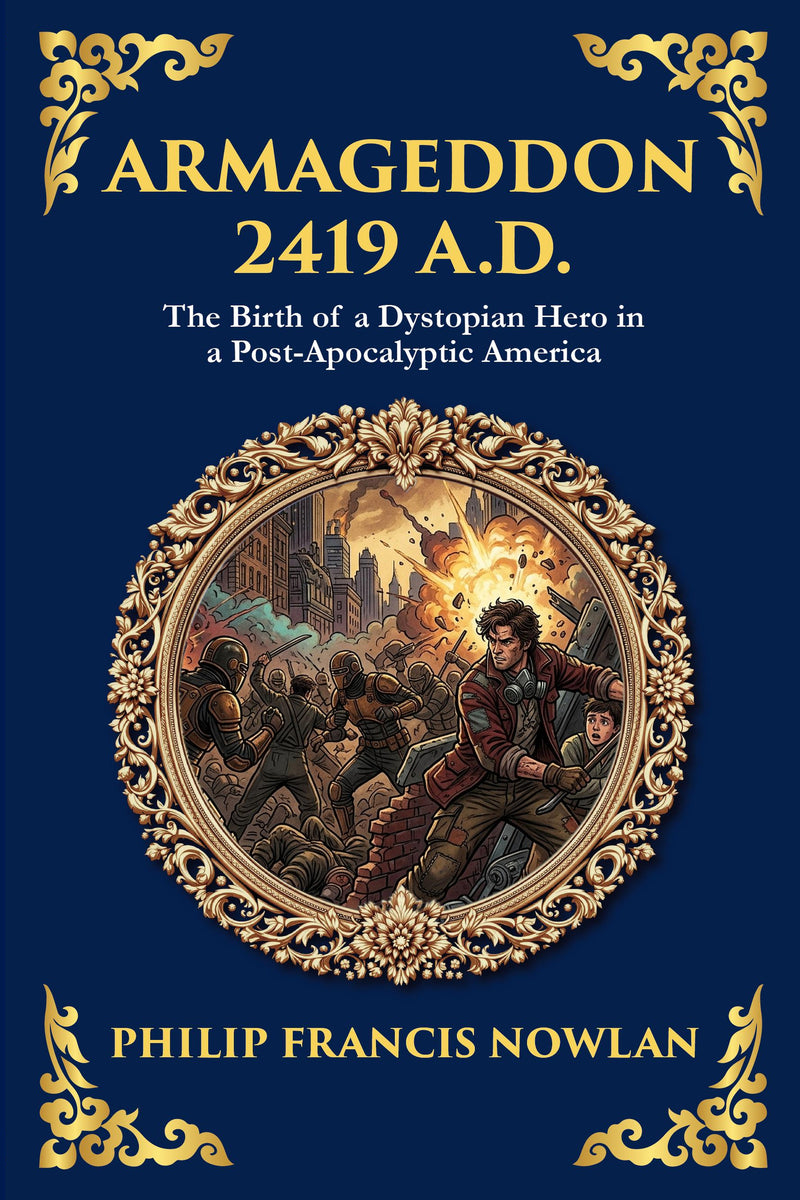
Armageddon—2419 A.D.
Awakening 500 years in the future after a mysterious accident, Anthony Rogers finds himself in a shattered America ruled by foreign overlords and stalked by war machines.
or free app
10,000+ hrs library
30-day guarantee
The complete Armageddon—2419 A.D. appears in modern English through Library of Alexandria Press, available online with audiobook narration included for members.
Have you ever wondered why the future belongs to those willing to fight for it? Before there was Flash Gordon or Star Wars, there was Armageddon—2419 A.D.—a groundbreaking tale of survival, resistance, and high-tech rebellion. Philip Francis Nowlan’s gripping novella is the birthplace of Buck Rogers, one of science fiction’s most enduring icons, and a foundational text in the creation of the modern space opera.
Anthony “Buck” Rogers is an ordinary man thrust into extraordinary circumstances. After a mining accident in 1927 exposes him to radioactive gases, he falls into suspended animation— only to awaken five centuries later in a world ravaged by war and ruled by the tyrannical Han invaders. With America reduced to a fragmented wilderness and its people pushed to the margins, Rogers aligns himself with an underground resistance movement determined to reclaim their land and freedom.
Armed with advanced technology, strategic brilliance, and unbreakable spirit, Buck becomes a symbol of hope and resilience. From dogfights in the sky to guerrilla warfare in ruined cities, Armageddon—2419 A.D. delivers a bold vision of a future forged in fire.
What you’ll discover in this modern edition
- The Origin of Buck Rogers Meet the hero who inspired a century of science fiction—first appearing right here.
| Formats | eBook (EPUB + PDF) · Audiobook · Paperback · Hardcover · Large Print |
| Language | English |
| Trim size (print) | 6 × 9 in |
| Binding | Paperback — perfect-bound · Hardcover — casewrap |
| Large Print edition | Same text in a larger, easy-read type — a larger font, not a larger trim |
| Print pricing | Every physical book at our true cost — at-cost, no profit (members) |
| Library | 873 restored titles, always growing |
| Length | 28,734 words · ~1 hr 55 min reading |
| Reading level | Grade 10 · a comfortable read (this modern-English edition) |
| Edition | Modern English translation · 2026 |
Member reviews for this edition are collected as readers finish it — be the first. Across the library: 12,000+ books shipped, every plan covered by a 365-day print guarantee.
About this edition
A faithful, unabridged modern-English edition by The Library of Alexandria — carefully rendered for today's reader and verified paragraph-by-paragraph against the public-domain source. Available as eBook, audiobook, paperback, hardcover, and large print.
- Complete & unabridgedVerified paragraph by paragraph against the source — never a scan, never abridged.
- Modern English, faithfulReadable today, with the author’s meaning kept intact. Readable — not simplified.
- Every format, one membershipRead in your browser or the free app, or listen to the full audiobook.
Included free with your membership
Cancel anytime, one click · 30-day money-back guarantee
Edition last updated July 2026
What’s inside
Armageddon—2419 A.D. — complete and unabridged: all 14 sections included with membership, plus the full audiobook.
Begin reading Armageddon—2419 A.D.
In clear modern English — the complete text is included with membership.
Introduction
When Armageddon—2419 A.D. first appeared in the pages of Amazing Stories magazine in August of 1928, few readers could have anticipated that they were witnessing the birth of an entire mythology. The novella, written by a forty-year-old former newspaperman named Philip Francis Nowlan, introduced the world to a character who would soon transcend the printed page and become one of the most enduring icons of twentieth-century popular imagination. That character’s name was Anthony Rogers—though history would come to know him better by another name entirely. From the pulp magazines to the daily comic strips, from radio serials to film matinees and eventually to television and beyond, the hero born in these pages would help define what we now call science fiction, shaping not only a genre but the very way that ordinary people dreamed about the future.
This edition presents Nowlan’s foundational work in a form intended for the contemporary reader. The language has been carefully modernized and adapted to remove the obstacles that nearly a century of linguistic drift can place between a story and its audience, while preserving the original’s distinctive voice, its breathless energy, and the peculiar visionary quality that made it so influential in the first place. What you are about to read is not a watered-down summary or a loose reimagining, but a faithful translation of Nowlan’s vision into prose that flows naturally for a twenty-first-century reader. The aim throughout has been to let the story do what it was always meant to do: to grip you, to transport you, and to make you feel the wonder and terror of a world utterly transformed.
To approach this book with the fullest appreciation, it helps to understand something of the moment from which it emerged, the man who created it, and the extraordinary cultural afterlife it would go on to enjoy. It also helps to set aside certain expectations. This is a story from the very dawn of modern science fiction, written before the conventions of the genre had hardened into familiar shapes. Reading it today is a little like visiting the headwaters of a great river, the place where currents that would later spread across the entire landscape of imaginative literature first began to flow. There is a freshness to that experience, an unrepeatable quality, that this introduction hopes to help you savor.
Philip Francis Nowlan was born in Philadelphia in 1888 and lived a life that, on its surface, gave little indication of the imaginative legacy he would leave behind. He attended the University of Pennsylvania, married, raised a large family of ten children, and made his living primarily as a journalist and newspaper columnist. He was, by all accounts, a practical man of his era, the kind of person who understood how to put words on a page to earn a living and feed a household. Yet beneath that workaday surface ran a current of speculation and possibility that, when it finally found its outlet, would touch millions.
The late 1920s were a remarkable time to be alive, and an even more remarkable time to be thinking about the future. The world had recently emerged from the catastrophe of the First World War, a conflict that had demonstrated, with horrifying clarity, the destructive potential of modern technology. Poison gas, the machine gun, the airplane, the submarine, and the long-range artillery shell had all transformed warfare into something mechanized and impersonal, capable of slaughter on an industrial scale. At the same time, the decade was alive with technological optimism. Radio was knitting the nation together. Automobiles were transforming the landscape. Aviation was advancing at a dizzying pace—Charles Lindbergh had crossed the Atlantic only the year before Nowlan’s novella appeared. Electricity, telephones, and a host of new conveniences were reshaping daily life. It was an age caught between the memory of unprecedented horror and the promise of unprecedented marvel, and that tension—between the wonders technology might bring and the devastation it might unleash—runs straight through the heart of this story.
Nowlan also wrote in the context of a particular American anxiety about the future, one that found expression in the speculative fiction of his time. The early science fiction writers were fascinated by the question of what the world might look like centuries hence, and how the great forces shaping the present—industrialization, scientific discovery, geopolitical rivalry—might play out across the long span of time. Nowlan imagined a future five hundred years removed from his own, a future in which the familiar America had been swept away and replaced by something almost unrecognizable. To construct this vision, he drew on the technological speculation of his day, extrapolating wildly from the inventions and possibilities he saw emerging around him. The result was a future that, while clearly a product of the 1920s imagination, nonetheless anticipated certain developments with striking prescience.
It is worth pausing on this prescience, because it forms one of the great pleasures of reading the book today. Nowlan envisioned forms of personal flight, advanced energy weapons, and methods of communication and detection that bear an uncanny resemblance to technologies that would only become reality decades later. He imagined a world in which the physical environment itself had been reshaped by warfare and by the long passage of centuries, in which old certainties had collapsed and new ways of living had taken their place. Some of his guesses now seem quaint, the products of an era that did not yet understand the full implications of the atomic age or the digital revolution. But many of them remain startlingly resonant, and the experience of recognizing, in a story nearly a century old, the seeds of our own present moment is one of the things that makes early science fiction so rewarding.
The novella that became Armageddon—2419 A.D. was published in the same issue of Amazing Stories that carried E. E. “Doc” Smith’s The Skylark of Space, in what many historians regard as a landmark moment for the genre. Amazing Stories itself was a recent creation, founded only two years earlier by the editor and publisher Hugo Gernsfeld—the man whose name would eventually be immortalized in science fiction’s most prestigious award. Gernsfeld believed passionately that imaginative fiction grounded in scientific speculation could do more than entertain; it could educate, inspire, and prepare readers for the world to come. His magazines provided a crucial early home for the writers who would build the genre, and Nowlan’s contribution proved to be among the most consequential of all.
Nowlan would follow the original novella with a sequel, The Airlords of Han, published the following year, which continued and expanded the story he had begun. Together, these two works form the foundation of the saga, and they reveal Nowlan as a writer of genuine imaginative ambition, willing to think on a grand scale about the destiny of nations and the trajectory of human civilization across centuries. He was not content merely to spin an adventure yarn, though he certainly knew how to do that. He wanted to imagine an entire future world, complete with its own social structures, its own technologies, its own conflicts and aspirations. That world-building impulse, which would later become central to science fiction as a genre, was already fully present in Nowlan’s pioneering work.
The most extraordinary thing about Armageddon—2419 A.D. is what happened after its publication. The story caught the attention of John F. Dille, the head of a newspaper syndicate, who recognized in Nowlan’s hero the potential for something far larger than a single magazine story. Dille proposed that the character be adapted into a daily comic strip, a relatively new form of mass entertainment that was rapidly growing in popularity. Nowlan agreed to write the strip, and an artist named Richard Calkins was brought on to illustrate it. There was just one significant change: the hero’s name. Anthony Rogers, as he appears in the novella you are about to read, was rechristened for the comic strip. He became Buck Rogers.
The Buck Rogers comic strip debuted on January 7, 1929, and it was an immediate and overwhelming success. It is generally credited as the first science fiction comic strip in American newspapers, and it opened the floodgates for an entire tradition of futuristic adventure in the medium. Within a few years, Buck Rogers had become a household name. The strip spawned a vast merchandising empire—toys, ray guns, costumes, badges, and countless other items that made the character a fixture of American childhood. A radio program followed, bringing the adventures to a new audience through the most intimate of media. In 1939, a movie serial starring Buster Crabbe brought Buck Rogers to the silver screen, and decades later the character would be revived for television in a series that introduced him to yet another generation. The phrase “that Buck Rogers stuff” entered the American vernacular as a shorthand for anything wildly futuristic or technologically fanciful—a testament to just how thoroughly the character had penetrated the popular consciousness.
What this means is that the modest novella in your hands is, in a very real sense, the origin point of a cultural phenomenon that shaped the imagination of the twentieth century. Every spaceship in every comic strip, every ray gun in every film serial, every dashing hero rocketing through the future to do battle with sinister forces—all of these owe a debt, direct or indirect, to the world Nowlan first sketched in these pages. When later generations of science fiction creators set out to build their own futures, they did so in a landscape that Buck Rogers had helped to clear. The character became a kind of cultural reference point, the figure against whom all subsequent visions of the future were measured, the embodiment of a particular kind of optimistic, action-driven, technologically dazzled dream of tomorrow.
And yet—and this is one of the great pleasures awaiting you—the original novella is in many ways quite different from the lighthearted, swashbuckling Buck Rogers of the comic strips and movie serials. Nowlan’s text is more serious, more thoughtful, and in places considerably darker than the popular image of the character might suggest. It is concerned with weighty questions about the fate of nations, the nature of civilization, and the long consequences of historical forces. It contains passages of genuine wonder and passages of genuine unease. To read it is to discover the source material in its raw, original form, before it was softened and simplified for mass consumption, and to appreciate the depth and ambition of Nowlan’s initial conception.
It is also important to approach the book with an awareness of its historical context. Like many works of its era, Armageddon—2419 A.D. reflects the attitudes, assumptions, and anxieties of the time and place in which it was written. The geopolitical fears and cultural prejudices of 1920s America find expression in the story, particularly in its depiction of the conflict at the heart of the plot. A modern reader will inevitably encounter elements that feel dated, and in some cases uncomfortable, when judged by the standards of our own time. This edition presents the work as a historical artifact, a window into how an earlier generation imagined the future and understood the forces shaping their world. Part of the value of reading older literature lies precisely in this encounter with the past—in seeing both how much has changed and how some of the deepest human concerns endure. The reader is encouraged to engage with the text thoughtfully, recognizing it as a product of its era while appreciating the genuine imaginative achievement it represents.
This modernized translation has been undertaken with great care to preserve the integrity of Nowlan’s original while making it accessible and pleasurable for today’s reader. The pulp fiction of the 1920s had its own distinctive style—sometimes ornate, sometimes hurried, often shaped by the conventions of magazine serialization and the tastes of its original audience. Sentence structures that felt natural to readers of that era can feel cumbersome or obscure to us now. Certain words have shifted in meaning or fallen out of use entirely. The pacing and rhythm of storytelling have evolved. In adapting the text, the goal has been to clear away these incidental obstacles so that the underlying story can shine through, while taking great care not to alter the substance of Nowlan’s vision or the character of his prose. The futuristic concepts, the dramatic situations, the imaginative leaps—all of these remain as Nowlan conceived them. What has changed is the surface, the texture of the language, smoothed and clarified to let the contemporary reader experience the story as vividly as its original audience did.
Cancel anytime, one click · 30-day money-back guarantee
Founding annual rate available now — your price locks for life when you join.
Not ready? Get this free chapter by email — read it anytime.
✓ Sent — check your inbox for Armageddon—2419 A.D..
Questions about Armageddon—2419 A.D.
What is Armageddon—2419 A.D. about?
Awakening 500 years in the future after a mysterious accident, Anthony Rogers finds himself in a shattered America ruled by foreign overlords and stalked by war machines. The cities he once knew are gone, replaced by jungle, ruins, and rebel enclaves. But from the ashes, he rises—not as a relic of the past, but as a revolutionary force of the future.
Who wrote Armageddon—2419 A.D.?
Armageddon—2419 A.D. was written by Philip Francis Nowlan. This edition presents the complete work in clear modern English, faithfully rendered from the public-domain original by Library of Alexandria Press.
Is Armageddon—2419 A.D. free to read?
The opening chapter is free to read on this page. Members read and listen to the complete work — and the entire library — free, and can order any physical book at our true print cost.
How long is Armageddon—2419 A.D.?
14 chapters (~28,734 words) — about 1 hr 55 min of reading in this modern-English edition.
Is this an abridged version of Armageddon—2419 A.D.?
No. This is the complete, unabridged Armageddon—2419 A.D., carefully rendered into clear modern English and verified paragraph-by-paragraph against the public-domain source — nothing is cut or summarised.
What formats does Armageddon—2419 A.D. come in?
Armageddon—2419 A.D. is available as eBook, paperback, hardcover and large print. eBook and audiobook are included with membership; printed editions ship at our true print cost.
Shipping & returns
Billing & membership
More from the library


Explore Military & Strategy
- The War of the Worlds · H. G. Wells
- The Belle of Bowling Green · Amelia E. Barr
- Give Me Liberty or Give Me Death · Patrick Henry
- The Thirty-Nine Steps · John Buchan
- Julius Caesar · William Shakespeare
- Rilla of Ingleside · L. M. Montgomery
- Troilus and Criseyde · Geoffrey Chaucer
- The Adventures of Heine · Edgar Wallace
- The Declaration of Independence of the United States of America · Thomas Jefferson
- The Variable Man · Philip K. Dick
- Arms and the Man · Bernard Shaw
- South Africa and the Transvaal War, Vol. 2 (of 8) · Louis Creswicke
- The Red Badge of Courage: An Episode of the American Civil War · Stephen Crane
- Second Variety · Philip K. Dick
- Lysistrata · Aristophanes
- The Iliad · Homer
- A Matter of Proportion · Anne Walker
- This Side of Paradise · F. Scott Fitzgerald
Armageddon—2419 A.D.
Armageddon—2419 A.D.
The Rise of a Dystopian Hero in a Post-Apocalyptic America
Philip Francis Nowlan
Contents
- Introduction
- Armageddon—2419 A.D.
- Chapter 1
- Chapter 2
- Chapter 3
- Chapter 4
- Chapter 5
- Chapter 6
- Chapter 7
- Chapter 8
- Chapter 9
- Chapter 10
- Chapter 11
- Chapter 12
Introduction
When Armageddon—2419 A.D. first appeared in the pages of Amazing Stories magazine in August of 1928, few readers could have anticipated that they were witnessing the birth of an entire mythology. The novella, written by a forty-year-old former newspaperman named Philip Francis Nowlan, introduced the world to a character who would soon transcend the printed page and become one of the most enduring icons of twentieth-century popular imagination. That character’s name was Anthony Rogers—though history would come to know him better by another name entirely. From the pulp magazines to the daily comic strips, from radio serials to film matinees and eventually to television and beyond, the hero born in these pages would help define what we now call science fiction, shaping not only a genre but the very way that ordinary people dreamed about the future.
This edition presents Nowlan’s foundational work in a form intended for the contemporary reader. The language has been carefully modernized and adapted to remove the obstacles that nearly a century of linguistic drift can place between a story and its audience, while preserving the original’s distinctive voice, its breathless energy, and the peculiar visionary quality that made it so influential in the first place. What you are about to read is not a watered-down summary or a loose reimagining, but a faithful translation of Nowlan’s vision into prose that flows naturally for a twenty-first-century reader. The aim throughout has been to let the story do what it was always meant to do: to grip you, to transport you, and to make you feel the wonder and terror of a world utterly transformed.
To approach this book with the fullest appreciation, it helps to understand something of the moment from which it emerged, the man who created it, and the extraordinary cultural afterlife it would go on to enjoy. It also helps to set aside certain expectations. This is a story from the very dawn of modern science fiction, written before the conventions of the genre had hardened into familiar shapes. Reading it today is a little like visiting the headwaters of a great river, the place where currents that would later spread across the entire landscape of imaginative literature first began to flow. There is a freshness to that experience, an unrepeatable quality, that this introduction hopes to help you savor.
Philip Francis Nowlan was born in Philadelphia in 1888 and lived a life that, on its surface, gave little indication of the imaginative legacy he would leave behind. He attended the University of Pennsylvania, married, raised a large family of ten children, and made his living primarily as a journalist and newspaper columnist. He was, by all accounts, a practical man of his era, the kind of person who understood how to put words on a page to earn a living and feed a household. Yet beneath that workaday surface ran a current of speculation and possibility that, when it finally found its outlet, would touch millions.
The late 1920s were a remarkable time to be alive, and an even more remarkable time to be thinking about the future. The world had recently emerged from the catastrophe of the First World War, a conflict that had demonstrated, with horrifying clarity, the destructive potential of modern technology. Poison gas, the machine gun, the airplane, the submarine, and the long-range artillery shell had all transformed warfare into something mechanized and impersonal, capable of slaughter on an industrial scale. At the same time, the decade was alive with technological optimism. Radio was knitting the nation together. Automobiles were transforming the landscape. Aviation was advancing at a dizzying pace—Charles Lindbergh had crossed the Atlantic only the year before Nowlan’s novella appeared. Electricity, telephones, and a host of new conveniences were reshaping daily life. It was an age caught between the memory of unprecedented horror and the promise of unprecedented marvel, and that tension—between the wonders technology might bring and the devastation it might unleash—runs straight through the heart of this story.
Nowlan also wrote in the context of a particular American anxiety about the future, one that found expression in the speculative fiction of his time. The early science fiction writers were fascinated by the question of what the world might look like centuries hence, and how the great forces shaping the present—industrialization, scientific discovery, geopolitical rivalry—might play out across the long span of time. Nowlan imagined a future five hundred years removed from his own, a future in which the familiar America had been swept away and replaced by something almost unrecognizable. To construct this vision, he drew on the technological speculation of his day, extrapolating wildly from the inventions and possibilities he saw emerging around him. The result was a future that, while clearly a product of the 1920s imagination, nonetheless anticipated certain developments with striking prescience.
It is worth pausing on this prescience, because it forms one of the great pleasures of reading the book today. Nowlan envisioned forms of personal flight, advanced energy weapons, and methods of communication and detection that bear an uncanny resemblance to technologies that would only become reality decades later. He imagined a world in which the physical environment itself had been reshaped by warfare and by the long passage of centuries, in which old certainties had collapsed and new ways of living had taken their place. Some of his guesses now seem quaint, the products of an era that did not yet understand the full implications of the atomic age or the digital revolution. But many of them remain startlingly resonant, and the experience of recognizing, in a story nearly a century old, the seeds of our own present moment is one of the things that makes early science fiction so rewarding.
The novella that became Armageddon—2419 A.D. was published in the same issue of Amazing Stories that carried E. E. “Doc” Smith’s The Skylark of Space, in what many historians regard as a landmark moment for the genre. Amazing Stories itself was a recent creation, founded only two years earlier by the editor and publisher Hugo Gernsfeld—the man whose name would eventually be immortalized in science fiction’s most prestigious award. Gernsfeld believed passionately that imaginative fiction grounded in scientific speculation could do more than entertain; it could educate, inspire, and prepare readers for the world to come. His magazines provided a crucial early home for the writers who would build the genre, and Nowlan’s contribution proved to be among the most consequential of all.
Nowlan would follow the original novella with a sequel, The Airlords of Han, published the following year, which continued and expanded the story he had begun. Together, these two works form the foundation of the saga, and they reveal Nowlan as a writer of genuine imaginative ambition, willing to think on a grand scale about the destiny of nations and the trajectory of human civilization across centuries. He was not content merely to spin an adventure yarn, though he certainly knew how to do that. He wanted to imagine an entire future world, complete with its own social structures, its own technologies, its own conflicts and aspirations. That world-building impulse, which would later become central to science fiction as a genre, was already fully present in Nowlan’s pioneering work.
The most extraordinary thing about Armageddon—2419 A.D. is what happened after its publication. The story caught the attention of John F. Dille, the head of a newspaper syndicate, who recognized in Nowlan’s hero the potential for something far larger than a single magazine story. Dille proposed that the character be adapted into a daily comic strip, a relatively new form of mass entertainment that was rapidly growing in popularity. Nowlan agreed to write the strip, and an artist named Richard Calkins was brought on to illustrate it. There was just one significant change: the hero’s name. Anthony Rogers, as he appears in the novella you are about to read, was rechristened for the comic strip. He became Buck Rogers.
The Buck Rogers comic strip debuted on January 7, 1929, and it was an immediate and overwhelming success. It is generally credited as the first science fiction comic strip in American newspapers, and it opened the floodgates for an entire tradition of futuristic adventure in the medium. Within a few years, Buck Rogers had become a household name. The strip spawned a vast merchandising empire—toys, ray guns, costumes, badges, and countless other items that made the character a fixture of American childhood. A radio program followed, bringing the adventures to a new audience through the most intimate of media. In 1939, a movie serial starring Buster Crabbe brought Buck Rogers to the silver screen, and decades later the character would be revived for television in a series that introduced him to yet another generation. The phrase “that Buck Rogers stuff” entered the American vernacular as a shorthand for anything wildly futuristic or technologically fanciful—a testament to just how thoroughly the character had penetrated the popular consciousness.
What this means is that the modest novella in your hands is, in a very real sense, the origin point of a cultural phenomenon that shaped the imagination of the twentieth century. Every spaceship in every comic strip, every ray gun in every film serial, every dashing hero rocketing through the future to do battle with sinister forces—all of these owe a debt, direct or indirect, to the world Nowlan first sketched in these pages. When later generations of science fiction creators set out to build their own futures, they did so in a landscape that Buck Rogers had helped to clear. The character became a kind of cultural reference point, the figure against whom all subsequent visions of the future were measured, the embodiment of a particular kind of optimistic, action-driven, technologically dazzled dream of tomorrow.
And yet—and this is one of the great pleasures awaiting you—the original novella is in many ways quite different from the lighthearted, swashbuckling Buck Rogers of the comic strips and movie serials. Nowlan’s text is more serious, more thoughtful, and in places considerably darker than the popular image of the character might suggest. It is concerned with weighty questions about the fate of nations, the nature of civilization, and the long consequences of historical forces. It contains passages of genuine wonder and passages of genuine unease. To read it is to discover the source material in its raw, original form, before it was softened and simplified for mass consumption, and to appreciate the depth and ambition of Nowlan’s initial conception.
It is also important to approach the book with an awareness of its historical context. Like many works of its era, Armageddon—2419 A.D. reflects the attitudes, assumptions, and anxieties of the time and place in which it was written. The geopolitical fears and cultural prejudices of 1920s America find expression in the story, particularly in its depiction of the conflict at the heart of the plot. A modern reader will inevitably encounter elements that feel dated, and in some cases uncomfortable, when judged by the standards of our own time. This edition presents the work as a historical artifact, a window into how an earlier generation imagined the future and understood the forces shaping their world. Part of the value of reading older literature lies precisely in this encounter with the past—in seeing both how much has changed and how some of the deepest human concerns endure. The reader is encouraged to engage with the text thoughtfully, recognizing it as a product of its era while appreciating the genuine imaginative achievement it represents.
This modernized translation has been undertaken with great care to preserve the integrity of Nowlan’s original while making it accessible and pleasurable for today’s reader. The pulp fiction of the 1920s had its own distinctive style—sometimes ornate, sometimes hurried, often shaped by the conventions of magazine serialization and the tastes of its original audience. Sentence structures that felt natural to readers of that era can feel cumbersome or obscure to us now. Certain words have shifted in meaning or fallen out of use entirely. The pacing and rhythm of storytelling have evolved. In adapting the text, the goal has been to clear away these incidental obstacles so that the underlying story can shine through, while taking great care not to alter the substance of Nowlan’s vision or the character of his prose. The futuristic concepts, the dramatic situations, the imaginative leaps—all of these remain as Nowlan conceived them. What has changed is the surface, the texture of the language, smoothed and clarified to let the contemporary reader experience the story as vividly as its original audience did.
In another place, I wrote down my personal memories of the 20th century, for anyone in the 25th century who might be interested.
It now occurs to me that my memories of the 25th century might be just as interesting 500 years from now—especially because of the unique way I experienced this era, having jumped across a gap of 492 years to enter it.
I need to explain this further. There are still many people in the world who aren’t aware of my unusual experience. In five centuries, there may be even more who don’t know, especially if civilization suffers even worse upheavals than those that happened between 1975 A.D. and today.
Therefore, I should clarify that I, Anthony Rogers, am—as far as I know—the only living man whose normal eighty-one-year lifespan has been stretched across 573 years. To be exact, I lived the first twenty-nine years of my life from 1898 to 1927, and the remaining fifty-two years since 2419. I spent the nearly five-hundred-year gap between these two periods in a state of suspended animation, where my body didn’t age or break down, and my physical and mental abilities remained completely intact.
Once again, we have a truly exceptional science fiction story. It is a tale that will make many readers’ hearts race with excitement.
We have rarely published a story in this magazine that can compete with this one in terms of scientific interest and suspense. We predict that this story will only grow more valuable as time passes. It contains several fascinating prophecies, many of which will undoubtedly come true. In terms of scientific depth, it will be hard to top for a long time. It is one of those rare stories that is worth reading over and over again.
End of the free sample
Keep reading, free
Members read and listen to the complete book — and the entire library. Cancel anytime, one click · 30-day money-back guarantee.