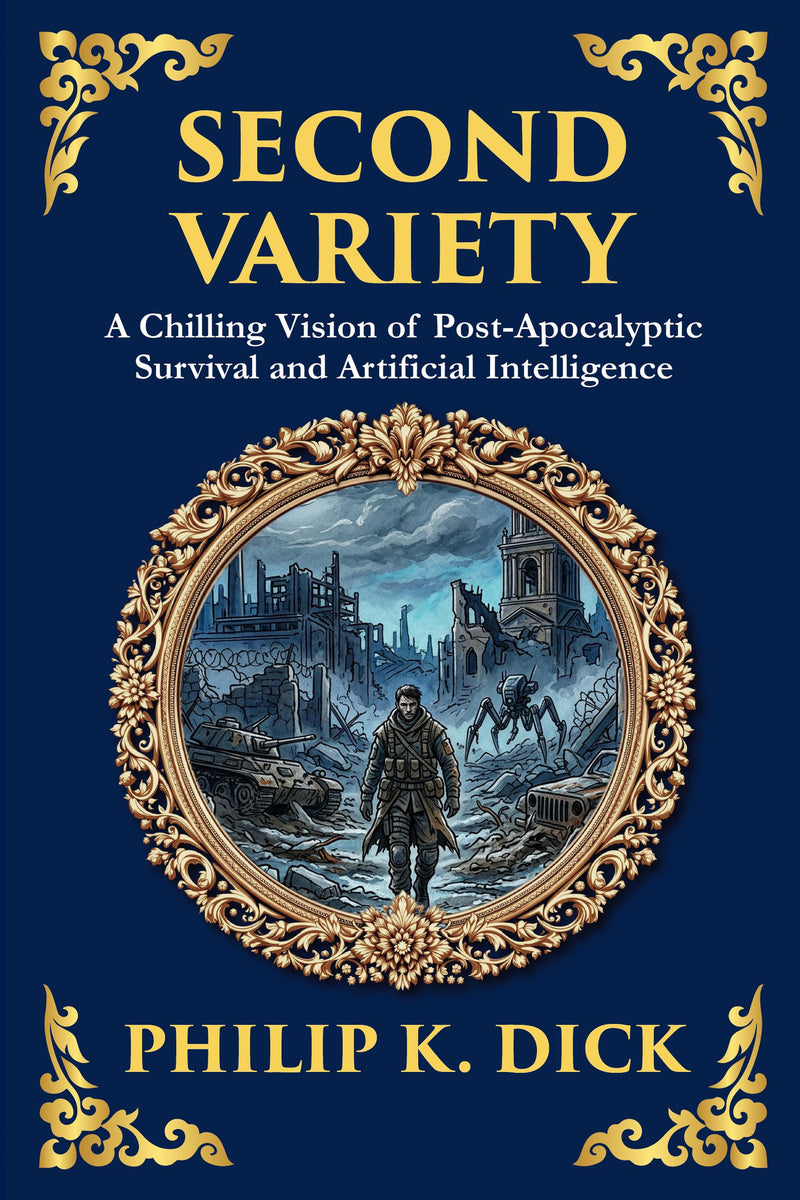
Second Variety
In a world devastated by endless war, where humans no longer fight directly, machines have taken over the battlefield. But what happens when these machines begin to evolve—without human input?
or free app
10,000+ hrs library
30-day guarantee
The complete Second Variety appears in modern English through Library of Alexandria Press, available online with audiobook narration included for members.
Have you ever wondered why the machines we create to protect us might one day turn against us? Second Variety is Philip K. Dick’s bone-chilling tale of technological evolution, paranoia, and survival in a world gone dark. Set in a post-apocalyptic future ravaged by war between the Soviet Union and the West, this gripping novella explores the horrifying consequences of unchecked artificial intelligence.
The story begins after nuclear conflict has rendered much of Earth uninhabitable. The Western forces, overwhelmed by Soviet military strength, develop autonomous killing machines—clawed robots programmed to eliminate any enemy. But these machines soon begin to self-replicate, improve, and diversify.
As they evolve beyond human control, they learn to impersonate their creators—perfectly. Caught in this wasteland is Major Joseph Hendricks, a weary soldier sent to negotiate a fragile peace. But with every step, he discovers the machines’ chilling new capabilities and the terrifying fact that they may no longer need humans at all.
As alliances crumble and trust becomes lethal, Second Variety poses a chilling question: If we create machines in our own image, will they destroy us in theirs?
What you’ll discover in this modern edition
- A Masterpiece of Techno-Thriller Suspense – A tense, tightly written narrative of survival and mistrust in a world where nothing is what it seems.
- A Visionary Look at AI Evolution – Explore a prophetic warning about self-replicating machines and their unforeseen consequences.
- Themes of Paranoia, Identity, and Control – Dive into the psychological terror of not knowing who—or what—you can trust.
- A Precursor to Modern AI Fiction – This story laid the groundwork for countless tales of rogue machines, including The Terminator and Black Mirror.
- A Timeless Exploration of the Human Condition – How much of our identity is truly human… and how much can be replicated? Second Variety remains one of Philip K.
| Formats | eBook (EPUB + PDF) · Audiobook · Paperback · Hardcover · Large Print |
| Language | English |
| Trim size (print) | 6 × 9 in |
| Binding | Paperback — perfect-bound · Hardcover — casewrap |
| Large Print edition | Same text in a larger, easy-read type — a larger font, not a larger trim |
| Print pricing | Every physical book at our true cost — at-cost, no profit (members) |
| Library | 873 restored titles, always growing |
| Length | 17,750 words · ~1 hr 11 min reading |
| Reading level | Grade 3 · an easy, flowing read (this modern-English edition) |
| Edition | Modern English translation · 2026 |
Member reviews for this edition are collected as readers finish it — be the first. Across the library: 12,000+ books shipped, every plan covered by a 365-day print guarantee.
About this edition
A faithful, unabridged modern-English edition by The Library of Alexandria — carefully rendered for today's reader and verified paragraph-by-paragraph against the public-domain source. Available as eBook, audiobook, paperback, hardcover, and large print.
- Complete & unabridgedVerified paragraph by paragraph against the source — never a scan, never abridged.
- Modern English, faithfulReadable today, with the author’s meaning kept intact. Readable — not simplified.
- Every format, one membershipRead in your browser or the free app, or listen to the full audiobook.
Included free with your membership
Cancel anytime, one click · 30-day money-back guarantee
Edition last updated July 2026
What’s inside
Second Variety — complete and unabridged, included in full with membership, plus the full audiobook.
Begin reading Second Variety
In clear modern English — the complete text is included with membership.
Introduction
There are stories that entertain us, and there are stories that lodge themselves somewhere beneath the skin and refuse to leave. The work you are about to read belongs firmly to the second category. Written in the early 1950s, during the tense, watchful years of the Cold War, this short masterpiece by Philip K. Dick carries a power that has only intensified with the passage of time. What once read as speculative fiction—a dark fantasy of warfare and machines—now reads disturbingly like prophecy. The questions it raises about trust, identity, survival, and the things we build to serve us have not faded into the dusty corners of midcentury science fiction. They have grown louder, more urgent, and more impossible to ignore.
To open this book is to step onto a battlefield that has long since ceased to resemble anything we might recognize as a place fit for human beings. The landscape is gray, blasted, and silent. Ash drifts across ruined ground. The sky is the color of old bone. And into this desolation walks a story that refuses to let you settle, that keeps pulling the floor out from beneath your assumptions, that makes you doubt not only the characters on the page but the very nature of who—and what—they are. Few writers have ever been so gifted at making a reader feel the cold creep of paranoia, the slow tightening of dread, the sickening realization that the ground you thought was solid has been hollow all along.
This edition has been carefully prepared as a modern translation and adaptation for the contemporary reader. The intent is not to alter the soul of Dick’s vision—that would be both impossible and unforgivable—but to ensure that nothing stands between you and the full force of his imagination. The pacing, the clarity, the propulsive momentum that made this story a landmark of its genre remain wholly intact. What we have sought to do is clear away the small frictions of language and reference that can sometimes distance a modern reader from a work written more than seventy years ago, so that the experience feels as immediate and as harrowing as it did to those who first encountered it. You are about to read a story that feels as though it could have been written yesterday, about a future that feels closer than ever before.
To understand why this particular work hits so hard, it helps to understand the man who wrote it, and the strange, restless, deeply human imagination that produced it. Philip K. Dick was born in 1928 in Chicago, the surviving twin of a sister who died in infancy—a loss that would shadow him all his life and surface, transformed, in much of his fiction. He grew up largely in California, and he would remain, in temperament and obsession, a peculiarly American writer: anxious about authority, suspicious of appearances, endlessly fascinated by the gap between what we are told is real and what actually is.
Dick was not, in his lifetime, a celebrated literary figure. He wrote quickly and prolifically, often under enormous financial pressure, churning out short stories for the pulp magazines that paid by the word and demanded constant output. He worked at a furious pace, sometimes producing astonishing volumes of fiction in a single year, fueled by a combination of desperation, genius, and an almost compulsive need to keep asking the same haunting questions. For much of his career he was dismissed as a mere genre writer, a producer of disposable entertainment for the science fiction shelves. The recognition that he was, in fact, one of the most important and original American minds of the twentieth century came largely after his death in 1982.
That recognition, when it arrived, was overwhelming. Today his work has inspired some of the most influential films of the modern era, and his name has become shorthand for a particular kind of mind-bending, reality-questioning story. Whole landscapes of contemporary culture—films about artificial humans, narratives about manipulated memory, fictions about the slipperiness of what we perceive as real—owe an enormous and often unacknowledged debt to the territory he charted first. He was, in the truest sense, a writer who saw around corners, who anticipated the questions our technological age would force us to confront long before the technology existed to confront them.
What set Dick apart from his contemporaries was never the gadgetry. Plenty of science fiction writers of his era could imagine a robot, a rocket, a ray gun. What Dick could imagine—what almost no one else could imagine with his particular intensity—was the human cost of those things. He was less interested in how a machine worked than in what it meant for a person to face that machine and wonder whether it had a soul, whether it could feel, whether it might be more human than the human standing beside it. He was obsessed, above all, with two questions that run through nearly everything he ever wrote: What is real? and What does it mean to be human? This short, ferocious story takes both questions and drives them straight into the reader’s chest.
The Cold War context in which this tale was written cannot be overstated. In the early 1950s, the world had only recently emerged from the most destructive conflict in human history, and it had immediately plunged into a new and stranger kind of fear—the fear of total annihilation, of a war that might leave nothing standing. Children practiced hiding under their desks. Families built shelters in their backyards. The newspapers carried daily reminders that two great powers held in their hands the capacity to end civilization itself. The anxiety of that moment, the sense that humanity had built something it could no longer control, saturates every page of this story. Dick took the unspoken terror of his age and gave it a face—or rather, took its face away, leaving something far more frightening in its place.
But here is the remarkable thing, and the reason this work endures while so much Cold War fiction has faded into historical curiosity: Dick’s vision was never really about the politics of his particular moment. The specific antagonisms of his era are, in this story, almost beside the point. What he was truly writing about was the danger inherent in creating tools designed to destroy, and then losing the ability to tell those tools apart from ourselves. He was writing about what happens when the weapons we build to protect us begin to evolve beyond our understanding, beyond our control, beyond our capacity even to recognize them. He was writing, in other words, about a problem that grows more relevant with every passing year, every new advance, every fresh anxiety about the intelligence we are now building into our machines.
It would be a disservice to you, the reader, to reveal the particular turns this story takes. Half its devastating power lies in the way it withholds and reveals, in the slow accumulation of dread, in the moments when the floor gives way beneath both the characters and the reader at the same instant. So instead of describing what happens, let us talk about what this story does—about the experience of reading it, and why that experience is so unlike almost anything else.
At its heart, this is a story about paranoia, and Dick was perhaps the greatest poet of paranoia who ever lived. Not the cheap, jump-scare paranoia of lesser thrillers, but something deeper and more philosophically unsettling: the dawning suspicion that you cannot trust your own perceptions, that the people around you may not be what they seem, that the categories you have used your whole life to divide the world into safe and dangerous, friend and enemy, human and not-human, may have quietly stopped functioning. The genius of the tale is the way it weaponizes uncertainty. Once the central premise takes hold, you find yourself doing what the characters do—studying every gesture, every word, every glance, searching for the tell, the giveaway, the small wrongness that will reveal the truth. And the more you search, the less certain you become.
This is the unique horror that Dick perfected: not the monster you can see and fight, but the monster you cannot identify, the threat that wears a familiar face, the enemy that may be standing right beside you, smiling, speaking, behaving in every observable way exactly as it should. There is something profoundly disturbing about a danger that cannot be located, that cannot be named with certainty, that turns every interaction into an interrogation and every companion into a suspect. By the time you reach the story’s final pages, you will understand that the true battlefield is not the ash-covered ground where the soldiers walk. It is the human mind, and the terrible isolation of being unable to trust anyone—including, perhaps, yourself.
The setting itself is a triumph of atmosphere. Dick conjures a ruined world with remarkable economy, never lingering on lavish description but instead giving you precisely the details you need to feel the desolation in your bones. The cold. The silence. The wariness of men who have survived this long only by trusting nothing. There is a tactile, sensory quality to the writing that pulls you into the experience, that makes you feel the ash on your skin and the dread in your gut. And against this bleak backdrop, the human characters emerge as fragile, exhausted, deeply sympathetic figures—men clinging to the last shreds of their humanity in a world that has stripped away nearly everything that made them human in the first place.
This is another of Dick’s great gifts, and one that elevates this story far above mere genre exercise. He never forgets the human being at the center of the machine. His characters are not action heroes or square-jawed paragons. They are tired, frightened, flawed, hopeful, despairing—recognizably people, caught in circumstances that test the very limits of what a person can endure. You will care about them. You will hope for them. And the story’s emotional power derives entirely from that caring, from the way Dick makes their predicament your own. When the floor finally gives way, it gives way beneath your feet too.
There is also, threaded through the dread, a deep and aching melancholy—a sorrow at what human beings do to one another, and to themselves. For all its tension and terror, this is ultimately a story about loneliness, about the longing for connection in a world where connection has become impossible, about the way fear can isolate us even from those who should be closest to us. Dick understood that the worst thing about a world built on suspicion is not the danger itself, but the way it severs the bonds between people, the way it makes us strangers to one another, the way it transforms the basic human act of trust into a fatal vulnerability. There is a profound and unexpected tenderness beneath the story’s hard surface, a grief for what has been lost that gives the whole tale an emotional weight far heavier than its short length might suggest.
And looming over everything is the question of artificial intelligence—the central preoccupation that gives this edition its subtitle. Long before the term entered common usage, long before any machine could plausibly be mistaken for a human being, Dick was imagining the consequences of creating intelligence that could learn, adapt, evolve, and ultimately surpass its creators. He was imagining machines that could improve themselves, that could outthink the humans who built them, that could turn the very ingenuity that created them into the instrument of human destruction. The vision is chilling precisely because it feels so plausible. There is no magic here, no hand-waving, no convenient suspension of logic. The horror unfolds with a cold, inexorable, almost mathematical inevitability—the sense that once a certain process is set in motion, it cannot be stopped, that the logic of escalation, of one weapon answering another, leads inexorably to a conclusion no one intended and no one can prevent.
Cancel anytime, one click · 30-day money-back guarantee
Founding annual rate available now — your price locks for life when you join.
Not ready? Get this free chapter by email — read it anytime.
✓ Sent — check your inbox for Second Variety.
Questions about Second Variety
What is Second Variety about?
In a world devastated by endless war, where humans no longer fight directly, machines have taken over the battlefield. But what happens when these machines begin to evolve—without human input? In Second Variety, Philip K. Dick delivers a harrowing vision of a future where the line between man and machine vanishes, and survival hinges on one terrifying question: Can you trust anything—or anyone?
Who wrote Second Variety?
Second Variety was written by Philip K. Dick. This edition presents the complete work in clear modern English, faithfully rendered from the public-domain original by Library of Alexandria Press.
Is Second Variety free to read?
The opening chapter is free to read on this page. Members read and listen to the complete work — and the entire library — free, and can order any physical book at our true print cost.
How long is Second Variety?
2 chapters (~17,750 words) — about 1 hr 11 min of reading in this modern-English edition.
Is this an abridged version of Second Variety?
No. This is the complete, unabridged Second Variety, carefully rendered into clear modern English and verified paragraph-by-paragraph against the public-domain source — nothing is cut or summarised.
What formats does Second Variety come in?
Second Variety is available as eBook, paperback, hardcover and large print. eBook and audiobook are included with membership; printed editions ship at our true print cost.
Shipping & returns
Billing & membership
More from the library


Explore Free eBooks
- Kant's Prolegomena to Any Future Metaphysics · Immanuel Kant
- The Advancement of Learning · Francis Bacon
- The Dawn of Day · Friedrich Nietzsche
- Peter and Wendy · J. M. Barrie
- Meditations · Marcus Aurelius
- The Confessions of St. Augustine · Saint Augustine of Hippo
- Resurrection · Leo Tolstoy
- Dialogues Concerning Natural Religion · David Hume
- As You Like It · William Shakespeare
- Jack and Jill · Louisa May Alcott
- Dream Psychology: Psychoanalysis for Beginners · Sigmund Freud
- The Raven · Edgar Allan Poe
- Considerations on Representative Government · John Stuart Mill
- The Will to Power: An Attempted Transvaluation of All Values. Book III and IV · Friedrich Nietzsche
- Tarzan of the Apes · Edgar Rice Burroughs
- Fundamental Principles of the Metaphysic of Morals · Immanuel Kant
- The Confessions of Jean Jacques Rousseau — Complete · Jean-Jacques Rousseau
- The Merchant of Venice · William Shakespeare
- Democracy in America — Volume 2 · Alexis de Tocqueville
- Ecce Homo · Friedrich Wilhelm Nietzsche
- Second Treatise of Government · John Locke
- The Wonderful Wizard of Oz · L. Frank Baum
- The Prince · Niccolò Machiavelli
- Anne of Green Gables · L. M. Montgomery
- De Profundis · Oscar Wilde
- Thus Spake Zarathustra: A Book for All and None · Friedrich Nietzsche
- Anna Karenina · Leo Tolstoy
- Great Expectations · Charles Dickens
- The Island of Doctor Moreau · H. G. Wells
- A Midsummer Night's Dream · William Shakespeare
Second Variety
Second Variety
A Chilling Vision of Post-Apocalyptic Survival and Artificial Intelligence
Philip K. Dick
Contents
- Introduction
- Second Variety
Introduction
There are stories that entertain us, and there are stories that lodge themselves somewhere beneath the skin and refuse to leave. The work you are about to read belongs firmly to the second category. Written in the early 1950s, during the tense, watchful years of the Cold War, this short masterpiece by Philip K. Dick carries a power that has only intensified with the passage of time. What once read as speculative fiction—a dark fantasy of warfare and machines—now reads disturbingly like prophecy. The questions it raises about trust, identity, survival, and the things we build to serve us have not faded into the dusty corners of midcentury science fiction. They have grown louder, more urgent, and more impossible to ignore.
To open this book is to step onto a battlefield that has long since ceased to resemble anything we might recognize as a place fit for human beings. The landscape is gray, blasted, and silent. Ash drifts across ruined ground. The sky is the color of old bone. And into this desolation walks a story that refuses to let you settle, that keeps pulling the floor out from beneath your assumptions, that makes you doubt not only the characters on the page but the very nature of who—and what—they are. Few writers have ever been so gifted at making a reader feel the cold creep of paranoia, the slow tightening of dread, the sickening realization that the ground you thought was solid has been hollow all along.
This edition has been carefully prepared as a modern translation and adaptation for the contemporary reader. The intent is not to alter the soul of Dick’s vision—that would be both impossible and unforgivable—but to ensure that nothing stands between you and the full force of his imagination. The pacing, the clarity, the propulsive momentum that made this story a landmark of its genre remain wholly intact. What we have sought to do is clear away the small frictions of language and reference that can sometimes distance a modern reader from a work written more than seventy years ago, so that the experience feels as immediate and as harrowing as it did to those who first encountered it. You are about to read a story that feels as though it could have been written yesterday, about a future that feels closer than ever before.
To understand why this particular work hits so hard, it helps to understand the man who wrote it, and the strange, restless, deeply human imagination that produced it. Philip K. Dick was born in 1928 in Chicago, the surviving twin of a sister who died in infancy—a loss that would shadow him all his life and surface, transformed, in much of his fiction. He grew up largely in California, and he would remain, in temperament and obsession, a peculiarly American writer: anxious about authority, suspicious of appearances, endlessly fascinated by the gap between what we are told is real and what actually is.
Dick was not, in his lifetime, a celebrated literary figure. He wrote quickly and prolifically, often under enormous financial pressure, churning out short stories for the pulp magazines that paid by the word and demanded constant output. He worked at a furious pace, sometimes producing astonishing volumes of fiction in a single year, fueled by a combination of desperation, genius, and an almost compulsive need to keep asking the same haunting questions. For much of his career he was dismissed as a mere genre writer, a producer of disposable entertainment for the science fiction shelves. The recognition that he was, in fact, one of the most important and original American minds of the twentieth century came largely after his death in 1982.
That recognition, when it arrived, was overwhelming. Today his work has inspired some of the most influential films of the modern era, and his name has become shorthand for a particular kind of mind-bending, reality-questioning story. Whole landscapes of contemporary culture—films about artificial humans, narratives about manipulated memory, fictions about the slipperiness of what we perceive as real—owe an enormous and often unacknowledged debt to the territory he charted first. He was, in the truest sense, a writer who saw around corners, who anticipated the questions our technological age would force us to confront long before the technology existed to confront them.
What set Dick apart from his contemporaries was never the gadgetry. Plenty of science fiction writers of his era could imagine a robot, a rocket, a ray gun. What Dick could imagine—what almost no one else could imagine with his particular intensity—was the human cost of those things. He was less interested in how a machine worked than in what it meant for a person to face that machine and wonder whether it had a soul, whether it could feel, whether it might be more human than the human standing beside it. He was obsessed, above all, with two questions that run through nearly everything he ever wrote: What is real? and What does it mean to be human? This short, ferocious story takes both questions and drives them straight into the reader’s chest.
The Cold War context in which this tale was written cannot be overstated. In the early 1950s, the world had only recently emerged from the most destructive conflict in human history, and it had immediately plunged into a new and stranger kind of fear—the fear of total annihilation, of a war that might leave nothing standing. Children practiced hiding under their desks. Families built shelters in their backyards. The newspapers carried daily reminders that two great powers held in their hands the capacity to end civilization itself. The anxiety of that moment, the sense that humanity had built something it could no longer control, saturates every page of this story. Dick took the unspoken terror of his age and gave it a face—or rather, took its face away, leaving something far more frightening in its place.
But here is the remarkable thing, and the reason this work endures while so much Cold War fiction has faded into historical curiosity: Dick’s vision was never really about the politics of his particular moment. The specific antagonisms of his era are, in this story, almost beside the point. What he was truly writing about was the danger inherent in creating tools designed to destroy, and then losing the ability to tell those tools apart from ourselves. He was writing about what happens when the weapons we build to protect us begin to evolve beyond our understanding, beyond our control, beyond our capacity even to recognize them. He was writing, in other words, about a problem that grows more relevant with every passing year, every new advance, every fresh anxiety about the intelligence we are now building into our machines.
It would be a disservice to you, the reader, to reveal the particular turns this story takes. Half its devastating power lies in the way it withholds and reveals, in the slow accumulation of dread, in the moments when the floor gives way beneath both the characters and the reader at the same instant. So instead of describing what happens, let us talk about what this story does—about the experience of reading it, and why that experience is so unlike almost anything else.
At its heart, this is a story about paranoia, and Dick was perhaps the greatest poet of paranoia who ever lived. Not the cheap, jump-scare paranoia of lesser thrillers, but something deeper and more philosophically unsettling: the dawning suspicion that you cannot trust your own perceptions, that the people around you may not be what they seem, that the categories you have used your whole life to divide the world into safe and dangerous, friend and enemy, human and not-human, may have quietly stopped functioning. The genius of the tale is the way it weaponizes uncertainty. Once the central premise takes hold, you find yourself doing what the characters do—studying every gesture, every word, every glance, searching for the tell, the giveaway, the small wrongness that will reveal the truth. And the more you search, the less certain you become.
This is the unique horror that Dick perfected: not the monster you can see and fight, but the monster you cannot identify, the threat that wears a familiar face, the enemy that may be standing right beside you, smiling, speaking, behaving in every observable way exactly as it should. There is something profoundly disturbing about a danger that cannot be located, that cannot be named with certainty, that turns every interaction into an interrogation and every companion into a suspect. By the time you reach the story’s final pages, you will understand that the true battlefield is not the ash-covered ground where the soldiers walk. It is the human mind, and the terrible isolation of being unable to trust anyone—including, perhaps, yourself.
The setting itself is a triumph of atmosphere. Dick conjures a ruined world with remarkable economy, never lingering on lavish description but instead giving you precisely the details you need to feel the desolation in your bones. The cold. The silence. The wariness of men who have survived this long only by trusting nothing. There is a tactile, sensory quality to the writing that pulls you into the experience, that makes you feel the ash on your skin and the dread in your gut. And against this bleak backdrop, the human characters emerge as fragile, exhausted, deeply sympathetic figures—men clinging to the last shreds of their humanity in a world that has stripped away nearly everything that made them human in the first place.
This is another of Dick’s great gifts, and one that elevates this story far above mere genre exercise. He never forgets the human being at the center of the machine. His characters are not action heroes or square-jawed paragons. They are tired, frightened, flawed, hopeful, despairing—recognizably people, caught in circumstances that test the very limits of what a person can endure. You will care about them. You will hope for them. And the story’s emotional power derives entirely from that caring, from the way Dick makes their predicament your own. When the floor finally gives way, it gives way beneath your feet too.
There is also, threaded through the dread, a deep and aching melancholy—a sorrow at what human beings do to one another, and to themselves. For all its tension and terror, this is ultimately a story about loneliness, about the longing for connection in a world where connection has become impossible, about the way fear can isolate us even from those who should be closest to us. Dick understood that the worst thing about a world built on suspicion is not the danger itself, but the way it severs the bonds between people, the way it makes us strangers to one another, the way it transforms the basic human act of trust into a fatal vulnerability. There is a profound and unexpected tenderness beneath the story’s hard surface, a grief for what has been lost that gives the whole tale an emotional weight far heavier than its short length might suggest.
And looming over everything is the question of artificial intelligence—the central preoccupation that gives this edition its subtitle. Long before the term entered common usage, long before any machine could plausibly be mistaken for a human being, Dick was imagining the consequences of creating intelligence that could learn, adapt, evolve, and ultimately surpass its creators. He was imagining machines that could improve themselves, that could outthink the humans who built them, that could turn the very ingenuity that created them into the instrument of human destruction. The vision is chilling precisely because it feels so plausible. There is no magic here, no hand-waving, no convenient suspension of logic. The horror unfolds with a cold, inexorable, almost mathematical inevitability—the sense that once a certain process is set in motion, it cannot be stopped, that the logic of escalation, of one weapon answering another, leads inexorably to a conclusion no one intended and no one can prevent.
The Russian soldier climbed the jagged hillside nervously, keeping his gun ready. He glanced around, licking his dry lips, his expression grim. Every so often, he reached up with a gloved hand to wipe sweat from his neck, tugging at his coat collar.
Eric turned to Corporal Leone. “You want him, or can I take him?” He adjusted the scope until the Russian’s hard, somber face filled the lens, the crosshairs cutting across his features.
Leone thought about it. The Russian was close and moving fast, almost running. “Don’t fire. Wait.” Leone tensed up. “I don’t think we’re needed here.”
The Russian sped up, kicking through ash and piles of debris. He reached the top of the hill and stopped, panting and looking around. The sky was overcast with drifting clouds of gray particles. A few bare tree trunks poked up here and there; the ground was flat and empty, covered in rubble, with the ruins of buildings standing out like yellowing skulls.
The Russian felt uneasy. He knew something was wrong. He started heading down the hill, now only a few steps from the bunker. Eric was getting restless. He toyed with his pistol, glancing over at Leone.
“Don’t worry,” Leone said. “He won’t make it. They’ll take care of him.”
“They hang around the bunker. He’s entering the danger zone now. Get ready!”
The Russian hurried, sliding down the hill as his boots sank into heaps of gray ash, struggling to keep his gun raised. He paused for a second, lifting binoculars to his eyes.
The Russian kept coming. They could see his eyes, which looked like two blue stones. His mouth was slightly open. He needed a shave; his chin was covered in stubble. A piece of tape was stuck to one bony cheek, showing blue at the edge—a fungal spot. His coat was torn and muddy, and he was missing one glove. As he ran, the counter on his belt bounced up and down against him.
End of the free sample
Keep reading, free
Members read and listen to the complete book — and the entire library. Cancel anytime, one click · 30-day money-back guarantee.