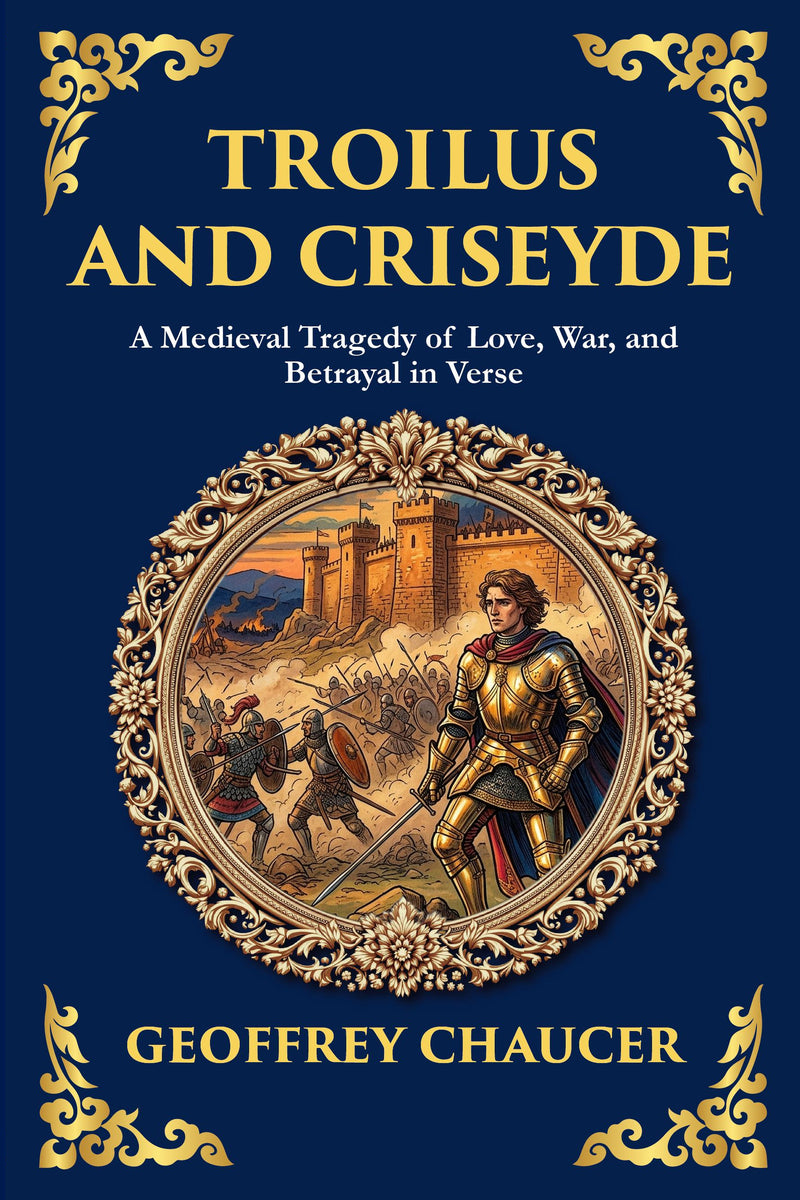
Troilus and Criseyde
In the shadow of war and political unrest, a young Trojan prince falls hopelessly in love with the daughter of a traitor.
or free app
10,000+ hrs library
30-day guarantee
The complete Troilus and Criseyde appears in modern English through Library of Alexandria Press, available online with audiobook narration included for members.
Have you ever wondered why even the purest love can fall to ruin amidst the chaos of war? Troilus and Criseyde is Geoffrey Chaucer’s epic and heartbreaking narrative poem, often regarded as his finest achievement. Set during the Trojan War and written in the elegant English of the 14th century, this medieval masterpiece explores themes of love, fate, betrayal, and the emotional consequences of political decisions.
When Prince Troilus, the noble son of King Priam, falls deeply in love with Criseyde, the daughter of a condemned traitor, their forbidden romance blossoms in secret. With the help of Pandarus, Criseyde’s scheming uncle, their affections grow—only to be torn apart when Criseyde is handed over to the Greeks as part of a prisoner exchange. Will love endure across enemy lines, or will duty, pride, and human weakness prevail?
This modern formatting of Chaucer’s timeless verse invites a new generation to experience the emotional depth, psychological insight, and tragic beauty of a love that dared to bloom in wartime.
What you’ll discover in this modern edition
- A Poetic Story of Passion and Betrayal Follow the doomed romance of Troilus and Criseyde, lovers caught between loyalty to country and devotion to each other.
- The Complex Psychology of Courtly Love Explore how honor, shame, and manipulation shape every decision, mirroring timeless emotional struggles.
- A Medieval Tale with Modern Relevance Themes of war, gender dynamics, political manipulation, and human vulnerability resonate across ages.
- Chaucer’s Rich and Musical Verse Appreciate the elegant rhyme and rhythm of Chaucer’s Middle English, preserved and formatted for modern readability.
- A Precursor to Shakespearean Tragedy Recognized as a key influence on later tragic literature, including Romeo and Juliet and Troilus and Cressida.
| Formats | eBook (EPUB + PDF) · Audiobook · Paperback · Hardcover · Large Print |
| Language | English |
| Trim size (print) | 6 × 9 in |
| Binding | Paperback — perfect-bound · Hardcover — casewrap |
| Large Print edition | Same text in a larger, easy-read type — a larger font, not a larger trim |
| Print pricing | Every physical book at our true cost — at-cost, no profit (members) |
| Library | 873 restored titles, always growing |
| Length | 49,672 words · ~3 hr 19 min reading |
| Reading level | Grade 3 · an easy, flowing read (this modern-English edition) |
| Edition | Modern English translation · 2026 |
Member reviews for this edition are collected as readers finish it — be the first. Across the library: 12,000+ books shipped, every plan covered by a 365-day print guarantee.
About this edition
A faithful, unabridged modern-English edition by The Library of Alexandria — carefully rendered for today's reader and verified paragraph-by-paragraph against the public-domain source. Available as eBook, audiobook, paperback, hardcover, and large print.
- Complete & unabridgedVerified paragraph by paragraph against the source — never a scan, never abridged.
- Modern English, faithfulReadable today, with the author’s meaning kept intact. Readable — not simplified.
- Every format, one membershipRead in your browser or the free app, or listen to the full audiobook.
Included free with your membership
Cancel anytime, one click · 30-day money-back guarantee
Edition last updated July 2026
What’s inside
Troilus and Criseyde — complete and unabridged: all 6 sections included with membership, plus the full audiobook.
Begin reading Troilus and Criseyde
In clear modern English — the complete text is included with membership.
Introduction
There are love stories, and then there is Troilus and Criseyde. Composed in the mid-1380s, in the heart of the English Middle Ages, this poem represents one of the most ambitious and emotionally sophisticated achievements in all of English literature. Long before the novel existed as a form, Geoffrey Chaucer wrote what many scholars consider the first great work of psychological fiction in the language—a story that probes the inner lives of its characters with a tenderness, precision, and honesty that feels startlingly modern even now, more than six hundred years after the poet set down his pen. To open this book is to step into a world at once impossibly distant and intimately familiar: a world of ancient siege and courtly ritual, yet populated by people who hope, scheme, desire, doubt, and grieve in ways we recognize as our own.
The version you hold in your hands is a modern translation, adapted for the contemporary reader. This is no small thing, and it deserves a word of explanation. Chaucer wrote in Middle English, a language that looks deceptively like our own on the page but sounds and moves quite differently—full of vowels we no longer pronounce, grammatical forms we no longer use, and vocabulary that has either vanished or shifted meaning over the centuries. For generations, this linguistic barrier has kept Troilus and Criseyde locked away as the property of specialists, read in university seminars with a glossary in one hand and a furrowed brow on the face. That is a genuine loss, because the poem at its core is not a museum piece. It is a living, breathing drama of human feeling, and it was written to be enjoyed—to be read aloud, savored, laughed over, and wept through. This translation aims to return that pleasure to you, to let the story speak directly and clearly, while preserving the grace, the wit, and the heartbreak that have made it endure.
Before you begin, it is worth spending a little time with the man who wrote it, the strange and beautiful tradition out of which the poem grew, and the qualities that make this particular tale so worthy of your attention. The pages that follow are designed to enrich your reading without spoiling a single turn of the narrative. Think of this as a friendly companion at the threshold—someone pointing out the landmarks before you set off, so that the journey itself can unfold in all its surprise.
Geoffrey Chaucer is often called the father of English poetry, and while such titles are always a little too neat, this one carries real weight. Before Chaucer, English was widely regarded as a coarse and provincial tongue, fit for common folk but hardly the language of high art. The cultured classes of medieval England wrote and read in Latin, the language of the Church and learning, or in French, the language of the aristocracy and of fashionable courtly literature. Chaucer made a radical wager: that English—the actual spoken language of the people around him—could carry the full freight of human experience, the philosophical and the comic, the sacred and the bawdy, the tragic and the tender. He won that wager so completely that we have been reading him ever since.
Born around 1343, Chaucer lived through one of the most turbulent and consequential centuries in English history. He came into the world in the shadow of the Black Death, the plague that swept through Europe and killed perhaps a third of its population, reshaping the economic and social order in ways no one had foreseen. He grew up during the long and bloody conflict we now call the Hundred Years’ War, served in military campaigns in France, and was captured and ransomed as a young man. He witnessed the Peasants’ Revolt of 1381, when ordinary working people, pushed beyond endurance, marched on London and very nearly toppled the established order. He lived under three kings and navigated the treacherous waters of court politics through it all, surviving where many of his associates did not.
What sets Chaucer apart from nearly every other major poet of his era is that he was not a nobleman, nor a cleric, nor a scholar by trade. He was, for most of his working life, a civil servant—a man of business and administration. He served as a customs official on the wool trade in the port of London, as a justice of the peace, as a member of Parliament, as a clerk of the king’s works responsible for the upkeep of royal buildings. He traveled abroad on diplomatic missions, including journeys to Italy that would prove decisive for his art. This worldly, practical experience gave him something rare among poets: an extraordinarily wide acquaintance with people of every rank and station. He knew merchants and knights, cooks and prioresses, lawyers and millers, courtiers and laborers. He had heard how they talked, watched how they behaved, understood what moved them. When you read Chaucer, you feel the presence of a man who has paid close and amused attention to the whole crowded spectacle of human life.
His Italian journeys deserve special mention, because they bear directly on the book before you. In the 1370s, Chaucer traveled to Italy on the king’s diplomatic business, and there he encountered the great flowering of Italian literature that we now call the early Renaissance. He discovered the work of Dante, whose vast and visionary poetry stretched from the depths of Hell to the heights of Paradise. He discovered Petrarch, whose love sonnets had refined the expression of romantic longing to an unprecedented exquisite pitch. And he discovered Giovanni Boccaccio, a writer whose storytelling energy and earthy humanity would influence Chaucer profoundly. It was Boccaccio, in fact, who gave Chaucer the raw material for Troilus and Criseyde. Boccaccio had written a poem called Il Filostrato, telling the same essential story, and Chaucer took it as his starting point—but what he made of it was something altogether richer, deeper, and more searching than his source. Chaucer was a translator and adapter throughout his career, but in the truest sense he was never a mere copyist. He took the stories the world handed him and remade them in his own image, breathing into them a complexity and a compassion that were entirely his own.
It is one of the small ironies of literary history that Chaucer is best known today for The Canterbury Tales, his sprawling, unfinished masterpiece of pilgrims swapping stories on the road to Canterbury. The Canterbury Tales is dazzling, various, and endlessly entertaining—but it is a collection, a mosaic, deliberately fragmented and many-voiced. Troilus and Criseyde is something different and, in certain ways, even more remarkable: a single, sustained, unified work of art, a complete narrative arc carried from beginning to end with extraordinary control. It is Chaucer’s most polished and ambitious finished poem, and many readers who come to know both works find themselves cherishing this one above all. Where The Canterbury Tales shows us the breadth of Chaucer’s genius, Troilus and Criseyde shows us its depth.
A Story Older Than Memory, Told as Never Before
The setting of the poem is the legendary city of Troy, during the long and famous siege that the ancient Greeks laid against it—the same war that Homer sang of in the Iliad, the war of Helen and Hector and Achilles. But here is a crucial and delightful fact: Chaucer never read Homer. The Greek epics were almost entirely unknown in Western Europe during the Middle Ages, lost to the Latin-reading world for centuries. What medieval people knew of Troy came to them through a long, winding chain of later retellings, Roman and medieval, each generation adding, embellishing, and reinventing. By Chaucer’s time, the matter of Troy had become a vast and beloved tradition, a shared imaginative landscape that everyone knew the way we might know the broad strokes of a famous historical event.
And medieval Europeans had a special reason to care about Troy: many of them believed they were descended from its survivors. According to legend, refugees fleeing the fallen city had founded new nations across Europe—Rome itself was said to have been established by the Trojan prince Aeneas and his line, and Britain, by tradition, took its name from a Trojan named Brutus. So when Chaucer wrote of Troy, he was not writing of some remote foreign place. He was writing, in a sense, of the imagined origins of his own civilization, a mythic homeland to which his readers felt a deep and proud connection. The doomed city, beautiful and brilliant and destined to fall, held a powerful grip on the medieval imagination.
Yet here is what makes Chaucer’s achievement so astonishing. He took this grand, public, world-historical backdrop—the clash of armies, the fate of nations, the great names of legend—and used it as the frame for an intensely private story. The war rages in the background, important and ever-present, but the poem’s true subject is the secret inner experience of a small handful of people: their feelings, their words, their hesitations, their joys, their devastating disappointments. Chaucer turns the camera, so to speak, away from the battlefield and toward the bedchamber, the garden, the quiet conversation between two people learning to trust one another. He understood, centuries before the novel was invented, that the most gripping drama of all is often the drama unfolding inside a single human heart.
The poem’s title names two of its three central figures. Troilus is a young prince of Troy, a son of King Priam, a warrior of proven courage who has nonetheless held himself aloof from love, regarding those who fall victim to it with the easy scorn of youth. Criseyde is a young widow living within the besieged city, a woman of remarkable beauty and intelligence whose situation is delicate and exposed, for reasons the story will make clear. And the third figure—who in some ways dominates the poem more than either of the lovers—is Pandarus, an older man, worldly and talkative and endlessly resourceful, who appoints himself the engineer and go-between of the entire affair. Pandarus is one of the great characters in English literature, a creation so vivid and so morally ambiguous that readers have been arguing about him for centuries. Is he a generous friend or a meddling schemer? A figure of comedy or something darker? Chaucer refuses to tell us, and that refusal is part of his genius.
What unfolds among these three is a story told with such patience and psychological realism that you may find yourself forgetting, at times, that you are reading a medieval poem at all. Chaucer lingers over the small, telling moments that lesser writers rush past: the way a glance can change everything, the agony of waiting for a message, the way lovers talk themselves into and out of their feelings, the gap between what people say and what they mean, the difference between how we imagine a future and how it actually arrives. He renders the experience of falling in love with breathtaking exactness—the sleeplessness, the obsessive replaying of small encounters, the sweet torment of hope, the way the beloved comes to fill the entire horizon of one’s thoughts. And he renders, with equal honesty and far greater pain, the experience of love tested by circumstance, by distance, by fear, and by the relentless pressure of a world that does not care about the happiness of two people.
I will not tell you how the story moves or where it ends. The subtitle of this book calls it a tragedy, and Chaucer himself, in the poem’s closing pages, uses that very word—indeed, he was among the first writers in English to use it at all. But to know that a story is a tragedy is not to know the tragedy itself, any more than knowing that a person is mortal tells you anything about their life. What matters is the journey: the texture of each scene, the unfolding of each conversation, the slow accumulation of feeling and consequence. Chaucer wants you to live alongside these people, to be in the room with them, to feel what they feel as they feel it. The ending, when it comes, will land with full force precisely because you will have come to know and care for those it touches.
Cancel anytime, one click · 30-day money-back guarantee
Founding annual rate available now — your price locks for life when you join.
Not ready? Get this free chapter by email — read it anytime.
✓ Sent — check your inbox for Troilus and Criseyde.
Questions about Troilus and Criseyde
What is Troilus and Criseyde about?
In the shadow of war and political unrest, a young Trojan prince falls hopelessly in love with the daughter of a traitor. Their love, tender and passionate, is doomed by fate and fractured loyalties. Troilus and Criseyde, Geoffrey Chaucer’s masterful tragic romance, is a poetic meditation on the fragility of love, the illusions of hope, and the inescapable grip of destiny.
Who wrote Troilus and Criseyde?
Troilus and Criseyde was written by Geoffrey Chaucer. This edition presents the complete work in clear modern English, faithfully rendered from the public-domain original by Library of Alexandria Press.
Is Troilus and Criseyde free to read?
The opening chapter is free to read on this page. Members read and listen to the complete work — and the entire library — free, and can order any physical book at our true print cost.
How long is Troilus and Criseyde?
6 chapters (~49,672 words) — about 3 hr 19 min of reading in this modern-English edition.
Is this an abridged version of Troilus and Criseyde?
No. This is the complete, unabridged Troilus and Criseyde, carefully rendered into clear modern English and verified paragraph-by-paragraph against the public-domain source — nothing is cut or summarised.
What formats does Troilus and Criseyde come in?
Troilus and Criseyde is available as eBook, paperback, hardcover and large print. eBook and audiobook are included with membership; printed editions ship at our true print cost.
Shipping & returns
Billing & membership
More from the library


Explore Military & Strategy
- The War of the Worlds · H. G. Wells
- The Belle of Bowling Green · Amelia E. Barr
- Give Me Liberty or Give Me Death · Patrick Henry
- The Thirty-Nine Steps · John Buchan
- Julius Caesar · William Shakespeare
- Rilla of Ingleside · L. M. Montgomery
- The Adventures of Heine · Edgar Wallace
- The Declaration of Independence of the United States of America · Thomas Jefferson
- Armageddon—2419 A.D. · Philip Francis Nowlan
- The Variable Man · Philip K. Dick
- Arms and the Man · Bernard Shaw
- South Africa and the Transvaal War, Vol. 2 (of 8) · Louis Creswicke
- The Red Badge of Courage: An Episode of the American Civil War · Stephen Crane
- Second Variety · Philip K. Dick
- Lysistrata · Aristophanes
- The Iliad · Homer
- A Matter of Proportion · Anne Walker
- This Side of Paradise · F. Scott Fitzgerald
Troilus and Criseyde
Troilus and Criseyde
A Medieval Tragedy of Love, War, and Betrayal in Verse
Geoffrey Chaucer
Contents
- Introduction
- Book 1
- Book 2
- Book 3
- Book 4
- Book 5
Introduction
There are love stories, and then there is Troilus and Criseyde. Composed in the mid-1380s, in the heart of the English Middle Ages, this poem represents one of the most ambitious and emotionally sophisticated achievements in all of English literature. Long before the novel existed as a form, Geoffrey Chaucer wrote what many scholars consider the first great work of psychological fiction in the language—a story that probes the inner lives of its characters with a tenderness, precision, and honesty that feels startlingly modern even now, more than six hundred years after the poet set down his pen. To open this book is to step into a world at once impossibly distant and intimately familiar: a world of ancient siege and courtly ritual, yet populated by people who hope, scheme, desire, doubt, and grieve in ways we recognize as our own.
The version you hold in your hands is a modern translation, adapted for the contemporary reader. This is no small thing, and it deserves a word of explanation. Chaucer wrote in Middle English, a language that looks deceptively like our own on the page but sounds and moves quite differently—full of vowels we no longer pronounce, grammatical forms we no longer use, and vocabulary that has either vanished or shifted meaning over the centuries. For generations, this linguistic barrier has kept Troilus and Criseyde locked away as the property of specialists, read in university seminars with a glossary in one hand and a furrowed brow on the face. That is a genuine loss, because the poem at its core is not a museum piece. It is a living, breathing drama of human feeling, and it was written to be enjoyed—to be read aloud, savored, laughed over, and wept through. This translation aims to return that pleasure to you, to let the story speak directly and clearly, while preserving the grace, the wit, and the heartbreak that have made it endure.
Before you begin, it is worth spending a little time with the man who wrote it, the strange and beautiful tradition out of which the poem grew, and the qualities that make this particular tale so worthy of your attention. The pages that follow are designed to enrich your reading without spoiling a single turn of the narrative. Think of this as a friendly companion at the threshold—someone pointing out the landmarks before you set off, so that the journey itself can unfold in all its surprise.
Geoffrey Chaucer is often called the father of English poetry, and while such titles are always a little too neat, this one carries real weight. Before Chaucer, English was widely regarded as a coarse and provincial tongue, fit for common folk but hardly the language of high art. The cultured classes of medieval England wrote and read in Latin, the language of the Church and learning, or in French, the language of the aristocracy and of fashionable courtly literature. Chaucer made a radical wager: that English—the actual spoken language of the people around him—could carry the full freight of human experience, the philosophical and the comic, the sacred and the bawdy, the tragic and the tender. He won that wager so completely that we have been reading him ever since.
Born around 1343, Chaucer lived through one of the most turbulent and consequential centuries in English history. He came into the world in the shadow of the Black Death, the plague that swept through Europe and killed perhaps a third of its population, reshaping the economic and social order in ways no one had foreseen. He grew up during the long and bloody conflict we now call the Hundred Years’ War, served in military campaigns in France, and was captured and ransomed as a young man. He witnessed the Peasants’ Revolt of 1381, when ordinary working people, pushed beyond endurance, marched on London and very nearly toppled the established order. He lived under three kings and navigated the treacherous waters of court politics through it all, surviving where many of his associates did not.
What sets Chaucer apart from nearly every other major poet of his era is that he was not a nobleman, nor a cleric, nor a scholar by trade. He was, for most of his working life, a civil servant—a man of business and administration. He served as a customs official on the wool trade in the port of London, as a justice of the peace, as a member of Parliament, as a clerk of the king’s works responsible for the upkeep of royal buildings. He traveled abroad on diplomatic missions, including journeys to Italy that would prove decisive for his art. This worldly, practical experience gave him something rare among poets: an extraordinarily wide acquaintance with people of every rank and station. He knew merchants and knights, cooks and prioresses, lawyers and millers, courtiers and laborers. He had heard how they talked, watched how they behaved, understood what moved them. When you read Chaucer, you feel the presence of a man who has paid close and amused attention to the whole crowded spectacle of human life.
His Italian journeys deserve special mention, because they bear directly on the book before you. In the 1370s, Chaucer traveled to Italy on the king’s diplomatic business, and there he encountered the great flowering of Italian literature that we now call the early Renaissance. He discovered the work of Dante, whose vast and visionary poetry stretched from the depths of Hell to the heights of Paradise. He discovered Petrarch, whose love sonnets had refined the expression of romantic longing to an unprecedented exquisite pitch. And he discovered Giovanni Boccaccio, a writer whose storytelling energy and earthy humanity would influence Chaucer profoundly. It was Boccaccio, in fact, who gave Chaucer the raw material for Troilus and Criseyde. Boccaccio had written a poem called Il Filostrato, telling the same essential story, and Chaucer took it as his starting point—but what he made of it was something altogether richer, deeper, and more searching than his source. Chaucer was a translator and adapter throughout his career, but in the truest sense he was never a mere copyist. He took the stories the world handed him and remade them in his own image, breathing into them a complexity and a compassion that were entirely his own.
It is one of the small ironies of literary history that Chaucer is best known today for The Canterbury Tales, his sprawling, unfinished masterpiece of pilgrims swapping stories on the road to Canterbury. The Canterbury Tales is dazzling, various, and endlessly entertaining—but it is a collection, a mosaic, deliberately fragmented and many-voiced. Troilus and Criseyde is something different and, in certain ways, even more remarkable: a single, sustained, unified work of art, a complete narrative arc carried from beginning to end with extraordinary control. It is Chaucer’s most polished and ambitious finished poem, and many readers who come to know both works find themselves cherishing this one above all. Where The Canterbury Tales shows us the breadth of Chaucer’s genius, Troilus and Criseyde shows us its depth.
A Story Older Than Memory, Told as Never Before
The setting of the poem is the legendary city of Troy, during the long and famous siege that the ancient Greeks laid against it—the same war that Homer sang of in the Iliad, the war of Helen and Hector and Achilles. But here is a crucial and delightful fact: Chaucer never read Homer. The Greek epics were almost entirely unknown in Western Europe during the Middle Ages, lost to the Latin-reading world for centuries. What medieval people knew of Troy came to them through a long, winding chain of later retellings, Roman and medieval, each generation adding, embellishing, and reinventing. By Chaucer’s time, the matter of Troy had become a vast and beloved tradition, a shared imaginative landscape that everyone knew the way we might know the broad strokes of a famous historical event.
And medieval Europeans had a special reason to care about Troy: many of them believed they were descended from its survivors. According to legend, refugees fleeing the fallen city had founded new nations across Europe—Rome itself was said to have been established by the Trojan prince Aeneas and his line, and Britain, by tradition, took its name from a Trojan named Brutus. So when Chaucer wrote of Troy, he was not writing of some remote foreign place. He was writing, in a sense, of the imagined origins of his own civilization, a mythic homeland to which his readers felt a deep and proud connection. The doomed city, beautiful and brilliant and destined to fall, held a powerful grip on the medieval imagination.
Yet here is what makes Chaucer’s achievement so astonishing. He took this grand, public, world-historical backdrop—the clash of armies, the fate of nations, the great names of legend—and used it as the frame for an intensely private story. The war rages in the background, important and ever-present, but the poem’s true subject is the secret inner experience of a small handful of people: their feelings, their words, their hesitations, their joys, their devastating disappointments. Chaucer turns the camera, so to speak, away from the battlefield and toward the bedchamber, the garden, the quiet conversation between two people learning to trust one another. He understood, centuries before the novel was invented, that the most gripping drama of all is often the drama unfolding inside a single human heart.
The poem’s title names two of its three central figures. Troilus is a young prince of Troy, a son of King Priam, a warrior of proven courage who has nonetheless held himself aloof from love, regarding those who fall victim to it with the easy scorn of youth. Criseyde is a young widow living within the besieged city, a woman of remarkable beauty and intelligence whose situation is delicate and exposed, for reasons the story will make clear. And the third figure—who in some ways dominates the poem more than either of the lovers—is Pandarus, an older man, worldly and talkative and endlessly resourceful, who appoints himself the engineer and go-between of the entire affair. Pandarus is one of the great characters in English literature, a creation so vivid and so morally ambiguous that readers have been arguing about him for centuries. Is he a generous friend or a meddling schemer? A figure of comedy or something darker? Chaucer refuses to tell us, and that refusal is part of his genius.
What unfolds among these three is a story told with such patience and psychological realism that you may find yourself forgetting, at times, that you are reading a medieval poem at all. Chaucer lingers over the small, telling moments that lesser writers rush past: the way a glance can change everything, the agony of waiting for a message, the way lovers talk themselves into and out of their feelings, the gap between what people say and what they mean, the difference between how we imagine a future and how it actually arrives. He renders the experience of falling in love with breathtaking exactness—the sleeplessness, the obsessive replaying of small encounters, the sweet torment of hope, the way the beloved comes to fill the entire horizon of one’s thoughts. And he renders, with equal honesty and far greater pain, the experience of love tested by circumstance, by distance, by fear, and by the relentless pressure of a world that does not care about the happiness of two people.
I will not tell you how the story moves or where it ends. The subtitle of this book calls it a tragedy, and Chaucer himself, in the poem’s closing pages, uses that very word—indeed, he was among the first writers in English to use it at all. But to know that a story is a tragedy is not to know the tragedy itself, any more than knowing that a person is mortal tells you anything about their life. What matters is the journey: the texture of each scene, the unfolding of each conversation, the slow accumulation of feeling and consequence. Chaucer wants you to live alongside these people, to be in the room with them, to feel what they feel as they feel it. The ending, when it comes, will land with full force precisely because you will have come to know and care for those it touches.
from woe to prosperity, and then out of joy,
these mournful lines that weep as I write them!
you cruel Fury, forever grieving in pain;
that helps lovers, as best I can, to lament!
For it is fitting, to speak the plain truth,
that a wretched soul should have a grim companion,
and for a sorrowful tale, a sorrowful face.
For I, who serve the servants of the god of Love,
dare not pray to Love for success, unfit as I am—
so far from his help I stand, lost in darkness.
But still, if this work can bring any gladness
let him take my thanks—and let the labor be mine!
But you lovers, who are bathing in happiness—
remember the sorrows you have already passed through,
the hardships you have felt, and the misfortunes
of other people, and think how you yourselves
have known what it is for Love to cause you pain,
And pray for those who find themselves in the same plight
that Love may bring them comfort in heaven;
the kind of pain and grief that lovers endure
And pray as well for those who have despaired in love
and for those who have been falsely slandered
by malicious tongues, whether man or woman;
to let those who are shut out from Love’s grace
that God grant them always good perseverance,
and send them the power to please their ladies so
that it may be honor and pleasure to Love.
For in this way I hope to best advance my soul,
by praying for those who are Love’s servants,
and writing their grief, and living in charity.
because I am going straight to my subject,
in which you will hear the double sorrows
and how she abandoned him before she died.
sailed with a thousand ships in arms toward Troy
and besieged the city for nearly ten years
End of the free sample
Keep reading, free
Members read and listen to the complete book — and the entire library. Cancel anytime, one click · 30-day money-back guarantee.