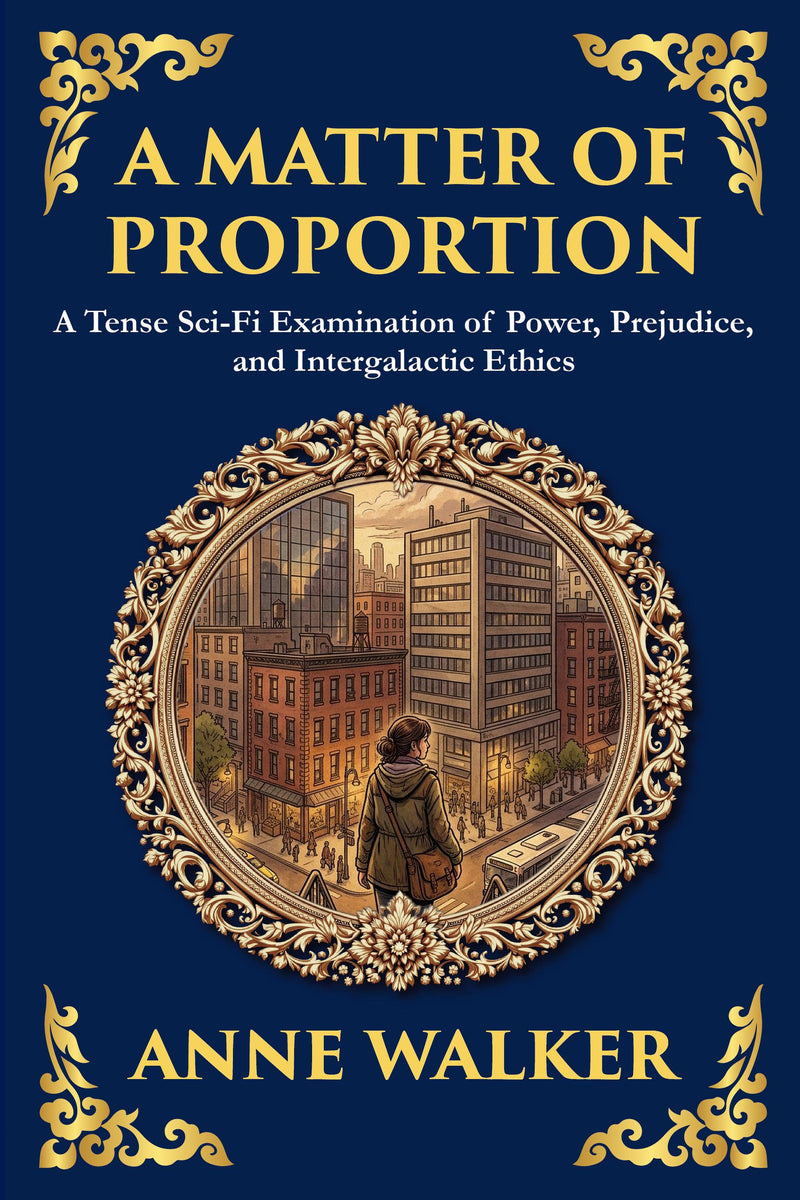
A Matter of Proportion
When a single human ambassador is sent to represent Earth in an intergalactic tribunal, she walks into a hall of alien species far more advanced, far more powerful—and far less forgiving.
or free app
10,000+ hrs library
30-day guarantee
The complete A Matter of Proportion appears in modern English through Library of Alexandria Press, available online with audiobook narration included for members.
Have you ever wondered why morality changes when the universe is watching? In A Matter of Proportion, Anne Walker crafts a masterful science fiction narrative where high- stakes diplomacy collides with ethical dilemmas that stretch across worlds. When Earth is summoned to account for its conduct by an intergalactic council, one human must stand alone to justify the actions, decisions, and values of an entire species.
But what happens when our moral framework doesn’t scale? What happens when justice is judged not by intent—but by consequence? This isn’t just a court case.
It’s a test of humanity itself.
What you’ll discover in this modern edition
- A Battle of Wits Across Species – Witness the sharp, philosophical confrontations between the human ambassador and alien representatives who see justice from wildly different perspectives.
- A Deep Dive into Ethics and Responsibility – Grapple with themes of collective guilt, proportional response, and the blindness of power.
- A Tense, Introspective Narrative – Not an action-packed saga, but a slow-burning confrontation of ideas, prejudice, and conscience.
- A Female Lead Unlike Any Other – Brilliant, composed, and morally torn, the protagonist balances reason, emotion, and duty in the face of crushing galactic pressure.
- A Story for Our Time – With clear allegorical resonance, this novel speaks to modern questions of colonialism, institutional bias, and global accountability. For fans of Ursula K. Le Guin’s The Dispossessed, C.J.
| Formats | eBook (EPUB + PDF) · Audiobook · Paperback · Hardcover · Large Print |
| Language | English |
| Trim size (print) | 6 × 9 in |
| Binding | Paperback — perfect-bound · Hardcover — casewrap |
| Large Print edition | Same text in a larger, easy-read type — a larger font, not a larger trim |
| Print pricing | Every physical book at our true cost — at-cost, no profit (members) |
| Library | 873 restored titles, always growing |
| Length | 9,500 words · ~38 min reading |
| Reading level | Grade 6 · an easy, flowing read (this modern-English edition) |
| Edition | Modern English translation · 2026 |
Member reviews for this edition are collected as readers finish it — be the first. Across the library: 12,000+ books shipped, every plan covered by a 365-day print guarantee.
About this edition
A faithful, unabridged modern-English edition by The Library of Alexandria — carefully rendered for today's reader and verified paragraph-by-paragraph against the public-domain source. Available as eBook, audiobook, paperback, hardcover, and large print.
- Complete & unabridgedVerified paragraph by paragraph against the source — never a scan, never abridged.
- Modern English, faithfulReadable today, with the author’s meaning kept intact. Readable — not simplified.
- Every format, one membershipRead in your browser or the free app, or listen to the full audiobook.
Included free with your membership
Cancel anytime, one click · 30-day money-back guarantee
Edition last updated July 2026
What’s inside
A Matter of Proportion — complete and unabridged, included in full with membership, plus the full audiobook.
Begin reading A Matter of Proportion
In clear modern English — the complete text is included with membership.
Introduction
There are stories that entertain us, and there are stories that unsettle us in ways we cannot quite name until long after we have set the book down. A Matter of Proportion belongs firmly to the second category. It is a work that wears the costume of science fiction—the unfamiliar settings, the speculative leaps, the sense of a world tilted just slightly off the axis of our own—yet beneath that costume beats the heart of something far older and far more dangerous: a meditation on what it means to be human, to be free, and to recognize the humanity of those who do not look, think, or live as we do. To open this book is to step into a moral laboratory, one in which the reader is invited not merely to observe an experiment but to become a participant in it.
Anne Walker’s narrative arrives to the contemporary reader after a journey through time, presented here in a modern translation and adaptation designed to remove the small obstacles of dated phrasing and unfamiliar idiom that can stand between a reader and the full force of a story. What remains, once those obstacles are cleared away, is a tale of remarkable tension and intelligence—a story that grips first as an adventure and then, almost without the reader noticing, transforms into something more searching. The pleasure of this book is double. There is the immediate, visceral pleasure of plot, of danger, of the question that propels us from one page to the next: what happens? And there is the slower, deeper pleasure that arrives later, in quiet moments away from the page, when the reader realizes that the questions the book raised about identity and prejudice and power have not finished asking themselves. They linger. They follow you home.
This introduction is offered as a companion to your reading, not as a substitute for it. I will not tell you what happens in these pages, because to do so would be to rob you of the very experience the book is constructed to deliver—an experience that depends, in large part, on discovery, on the gradual peeling back of assumptions, on the disorientation that precedes understanding. What I hope to offer instead is a frame: a sense of the territory you are about to enter, the themes that animate it, and the particular ways in which this story rewards a patient and attentive reader. Think of these pages as the conversation you might have with a friend who has read the book before you, who hands it over with a knowing look and says only: trust it. Let it work on you. You will see.
A Story Built on a Single, Devastating Premise
The greatest works of speculative fiction tend to grow from a single seed—one idea, planted early, whose consequences blossom across the whole structure of the narrative. The science fiction of ideas, as distinct from the science fiction of spectacle, asks a question and then follows that question with relentless honesty wherever it leads. A Matter of Proportion is a novel of this kind. Its title itself is a clue, though its full meaning will not become clear until you have lived inside the story for some time. Proportion: a question of scale, of relation, of how one thing measures against another. How much of a person is determined by their parts and how much by the whole? At what point does difference become so great that we cease to recognize ourselves in another? And who, exactly, gets to decide where that line is drawn?
These are not abstract questions in Walker’s hands. They are dramatized, embodied, made urgent through the predicament of characters whose very survival depends on the answers. The genius of the book lies in the way it takes ideas that might, in another writer’s hands, remain coolly philosophical, and renders them hot to the touch. You will feel the stakes before you fully understand them. You will care about what is happening long before you grasp everything that is at issue. This is the mark of a storyteller who understands that the way to a reader’s mind runs first through the heart and the pulse.
I want to be careful here, because the architecture of this book depends on a series of revelations, and I have no intention of dismantling that architecture before you have had the chance to walk through it yourself. What I can say is that the story concerns power and its uses—the power that one group holds over another, the power of definition, the power to determine who counts as a person deserving of rights and dignity and who does not. It concerns prejudice, not as a comfortable abstraction we can all agree to condemn from a safe distance, but as a living force that shapes the thoughts and actions even of those who believe themselves to be just. And it concerns ethics on the grandest possible scale—the kind of ethics that must reckon not merely with the relations between individuals but with the relations between whole peoples, whole worlds, whole conceptions of what is and is not worthy of survival.
The science-fiction setting is essential to this project, and not incidental to it. By lifting these questions out of the immediate political circumstances of any particular moment and placing them in a speculative context, Walker accomplishes something that purely realistic fiction often cannot. She strips away the reflexive defenses we all carry. When a story addresses our prejudices directly, in the familiar terms of our own world, we tend to armor ourselves; we know which side we are supposed to be on, and we read accordingly, congratulating ourselves on our enlightenment. But when the same questions are posed in unfamiliar terms, in a setting where our usual loyalties and assumptions have no purchase, the armor slips. We find ourselves making judgments before we have realized what we are judging. We find ourselves sympathizing, or recoiling, or fearing, and only afterward asking why. This is the oldest and most powerful trick in the speculative writer’s arsenal—the estrangement that allows us to see freshly what familiarity had rendered invisible—and Walker deploys it with a sure and patient hand.
There is a particular kind of intellectual courage in writing a book like this. It would be easy to write a story that flatters its readers, that confirms what they already believe, that lets them finish the final page feeling virtuous and unchallenged. Walker has not written that book. She has written something harder and more valuable: a story that implicates its reader, that asks uncomfortable questions and refuses to answer them on the reader’s behalf. You may find, as you read, that your sympathies shift in ways you did not anticipate, that you are forced to examine the grounds of your own judgments, that the comfortable distinction between us and them grows blurry and uncertain in your hands. This is not an accident. It is the whole point.
Why This Story Endures, and Why It Speaks to Us Now
Every work of fiction is born in a particular moment, shaped by the anxieties and hopes and blind spots of its time. The science fiction of earlier decades, in particular, often carried the fingerprints of its era so plainly that later readers might be tempted to dismiss it as a curiosity, a relic of attitudes we have outgrown. But the truly remarkable works of the genre transcend their origins. They were written about their moment, but they were not written only for their moment. They reached toward something permanent in the human condition, and because they reached, they still speak.
A Matter of Proportion is such a work. The questions it raises about prejudice and the perception of difference are not questions that any society has solved. They were urgent when the story was first conceived, and they are urgent now, perhaps more so. We live in an age that prides itself on its sensitivity to questions of identity and inclusion, an age that has built an elaborate vocabulary for discussing who belongs and who is excluded, who is seen and who is rendered invisible. And yet the underlying impulses that the book anatomizes—the instinct to divide the world into kinds, to elevate the familiar and fear the strange, to confuse difference with danger and similarity with virtue—remain stubbornly with us. The technology changes. The settings change. The fundamental drama of recognition and misrecognition does not.
What gives the book its peculiar power is its refusal to treat prejudice as a simple matter of villainy. It would be far less disturbing, and far less true, if the story presented us with obvious monsters whose cruelty we could safely condemn. Instead, Walker shows us how prejudice operates within ordinary minds, how it disguises itself as prudence, as loyalty, as common sense, as love of one’s own. She shows us how the very people who suffer under one system of exclusion may turn around and enforce another. She shows us how easily the categories that govern our perceptions can be turned against us, and how the line between the included and the excluded is never fixed but always being redrawn—often by those who do not realize they are drawing it at all.
There is also, woven through the narrative, a profound meditation on the nature of identity itself. What is it that makes you you? Is it your body, your form, the shape you present to the world? Is it your mind, your memories, your sense of yourself? Is it the way others perceive you, the role you are assigned within a community, the box into which the world insists on placing you? When these things come apart—when the self you know yourself to be no longer matches the self the world sees—what remains? These are questions that the science-fiction frame allows Walker to dramatize with extraordinary vividness, pushing them to extremes that realistic fiction could never reach. And in pushing them to extremes, she illuminates the more ordinary versions of the same questions that every reader confronts in their own life: the gap between how we feel and how we are seen, the labor of being understood, the loneliness of difference and the longing for recognition.
The intergalactic dimension of the story—the sense that what is at stake reaches beyond any single individual to encompass whole worlds and the relations between them—lends the book a scope that elevates its personal dramas into something approaching the mythic. This is fiction that thinks big, that is unafraid to ask the largest questions: about the meeting of strangers across the vast distances of space and difference, about the ethics that must govern such meetings, about whether understanding is possible at all between beings whose experiences and forms diverge so radically. These are the questions that have always preoccupied the most ambitious science fiction, the questions that make the genre, at its best, a uniquely powerful instrument for moral inquiry. For where else can we rehearse, in the safety of imagination, the encounters that may one day define our future—and that, in subtler forms, already define our present?
It is worth pausing to appreciate the tension that drives the narrative forward, because intellectual ambition alone does not make a book worth reading. A novel may be full of important ideas and still be a chore to get through. A Matter of Proportion is not a chore. It is a thriller, in the most honorable sense of that word—a story constructed to keep you turning pages, to make you anxious for its characters, to plant questions in your mind that demand resolution. The tension is not merely intellectual but emotional and physical; there is genuine danger here, genuine suspense, genuine peril. Walker understands that ideas land hardest when they arrive on the back of feeling, and she has built her story to deliver feeling in abundance. You will worry. You will hope. You will be surprised. And it is precisely because you are gripped by the story’s surface that its depths are able to work on you so effectively.
A Note on This Edition, and an Invitation to the Reader
This volume presents A Matter of Proportion in a modern translation and adaptation, prepared with the contemporary reader in mind. A word about what this means, and why it matters, may help you approach the text with the right expectations.
Cancel anytime, one click · 30-day money-back guarantee
Founding annual rate available now — your price locks for life when you join.
Not ready? Get this free chapter by email — read it anytime.
✓ Sent — check your inbox for A Matter of Proportion.
Questions about A Matter of Proportion
What is A Matter of Proportion about?
When a single human ambassador is sent to represent Earth in an intergalactic tribunal, she walks into a hall of alien species far more advanced, far more powerful—and far less forgiving. Tasked with defending humanity's role in a rapidly expanding alliance, she must navigate moral ambiguity, cultural bias, and decisions that threaten to tip the balance of cosmic justice. A Matter of Proportion is a thought-provoking science fiction drama that challenges the reader to consider how power is wielded, how ethics shift
Who wrote A Matter of Proportion?
A Matter of Proportion was written by Anne Walker. This edition presents the complete work in clear modern English, faithfully rendered from the public-domain original by Library of Alexandria Press.
Is A Matter of Proportion free to read?
The opening chapter is free to read on this page. Members read and listen to the complete work — and the entire library — free, and can order any physical book at our true print cost.
How long is A Matter of Proportion?
2 chapters (~9,500 words) — about 38 min of reading in this modern-English edition.
Is this an abridged version of A Matter of Proportion?
No. This is the complete, unabridged A Matter of Proportion, carefully rendered into clear modern English and verified paragraph-by-paragraph against the public-domain source — nothing is cut or summarised.
What formats does A Matter of Proportion come in?
A Matter of Proportion is available as eBook, paperback, hardcover and large print. eBook and audiobook are included with membership; printed editions ship at our true print cost.
Shipping & returns
Billing & membership
More from the library


Explore Military & Strategy
- The War of the Worlds · H. G. Wells
- The Belle of Bowling Green · Amelia E. Barr
- Give Me Liberty or Give Me Death · Patrick Henry
- The Thirty-Nine Steps · John Buchan
- Julius Caesar · William Shakespeare
- Rilla of Ingleside · L. M. Montgomery
- Troilus and Criseyde · Geoffrey Chaucer
- The Adventures of Heine · Edgar Wallace
- The Declaration of Independence of the United States of America · Thomas Jefferson
- Armageddon—2419 A.D. · Philip Francis Nowlan
- The Variable Man · Philip K. Dick
- Arms and the Man · Bernard Shaw
- South Africa and the Transvaal War, Vol. 2 (of 8) · Louis Creswicke
- The Red Badge of Courage: An Episode of the American Civil War · Stephen Crane
- Second Variety · Philip K. Dick
- Lysistrata · Aristophanes
- The Iliad · Homer
- This Side of Paradise · F. Scott Fitzgerald
A Matter of Proportion
A Matter of Proportion
A Tense Sci-Fi Examination of Power, Prejudice, and Intergalactic Ethics
Anne Walker
Contents
- Introduction
- A Matter of Proportion
Introduction
There are stories that entertain us, and there are stories that unsettle us in ways we cannot quite name until long after we have set the book down. A Matter of Proportion belongs firmly to the second category. It is a work that wears the costume of science fiction—the unfamiliar settings, the speculative leaps, the sense of a world tilted just slightly off the axis of our own—yet beneath that costume beats the heart of something far older and far more dangerous: a meditation on what it means to be human, to be free, and to recognize the humanity of those who do not look, think, or live as we do. To open this book is to step into a moral laboratory, one in which the reader is invited not merely to observe an experiment but to become a participant in it.
Anne Walker’s narrative arrives to the contemporary reader after a journey through time, presented here in a modern translation and adaptation designed to remove the small obstacles of dated phrasing and unfamiliar idiom that can stand between a reader and the full force of a story. What remains, once those obstacles are cleared away, is a tale of remarkable tension and intelligence—a story that grips first as an adventure and then, almost without the reader noticing, transforms into something more searching. The pleasure of this book is double. There is the immediate, visceral pleasure of plot, of danger, of the question that propels us from one page to the next: what happens? And there is the slower, deeper pleasure that arrives later, in quiet moments away from the page, when the reader realizes that the questions the book raised about identity and prejudice and power have not finished asking themselves. They linger. They follow you home.
This introduction is offered as a companion to your reading, not as a substitute for it. I will not tell you what happens in these pages, because to do so would be to rob you of the very experience the book is constructed to deliver—an experience that depends, in large part, on discovery, on the gradual peeling back of assumptions, on the disorientation that precedes understanding. What I hope to offer instead is a frame: a sense of the territory you are about to enter, the themes that animate it, and the particular ways in which this story rewards a patient and attentive reader. Think of these pages as the conversation you might have with a friend who has read the book before you, who hands it over with a knowing look and says only: trust it. Let it work on you. You will see.
A Story Built on a Single, Devastating Premise
The greatest works of speculative fiction tend to grow from a single seed—one idea, planted early, whose consequences blossom across the whole structure of the narrative. The science fiction of ideas, as distinct from the science fiction of spectacle, asks a question and then follows that question with relentless honesty wherever it leads. A Matter of Proportion is a novel of this kind. Its title itself is a clue, though its full meaning will not become clear until you have lived inside the story for some time. Proportion: a question of scale, of relation, of how one thing measures against another. How much of a person is determined by their parts and how much by the whole? At what point does difference become so great that we cease to recognize ourselves in another? And who, exactly, gets to decide where that line is drawn?
These are not abstract questions in Walker’s hands. They are dramatized, embodied, made urgent through the predicament of characters whose very survival depends on the answers. The genius of the book lies in the way it takes ideas that might, in another writer’s hands, remain coolly philosophical, and renders them hot to the touch. You will feel the stakes before you fully understand them. You will care about what is happening long before you grasp everything that is at issue. This is the mark of a storyteller who understands that the way to a reader’s mind runs first through the heart and the pulse.
I want to be careful here, because the architecture of this book depends on a series of revelations, and I have no intention of dismantling that architecture before you have had the chance to walk through it yourself. What I can say is that the story concerns power and its uses—the power that one group holds over another, the power of definition, the power to determine who counts as a person deserving of rights and dignity and who does not. It concerns prejudice, not as a comfortable abstraction we can all agree to condemn from a safe distance, but as a living force that shapes the thoughts and actions even of those who believe themselves to be just. And it concerns ethics on the grandest possible scale—the kind of ethics that must reckon not merely with the relations between individuals but with the relations between whole peoples, whole worlds, whole conceptions of what is and is not worthy of survival.
The science-fiction setting is essential to this project, and not incidental to it. By lifting these questions out of the immediate political circumstances of any particular moment and placing them in a speculative context, Walker accomplishes something that purely realistic fiction often cannot. She strips away the reflexive defenses we all carry. When a story addresses our prejudices directly, in the familiar terms of our own world, we tend to armor ourselves; we know which side we are supposed to be on, and we read accordingly, congratulating ourselves on our enlightenment. But when the same questions are posed in unfamiliar terms, in a setting where our usual loyalties and assumptions have no purchase, the armor slips. We find ourselves making judgments before we have realized what we are judging. We find ourselves sympathizing, or recoiling, or fearing, and only afterward asking why. This is the oldest and most powerful trick in the speculative writer’s arsenal—the estrangement that allows us to see freshly what familiarity had rendered invisible—and Walker deploys it with a sure and patient hand.
There is a particular kind of intellectual courage in writing a book like this. It would be easy to write a story that flatters its readers, that confirms what they already believe, that lets them finish the final page feeling virtuous and unchallenged. Walker has not written that book. She has written something harder and more valuable: a story that implicates its reader, that asks uncomfortable questions and refuses to answer them on the reader’s behalf. You may find, as you read, that your sympathies shift in ways you did not anticipate, that you are forced to examine the grounds of your own judgments, that the comfortable distinction between us and them grows blurry and uncertain in your hands. This is not an accident. It is the whole point.
Why This Story Endures, and Why It Speaks to Us Now
Every work of fiction is born in a particular moment, shaped by the anxieties and hopes and blind spots of its time. The science fiction of earlier decades, in particular, often carried the fingerprints of its era so plainly that later readers might be tempted to dismiss it as a curiosity, a relic of attitudes we have outgrown. But the truly remarkable works of the genre transcend their origins. They were written about their moment, but they were not written only for their moment. They reached toward something permanent in the human condition, and because they reached, they still speak.
A Matter of Proportion is such a work. The questions it raises about prejudice and the perception of difference are not questions that any society has solved. They were urgent when the story was first conceived, and they are urgent now, perhaps more so. We live in an age that prides itself on its sensitivity to questions of identity and inclusion, an age that has built an elaborate vocabulary for discussing who belongs and who is excluded, who is seen and who is rendered invisible. And yet the underlying impulses that the book anatomizes—the instinct to divide the world into kinds, to elevate the familiar and fear the strange, to confuse difference with danger and similarity with virtue—remain stubbornly with us. The technology changes. The settings change. The fundamental drama of recognition and misrecognition does not.
What gives the book its peculiar power is its refusal to treat prejudice as a simple matter of villainy. It would be far less disturbing, and far less true, if the story presented us with obvious monsters whose cruelty we could safely condemn. Instead, Walker shows us how prejudice operates within ordinary minds, how it disguises itself as prudence, as loyalty, as common sense, as love of one’s own. She shows us how the very people who suffer under one system of exclusion may turn around and enforce another. She shows us how easily the categories that govern our perceptions can be turned against us, and how the line between the included and the excluded is never fixed but always being redrawn—often by those who do not realize they are drawing it at all.
There is also, woven through the narrative, a profound meditation on the nature of identity itself. What is it that makes you you? Is it your body, your form, the shape you present to the world? Is it your mind, your memories, your sense of yourself? Is it the way others perceive you, the role you are assigned within a community, the box into which the world insists on placing you? When these things come apart—when the self you know yourself to be no longer matches the self the world sees—what remains? These are questions that the science-fiction frame allows Walker to dramatize with extraordinary vividness, pushing them to extremes that realistic fiction could never reach. And in pushing them to extremes, she illuminates the more ordinary versions of the same questions that every reader confronts in their own life: the gap between how we feel and how we are seen, the labor of being understood, the loneliness of difference and the longing for recognition.
The intergalactic dimension of the story—the sense that what is at stake reaches beyond any single individual to encompass whole worlds and the relations between them—lends the book a scope that elevates its personal dramas into something approaching the mythic. This is fiction that thinks big, that is unafraid to ask the largest questions: about the meeting of strangers across the vast distances of space and difference, about the ethics that must govern such meetings, about whether understanding is possible at all between beings whose experiences and forms diverge so radically. These are the questions that have always preoccupied the most ambitious science fiction, the questions that make the genre, at its best, a uniquely powerful instrument for moral inquiry. For where else can we rehearse, in the safety of imagination, the encounters that may one day define our future—and that, in subtler forms, already define our present?
It is worth pausing to appreciate the tension that drives the narrative forward, because intellectual ambition alone does not make a book worth reading. A novel may be full of important ideas and still be a chore to get through. A Matter of Proportion is not a chore. It is a thriller, in the most honorable sense of that word—a story constructed to keep you turning pages, to make you anxious for its characters, to plant questions in your mind that demand resolution. The tension is not merely intellectual but emotional and physical; there is genuine danger here, genuine suspense, genuine peril. Walker understands that ideas land hardest when they arrive on the back of feeling, and she has built her story to deliver feeling in abundance. You will worry. You will hope. You will be surprised. And it is precisely because you are gripped by the story’s surface that its depths are able to work on you so effectively.
A Note on This Edition, and an Invitation to the Reader
This volume presents A Matter of Proportion in a modern translation and adaptation, prepared with the contemporary reader in mind. A word about what this means, and why it matters, may help you approach the text with the right expectations.
In the dark, our glider chutes landed perfectly on target—except for Art Benjamin, who missed the edge of the gorge. Once we were sure the Invader hadn’t heard the bushes crashing, I climbed down after him. The climb, and what I found at the bottom, left me shaken. By regulation, a Special Corps squad leader isn’t expendable. Clyde Esterbrook, my second-in-command and ICEG partner, would have to mine the viaduct while I waited for my nerves and energy to recover.
We timed the patrols. Clyde said, “We have to wait for a train. Otherwise, there’s no time.” It was his call. When the next pair of men in heavy coats trotted past, he whispered, “Now!” and slipped out almost before they were gone.
I switched on the ICEG—an inter-cortical encephalograph—implanted in my temporal bone. With my own senses, I could hear young Ferd breathing and smell the mat of pine needles beneath me. Through Clyde’s senses, I could hear the wind whistling through the girders and feel the rough wood of the ties and the freezing iron of the rails in the starlit dark. I could also feel a strange, rhythmic excitement in his mind, as if he actually enjoyed taking on this brutal environment—spray guns, freezing cold, and all.
We wanted to set the mine so the wreckage would crush a trail below—the kind of path they built in Burma and Japan that looks impassable even to a monkey, but likely carries more supplies than the viaduct itself. Clyde made the adjustments precisely, following the plan we’d developed with the model back at base. It was a difficult, slow process in the freezing dark.
I started worrying: if he armed it for this train and ran, it would go off while we were still in the area, and we’d be caught in searchlights and spray guns. Through his fingers, I already felt the vibration in the rails that any kid raised in a tank-town recognizes. I turned up my ICEG. “All right, Clyde, get back. Arm it for the next train after this one passes.”
End of the free sample
Keep reading, free
Members read and listen to the complete book — and the entire library. Cancel anytime, one click · 30-day money-back guarantee.