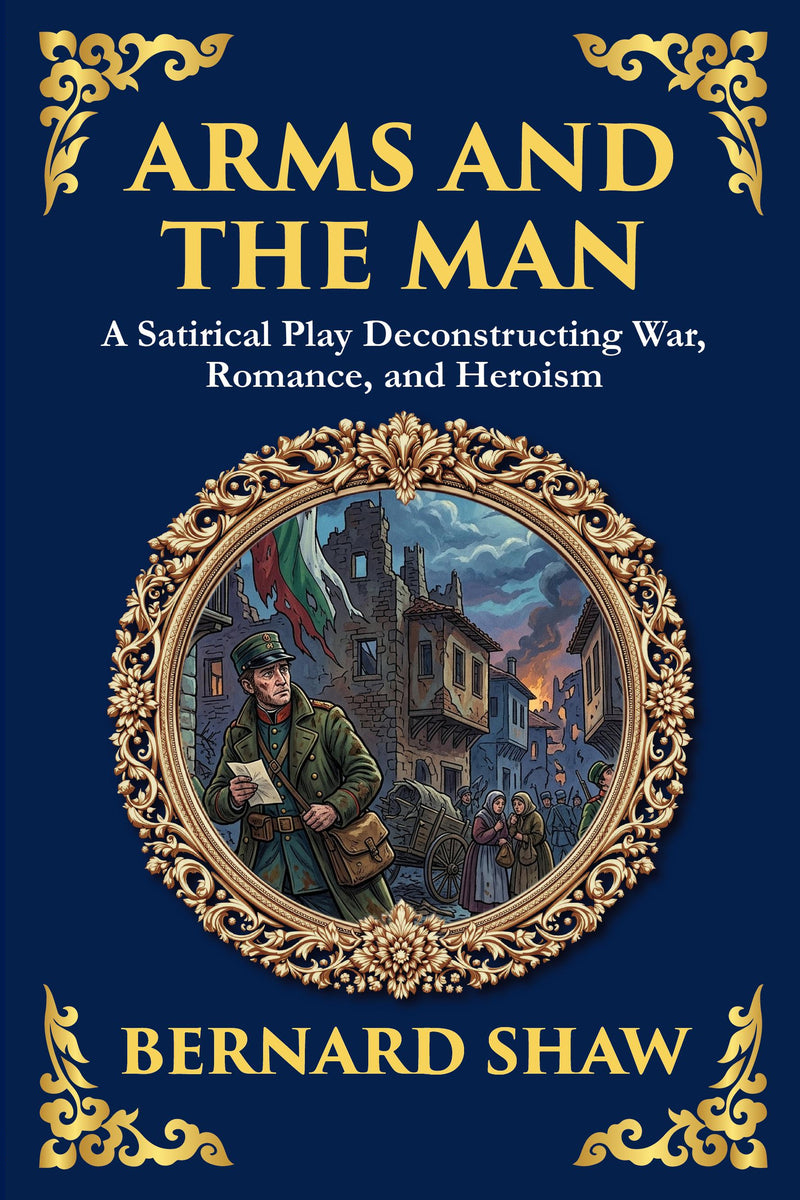
Arms and the Man
In a world obsessed with honor, bravery, and romanticized notions of war, Arms and the Man shatters illusions with razor-sharp wit and biting insight.
or free app
10,000+ hrs library
30-day guarantee
The complete Arms and the Man appears in modern English through Library of Alexandria Press, available online with audiobook narration included for members.
Have you ever wondered why the truth about war is often hidden behind romance and illusion? Arms and the Man: A Satirical Play Deconstructing War, Romance, and Heroism by Bernard Shaw boldly dares to ask the uncomfortable questions: What is a true hero? Can love survive when based on fantasy?
Is war really about honor—or just survival? Set during the Serbo-Bulgarian War, the play begins with Raina Petkoff, a romantic young woman engaged to a dashing soldier, dreaming of gallant victories. Her ideals are quickly tested when Captain Bluntschli, a pragmatic Swiss mercenary who prefers chocolates to bullets, climbs into her window seeking refuge.
What unfolds is a battle not of armies, but of ideas: courage versus cowardice, truth versus illusion, and sincerity versus performance.
What you’ll discover in this modern edition
- A Comedy That Skewers Romantic Ideals of War – Laugh at how Shaw deconstructs the myths of military glory.
- A Soldier Who Prefers Sweets to Swords – Meet Captain Bluntschli, a reluctant warrior with a sharp mind and dry humor.
- A Heroine’s Awakening – Watch Raina evolve from fantasy-fed aristocrat to a woman who sees beyond appearances.
- Themes Still Relevant Today – From blind nationalism to performative masculinity, Shaw’s critiques resonate in any era.
- A Masterclass in Satirical Theatre – Discover why this play is still studied, performed, and celebrated worldwide. First staged in 1894, Arms and the Man was a sensation for its daring honesty and comic brilliance.
| Formats | eBook (EPUB + PDF) · Audiobook · Paperback · Hardcover · Large Print |
| Language | English |
| Trim size (print) | 6 × 9 in |
| Binding | Paperback — perfect-bound · Hardcover — casewrap |
| Large Print edition | Same text in a larger, easy-read type — a larger font, not a larger trim |
| Print pricing | Every physical book at our true cost — at-cost, no profit (members) |
| Library | 873 restored titles, always growing |
| Length | 25,797 words · ~1 hr 43 min reading |
| Reading level | Grade 3 · an easy, flowing read (this modern-English edition) |
| Edition | Modern English translation · 2026 |
Member reviews for this edition are collected as readers finish it — be the first. Across the library: 12,000+ books shipped, every plan covered by a 365-day print guarantee.
About this edition
A faithful, unabridged modern-English edition by The Library of Alexandria — carefully rendered for today's reader and verified paragraph-by-paragraph against the public-domain source. Available as eBook, audiobook, paperback, hardcover, and large print.
- Complete & unabridgedVerified paragraph by paragraph against the source — never a scan, never abridged.
- Modern English, faithfulReadable today, with the author’s meaning kept intact. Readable — not simplified.
- Every format, one membershipRead in your browser or the free app, or listen to the full audiobook.
Included free with your membership
Cancel anytime, one click · 30-day money-back guarantee
Edition last updated July 2026
What’s inside
Arms and the Man — complete and unabridged: all 4 sections included with membership, plus the full audiobook.
Begin reading Arms and the Man
In clear modern English — the complete text is included with membership.
Introduction
When Arms and the Man first burst onto the London stage in the spring of 1894, audiences laughed heartily, applauded enthusiastically, and—according to a now-famous anecdote—delivered one solitary boo from the gallery on opening night. The playwright, taking his bow, looked up at the lone dissenter and replied, “My dear fellow, I quite agree with you, but what are we two against so many?” That moment of impish self-deprecation captures everything you need to know about the mind behind this play: a man perpetually amused by the gap between what people pretend to believe and what they actually do, a writer who delighted in puncturing pomposity, and an artist who understood that the surest way to deliver a serious idea is to wrap it in laughter so irresistible that the audience swallows the medicine before they realize they’ve been treated.
What you hold in your hands is a comedy that has refused to age. More than a century after its premiere, it remains brisk, funny, and startlingly relevant—a play about war that contains no battles you would recognize as heroic, a play about love that treats romance as something closer to a comedy of errors than a fairy tale, and a play about social class that manages to skewer everyone without ever turning cruel. This modern adaptation has been prepared with the contemporary reader in mind, smoothing the occasional archaism and clarifying the references that have grown dim with the passage of time, while preserving the wit, rhythm, and intellectual mischief that made the original a sensation. The goal is simple: to let you experience this play the way its first delighted audiences did, free of the friction that sometimes accumulates around older texts, and ready to be surprised.
Before you begin, it is worth spending a few moments understanding the world from which this play emerged, the peculiar genius of the man who wrote it, and the ideas that animate every scene. Knowing these things will not spoil a single twist—the pleasures of this play lie entirely in its execution, its dialogue, and its characters’ delicious refusal to behave the way conventional stories tell us they should. Rather, this context will sharpen your appreciation, allowing you to catch the jokes that operate on two levels at once and to recognize the targets at which the author so gleefully takes aim.
Bernard Shaw—he detested the “George” and dropped it from his professional name—was, by the time he wrote this play, one of the most formidable critics in London, though not yet one of its most celebrated dramatists. Born in Dublin in 1856 to a family of shabby-genteel pretensions and chronic financial difficulty, he absorbed early the lesson that respectability is often a thin veneer stretched over uncomfortable realities. His father was an unsuccessful corn merchant with a fondness for drink; his mother, a gifted musician, eventually decamped to London with her singing teacher, and the young Shaw followed her there in 1876. He arrived in the imperial capital as an awkward, self-educated, fiercely opinionated young man with enormous ambition and very little money.
The years that followed were a long apprenticeship in failure and self-improvement. He wrote five novels, all of which were rejected by publishers with monotonous regularity. He educated himself relentlessly in the reading room of the British Museum. He became a passionate socialist, joining the newly founded Fabian Society, whose members believed that society could be reformed gradually and rationally rather than through violent revolution. He taught himself to speak in public, transforming a shy and stammering young man into one of the most electrifying orators of his generation. And he became a critic—of music, of art, and most consequentially of theater—wielding a pen so sharp and a wit so dazzling that his reviews were read as eagerly as the performances they discussed.
It was as a theater critic that Shaw developed the convictions that would shape his own playwriting. He had become a passionate champion of the Norwegian dramatist Henrik Ibsen, whose plays tore away the comfortable illusions of middle-class society and forced audiences to confront uncomfortable truths about marriage, morality, and individual conscience. In 1891, Shaw published The Quintessence of Ibsenism, a study that was as much a manifesto for his own ambitions as an analysis of Ibsen’s work. He believed that the theater should be a place of ideas, a forum where audiences could examine their own assumptions and prejudices. But he also understood, with the instincts of a born entertainer, that nobody buys a ticket to be lectured. The trick was to make the examination of ideas so entertaining that audiences would do it willingly, even gratefully.
Arms and the Man was one of his earliest successful attempts to put this theory into practice. It belongs to a group of works he later published under the title Plays Pleasant, to distinguish them from his Plays Unpleasant, which dealt more directly with social problems like slum landlordism and prostitution. The “pleasant” designation should not be mistaken for frivolity. This is a play with serious things to say about how we deceive ourselves, particularly about war and love—the two subjects on which human beings have always been most prone to romantic delusion. But Shaw chose to say them through comedy, and the result is a work that goes down like champagne while leaving you, hours later, thinking about things you had never questioned before.
The title itself is a joke that announces the play’s intentions. “Arms and the man I sing” is the opening line of Virgil’s Aeneid, the great Roman epic that celebrates heroic warfare and the founding of an empire. By borrowing this lofty phrase for a comedy that systematically deflates every notion of military glory, Shaw signals from the very first that he intends to take the grand tradition of heroic literature and turn it cheerfully on its head. The reader who recognizes the allusion will smile; the reader who does not will lose nothing, for the play’s irony operates perfectly well without it. But it is worth knowing that the entire enterprise begins with a wink at twenty centuries of war poetry.
Shaw would go on to write more than sixty plays over a career that lasted into his nineties, winning the Nobel Prize for Literature in 1925 and becoming, in the process, the most important British dramatist since Shakespeare. Works like Pygmalion—later adapted into the beloved musical My Fair Lady—Major Barbara, Man and Superman, and Saint Joan secured his reputation as a thinker of the first rank who happened also to be one of the funniest writers in the English language. But Arms and the Man holds a special place in this magnificent body of work. It was the play that proved his method could succeed, that an audience would pay to have its illusions punctured if the puncturing was done with enough charm. Everything Shaw would later become is visible here in embryo: the brilliant dialogue, the inverted expectations, the characters who say the unsayable, and the relentless, joyful assault on hypocrisy.
A War Without Heroes, a Love Without Illusions
The play is set during a real conflict—the Serbo-Bulgarian War of 1885, a brief and somewhat absurd affair that pitted two small Balkan nations against each other in a dispute that few outside the region could fully understand. Shaw chose this setting deliberately. It was recent enough to feel current to his original audience, yet remote enough—geographically and culturally—that English theatergoers would not feel personally implicated by the play’s mockery of military pretension. He could deflate the romance of war without anyone in the stalls feeling that their own nation’s glorious traditions were under attack. This was a characteristically shrewd piece of stagecraft from a man who understood exactly how far he could push his audience before they stopped laughing and started bristling.
The genius of the play’s treatment of war lies in its refusal to take the conventional view of soldiering. In the popular imagination of Shaw’s day—and, frankly, in much of ours—the soldier is a figure of romance: brave, dashing, contemptuous of danger, ready to charge gloriously into the enemy’s guns for the honor of his country. The cavalry charge, in particular, occupied a sacred place in the Victorian mind, the supreme expression of martial courage and national glory. Shaw takes this entire mythology and examines it through the eyes of a professional soldier who has actually been to war and learned what it really involves. The result is a portrait of warfare as something closer to a grim, often ridiculous business of survival, where the practical man who carries food instead of ammunition and runs away when running away makes sense is worth more than the romantic fool who charges to certain death.
This is not, however, a grim or preachy play. The deflation of military romance is accomplished through laughter, through situations so comically at odds with the heroic ideal that the audience cannot help but recognize how absurd that ideal always was. Shaw never tells you that war is foolish; he simply shows you soldiers behaving like sensible human beings rather than like the marble statues of the recruiting posters, and lets you draw your own conclusions. The contrast between what the characters say about war and heroism and what actually happens—or what they actually did when the bullets were flying—is the engine of much of the play’s comedy.
If the play deflates the romance of war, it is equally merciless toward the romance of love. The young woman at the center of the story has been raised on the same diet of heroic illusion that shapes the soldiers, and she has applied it to her own emotional life. She believes in a particular kind of grand, noble, self-sacrificing love—the love of poetry and opera, all soaring sentiment and lofty declarations. Shaw takes this notion of “higher love” and subjects it to the same searching examination he applies to military glory, asking what lies beneath the pretty language and whether anyone can actually live according to such impossible standards.
Here we encounter one of Shaw’s most enduring preoccupations: the gap between the roles people play and the human beings underneath. His characters are forever striking poses, performing versions of themselves that they think the world expects—the romantic heroine, the dashing hero, the dignified aristocrat, the devoted servant. The comedy and the wisdom of the play both arise from the moments when these poses slip, when the real person peeks out from behind the performance, when characters are surprised into honesty. Shaw believed that most human unhappiness comes from the effort of maintaining these false selves, and that liberation lies in the courage to drop the act and admit what one actually feels and wants. This idea, dressed up in the most delightful comic situations, runs through every scene.
It is worth dwelling for a moment on the figure of the realist who moves through the play’s romantic delusions like a cool breeze through an overheated room. This character—pragmatic, honest, unimpressed by grand gestures, and possessed of a disarming candor about his own limitations—represents Shaw’s ideal: the person who sees the world clearly and refuses to be governed by illusions, whether about war, love, or social position. Such characters recur throughout Shaw’s work, and they are always the ones who win our affection, precisely because they refuse to pretend. There is something profoundly liberating about a character who simply tells the truth, especially when everyone around him is busy performing nobility. The audience, watching, experiences a kind of release, as if a tight collar had been loosened.
The play also takes aim, with characteristic precision, at the pretensions of social class. Several characters are desperately concerned with appearing more refined, more cultured, more aristocratic than they actually are. They have acquired the trappings of higher status—books they do not read, an electric bell they are proud to possess, a library that consists mostly of empty appearances—and they cling to these markers of sophistication with an anxiety that Shaw finds both funny and revealing. The Irish outsider who had clawed his way into London society understood social climbing intimately, and he renders it here with an affectionate mockery that never quite tips into contempt. He laughs at his characters’ snobbery, but he also understands the human insecurity that drives it. This balance of satire and sympathy is one of the play’s quiet achievements.
Cancel anytime, one click · 30-day money-back guarantee
Founding annual rate available now — your price locks for life when you join.
Not ready? Get this free chapter by email — read it anytime.
✓ Sent — check your inbox for Arms and the Man.
Questions about Arms and the Man
What is Arms and the Man about?
In a world obsessed with honor, bravery, and romanticized notions of war, Arms and the Man shatters illusions with razor-sharp wit and biting insight. Bernard Shaw’s classic play follows the unexpected collision of ideals and reality when a Swiss soldier—more practical than heroic— finds refuge in the bedroom of a young Bulgarian aristocrat. As love triangles unfold and patriotic bravado crumbles, Shaw exposes the absurdities of both battlefield glory and societal expectations.
Who wrote Arms and the Man?
Arms and the Man was written by Bernard Shaw. This edition presents the complete work in clear modern English, faithfully rendered from the public-domain original by Library of Alexandria Press.
Is Arms and the Man free to read?
The opening chapter is free to read on this page. Members read and listen to the complete work — and the entire library — free, and can order any physical book at our true print cost.
How long is Arms and the Man?
4 chapters (~25,797 words) — about 1 hr 43 min of reading in this modern-English edition.
Is this an abridged version of Arms and the Man?
No. This is the complete, unabridged Arms and the Man, carefully rendered into clear modern English and verified paragraph-by-paragraph against the public-domain source — nothing is cut or summarised.
What formats does Arms and the Man come in?
Arms and the Man is available as eBook, paperback, hardcover and large print. eBook and audiobook are included with membership; printed editions ship at our true print cost.
Shipping & returns
Billing & membership
More from the library


Explore Military & Strategy
- The War of the Worlds · H. G. Wells
- The Belle of Bowling Green · Amelia E. Barr
- Give Me Liberty or Give Me Death · Patrick Henry
- The Thirty-Nine Steps · John Buchan
- Julius Caesar · William Shakespeare
- Rilla of Ingleside · L. M. Montgomery
- Troilus and Criseyde · Geoffrey Chaucer
- The Adventures of Heine · Edgar Wallace
- The Declaration of Independence of the United States of America · Thomas Jefferson
- Armageddon—2419 A.D. · Philip Francis Nowlan
- The Variable Man · Philip K. Dick
- South Africa and the Transvaal War, Vol. 2 (of 8) · Louis Creswicke
- The Red Badge of Courage: An Episode of the American Civil War · Stephen Crane
- Second Variety · Philip K. Dick
- Lysistrata · Aristophanes
- The Iliad · Homer
- A Matter of Proportion · Anne Walker
- This Side of Paradise · F. Scott Fitzgerald
Arms and the Man
Arms and the Man
A Satirical Play Deconstructing War, Romance, and Heroism
Bernard Shaw
Contents
- Introduction
- Chapter 1
- Chapter 2
- Chapter 3
Introduction
When Arms and the Man first burst onto the London stage in the spring of 1894, audiences laughed heartily, applauded enthusiastically, and—according to a now-famous anecdote—delivered one solitary boo from the gallery on opening night. The playwright, taking his bow, looked up at the lone dissenter and replied, “My dear fellow, I quite agree with you, but what are we two against so many?” That moment of impish self-deprecation captures everything you need to know about the mind behind this play: a man perpetually amused by the gap between what people pretend to believe and what they actually do, a writer who delighted in puncturing pomposity, and an artist who understood that the surest way to deliver a serious idea is to wrap it in laughter so irresistible that the audience swallows the medicine before they realize they’ve been treated.
What you hold in your hands is a comedy that has refused to age. More than a century after its premiere, it remains brisk, funny, and startlingly relevant—a play about war that contains no battles you would recognize as heroic, a play about love that treats romance as something closer to a comedy of errors than a fairy tale, and a play about social class that manages to skewer everyone without ever turning cruel. This modern adaptation has been prepared with the contemporary reader in mind, smoothing the occasional archaism and clarifying the references that have grown dim with the passage of time, while preserving the wit, rhythm, and intellectual mischief that made the original a sensation. The goal is simple: to let you experience this play the way its first delighted audiences did, free of the friction that sometimes accumulates around older texts, and ready to be surprised.
Before you begin, it is worth spending a few moments understanding the world from which this play emerged, the peculiar genius of the man who wrote it, and the ideas that animate every scene. Knowing these things will not spoil a single twist—the pleasures of this play lie entirely in its execution, its dialogue, and its characters’ delicious refusal to behave the way conventional stories tell us they should. Rather, this context will sharpen your appreciation, allowing you to catch the jokes that operate on two levels at once and to recognize the targets at which the author so gleefully takes aim.
Bernard Shaw—he detested the “George” and dropped it from his professional name—was, by the time he wrote this play, one of the most formidable critics in London, though not yet one of its most celebrated dramatists. Born in Dublin in 1856 to a family of shabby-genteel pretensions and chronic financial difficulty, he absorbed early the lesson that respectability is often a thin veneer stretched over uncomfortable realities. His father was an unsuccessful corn merchant with a fondness for drink; his mother, a gifted musician, eventually decamped to London with her singing teacher, and the young Shaw followed her there in 1876. He arrived in the imperial capital as an awkward, self-educated, fiercely opinionated young man with enormous ambition and very little money.
The years that followed were a long apprenticeship in failure and self-improvement. He wrote five novels, all of which were rejected by publishers with monotonous regularity. He educated himself relentlessly in the reading room of the British Museum. He became a passionate socialist, joining the newly founded Fabian Society, whose members believed that society could be reformed gradually and rationally rather than through violent revolution. He taught himself to speak in public, transforming a shy and stammering young man into one of the most electrifying orators of his generation. And he became a critic—of music, of art, and most consequentially of theater—wielding a pen so sharp and a wit so dazzling that his reviews were read as eagerly as the performances they discussed.
It was as a theater critic that Shaw developed the convictions that would shape his own playwriting. He had become a passionate champion of the Norwegian dramatist Henrik Ibsen, whose plays tore away the comfortable illusions of middle-class society and forced audiences to confront uncomfortable truths about marriage, morality, and individual conscience. In 1891, Shaw published The Quintessence of Ibsenism, a study that was as much a manifesto for his own ambitions as an analysis of Ibsen’s work. He believed that the theater should be a place of ideas, a forum where audiences could examine their own assumptions and prejudices. But he also understood, with the instincts of a born entertainer, that nobody buys a ticket to be lectured. The trick was to make the examination of ideas so entertaining that audiences would do it willingly, even gratefully.
Arms and the Man was one of his earliest successful attempts to put this theory into practice. It belongs to a group of works he later published under the title Plays Pleasant, to distinguish them from his Plays Unpleasant, which dealt more directly with social problems like slum landlordism and prostitution. The “pleasant” designation should not be mistaken for frivolity. This is a play with serious things to say about how we deceive ourselves, particularly about war and love—the two subjects on which human beings have always been most prone to romantic delusion. But Shaw chose to say them through comedy, and the result is a work that goes down like champagne while leaving you, hours later, thinking about things you had never questioned before.
The title itself is a joke that announces the play’s intentions. “Arms and the man I sing” is the opening line of Virgil’s Aeneid, the great Roman epic that celebrates heroic warfare and the founding of an empire. By borrowing this lofty phrase for a comedy that systematically deflates every notion of military glory, Shaw signals from the very first that he intends to take the grand tradition of heroic literature and turn it cheerfully on its head. The reader who recognizes the allusion will smile; the reader who does not will lose nothing, for the play’s irony operates perfectly well without it. But it is worth knowing that the entire enterprise begins with a wink at twenty centuries of war poetry.
Shaw would go on to write more than sixty plays over a career that lasted into his nineties, winning the Nobel Prize for Literature in 1925 and becoming, in the process, the most important British dramatist since Shakespeare. Works like Pygmalion—later adapted into the beloved musical My Fair Lady—Major Barbara, Man and Superman, and Saint Joan secured his reputation as a thinker of the first rank who happened also to be one of the funniest writers in the English language. But Arms and the Man holds a special place in this magnificent body of work. It was the play that proved his method could succeed, that an audience would pay to have its illusions punctured if the puncturing was done with enough charm. Everything Shaw would later become is visible here in embryo: the brilliant dialogue, the inverted expectations, the characters who say the unsayable, and the relentless, joyful assault on hypocrisy.
A War Without Heroes, a Love Without Illusions
The play is set during a real conflict—the Serbo-Bulgarian War of 1885, a brief and somewhat absurd affair that pitted two small Balkan nations against each other in a dispute that few outside the region could fully understand. Shaw chose this setting deliberately. It was recent enough to feel current to his original audience, yet remote enough—geographically and culturally—that English theatergoers would not feel personally implicated by the play’s mockery of military pretension. He could deflate the romance of war without anyone in the stalls feeling that their own nation’s glorious traditions were under attack. This was a characteristically shrewd piece of stagecraft from a man who understood exactly how far he could push his audience before they stopped laughing and started bristling.
The genius of the play’s treatment of war lies in its refusal to take the conventional view of soldiering. In the popular imagination of Shaw’s day—and, frankly, in much of ours—the soldier is a figure of romance: brave, dashing, contemptuous of danger, ready to charge gloriously into the enemy’s guns for the honor of his country. The cavalry charge, in particular, occupied a sacred place in the Victorian mind, the supreme expression of martial courage and national glory. Shaw takes this entire mythology and examines it through the eyes of a professional soldier who has actually been to war and learned what it really involves. The result is a portrait of warfare as something closer to a grim, often ridiculous business of survival, where the practical man who carries food instead of ammunition and runs away when running away makes sense is worth more than the romantic fool who charges to certain death.
This is not, however, a grim or preachy play. The deflation of military romance is accomplished through laughter, through situations so comically at odds with the heroic ideal that the audience cannot help but recognize how absurd that ideal always was. Shaw never tells you that war is foolish; he simply shows you soldiers behaving like sensible human beings rather than like the marble statues of the recruiting posters, and lets you draw your own conclusions. The contrast between what the characters say about war and heroism and what actually happens—or what they actually did when the bullets were flying—is the engine of much of the play’s comedy.
If the play deflates the romance of war, it is equally merciless toward the romance of love. The young woman at the center of the story has been raised on the same diet of heroic illusion that shapes the soldiers, and she has applied it to her own emotional life. She believes in a particular kind of grand, noble, self-sacrificing love—the love of poetry and opera, all soaring sentiment and lofty declarations. Shaw takes this notion of “higher love” and subjects it to the same searching examination he applies to military glory, asking what lies beneath the pretty language and whether anyone can actually live according to such impossible standards.
Here we encounter one of Shaw’s most enduring preoccupations: the gap between the roles people play and the human beings underneath. His characters are forever striking poses, performing versions of themselves that they think the world expects—the romantic heroine, the dashing hero, the dignified aristocrat, the devoted servant. The comedy and the wisdom of the play both arise from the moments when these poses slip, when the real person peeks out from behind the performance, when characters are surprised into honesty. Shaw believed that most human unhappiness comes from the effort of maintaining these false selves, and that liberation lies in the courage to drop the act and admit what one actually feels and wants. This idea, dressed up in the most delightful comic situations, runs through every scene.
It is worth dwelling for a moment on the figure of the realist who moves through the play’s romantic delusions like a cool breeze through an overheated room. This character—pragmatic, honest, unimpressed by grand gestures, and possessed of a disarming candor about his own limitations—represents Shaw’s ideal: the person who sees the world clearly and refuses to be governed by illusions, whether about war, love, or social position. Such characters recur throughout Shaw’s work, and they are always the ones who win our affection, precisely because they refuse to pretend. There is something profoundly liberating about a character who simply tells the truth, especially when everyone around him is busy performing nobility. The audience, watching, experiences a kind of release, as if a tight collar had been loosened.
The play also takes aim, with characteristic precision, at the pretensions of social class. Several characters are desperately concerned with appearing more refined, more cultured, more aristocratic than they actually are. They have acquired the trappings of higher status—books they do not read, an electric bell they are proud to possess, a library that consists mostly of empty appearances—and they cling to these markers of sophistication with an anxiety that Shaw finds both funny and revealing. The Irish outsider who had clawed his way into London society understood social climbing intimately, and he renders it here with an affectionate mockery that never quite tips into contempt. He laughs at his characters’ snobbery, but he also understands the human insecurity that drives it. This balance of satire and sympathy is one of the play’s quiet achievements.
Night. A lady’s bedroom in a small Bulgarian town near the Dragoman Pass. It is late November 1885. Through an open window with a small balcony on the left, a peak of the Balkans is visible, looking beautiful and bright white in the starlit snow. The room’s interior is unlike anything typically found in Eastern Europe; it is a mix of rich Bulgarian and cheap Viennese styles. The bedspread, bed hangings, curtains, small rug, and all the decorative fabrics are gorgeous and Oriental, but the wallpaper is plain and Western. Above the head of the bed, which is positioned against a small wall that cuts diagonally across the right corner of the room, is a blue and gold wooden shrine. It holds an ivory image of Christ, with a light hanging in front of it inside a perforated metal ball suspended by three chains. To the left and slightly forward is an ottoman. Against the left wall is a washstand consisting of an enameled iron basin with a bucket underneath in a painted metal frame, and a single towel on the side rail. Nearby is an Austrian bentwood chair with a cane seat. Between the bed and the window is a simple pine dressing table covered with a colorful cloth and topped with an expensive mirror. The door is on the right, with a chest of drawers between the door and the bed. This chest is also covered with a colorful local cloth. On top of it is a stack of paperback novels, a box of chocolate creams, and a small easel holding a large photograph of an extremely handsome officer, whose proud posture and magnetic gaze are evident even in the picture. The room is lit by a candle on the chest of drawers and another on the dressing table, with a box of matches beside it.
End of the free sample
Keep reading, free
Members read and listen to the complete book — and the entire library. Cancel anytime, one click · 30-day money-back guarantee.