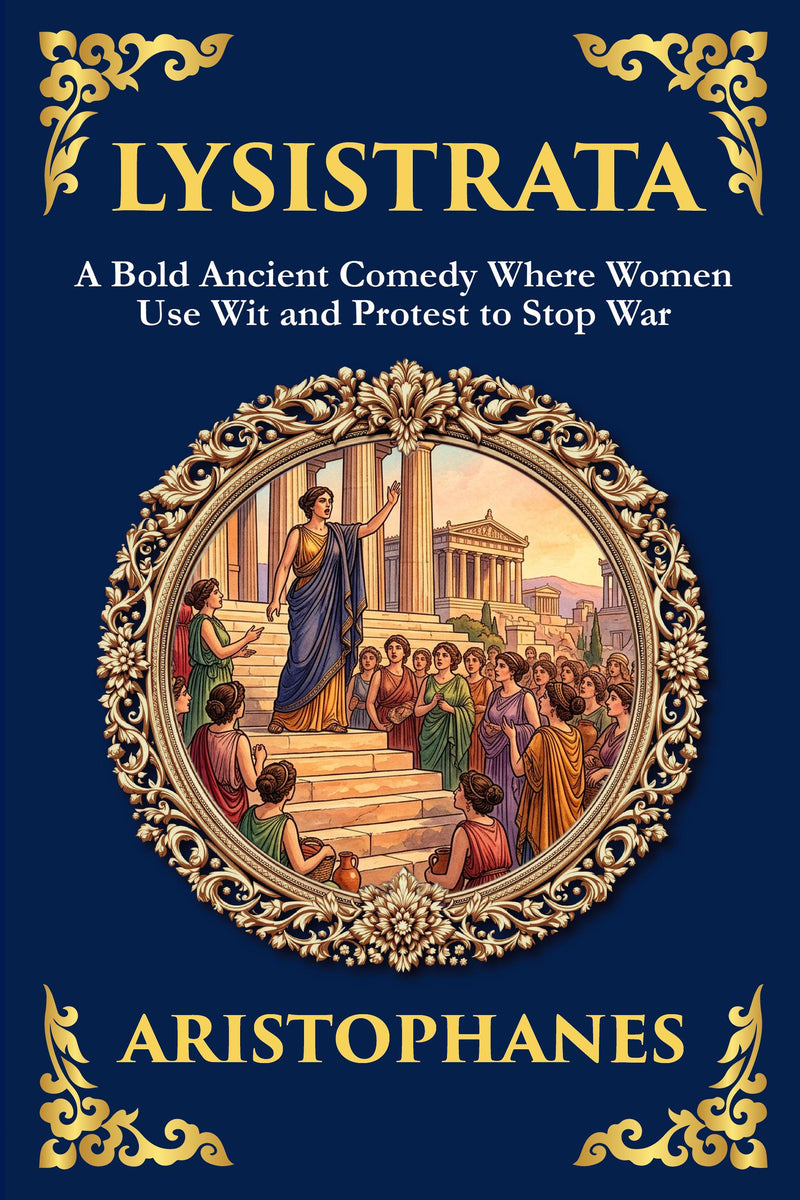
Lysistrata
One of the most daring and enduring comedies of all time, Lysistrata tells the outrageous story of women taking peace into their own hands—by putting love on hold.
or free app
10,000+ hrs library
30-day guarantee
The complete Lysistrata appears in modern English through Library of Alexandria Press, available online with audiobook narration included for members.
Have you ever wondered why laughter might be the strongest weapon against war? In Lysistrata, the ancient Greek playwright Aristophanes offers a comedy so revolutionary, it still resonates more than two thousand years later. Fed up with the never-ending Peloponnesian War, Lysistrata hatches a scheme: rally all the women of Greece to withhold physical affection until their men lay down their weapons.
What begins as a hilarious protest quickly escalates into a nationwide standoff—one that exposes the absurdities of war and the power dynamics between men and women. This modern, accessible translation captures the biting humor, brilliant wordplay, and bold political commentary of the original, delivering a story that feels as urgent and empowering today as it did on the Athenian stage. Lysistrata is not just a play about sex and politics—it’s about strategy, solidarity, and what it truly means to fight for peace.
What you’ll discover in this modern edition
- A Female-Led Rebellion Like No Other – Watch as Lysistrata leads an unprecedented protest that turns desire into a political weapon.
- Comedy With a Cause – Laugh at outrageous antics while confronting timeless themes of war, peace, and resistance.
- A Fierce Feminist Icon in Ancient Drama – Discover one of the earliest—and most unforgettable—female protagonists in literature.
- Political Satire That Still Bites – See how Aristophanes critiques toxic masculinity, power, and national pride with razor-sharp wit.
- A Classic That Still Speaks to Modern Movements – From anti-war activism to gender equality, Lysistrata echoes the spirit of modern protest.
| Formats | eBook (EPUB + PDF) · Audiobook · Paperback · Hardcover · Large Print |
| Language | English |
| Trim size (print) | 6 × 9 in |
| Binding | Paperback — perfect-bound · Hardcover — casewrap |
| Large Print edition | Same text in a larger, easy-read type — a larger font, not a larger trim |
| Print pricing | Every physical book at our true cost — at-cost, no profit (members) |
| Library | 873 restored titles, always growing |
| Length | 11,267 words · ~45 min reading |
| Reading level | Grade 3 · an easy, flowing read (this modern-English edition) |
| Edition | Modern English translation · 2026 |
Member reviews for this edition are collected as readers finish it — be the first. Across the library: 12,000+ books shipped, every plan covered by a 365-day print guarantee.
About this edition
A faithful, unabridged modern-English edition by The Library of Alexandria — carefully rendered for today's reader and verified paragraph-by-paragraph against the public-domain source. Available as eBook, audiobook, paperback, hardcover, and large print.
- Complete & unabridgedVerified paragraph by paragraph against the source — never a scan, never abridged.
- Modern English, faithfulReadable today, with the author’s meaning kept intact. Readable — not simplified.
- Every format, one membershipRead in your browser or the free app, or listen to the full audiobook.
Included free with your membership
Cancel anytime, one click · 30-day money-back guarantee
Edition last updated July 2026
What’s inside
Lysistrata — complete and unabridged, included in full with membership, plus the full audiobook.
Begin reading Lysistrata
In clear modern English — the complete text is included with membership.
Introduction
When Lysistrata first burst onto the Athenian stage in 411 BCE, its audience knew the meaning of war in their bones. They were citizens of a city worn thin by more than two decades of brutal conflict, a generation who had buried fathers, brothers, and sons, who had watched ambition curdle into catastrophe and confidence collapse into desperation. Into this exhausted world stepped Aristophanes, the most daring comic genius of the ancient world, with a play so audacious in its premise, so wickedly funny in its execution, and so startlingly relevant in its concerns that it has refused to die for nearly two and a half thousand years. Here was a comedy that dared to imagine the unimaginable: that the women of Greece, denied any formal voice in the affairs of state, might seize the one form of leverage available to them and, through sheer cunning and collective will, bring the great men of the age to their knees.
The play you are about to read is one of the boldest works of imagination ever committed to the stage. It is funny in the way that only the truly fearless can be funny, willing to scandalize, to provoke, to push against every boundary of decorum its society had erected. Yet beneath the laughter runs a current of genuine moral seriousness, an anguished cry against the waste and folly of endless war. This combination of the ribald and the profound, the absurd and the sincere, is what has made Lysistrata not merely a survivor of antiquity but a living, breathing presence on stages across the world, invoked again and again wherever people gather to protest the madness of conflict. To open these pages is to join a conversation that has continued, unbroken, across the centuries.
To appreciate what Aristophanes accomplished, it helps to understand the soil from which this strange and brilliant flower grew. The Athens of the late fifth century BCE was a city of dazzling contradictions. It had given the world democracy, philosophy, the great tragedies of Aeschylus, Sophocles, and Euripides, the sculpture of Phidias, and an intellectual ferment unmatched in the ancient Mediterranean. Yet this same city was also locked in the long, grinding agony of the Peloponnesian War, a conflict between Athens and Sparta and their respective allies that had begun in 431 BCE and would not end until 404, when Athens finally fell. By the time Lysistrata was performed, the war had consumed twenty years and showed no sign of resolution. Worse still, only two years earlier, in 413 BCE, Athens had suffered one of the most devastating defeats in its history with the catastrophic failure of the Sicilian Expedition, an overreaching military adventure that destroyed an entire fleet and army and left the city reeling.
This was a society in which the public sphere belonged entirely to men. Women in classical Athens occupied a position that modern readers may find difficult to imagine. Respectable citizen women were expected to remain largely within the household, managing domestic affairs, weaving, raising children, and overseeing servants. They could not vote, could not speak in the Assembly, could not hold office, and rarely appeared in public except for religious festivals. Their lives were defined and circumscribed by the men around them: fathers, husbands, guardians. To imagine such women not merely entering political life but actively seizing control of the state and dictating terms to the men who held all formal power was, to the original audience, an idea so preposterous that it carried an inherent comic charge. The very premise was a fantasy, a delicious impossibility, and Aristophanes knew it.
And yet the fantasy carried a sting. For if women, the very people excluded from all decision-making, could see clearly what the men in power could not, if they could perceive the obvious truth that the war was destroying everyone and everything, then what did that say about the wisdom of those entrusted with the city’s fate? Aristophanes was a master of this kind of inversion. By turning the social order upside down, by placing power in the hands of those who had none, he could hold up a mirror to his fellow citizens and force them to confront their own folly through the distorting, clarifying lens of comedy.
Comedy in Athens was not the gentle, decorous thing we might expect from a culture we associate with marble columns and lofty philosophy. The Greek comic tradition in which Aristophanes worked, known to scholars as Old Comedy, was raucous, obscene, politically pointed, and utterly fearless. It mocked real and prominent living people by name, lampooned the gods, satirized the institutions of the state, and reveled in scatological and sexual humor of a directness that can still startle. Comedies were performed as part of great religious festivals, the Lenaea and the City Dionysia, where they competed for prizes before enormous audiences of thousands. To win, a playwright had to be more outrageous, more inventive, and more cutting than his rivals. This was satire as blood sport, and Aristophanes was its undisputed champion, having already produced a string of brilliant works including The Acharnians, The Knights, The Clouds, The Wasps, Peace, and The Birds.
What sets Lysistrata apart, even within this remarkable body of work, is the way it weds its outrageous comic premise to a theme of universal and enduring weight. War and peace, the relationship between the sexes, the gulf between those who wage war and those who suffer its consequences, the question of whether ordinary human longing for ordinary human happiness might prove stronger than the abstract pride of states. These are not parochial concerns confined to one ancient city in one ancient war. They are the perennial subjects of human existence, and Aristophanes treats them with a combination of belly-laugh comedy and unexpected tenderness that no other ancient author quite matches.
It is worth pausing, too, on the women themselves. While the comedy depends on the absurdity of women taking charge, Aristophanes does something genuinely remarkable: he gives his female characters voices of real intelligence, real wit, and real moral authority. The heroine whose name graces this play is no fool and no figure of mere ridicule. Her name itself, which can be understood to mean something like “she who disbands armies” or “she who looses the host,” signals her function within the story, and she carries herself with a strategic brilliance and a steely resolve that would not be out of place in any general or statesman. Through her and her companions, the play voices arguments about the war, about the running of the city, about the value of women’s contributions to society, that are delivered with a seriousness that cuts through the surrounding laughter. There has been much scholarly debate about whether Aristophanes can be called any kind of proto-feminist, and the honest answer is complicated; he was a man of his time, and the play is built on assumptions about gender that we would now reject. Yet the simple fact that he was willing to put such words in the mouths of women, to let them articulate truths the men of the city could not see, gives the comedy a resonance that has spoken powerfully to readers and audiences in every age, and never more so than in our own.
A Comedy of Wit, Protest, and the Human Body
One of the great pleasures awaiting you in these pages is the sheer ingenuity of the play’s central scheme. Faced with a war that the men seem determined to prolong indefinitely, the women of Greece, summoned together across the lines of their warring cities, devise a strategy of extraordinary boldness. They will withhold from their husbands and lovers the one thing those men desire above all else, and through this collective act of refusal, they will compel an end to the fighting. At the same time, they seize control of the treasury that funds the war, occupying the sacred citadel where the city’s wealth is stored, cutting off the money that keeps the slaughter going. It is a plan that operates on two fronts at once, the bedroom and the bank, and Aristophanes wrings every possible drop of comedy from the resulting chaos.
What follows is a riot of farce, frustration, and frantic negotiation. The men, accustomed to getting their way in all things, find themselves outmaneuvered, outargued, and increasingly desperate. The women, meanwhile, must contend not only with the men’s bluster and attempts at force but also with their own desires and the strain of maintaining their resolve. Aristophanes is too honest a comic playwright to pretend that the women find their vow easy to keep, and some of the funniest moments in the play arise from the difficulty of the bargain they have struck. The result is a comedy that is both about power and about desire, about the public stakes of war and peace and the intensely private longings that drive human beings, and the genius of the play lies in showing how inseparable these things truly are.
Readers coming to Aristophanes for the first time should be prepared for the frankness of his humor. This is a comedy that talks openly about sex, that stages physical desire in ways that would have been embodied on the ancient stage through costume and gesture with a directness modern theater rarely matches, and that does not shy away from the crude, the bawdy, or the gloriously vulgar. This earthiness is not incidental; it is central to the play’s vision and its argument. By rooting the great questions of war and peace in the most basic facts of human appetite and human need, Aristophanes insists that the abstractions of politics and the realities of the body cannot finally be separated. The war is fought by men who have bodies, who have wives and homes and beds, and the play’s wager is that these human realities, properly mobilized, can overcome even the most entrenched political deadlock. There is something profoundly democratic, even subversive, in this insistence that the lowest common denominators of human existence might prove mightier than the loftiest pretensions of statecraft.
At the same time, the comedy is laced with moments of genuine pathos and even beauty. The choruses, divided between old men and old women, trade insults and engage in slapstick conflict, but they also voice deeper sentiments about the city, about aging, about the bonds that unite a community even in the midst of strife. There are passages in which the longing for peace becomes so palpable, so heartfelt, that the laughter momentarily catches in the throat. Aristophanes never lets us forget that the war was real, that the suffering was real, that behind the comic conceit lay an entire society’s exhaustion and grief. This is what elevates the play above mere bawdy farce and gives it its enduring power. It is funny, yes, gloriously and unapologetically funny, but it is also, in its way, a serious plea for sanity, addressed by a citizen to his fellow citizens at a moment of national crisis.
This particular edition presents the play in a modern translation, adapted for the contemporary reader, and a word about translation is in order, because few works pose greater challenges to the translator than an ancient comedy. The humor of Aristophanes is rooted in puns, in topical references to people and events long forgotten, in dialect jokes that distinguish the speech of Spartans from Athenians, and in obscenities that depend on the particular textures of the ancient Greek language. A literal, word-for-word rendering would leave a modern reader baffled, the jokes inert on the page, the references opaque. The art of translating Aristophanes lies in finding living equivalents, in capturing the spirit and the energy and the irreverence of the original even where the literal sense must be sacrificed. A good translation of this play should make you laugh, should feel alive and immediate, should convey the breathless momentum of the comedy and the sharpness of its wit. The aim of a modern adaptation is to do for today’s reader what the original did for its first audience: to delight, to provoke, to entertain, and to make the ancient world feel suddenly, vividly present.
Cancel anytime, one click · 30-day money-back guarantee
Founding annual rate available now — your price locks for life when you join.
Not ready? Get this free chapter by email — read it anytime.
✓ Sent — check your inbox for Lysistrata.
Questions about Lysistrata
What is Lysistrata about?
One of the most daring and enduring comedies of all time, Lysistrata tells the outrageous story of women taking peace into their own hands—by putting love on hold. Tired of the endless Peloponnesian War, the clever and strong-willed Lysistrata unites the women of Greece with one radical strategy: deny their husbands until they agree to end the war. What follows is a hilariously bold, deeply satirical, and surprisingly modern exploration of gender politics, civic duty, and the power of collective resistance.
Who wrote Lysistrata?
Lysistrata was written by Aristophanes. This edition presents the complete work in clear modern English, faithfully rendered from the public-domain original by Library of Alexandria Press.
Is Lysistrata free to read?
The opening chapter is free to read on this page. Members read and listen to the complete work — and the entire library — free, and can order any physical book at our true print cost.
How long is Lysistrata?
2 chapters (~11,267 words) — about 45 min of reading in this modern-English edition.
Is this an abridged version of Lysistrata?
No. This is the complete, unabridged Lysistrata, carefully rendered into clear modern English and verified paragraph-by-paragraph against the public-domain source — nothing is cut or summarised.
What formats does Lysistrata come in?
Lysistrata is available as eBook, paperback, hardcover and large print. eBook and audiobook are included with membership; printed editions ship at our true print cost.
Shipping & returns
Billing & membership
More from the library


Explore Military & Strategy
- The War of the Worlds · H. G. Wells
- The Belle of Bowling Green · Amelia E. Barr
- Give Me Liberty or Give Me Death · Patrick Henry
- The Thirty-Nine Steps · John Buchan
- Julius Caesar · William Shakespeare
- Rilla of Ingleside · L. M. Montgomery
- Troilus and Criseyde · Geoffrey Chaucer
- The Adventures of Heine · Edgar Wallace
- The Declaration of Independence of the United States of America · Thomas Jefferson
- Armageddon—2419 A.D. · Philip Francis Nowlan
- The Variable Man · Philip K. Dick
- Arms and the Man · Bernard Shaw
- South Africa and the Transvaal War, Vol. 2 (of 8) · Louis Creswicke
- The Red Badge of Courage: An Episode of the American Civil War · Stephen Crane
- Second Variety · Philip K. Dick
- The Iliad · Homer
- A Matter of Proportion · Anne Walker
- This Side of Paradise · F. Scott Fitzgerald
Lysistrata
Lysistrata
A Bold Ancient Comedy Where Women Use Wit and Protest to Stop War
Aristophanes
Contents
- Introduction
- Lysistrata
Introduction
When Lysistrata first burst onto the Athenian stage in 411 BCE, its audience knew the meaning of war in their bones. They were citizens of a city worn thin by more than two decades of brutal conflict, a generation who had buried fathers, brothers, and sons, who had watched ambition curdle into catastrophe and confidence collapse into desperation. Into this exhausted world stepped Aristophanes, the most daring comic genius of the ancient world, with a play so audacious in its premise, so wickedly funny in its execution, and so startlingly relevant in its concerns that it has refused to die for nearly two and a half thousand years. Here was a comedy that dared to imagine the unimaginable: that the women of Greece, denied any formal voice in the affairs of state, might seize the one form of leverage available to them and, through sheer cunning and collective will, bring the great men of the age to their knees.
The play you are about to read is one of the boldest works of imagination ever committed to the stage. It is funny in the way that only the truly fearless can be funny, willing to scandalize, to provoke, to push against every boundary of decorum its society had erected. Yet beneath the laughter runs a current of genuine moral seriousness, an anguished cry against the waste and folly of endless war. This combination of the ribald and the profound, the absurd and the sincere, is what has made Lysistrata not merely a survivor of antiquity but a living, breathing presence on stages across the world, invoked again and again wherever people gather to protest the madness of conflict. To open these pages is to join a conversation that has continued, unbroken, across the centuries.
To appreciate what Aristophanes accomplished, it helps to understand the soil from which this strange and brilliant flower grew. The Athens of the late fifth century BCE was a city of dazzling contradictions. It had given the world democracy, philosophy, the great tragedies of Aeschylus, Sophocles, and Euripides, the sculpture of Phidias, and an intellectual ferment unmatched in the ancient Mediterranean. Yet this same city was also locked in the long, grinding agony of the Peloponnesian War, a conflict between Athens and Sparta and their respective allies that had begun in 431 BCE and would not end until 404, when Athens finally fell. By the time Lysistrata was performed, the war had consumed twenty years and showed no sign of resolution. Worse still, only two years earlier, in 413 BCE, Athens had suffered one of the most devastating defeats in its history with the catastrophic failure of the Sicilian Expedition, an overreaching military adventure that destroyed an entire fleet and army and left the city reeling.
This was a society in which the public sphere belonged entirely to men. Women in classical Athens occupied a position that modern readers may find difficult to imagine. Respectable citizen women were expected to remain largely within the household, managing domestic affairs, weaving, raising children, and overseeing servants. They could not vote, could not speak in the Assembly, could not hold office, and rarely appeared in public except for religious festivals. Their lives were defined and circumscribed by the men around them: fathers, husbands, guardians. To imagine such women not merely entering political life but actively seizing control of the state and dictating terms to the men who held all formal power was, to the original audience, an idea so preposterous that it carried an inherent comic charge. The very premise was a fantasy, a delicious impossibility, and Aristophanes knew it.
And yet the fantasy carried a sting. For if women, the very people excluded from all decision-making, could see clearly what the men in power could not, if they could perceive the obvious truth that the war was destroying everyone and everything, then what did that say about the wisdom of those entrusted with the city’s fate? Aristophanes was a master of this kind of inversion. By turning the social order upside down, by placing power in the hands of those who had none, he could hold up a mirror to his fellow citizens and force them to confront their own folly through the distorting, clarifying lens of comedy.
Comedy in Athens was not the gentle, decorous thing we might expect from a culture we associate with marble columns and lofty philosophy. The Greek comic tradition in which Aristophanes worked, known to scholars as Old Comedy, was raucous, obscene, politically pointed, and utterly fearless. It mocked real and prominent living people by name, lampooned the gods, satirized the institutions of the state, and reveled in scatological and sexual humor of a directness that can still startle. Comedies were performed as part of great religious festivals, the Lenaea and the City Dionysia, where they competed for prizes before enormous audiences of thousands. To win, a playwright had to be more outrageous, more inventive, and more cutting than his rivals. This was satire as blood sport, and Aristophanes was its undisputed champion, having already produced a string of brilliant works including The Acharnians, The Knights, The Clouds, The Wasps, Peace, and The Birds.
What sets Lysistrata apart, even within this remarkable body of work, is the way it weds its outrageous comic premise to a theme of universal and enduring weight. War and peace, the relationship between the sexes, the gulf between those who wage war and those who suffer its consequences, the question of whether ordinary human longing for ordinary human happiness might prove stronger than the abstract pride of states. These are not parochial concerns confined to one ancient city in one ancient war. They are the perennial subjects of human existence, and Aristophanes treats them with a combination of belly-laugh comedy and unexpected tenderness that no other ancient author quite matches.
It is worth pausing, too, on the women themselves. While the comedy depends on the absurdity of women taking charge, Aristophanes does something genuinely remarkable: he gives his female characters voices of real intelligence, real wit, and real moral authority. The heroine whose name graces this play is no fool and no figure of mere ridicule. Her name itself, which can be understood to mean something like “she who disbands armies” or “she who looses the host,” signals her function within the story, and she carries herself with a strategic brilliance and a steely resolve that would not be out of place in any general or statesman. Through her and her companions, the play voices arguments about the war, about the running of the city, about the value of women’s contributions to society, that are delivered with a seriousness that cuts through the surrounding laughter. There has been much scholarly debate about whether Aristophanes can be called any kind of proto-feminist, and the honest answer is complicated; he was a man of his time, and the play is built on assumptions about gender that we would now reject. Yet the simple fact that he was willing to put such words in the mouths of women, to let them articulate truths the men of the city could not see, gives the comedy a resonance that has spoken powerfully to readers and audiences in every age, and never more so than in our own.
A Comedy of Wit, Protest, and the Human Body
One of the great pleasures awaiting you in these pages is the sheer ingenuity of the play’s central scheme. Faced with a war that the men seem determined to prolong indefinitely, the women of Greece, summoned together across the lines of their warring cities, devise a strategy of extraordinary boldness. They will withhold from their husbands and lovers the one thing those men desire above all else, and through this collective act of refusal, they will compel an end to the fighting. At the same time, they seize control of the treasury that funds the war, occupying the sacred citadel where the city’s wealth is stored, cutting off the money that keeps the slaughter going. It is a plan that operates on two fronts at once, the bedroom and the bank, and Aristophanes wrings every possible drop of comedy from the resulting chaos.
What follows is a riot of farce, frustration, and frantic negotiation. The men, accustomed to getting their way in all things, find themselves outmaneuvered, outargued, and increasingly desperate. The women, meanwhile, must contend not only with the men’s bluster and attempts at force but also with their own desires and the strain of maintaining their resolve. Aristophanes is too honest a comic playwright to pretend that the women find their vow easy to keep, and some of the funniest moments in the play arise from the difficulty of the bargain they have struck. The result is a comedy that is both about power and about desire, about the public stakes of war and peace and the intensely private longings that drive human beings, and the genius of the play lies in showing how inseparable these things truly are.
Readers coming to Aristophanes for the first time should be prepared for the frankness of his humor. This is a comedy that talks openly about sex, that stages physical desire in ways that would have been embodied on the ancient stage through costume and gesture with a directness modern theater rarely matches, and that does not shy away from the crude, the bawdy, or the gloriously vulgar. This earthiness is not incidental; it is central to the play’s vision and its argument. By rooting the great questions of war and peace in the most basic facts of human appetite and human need, Aristophanes insists that the abstractions of politics and the realities of the body cannot finally be separated. The war is fought by men who have bodies, who have wives and homes and beds, and the play’s wager is that these human realities, properly mobilized, can overcome even the most entrenched political deadlock. There is something profoundly democratic, even subversive, in this insistence that the lowest common denominators of human existence might prove mightier than the loftiest pretensions of statecraft.
At the same time, the comedy is laced with moments of genuine pathos and even beauty. The choruses, divided between old men and old women, trade insults and engage in slapstick conflict, but they also voice deeper sentiments about the city, about aging, about the bonds that unite a community even in the midst of strife. There are passages in which the longing for peace becomes so palpable, so heartfelt, that the laughter momentarily catches in the throat. Aristophanes never lets us forget that the war was real, that the suffering was real, that behind the comic conceit lay an entire society’s exhaustion and grief. This is what elevates the play above mere bawdy farce and gives it its enduring power. It is funny, yes, gloriously and unapologetically funny, but it is also, in its way, a serious plea for sanity, addressed by a citizen to his fellow citizens at a moment of national crisis.
This particular edition presents the play in a modern translation, adapted for the contemporary reader, and a word about translation is in order, because few works pose greater challenges to the translator than an ancient comedy. The humor of Aristophanes is rooted in puns, in topical references to people and events long forgotten, in dialect jokes that distinguish the speech of Spartans from Athenians, and in obscenities that depend on the particular textures of the ancient Greek language. A literal, word-for-word rendering would leave a modern reader baffled, the jokes inert on the page, the references opaque. The art of translating Aristophanes lies in finding living equivalents, in capturing the spirit and the energy and the irreverence of the original even where the literal sense must be sacrificed. A good translation of this play should make you laugh, should feel alive and immediate, should convey the breathless momentum of the comedy and the sharpness of its wit. The aim of a modern adaptation is to do for today’s reader what the original did for its first audience: to delight, to provoke, to entertain, and to make the ancient world feel suddenly, vividly present.
LYSISTRATA stands alone with the Propylaea behind her.
A festival for Pan, Colias, or Genetyllis,
The tambourines would be filling the noisy streets,
Except—oh, wait—there’s my neighbor over there.
But what’s bothering you so much? Tell me, honey.
I’m absolutely embarrassed for all women.
And yet, even when called for the most urgent business
To make a decision, they’re still lounging in bed.
My dear, they’ll be here. You know how hard it is for women
Servants to be managed, children to be bathed,
Or rocked to sleep and fed their porridge.
But I’m telling you, we have a much more important goal here.
That you’ve gathered all the women here in a crowd?
If they were, they’d be rushing over here.
No, not at all. This is about something I’ve felt
and tossed and turned over for many sleepless nights.
It must be impressive to stay focused for that long.
So impressive that it’s come to this—women will be the ones to save Greece!
Saved by women? Poor thing, I feel sorry for it.
From now on, the fate of our country is in our hands:
We’ll wipe out the Peloponnesians completely—
Not completely. Have some mercy on the eels!
But when it comes to Athens, I’m being careful
though I’m free to think what I want. But if the women
from the Peloponnese and Boeotia join us,
something so bold and clever? We women, who usually stay
hidden away in the back rooms, dressing up
in shimmering gold gowns and fancy outfits
of elegant silk and cute little slippers...
Those are exactly the tools we’ll use for the rescue.
These saffron dresses, the finest perfumes,
the slippers, the makeup that enhances beauty, and robes
Now tell me, is it right for the other women to be lagging behind?
End of the free sample
Keep reading, free
Members read and listen to the complete book — and the entire library. Cancel anytime, one click · 30-day money-back guarantee.