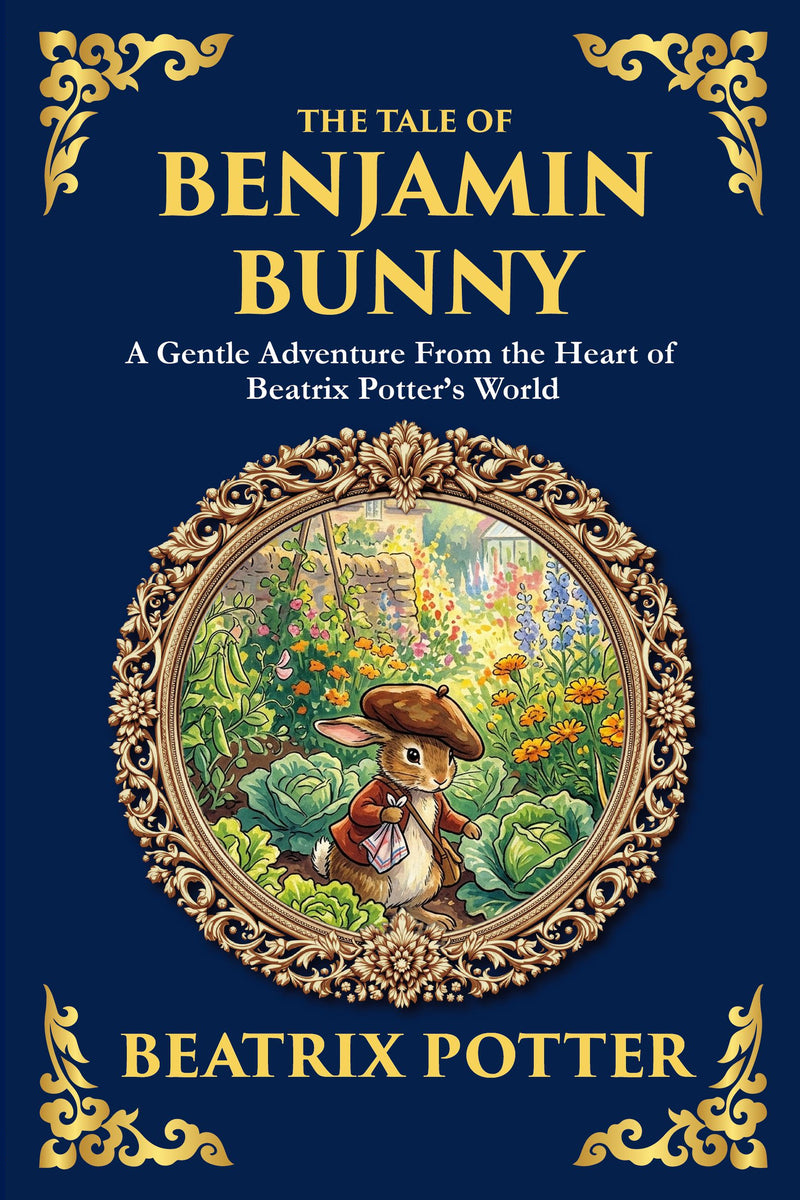
The Tale of Benjamin Bunny — Large Print
In this charming sequel to The Tale of Peter Rabbit, Beatrix Potter continues her timeless storytelling with warmth and wit.
or free app
10,000+ hrs library
30-day guarantee
The complete The Tale of Benjamin Bunny appears in modern English through Library of Alexandria Press, available online with audiobook narration included for members.
Have you ever wondered why the smallest adventures often lead to the biggest life lessons? Step back into the magical countryside world of Beatrix Potter, where animals dress in waistcoats, gardens are full of secrets, and bravery comes in the fluffiest of forms. The Tale of Benjamin Bunny picks up where The Tale of Peter Rabbit left off, following Peter and his cousin Benjamin as they sneak back into Mr.
McGregor’s garden—on a daring mission to recover Peter’s missing clothes and shoes. But what starts as a simple errand turns into a test of nerve, cleverness, and the importance of listening to wise elders. As they navigate onions, cats, and capers, Benjamin and Peter discover that there’s no substitute for quick thinking—and that sometimes, even bunnies need a helping paw from home.
What you’ll discover in this modern edition
- A Continuation of Peter Rabbit’s Story – Follow Peter’s next adventure alongside his brave cousin Benjamin Bunny.
- Whimsical Illustrations by Beatrix Potter – Enjoy the iconic, gentle watercolor scenes that bring this countryside world to life.
- A Tale of Family, Risk, and Rescue – Learn the value of family support, even when young rabbits don’t always follow the rules.
- A Beloved Children’s Classic – Perfect for bedtime reading, storytime sharing, or introducing young readers to the magic of Beatrix Potter. From Mr.
| Formats | eBook (EPUB + PDF) · Audiobook · Paperback · Hardcover · Large Print |
| Language | English |
| Trim size (print) | 6 × 9 in |
| Binding | Paperback — perfect-bound · Hardcover — casewrap |
| Large Print edition | Same text in a larger, easy-read type — a larger font, not a larger trim |
| Print pricing | Every physical book at our true cost — at-cost, no profit (members) |
| Library | 873 restored titles, always growing |
| Length | 4,310 words · ~17 min reading |
| Reading level | Grade 11 · a confident, adult read (this modern-English edition) |
| Edition | Modern English translation · 2026 |
Member reviews for this edition are collected as readers finish it — be the first. Across the library: 12,000+ books shipped, every plan covered by a 365-day print guarantee.
About this edition
A faithful, unabridged modern-English edition by The Library of Alexandria — carefully rendered for today's reader and verified paragraph-by-paragraph against the public-domain source. Available as eBook, audiobook, paperback, hardcover, and large print.
- Complete & unabridgedVerified paragraph by paragraph against the source — never a scan, never abridged.
- Modern English, faithfulReadable today, with the author’s meaning kept intact. Readable — not simplified.
- Every format, one membershipRead in your browser or the free app, or listen to the full audiobook.
Included free with your membership
Cancel anytime, one click · 30-day money-back guarantee
Edition last updated July 2026
What’s inside
The Tale of Benjamin Bunny — Large Print — complete and unabridged, included in full with membership, plus the full audiobook.
Begin reading The Tale of Benjamin Bunny — Large Print
In clear modern English — the complete text is included with membership.
Introduction
There is a particular kind of magic that lives in the smallest of stories. It is the magic that allows a tale told in a few dozen pages, with words simple enough for a child to follow and pictures soft enough to soothe a restless evening, to remain in the heart for a lifetime. Few authors have ever understood this magic as thoroughly as Beatrix Potter, and few of her creations embody it as warmly as the gentle, mischievous, irrepressible adventure you are about to read. This particular tale, brought into a modern translation for the contemporary reader, invites you to step once more into a green and dappled corner of the English countryside, where rabbits wear little blue jackets, where gardens are full of both bounty and peril, and where the boundary between the safe world of home and the thrilling world beyond is crossed by paws far braver than their size would suggest.
To open this book is to accept an invitation that has been extended to readers for well over a century. It is an invitation to slow down, to look closely, and to find delight in the ordinary turned extraordinary. Potter’s world is not one of grand quests or sweeping epics. It is a world measured in hedgerows and vegetable rows, in stone walls and basket lids, in the rustle of lettuce leaves and the soft thud of small feet on garden soil. And yet, within these modest dimensions, she manages to capture something universal: the pull of curiosity, the warmth of family, the comfort of being rescued, and the quiet lessons that come from venturing where one perhaps ought not to go. This is a story that has been read aloud at bedsides across generations, and it carries within it the gentle wisdom of a writer who knew that the truest adventures often happen very close to home.
The Woman Behind the Whiskers and Waistcoats
To appreciate fully what awaits you in these pages, it helps to know a little about the remarkable woman who created them. Helen Beatrix Potter was born in 1866 into a comfortable, well-to-do Victorian household in London, a setting that, on the surface, seems an unlikely cradle for one of the most beloved chroniclers of the natural world. Her upbringing was, by the standards of the time, somewhat isolated. She and her younger brother were largely confined to the nursery, educated by governesses, and kept at a careful distance from the bustle of the city outside. Yet what might have been a stifling childhood became, in Beatrix’s hands, the seedbed of an extraordinary imagination.
The Potter family spent their summers away from London, first in Scotland and later in the Lake District of northern England, and it was during these long holidays that young Beatrix found her truest companions: not other children, but the animals, plants, and landscapes of the countryside. She kept an astonishing menagerie of pets throughout her life — rabbits, mice, hedgehogs, frogs, a bat, and more — and she observed them with the patient, devoted eye of a born naturalist. She did not merely admire these creatures; she studied them. She sketched them endlessly, learning the precise way a rabbit’s ears folded back in alarm, the exact set of a mouse’s paws, the texture of fur and the angle of a whisker. This was not sentimental cooing over cute animals. It was rigorous, attentive, scientific observation, and it gave her work a foundation of authenticity that countless imitators have never quite managed to replicate.
Indeed, before she ever became a writer of children’s stories, Potter was a serious amateur scientist. She developed a deep fascination with fungi and produced detailed, accurate botanical illustrations of mushrooms and lichens that were admired by experts of her day. She even formulated a theory about the germination of fungal spores and prepared a scientific paper on the subject. That the doors of the scientific establishment were largely closed to her — a woman in a world that did not yet take women’s intellectual contributions seriously — is one of the quieter tragedies of her early life. But it is also, perhaps, one of the great fortunes of literary history, for the energy and precision she might have poured into mycology found their way instead into the small painted worlds of her storybooks.
The path to becoming a published author was itself a story of quiet determination. The tale that launched her career began as a picture letter written to entertain the sick child of a former governess. When she later sought to publish it, she was rejected by several publishers before deciding to print it privately at her own expense. Only then did a commercial publisher take notice. From that point forward, Potter approached her books not as a hobby but as a profession. She had a remarkably shrewd commercial instinct, insisting that her books be made small — sized perfectly for a child’s hands — and affordable, so that ordinary children could own and treasure them. She understood her audience with a precision that matched her understanding of her animal subjects.
What makes Potter so enduring is the way these two halves of her nature fused together. She was both the careful naturalist and the imaginative storyteller, both the businesswoman and the dreamer. Her animals are dressed in jackets and bonnets, they speak and scheme and feel, and yet they never lose their essential animal-ness. A rabbit in her world remains, at heart, a rabbit — twitchy, hungry, fond of vegetables, fearful of cats and larger creatures, governed by instinct as much as by thought. This delicate balance between the human and the animal is precisely what gives her tales their peculiar charm and their lasting power. The reader is never asked to forget that these are creatures of the hedgerow, even as they behave with all the foibles and affections of people.
In her later years, Potter used the considerable fortune she earned from her books to become a farmer and a fierce protector of the very Lake District landscape that had nurtured her imagination. She bought farm after farm, raised prize-winning sheep, and worked tirelessly to preserve the traditional fells and countryside from development. Upon her death, she left thousands of acres to the National Trust, ensuring that the rolling green world she loved would remain unspoiled for generations to come. There is a beautiful symmetry in this: the woman who immortalized the countryside in ink and watercolor also acted, in the most practical and lasting way possible, to keep it real. When you read her tales, you are reading the work of someone who did not merely imagine a pastoral paradise but fought to protect a living one.
A World of Gardens, Burrows, and Gentle Peril
The story you hold continues a thread woven through several of Potter’s most cherished works, returning us to the familiar territory of rabbits and gardens, of family ties and youthful escapades. Without revealing the turns the tale will take, it is worth preparing yourself for the particular flavor of Potter’s storytelling, for it is unlike much of what passes for children’s literature today, and understanding its rhythms will only deepen your enjoyment.
First, there is the matter of pace and scale. Potter’s stories are short — gloriously, deliberately short. She does not pad or embellish. Every sentence earns its place. This economy is not a limitation but a strength; it gives her tales the crisp, satisfying shape of a well-told anecdote, the kind of story a beloved relative might recount over a cup of tea. There is a beginning that draws you in, a middle that tightens with tension, and a resolution that releases it. In an age when so much storytelling sprawls and lingers, there is something deeply refreshing about a narrative that knows exactly what it wants to say and says it with such grace.
Then there is the tone — and this is perhaps where Potter most surprises readers who come to her expecting nothing but sweetness. Her world is gentle, yes, but it is not without danger. The gardens her characters explore are not merely picturesque; they are guarded, contested spaces where small creatures must be wary and clever to survive. There are larger animals to be feared, traps and obstacles to be navigated, and the very real possibility that an adventure might end badly. Potter never condescends to her young readers by pretending the world is entirely safe. Instead, she presents danger in measured, manageable doses, always wrapped in a reassuring framework where home and family wait to gather up the wayward and the wounded. This is, in fact, one of the secrets of her enduring appeal. Children are not naive; they know, instinctively, that the world contains risk. Potter’s stories honor that knowledge while also offering the comfort of safe return. The thrill of venturing out is balanced by the relief of coming home, and few writers have ever struck that balance so perfectly.
The characters themselves are drawn with a wonderful blend of individuality and warmth. Potter’s animals have distinct personalities — some bold, some timid, some sensible, some hopelessly impulsive. They make mistakes. They give in to temptation. They get themselves into scrapes through a combination of curiosity, greed, and the simple high spirits of youth. And they are, for all their faults, deeply lovable. There is no moralizing villainy in these creatures, no heavy-handed lessons clumsily delivered. Instead, the lessons emerge naturally from the events of the story, the way real wisdom is acquired: through experience, through consequence, through the gentle guidance of those who love us. A young reader will come away not having been lectured but having quietly absorbed something true about the world — about the difference between bravery and recklessness, about the value of family, about the way that small choices can lead to large consequences.
It is also worth dwelling, for a moment, on the role of the natural world in these tales. Potter’s settings are not generic backdrops but living, breathing places, rendered with the precision of someone who knew them intimately. When she describes a garden, she describes real plants growing in real soil. When she describes the behavior of an animal, she describes what that animal would actually do. This grounding in reality is part of what gives her fantasy its credibility. The talking rabbits in their little jackets feel believable precisely because the world around them is so carefully, accurately observed. There is a richness of sensory detail in her work — the smell of damp earth, the feel of soft fur, the rustle of leaves, the warmth of sunlight — that immerses the reader completely. Reading Potter is a sensory pleasure as much as a narrative one.
This modern translation has been prepared with great care to preserve all of these qualities while making the language fresh and accessible for today’s readers. Potter wrote in the idiom of her own era, and while her prose has a timeless quality, certain turns of phrase, certain rhythms and vocabulary, can occasionally feel distant to a contemporary ear, particularly to young readers encountering her for the first time. The aim of this adaptation is not to replace Potter’s voice but to clear away any small obstacles that might stand between the reader and the joy of her storytelling. The wit, the warmth, the gentle suspense, the deep affection for the natural world — all of these remain fully intact. What you will find here is the same story that has enchanted readers for generations, presented in a way that allows it to enchant anew.
How to Read This Tale, and Why It Still Matters
There is a temptation, when approaching a beloved classic of children’s literature, to treat it as a kind of cultural artifact — something to be respected and admired from a polite distance, dusted off for nostalgia’s sake and then returned to the shelf. This would be a great mistake with Potter. Her tales are not museum pieces. They are alive, and they are meant to be enjoyed in the most active, immediate way possible. So before you begin, allow me to offer a few thoughts on how to get the very most from the pages ahead.
Cancel anytime, one click · 30-day money-back guarantee
Founding annual rate available now — your price locks for life when you join.
Not ready? Get this free chapter by email — read it anytime.
✓ Sent — check your inbox for The Tale of Benjamin Bunny — Large Print.
Questions about The Tale of Benjamin Bunny — Large Print
What is The Tale of Benjamin Bunny about?
In this charming sequel to The Tale of Peter Rabbit, Beatrix Potter continues her timeless storytelling with warmth and wit. Join young Benjamin Bunny as he ventures into Mr. McGregor’s garden to retrieve Peter’s lost clothes—only to find that courage and curiosity can sometimes lead to unexpected trouble.
Who wrote The Tale of Benjamin Bunny?
The Tale of Benjamin Bunny was written by Beatrix Potter. This edition presents the complete work in clear modern English, faithfully rendered from the public-domain original by Library of Alexandria Press.
Is The Tale of Benjamin Bunny free to read?
The opening chapter is free to read on this page. Members read and listen to the complete work — and the entire library — free, and can order any physical book at our true print cost.
How long is The Tale of Benjamin Bunny?
2 chapters (~4,310 words) — about 17 min of reading in this modern-English edition.
Is this an abridged version of The Tale of Benjamin Bunny?
No. This is the complete, unabridged The Tale of Benjamin Bunny, carefully rendered into clear modern English and verified paragraph-by-paragraph against the public-domain source — nothing is cut or summarised.
What formats does The Tale of Benjamin Bunny come in?
The Tale of Benjamin Bunny is available as eBook, paperback and large print. eBook and audiobook are included with membership; printed editions ship at our true print cost.
Shipping & returns
Billing & membership
More from the library


Explore Children's Classics
- Jack and Jill · Louisa May Alcott
- The Wonderful Wizard of Oz · L. Frank Baum
- Peter Pan · J. M. Barrie
- The Prince and the Pauper · Mark Twain
- The Red Fairy Book · Andrew Lang
- Old Christmas: from the Sketch Book of Washington Irving · Washington Irving
- A Houseful of Girls · Sarah Tytler
- In the hollow of His hand · Hesba Stretton
- Miss Primrose · Agnes Giberne
- Five Little Peppers and How They Grew · Margaret Sidney
- The Loss of the Swansea: A Story of the Florida Coast · W. L. Alden
- Sky Island · L. Frank Baum
- The Book of Dragons · E. Nesbit
- Wild Animals I Have Known · Ernest Thompson Seton
- Skinny McCord · Percy Keese Fitzhugh
- The Hunniwell Boys and the Platinum Mystery · L. P. Wyman
- Rainbow Valley · L. M. Montgomery
- "Us and Our Donkey" · Amy Le Feuvre
- Dorothy and the Wizard in Oz · L. Frank Baum
- The Home Book of Verse — Volume 4 · Burton Egbert Stevenson
- The Story of Doctor Dolittle · Hugh Lofting
- The Tale of Benjamin Bunny · Beatrix Potter
- Fifty Famous Stories Retold · James Baldwin
- Rilla of Ingleside · L. M. Montgomery
- The House at Pooh Corner · A. A. Milne
- Rich and Humble: A Story for Young People · Oliver Optic
- The Three Bears · A. E. Kennedy
- Peter and Wendy · J. M. Barrie
- The Marvelous Land of Oz · L. Frank Baum
- Andersen’s Fairy Tales · H. C. Andersen
The Tale of Benjamin Bunny — Large Print
The Tale of Benjamin Bunny — Large Print
A Gentle Adventure from the Heart of Beatrix Potter’s World
Beatrix Potter
Contents
- Introduction
- The Tale of Benjamin Bunny
Introduction
There is a particular kind of magic that lives in the smallest of stories. It is the magic that allows a tale told in a few dozen pages, with words simple enough for a child to follow and pictures soft enough to soothe a restless evening, to remain in the heart for a lifetime. Few authors have ever understood this magic as thoroughly as Beatrix Potter, and few of her creations embody it as warmly as the gentle, mischievous, irrepressible adventure you are about to read. This particular tale, brought into a modern translation for the contemporary reader, invites you to step once more into a green and dappled corner of the English countryside, where rabbits wear little blue jackets, where gardens are full of both bounty and peril, and where the boundary between the safe world of home and the thrilling world beyond is crossed by paws far braver than their size would suggest.
To open this book is to accept an invitation that has been extended to readers for well over a century. It is an invitation to slow down, to look closely, and to find delight in the ordinary turned extraordinary. Potter’s world is not one of grand quests or sweeping epics. It is a world measured in hedgerows and vegetable rows, in stone walls and basket lids, in the rustle of lettuce leaves and the soft thud of small feet on garden soil. And yet, within these modest dimensions, she manages to capture something universal: the pull of curiosity, the warmth of family, the comfort of being rescued, and the quiet lessons that come from venturing where one perhaps ought not to go. This is a story that has been read aloud at bedsides across generations, and it carries within it the gentle wisdom of a writer who knew that the truest adventures often happen very close to home.
The Woman Behind the Whiskers and Waistcoats
To appreciate fully what awaits you in these pages, it helps to know a little about the remarkable woman who created them. Helen Beatrix Potter was born in 1866 into a comfortable, well-to-do Victorian household in London, a setting that, on the surface, seems an unlikely cradle for one of the most beloved chroniclers of the natural world. Her upbringing was, by the standards of the time, somewhat isolated. She and her younger brother were largely confined to the nursery, educated by governesses, and kept at a careful distance from the bustle of the city outside. Yet what might have been a stifling childhood became, in Beatrix’s hands, the seedbed of an extraordinary imagination.
The Potter family spent their summers away from London, first in Scotland and later in the Lake District of northern England, and it was during these long holidays that young Beatrix found her truest companions: not other children, but the animals, plants, and landscapes of the countryside. She kept an astonishing menagerie of pets throughout her life — rabbits, mice, hedgehogs, frogs, a bat, and more — and she observed them with the patient, devoted eye of a born naturalist. She did not merely admire these creatures; she studied them. She sketched them endlessly, learning the precise way a rabbit’s ears folded back in alarm, the exact set of a mouse’s paws, the texture of fur and the angle of a whisker. This was not sentimental cooing over cute animals. It was rigorous, attentive, scientific observation, and it gave her work a foundation of authenticity that countless imitators have never quite managed to replicate.
Indeed, before she ever became a writer of children’s stories, Potter was a serious amateur scientist. She developed a deep fascination with fungi and produced detailed, accurate botanical illustrations of mushrooms and lichens that were admired by experts of her day. She even formulated a theory about the germination of fungal spores and prepared a scientific paper on the subject. That the doors of the scientific establishment were largely closed to her — a woman in a world that did not yet take women’s intellectual contributions seriously — is one of the quieter tragedies of her early life. But it is also, perhaps, one of the great fortunes of literary history, for the energy and precision she might have poured into mycology found their way instead into the small painted worlds of her storybooks.
The path to becoming a published author was itself a story of quiet determination. The tale that launched her career began as a picture letter written to entertain the sick child of a former governess. When she later sought to publish it, she was rejected by several publishers before deciding to print it privately at her own expense. Only then did a commercial publisher take notice. From that point forward, Potter approached her books not as a hobby but as a profession. She had a remarkably shrewd commercial instinct, insisting that her books be made small — sized perfectly for a child’s hands — and affordable, so that ordinary children could own and treasure them. She understood her audience with a precision that matched her understanding of her animal subjects.
What makes Potter so enduring is the way these two halves of her nature fused together. She was both the careful naturalist and the imaginative storyteller, both the businesswoman and the dreamer. Her animals are dressed in jackets and bonnets, they speak and scheme and feel, and yet they never lose their essential animal-ness. A rabbit in her world remains, at heart, a rabbit — twitchy, hungry, fond of vegetables, fearful of cats and larger creatures, governed by instinct as much as by thought. This delicate balance between the human and the animal is precisely what gives her tales their peculiar charm and their lasting power. The reader is never asked to forget that these are creatures of the hedgerow, even as they behave with all the foibles and affections of people.
In her later years, Potter used the considerable fortune she earned from her books to become a farmer and a fierce protector of the very Lake District landscape that had nurtured her imagination. She bought farm after farm, raised prize-winning sheep, and worked tirelessly to preserve the traditional fells and countryside from development. Upon her death, she left thousands of acres to the National Trust, ensuring that the rolling green world she loved would remain unspoiled for generations to come. There is a beautiful symmetry in this: the woman who immortalized the countryside in ink and watercolor also acted, in the most practical and lasting way possible, to keep it real. When you read her tales, you are reading the work of someone who did not merely imagine a pastoral paradise but fought to protect a living one.
A World of Gardens, Burrows, and Gentle Peril
The story you hold continues a thread woven through several of Potter’s most cherished works, returning us to the familiar territory of rabbits and gardens, of family ties and youthful escapades. Without revealing the turns the tale will take, it is worth preparing yourself for the particular flavor of Potter’s storytelling, for it is unlike much of what passes for children’s literature today, and understanding its rhythms will only deepen your enjoyment.
First, there is the matter of pace and scale. Potter’s stories are short — gloriously, deliberately short. She does not pad or embellish. Every sentence earns its place. This economy is not a limitation but a strength; it gives her tales the crisp, satisfying shape of a well-told anecdote, the kind of story a beloved relative might recount over a cup of tea. There is a beginning that draws you in, a middle that tightens with tension, and a resolution that releases it. In an age when so much storytelling sprawls and lingers, there is something deeply refreshing about a narrative that knows exactly what it wants to say and says it with such grace.
Then there is the tone — and this is perhaps where Potter most surprises readers who come to her expecting nothing but sweetness. Her world is gentle, yes, but it is not without danger. The gardens her characters explore are not merely picturesque; they are guarded, contested spaces where small creatures must be wary and clever to survive. There are larger animals to be feared, traps and obstacles to be navigated, and the very real possibility that an adventure might end badly. Potter never condescends to her young readers by pretending the world is entirely safe. Instead, she presents danger in measured, manageable doses, always wrapped in a reassuring framework where home and family wait to gather up the wayward and the wounded. This is, in fact, one of the secrets of her enduring appeal. Children are not naive; they know, instinctively, that the world contains risk. Potter’s stories honor that knowledge while also offering the comfort of safe return. The thrill of venturing out is balanced by the relief of coming home, and few writers have ever struck that balance so perfectly.
The characters themselves are drawn with a wonderful blend of individuality and warmth. Potter’s animals have distinct personalities — some bold, some timid, some sensible, some hopelessly impulsive. They make mistakes. They give in to temptation. They get themselves into scrapes through a combination of curiosity, greed, and the simple high spirits of youth. And they are, for all their faults, deeply lovable. There is no moralizing villainy in these creatures, no heavy-handed lessons clumsily delivered. Instead, the lessons emerge naturally from the events of the story, the way real wisdom is acquired: through experience, through consequence, through the gentle guidance of those who love us. A young reader will come away not having been lectured but having quietly absorbed something true about the world — about the difference between bravery and recklessness, about the value of family, about the way that small choices can lead to large consequences.
It is also worth dwelling, for a moment, on the role of the natural world in these tales. Potter’s settings are not generic backdrops but living, breathing places, rendered with the precision of someone who knew them intimately. When she describes a garden, she describes real plants growing in real soil. When she describes the behavior of an animal, she describes what that animal would actually do. This grounding in reality is part of what gives her fantasy its credibility. The talking rabbits in their little jackets feel believable precisely because the world around them is so carefully, accurately observed. There is a richness of sensory detail in her work — the smell of damp earth, the feel of soft fur, the rustle of leaves, the warmth of sunlight — that immerses the reader completely. Reading Potter is a sensory pleasure as much as a narrative one.
This modern translation has been prepared with great care to preserve all of these qualities while making the language fresh and accessible for today’s readers. Potter wrote in the idiom of her own era, and while her prose has a timeless quality, certain turns of phrase, certain rhythms and vocabulary, can occasionally feel distant to a contemporary ear, particularly to young readers encountering her for the first time. The aim of this adaptation is not to replace Potter’s voice but to clear away any small obstacles that might stand between the reader and the joy of her storytelling. The wit, the warmth, the gentle suspense, the deep affection for the natural world — all of these remain fully intact. What you will find here is the same story that has enchanted readers for generations, presented in a way that allows it to enchant anew.
How to Read This Tale, and Why It Still Matters
There is a temptation, when approaching a beloved classic of children’s literature, to treat it as a kind of cultural artifact — something to be respected and admired from a polite distance, dusted off for nostalgia’s sake and then returned to the shelf. This would be a great mistake with Potter. Her tales are not museum pieces. They are alive, and they are meant to be enjoyed in the most active, immediate way possible. So before you begin, allow me to offer a few thoughts on how to get the very most from the pages ahead.
He perked up his ears and listened to the clip-clop, clip-clop of a pony.
A small carriage was coming down the road; Mr. McGregor was driving it, and Mrs. McGregor sat beside him wearing her finest hat.
Once they had passed, little Benjamin Bunny slid down onto the road and headed off—hopping, skipping, and jumping—to visit his relatives, who lived in the woods behind Mr. McGregor’s garden.
That forest was filled with rabbit burrows; and in the cleanest, sandiest hole of all lived Benjamin’s aunt and his cousins—Flopsy, Mopsy, Cotton-tail, and Peter.
Old Mrs. Rabbit was a widow who made a living by knitting mittens and hand-warmers out of rabbit wool (I actually bought a pair once at a fair). She also sold various herbs, rosemary tea, and “rabbit tobacco,” which is simply what they call lavender.
He walked around the back of a fir tree and almost tripped right onto his cousin Peter.
Peter was sitting alone. He looked a bit sick and was wearing a red cotton handkerchief.
Peter answered, “The scarecrow in Mr. McGregor’s garden,” and explained how he had been chased all around the garden, losing his coat and shoes in the process.
Little Benjamin sat down next to his cousin and reassured him that Mr. and Mrs. McGregor had both left in a carriage; they would definitely be gone for the day, since Mrs. McGregor was wearing her finest hat.
Just then, old Mrs. Rabbit’s voice drifted out from the burrow, calling, “Cotton-tail! Cotton-tail! Go get some more chamomile!”
They walked away holding hands and climbed onto the flat top of the wall at the edge of the woods. From there, they looked down into Mr. McGregor’s garden. Peter’s coat and shoes were clearly visible on the scarecrow, which was topped with one of Mr. McGregor’s old tam-o’-shanters.
End of the free sample
Keep reading, free
Members read and listen to the complete book — and the entire library. Cancel anytime, one click · 30-day money-back guarantee.