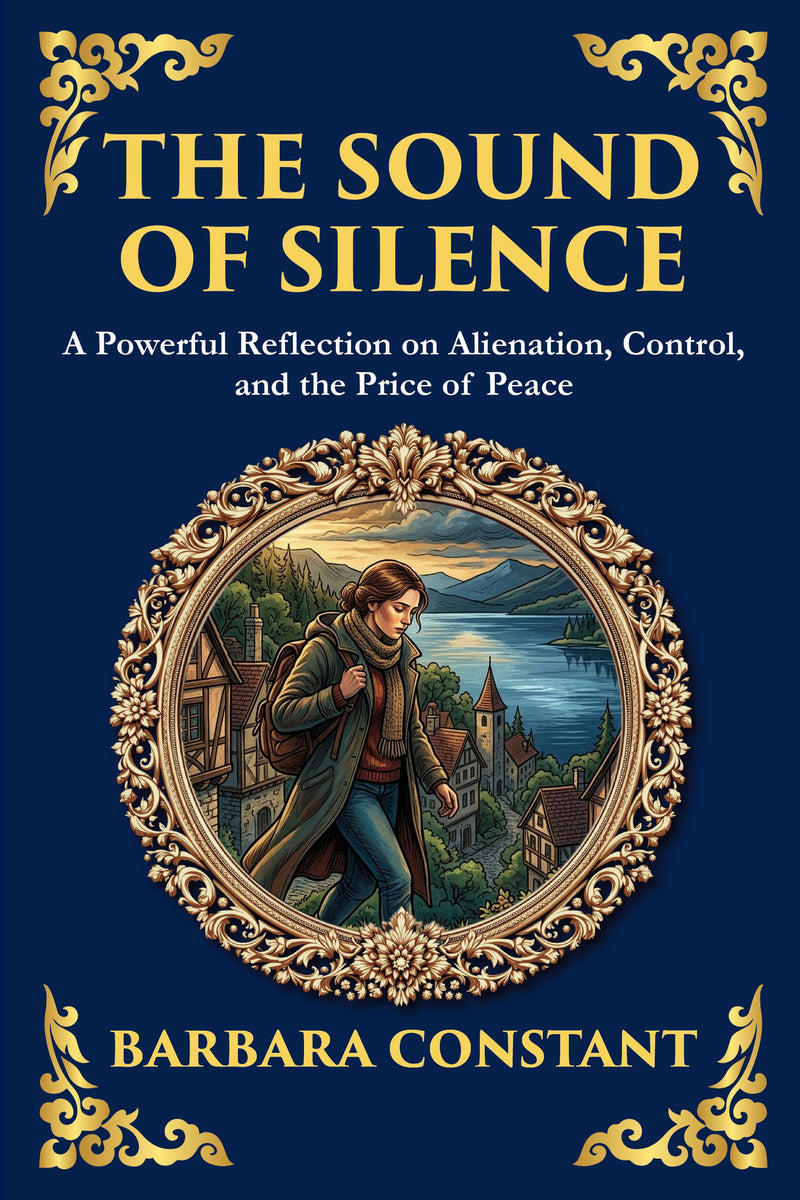
The Sound of Silence
In a world where words are outlawed and conformity is peace, one woman dares to think for herself. The Sound of Silence is a chilling dystopian tale that probes the fragile balance between security and freedom, and questions the true cost of silence.
or free app
10,000+ hrs library
30-day guarantee
The complete The Sound of Silence appears in modern English through Library of Alexandria Press, available online with audiobook narration included for members.
Have you ever wondered why true peace often begins with the courage to speak? The Sound of Silence by Barbara Constant is a provocative and unforgettable dystopian story about what happens when silence becomes law—and thinking becomes rebellion. In this tightly wound narrative, we enter a future society where speech is criminalized, emotions are suppressed, and peace is enforced not through mutual understanding, but through absolute control.
The protagonist, a woman once loyal to the regime, begins to notice the cracks in the stillness surrounding her. Haunted by distant memories of laughter, music, and defiance, she slowly uncovers the truth behind the state’s obsession with silence. As she awakens to her own stolen voice, she faces an impossible choice: conform to survive, or speak to truly live.
Constant’s masterwork stands alongside dystopian classics like 1984, Fahrenheit 451, and The Giver, offering a uniquely female lens on psychological control and cultural erasure.
What you’ll discover in this modern edition
- A Future Where Words Are Weapons – Explore a society where speech, sound, and even free thought are outlawed.
- A Quiet Resistance – Witness the journey of a woman who dares to reclaim her voice in a world that punishes expression.
- Themes of Alienation and Identity – Delve into what it means to be human when culture, creativity, and language are stripped away.
- A Powerful Social Allegory – Reflects real-world fears of censorship, mass surveillance, and emotional suppression.
- Written with Lyrical Precision – Barbara Constant’s prose is spare, piercing, and profoundly resonant. If you're drawn to stories of individual courage in the face of totalitarian quietude, The Sound of Silence is a must-read.
| Formats | eBook (EPUB + PDF) · Audiobook · Paperback · Hardcover · Large Print |
| Language | English |
| Trim size (print) | 6 × 9 in |
| Binding | Paperback — perfect-bound · Hardcover — casewrap |
| Large Print edition | Same text in a larger, easy-read type — a larger font, not a larger trim |
| Print pricing | Every physical book at our true cost — at-cost, no profit (members) |
| Library | 873 restored titles, always growing |
| Length | 8,967 words · ~36 min reading |
| Reading level | Grade 5 · an easy, flowing read (this modern-English edition) |
| Edition | Modern English translation · 2026 |
Member reviews for this edition are collected as readers finish it — be the first. Across the library: 12,000+ books shipped, every plan covered by a 365-day print guarantee.
About this edition
A faithful, unabridged modern-English edition by The Library of Alexandria — carefully rendered for today's reader and verified paragraph-by-paragraph against the public-domain source. Available as eBook, audiobook, paperback, hardcover, and large print.
- Complete & unabridgedVerified paragraph by paragraph against the source — never a scan, never abridged.
- Modern English, faithfulReadable today, with the author’s meaning kept intact. Readable — not simplified.
- Every format, one membershipRead in your browser or the free app, or listen to the full audiobook.
Included free with your membership
Cancel anytime, one click · 30-day money-back guarantee
Edition last updated July 2026
What’s inside
The Sound of Silence — complete and unabridged, included in full with membership, plus the full audiobook.
Begin reading The Sound of Silence
In clear modern English — the complete text is included with membership.
Introduction
There are stories that arrive quietly, the way the most unsettling truths often do. They do not announce themselves with spectacle or fanfare. Instead, they slip in through the smallest cracks in our certainties, asking questions we have spent a lifetime avoiding. The Sound of Silence is one of those stories. It is a work that lingers in the spaces between words, in the unspoken agreements that hold societies together, and in the private bargains each of us makes to keep the peace within ourselves. Barbara Constant has given us not merely a narrative but a mirror—one that reflects back the costs of comfort, the seductions of control, and the strange, aching loneliness that can exist even at the very heart of belonging.
This edition presents the work in a modern translation, carefully adapted for the contemporary reader. That phrase, “adapted for the contemporary reader,” deserves a moment of consideration before you begin, because it shapes the experience awaiting you. What you hold is a bridge between an original vision and the present moment, an attempt to carry forward the essential power of a story while smoothing the linguistic and cultural distances that time inevitably creates. The intention is never to diminish or simplify, but to clarify—to allow the emotional and intellectual force of the work to reach you with the same immediacy it once possessed for its earliest audiences. In doing so, this edition honors a long and noble tradition: the belief that great ideas should not be locked away behind the bars of archaic phrasing or obscure reference, but should remain alive, breathing, and available to each new generation that seeks them.
The title itself is a paradox, and paradoxes are where this book lives most comfortably. Silence is not, as we so often assume, an absence. It is a presence—dense, textured, and capable of carrying enormous meaning. We speak of “an awkward silence,” “a respectful silence,” “a deafening silence,” and in each phrase we acknowledge, almost without realizing it, that silence can be louder than any noise. It can be a refuge or a prison. It can be the sound of peace settling over a weary mind, or it can be the sound of something vital being suppressed, swallowed, erased. The genius of this work lies in its refusal to let us settle on a single interpretation. Throughout these pages, silence shifts and transforms, sometimes comforting, sometimes menacing, always significant.
Consider how much of our own lives is governed by what goes unsaid. The conversations we choose not to have. The questions we decide not to ask. The objections we swallow in the name of harmony, of efficiency, of not making waves. Constant understands this intimately, and she builds her reflection upon the recognition that the most profound forms of control are rarely loud. They do not always come with shouting or force. More often, they arrive softly, dressed as kindness, as order, as the reasonable solution to a difficult problem. We accept them because resistance seems exhausting, because the alternative seems chaotic, because—and this is perhaps the hardest truth the book asks us to confront—we have come to prefer the quiet.
This is the central tension that gives the work its haunting power: the relationship between peace and price. We all want peace. We long for it in our homes, our communities, our inner lives. But peace, the book gently insists, is never free. There is always a cost, and the question is whether we are willing to look that cost squarely in the face or whether we would rather avert our eyes and enjoy the calm. What do we surrender to feel safe? What parts of ourselves do we mute to fit in? What do we agree not to notice so that the machinery of our lives can keep running smoothly? These are not abstract philosophical puzzles. They are the daily negotiations of every human being who has ever lived within a family, a workplace, a nation. Constant takes these ordinary compromises and holds them up to a light so unflinching that we cannot help but see ourselves reflected in them.
The theme of alienation runs like a deep underground current beneath everything. There is a particular kind of loneliness that the modern world has perfected—the experience of being surrounded by others and yet profoundly disconnected, of participating in the rituals of community while feeling like a stranger observing from behind glass. The book captures this sensation with extraordinary precision. Its characters move through their world performing the expected gestures, speaking the expected words, and yet something essential remains locked away, unreachable, untouched. This is alienation not as dramatic exile but as a quiet, internal exile—the kind that can coexist with apparent normalcy, the kind that smiles at dinner parties and answers politely when asked how it is doing. Many readers will recognize this feeling with an uncomfortable jolt of familiarity, because it is among the defining afflictions of our age.
What makes Constant’s treatment of alienation so resonant is her refusal to treat it as a personal failing. The isolation her characters experience is not simply the result of bad choices or weak character. It is, in large part, structural—built into the very systems that promise connection and belonging. This is a crucial insight, and it elevates the book from a private meditation into something approaching social analysis. The forces that pull people apart, that hollow out their relationships and leave them estranged from one another and from themselves, are often the same forces that present themselves as guarantors of stability and order. The book asks us to consider whether the systems we trust to bring us together might, in fact, be the very things driving us apart—and whether the peace they offer is worth the alienation they require.
Control, the third great theme, threads through the others and binds them together. Here, too, the book resists easy answers. Control is not presented as simply evil, nor are those who exercise it cast as straightforward villains. Constant is far too sophisticated for such crude moralizing. Instead, she shows us how control often emerges from genuine desires—the desire for safety, for predictability, for an end to suffering and disorder. The most chilling forms of control in these pages are not the obvious tyrannies we are taught to fear, but the subtle, well-intentioned, even loving forms that creep in under the banner of helping, protecting, and improving. This is what gives the book its sustained tension. We are never entirely sure whether what we are witnessing is salvation or subjugation, care or captivity. And that uncertainty is precisely the point.
A word about the experience of reading a work in modern translation, because it matters to how you will encounter these pages. There is sometimes a suspicion that to translate or adapt a work is to betray it, to dilute its purity or strip away its authenticity. But this suspicion misunderstands the living nature of literature. Every act of reading is, in a sense, an act of translation—a movement of meaning from the page into the mind, across the gap of time, culture, and individual experience. When a work is rendered into contemporary language, it is not being weakened; it is being released. It is being freed from the incidental barriers that would otherwise keep it from reaching the very readers who most need to hear what it has to say.
The adaptation you are about to read has been undertaken with a deep respect for the original spirit of the work. The aim throughout has been to preserve what is essential—the emotional truth, the intellectual provocation, the atmosphere of mounting unease and quiet revelation—while ensuring that the prose moves with the rhythm and clarity that contemporary readers expect. Where the original might have relied on conventions or references that have faded with time, the adaptation seeks to render their underlying meaning in terms that resonate today. This is delicate work, requiring a constant balancing act between fidelity and accessibility, between honoring the past and serving the present. The result, I hope you will find, is a reading experience that feels both timeless and immediate, both rooted in its origins and vibrantly alive in your hands.
It is worth pausing to appreciate why this particular work has earned the effort of such careful adaptation. Not every story merits the labor of bringing it across the divide of time and language. The ones that do are those whose concerns transcend their original moment—works that speak not only to the conditions of their making but to something enduring in the human situation. The Sound of Silence belongs unmistakably to this category. Its meditation on the price of peace, on the seductions of control, and on the loneliness woven into modern existence speaks to dilemmas that have only intensified in our own era. We live in a time of unprecedented connection and unprecedented isolation, of remarkable comfort and pervasive unease, of systems that promise to manage every aspect of our lives in exchange for our quiet consent. The questions this book raises are not relics of an earlier age. They are the urgent questions of now.
As you read, you may find yourself recognizing patterns in your own life and in the world around you. This is not accidental. The most powerful works of reflection function as instruments of recognition—they name things we have felt but could not articulate, they give shape to anxieties we have carried without understanding, they make visible the invisible structures that govern our days. There is a peculiar relief in this, even when the truths revealed are uncomfortable. To see clearly is itself a form of liberation, however small. And so I would encourage you to read not as a passive observer but as an active participant, allowing the book’s questions to become your own, allowing its silences to provoke your own reflections, allowing its disquiet to disturb your own comfortable assumptions.
There is also a deep pleasure to be found here, and it would be a disservice to suggest that this is merely a grim or didactic work. Constant is a writer of genuine artistry, and the experience of reading her is one of immersion and discovery. Her prose has a hypnotic quality, drawing you steadily into a world that feels at once familiar and subtly wrong, like a reflection glimpsed in a slightly warped mirror. There is craft in how she builds atmosphere, in how she controls the release of information, in how she makes you complicit in the unfolding of events even as you sense that something is amiss. The reading experience is one of accumulating tension, of pieces slowly fitting together, of a picture gradually coming into focus that you may not be entirely prepared to see. This is storytelling of a high order, and it rewards the patient, attentive reader with an experience that resonates long after the final page.
I want to offer a few thoughts on how best to approach what lies ahead, not as prescriptions but as invitations. This is a book that rewards a certain quality of attention—a willingness to sit with discomfort, to resist the urge to resolve every ambiguity, to dwell in the uncertain spaces the author so deliberately creates. Our instinct, trained by a culture of instant answers and tidy conclusions, is often to demand resolution, to want to know who is right and who is wrong, what we should think and how we should feel. But this work asks something different of us. It asks us to hold competing possibilities in mind at once, to entertain the unsettling notion that the same action might be both rescue and ruin, that the same silence might be both peace and erasure. The richness of the experience depends on your willingness to remain open, to let the questions breathe rather than rushing to close them.
Read slowly, if you can. This is not a book to be raced through in pursuit of plot, though it certainly will compel you forward. Its deeper rewards reveal themselves to those who linger over its details, who notice the recurring images and motifs, who pay attention to what is said and, more importantly, to what is left unsaid. The title is a clue here as well: listen for the silences. Notice the moments when characters do not speak, when a question goes unanswered, when a subject is conspicuously avoided. In these gaps, the book conducts much of its most important work. The unspoken is never empty. It is charged with meaning, heavy with implication, alive with everything that cannot or will not be said aloud.
Cancel anytime, one click · 30-day money-back guarantee
Founding annual rate available now — your price locks for life when you join.
Not ready? Get this free chapter by email — read it anytime.
✓ Sent — check your inbox for The Sound of Silence.
Questions about The Sound of Silence
What is The Sound of Silence about?
In a world where words are outlawed and conformity is peace, one woman dares to think for herself. The Sound of Silence is a chilling dystopian tale that probes the fragile balance between security and freedom, and questions the true cost of silence. When society trades chaos for enforced harmony, even thought becomes dangerous.
Who wrote The Sound of Silence?
The Sound of Silence was written by Barbara Constant. This edition presents the complete work in clear modern English, faithfully rendered from the public-domain original by Library of Alexandria Press.
Is The Sound of Silence free to read?
The opening chapter is free to read on this page. Members read and listen to the complete work — and the entire library — free, and can order any physical book at our true print cost.
How long is The Sound of Silence?
2 chapters (~8,967 words) — about 36 min of reading in this modern-English edition.
Is this an abridged version of The Sound of Silence?
No. This is the complete, unabridged The Sound of Silence, carefully rendered into clear modern English and verified paragraph-by-paragraph against the public-domain source — nothing is cut or summarised.
What formats does The Sound of Silence come in?
The Sound of Silence is available as eBook, paperback, hardcover and large print. eBook and audiobook are included with membership; printed editions ship at our true print cost.
Shipping & returns
Billing & membership
More from the library


Explore Free eBooks
- Kant's Prolegomena to Any Future Metaphysics · Immanuel Kant
- The Advancement of Learning · Francis Bacon
- The Dawn of Day · Friedrich Nietzsche
- Peter and Wendy · J. M. Barrie
- Meditations · Marcus Aurelius
- The Confessions of St. Augustine · Saint Augustine of Hippo
- Resurrection · Leo Tolstoy
- Dialogues Concerning Natural Religion · David Hume
- As You Like It · William Shakespeare
- Jack and Jill · Louisa May Alcott
- Dream Psychology: Psychoanalysis for Beginners · Sigmund Freud
- The Raven · Edgar Allan Poe
- Considerations on Representative Government · John Stuart Mill
- The Will to Power: An Attempted Transvaluation of All Values. Book III and IV · Friedrich Nietzsche
- Tarzan of the Apes · Edgar Rice Burroughs
- Fundamental Principles of the Metaphysic of Morals · Immanuel Kant
- The Confessions of Jean Jacques Rousseau — Complete · Jean-Jacques Rousseau
- The Merchant of Venice · William Shakespeare
- Democracy in America — Volume 2 · Alexis de Tocqueville
- Ecce Homo · Friedrich Wilhelm Nietzsche
- Second Treatise of Government · John Locke
- The Wonderful Wizard of Oz · L. Frank Baum
- The Prince · Niccolò Machiavelli
- Anne of Green Gables · L. M. Montgomery
- De Profundis · Oscar Wilde
- Thus Spake Zarathustra: A Book for All and None · Friedrich Nietzsche
- Anna Karenina · Leo Tolstoy
- Great Expectations · Charles Dickens
- The Island of Doctor Moreau · H. G. Wells
- A Midsummer Night's Dream · William Shakespeare
The Sound of Silence
The Sound of Silence
A Powerful Reflection on Alienation, Control, and the Price of Peace
Barbara Constant
Contents
- Introduction
- The Sound of Silence
Introduction
There are stories that arrive quietly, the way the most unsettling truths often do. They do not announce themselves with spectacle or fanfare. Instead, they slip in through the smallest cracks in our certainties, asking questions we have spent a lifetime avoiding. The Sound of Silence is one of those stories. It is a work that lingers in the spaces between words, in the unspoken agreements that hold societies together, and in the private bargains each of us makes to keep the peace within ourselves. Barbara Constant has given us not merely a narrative but a mirror—one that reflects back the costs of comfort, the seductions of control, and the strange, aching loneliness that can exist even at the very heart of belonging.
This edition presents the work in a modern translation, carefully adapted for the contemporary reader. That phrase, “adapted for the contemporary reader,” deserves a moment of consideration before you begin, because it shapes the experience awaiting you. What you hold is a bridge between an original vision and the present moment, an attempt to carry forward the essential power of a story while smoothing the linguistic and cultural distances that time inevitably creates. The intention is never to diminish or simplify, but to clarify—to allow the emotional and intellectual force of the work to reach you with the same immediacy it once possessed for its earliest audiences. In doing so, this edition honors a long and noble tradition: the belief that great ideas should not be locked away behind the bars of archaic phrasing or obscure reference, but should remain alive, breathing, and available to each new generation that seeks them.
The title itself is a paradox, and paradoxes are where this book lives most comfortably. Silence is not, as we so often assume, an absence. It is a presence—dense, textured, and capable of carrying enormous meaning. We speak of “an awkward silence,” “a respectful silence,” “a deafening silence,” and in each phrase we acknowledge, almost without realizing it, that silence can be louder than any noise. It can be a refuge or a prison. It can be the sound of peace settling over a weary mind, or it can be the sound of something vital being suppressed, swallowed, erased. The genius of this work lies in its refusal to let us settle on a single interpretation. Throughout these pages, silence shifts and transforms, sometimes comforting, sometimes menacing, always significant.
Consider how much of our own lives is governed by what goes unsaid. The conversations we choose not to have. The questions we decide not to ask. The objections we swallow in the name of harmony, of efficiency, of not making waves. Constant understands this intimately, and she builds her reflection upon the recognition that the most profound forms of control are rarely loud. They do not always come with shouting or force. More often, they arrive softly, dressed as kindness, as order, as the reasonable solution to a difficult problem. We accept them because resistance seems exhausting, because the alternative seems chaotic, because—and this is perhaps the hardest truth the book asks us to confront—we have come to prefer the quiet.
This is the central tension that gives the work its haunting power: the relationship between peace and price. We all want peace. We long for it in our homes, our communities, our inner lives. But peace, the book gently insists, is never free. There is always a cost, and the question is whether we are willing to look that cost squarely in the face or whether we would rather avert our eyes and enjoy the calm. What do we surrender to feel safe? What parts of ourselves do we mute to fit in? What do we agree not to notice so that the machinery of our lives can keep running smoothly? These are not abstract philosophical puzzles. They are the daily negotiations of every human being who has ever lived within a family, a workplace, a nation. Constant takes these ordinary compromises and holds them up to a light so unflinching that we cannot help but see ourselves reflected in them.
The theme of alienation runs like a deep underground current beneath everything. There is a particular kind of loneliness that the modern world has perfected—the experience of being surrounded by others and yet profoundly disconnected, of participating in the rituals of community while feeling like a stranger observing from behind glass. The book captures this sensation with extraordinary precision. Its characters move through their world performing the expected gestures, speaking the expected words, and yet something essential remains locked away, unreachable, untouched. This is alienation not as dramatic exile but as a quiet, internal exile—the kind that can coexist with apparent normalcy, the kind that smiles at dinner parties and answers politely when asked how it is doing. Many readers will recognize this feeling with an uncomfortable jolt of familiarity, because it is among the defining afflictions of our age.
What makes Constant’s treatment of alienation so resonant is her refusal to treat it as a personal failing. The isolation her characters experience is not simply the result of bad choices or weak character. It is, in large part, structural—built into the very systems that promise connection and belonging. This is a crucial insight, and it elevates the book from a private meditation into something approaching social analysis. The forces that pull people apart, that hollow out their relationships and leave them estranged from one another and from themselves, are often the same forces that present themselves as guarantors of stability and order. The book asks us to consider whether the systems we trust to bring us together might, in fact, be the very things driving us apart—and whether the peace they offer is worth the alienation they require.
Control, the third great theme, threads through the others and binds them together. Here, too, the book resists easy answers. Control is not presented as simply evil, nor are those who exercise it cast as straightforward villains. Constant is far too sophisticated for such crude moralizing. Instead, she shows us how control often emerges from genuine desires—the desire for safety, for predictability, for an end to suffering and disorder. The most chilling forms of control in these pages are not the obvious tyrannies we are taught to fear, but the subtle, well-intentioned, even loving forms that creep in under the banner of helping, protecting, and improving. This is what gives the book its sustained tension. We are never entirely sure whether what we are witnessing is salvation or subjugation, care or captivity. And that uncertainty is precisely the point.
A word about the experience of reading a work in modern translation, because it matters to how you will encounter these pages. There is sometimes a suspicion that to translate or adapt a work is to betray it, to dilute its purity or strip away its authenticity. But this suspicion misunderstands the living nature of literature. Every act of reading is, in a sense, an act of translation—a movement of meaning from the page into the mind, across the gap of time, culture, and individual experience. When a work is rendered into contemporary language, it is not being weakened; it is being released. It is being freed from the incidental barriers that would otherwise keep it from reaching the very readers who most need to hear what it has to say.
The adaptation you are about to read has been undertaken with a deep respect for the original spirit of the work. The aim throughout has been to preserve what is essential—the emotional truth, the intellectual provocation, the atmosphere of mounting unease and quiet revelation—while ensuring that the prose moves with the rhythm and clarity that contemporary readers expect. Where the original might have relied on conventions or references that have faded with time, the adaptation seeks to render their underlying meaning in terms that resonate today. This is delicate work, requiring a constant balancing act between fidelity and accessibility, between honoring the past and serving the present. The result, I hope you will find, is a reading experience that feels both timeless and immediate, both rooted in its origins and vibrantly alive in your hands.
It is worth pausing to appreciate why this particular work has earned the effort of such careful adaptation. Not every story merits the labor of bringing it across the divide of time and language. The ones that do are those whose concerns transcend their original moment—works that speak not only to the conditions of their making but to something enduring in the human situation. The Sound of Silence belongs unmistakably to this category. Its meditation on the price of peace, on the seductions of control, and on the loneliness woven into modern existence speaks to dilemmas that have only intensified in our own era. We live in a time of unprecedented connection and unprecedented isolation, of remarkable comfort and pervasive unease, of systems that promise to manage every aspect of our lives in exchange for our quiet consent. The questions this book raises are not relics of an earlier age. They are the urgent questions of now.
As you read, you may find yourself recognizing patterns in your own life and in the world around you. This is not accidental. The most powerful works of reflection function as instruments of recognition—they name things we have felt but could not articulate, they give shape to anxieties we have carried without understanding, they make visible the invisible structures that govern our days. There is a peculiar relief in this, even when the truths revealed are uncomfortable. To see clearly is itself a form of liberation, however small. And so I would encourage you to read not as a passive observer but as an active participant, allowing the book’s questions to become your own, allowing its silences to provoke your own reflections, allowing its disquiet to disturb your own comfortable assumptions.
There is also a deep pleasure to be found here, and it would be a disservice to suggest that this is merely a grim or didactic work. Constant is a writer of genuine artistry, and the experience of reading her is one of immersion and discovery. Her prose has a hypnotic quality, drawing you steadily into a world that feels at once familiar and subtly wrong, like a reflection glimpsed in a slightly warped mirror. There is craft in how she builds atmosphere, in how she controls the release of information, in how she makes you complicit in the unfolding of events even as you sense that something is amiss. The reading experience is one of accumulating tension, of pieces slowly fitting together, of a picture gradually coming into focus that you may not be entirely prepared to see. This is storytelling of a high order, and it rewards the patient, attentive reader with an experience that resonates long after the final page.
I want to offer a few thoughts on how best to approach what lies ahead, not as prescriptions but as invitations. This is a book that rewards a certain quality of attention—a willingness to sit with discomfort, to resist the urge to resolve every ambiguity, to dwell in the uncertain spaces the author so deliberately creates. Our instinct, trained by a culture of instant answers and tidy conclusions, is often to demand resolution, to want to know who is right and who is wrong, what we should think and how we should feel. But this work asks something different of us. It asks us to hold competing possibilities in mind at once, to entertain the unsettling notion that the same action might be both rescue and ruin, that the same silence might be both peace and erasure. The richness of the experience depends on your willingness to remain open, to let the questions breathe rather than rushing to close them.
Read slowly, if you can. This is not a book to be raced through in pursuit of plot, though it certainly will compel you forward. Its deeper rewards reveal themselves to those who linger over its details, who notice the recurring images and motifs, who pay attention to what is said and, more importantly, to what is left unsaid. The title is a clue here as well: listen for the silences. Notice the moments when characters do not speak, when a question goes unanswered, when a subject is conspicuously avoided. In these gaps, the book conducts much of its most important work. The unspoken is never empty. It is charged with meaning, heavy with implication, alive with everything that cannot or will not be said aloud.
NOBODY at Hoskins, Haskell & Chapman, Inc. knew exactly why Lucilla Brown, G.G. Hoskins’ secretary, arrived at work half an hour early every Monday, Wednesday, and Friday. Even G.G. himself would have struggled to explain it if asked. He had occasionally wished, in a moment of frustration, that someone would just once get to the office before he did; he couldn’t imagine that this wish had prompted his attractive young secretary to start doing so three times a week—or why she had kept it up for months since that first gloomy day in March. No one asked G.G., though—not even Paul Chapman, the junior partner at the advertising firm. Paul had shown plenty of interest in Lucilla throughout the fall and winter, but by spring and summer, he seemed to have lost interest in everything. No one asked Lucilla why she left early on the days she arrived early—after all, eight hours is a full day’s work. And certainly, no one knew where Lucilla went at 4:30 on those three days—nor would anyone in the office have believed it if they had.
“Lucky Brown? Seeing a psychiatrist?” The typist would have giggled, the office boy would have snorted, and every salesman would have burst out laughing. Even Paul Chapman might have managed a smirk. A real laugh had escaped him for months—not since he had confidently asked Lucilla to marry him and she had replied, “I’m sorry, Paul—thanks, but no thanks.”
It wasn’t that seeing a psychiatrist was inherently laughable. It was 1962, after all, and there were almost as many serious articles on mental health as there were cartoons mocking psychoanalysts, even in the satire magazines. In certain cities—like Los Angeles—and certain industries—especially advertising—saying “I have a psychiatrist appointment” was a perfectly acceptable excuse to leave work early. Therefore, the idea of a secretary at one of the largest advertising firms in a prime suburb of the sprawling “City of Angels” doing so shouldn’t have seemed odd. It wouldn’t have, anyway, if the person had been anyone other than Lucilla Brown.
End of the free sample
Keep reading, free
Members read and listen to the complete book — and the entire library. Cancel anytime, one click · 30-day money-back guarantee.