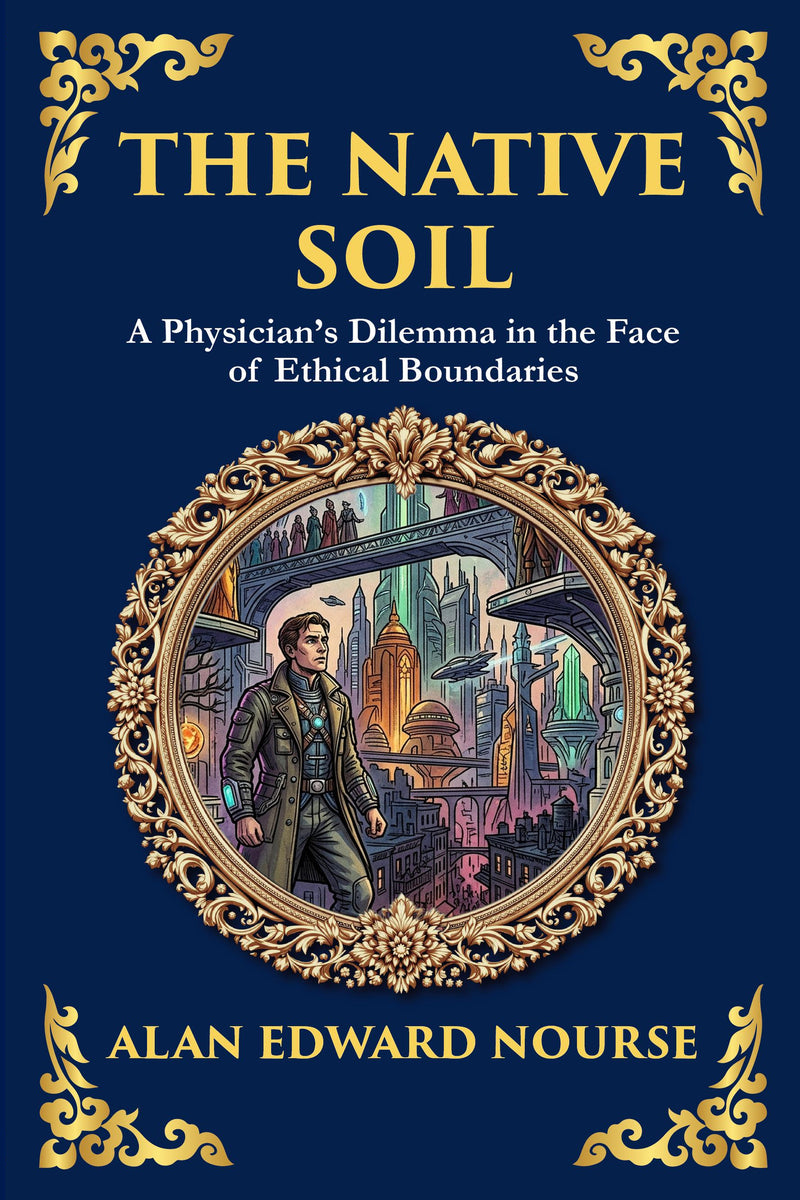
The Native Soil
When medical science collides with moral consequence, can one doctor’s conscience withstand the demands of duty? In The Native Soil, Alan Edward Nourse presents a gripping tale of science, ethics, and impossible choices.
or free app
10,000+ hrs library
30-day guarantee
The complete The Native Soil appears in modern English through Library of Alexandria Press, available online with audiobook narration included for members.
Have you ever wondered why doing the right thing sometimes means defying everything you’ve sworn to uphold? Alan Edward Nourse's The Native Soil is a haunting and thought-provoking narrative that pits a man of science against a system that demands silence, obedience, and blind allegiance. When Dr.
John Dalhousie is assigned to investigate a lethal epidemic sweeping through a distant land, he anticipates a routine humanitarian mission. But what he finds instead is a situation far more complex—and far more sinister. Behind the suffering lies a government agenda, one that values control over compassion and suppression over solution.
Faced with the agonizing choice of telling the truth or complying with orders, Dr. Dalhousie must weigh the lives of a people against the integrity of his profession—and the fate of his own soul. This modern edition brings Nourse’s powerful short story to contemporary readers, offering a chilling and relevant commentary on: Medical ethics vs. political mandates – Explore the conflict between the oath to heal and the command to obey. The moral weight of silence – Examine how truth can become a weapon and silence a betrayal. Global health and hidden agendas – Delve into the uncomfortable realities of foreign aid and intervention. The cost of integrity – Discover how one man's ethical stand becomes a battleground for conscience.
Nourse’s The Native Soil isn’t just a story—it’s a call to examine the uncomfortable truths behind the decisions that shape our world.
| Formats | eBook (EPUB + PDF) · Audiobook · Paperback · Hardcover · Large Print |
| Language | English |
| Trim size (print) | 6 × 9 in |
| Binding | Paperback — perfect-bound · Hardcover — casewrap |
| Large Print edition | Same text in a larger, easy-read type — a larger font, not a larger trim |
| Print pricing | Every physical book at our true cost — at-cost, no profit (members) |
| Library | 873 restored titles, always growing |
| Length | 9,581 words · ~38 min reading |
| Reading level | Grade 3 · an easy, flowing read (this modern-English edition) |
| Edition | Modern English translation · 2026 |
Member reviews for this edition are collected as readers finish it — be the first. Across the library: 12,000+ books shipped, every plan covered by a 365-day print guarantee.
About this edition
A faithful, unabridged modern-English edition by The Library of Alexandria — carefully rendered for today's reader and verified paragraph-by-paragraph against the public-domain source. Available as eBook, audiobook, paperback, hardcover, and large print.
- Complete & unabridgedVerified paragraph by paragraph against the source — never a scan, never abridged.
- Modern English, faithfulReadable today, with the author’s meaning kept intact. Readable — not simplified.
- Every format, one membershipRead in your browser or the free app, or listen to the full audiobook.
Included free with your membership
Cancel anytime, one click · 30-day money-back guarantee
Edition last updated July 2026
What’s inside
The Native Soil — complete and unabridged, included in full with membership, plus the full audiobook.
Begin reading The Native Soil
In clear modern English — the complete text is included with membership.
Introduction
There is a particular kind of science fiction that endures not because it predicted the future with mechanical accuracy, but because it asked the right questions about what it means to be human in a world remade by knowledge. The Native Soil belongs to this tradition. Beneath its modest surface—a tale of explorers, alien worlds, and the practical business of survival on a planet that resists every assumption brought to it—lies a quietly insistent meditation on humility, on the limits of expertise, and on the moral weight that settles upon those who hold the power to heal or to harm. Alan Edward Nourse, who wrote it, was uniquely positioned to explore these tensions. He was, after all, a physician as well as a writer, a man who understood from the inside the strange double burden of medicine: the obligation to act, and the equally pressing obligation to know when action is presumption rather than wisdom.
This new edition presents the work in a modern translation, adapted for the contemporary reader. That phrase deserves a word of explanation before we go further, because it shapes the experience you are about to have. The language of mid-century science fiction, for all its energy, can occasionally place obstacles between a reader and the story—turns of phrase that have aged, rhythms of dialogue that no longer ring true to the ear, technical asides that once felt cutting-edge and now feel quaint. The aim of this adaptation is not to rewrite Nourse or to impose a foreign sensibility upon his work, but to clear away the small frictions that accumulate over the decades, so that the intelligence and the moral seriousness of the original can reach you unobstructed. What remains is the essential Nourse: clear-eyed, compassionate, fascinated by the practical realities of how people actually solve problems, and never far from the ethical questions that give those problems their stakes.
To understand why The Native Soil feels different from much of the science fiction of its era, it helps to know something of the man who wrote it. Alan Edward Nourse was born in 1928 and trained as a doctor, earning his medical degree and practicing medicine before turning increasingly to writing. He never fully abandoned the world of medicine; rather, he carried it with him into everything he wrote. His most famous works for general readers were not science fiction at all but works of medical explanation—books that helped ordinary people understand their own bodies, their illnesses, and the choices facing them. He wrote with the patience of a good physician explaining a diagnosis: thoroughly, honestly, without condescension, and with an abiding respect for the person on the other side of the conversation.
This sensibility infuses his fiction in ways that set it apart. Where many of his contemporaries imagined the future as a procession of gleaming machines and conquering heroes, Nourse was drawn to the messier, more human dimensions of progress. He understood that knowledge is not the same as wisdom, that the ability to do something is not the same as the right to do it, and that the confident application of expertise can do as much harm as ignorance when it is not tempered by humility. These themes are not incidental to his work; they are its beating heart. A physician learns early that the patient is not a problem to be solved but a person to be served, and that the body has its own intelligence, its own logic, which the doctor must respect even when he does not fully understand it. Carry that lesson outward to the scale of worlds, and you begin to grasp the moral architecture of The Native Soil.
Nourse belonged to a generation of science fiction writers who came of age during the genre’s expansion beyond pulp adventure into something more reflective and more literate. He wrote during the years when science fiction was beginning to take itself seriously as a vehicle for ideas—not merely speculation about gadgets, but speculation about ethics, society, and the human condition under conditions that did not yet exist. His training gave him a particular advantage in this project. He knew, in a way that few of his peers could, how science actually works: not as a series of triumphant breakthroughs, but as a slow, frustrating, frequently humbling encounter with a reality that does not care about our theories. The scientist, like the physician, is forever confronting the gap between what he expects and what he finds. And it is precisely in that gap that the most interesting human dramas unfold.
The title itself, The Native Soil, rewards reflection. Soil is the ground beneath our feet, the medium from which life springs, the substance that nourishes and sustains. To call something “native” is to mark it as belonging, as original, as having a prior claim that the newcomer must reckon with. The phrase carries a quiet warning embedded in its very gentleness: that there are places where we are the visitors, the foreigners, the ones who do not understand the rules. It suggests humility before we have read a single page—the recognition that to arrive somewhere is not to own it, and that the most dangerous assumption an explorer can make is that his way of seeing is the only way, or even the correct one. This is the moral seed from which the whole book grows.
It is worth pausing, too, on what made Nourse’s voice distinctive within his profession of letters. He did not write down to his readers, but neither did he hide behind obscurity or technical jargon. His prose is lucid, his pacing humane, his characters recognizable as people rather than mouthpieces for ideas. When he wanted to explore a difficult question—and The Native Soil is built around several—he did not lecture. He dramatized. He placed human beings in situations where the question could not be avoided, and then he watched, with a clinician’s attentiveness, how they responded. The result is fiction that engages the mind without ever ceasing to engage the heart, that makes you think precisely because it first makes you care.
The Moral Struggle at the Heart of the Story
The subtitle of this edition calls the book “A Doctor’s Moral Struggle with Ethical Limits,” and that phrase points directly to the thematic core of what you are about to read. Without giving away the events of the story, it is fair to say that The Native Soil is concerned, above all, with the question of limits—with where they lie, how we recognize them, and what it costs us to honor or to ignore them.
This is a question that medicine confronts more directly than perhaps any other human enterprise. A doctor possesses, increasingly with each passing decade, the power to intervene in the most fundamental processes of life and death. But possessing the power is not the same as knowing when to use it, or whether to use it at all. The history of medicine is, in large part, a history of learning humility the hard way—of discovering that interventions undertaken with the best intentions sometimes do terrible harm, that the body’s own processes are often wiser than our attempts to override them, and that the line between healing and harming is far thinner and far harder to locate than we would like to believe. The physician who is worth anything carries this awareness with him always. It is a kind of moral vertigo, a constant questioning that never fully resolves: Should I act? Do I understand enough to act? What if I am wrong?
Nourse takes this intimate, professional dilemma and projects it onto a vastly larger canvas. What happens when human beings, armed with confidence and capability, encounter a situation they do not understand—a world, a system, a form of life that operates according to principles foreign to everything they have learned? The temptation, always, is to impose understanding, to force the unfamiliar into familiar categories, to apply solutions that worked elsewhere and assume they will work here. This is the characteristic error of the expert, and Nourse, who was an expert himself, understood it with painful clarity. Expertise breeds confidence, and confidence can blind. The very competence that makes us effective in known situations can make us dangerous in unknown ones, because it tempts us to act when we ought to observe, to prescribe when we ought to listen.
The “ethical limits” of the subtitle, then, are not merely external constraints imposed by rules or authorities. They are the limits of knowledge itself, the boundaries of what any of us can truly comprehend about a reality that does not share our assumptions. To recognize those limits requires a kind of moral courage that is, paradoxically, harder to summon than the courage to act. It is easy to be brave when bravery means doing something. It is far harder to be brave when bravery means restraint—when it means admitting that you do not understand, that your tools may not apply, that the right thing to do may be to do nothing at all until you have learned more. This is the struggle that gives the book its title and its enduring power.
What makes Nourse’s treatment of these themes so satisfying is that he never reduces them to abstraction. The moral questions arise organically from the practical situations his characters face. They are not philosophy lectures interrupted by plot; they are problems that must be solved by people who have to live with the consequences of their solutions. This is the great gift that Nourse’s medical background gave to his fiction: he understood that ethics is not a matter of theory but of decision, that the abstract question of “what is right” becomes real only in the concrete moment when someone must choose and act, often without sufficient information, often under pressure, often knowing that whatever they do will have consequences they cannot fully foresee. The physician makes such decisions every day. So do Nourse’s characters, and the reader, watching them, is invited to ask what he or she would do in their place.
There is something almost subversive in the patience the book demands. We live in a culture that prizes action, decisiveness, the bold stroke that cuts through complexity. Nourse offers a quieter and more difficult wisdom: that sometimes the most important thing is to slow down, to observe, to question one’s own certainties, to entertain the possibility that the framework through which one sees the world might be inadequate to the world as it actually is. This is not a counsel of passivity. It is a counsel of humility, which is something quite different. The humble person is not the one who refuses to act, but the one who acts with full awareness of how little he knows and how easily he might be wrong. In an age that often confuses confidence with competence and certainty with truth, this is a message worth hearing, and Nourse delivers it not as a sermon but as a story.
The reader who comes to The Native Soil expecting only the conventional pleasures of science fiction adventure—the thrill of strange worlds, the satisfaction of problems solved and obstacles overcome—will find those pleasures present and abundant. Nourse was a skilled storyteller who understood the importance of momentum, of mystery, of the satisfying click of a puzzle falling into place. But the reader who is attentive will find something more: a sustained and serious engagement with questions that matter, questions about the proper relationship between knowledge and action, between confidence and humility, between the power to change the world and the wisdom to know when that power should be withheld. These are not questions that belong to the future. They are questions that confront us now, in laboratories and hospitals and the councils where decisions about new technologies are made, and they will only grow more urgent as our power to reshape the world continues to outpace our understanding of the consequences.
It is a curious feature of the best older science fiction that it often grows more relevant rather than less as the years pass. When The Native Soil was written, many of its concerns might have seemed comfortably hypothetical—the stuff of speculation about distant futures and far-off worlds. Today they have an uncomfortable immediacy. We live in an age of extraordinary technological power, an age in which human beings can manipulate the building blocks of life, alter the climate of an entire planet, and create systems whose behavior we do not fully understand even as we deploy them. The gap between our capability and our wisdom has never been wider, and Nourse’s central preoccupation—the danger of confident intervention in systems we do not comprehend—speaks directly to the dilemmas of the present moment.
Cancel anytime, one click · 30-day money-back guarantee
Founding annual rate available now — your price locks for life when you join.
Not ready? Get this free chapter by email — read it anytime.
✓ Sent — check your inbox for The Native Soil.
Questions about The Native Soil
What is The Native Soil about?
When medical science collides with moral consequence, can one doctor’s conscience withstand the demands of duty? In The Native Soil, Alan Edward Nourse presents a gripping tale of science, ethics, and impossible choices. A skilled physician is sent on a mission to a foreign land ravaged by disease—but what he discovers challenges not only his knowledge, but his soul.
Who wrote The Native Soil?
The Native Soil was written by Alan Edward Nourse. This edition presents the complete work in clear modern English, faithfully rendered from the public-domain original by Library of Alexandria Press.
Is The Native Soil free to read?
The opening chapter is free to read on this page. Members read and listen to the complete work — and the entire library — free, and can order any physical book at our true print cost.
How long is The Native Soil?
2 chapters (~9,581 words) — about 38 min of reading in this modern-English edition.
Is this an abridged version of The Native Soil?
No. This is the complete, unabridged The Native Soil, carefully rendered into clear modern English and verified paragraph-by-paragraph against the public-domain source — nothing is cut or summarised.
What formats does The Native Soil come in?
The Native Soil is available as eBook, paperback, hardcover and large print. eBook and audiobook are included with membership; printed editions ship at our true print cost.
Shipping & returns
Billing & membership
More from the library


Explore Free eBooks
- Kant's Prolegomena to Any Future Metaphysics · Immanuel Kant
- The Advancement of Learning · Francis Bacon
- The Dawn of Day · Friedrich Nietzsche
- Peter and Wendy · J. M. Barrie
- Meditations · Marcus Aurelius
- The Confessions of St. Augustine · Saint Augustine of Hippo
- Resurrection · Leo Tolstoy
- Dialogues Concerning Natural Religion · David Hume
- As You Like It · William Shakespeare
- Jack and Jill · Louisa May Alcott
- Dream Psychology: Psychoanalysis for Beginners · Sigmund Freud
- The Raven · Edgar Allan Poe
- Considerations on Representative Government · John Stuart Mill
- The Will to Power: An Attempted Transvaluation of All Values. Book III and IV · Friedrich Nietzsche
- Tarzan of the Apes · Edgar Rice Burroughs
- Fundamental Principles of the Metaphysic of Morals · Immanuel Kant
- The Confessions of Jean Jacques Rousseau — Complete · Jean-Jacques Rousseau
- The Merchant of Venice · William Shakespeare
- Democracy in America — Volume 2 · Alexis de Tocqueville
- Ecce Homo · Friedrich Wilhelm Nietzsche
- Second Treatise of Government · John Locke
- The Wonderful Wizard of Oz · L. Frank Baum
- The Prince · Niccolò Machiavelli
- Anne of Green Gables · L. M. Montgomery
- De Profundis · Oscar Wilde
- Thus Spake Zarathustra: A Book for All and None · Friedrich Nietzsche
- Anna Karenina · Leo Tolstoy
- Great Expectations · Charles Dickens
- The Island of Doctor Moreau · H. G. Wells
- A Midsummer Night's Dream · William Shakespeare
The Native Soil
The Native Soil
A Doctor's Moral Struggle with Ethical Limits
Alan Edward Nourse
Contents
- Introduction
- The Native Soil
Introduction
There is a particular kind of science fiction that endures not because it predicted the future with mechanical accuracy, but because it asked the right questions about what it means to be human in a world remade by knowledge. The Native Soil belongs to this tradition. Beneath its modest surface—a tale of explorers, alien worlds, and the practical business of survival on a planet that resists every assumption brought to it—lies a quietly insistent meditation on humility, on the limits of expertise, and on the moral weight that settles upon those who hold the power to heal or to harm. Alan Edward Nourse, who wrote it, was uniquely positioned to explore these tensions. He was, after all, a physician as well as a writer, a man who understood from the inside the strange double burden of medicine: the obligation to act, and the equally pressing obligation to know when action is presumption rather than wisdom.
This new edition presents the work in a modern translation, adapted for the contemporary reader. That phrase deserves a word of explanation before we go further, because it shapes the experience you are about to have. The language of mid-century science fiction, for all its energy, can occasionally place obstacles between a reader and the story—turns of phrase that have aged, rhythms of dialogue that no longer ring true to the ear, technical asides that once felt cutting-edge and now feel quaint. The aim of this adaptation is not to rewrite Nourse or to impose a foreign sensibility upon his work, but to clear away the small frictions that accumulate over the decades, so that the intelligence and the moral seriousness of the original can reach you unobstructed. What remains is the essential Nourse: clear-eyed, compassionate, fascinated by the practical realities of how people actually solve problems, and never far from the ethical questions that give those problems their stakes.
To understand why The Native Soil feels different from much of the science fiction of its era, it helps to know something of the man who wrote it. Alan Edward Nourse was born in 1928 and trained as a doctor, earning his medical degree and practicing medicine before turning increasingly to writing. He never fully abandoned the world of medicine; rather, he carried it with him into everything he wrote. His most famous works for general readers were not science fiction at all but works of medical explanation—books that helped ordinary people understand their own bodies, their illnesses, and the choices facing them. He wrote with the patience of a good physician explaining a diagnosis: thoroughly, honestly, without condescension, and with an abiding respect for the person on the other side of the conversation.
This sensibility infuses his fiction in ways that set it apart. Where many of his contemporaries imagined the future as a procession of gleaming machines and conquering heroes, Nourse was drawn to the messier, more human dimensions of progress. He understood that knowledge is not the same as wisdom, that the ability to do something is not the same as the right to do it, and that the confident application of expertise can do as much harm as ignorance when it is not tempered by humility. These themes are not incidental to his work; they are its beating heart. A physician learns early that the patient is not a problem to be solved but a person to be served, and that the body has its own intelligence, its own logic, which the doctor must respect even when he does not fully understand it. Carry that lesson outward to the scale of worlds, and you begin to grasp the moral architecture of The Native Soil.
Nourse belonged to a generation of science fiction writers who came of age during the genre’s expansion beyond pulp adventure into something more reflective and more literate. He wrote during the years when science fiction was beginning to take itself seriously as a vehicle for ideas—not merely speculation about gadgets, but speculation about ethics, society, and the human condition under conditions that did not yet exist. His training gave him a particular advantage in this project. He knew, in a way that few of his peers could, how science actually works: not as a series of triumphant breakthroughs, but as a slow, frustrating, frequently humbling encounter with a reality that does not care about our theories. The scientist, like the physician, is forever confronting the gap between what he expects and what he finds. And it is precisely in that gap that the most interesting human dramas unfold.
The title itself, The Native Soil, rewards reflection. Soil is the ground beneath our feet, the medium from which life springs, the substance that nourishes and sustains. To call something “native” is to mark it as belonging, as original, as having a prior claim that the newcomer must reckon with. The phrase carries a quiet warning embedded in its very gentleness: that there are places where we are the visitors, the foreigners, the ones who do not understand the rules. It suggests humility before we have read a single page—the recognition that to arrive somewhere is not to own it, and that the most dangerous assumption an explorer can make is that his way of seeing is the only way, or even the correct one. This is the moral seed from which the whole book grows.
It is worth pausing, too, on what made Nourse’s voice distinctive within his profession of letters. He did not write down to his readers, but neither did he hide behind obscurity or technical jargon. His prose is lucid, his pacing humane, his characters recognizable as people rather than mouthpieces for ideas. When he wanted to explore a difficult question—and The Native Soil is built around several—he did not lecture. He dramatized. He placed human beings in situations where the question could not be avoided, and then he watched, with a clinician’s attentiveness, how they responded. The result is fiction that engages the mind without ever ceasing to engage the heart, that makes you think precisely because it first makes you care.
The Moral Struggle at the Heart of the Story
The subtitle of this edition calls the book “A Doctor’s Moral Struggle with Ethical Limits,” and that phrase points directly to the thematic core of what you are about to read. Without giving away the events of the story, it is fair to say that The Native Soil is concerned, above all, with the question of limits—with where they lie, how we recognize them, and what it costs us to honor or to ignore them.
This is a question that medicine confronts more directly than perhaps any other human enterprise. A doctor possesses, increasingly with each passing decade, the power to intervene in the most fundamental processes of life and death. But possessing the power is not the same as knowing when to use it, or whether to use it at all. The history of medicine is, in large part, a history of learning humility the hard way—of discovering that interventions undertaken with the best intentions sometimes do terrible harm, that the body’s own processes are often wiser than our attempts to override them, and that the line between healing and harming is far thinner and far harder to locate than we would like to believe. The physician who is worth anything carries this awareness with him always. It is a kind of moral vertigo, a constant questioning that never fully resolves: Should I act? Do I understand enough to act? What if I am wrong?
Nourse takes this intimate, professional dilemma and projects it onto a vastly larger canvas. What happens when human beings, armed with confidence and capability, encounter a situation they do not understand—a world, a system, a form of life that operates according to principles foreign to everything they have learned? The temptation, always, is to impose understanding, to force the unfamiliar into familiar categories, to apply solutions that worked elsewhere and assume they will work here. This is the characteristic error of the expert, and Nourse, who was an expert himself, understood it with painful clarity. Expertise breeds confidence, and confidence can blind. The very competence that makes us effective in known situations can make us dangerous in unknown ones, because it tempts us to act when we ought to observe, to prescribe when we ought to listen.
The “ethical limits” of the subtitle, then, are not merely external constraints imposed by rules or authorities. They are the limits of knowledge itself, the boundaries of what any of us can truly comprehend about a reality that does not share our assumptions. To recognize those limits requires a kind of moral courage that is, paradoxically, harder to summon than the courage to act. It is easy to be brave when bravery means doing something. It is far harder to be brave when bravery means restraint—when it means admitting that you do not understand, that your tools may not apply, that the right thing to do may be to do nothing at all until you have learned more. This is the struggle that gives the book its title and its enduring power.
What makes Nourse’s treatment of these themes so satisfying is that he never reduces them to abstraction. The moral questions arise organically from the practical situations his characters face. They are not philosophy lectures interrupted by plot; they are problems that must be solved by people who have to live with the consequences of their solutions. This is the great gift that Nourse’s medical background gave to his fiction: he understood that ethics is not a matter of theory but of decision, that the abstract question of “what is right” becomes real only in the concrete moment when someone must choose and act, often without sufficient information, often under pressure, often knowing that whatever they do will have consequences they cannot fully foresee. The physician makes such decisions every day. So do Nourse’s characters, and the reader, watching them, is invited to ask what he or she would do in their place.
There is something almost subversive in the patience the book demands. We live in a culture that prizes action, decisiveness, the bold stroke that cuts through complexity. Nourse offers a quieter and more difficult wisdom: that sometimes the most important thing is to slow down, to observe, to question one’s own certainties, to entertain the possibility that the framework through which one sees the world might be inadequate to the world as it actually is. This is not a counsel of passivity. It is a counsel of humility, which is something quite different. The humble person is not the one who refuses to act, but the one who acts with full awareness of how little he knows and how easily he might be wrong. In an age that often confuses confidence with competence and certainty with truth, this is a message worth hearing, and Nourse delivers it not as a sermon but as a story.
The reader who comes to The Native Soil expecting only the conventional pleasures of science fiction adventure—the thrill of strange worlds, the satisfaction of problems solved and obstacles overcome—will find those pleasures present and abundant. Nourse was a skilled storyteller who understood the importance of momentum, of mystery, of the satisfying click of a puzzle falling into place. But the reader who is attentive will find something more: a sustained and serious engagement with questions that matter, questions about the proper relationship between knowledge and action, between confidence and humility, between the power to change the world and the wisdom to know when that power should be withheld. These are not questions that belong to the future. They are questions that confront us now, in laboratories and hospitals and the councils where decisions about new technologies are made, and they will only grow more urgent as our power to reshape the world continues to outpace our understanding of the consequences.
It is a curious feature of the best older science fiction that it often grows more relevant rather than less as the years pass. When The Native Soil was written, many of its concerns might have seemed comfortably hypothetical—the stuff of speculation about distant futures and far-off worlds. Today they have an uncomfortable immediacy. We live in an age of extraordinary technological power, an age in which human beings can manipulate the building blocks of life, alter the climate of an entire planet, and create systems whose behavior we do not fully understand even as we deploy them. The gap between our capability and our wisdom has never been wider, and Nourse’s central preoccupation—the danger of confident intervention in systems we do not comprehend—speaks directly to the dilemmas of the present moment.
Before the first ship from Earth landed on Venus, people spent a lot of time guessing what they would find beneath the thick clouds that hid the planet’s surface from view.
Some believed the surface of Venus was a dense jungle, thick with tropical humidity, filled with slithering creatures and carnivorous plants. Another group argued fiercely that Venus was a dry desert of wind-sculpted sandstone, harsh and cruel, where dust clouds blocked out the sun. Others predicted an ocean world with almost no solid land, inhabited by giant serpents waiting with open mouths to greet the first humans.
Of course, nobody actually knew. Venus was a planet of mystery.
When the first ship from Earth finally landed, all they found was a massive amount of mud.
There was enough mud on Venus to wrap around the entire planet twice with some to spare. It was warm, wet, soggy mud—sticky and thick. In some areas it was gray, and in others it was black. In other spots, it came in various shades of brown, yellow, green, blue, and purple. But regardless of the color, it was still just mud. The few Venusian plants grew out of it; the small native Venusians lived inside it; steam rose from it and rain fell upon it, and that seemed to be the whole story. The planet of mystery wasn’t mysterious anymore. It was just messy. People stopped talking about it.
However, the technicians from the research and development team at Piper Pharmaceuticals, Inc. found a certain appeal in that Venusian mud.
They started sending cautious, top-secret reports back to headquarters after discovering exactly what was growing in the mud alongside the native Venusians. The head office quickly bought the full exploration and mining rights to the planet for a ridiculously low price. Then, in a rush of excitement, they began spending millions of dollars on ships and equipment headed for the muddy world. The Board of Directors responded to public mockery with secret smiles, rubbing their hands together in anticipation. Specialized teams of psychologists were sent to Venus to make contact with the locals; they returned thrilled, with test results proving the natives were friendly, smart, helpful, and capable. The Board of Directors rubbed their hands together even more eagerly and poured even more money into the Piper Venusian Installation.
End of the free sample
Keep reading, free
Members read and listen to the complete book — and the entire library. Cancel anytime, one click · 30-day money-back guarantee.