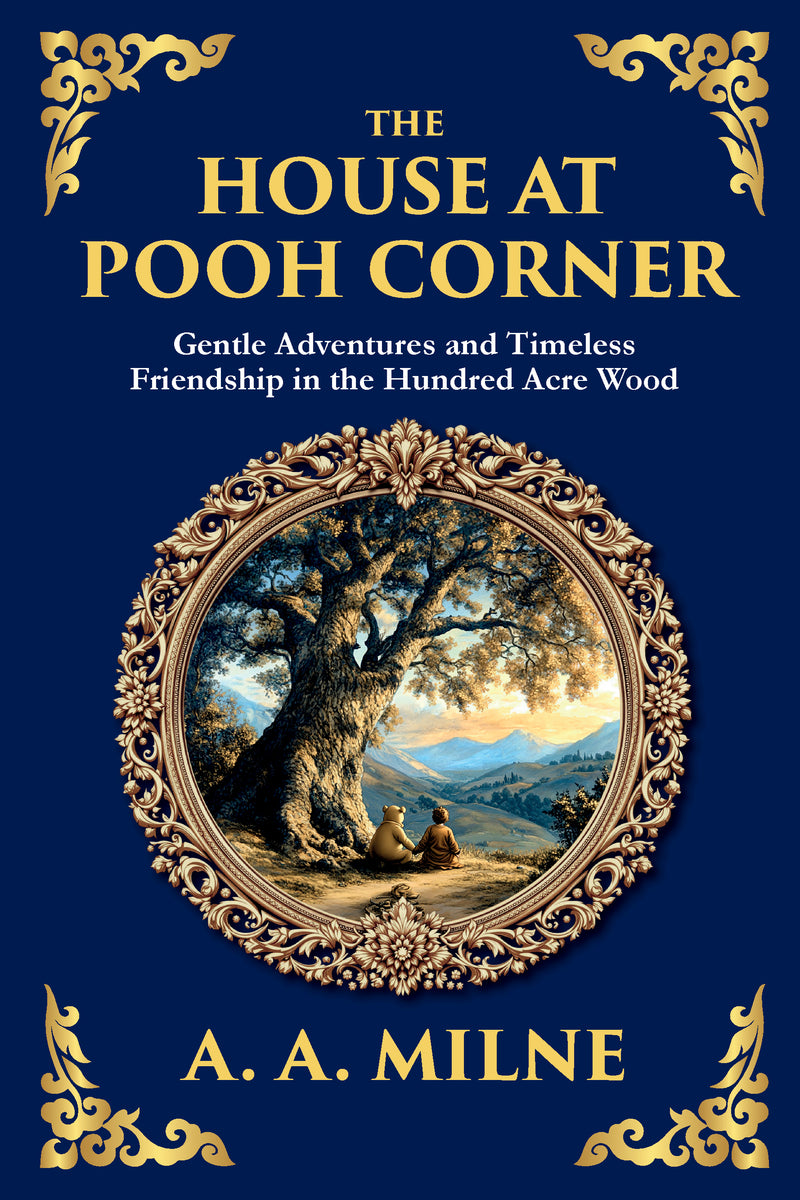
The House at Pooh Corner — Large Print
Return to the enchanting world of the Hundred Acre Wood, where friendship knows no bounds and every day brings a new gentle adventure.
or free app
10,000+ hrs library
30-day guarantee
The complete The House at Pooh Corner appears in modern English through Library of Alexandria Press, available online with audiobook narration included for members.
Have you ever wondered why the simplest days often become the most unforgettable adventures? In The House at Pooh Corner, A. A. Milne once again invites us into the tender and whimsical world of the Hundred Acre Wood, where Pooh and his friends continue to explore, imagine, and grow together. With gentle humor and heartfelt moments, this timeless sequel captures the innocence and joys of childhood in ways that speak to readers young and old.
This volume marks the first appearance of Tigger—bouncy, brave, and full of fun—who adds an extra dash of energy to the familiar group. From building Eeyore a house to searching for the elusive Heffalump, the characters take part in small yet meaningful moments that celebrate play, kindness, and togetherness. But perhaps the most touching tale of all is the quiet farewell between Christopher Robin and Pooh—an ending that reminds us of the bittersweet beauty of growing up, and the enduring comfort of memory and love.
What you’ll discover in this modern edition
- The Introduction of Tigger – Meet the endlessly energetic tiger who quickly becomes a beloved part of the Hundred Acre Wood.
- Tales of Gentle Humor and Wisdom – Enjoy stories filled with soft laughter, clever misunderstandings, and gentle life lessons.
- Endearing Adventures of Beloved Friends – From winter games to building houses, every chapter is a celebration of imagination and companionship.
- Timeless Reflections on Childhood and Change – Experience the deeply moving closing chapters where Christopher Robin begins to step into the wider world.
- A. A. Milne’s Signature Charm and Language – Relish the playful wordplay, poetic rhythm, and warmth that define Milne’s writing.
| Formats | eBook (EPUB + PDF) · Audiobook · Paperback · Hardcover · Large Print |
| Language | English |
| Trim size (print) | 6 × 9 in |
| Binding | Paperback — perfect-bound · Hardcover — casewrap |
| Large Print edition | Same text in a larger, easy-read type — a larger font, not a larger trim |
| Print pricing | Every physical book at our true cost — at-cost, no profit (members) |
| Library | 873 restored titles, always growing |
| Length | 26,461 words · ~1 hr 46 min reading |
| Reading level | Grade 7 · an easy, flowing read (this modern-English edition) |
| Edition | Modern English translation · 2026 |
Member reviews for this edition are collected as readers finish it — be the first. Across the library: 12,000+ books shipped, every plan covered by a 365-day print guarantee.
About this edition
A faithful, unabridged modern-English edition by The Library of Alexandria — carefully rendered for today's reader and verified paragraph-by-paragraph against the public-domain source. Available as eBook, audiobook, paperback, hardcover, and large print.
- Complete & unabridgedVerified paragraph by paragraph against the source — never a scan, never abridged.
- Modern English, faithfulReadable today, with the author’s meaning kept intact. Readable — not simplified.
- Every format, one membershipRead in your browser or the free app, or listen to the full audiobook.
Included free with your membership
Cancel anytime, one click · 30-day money-back guarantee
Edition last updated July 2026
What’s inside
The House at Pooh Corner — Large Print — complete and unabridged: all 11 sections included with membership, plus the full audiobook.
Begin reading The House at Pooh Corner — Large Print
In clear modern English — the complete text is included with membership.
Introduction
There are certain corners of the literary world that feel less like places we have read about and more like places we have actually been. We remember the slant of light through the trees, the particular hush of an afternoon spent doing nothing in especially good company, the warmth of a friendship that asks nothing of us except that we show up. The Hundred Acre Wood is one of those places. To open this book is not to begin an unfamiliar journey but to return — to step back through a gap in the hedge into a world that has been patiently waiting, exactly as we left it, ready to fold us once again into its slow and golden rhythms.
A. A. Milne’s beloved collection of stories about a bear of very little brain and his assorted companions has endured for the better part of a century not because it is grand or sweeping or filled with high drama, but precisely because it is none of those things. It is small. It is gentle. It concerns itself with the ordinary business of being alive among friends — with picnics and expeditions, with games invented on the spot, with the building of houses and the rescuing of one another from minor catastrophes, with the deep and serious work of doing very little at all. And yet within that smallness lives something enormous: a vision of how people might treat one another, how kindness might be practiced as a daily art, and how the most important things in life are very often the things we almost overlook.
This edition has been prepared as a modern translation, adapted thoughtfully for the contemporary reader. That phrase deserves a moment of explanation, because it might raise an eyebrow among those who hold the original prose close to their hearts — and rightly so, for the original is a treasure. What this adaptation seeks to do is not to replace the music of Milne’s language but to clear away the small obstacles that time inevitably places between a writer of one era and a reader of another. Turns of phrase that have drifted out of common use, rhythms of speech that have grown unfamiliar, idioms that once landed lightly but now require a footnote — these are smoothed and clarified so that the contemporary reader, and especially the young contemporary reader meeting these characters for the very first time, can pass directly into the heart of the matter without stumbling at the threshold.
The spirit, the gentleness, the wit, the unmistakable tenderness — all of that remains untouched, because all of that is the very substance of the book. What changes is only the surface, and only where the surface had begun to obscure rather than reveal. The aim, in every sentence, has been to honor what made these stories immortal while ensuring they continue to feel alive and immediate to readers who are coming to them across the distance of decades. If the adaptation has done its work well, you will hardly notice it at all. You will simply find yourself in the Wood, among friends, and you will not want to leave.
It is worth saying, too, that this is a book best read aloud. So much of its charm lives in the sound of it — in the spoken cadence of a conversation between a small anxious animal and a large comfortable one, in the way a song bubbles up out of nowhere and tumbles across the page, in the gentle comedy of misunderstandings that arise simply because one character has heard a word slightly differently than another intended it. Read alone, the stories are warm and lovely. Read aloud, with a child on your knee or a friend across the room, they become something closer to a shared experience of joy. The pauses matter. The silliness matters. The way a long word gets tangled on the tongue is part of the fun, not an obstacle to it. So if you are able, find a voice for these pages — your own or someone else’s — and let the words live in the air.
A Wood Full of Friends, and What They Teach Us Without Trying
The genius of these stories lies, more than anywhere else, in their characters — and in the quiet truth that each of them is recognizably, achingly human, despite being a bear, or a small pink piglet, or a gloomy grey donkey, or a bouncing creature of irrepressible energy. Milne understood something that the greatest writers for children have always understood: that the inner lives of small creatures, when drawn with honesty and affection, are large enough to contain the whole of human nature. Within this Wood you will find every kind of temperament, every kind of worry, every kind of joy. And because the characters are so vividly themselves, we recognize in them not caricatures but companions — figures who reflect back to us our own anxieties and appetites, our own loyalties and longings.
There is, of course, the bear at the center of it all, whose appetite for honey is matched only by his capacity for accidental wisdom. He is not clever, and he knows he is not clever, and he carries this knowledge without the slightest trace of shame. This is one of the most quietly radical things about him. In a world that so often measures worth by cleverness, here is a character whose value has nothing to do with how much he knows and everything to do with how he is — steady, affectionate, present, and unfailingly kind. His muddles and miscalculations never diminish him in the eyes of his friends, and they should never diminish him in ours, because what he offers is something cleverness cannot buy: a warm and constant heart, and the willingness to show up for the people he loves.
Beside him is the small companion who worries about everything, who is frightened of large things and loud noises and the unknown, and who discovers again and again that courage is not the absence of fear but the act of doing the brave thing anyway, often while trembling. There is something profoundly reassuring in this character for any reader who has ever felt too small for the world, who has ever stood at the edge of something daunting and wished to be braver. The lesson, offered without a lecture, is that smallness and fear are no barrier to love or loyalty or even heroism. The smallest among us often turn out to be the bravest when it counts.
And then there is the donkey, perhaps the most beloved of them all precisely because he is the most melancholy. He expects the worst, sees the gloomy side of everything, and carries his pessimism like a damp blanket he cannot put down. It would be easy for such a character to become tiresome, and yet he never does — because Milne treats his sadness not as a flaw to be corrected but as a part of who he is, to be accepted and loved exactly as it stands. His friends do not try to fix him or insist that he cheer up. They simply include him, again and again, and in their patient inclusion there is a model of friendship so generous that it can take the breath away. To be loved not despite one’s gloom but along with it — this is a gift the donkey receives over and over, and it is a gift the stories quietly offer to every reader who has ever felt themselves to be difficult or different or hard to love.
The cast widens from there: the energetic bouncer who arrives like a force of nature and must learn, gently, that not everyone bounces; the wise old bird who knows many long words and occasionally even what they mean; the busy, anxious organizer forever counting heads and worrying about responsibilities; the brisk and capable mother with her tiny, fearless child. Each of them brings a distinct flavor to the Wood, and the magic of the stories lies largely in how these different temperaments rub up against one another. Conflicts arise, but they are small and they are always resolved through patience, generosity, and a kind of instinctive forgiveness. Nobody in the Wood holds a grudge for long. Nobody is cast out. The community absorbs every personality, every quirk, every misunderstanding, and somehow grows warmer for it.
Presiding over all of this, half-inside the stories and half-outside them, is a boy — the one human child whose imagination holds the whole Wood together. He is the still point at the center, the one the animals turn to when things go truly wrong, the one whose love gives the place its gravity and its meaning. His presence is a reminder that this entire world springs from the boundless imaginative play of childhood, that it is, in a sense, a map of a child’s heart drawn in the shape of a forest. And this gives the stories a tender double quality: they are at once perfectly real within their own pages and quietly understood, by the adult reader, to be the precious imaginings of a young mind, the kind of imaginings that the grown-up world too often forgets how to value.
What these characters teach us, they teach without ever seeming to teach at all. There are no morals stamped at the bottom of the page, no lessons delivered with a raised finger. Instead, wisdom seeps up through the stories the way warmth seeps up through a sunny patch of grass. We learn about loyalty by watching loyalty in action. We learn about patience, about generosity, about the importance of taking others as they are. We learn that adventures need not be grand to be worthwhile, that a long expedition to nowhere in particular can be the best kind of day, that the right response to a friend in distress is simply to be there. And we learn, perhaps most importantly of all, that there is no friendship so important as the easy, undemanding kind — the kind that is content to sit together and say nothing, the kind that knows the other person well enough to predict their next thought, the kind that makes the world feel safe simply because someone you trust is in it with you.
How to Read This Book, and Why It Matters More Than Ever
To read these stories now, in our particular moment, is to receive something we may not have known we were missing. We live in a hurried age, an age of noise and notification, of relentless productivity and the nagging sense that we ought always to be doing more. The Hundred Acre Wood is the gentle and complete opposite of all this. It moves at the pace of a slow afternoon. It treats doing nothing as a legitimate and even admirable occupation. It insists, again and again, that the small things — a pot of honey, a game by the river, a visit to a friend, a song made up on the spot — are not distractions from a meaningful life but the very substance of one. There is, in this, a kind of medicine for the modern soul.
I would gently encourage you, therefore, to resist the urge to rush. These are not stories to be consumed quickly and ticked off a list. They are stories to be savored, one at a time, perhaps one a night, with long pauses to let the pleasure of each one settle. The book rewards this kind of unhurried attention. Read too fast, and the stories can seem slight; read slowly, and they reveal layer upon layer of warmth and wit and quiet profundity. The humor in particular benefits from a leisurely pace, because so much of it lives in the gaps between things, in the gentle absurdity of a character’s logic, in the comic dignity with which the most ridiculous situations are approached. Give the jokes room to breathe and they will repay you handsomely.
For the adult reader returning to these pages after many years, a particular and bittersweet pleasure awaits. You will find that the stories you remember as simple childhood entertainments are quietly threaded with feelings you could not possibly have understood as a child — feelings about the passage of time, about the inevitability of growing up, about the way that childhood, for all its golden permanence in the moment, must eventually be left behind. There is a wistfulness running beneath the surface of this book, a tender awareness that the enchanted years cannot last forever, and it is this undertone that gives the stories their surprising emotional depth. As a child, you read about the adventures. As an adult, you feel the time slipping by underneath them, and you understand at last why these tales have lodged themselves so permanently in the collective heart. Do not be surprised if you find yourself unexpectedly moved. Many readers do. The book has a way of catching grown-ups off guard, of reaching past their defenses to touch the child they used to be, and the children they themselves may now be raising.
Cancel anytime, one click · 30-day money-back guarantee
Founding annual rate available now — your price locks for life when you join.
Not ready? Get this free chapter by email — read it anytime.
✓ Sent — check your inbox for The House at Pooh Corner — Large Print.
Questions about The House at Pooh Corner — Large Print
What is The House at Pooh Corner about?
Return to the enchanting world of the Hundred Acre Wood, where friendship knows no bounds and every day brings a new gentle adventure. In The House at Pooh Corner, A. A. Milne reunites readers with Winnie-the-Pooh, Piglet, Tigger, Eeyore, and the rest of the beloved friends as they discover new places, play thoughtful games, and learn what it means to care deeply for one another. Charming, humorous, and poignantly wise, this sequel to Winnie-the-Pooh captures the fleeting beauty of childhood, the quiet strength of
Who wrote The House at Pooh Corner?
The House at Pooh Corner was written by A. A. Milne. This edition presents the complete work in clear modern English, faithfully rendered from the public-domain original by Library of Alexandria Press.
Is The House at Pooh Corner free to read?
The opening chapter is free to read on this page. Members read and listen to the complete work — and the entire library — free, and can order any physical book at our true print cost.
How long is The House at Pooh Corner?
11 chapters (~26,461 words) — about 1 hr 46 min of reading in this modern-English edition.
Is this an abridged version of The House at Pooh Corner?
No. This is the complete, unabridged The House at Pooh Corner, carefully rendered into clear modern English and verified paragraph-by-paragraph against the public-domain source — nothing is cut or summarised.
What formats does The House at Pooh Corner come in?
The House at Pooh Corner is available as eBook, paperback, hardcover and large print. eBook and audiobook are included with membership; printed editions ship at our true print cost.
Shipping & returns
Billing & membership
More from the library


Explore Children's Classics
- Jack and Jill · Louisa May Alcott
- The Wonderful Wizard of Oz · L. Frank Baum
- Peter Pan · J. M. Barrie
- The Prince and the Pauper · Mark Twain
- The Red Fairy Book · Andrew Lang
- Old Christmas: from the Sketch Book of Washington Irving · Washington Irving
- A Houseful of Girls · Sarah Tytler
- In the hollow of His hand · Hesba Stretton
- Miss Primrose · Agnes Giberne
- Five Little Peppers and How They Grew · Margaret Sidney
- The Loss of the Swansea: A Story of the Florida Coast · W. L. Alden
- Sky Island · L. Frank Baum
- The Book of Dragons · E. Nesbit
- Wild Animals I Have Known · Ernest Thompson Seton
- Skinny McCord · Percy Keese Fitzhugh
- The Hunniwell Boys and the Platinum Mystery · L. P. Wyman
- Rainbow Valley · L. M. Montgomery
- "Us and Our Donkey" · Amy Le Feuvre
- Dorothy and the Wizard in Oz · L. Frank Baum
- The Home Book of Verse — Volume 4 · Burton Egbert Stevenson
- The Story of Doctor Dolittle · Hugh Lofting
- The Tale of Benjamin Bunny · Beatrix Potter
- Fifty Famous Stories Retold · James Baldwin
- Rilla of Ingleside · L. M. Montgomery
- The House at Pooh Corner · A. A. Milne
- Rich and Humble: A Story for Young People · Oliver Optic
- The Three Bears · A. E. Kennedy
- Peter and Wendy · J. M. Barrie
- The Marvelous Land of Oz · L. Frank Baum
- Andersen’s Fairy Tales · H. C. Andersen
The House at Pooh Corner — Large Print
The House at Pooh Corner — Large Print
Sweet Adventures and Lasting Friendship in the Hundred Acre Wood
A. A. Milne
Contents
- Introduction
- Chapter 1
- Chapter 2
- Chapter 3
- Chapter 4
- Chapter 5
- Chapter 6
- Chapter 7
- Chapter 8
- Chapter 9
- Chapter 10
Introduction
There are certain corners of the literary world that feel less like places we have read about and more like places we have actually been. We remember the slant of light through the trees, the particular hush of an afternoon spent doing nothing in especially good company, the warmth of a friendship that asks nothing of us except that we show up. The Hundred Acre Wood is one of those places. To open this book is not to begin an unfamiliar journey but to return — to step back through a gap in the hedge into a world that has been patiently waiting, exactly as we left it, ready to fold us once again into its slow and golden rhythms.
A. A. Milne’s beloved collection of stories about a bear of very little brain and his assorted companions has endured for the better part of a century not because it is grand or sweeping or filled with high drama, but precisely because it is none of those things. It is small. It is gentle. It concerns itself with the ordinary business of being alive among friends — with picnics and expeditions, with games invented on the spot, with the building of houses and the rescuing of one another from minor catastrophes, with the deep and serious work of doing very little at all. And yet within that smallness lives something enormous: a vision of how people might treat one another, how kindness might be practiced as a daily art, and how the most important things in life are very often the things we almost overlook.
This edition has been prepared as a modern translation, adapted thoughtfully for the contemporary reader. That phrase deserves a moment of explanation, because it might raise an eyebrow among those who hold the original prose close to their hearts — and rightly so, for the original is a treasure. What this adaptation seeks to do is not to replace the music of Milne’s language but to clear away the small obstacles that time inevitably places between a writer of one era and a reader of another. Turns of phrase that have drifted out of common use, rhythms of speech that have grown unfamiliar, idioms that once landed lightly but now require a footnote — these are smoothed and clarified so that the contemporary reader, and especially the young contemporary reader meeting these characters for the very first time, can pass directly into the heart of the matter without stumbling at the threshold.
The spirit, the gentleness, the wit, the unmistakable tenderness — all of that remains untouched, because all of that is the very substance of the book. What changes is only the surface, and only where the surface had begun to obscure rather than reveal. The aim, in every sentence, has been to honor what made these stories immortal while ensuring they continue to feel alive and immediate to readers who are coming to them across the distance of decades. If the adaptation has done its work well, you will hardly notice it at all. You will simply find yourself in the Wood, among friends, and you will not want to leave.
It is worth saying, too, that this is a book best read aloud. So much of its charm lives in the sound of it — in the spoken cadence of a conversation between a small anxious animal and a large comfortable one, in the way a song bubbles up out of nowhere and tumbles across the page, in the gentle comedy of misunderstandings that arise simply because one character has heard a word slightly differently than another intended it. Read alone, the stories are warm and lovely. Read aloud, with a child on your knee or a friend across the room, they become something closer to a shared experience of joy. The pauses matter. The silliness matters. The way a long word gets tangled on the tongue is part of the fun, not an obstacle to it. So if you are able, find a voice for these pages — your own or someone else’s — and let the words live in the air.
A Wood Full of Friends, and What They Teach Us Without Trying
The genius of these stories lies, more than anywhere else, in their characters — and in the quiet truth that each of them is recognizably, achingly human, despite being a bear, or a small pink piglet, or a gloomy grey donkey, or a bouncing creature of irrepressible energy. Milne understood something that the greatest writers for children have always understood: that the inner lives of small creatures, when drawn with honesty and affection, are large enough to contain the whole of human nature. Within this Wood you will find every kind of temperament, every kind of worry, every kind of joy. And because the characters are so vividly themselves, we recognize in them not caricatures but companions — figures who reflect back to us our own anxieties and appetites, our own loyalties and longings.
There is, of course, the bear at the center of it all, whose appetite for honey is matched only by his capacity for accidental wisdom. He is not clever, and he knows he is not clever, and he carries this knowledge without the slightest trace of shame. This is one of the most quietly radical things about him. In a world that so often measures worth by cleverness, here is a character whose value has nothing to do with how much he knows and everything to do with how he is — steady, affectionate, present, and unfailingly kind. His muddles and miscalculations never diminish him in the eyes of his friends, and they should never diminish him in ours, because what he offers is something cleverness cannot buy: a warm and constant heart, and the willingness to show up for the people he loves.
Beside him is the small companion who worries about everything, who is frightened of large things and loud noises and the unknown, and who discovers again and again that courage is not the absence of fear but the act of doing the brave thing anyway, often while trembling. There is something profoundly reassuring in this character for any reader who has ever felt too small for the world, who has ever stood at the edge of something daunting and wished to be braver. The lesson, offered without a lecture, is that smallness and fear are no barrier to love or loyalty or even heroism. The smallest among us often turn out to be the bravest when it counts.
And then there is the donkey, perhaps the most beloved of them all precisely because he is the most melancholy. He expects the worst, sees the gloomy side of everything, and carries his pessimism like a damp blanket he cannot put down. It would be easy for such a character to become tiresome, and yet he never does — because Milne treats his sadness not as a flaw to be corrected but as a part of who he is, to be accepted and loved exactly as it stands. His friends do not try to fix him or insist that he cheer up. They simply include him, again and again, and in their patient inclusion there is a model of friendship so generous that it can take the breath away. To be loved not despite one’s gloom but along with it — this is a gift the donkey receives over and over, and it is a gift the stories quietly offer to every reader who has ever felt themselves to be difficult or different or hard to love.
The cast widens from there: the energetic bouncer who arrives like a force of nature and must learn, gently, that not everyone bounces; the wise old bird who knows many long words and occasionally even what they mean; the busy, anxious organizer forever counting heads and worrying about responsibilities; the brisk and capable mother with her tiny, fearless child. Each of them brings a distinct flavor to the Wood, and the magic of the stories lies largely in how these different temperaments rub up against one another. Conflicts arise, but they are small and they are always resolved through patience, generosity, and a kind of instinctive forgiveness. Nobody in the Wood holds a grudge for long. Nobody is cast out. The community absorbs every personality, every quirk, every misunderstanding, and somehow grows warmer for it.
Presiding over all of this, half-inside the stories and half-outside them, is a boy — the one human child whose imagination holds the whole Wood together. He is the still point at the center, the one the animals turn to when things go truly wrong, the one whose love gives the place its gravity and its meaning. His presence is a reminder that this entire world springs from the boundless imaginative play of childhood, that it is, in a sense, a map of a child’s heart drawn in the shape of a forest. And this gives the stories a tender double quality: they are at once perfectly real within their own pages and quietly understood, by the adult reader, to be the precious imaginings of a young mind, the kind of imaginings that the grown-up world too often forgets how to value.
What these characters teach us, they teach without ever seeming to teach at all. There are no morals stamped at the bottom of the page, no lessons delivered with a raised finger. Instead, wisdom seeps up through the stories the way warmth seeps up through a sunny patch of grass. We learn about loyalty by watching loyalty in action. We learn about patience, about generosity, about the importance of taking others as they are. We learn that adventures need not be grand to be worthwhile, that a long expedition to nowhere in particular can be the best kind of day, that the right response to a friend in distress is simply to be there. And we learn, perhaps most importantly of all, that there is no friendship so important as the easy, undemanding kind — the kind that is content to sit together and say nothing, the kind that knows the other person well enough to predict their next thought, the kind that makes the world feel safe simply because someone you trust is in it with you.
How to Read This Book, and Why It Matters More Than Ever
To read these stories now, in our particular moment, is to receive something we may not have known we were missing. We live in a hurried age, an age of noise and notification, of relentless productivity and the nagging sense that we ought always to be doing more. The Hundred Acre Wood is the gentle and complete opposite of all this. It moves at the pace of a slow afternoon. It treats doing nothing as a legitimate and even admirable occupation. It insists, again and again, that the small things — a pot of honey, a game by the river, a visit to a friend, a song made up on the spot — are not distractions from a meaningful life but the very substance of one. There is, in this, a kind of medicine for the modern soul.
I would gently encourage you, therefore, to resist the urge to rush. These are not stories to be consumed quickly and ticked off a list. They are stories to be savored, one at a time, perhaps one a night, with long pauses to let the pleasure of each one settle. The book rewards this kind of unhurried attention. Read too fast, and the stories can seem slight; read slowly, and they reveal layer upon layer of warmth and wit and quiet profundity. The humor in particular benefits from a leisurely pace, because so much of it lives in the gaps between things, in the gentle absurdity of a character’s logic, in the comic dignity with which the most ridiculous situations are approached. Give the jokes room to breathe and they will repay you handsomely.
For the adult reader returning to these pages after many years, a particular and bittersweet pleasure awaits. You will find that the stories you remember as simple childhood entertainments are quietly threaded with feelings you could not possibly have understood as a child — feelings about the passage of time, about the inevitability of growing up, about the way that childhood, for all its golden permanence in the moment, must eventually be left behind. There is a wistfulness running beneath the surface of this book, a tender awareness that the enchanted years cannot last forever, and it is this undertone that gives the stories their surprising emotional depth. As a child, you read about the adventures. As an adult, you feel the time slipping by underneath them, and you understand at last why these tales have lodged themselves so permanently in the collective heart. Do not be surprised if you find yourself unexpectedly moved. Many readers do. The book has a way of catching grown-ups off guard, of reaching past their defenses to touch the child they used to be, and the children they themselves may now be raising.
One day, when Winnie-the-Pooh had nothing to do, he decided he wanted to do something, so he walked over to Piglet’s house to see what he was up to. It was still snowing as he trudged along the white forest path. He expected to find Piglet warming his toes by the fire, but he was surprised to see that the door was open, and the more he looked inside, the clearer it became that Piglet wasn’t there.
“He’s out,” Pooh said sadly. “That’s the way it is. He’s not home. Now I’ll have to take a fast Thinking Walk all by myself. Bother!”
But first, he decided to knock very loudly just to be absolutely sure... and while he waited for Piglet to not answer, he jumped up and down to stay warm. Suddenly, a little tune popped into his head, which felt like a Good Hum—the kind of hum one shares hopefully with others.
“So here is my plan,” Pooh said. “I’ll go home first to check the time, and maybe I’ll put a scarf around my neck, and then I’ll go visit Eeyore and sing it to him.”
He rushed back to his house, so focused on the song he was preparing for Eeyore that when he suddenly spotted Piglet sitting in his favorite armchair, he just stood there scratching his head, wondering whose house he had walked into.
“Hello, Piglet,” he said. “I thought you had gone out.”
“No,” Piglet replied, “you were the one who went out, Pooh.”
“That’s true,” Pooh said. “I knew one of us had.”
He glanced at his clock, which had stopped at five minutes to eleven several weeks ago.
“It’s almost eleven o’clock,” Pooh said happily. “You’ve arrived just in time for a little snack,” he added, poking his head into the cupboard. “After that, Piglet, we’ll go outside and sing my song to Eeyore.”
End of the free sample
Keep reading, free
Members read and listen to the complete book — and the entire library. Cancel anytime, one click · 30-day money-back guarantee.