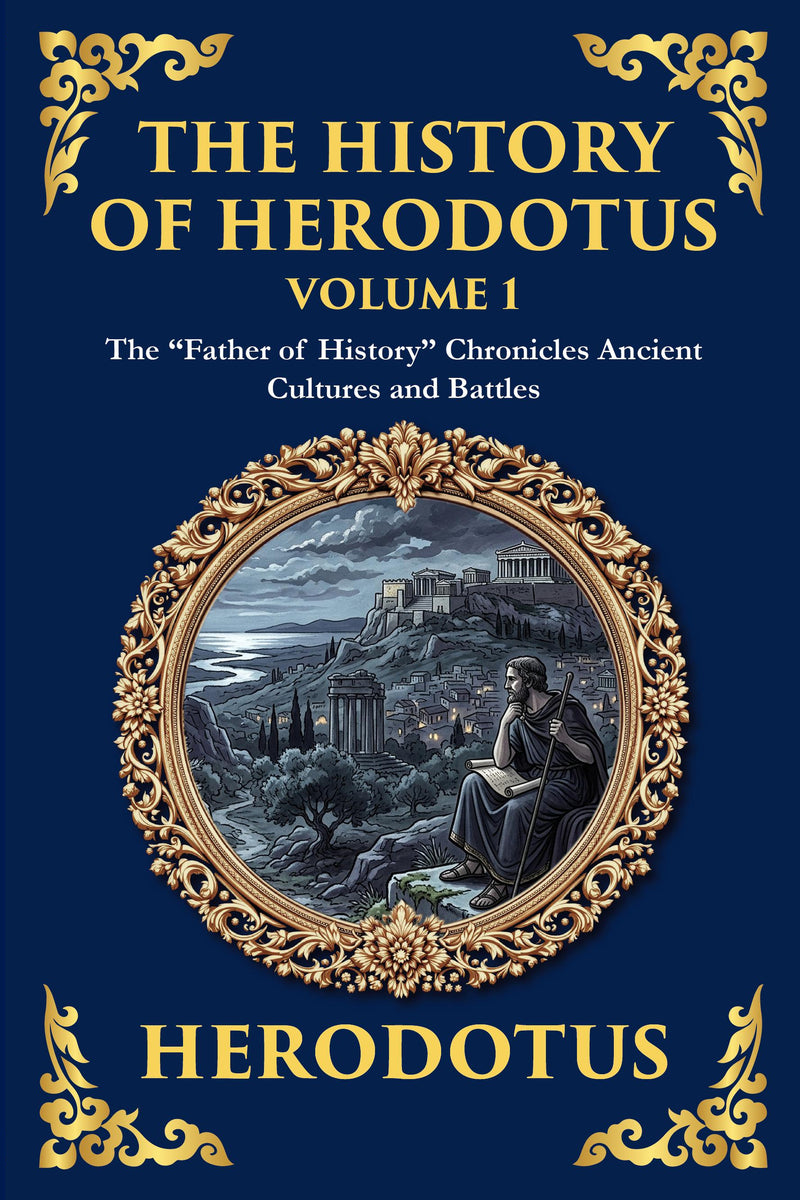
The History of Herodotus — Volume 1
Journey back to the dawn of Western history with Herodotus, the man revered as the "Father of History." In The History of Herodotus — Volume 1, ancient empires rise and fall, legendary battles are fought, and the origins of cultures are vividly brought to life.
or free app
10,000+ hrs library
30-day guarantee
The complete The History of Herodotus — Volume 1 appears in modern English through Library of Alexandria Press, available online with audiobook narration included for members.
Have you ever wondered why ancient history still shapes the world we live in today? Step into a world of kings and warriors, myths and realities, as The History of Herodotus — Volume 1 unveils the earliest known account of human history. Written by Herodotus, often hailed as the “Father of History,” this masterpiece stands at the crossroads of legend and fact, offering a fascinating glimpse into the rise and fall of ancient empires.
In this first volume, Herodotus chronicles the dramatic conflicts between the Persian Empire and the Greek city-states, capturing not only the great battles like Marathon and Thermopylae but also the beliefs, customs, and stories of diverse ancient cultures. His narrative is filled with extraordinary characters—from cunning rulers and heroic soldiers to ordinary people caught in the tides of history. This modern, accessible edition allows today’s readers to experience the grandeur and drama of Herodotus’s world while appreciating the profound lessons it offers about power, ambition, and the cyclical nature of history.
What you’ll discover in this modern edition
- The Roots of Western History – Explore the origins of ancient civilizations and their profound influence on the modern world.
- Epic Battles and Heroic Tales – Relive legendary confrontations like Marathon, Salamis, and Thermopylae through Herodotus’s vivid storytelling.
- Myths, Legends, and Culture – Discover the fascinating customs, beliefs, and myths that shaped ancient societies.
- The Persian-Greek Conflict Unfolds – Witness the clash of two great civilizations as they battle for dominance and survival.
- Timeless Lessons on Human Nature – Reflect on ambition, hubris, and the enduring consequences of historical decisions.
| Formats | eBook (EPUB + PDF) · Audiobook · Paperback · Hardcover · Large Print |
| Language | English |
| Trim size (print) | 6 × 9 in |
| Binding | Paperback — perfect-bound · Hardcover — casewrap |
| Large Print edition | Same text in a larger, easy-read type — a larger font, not a larger trim |
| Print pricing | Every physical book at our true cost — at-cost, no profit (members) |
| Library | 873 restored titles, always growing |
| Length | 118,179 words · ~7 hr 53 min reading |
| Reading level | Grade 3 · an easy, flowing read (this modern-English edition) |
| Edition | Modern English translation · 2026 |
Member reviews for this edition are collected as readers finish it — be the first. Across the library: 12,000+ books shipped, every plan covered by a 365-day print guarantee.
About this edition
A faithful, unabridged modern-English edition by The Library of Alexandria — carefully rendered for today's reader and verified paragraph-by-paragraph against the public-domain source. Available as eBook, audiobook, paperback, hardcover, and large print.
- Complete & unabridgedVerified paragraph by paragraph against the source — never a scan, never abridged.
- Modern English, faithfulReadable today, with the author’s meaning kept intact. Readable — not simplified.
- Every format, one membershipRead in your browser or the free app, or listen to the full audiobook.
Included free with your membership
Cancel anytime, one click · 30-day money-back guarantee
Edition last updated July 2026
What’s inside
The History of Herodotus — Volume 1 — complete and unabridged: all 5 sections included with membership, plus the full audiobook.
Begin reading The History of Herodotus — Volume 1
In clear modern English — the complete text is included with membership.
Introduction
When you open the pages that follow, you are stepping into the company of the very first person in the Western tradition to attempt something that now seems utterly natural to us: to investigate the past, to gather what people remember, to weigh competing accounts, and to set it all down so that the deeds of men and women might not fade with the passing of generations. The word he used to describe his project was historiē, which in his native Greek meant something closer to “inquiry” or “investigation” than to the orderly chronicle we associate with the word “history” today. From that single Greek term, and from this single sprawling, curious, generous book, descends an entire way of thinking about ourselves and the world we inhabit. To read Herodotus is to witness the birth of an idea, and few experiences in literature are as exhilarating as standing at the source of a great river that has since watered the imagination of civilizations.
The author who undertook this monumental task lived in the fifth century before the common era, born in Halicarnassus, a Greek city on the southwestern coast of what is now Turkey. This was a borderland in the truest sense, a place where the Greek world brushed against the vast and dazzling empires of the East. Such a vantage point shaped everything about the man and his work. He was neither a pure insider nor a pure outsider but something more valuable: a traveler with one foot in each world, equipped with the restless curiosity of someone who has seen enough to know that his own customs are not the only reasonable way to live. He journeyed, by his own account, to Egypt and into the lands of the Black Sea, to the islands of the Aegean and perhaps as far as Babylon, talking to priests and sailors, soldiers and merchants, asking endless questions, and assembling the great mosaic that lies before you now.
It is worth pausing at the very beginning to address the famous title bestowed upon him by later generations: the Father of History. The Roman statesman Cicero gave him this honorific, and it has clung to his name ever since. But it is a title that carries a faint sting, because Herodotus has also been called, less charitably, the Father of Lies. The two accusations are bound together, and understanding the tension between them is one of the keys to enjoying this work as it deserves to be enjoyed. Herodotus collected everything. He recorded what he was told, and when he found two contradictory versions of an event, he often gave you both and let you decide. He noted when he believed a story and when he doubted it, frequently with a phrase that amounts to “this is what they say, but I am only obliged to report it, not to believe it.” For centuries, scholars who prized precision above all else regarded this method as a kind of credulous gullibility. They wanted facts, hard and verifiable, and they were impatient with a writer who would happily relay a tale of gold-digging ants the size of foxes or of a people who slept for half the year.
Yet the modern reader, freed from the narrow demand that history be only a ledger of confirmed fact, can appreciate something the older critics missed. Herodotus was not merely a recorder of events; he was a recorder of what people believed, what they feared, what they boasted about, what stories they told to explain themselves to strangers. In doing so, he preserved not only the bones of the past but its living tissue: its rumors, its prejudices, its wonders, its sense of meaning. When a modern archaeologist’s spade turns up evidence that confirms one of his seemingly fanciful claims, as has happened more than once, we are reminded that beneath the strangeness there is often a stubborn kernel of truth. And even where the truth has slipped away beyond all recovery, we are left with something arguably more precious: a window into how the ancient world understood itself.
It would be a disservice to reveal the particulars of the great events that unfold across these pages, for part of the pleasure of reading lies in encountering them with the same sense of discovery that the author intends. But it helps enormously to know the shape of the whole before setting out, the way a traveler studies a map before a long expedition without thereby spoiling the adventure of the road itself.
The overarching subject of the work is one of the defining confrontations of the ancient world: the long and escalating collision between the Greek city-states and the immense Persian Empire that loomed to their east. This was not a single battle or even a single war but a generational struggle, one that shaped the identity of Greece and, through Greece, the cultural inheritance of much of the world that came after. The author announces at the outset that he means to explain how this conflict came about, to trace the chain of causes and grievances back to their origins, and to commemorate the astonishing deeds performed on both sides. He is scrupulously fair about this. He does not simply celebrate Greek courage and condemn Persian aggression. He gives the Persian side its due, presents its kings as complex and often admirable figures, and reminds us repeatedly that grand human affairs are rarely as simple as the partisans on either side would like to believe.
But here is what makes the experience so unexpectedly rich: the author does not march in a straight line toward his subject. He wanders. He digresses, magnificently and constantly. When he introduces a new people who will play a part in the larger story, he stops to tell you everything about them: where they live, how they marry and bury their dead, what gods they worship, what they eat, how they wage war, what peculiar customs distinguish them from their neighbors. These digressions can stretch on for what feels like miles, and a reader trained on the brisk efficiency of modern narrative might at first feel impatient. Resist that impatience. These detours are not flaws in the design; they are the design. They are the reason this book is not merely a war chronicle but one of the great repositories of human variety ever assembled. Through them you will travel to the banks of the Nile and learn of a civilization so ancient that even the Greeks regarded it as venerable beyond reckoning. You will visit nomadic peoples of the northern steppes whose freedom and ferocity baffled the settled empires that tried to conquer them. You will meet kings undone by their own pride, oracles whose pronouncements twist in the hearing, and ordinary people caught in the gears of enormous events.
This first volume lays the essential groundwork. It opens with the question of how the great enmity began, reaching back into legend and the deep past before settling into firmer historical ground. It introduces the rise of the powers that will eventually clash, traces the expansion of empire in the East, and immerses you in the cultures and characters that give the conflict its meaning. By the time you reach the end of these pages, you will have acquired not only the narrative threads that will be drawn taut in what follows but also a profound sense of the world’s breadth and strangeness, of how differently human beings can choose to live, and of how the proud and the powerful so often stumble upon the very thing they sought to avoid.
One of the deepest currents running beneath the entire work is a meditation on the rise and fall of fortune. The author returns again and again to the idea that human prosperity is unstable, that the gods, or fate, or simply the turning of the wheel of circumstance, will not permit any man or nation to remain forever at the summit. Great cities that were once small become great, he tells us early on, and great cities that were once mighty have become small, for human happiness never remains long in the same place. This is not a gloomy fatalism but a kind of wisdom, a way of seeing that lends dignity to the humble and a sobering caution to the mighty. It is also what elevates the book above mere reportage. The events are told, but they are told by a mind constantly searching for the patterns and lessons within them, and that searching intelligence is one of the great companions you will keep across these pages.
You will notice, too, that the author has a marvelous instinct for the human dimension of great affairs. He understands that history is made by people, and that people are driven by passions, jealousies, loves, fears, and vanities as much as by reasoned policy. Some of the most memorable passages turn on small, intimate moments: a private conversation, a fatal piece of advice, a dream that troubles a king’s sleep, a wife’s wounded pride that sets in motion the ruin of a dynasty. These vignettes are crafted with the skill of a born storyteller, and they reveal that the author was, among his many other gifts, a superb judge of character and a connoisseur of the ironies that thread through human life. There is humor here, often dry and sly, and there is tragedy of real weight. Read slowly enough to savor these moments, for they are where the book most fully comes alive.
How to Read This Ancient Book in a Modern World
A reader picking up a work composed nearly two and a half thousand years ago may reasonably wonder how much patience the encounter will demand. This particular edition, presented as a modern translation adapted for the contemporary reader, has been prepared with exactly that concern in mind. The aim has been to clear away the obstacles that can make ancient texts feel forbidding, while preserving the voice, the spirit, and the substance of the original. The cascading sentences, the leisurely pace of the digressions, the abundance of unfamiliar names and places, all of these are essential features of the work and have been respected. But the language has been rendered in a way that flows naturally to a modern ear, so that you can give your attention to the wonders being described rather than struggling against an archaic and cumbersome style.
Even so, a few words of guidance will improve your experience considerably. First, do not feel obliged to memorize every name. The author introduces a great many kings, generals, peoples, and places, and it is genuinely impossible to keep them all straight on a first reading, nor is it necessary. The major figures will reassert themselves often enough that you will come to know them well, and the minor ones serve mostly to give texture and depth to the world. Let the unfamiliar names wash over you like the names of distant towns glimpsed from a train window. What matters is the sweep of the whole, the accumulating sense of a vast and various world, and the emergence of the central figures and conflicts from the rich background.
Second, embrace the digressions rather than enduring them. If you approach this book as a story that keeps getting interrupted, you will find it frustrating. If instead you approach it as a guided tour of the entire known world, conducted by an endlessly curious and entertaining companion who happens also to be telling you the story of a great war whenever the path leads back to it, you will find it inexhaustibly delightful. The author is, in a very real sense, the world’s first travel writer as well as its first historian, and the two roles are inseparable in his work. The account of how a particular people embalms its dead, or what marvelous animals inhabit a distant land, or how a remote nation chooses its rulers, is not a distraction from the main subject. It is part of the author’s grand argument that the conflict at the heart of his book was a meeting of entire worlds, and that to understand it you must understand those worlds in their fullness.
Third, allow yourself to be skeptical alongside the author, and to enjoy the skepticism. Part of the charm of reading him is the constant, lively interplay between belief and doubt. He will tell you a tale and then confess that he does not credit it. He will weigh two versions and tell you which he finds more plausible and why. He will note that he is reporting what he was told without vouching for its truth. This is not the mark of a careless writer but of a remarkably honest one, who refuses to pretend to a certainty he does not possess. In an age that often demands tidy answers, there is something refreshing and even modern about a writer who is comfortable with the limits of his own knowledge and who invites you to think for yourself.
Cancel anytime, one click · 30-day money-back guarantee
Founding annual rate available now — your price locks for life when you join.
Not ready? Get this free chapter by email — read it anytime.
✓ Sent — check your inbox for The History of Herodotus — Volume 1.
Questions about The History of Herodotus — Volume 1
What is The History of Herodotus — Volume 1 about?
Journey back to the dawn of Western history with Herodotus, the man revered as the "Father of History." In The History of Herodotus — Volume 1, ancient empires rise and fall, legendary battles are fought, and the origins of cultures are vividly brought to life. This monumental work blends meticulous historical detail with thrilling storytelling. From the mighty Persian Empire to the Greek city-states, Herodotus examines the causes and consequences of human actions, weaving tales of heroism, ambition, betrayal, and
Who wrote The History of Herodotus — Volume 1?
The History of Herodotus — Volume 1 was written by Herodotus. This edition presents the complete work in clear modern English, faithfully rendered from the public-domain original by Library of Alexandria Press.
Is The History of Herodotus — Volume 1 free to read?
The opening chapter is free to read on this page. Members read and listen to the complete work — and the entire library — free, and can order any physical book at our true print cost.
How long is The History of Herodotus — Volume 1?
5 chapters (~118,179 words) — about 7 hr 53 min of reading in this modern-English edition.
Is this an abridged version of The History of Herodotus — Volume 1?
No. This is the complete, unabridged The History of Herodotus — Volume 1, carefully rendered into clear modern English and verified paragraph-by-paragraph against the public-domain source — nothing is cut or summarised.
What formats does The History of Herodotus — Volume 1 come in?
The History of Herodotus — Volume 1 is available as eBook, paperback, hardcover and large print. eBook and audiobook are included with membership; printed editions ship at our true print cost.
Shipping & returns
Billing & membership
More from the library


Explore Free eBooks
- Kant's Prolegomena to Any Future Metaphysics · Immanuel Kant
- The Advancement of Learning · Francis Bacon
- The Dawn of Day · Friedrich Nietzsche
- Peter and Wendy · J. M. Barrie
- Meditations · Marcus Aurelius
- The Confessions of St. Augustine · Saint Augustine of Hippo
- Resurrection · Leo Tolstoy
- Dialogues Concerning Natural Religion · David Hume
- As You Like It · William Shakespeare
- Jack and Jill · Louisa May Alcott
- Dream Psychology: Psychoanalysis for Beginners · Sigmund Freud
- The Raven · Edgar Allan Poe
- Considerations on Representative Government · John Stuart Mill
- The Will to Power: An Attempted Transvaluation of All Values. Book III and IV · Friedrich Nietzsche
- Tarzan of the Apes · Edgar Rice Burroughs
- Fundamental Principles of the Metaphysic of Morals · Immanuel Kant
- The Confessions of Jean Jacques Rousseau — Complete · Jean-Jacques Rousseau
- The Merchant of Venice · William Shakespeare
- Democracy in America — Volume 2 · Alexis de Tocqueville
- Ecce Homo · Friedrich Wilhelm Nietzsche
- Second Treatise of Government · John Locke
- The Wonderful Wizard of Oz · L. Frank Baum
- The Prince · Niccolò Machiavelli
- Anne of Green Gables · L. M. Montgomery
- De Profundis · Oscar Wilde
- Thus Spake Zarathustra: A Book for All and None · Friedrich Nietzsche
- Anna Karenina · Leo Tolstoy
- Great Expectations · Charles Dickens
- The Island of Doctor Moreau · H. G. Wells
- A Midsummer Night's Dream · William Shakespeare
The History of Herodotus — Volume 1
The History of Herodotus — Volume 1
The “Father of History” Chronicles Ancient Cultures and Battles
Herodotus
Contents
- Introduction
- Book 1
- Book 2
- Book 3
- Book 4
Introduction
When you open the pages that follow, you are stepping into the company of the very first person in the Western tradition to attempt something that now seems utterly natural to us: to investigate the past, to gather what people remember, to weigh competing accounts, and to set it all down so that the deeds of men and women might not fade with the passing of generations. The word he used to describe his project was historiē, which in his native Greek meant something closer to “inquiry” or “investigation” than to the orderly chronicle we associate with the word “history” today. From that single Greek term, and from this single sprawling, curious, generous book, descends an entire way of thinking about ourselves and the world we inhabit. To read Herodotus is to witness the birth of an idea, and few experiences in literature are as exhilarating as standing at the source of a great river that has since watered the imagination of civilizations.
The author who undertook this monumental task lived in the fifth century before the common era, born in Halicarnassus, a Greek city on the southwestern coast of what is now Turkey. This was a borderland in the truest sense, a place where the Greek world brushed against the vast and dazzling empires of the East. Such a vantage point shaped everything about the man and his work. He was neither a pure insider nor a pure outsider but something more valuable: a traveler with one foot in each world, equipped with the restless curiosity of someone who has seen enough to know that his own customs are not the only reasonable way to live. He journeyed, by his own account, to Egypt and into the lands of the Black Sea, to the islands of the Aegean and perhaps as far as Babylon, talking to priests and sailors, soldiers and merchants, asking endless questions, and assembling the great mosaic that lies before you now.
It is worth pausing at the very beginning to address the famous title bestowed upon him by later generations: the Father of History. The Roman statesman Cicero gave him this honorific, and it has clung to his name ever since. But it is a title that carries a faint sting, because Herodotus has also been called, less charitably, the Father of Lies. The two accusations are bound together, and understanding the tension between them is one of the keys to enjoying this work as it deserves to be enjoyed. Herodotus collected everything. He recorded what he was told, and when he found two contradictory versions of an event, he often gave you both and let you decide. He noted when he believed a story and when he doubted it, frequently with a phrase that amounts to “this is what they say, but I am only obliged to report it, not to believe it.” For centuries, scholars who prized precision above all else regarded this method as a kind of credulous gullibility. They wanted facts, hard and verifiable, and they were impatient with a writer who would happily relay a tale of gold-digging ants the size of foxes or of a people who slept for half the year.
Yet the modern reader, freed from the narrow demand that history be only a ledger of confirmed fact, can appreciate something the older critics missed. Herodotus was not merely a recorder of events; he was a recorder of what people believed, what they feared, what they boasted about, what stories they told to explain themselves to strangers. In doing so, he preserved not only the bones of the past but its living tissue: its rumors, its prejudices, its wonders, its sense of meaning. When a modern archaeologist’s spade turns up evidence that confirms one of his seemingly fanciful claims, as has happened more than once, we are reminded that beneath the strangeness there is often a stubborn kernel of truth. And even where the truth has slipped away beyond all recovery, we are left with something arguably more precious: a window into how the ancient world understood itself.
It would be a disservice to reveal the particulars of the great events that unfold across these pages, for part of the pleasure of reading lies in encountering them with the same sense of discovery that the author intends. But it helps enormously to know the shape of the whole before setting out, the way a traveler studies a map before a long expedition without thereby spoiling the adventure of the road itself.
The overarching subject of the work is one of the defining confrontations of the ancient world: the long and escalating collision between the Greek city-states and the immense Persian Empire that loomed to their east. This was not a single battle or even a single war but a generational struggle, one that shaped the identity of Greece and, through Greece, the cultural inheritance of much of the world that came after. The author announces at the outset that he means to explain how this conflict came about, to trace the chain of causes and grievances back to their origins, and to commemorate the astonishing deeds performed on both sides. He is scrupulously fair about this. He does not simply celebrate Greek courage and condemn Persian aggression. He gives the Persian side its due, presents its kings as complex and often admirable figures, and reminds us repeatedly that grand human affairs are rarely as simple as the partisans on either side would like to believe.
But here is what makes the experience so unexpectedly rich: the author does not march in a straight line toward his subject. He wanders. He digresses, magnificently and constantly. When he introduces a new people who will play a part in the larger story, he stops to tell you everything about them: where they live, how they marry and bury their dead, what gods they worship, what they eat, how they wage war, what peculiar customs distinguish them from their neighbors. These digressions can stretch on for what feels like miles, and a reader trained on the brisk efficiency of modern narrative might at first feel impatient. Resist that impatience. These detours are not flaws in the design; they are the design. They are the reason this book is not merely a war chronicle but one of the great repositories of human variety ever assembled. Through them you will travel to the banks of the Nile and learn of a civilization so ancient that even the Greeks regarded it as venerable beyond reckoning. You will visit nomadic peoples of the northern steppes whose freedom and ferocity baffled the settled empires that tried to conquer them. You will meet kings undone by their own pride, oracles whose pronouncements twist in the hearing, and ordinary people caught in the gears of enormous events.
This first volume lays the essential groundwork. It opens with the question of how the great enmity began, reaching back into legend and the deep past before settling into firmer historical ground. It introduces the rise of the powers that will eventually clash, traces the expansion of empire in the East, and immerses you in the cultures and characters that give the conflict its meaning. By the time you reach the end of these pages, you will have acquired not only the narrative threads that will be drawn taut in what follows but also a profound sense of the world’s breadth and strangeness, of how differently human beings can choose to live, and of how the proud and the powerful so often stumble upon the very thing they sought to avoid.
One of the deepest currents running beneath the entire work is a meditation on the rise and fall of fortune. The author returns again and again to the idea that human prosperity is unstable, that the gods, or fate, or simply the turning of the wheel of circumstance, will not permit any man or nation to remain forever at the summit. Great cities that were once small become great, he tells us early on, and great cities that were once mighty have become small, for human happiness never remains long in the same place. This is not a gloomy fatalism but a kind of wisdom, a way of seeing that lends dignity to the humble and a sobering caution to the mighty. It is also what elevates the book above mere reportage. The events are told, but they are told by a mind constantly searching for the patterns and lessons within them, and that searching intelligence is one of the great companions you will keep across these pages.
You will notice, too, that the author has a marvelous instinct for the human dimension of great affairs. He understands that history is made by people, and that people are driven by passions, jealousies, loves, fears, and vanities as much as by reasoned policy. Some of the most memorable passages turn on small, intimate moments: a private conversation, a fatal piece of advice, a dream that troubles a king’s sleep, a wife’s wounded pride that sets in motion the ruin of a dynasty. These vignettes are crafted with the skill of a born storyteller, and they reveal that the author was, among his many other gifts, a superb judge of character and a connoisseur of the ironies that thread through human life. There is humor here, often dry and sly, and there is tragedy of real weight. Read slowly enough to savor these moments, for they are where the book most fully comes alive.
How to Read This Ancient Book in a Modern World
A reader picking up a work composed nearly two and a half thousand years ago may reasonably wonder how much patience the encounter will demand. This particular edition, presented as a modern translation adapted for the contemporary reader, has been prepared with exactly that concern in mind. The aim has been to clear away the obstacles that can make ancient texts feel forbidding, while preserving the voice, the spirit, and the substance of the original. The cascading sentences, the leisurely pace of the digressions, the abundance of unfamiliar names and places, all of these are essential features of the work and have been respected. But the language has been rendered in a way that flows naturally to a modern ear, so that you can give your attention to the wonders being described rather than struggling against an archaic and cumbersome style.
Even so, a few words of guidance will improve your experience considerably. First, do not feel obliged to memorize every name. The author introduces a great many kings, generals, peoples, and places, and it is genuinely impossible to keep them all straight on a first reading, nor is it necessary. The major figures will reassert themselves often enough that you will come to know them well, and the minor ones serve mostly to give texture and depth to the world. Let the unfamiliar names wash over you like the names of distant towns glimpsed from a train window. What matters is the sweep of the whole, the accumulating sense of a vast and various world, and the emergence of the central figures and conflicts from the rich background.
Second, embrace the digressions rather than enduring them. If you approach this book as a story that keeps getting interrupted, you will find it frustrating. If instead you approach it as a guided tour of the entire known world, conducted by an endlessly curious and entertaining companion who happens also to be telling you the story of a great war whenever the path leads back to it, you will find it inexhaustibly delightful. The author is, in a very real sense, the world’s first travel writer as well as its first historian, and the two roles are inseparable in his work. The account of how a particular people embalms its dead, or what marvelous animals inhabit a distant land, or how a remote nation chooses its rulers, is not a distraction from the main subject. It is part of the author’s grand argument that the conflict at the heart of his book was a meeting of entire worlds, and that to understand it you must understand those worlds in their fullness.
Third, allow yourself to be skeptical alongside the author, and to enjoy the skepticism. Part of the charm of reading him is the constant, lively interplay between belief and doubt. He will tell you a tale and then confess that he does not credit it. He will weigh two versions and tell you which he finds more plausible and why. He will note that he is reporting what he was told without vouching for its truth. This is not the mark of a careless writer but of a remarkably honest one, who refuses to pretend to a certainty he does not possess. In an age that often demands tidy answers, there is something refreshing and even modern about a writer who is comfortable with the limits of his own knowledge and who invites you to think for yourself.
This is the account of the inquiry by Herodotus of Halicarnassos. He wrote this so that the achievements of humanity would not be forgotten over time, and so that the great and wonderful works produced by both Greeks and non-Greeks would keep their fame—especially the reasons why these people fought one another.
1. Persians who know history claim that the Phoenicians started the conflict. They say the Phoenicians traveled from the Red Sea to our own; after settling in the land where they still live today, they immediately began making long sea voyages. Carrying goods from Egypt and Assyria, they visited various places, including Argos. At that time, Argos was the leading city-state in the land now called Greece. When the Phoenicians arrived in Argos, they began selling their cargo. On the fifth or sixth day, just as they had almost sold everything, a large group of women came down to the shore, including the king’s daughter. As the Greeks also agree, her name was Io, daughter of Inachos. While the women stood by the stern of the ship buying the things they liked best, the Phoenicians suddenly signaled one another and rushed them. Most of the women managed to escape, but Io and a few others were kidnapped. The Phoenicians put them on the ship and immediately sailed away to Egypt.
2. This is how the Persians report that Io came to Egypt, which contradicts the Greek account. They say this was the first injustice. Later, they claim some Greeks (though they cannot name the specific people) docked at the city of Tyre in Phoenicia and kidnapped the king’s daughter, Europa—these were likely Cretans. This act settled the score for the first injury. However, the Persians say the Greeks committed a second wrong: they sailed a warship to Aia in Colchis and to the Phasis River. After completing the business they had come for, they kidnapped the king’s daughter, Medea. The king of Colchis sent a messenger to Greece demanding compensation for the kidnapping and the return of his daughter. The Greeks replied that since the non-Greeks had provided no compensation for the kidnapping of Io the Argive, they would not provide any for this.
End of the free sample
Keep reading, free
Members read and listen to the complete book — and the entire library. Cancel anytime, one click · 30-day money-back guarantee.