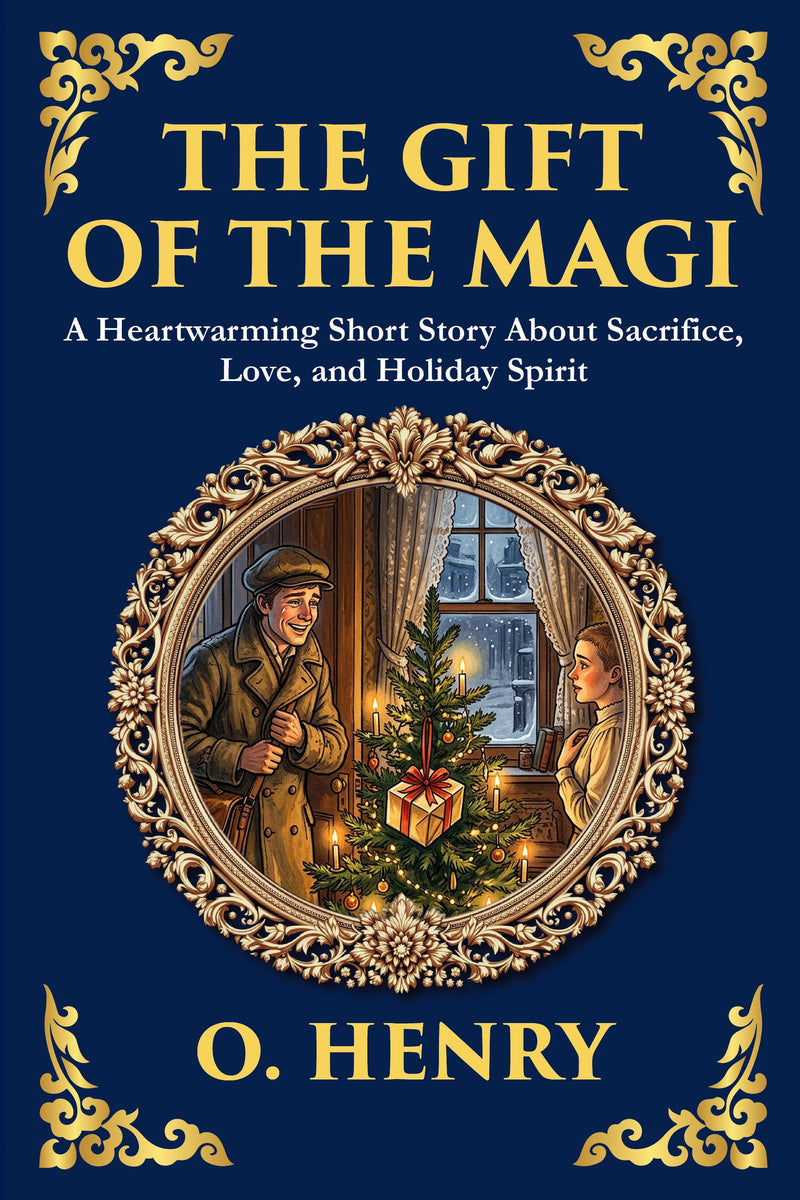
The Gift of the Magi
In a small, shabby apartment on Christmas Eve, a young couple faces a dilemma: how to express their love with no money to spare.
or free app
10,000+ hrs library
30-day guarantee
The complete The Gift of the Magi appears in modern English through Library of Alexandria Press, available online with audiobook narration included for members.
Have you ever wondered why the most valuable gifts can’t be bought? In The Gift of the Magi, O. Henry delivers one of the most beloved short stories in American literature—an enduring celebration of humility, love, and the true spirit of giving. This modern edition brings new clarity to the tale’s emotional resonance while preserving the wit and wisdom that made it a classic.
Set in a modest New York apartment during the early 1900s, the story follows Jim and Della, a young married couple struggling to afford Christmas gifts for one another. With nothing to offer but their deepest affection, each secretly parts with their most prized possession to buy a gift for the other—only to discover a deeply ironic and profoundly moving outcome. Far more than a holiday story, The Gift of the Magi is a masterclass in storytelling economy, irony, and emotional impact.
It reminds us that sacrifice in the name of love is the truest form of wealth, and that kindness lives quietly in the hearts of ordinary people.
What you’ll discover in this modern edition
- A Masterpiece of Short Fiction – Experience one of the most iconic and emotionally resonant stories ever written.
- Themes of Love, Sacrifice, and Humility – Explore how the simplest acts of giving can carry the greatest emotional weight.
- Holiday Warmth for All Seasons – Though set at Christmas, its lessons resonate throughout the year.
- A Touching Glimpse into Early 20th Century America – Reflect on the timeless humanity within the hardships of the past.
- A Clear, Modern Presentation – This edition preserves O. Henry’s charm while ensuring accessibility for today’s readers.
| Formats | eBook (EPUB + PDF) · Audiobook · Paperback · Hardcover · Large Print |
| Language | English |
| Trim size (print) | 6 × 9 in |
| Binding | Paperback — perfect-bound · Hardcover — casewrap |
| Large Print edition | Same text in a larger, easy-read type — a larger font, not a larger trim |
| Print pricing | Every physical book at our true cost — at-cost, no profit (members) |
| Library | 873 restored titles, always growing |
| Length | 5,488 words · ~22 min reading |
| Reading level | Grade 10 · a comfortable read (this modern-English edition) |
| Edition | Modern English translation · 2026 |
Member reviews for this edition are collected as readers finish it — be the first. Across the library: 12,000+ books shipped, every plan covered by a 365-day print guarantee.
About this edition
A faithful, unabridged modern-English edition by The Library of Alexandria — carefully rendered for today's reader and verified paragraph-by-paragraph against the public-domain source. Available as eBook, audiobook, paperback, hardcover, and large print.
- Complete & unabridgedVerified paragraph by paragraph against the source — never a scan, never abridged.
- Modern English, faithfulReadable today, with the author’s meaning kept intact. Readable — not simplified.
- Every format, one membershipRead in your browser or the free app, or listen to the full audiobook.
Included free with your membership
Cancel anytime, one click · 30-day money-back guarantee
Edition last updated July 2026
What’s inside
The Gift of the Magi — complete and unabridged, included in full with membership, plus the full audiobook.
Begin reading The Gift of the Magi
In clear modern English — the complete text is included with membership.
Introduction
There are certain stories that, once read, take up permanent residence somewhere just behind the heart. They are not necessarily the longest stories, nor the most elaborate, nor the ones that announce their own importance with grand gestures and sweeping declarations. Sometimes the stories that linger longest are the small ones—the ones that fit into a single sitting, that pass before our eyes in the span of a quiet afternoon, and yet manage to leave behind an impression so vivid and so tender that we find ourselves returning to them year after year, often without quite knowing why. This is one of those stories. It is brief, it is unadorned in its essentials, and it accomplishes more in a handful of pages than many novels accomplish in hundreds. Generations of readers have discovered it, fallen in love with it, and passed it along to others as one passes along a cherished family recipe or a beloved song. That it continues to be read more than a century after its first appearance is a testament not to fashion or marketing but to something far more durable: the simple, unkillable truth that lies at its center.
The work you are about to read belongs to a particular kind of literary tradition—one that prizes economy, warmth, and the sudden flash of recognition that comes when a tale reveals itself to be about something larger than its modest surface suggested. It is a holiday story, yes, in the sense that it unfolds against the backdrop of a season devoted to giving. But to call it merely a holiday story would be to undersell it considerably. It is, at its core, a meditation on love—on what we are willing to surrender for the people who matter most to us, and on the curious mathematics of generosity, in which the act of giving up something precious somehow multiplies rather than diminishes what remains. It is a story about young people with very little money and a great deal of feeling, navigating a world that offers them few luxuries beyond the luxury of one another. And it is, finally, a story about the strange and beautiful logic of devotion, which so often defies the cold accounting of practical sense.
This edition presents the tale in a fresh, modern translation, carefully adapted for the contemporary reader. That phrase deserves a moment of explanation, because it speaks directly to the experience you are about to have. The original prose, written in the opening years of the twentieth century, carries with it the particular cadences and vocabulary of its era—turns of phrase that were vivid and immediate to readers of that time but which can occasionally feel, to a modern eye, like a thin layer of frost on a windowpane: lovely, but slightly obscuring the view. The aim of this adaptation is to clear that frost away, to allow the warmth and humor and tenderness of the story to shine through with the same clarity and immediacy that its first audience would have felt. Nothing essential has been sacrificed. The wit remains; the affection remains; the gentle, knowing voice of the storyteller remains. What has changed is simply the ease with which a reader today can step inside the story and feel entirely at home there.
To understand why this story has endured, it helps to understand a little about the man who wrote it. The author published under the pen name O. Henry, a name that has become practically synonymous with a particular kind of storytelling—the kind that builds quietly toward a final, often unexpected revelation that recasts everything that came before it. His real name was William Sydney Porter, and his life was, in many respects, a story worthy of one of his own tales: full of reversals, hardships, sudden fortunes and equally sudden losses, and the kind of hard-won understanding of human nature that comes only from living among ordinary people and paying close attention to their joys and sorrows. He came to writing relatively late, and through a circuitous and difficult path, but once he found his voice, he poured forth an extraordinary number of short stories—hundreds of them—chronicling the lives of clerks, shopgirls, drifters, tradesmen, and dreamers, the everyday inhabitants of a bustling, growing America.
What set him apart was his profound sympathy for these characters. He did not look down upon them, nor did he sentimentalize them into cardboard figures of virtue. He saw them as fully human—flawed, funny, prideful, foolish, and capable of astonishing grace. He understood that the most dramatic events in most people’s lives do not involve grand battles or sweeping romances of the kind found in the more self-important fiction of his day. They involve quiet decisions made at kitchen tables and in cramped apartments, the small sacrifices and secret hopes that pass largely unnoticed by the wider world but which constitute the true substance of a life. He had a particular genius for finding the poetry in poverty—not by glorifying hardship, which he knew too well to romanticize, but by revealing the dignity and the deep emotional richness that can exist even in circumstances of considerable material want.
His signature device, the surprise ending, has been so widely imitated and discussed that it has become something of a cliché in the century since. But it would be a mistake to think of his stories as mere puzzles built around a clever twist. The endings work not because they trick the reader but because they illuminate. The best of his conclusions do not simply surprise us; they move us, precisely because they reveal a truth about the characters and their situation that was there all along, waiting to be understood. The twist is not a magician’s trick but a sudden opening of the heart—a moment in which we see the full meaning of what has unfolded, and feel the impact of it all the more keenly for having been brought to it gradually. This particular story stands as perhaps the finest example of that art he ever produced. It is the one most readers think of first when his name is mentioned, and for good reason. Everything he did well, he did supremely well here.
There is also, woven throughout his work, a distinctive narrative voice—warm, conversational, frequently amused, occasionally given to little digressions and observations that feel like the asides of a friend telling you a story over the course of an evening. This voice is one of the great pleasures of reading him, and it is something this modern translation has taken particular care to preserve. The storyteller is present throughout, not as a cold and distant chronicler but as a companion, someone who clearly loves the people he is telling you about and wants you to love them too. He nudges you, he winks at you, he sometimes pretends to apologize for his own storytelling even as he delivers it with consummate skill. The result is an intimacy that draws you in and makes you feel, by the final lines, as though you have not merely read about these characters but genuinely come to know and care for them. In a story this short, that achievement is nothing short of remarkable.
It is worth saying a word, too, about the world in which this story is set—a world of modest apartments, of careful budgeting, of weekly wages and the constant low-level anxiety that accompanies a life lived close to the edge of what one can afford. The characters here are not wealthy. Far from it. Much of the emotional texture of the story arises from the gap between their love for one another and the slenderness of their means to express it. In an age and a culture that often equates the value of a gift with its price, there is something quietly radical about a tale that locates the deepest meaning of giving entirely outside the realm of money. The characters have almost nothing, materially speaking, and yet they possess something that cannot be bought at any price. The story understands this distinction perfectly, and it invites us to understand it too. In doing so, it offers a gentle but persistent challenge to the way we ourselves tend to think about generosity, abundance, and what it really means to have enough.
Though it is most often read during the winter holidays, and though its events are bound up with a particular festive occasion, this is not a story whose appeal is limited to a single time of year. Its real subject is love—not the swooning, idealized love of romance novels, but the daily, practical, deeply rooted love of two people who have committed themselves to one another and who must figure out, with limited resources and abundant feeling, how to honor that commitment. This is a kind of love that anyone can recognize, regardless of their circumstances. It is the love of people who lie awake worrying about how to please the person beside them, who scrimp and save and plan in secret, who would rather go without themselves than see the one they love disappointed. It is, in short, the love that animates countless ordinary lives, and which has rarely been captured in fiction with such tenderness and precision.
Part of what makes the story so universally beloved is its compression. There is not a wasted word in it. Every detail counts; every observation contributes to the cumulative emotional effect. By the time you reach the final page, you will likely be astonished at how much the author has accomplished in so little space. He has drawn two characters you feel you know intimately, established the texture of their world, set in motion a small but consequential drama, and brought it to a conclusion that resonates far beyond the boundaries of the page. This is the work of a master craftsman who understood that brevity, far from being a limitation, can be a source of enormous power. When every sentence must earn its place, the result is a kind of distilled intensity that longer works often struggle to achieve. Reading this story is a little like holding a single perfect gemstone in your palm: small enough to contain entirely within your hand, yet possessed of a brilliance that seems to far exceed its size.
For readers encountering the tale for the first time, I want to be careful not to say too much about what actually happens within it. Part of the magic of this story—a magic that has worked its spell on millions of readers over more than a century—lies in experiencing its unfolding without foreknowledge. The author has arranged his revelations with exquisite care, and to spoil that arrangement would be to rob you of one of the great pleasures the work has to offer. So I will say only this: the story concerns a husband and wife, deeply in love, who each wish to give the other a meaningful gift on a special occasion, and who find that their love for one another leads them to choices that are at once heartbreaking and beautiful. What they do, why they do it, and what it all ultimately means—these are matters best discovered in the reading itself. Trust the storyteller. He knows exactly where he is taking you, and the journey, though brief, is one you will not soon forget.
For those returning to the story after years away, or who perhaps read it long ago in school and remember only its general outline, this fresh translation offers an opportunity to rediscover it as if for the first time. Stories like this one have a way of growing along with us. What strikes a young reader as a sweet and simple tale may strike an older reader, who has known the weight of love and the cost of sacrifice firsthand, as something almost unbearably poignant. The story does not change, but we do, and each new encounter with it reveals depths we may have missed before. This is the mark of a true classic: it does not exhaust itself on a single reading but rewards return after return, yielding new meanings as our own understanding deepens. I suspect that many of you who pick up this volume will find, somewhere in its pages, a reflection of moments from your own lives—gifts given and received, sacrifices made quietly and without fanfare, the countless small ways in which we try to show the people we love just how much they mean to us.
Cancel anytime, one click · 30-day money-back guarantee
Founding annual rate available now — your price locks for life when you join.
Not ready? Get this free chapter by email — read it anytime.
✓ Sent — check your inbox for The Gift of the Magi.
Questions about The Gift of the Magi
What is The Gift of the Magi about?
In a small, shabby apartment on Christmas Eve, a young couple faces a dilemma: how to express their love with no money to spare. Each resolves to make a sacrifice for the other, leading to a twist that’s both heartbreaking and beautiful. The Gift of the Magi is a timeless tale of selfless love and quiet devotion—a poignant reminder that the greatest gifts come not from wealth, but from the heart.
Who wrote The Gift of the Magi?
The Gift of the Magi was written by O. Henry. This edition presents the complete work in clear modern English, faithfully rendered from the public-domain original by Library of Alexandria Press.
Is The Gift of the Magi free to read?
The opening chapter is free to read on this page. Members read and listen to the complete work — and the entire library — free, and can order any physical book at our true print cost.
How long is The Gift of the Magi?
2 chapters (~5,488 words) — about 22 min of reading in this modern-English edition.
Is this an abridged version of The Gift of the Magi?
No. This is the complete, unabridged The Gift of the Magi, carefully rendered into clear modern English and verified paragraph-by-paragraph against the public-domain source — nothing is cut or summarised.
What formats does The Gift of the Magi come in?
The Gift of the Magi is available as eBook, paperback, hardcover and large print. eBook and audiobook are included with membership; printed editions ship at our true print cost.
Shipping & returns
Billing & membership
More from the library


Explore Short Stories
- My Man Jeeves · P. G. Wodehouse
- Men without women · Ernest Hemingway
- Four Short Stories by Emile Zola · Émile Zola
- The Wisdom of Father Brown · G. K. Chesterton
- The Cask of Amontillado · Edgar Allan Poe
- Tales of Unrest · Joseph Conrad
- The Man with Two Left Feet, and Other Stories · P. G. Wodehouse
- The Book of Dragons · E. Nesbit
- The Four Million · O. Henry
- Ghost Stories of an Antiquary · M. R. James
- Carry On, Jeeves · P. G. Wodehouse
- Wild Animals I Have Known · Ernest Thompson Seton
- The Queen of Spades and Other Stories · Aleksandr Sergeevich Pushkin
- The Man Who Would Be King · Rudyard Kipling
- The Monkey’s Paw · W. W. Jacobs
- The Adventures of Heine · Edgar Wallace
- The Life-Eater · Harold Ward
- What Men Live By, and Other Tales · graf Leo Tolstoy
- The Innocence of Father Brown · G. K. Chesterton
- The Black Kiss
- The Beasts in the Void · Paul W. Fairman
- John Jones’s Dollar · Harry Stephen Keeler
- Subversive · Mack Reynolds
- The Mississippi Saucer · Frank Belknap Long
- Man of Distinction · Michael Shaara
- The Golden Judge · Nathaniel Gordon
- The Big Fix · George O. Smith
- Time and Time Again · H. Beam Piper
- Missing Link · Frank Herbert
- We're Civilized!
The Gift of the Magi
The Gift of the Magi
A Heartwarming Short Story About Sacrifice, Love, and Holiday Spirit
O. Henry
Contents
- Introduction
- The Gift of the Magi
Introduction
There are certain stories that, once read, take up permanent residence somewhere just behind the heart. They are not necessarily the longest stories, nor the most elaborate, nor the ones that announce their own importance with grand gestures and sweeping declarations. Sometimes the stories that linger longest are the small ones—the ones that fit into a single sitting, that pass before our eyes in the span of a quiet afternoon, and yet manage to leave behind an impression so vivid and so tender that we find ourselves returning to them year after year, often without quite knowing why. This is one of those stories. It is brief, it is unadorned in its essentials, and it accomplishes more in a handful of pages than many novels accomplish in hundreds. Generations of readers have discovered it, fallen in love with it, and passed it along to others as one passes along a cherished family recipe or a beloved song. That it continues to be read more than a century after its first appearance is a testament not to fashion or marketing but to something far more durable: the simple, unkillable truth that lies at its center.
The work you are about to read belongs to a particular kind of literary tradition—one that prizes economy, warmth, and the sudden flash of recognition that comes when a tale reveals itself to be about something larger than its modest surface suggested. It is a holiday story, yes, in the sense that it unfolds against the backdrop of a season devoted to giving. But to call it merely a holiday story would be to undersell it considerably. It is, at its core, a meditation on love—on what we are willing to surrender for the people who matter most to us, and on the curious mathematics of generosity, in which the act of giving up something precious somehow multiplies rather than diminishes what remains. It is a story about young people with very little money and a great deal of feeling, navigating a world that offers them few luxuries beyond the luxury of one another. And it is, finally, a story about the strange and beautiful logic of devotion, which so often defies the cold accounting of practical sense.
This edition presents the tale in a fresh, modern translation, carefully adapted for the contemporary reader. That phrase deserves a moment of explanation, because it speaks directly to the experience you are about to have. The original prose, written in the opening years of the twentieth century, carries with it the particular cadences and vocabulary of its era—turns of phrase that were vivid and immediate to readers of that time but which can occasionally feel, to a modern eye, like a thin layer of frost on a windowpane: lovely, but slightly obscuring the view. The aim of this adaptation is to clear that frost away, to allow the warmth and humor and tenderness of the story to shine through with the same clarity and immediacy that its first audience would have felt. Nothing essential has been sacrificed. The wit remains; the affection remains; the gentle, knowing voice of the storyteller remains. What has changed is simply the ease with which a reader today can step inside the story and feel entirely at home there.
To understand why this story has endured, it helps to understand a little about the man who wrote it. The author published under the pen name O. Henry, a name that has become practically synonymous with a particular kind of storytelling—the kind that builds quietly toward a final, often unexpected revelation that recasts everything that came before it. His real name was William Sydney Porter, and his life was, in many respects, a story worthy of one of his own tales: full of reversals, hardships, sudden fortunes and equally sudden losses, and the kind of hard-won understanding of human nature that comes only from living among ordinary people and paying close attention to their joys and sorrows. He came to writing relatively late, and through a circuitous and difficult path, but once he found his voice, he poured forth an extraordinary number of short stories—hundreds of them—chronicling the lives of clerks, shopgirls, drifters, tradesmen, and dreamers, the everyday inhabitants of a bustling, growing America.
What set him apart was his profound sympathy for these characters. He did not look down upon them, nor did he sentimentalize them into cardboard figures of virtue. He saw them as fully human—flawed, funny, prideful, foolish, and capable of astonishing grace. He understood that the most dramatic events in most people’s lives do not involve grand battles or sweeping romances of the kind found in the more self-important fiction of his day. They involve quiet decisions made at kitchen tables and in cramped apartments, the small sacrifices and secret hopes that pass largely unnoticed by the wider world but which constitute the true substance of a life. He had a particular genius for finding the poetry in poverty—not by glorifying hardship, which he knew too well to romanticize, but by revealing the dignity and the deep emotional richness that can exist even in circumstances of considerable material want.
His signature device, the surprise ending, has been so widely imitated and discussed that it has become something of a cliché in the century since. But it would be a mistake to think of his stories as mere puzzles built around a clever twist. The endings work not because they trick the reader but because they illuminate. The best of his conclusions do not simply surprise us; they move us, precisely because they reveal a truth about the characters and their situation that was there all along, waiting to be understood. The twist is not a magician’s trick but a sudden opening of the heart—a moment in which we see the full meaning of what has unfolded, and feel the impact of it all the more keenly for having been brought to it gradually. This particular story stands as perhaps the finest example of that art he ever produced. It is the one most readers think of first when his name is mentioned, and for good reason. Everything he did well, he did supremely well here.
There is also, woven throughout his work, a distinctive narrative voice—warm, conversational, frequently amused, occasionally given to little digressions and observations that feel like the asides of a friend telling you a story over the course of an evening. This voice is one of the great pleasures of reading him, and it is something this modern translation has taken particular care to preserve. The storyteller is present throughout, not as a cold and distant chronicler but as a companion, someone who clearly loves the people he is telling you about and wants you to love them too. He nudges you, he winks at you, he sometimes pretends to apologize for his own storytelling even as he delivers it with consummate skill. The result is an intimacy that draws you in and makes you feel, by the final lines, as though you have not merely read about these characters but genuinely come to know and care for them. In a story this short, that achievement is nothing short of remarkable.
It is worth saying a word, too, about the world in which this story is set—a world of modest apartments, of careful budgeting, of weekly wages and the constant low-level anxiety that accompanies a life lived close to the edge of what one can afford. The characters here are not wealthy. Far from it. Much of the emotional texture of the story arises from the gap between their love for one another and the slenderness of their means to express it. In an age and a culture that often equates the value of a gift with its price, there is something quietly radical about a tale that locates the deepest meaning of giving entirely outside the realm of money. The characters have almost nothing, materially speaking, and yet they possess something that cannot be bought at any price. The story understands this distinction perfectly, and it invites us to understand it too. In doing so, it offers a gentle but persistent challenge to the way we ourselves tend to think about generosity, abundance, and what it really means to have enough.
Though it is most often read during the winter holidays, and though its events are bound up with a particular festive occasion, this is not a story whose appeal is limited to a single time of year. Its real subject is love—not the swooning, idealized love of romance novels, but the daily, practical, deeply rooted love of two people who have committed themselves to one another and who must figure out, with limited resources and abundant feeling, how to honor that commitment. This is a kind of love that anyone can recognize, regardless of their circumstances. It is the love of people who lie awake worrying about how to please the person beside them, who scrimp and save and plan in secret, who would rather go without themselves than see the one they love disappointed. It is, in short, the love that animates countless ordinary lives, and which has rarely been captured in fiction with such tenderness and precision.
Part of what makes the story so universally beloved is its compression. There is not a wasted word in it. Every detail counts; every observation contributes to the cumulative emotional effect. By the time you reach the final page, you will likely be astonished at how much the author has accomplished in so little space. He has drawn two characters you feel you know intimately, established the texture of their world, set in motion a small but consequential drama, and brought it to a conclusion that resonates far beyond the boundaries of the page. This is the work of a master craftsman who understood that brevity, far from being a limitation, can be a source of enormous power. When every sentence must earn its place, the result is a kind of distilled intensity that longer works often struggle to achieve. Reading this story is a little like holding a single perfect gemstone in your palm: small enough to contain entirely within your hand, yet possessed of a brilliance that seems to far exceed its size.
For readers encountering the tale for the first time, I want to be careful not to say too much about what actually happens within it. Part of the magic of this story—a magic that has worked its spell on millions of readers over more than a century—lies in experiencing its unfolding without foreknowledge. The author has arranged his revelations with exquisite care, and to spoil that arrangement would be to rob you of one of the great pleasures the work has to offer. So I will say only this: the story concerns a husband and wife, deeply in love, who each wish to give the other a meaningful gift on a special occasion, and who find that their love for one another leads them to choices that are at once heartbreaking and beautiful. What they do, why they do it, and what it all ultimately means—these are matters best discovered in the reading itself. Trust the storyteller. He knows exactly where he is taking you, and the journey, though brief, is one you will not soon forget.
For those returning to the story after years away, or who perhaps read it long ago in school and remember only its general outline, this fresh translation offers an opportunity to rediscover it as if for the first time. Stories like this one have a way of growing along with us. What strikes a young reader as a sweet and simple tale may strike an older reader, who has known the weight of love and the cost of sacrifice firsthand, as something almost unbearably poignant. The story does not change, but we do, and each new encounter with it reveals depths we may have missed before. This is the mark of a true classic: it does not exhaust itself on a single reading but rewards return after return, yielding new meanings as our own understanding deepens. I suspect that many of you who pick up this volume will find, somewhere in its pages, a reflection of moments from your own lives—gifts given and received, sacrifices made quietly and without fanfare, the countless small ways in which we try to show the people we love just how much they mean to us.
One dollar and eighty-seven cents. That was all. And sixty cents of it was in pennies. She had saved those pennies one or two at a time, haggling with the grocer, the vegetable man, and the butcher until her cheeks burned from the silent suggestion that she was cheap. Three times Della counted it. One dollar and eighty-seven cents. And tomorrow was Christmas.
There was clearly nothing left to do but flop down on the shabby little couch and cry. So Della did. This leads to the realization that life is made up of sobs, sniffles, and smiles—mostly sniffles.
While the lady of the house moves from sobbing to sniffing, take a look at the home. It was a furnished apartment renting for $8 a week. It wasn’t exactly impossible to describe, but it certainly looked like the kind of place that would attract the attention of a poverty squad.
In the entryway below was a mailbox that no letter could actually fit into, and a doorbell that no human finger could get to ring. There was also a nameplate that read “Mr. James Dillingham Young.”
The “Dillingham” had been displayed proudly during a more prosperous time when the owner was making $30 a week. Now that the income had dropped to $20, they were seriously thinking about shortening it to a modest, unassuming “D.” But whenever Mr. James Dillingham Young came home to his apartment, he was called “Jim” and given a huge hug by Mrs. James Dillingham Young—whom we’ve already met as Della. Which is all very sweet.
Della finished crying and touched up her cheeks with some powder. She stood by the window and looked gloomily at a gray cat walking along a gray fence in a gray backyard. Tomorrow was Christmas Day, and she only had $1.87 to buy Jim a present. She had been saving every penny she could for months, and this was the result. Twenty dollars a week doesn’t go far. Expenses had been higher than she expected. They always are. Only $1.87 for a gift for Jim. Her Jim. She had spent many happy hours planning something special for him. Something high-quality, rare, and genuine—something that was almost worthy of being owned by Jim.
End of the free sample
Keep reading, free
Members read and listen to the complete book — and the entire library. Cancel anytime, one click · 30-day money-back guarantee.