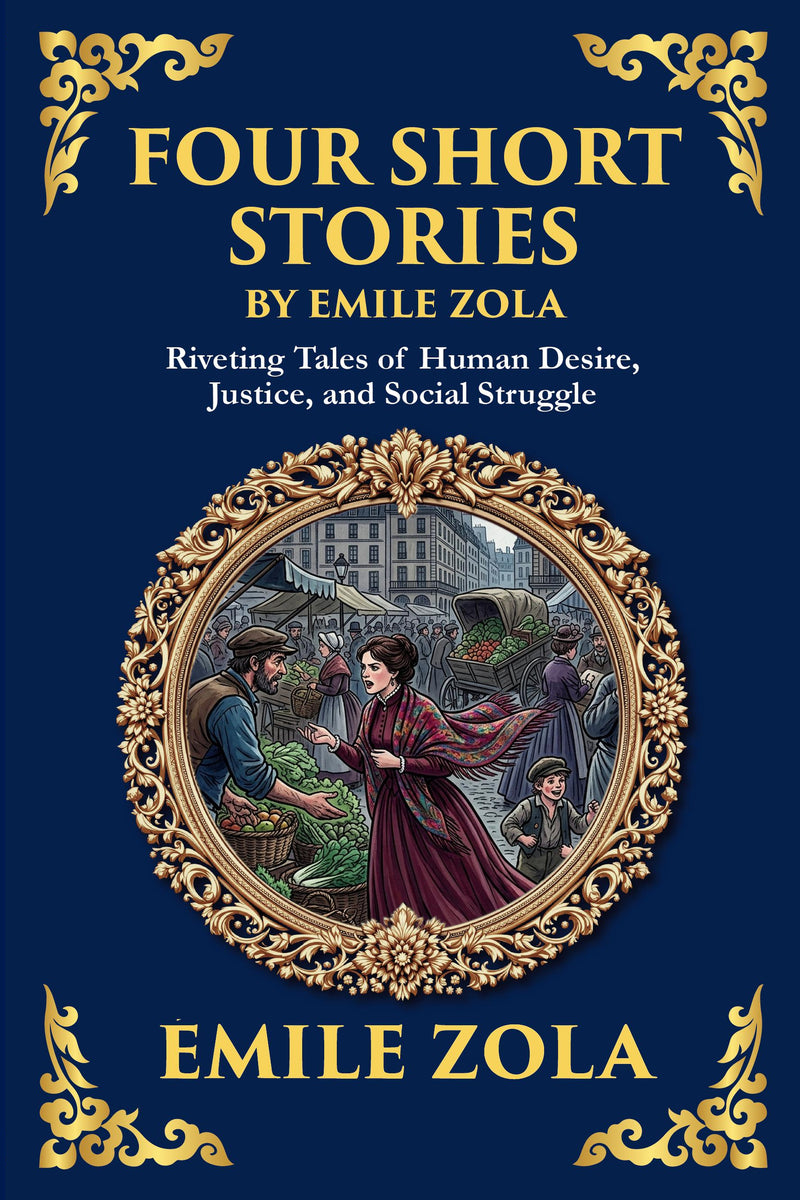
Four Short Stories by Emile Zola
Step into the uncompromising world of Émile Zola, the father of literary naturalism, in this powerful collection of four short stories that illuminate the raw truths of human nature.
or free app
10,000+ hrs library
30-day guarantee
The complete Four Short Stories By Emile Zola appears in modern English through Library of Alexandria Press, available online with audiobook narration included for members.
Have you ever wondered why even the smallest decisions can shape the course of an entire life? In Four Short Stories By Emile Zola, one of literature’s fiercest voices presents a vivid tableau of passion, poverty, and power. This carefully curated collection captures the essence of Zola’s genius—his commitment to realism, his fearless critiques of society, and his deep empathy for the marginalized.
Each story in this volume immerses the reader in a different facet of the human experience, from the personal to the political, from the tragic to the triumphant. Whether exploring the psychological torment of guilt or the grinding hardship of the working class, Zola’s pen cuts through pretense to reveal universal truths.
What you’ll discover in this modern edition
- A Tapestry of Emotion and Consequence – Zola exposes the intimate link between desire and downfall, illustrating how personal choices ripple across lives.
- Social Justice Through Storytelling – Each narrative confronts injustice with unflinching honesty, spotlighting issues of class, gender, and power.
- Rich Character Studies – Meet unforgettable characters driven by obsession, ambition, and survival.
- Zola’s Pioneering Realism – Experience the groundbreaking style that influenced an entire literary movement.
- Stories Included in This Volume: ○ Captain Burle – A harrowing look at military disgrace and moral decay. ○ The Flood – A devastating tale of nature’s fury and human tragedy.
| Formats | eBook (EPUB + PDF) · Audiobook · Paperback · Hardcover · Large Print |
| Language | English |
| Trim size (print) | 6 × 9 in |
| Binding | Paperback — perfect-bound · Hardcover — casewrap |
| Large Print edition | Same text in a larger, easy-read type — a larger font, not a larger trim |
| Print pricing | Every physical book at our true cost — at-cost, no profit (members) |
| Library | 873 restored titles, always growing |
| Length | 190,499 words · ~12 hr 42 min reading |
| Reading level | Grade 8 · an easy, flowing read (this modern-English edition) |
| Edition | Modern English translation · 2026 |
Member reviews for this edition are collected as readers finish it — be the first. Across the library: 12,000+ books shipped, every plan covered by a 365-day print guarantee.
About this edition
A faithful, unabridged modern-English edition by The Library of Alexandria — carefully rendered for today's reader and verified paragraph-by-paragraph against the public-domain source. Available as eBook, audiobook, paperback, hardcover, and large print.
- Complete & unabridgedVerified paragraph by paragraph against the source — never a scan, never abridged.
- Modern English, faithfulReadable today, with the author’s meaning kept intact. Readable — not simplified.
- Every format, one membershipRead in your browser or the free app, or listen to the full audiobook.
Included free with your membership
Cancel anytime, one click · 30-day money-back guarantee
Edition last updated July 2026
What’s inside
Four Short Stories by Emile Zola — complete and unabridged: all 60 sections included with membership, plus the full audiobook.
Begin reading Four Short Stories by Emile Zola
In clear modern English — the complete text is included with membership.
Introduction
Émile Zola arrived at his great subject — the human animal caught in the machinery of desire, money, and social performance — not through abstraction or theory but through the patient accumulation of sensory detail. He was a journalist before he was a novelist, a man who visited mines and markets and abattoirs and brothels with a reporter’s notebook, and the habit of close observation never left him. What it produced, across a career of extraordinary ambition and productivity, was a body of fiction unlike anything that had existed before it: novels that smelled of coal dust and cheap perfume, that vibrated with the noise of crowds and the silence of dying rooms, that refused to look away from the things polite literature had always agreed to leave in shadow. The four works gathered in this volume — the novella-length Nana, and the three shorter pieces The Miller’s Daughter, Captain Burle, and The Death of Olivier Bécaille — represent Zola working at a scale that strips away everything inessential and leaves only the engine of his art running at full speed. To read them in sequence is to receive a concentrated education in what this writer could do, and in why, more than a century after his death, he continues to matter.
It is worth pausing, before anything else, on the question of what kind of writer Zola actually was, because the label most commonly attached to him — Naturalist — has a way of making him sound drier and more programmatic than he is on the page. The Naturalist movement, which Zola championed in essays and manifested in fiction, held that the novelist should approach human life with something like the rigor of a scientist: observing heredity and environment, tracing cause and effect, refusing the consolations of sentimentality or the distortions of romantic idealization. All of that is true of Zola, and it matters. But what the label tends to obscure is the degree to which his fiction is also operatic, mythological, and shot through with a visionary intensity that has more in common with Dante or Hugo than with any laboratory report. His crowds are not merely sociological data; they are forces of nature, tidal and terrifying. His individual characters are not merely case studies; they are figures of almost archetypal power, carrying within them the concentrated weight of an entire social world. The Naturalist framework gave Zola permission to look at everything, to exclude nothing on grounds of taste or decorum. What he did with that permission was something far stranger and more magnificent than the framework itself could have predicted.
The Zola of the shorter forms is in some ways a more immediately accessible Zola than the Zola of the great Rougon-Macquart cycle, those twenty interconnected novels that trace the fortunes of a single family across the whole of Second Empire France. The cycle is one of the supreme achievements of nineteenth-century fiction, but it is also a commitment — a long, demanding, sometimes overwhelming immersion in a world that Zola constructed with the thoroughness of a god. The pieces in this collection ask less of the reader’s time while giving back, in concentrated form, many of the same pleasures. They are works in which Zola’s characteristic energies — his eye for the telling physical detail, his ear for the rhythms of social performance, his instinct for the moment when ordinary life tips over into something irreversible — operate without the sprawl that the longer novels require. They are, in the best sense, essential Zola: the writer at his most direct, his most economical, and in certain passages his most devastating.
The opening of Nana — which is the longest and in many ways the most ambitious of the four pieces here, though it should not be confused with the full-length novel of the same name that Zola published in 1880 as the ninth volume of the Rougon-Macquart series — announces its world with a confidence that is almost theatrical in itself. We are in the Théâtre des Variétés on the evening of a first night, and the house is still half empty, the great chandelier burning low, the red velvet of the seats glowing in the dimness like something organic and slightly threatening. Zola gives us the physical space before he gives us the people, and this is characteristic: he wants us to feel the environment as a pressure, a context that shapes and constrains everything that happens within it. The theater is not merely a setting; it is a social machine, a place where desire is manufactured and sold, where the distance between the stage and the audience is simultaneously absolute and entirely permeable. When the crowd begins to fill the house, Zola renders it with the kind of attention that makes you feel the heat and noise and collective anticipation as something almost physical. The name on everyone’s lips — Nana — rings through the entrance hall with what he calls the melodious vivacity of its two syllables, and that phrase is worth holding onto, because it captures something essential about how Zola thinks about his subject. The name is music before it is a person. The phenomenon precedes the individual. What the crowd desires is not a woman but an idea of a woman, a projection of their own appetites given a face and a body and a name.
This is the kind of social observation that Zola performs with a precision that never feels clinical, because it is always grounded in the specific and the sensory. The theater manager Bordenave, who insists on calling his establishment by a word that cannot be printed in polite company, is not a symbol of corruption but a man — coarse, shrewd, energetic, entirely without illusion about what he is selling and to whom. The two young men who arrive early and stand looking around the house, one of them a provincial trying to seem sophisticated, the other a journalist who has seen everything and is mildly bored by all of it, are not types but individuals, caught in the particular awkwardness of their social positions. And the banker Steiner, being steered through the crowd by the husband of the actress whose position Nana threatens to usurp, is a figure of comedy and pathos simultaneously — a man whose money gives him access to everything except the thing he actually wants, which is to be surprised. Zola populates his world with this kind of density, and the effect is cumulative: by the time the central figure of the piece actually appears, we have been so thoroughly immersed in the world that receives her that her arrival feels inevitable, overdetermined, as though the entire social apparatus has been constructed for precisely this moment.
The other three pieces in this collection work at different registers and in different emotional keys, but they share with Nana this quality of absolute groundedness in a specific material world. The Miller’s Daughter unfolds in a rural landscape that Zola renders with the same attentiveness he brings to the Parisian theater — the physical details of provincial life, the rhythms of agricultural labor, the way that social position and economic reality shape the possibilities available to the people who inhabit them. Captain Burle moves into the world of the military garrison town, a world of boredom and small corruptions and the terrible weight of respectability, and it builds toward a crisis that is all the more shattering for the quietness with which Zola approaches it. And The Death of Olivier Bécaille — perhaps the most formally audacious of the four, and certainly the most unsettling — takes as its premise a situation so extreme that it might seem to belong to the tradition of Gothic horror, yet handles it with a sobriety and a psychological precision that transforms it into something altogether more disturbing than any ghost story could be.
A reader coming to Zola for the first time might be tempted to approach these pieces as historical documents — windows onto a vanished world, interesting for what they reveal about nineteenth-century France but essentially remote from contemporary experience. This would be a mistake, and it would deprive the reader of most of what these works have to offer. Zola’s France is not our world, but the forces he is writing about — the machinery of celebrity and desire, the way that institutions corrupt individuals while allowing them to believe they are acting freely, the terrible vulnerability of the body, the gap between what people perform in public and what they feel in private — are not historical curiosities. They are permanent features of human social life, and Zola understood them with a clarity that has not been surpassed.
The better approach is to read these pieces as you would read any great fiction: with your full attention engaged, your senses open, your willingness to be surprised intact. Zola rewards close reading in the way that all writers of genuine density reward it — not because he is obscure or difficult, but because his surfaces are so richly textured that a casual reading will miss half of what is there. Pay attention to the physical details, because they are never merely decorative. When Zola describes the color of a curtain or the smell of a room or the way a character holds his hands, he is giving you information about the world those details inhabit — social, psychological, moral information encoded in the sensory. Pay attention to the crowds and the collective movements, because Zola is one of the great writers of collective behavior, and his crowds are characters in their own right, with their own desires and their own logic. And pay attention to the moments of silence and stillness, because in a writer so committed to noise and motion, the quiet passages carry an enormous charge.
It is also worth reading these four pieces in the order in which they are presented, rather than skipping around according to whim. They are not arranged arbitrarily. Moving from the theatrical spectacle and social satire of the opening piece through the rural world of The Miller’s Daughter and the military world of Captain Burle to the radical interiority of The Death of Olivier Bécaille traces a kind of arc — from the most public and performative of Zola’s concerns to the most private and existential. By the time you reach the final piece, you will have been prepared for its particular demands by everything that has come before, and the experience of reading it will be richer for that preparation. Each of these works is complete in itself, but together they constitute something more than the sum of their parts: a portrait of a writer at the height of his powers, working across a range of modes and registers, demonstrating the full extent of what his method could achieve.
The translation presented here has been made with the aim of giving contemporary English readers the most direct possible access to Zola’s prose — its energy, its precision, its occasional grandeur, and its willingness to be blunt. Victorian and Edwardian translations of Zola, some of which remain in circulation, were produced under conditions of censorship and social pressure that led their translators to soften, euphemize, and occasionally simply omit passages that the original handles with complete directness. The present version restores that directness, not in the interest of sensationalism but in the interest of accuracy. Zola’s frankness is not incidental to his art; it is central to it. The whole point of the Naturalist project was that nothing should be excluded on grounds of propriety, and a translation that reintroduces those exclusions is not a translation of Zola but a translation of a bowdlerized version of Zola, which is a different and lesser thing. Readers who come to this volume expecting the polished evasions of an earlier era of translation will find instead something closer to the original experience: a writer who looks at the world without flinching and asks his readers to do the same.
What finally distinguishes Zola from the many writers who have attempted to work in his tradition is something that is difficult to name precisely but easy to feel on the page: a quality of compassion that coexists with, and is inseparable from, his unflinching clarity. He is not a sentimental writer — sentimentality, which involves the falsification of feeling in the direction of comfort, is precisely what his method is designed to prevent. But he is a writer who takes his characters seriously as human beings, who grants them an inner life even when their outer behavior is contemptible, who understands that the forces shaping them are larger than they are and that their failures are rarely simply their own fault. The theater manager who reduces his actresses to commodities is also a man doing what his world has taught him to do, operating within a system whose logic he did not invent. The banker pursuing a woman he cannot have is also a man in the grip of something he does not understand and cannot control. The soldier in Captain Burle, the young lovers in The Miller’s Daughter, the man lying in the darkness of The Death of Olivier Bécaille — all of them are caught in circumstances that exceed their capacity to manage, and Zola’s refusal to judge them harshly is not moral weakness but moral intelligence. He knows that judgment is easy and understanding is hard, and he has chosen the harder thing.
Cancel anytime, one click · 30-day money-back guarantee
Founding annual rate available now — your price locks for life when you join.
Not ready? Get this free chapter by email — read it anytime.
✓ Sent — check your inbox for Four Short Stories by Emile Zola.
Questions about Four Short Stories by Emile Zola
What is Four Short Stories By Emile Zola about?
Step into the uncompromising world of Émile Zola, the father of literary naturalism, in this powerful collection of four short stories that illuminate the raw truths of human nature. From the haunting consequences of passion to the ruthless workings of society and justice, Zola’s sharp eye and unflinching prose reveal the beauty and brutality of life itself. With his hallmark realism and moral intensity, Zola crafts characters and settings that confront us with the cost of desire, the struggle for dignity, and the
Who wrote Four Short Stories By Emile Zola?
Four Short Stories By Emile Zola was written by Émile Zola. This edition presents the complete work in clear modern English, faithfully rendered from the public-domain original by Library of Alexandria Press.
Is Four Short Stories By Emile Zola free to read?
The opening chapter is free to read on this page. Members read and listen to the complete work — and the entire library — free, and can order any physical book at our true print cost.
How long is Four Short Stories By Emile Zola?
60 chapters (~190,499 words) — about 12 hr 42 min of reading in this modern-English edition.
Is this an abridged version of Four Short Stories By Emile Zola?
No. This is the complete, unabridged Four Short Stories By Emile Zola, carefully rendered into clear modern English and verified paragraph-by-paragraph against the public-domain source — nothing is cut or summarised.
What formats does Four Short Stories By Emile Zola come in?
Four Short Stories By Emile Zola is available as eBook, paperback and hardcover. eBook and audiobook are included with membership; printed editions ship at our true print cost.
Shipping & returns
Billing & membership
More from the library


Explore Short Stories
- My Man Jeeves · P. G. Wodehouse
- Men without women · Ernest Hemingway
- The Wisdom of Father Brown · G. K. Chesterton
- The Cask of Amontillado · Edgar Allan Poe
- Tales of Unrest · Joseph Conrad
- The Man with Two Left Feet, and Other Stories · P. G. Wodehouse
- The Book of Dragons · E. Nesbit
- The Four Million · O. Henry
- Ghost Stories of an Antiquary · M. R. James
- Carry On, Jeeves · P. G. Wodehouse
- Wild Animals I Have Known · Ernest Thompson Seton
- The Queen of Spades and Other Stories · Aleksandr Sergeevich Pushkin
- The Man Who Would Be King · Rudyard Kipling
- The Monkey’s Paw · W. W. Jacobs
- The Adventures of Heine · Edgar Wallace
- The Life-Eater · Harold Ward
- What Men Live By, and Other Tales · graf Leo Tolstoy
- The Innocence of Father Brown · G. K. Chesterton
- The Black Kiss
- The Beasts in the Void · Paul W. Fairman
- John Jones’s Dollar · Harry Stephen Keeler
- Subversive · Mack Reynolds
- The Mississippi Saucer · Frank Belknap Long
- Man of Distinction · Michael Shaara
- The Golden Judge · Nathaniel Gordon
- The Big Fix · George O. Smith
- Time and Time Again · H. Beam Piper
- Missing Link · Frank Herbert
- We're Civilized!
- The Crystal Crypt · Philip K. Dick
Four Short Stories by Emile Zola
Four Short Stories by Emile Zola
A Modern Translation
Émile Zola
Contents
- Introduction
- Chapter 1
- Chapter 2
- Chapter 3
- Chapter 4
- Chapter 5
- Chapter 6
- Chapter 7
- Chapter 8
- Chapter 9
- Chapter 10
- Chapter 11
- Chapter 12
- Chapter 13
- Chapter 14
- Chapter 15
- Chapter 16
- Chapter 17
- Chapter 18
- Chapter 19
- Chapter 20
- Chapter 21
- Chapter 22
- Chapter 23
- Chapter 24
- Chapter 25
- Chapter 26
- Chapter 27
- Chapter 28
- Chapter 29
- Chapter 30
- Chapter 31
- Chapter 32
- Chapter 33
- Chapter 34
- Chapter 35
- Chapter 36
- Chapter 37
- Chapter 38
- Chapter 39
- … and 20 more chapters
Introduction
Émile Zola arrived at his great subject — the human animal caught in the machinery of desire, money, and social performance — not through abstraction or theory but through the patient accumulation of sensory detail. He was a journalist before he was a novelist, a man who visited mines and markets and abattoirs and brothels with a reporter’s notebook, and the habit of close observation never left him. What it produced, across a career of extraordinary ambition and productivity, was a body of fiction unlike anything that had existed before it: novels that smelled of coal dust and cheap perfume, that vibrated with the noise of crowds and the silence of dying rooms, that refused to look away from the things polite literature had always agreed to leave in shadow. The four works gathered in this volume — the novella-length Nana, and the three shorter pieces The Miller’s Daughter, Captain Burle, and The Death of Olivier Bécaille — represent Zola working at a scale that strips away everything inessential and leaves only the engine of his art running at full speed. To read them in sequence is to receive a concentrated education in what this writer could do, and in why, more than a century after his death, he continues to matter.
It is worth pausing, before anything else, on the question of what kind of writer Zola actually was, because the label most commonly attached to him — Naturalist — has a way of making him sound drier and more programmatic than he is on the page. The Naturalist movement, which Zola championed in essays and manifested in fiction, held that the novelist should approach human life with something like the rigor of a scientist: observing heredity and environment, tracing cause and effect, refusing the consolations of sentimentality or the distortions of romantic idealization. All of that is true of Zola, and it matters. But what the label tends to obscure is the degree to which his fiction is also operatic, mythological, and shot through with a visionary intensity that has more in common with Dante or Hugo than with any laboratory report. His crowds are not merely sociological data; they are forces of nature, tidal and terrifying. His individual characters are not merely case studies; they are figures of almost archetypal power, carrying within them the concentrated weight of an entire social world. The Naturalist framework gave Zola permission to look at everything, to exclude nothing on grounds of taste or decorum. What he did with that permission was something far stranger and more magnificent than the framework itself could have predicted.
The Zola of the shorter forms is in some ways a more immediately accessible Zola than the Zola of the great Rougon-Macquart cycle, those twenty interconnected novels that trace the fortunes of a single family across the whole of Second Empire France. The cycle is one of the supreme achievements of nineteenth-century fiction, but it is also a commitment — a long, demanding, sometimes overwhelming immersion in a world that Zola constructed with the thoroughness of a god. The pieces in this collection ask less of the reader’s time while giving back, in concentrated form, many of the same pleasures. They are works in which Zola’s characteristic energies — his eye for the telling physical detail, his ear for the rhythms of social performance, his instinct for the moment when ordinary life tips over into something irreversible — operate without the sprawl that the longer novels require. They are, in the best sense, essential Zola: the writer at his most direct, his most economical, and in certain passages his most devastating.
The opening of Nana — which is the longest and in many ways the most ambitious of the four pieces here, though it should not be confused with the full-length novel of the same name that Zola published in 1880 as the ninth volume of the Rougon-Macquart series — announces its world with a confidence that is almost theatrical in itself. We are in the Théâtre des Variétés on the evening of a first night, and the house is still half empty, the great chandelier burning low, the red velvet of the seats glowing in the dimness like something organic and slightly threatening. Zola gives us the physical space before he gives us the people, and this is characteristic: he wants us to feel the environment as a pressure, a context that shapes and constrains everything that happens within it. The theater is not merely a setting; it is a social machine, a place where desire is manufactured and sold, where the distance between the stage and the audience is simultaneously absolute and entirely permeable. When the crowd begins to fill the house, Zola renders it with the kind of attention that makes you feel the heat and noise and collective anticipation as something almost physical. The name on everyone’s lips — Nana — rings through the entrance hall with what he calls the melodious vivacity of its two syllables, and that phrase is worth holding onto, because it captures something essential about how Zola thinks about his subject. The name is music before it is a person. The phenomenon precedes the individual. What the crowd desires is not a woman but an idea of a woman, a projection of their own appetites given a face and a body and a name.
This is the kind of social observation that Zola performs with a precision that never feels clinical, because it is always grounded in the specific and the sensory. The theater manager Bordenave, who insists on calling his establishment by a word that cannot be printed in polite company, is not a symbol of corruption but a man — coarse, shrewd, energetic, entirely without illusion about what he is selling and to whom. The two young men who arrive early and stand looking around the house, one of them a provincial trying to seem sophisticated, the other a journalist who has seen everything and is mildly bored by all of it, are not types but individuals, caught in the particular awkwardness of their social positions. And the banker Steiner, being steered through the crowd by the husband of the actress whose position Nana threatens to usurp, is a figure of comedy and pathos simultaneously — a man whose money gives him access to everything except the thing he actually wants, which is to be surprised. Zola populates his world with this kind of density, and the effect is cumulative: by the time the central figure of the piece actually appears, we have been so thoroughly immersed in the world that receives her that her arrival feels inevitable, overdetermined, as though the entire social apparatus has been constructed for precisely this moment.
The other three pieces in this collection work at different registers and in different emotional keys, but they share with Nana this quality of absolute groundedness in a specific material world. The Miller’s Daughter unfolds in a rural landscape that Zola renders with the same attentiveness he brings to the Parisian theater — the physical details of provincial life, the rhythms of agricultural labor, the way that social position and economic reality shape the possibilities available to the people who inhabit them. Captain Burle moves into the world of the military garrison town, a world of boredom and small corruptions and the terrible weight of respectability, and it builds toward a crisis that is all the more shattering for the quietness with which Zola approaches it. And The Death of Olivier Bécaille — perhaps the most formally audacious of the four, and certainly the most unsettling — takes as its premise a situation so extreme that it might seem to belong to the tradition of Gothic horror, yet handles it with a sobriety and a psychological precision that transforms it into something altogether more disturbing than any ghost story could be.
A reader coming to Zola for the first time might be tempted to approach these pieces as historical documents — windows onto a vanished world, interesting for what they reveal about nineteenth-century France but essentially remote from contemporary experience. This would be a mistake, and it would deprive the reader of most of what these works have to offer. Zola’s France is not our world, but the forces he is writing about — the machinery of celebrity and desire, the way that institutions corrupt individuals while allowing them to believe they are acting freely, the terrible vulnerability of the body, the gap between what people perform in public and what they feel in private — are not historical curiosities. They are permanent features of human social life, and Zola understood them with a clarity that has not been surpassed.
The better approach is to read these pieces as you would read any great fiction: with your full attention engaged, your senses open, your willingness to be surprised intact. Zola rewards close reading in the way that all writers of genuine density reward it — not because he is obscure or difficult, but because his surfaces are so richly textured that a casual reading will miss half of what is there. Pay attention to the physical details, because they are never merely decorative. When Zola describes the color of a curtain or the smell of a room or the way a character holds his hands, he is giving you information about the world those details inhabit — social, psychological, moral information encoded in the sensory. Pay attention to the crowds and the collective movements, because Zola is one of the great writers of collective behavior, and his crowds are characters in their own right, with their own desires and their own logic. And pay attention to the moments of silence and stillness, because in a writer so committed to noise and motion, the quiet passages carry an enormous charge.
It is also worth reading these four pieces in the order in which they are presented, rather than skipping around according to whim. They are not arranged arbitrarily. Moving from the theatrical spectacle and social satire of the opening piece through the rural world of The Miller’s Daughter and the military world of Captain Burle to the radical interiority of The Death of Olivier Bécaille traces a kind of arc — from the most public and performative of Zola’s concerns to the most private and existential. By the time you reach the final piece, you will have been prepared for its particular demands by everything that has come before, and the experience of reading it will be richer for that preparation. Each of these works is complete in itself, but together they constitute something more than the sum of their parts: a portrait of a writer at the height of his powers, working across a range of modes and registers, demonstrating the full extent of what his method could achieve.
The translation presented here has been made with the aim of giving contemporary English readers the most direct possible access to Zola’s prose — its energy, its precision, its occasional grandeur, and its willingness to be blunt. Victorian and Edwardian translations of Zola, some of which remain in circulation, were produced under conditions of censorship and social pressure that led their translators to soften, euphemize, and occasionally simply omit passages that the original handles with complete directness. The present version restores that directness, not in the interest of sensationalism but in the interest of accuracy. Zola’s frankness is not incidental to his art; it is central to it. The whole point of the Naturalist project was that nothing should be excluded on grounds of propriety, and a translation that reintroduces those exclusions is not a translation of Zola but a translation of a bowdlerized version of Zola, which is a different and lesser thing. Readers who come to this volume expecting the polished evasions of an earlier era of translation will find instead something closer to the original experience: a writer who looks at the world without flinching and asks his readers to do the same.
What finally distinguishes Zola from the many writers who have attempted to work in his tradition is something that is difficult to name precisely but easy to feel on the page: a quality of compassion that coexists with, and is inseparable from, his unflinching clarity. He is not a sentimental writer — sentimentality, which involves the falsification of feeling in the direction of comfort, is precisely what his method is designed to prevent. But he is a writer who takes his characters seriously as human beings, who grants them an inner life even when their outer behavior is contemptible, who understands that the forces shaping them are larger than they are and that their failures are rarely simply their own fault. The theater manager who reduces his actresses to commodities is also a man doing what his world has taught him to do, operating within a system whose logic he did not invent. The banker pursuing a woman he cannot have is also a man in the grip of something he does not understand and cannot control. The soldier in Captain Burle, the young lovers in The Miller’s Daughter, the man lying in the darkness of The Death of Olivier Bécaille — all of them are caught in circumstances that exceed their capacity to manage, and Zola’s refusal to judge them harshly is not moral weakness but moral intelligence. He knows that judgment is easy and understanding is hard, and he has chosen the harder thing.
At nine o’clock in the evening, the main auditorium of the Théâtres des Variétés was still mostly empty. A few people were sitting quietly in the balcony and stalls, but they were practically invisible among the rows of cardinal red velvet seats, which looked dark under the dim light of the chandelier. A shadow fell across the large red curtain, and the stage was silent; the footlights were off and the orchestra’s music stands were scattered. Only high up in the third gallery, around the domed ceiling where nude women and children flew through heavens that looked green under the gaslights, could you hear shouting and laughter over a constant roar of voices. Rows of people in women’s and workmen’s caps sat under the wide, gold-trimmed vaulted bays. Every few seconds, an attendant appeared, hurrying along with tickets in hand, leading a gentleman in evening dress and a slim, graceful lady who sat beside him, her eyes slowly scanning the room.
Two young men appeared in the stalls; they remained standing and looked around.
“Didn’t I tell you, Hector?” cried the older of the two, a tall man with a small black mustache. “We’re too early! I could have finished my cigar.”
“Oh, Monsieur Fauchery,” she said familiarly, “it won’t start for another half hour!”
“Then why do they advertise nine o’clock?” muttered Hector, his long, thin face looking annoyed. “Clarisse, who is in the play, swore just this morning that they would start exactly at nine.”
They were silent for a moment, looking up at the shadowy boxes. The green fabric hanging in the boxes made them look even darker. Below, under the dress circle, the lower boxes were in total darkness. In the second tier, there was only one plump lady, who seemed stranded against the velvet railing in front of her. To the right and left, between tall pillars, the stage boxes—draped with long, fringed, scalloped curtains—remained empty. The white and gold interior, accented by soft green tones, was only partially visible, as if covered in a fine dust falling from the small flames of the great glass chandelier.
End of the free sample
Keep reading, free
Members read and listen to the complete book — and the entire library. Cancel anytime, one click · 30-day money-back guarantee.