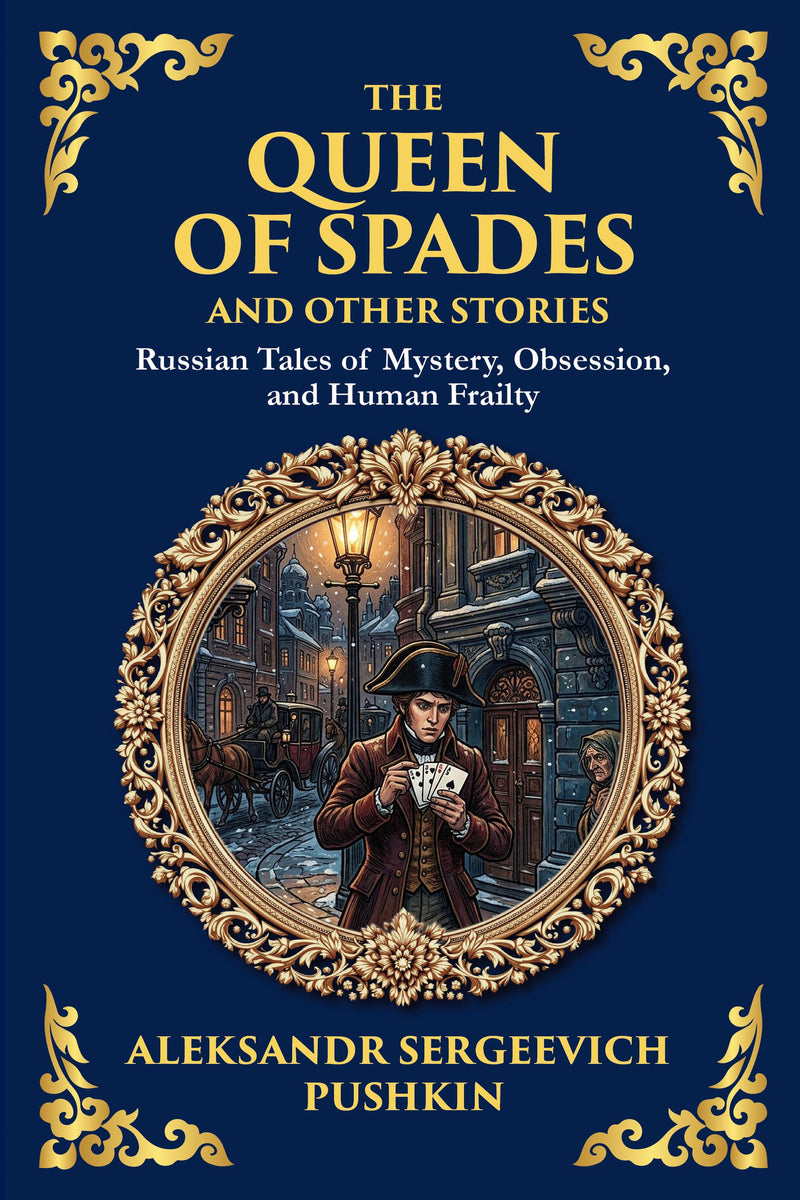
The Queen of Spades and Other Stories
Alexander Pushkin In the dim candlelit rooms of St. Petersburg’s aristocracy, secrets lie hidden beneath powdered wigs and porcelain masks.
or free app
10,000+ hrs library
30-day guarantee
The complete The Queen of Spades, and Other appears in modern English through Library of Alexandria Press, available online with audiobook narration included for members.
Have you ever wondered why desire, once awakened, can never be silenced? In The Queen of Spades, and Other Stories, Alexander Pushkin—the founding voice of Russian literature—offers readers a captivating journey through the moral labyrinths of love, ambition, greed, and fate. Blending Gothic atmosphere with elegant storytelling, Pushkin lays bare the secrets that dwell within the hearts of men.
The titular story, The Queen of Spades, is a psychological tour de force: Hermann, a cold and calculating officer, becomes obsessed with a rumored card secret that has brought others to ruin. His quest to extract it from an elderly countess leads to chilling consequences. Alongside this masterwork are other unforgettable tales: The Shot — A story of honor, delayed revenge, and the strange code of dueling men.
The Blizzard — A romance twisted by fate and mistaken identity. The Undertaker — A darkly ironic tale that blends supernatural dread with biting social satire. The Stationmaster — A moving story of innocence lost and the quiet tragedies of ordinary lives.
What you’ll discover in this modern edition
- Masterpieces of Short Fiction Explore Pushkin’s unmatched ability to create tension, irony, and tragedy in brief but unforgettable narratives.
- Themes of Obsession, Fate, and Moral Fragility Delve into characters whose deepest desires bring about their undoing.
- Foundations of Russian Literary Greatness Witness the early genius that influenced Dostoevsky, Tolstoy, and Turgenev.
- Elegant Gothic and Psychological Storytelling Perfect for lovers of Poe, Maupassant, and Hawthorne.
- A Mirror to the Russian Soul Through Pushkin’s lens, we see the grandeur, mystery, and melancholy that defined a nation and its people.
| Formats | eBook (EPUB + PDF) · Audiobook · Paperback · Hardcover · Large Print |
| Language | English |
| Trim size (print) | 6 × 9 in |
| Binding | Paperback — perfect-bound · Hardcover — casewrap |
| Large Print edition | Same text in a larger, easy-read type — a larger font, not a larger trim |
| Print pricing | Every physical book at our true cost — at-cost, no profit (members) |
| Library | 873 restored titles, always growing |
| Length | 55,218 words · ~3 hr 41 min reading |
| Reading level | Grade 4 · an easy, flowing read (this modern-English edition) |
| Edition | Modern English translation · 2026 |
Member reviews for this edition are collected as readers finish it — be the first. Across the library: 12,000+ books shipped, every plan covered by a 365-day print guarantee.
About this edition
A faithful, unabridged modern-English edition by The Library of Alexandria — carefully rendered for today's reader and verified paragraph-by-paragraph against the public-domain source. Available as eBook, audiobook, paperback, hardcover, and large print.
- Complete & unabridgedVerified paragraph by paragraph against the source — never a scan, never abridged.
- Modern English, faithfulReadable today, with the author’s meaning kept intact. Readable — not simplified.
- Every format, one membershipRead in your browser or the free app, or listen to the full audiobook.
Included free with your membership
Cancel anytime, one click · 30-day money-back guarantee
Edition last updated July 2026
What’s inside
The Queen of Spades and Other Stories — complete and unabridged: all 20 sections included with membership, plus the full audiobook.
Begin reading The Queen of Spades and Other Stories
In clear modern English — the complete text is included with membership.
Introduction
There are writers who become so thoroughly woven into the fabric of their nation’s identity that it grows difficult to imagine that culture without them. For Russia, Aleksandr Sergeevich Pushkin is that figure—not merely a great author among many, but the very fountainhead from which an entire literary tradition would flow. To open this collection is to step into the headwaters of Russian prose, to meet the imagination that would later shape Gogol, Dostoevsky, Tolstoy, Turgenev, and Chekhov. Yet Pushkin’s work, particularly the tales gathered here, requires no scholarly apparatus to enjoy. These are stories of obsession and chance, of love and ruin, of ordinary men driven to extraordinary acts by passions they cannot govern. They are, above all, marvelously readable—swift, precise, and charged with an energy that has lost none of its power across nearly two centuries.
The present volume brings together some of Pushkin’s finest achievements in short fiction, rendered in a modern translation designed for the contemporary reader. The aim throughout has been to preserve the crystalline economy and wit of the original while removing the barriers that older, more archaic translations sometimes placed between Pushkin and his audience. What remains is the essential Pushkin: lucid, ironic, emotionally acute, and endlessly surprising. Whether you come to these pages as a longtime admirer of Russian literature or as a newcomer curious about the source of so much that followed, you will find here a body of work that rewards both casual reading and the closest attention.
To understand why Pushkin occupies such an exalted place, it helps to know something of the world that produced him and the life he led—a life as dramatic, as governed by chance and passion, as anything he wrote. Born in Moscow in 1799 into an old but somewhat impoverished noble family, Pushkin was the great-grandson, on his mother’s side, of Abram Petrovich Gannibal, an African brought to Russia as a boy and raised at the court of Peter the Great, where he rose to become a distinguished general and engineer. Pushkin was intensely proud of this exotic ancestry and returned to it often in his writing, and it marked him in the eyes of his contemporaries as something singular even among the aristocracy. The poet who would come to embody the Russian soul carried in his veins the blood of distant continents, a fact that lends a particular resonance to his lifelong fascination with outsiders, with fate, and with those who do not quite fit the worlds into which they are born.
He was educated at the newly founded Imperial Lyceum at Tsarskoe Selo, an elite school established by Tsar Alexander I to train a new generation of administrators and statesmen. There, among a brilliant cohort of young men, Pushkin’s prodigious gifts revealed themselves early. He wrote verse with astonishing facility, and by the time he left the Lyceum he was already recognized as one of the most promising talents in Russia. But Pushkin was no docile servant of the state. His sympathies leaned toward reform, toward freedom, and his pen could be sharp and dangerous. Political poems circulated in manuscript, mocking the powerful and championing liberty, and these brought him to the attention of the authorities. He was exiled—first to the south of the empire, then to his family’s estate at Mikhailovskoe—a punishment that, paradoxically, gave him the solitude and stimulation he needed to mature as an artist.
The years of exile and the period that followed saw Pushkin produce an extraordinary range of work: lyric poetry of unmatched grace, the verse novel Eugene Onegin that would define a literary epoch, narrative poems, plays, and—most relevant to the present collection—a turn toward prose that would prove enormously consequential for the future of Russian literature. Pushkin came to prose relatively late, and somewhat self-consciously. The language of Russian prose in his day was still cumbersome, overburdened with the conventions of an earlier, more ornate style and with borrowings from French. Pushkin set out, almost deliberately, to forge a new kind of prose: clean, direct, fast-moving, free of unnecessary ornament. “Precision and brevity,” he wrote, “are the first virtues of prose. It demands thoughts and more thoughts—without them, brilliant expressions serve no purpose.” This conviction shaped everything he wrote in the form, and it accounts for the remarkable freshness his stories retain even today.
His personal life remained as turbulent as his political fortunes. In 1831 he married Natalya Goncharova, a celebrated beauty whose presence at court drew constant admiration and, eventually, the kind of attention that ruined him. Pushkin found himself trapped in a web of social obligation, financial strain, and jealousy. In 1837, defending his wife’s honor against the persistent attentions of a French officer named Georges d’Anthès, Pushkin fought a duel and was mortally wounded. He died two days later, at the age of thirty-seven. The nation mourned as though it had lost a member of its own family. In a sense, it had. The sense that Russia’s greatest voice had been silenced by the very codes of honor and chance that animate so much of his fiction gives his death a terrible symmetry with his art. He had written again and again of fate’s cruelty, of the thin line between fortune and ruin, of the way a single reckless act can undo a life. He lived—and died—inside one of his own stories.
It is worth dwelling on this because the themes that run through the tales in this volume are not abstract literary exercises. They emerge from a man who understood, intimately, the seductions of risk, the agony of jealousy, the weight of social pressure, and the terrible randomness of human events. When Pushkin writes of a gambler consumed by the dream of a winning hand, or of a man undone by his own passions, he is writing from somewhere very near the bone.
The centerpiece of this collection, and the work that gives it its title, is “The Queen of Spades”—a story that has fascinated readers, composers, and filmmakers ever since its first appearance in 1834. It is one of the supreme achievements of short fiction in any language: a tale of gambling, ambition, and the supernatural so tautly constructed that not a single sentence is wasted. Without revealing the turns of its plot, it can be said that the story concerns a young officer of cold and calculating temperament who becomes obsessed with a secret—a method, rumored to be infallible, for winning at cards. What follows is a study in the corrosive power of obsession, a meditation on the boundary between reason and madness, and a deliciously ambiguous ghost story that refuses to resolve the question of whether its uncanny events are real or the products of a disordered mind. Pushkin maintains an exquisite control throughout, never tipping his hand, leaving the reader suspended between rational and supernatural explanations in a way that anticipates the great psychological fiction of the century to come.
What makes “The Queen of Spades” so enduring is precisely this refusal to simplify. Its protagonist is no innocent led astray; he is a man whose own nature—his greed, his ambition, his refusal to leave anything to chance—becomes the engine of his fate. The card table, with its illusions of system and certainty in the face of pure randomness, serves as a perfect emblem of the human desire to master the uncontrollable. Pushkin, who knew the gaming table well and lost considerable sums at it during his life, writes about gambling with the authority of someone who understood both its mathematics and its madness. The story moves with the speed and inevitability of a dealt hand, and its final image lingers long after the book is closed.
Surrounding this masterpiece are tales drawn from Pushkin’s other great achievements in short fiction, including the cycle known as The Tales of the Late Ivan Petrovich Belkin. These stories, published in 1831 under the conceit that they had been collected by a fictional provincial gentleman, show Pushkin in a different but equally masterful mode. They are by turns comic, romantic, suspenseful, and quietly devastating. In them, Pushkin plays with the conventions of popular fiction—the romantic adventure, the tale of mistaken identity, the story of dueling honor—often beginning in a familiar register only to twist the expected outcome into something more truthful and more humane. There is a generosity of spirit in these tales, a willingness to let his characters surprise us, to let life prove larger and stranger than the literary formulas his readers would have anticipated.
One of these stories explores the aftermath of a duel deferred and the strange psychology of vengeance, examining what happens to a man who holds another’s life in his hands and chooses to wait. Another follows a young woman of imagination and spirit who, bored by provincial life, devises an elaborate masquerade in pursuit of love—a tale of disguise and self-invention that sparkles with wit and warmth. Yet another takes the humble figure of a station-master, one of the lowliest officials in the imperial bureaucracy, and finds in his small domestic tragedy a depth of feeling that would echo through Russian literature for generations. This last story in particular—with its compassionate attention to the dignity and suffering of an ordinary, overlooked man—planted a seed that Gogol, Dostoevsky, and countless others would cultivate. The figure of the “little man,” the insignificant clerk or official whose inner life nonetheless commands our full sympathy, became one of the great recurring subjects of Russian fiction, and it begins here.
What unites these various tales—and what justifies gathering them under the subtitle of mystery, obsession, and human weakness—is Pushkin’s unflinching yet deeply humane interest in the forces that drive people to act against their own interests. His characters gamble, they fall in love unwisely, they nurse grudges, they pursue revenge, they construct elaborate fantasies, they are undone by pride or greed or simple human longing. Pushkin observes them all with a gaze that is at once ironic and tender. He never moralizes, never lectures, never reduces his people to types or lessons. Instead he presents them in their full complexity and lets us draw our own conclusions. This is the essence of his modernity, and it is why these stories feel so alive even now.
A word should be said about Pushkin’s celebrated irony, for it is one of the chief pleasures of reading him and one that the careful reader should be alert to enjoy. Pushkin loved to play games with his readers and with the conventions of literature itself. He will set up an expectation only to overturn it; he will adopt the voice of a naive narrator while making us aware of everything that narrator misses; he will treat the gravest matters with a light touch and the most trivial with mock solemnity. There is in his work a constant, glinting intelligence, a sense of an author fully in command of his materials and delighting in his own dexterity. This is never cold or merely clever. Pushkin’s irony coexists with genuine feeling, and the combination produces a tone uniquely his own—worldly, humane, amused, and yet capable of sudden depths of pathos.
It is also worth understanding something of the society in which these stories unfold. Pushkin’s Russia was a rigidly stratified world dominated by an autocratic tsar and a nobility whose privileges and obligations were minutely codified. Rank governed everything—the famous Table of Ranks established by Peter the Great fixed every official’s place in an elaborate hierarchy, and a person’s standing in this system determined how he was addressed, where he could go, whom he could marry, what he could hope for. Beneath the nobility lay the vast mass of the peasantry, many of them serfs bound to the land. The army and the civil service offered the principal paths of advancement for ambitious young men, and the gulf between the glittering world of the capital’s salons and the grim provincial outposts was immense. Honor was paramount among the gentry, and disputes were frequently settled by duels, governed by an elaborate and deadly code—the very code that would claim Pushkin’s own life.
Cancel anytime, one click · 30-day money-back guarantee
Founding annual rate available now — your price locks for life when you join.
Not ready? Get this free chapter by email — read it anytime.
✓ Sent — check your inbox for The Queen of Spades and Other Stories.
Questions about The Queen of Spades and Other Stories
What is The Queen of Spades, and Other about?
Alexander Pushkin In the dim candlelit rooms of St. Petersburg’s aristocracy, secrets lie hidden beneath powdered wigs and porcelain masks. The Queen of Spades tells the haunting tale of a man consumed by the desire to unlock a mysterious card trick that promises unimaginable wealth—only to find himself ensnared by forces far darker than he imagined.
Who wrote The Queen of Spades, and Other?
The Queen of Spades, and Other was written by Aleksandr Sergeevich Pushkin. This edition presents the complete work in clear modern English, faithfully rendered from the public-domain original by Library of Alexandria Press.
Is The Queen of Spades, and Other free to read?
The opening chapter is free to read on this page. Members read and listen to the complete work — and the entire library — free, and can order any physical book at our true print cost.
How long is The Queen of Spades, and Other?
20 chapters (~55,218 words) — about 3 hr 41 min of reading in this modern-English edition.
Is this an abridged version of The Queen of Spades, and Other?
No. This is the complete, unabridged The Queen of Spades, and Other, carefully rendered into clear modern English and verified paragraph-by-paragraph against the public-domain source — nothing is cut or summarised.
What formats does The Queen of Spades, and Other come in?
The Queen of Spades, and Other is available as eBook, paperback, hardcover and large print. eBook and audiobook are included with membership; printed editions ship at our true print cost.
Shipping & returns
Billing & membership
More from the library


Explore Short Stories
- My Man Jeeves · P. G. Wodehouse
- Men without women · Ernest Hemingway
- Four Short Stories by Emile Zola · Émile Zola
- The Wisdom of Father Brown · G. K. Chesterton
- The Cask of Amontillado · Edgar Allan Poe
- Tales of Unrest · Joseph Conrad
- The Man with Two Left Feet, and Other Stories · P. G. Wodehouse
- The Book of Dragons · E. Nesbit
- The Four Million · O. Henry
- Ghost Stories of an Antiquary · M. R. James
- Carry On, Jeeves · P. G. Wodehouse
- Wild Animals I Have Known · Ernest Thompson Seton
- The Man Who Would Be King · Rudyard Kipling
- The Monkey’s Paw · W. W. Jacobs
- The Adventures of Heine · Edgar Wallace
- The Life-Eater · Harold Ward
- What Men Live By, and Other Tales · graf Leo Tolstoy
- The Innocence of Father Brown · G. K. Chesterton
- The Black Kiss
- The Beasts in the Void · Paul W. Fairman
- John Jones’s Dollar · Harry Stephen Keeler
- Subversive · Mack Reynolds
- The Mississippi Saucer · Frank Belknap Long
- Man of Distinction · Michael Shaara
- The Golden Judge · Nathaniel Gordon
- The Big Fix · George O. Smith
- Time and Time Again · H. Beam Piper
- Missing Link · Frank Herbert
- We're Civilized!
- The Crystal Crypt · Philip K. Dick
The Queen of Spades and Other Stories
The Queen of Spades and Other Stories
Russian Tales of Mystery, Obsession, and Human Weakness
Aleksandr Sergeevich Pushkin
Contents
- Introduction
- Chapter 1
- Chapter 2
- Chapter 3
- Chapter 4
- Chapter 5
- Chapter 6
- Chapter 7
- Chapter 8
- Chapter 9
- Chapter 10
- Chapter 11
- Chapter 12
- Chapter 13
- Chapter 14
- Chapter 15
- Chapter 16
- Chapter 17
- Chapter 18
- Chapter 19
Introduction
There are writers who become so thoroughly woven into the fabric of their nation’s identity that it grows difficult to imagine that culture without them. For Russia, Aleksandr Sergeevich Pushkin is that figure—not merely a great author among many, but the very fountainhead from which an entire literary tradition would flow. To open this collection is to step into the headwaters of Russian prose, to meet the imagination that would later shape Gogol, Dostoevsky, Tolstoy, Turgenev, and Chekhov. Yet Pushkin’s work, particularly the tales gathered here, requires no scholarly apparatus to enjoy. These are stories of obsession and chance, of love and ruin, of ordinary men driven to extraordinary acts by passions they cannot govern. They are, above all, marvelously readable—swift, precise, and charged with an energy that has lost none of its power across nearly two centuries.
The present volume brings together some of Pushkin’s finest achievements in short fiction, rendered in a modern translation designed for the contemporary reader. The aim throughout has been to preserve the crystalline economy and wit of the original while removing the barriers that older, more archaic translations sometimes placed between Pushkin and his audience. What remains is the essential Pushkin: lucid, ironic, emotionally acute, and endlessly surprising. Whether you come to these pages as a longtime admirer of Russian literature or as a newcomer curious about the source of so much that followed, you will find here a body of work that rewards both casual reading and the closest attention.
To understand why Pushkin occupies such an exalted place, it helps to know something of the world that produced him and the life he led—a life as dramatic, as governed by chance and passion, as anything he wrote. Born in Moscow in 1799 into an old but somewhat impoverished noble family, Pushkin was the great-grandson, on his mother’s side, of Abram Petrovich Gannibal, an African brought to Russia as a boy and raised at the court of Peter the Great, where he rose to become a distinguished general and engineer. Pushkin was intensely proud of this exotic ancestry and returned to it often in his writing, and it marked him in the eyes of his contemporaries as something singular even among the aristocracy. The poet who would come to embody the Russian soul carried in his veins the blood of distant continents, a fact that lends a particular resonance to his lifelong fascination with outsiders, with fate, and with those who do not quite fit the worlds into which they are born.
He was educated at the newly founded Imperial Lyceum at Tsarskoe Selo, an elite school established by Tsar Alexander I to train a new generation of administrators and statesmen. There, among a brilliant cohort of young men, Pushkin’s prodigious gifts revealed themselves early. He wrote verse with astonishing facility, and by the time he left the Lyceum he was already recognized as one of the most promising talents in Russia. But Pushkin was no docile servant of the state. His sympathies leaned toward reform, toward freedom, and his pen could be sharp and dangerous. Political poems circulated in manuscript, mocking the powerful and championing liberty, and these brought him to the attention of the authorities. He was exiled—first to the south of the empire, then to his family’s estate at Mikhailovskoe—a punishment that, paradoxically, gave him the solitude and stimulation he needed to mature as an artist.
The years of exile and the period that followed saw Pushkin produce an extraordinary range of work: lyric poetry of unmatched grace, the verse novel Eugene Onegin that would define a literary epoch, narrative poems, plays, and—most relevant to the present collection—a turn toward prose that would prove enormously consequential for the future of Russian literature. Pushkin came to prose relatively late, and somewhat self-consciously. The language of Russian prose in his day was still cumbersome, overburdened with the conventions of an earlier, more ornate style and with borrowings from French. Pushkin set out, almost deliberately, to forge a new kind of prose: clean, direct, fast-moving, free of unnecessary ornament. “Precision and brevity,” he wrote, “are the first virtues of prose. It demands thoughts and more thoughts—without them, brilliant expressions serve no purpose.” This conviction shaped everything he wrote in the form, and it accounts for the remarkable freshness his stories retain even today.
His personal life remained as turbulent as his political fortunes. In 1831 he married Natalya Goncharova, a celebrated beauty whose presence at court drew constant admiration and, eventually, the kind of attention that ruined him. Pushkin found himself trapped in a web of social obligation, financial strain, and jealousy. In 1837, defending his wife’s honor against the persistent attentions of a French officer named Georges d’Anthès, Pushkin fought a duel and was mortally wounded. He died two days later, at the age of thirty-seven. The nation mourned as though it had lost a member of its own family. In a sense, it had. The sense that Russia’s greatest voice had been silenced by the very codes of honor and chance that animate so much of his fiction gives his death a terrible symmetry with his art. He had written again and again of fate’s cruelty, of the thin line between fortune and ruin, of the way a single reckless act can undo a life. He lived—and died—inside one of his own stories.
It is worth dwelling on this because the themes that run through the tales in this volume are not abstract literary exercises. They emerge from a man who understood, intimately, the seductions of risk, the agony of jealousy, the weight of social pressure, and the terrible randomness of human events. When Pushkin writes of a gambler consumed by the dream of a winning hand, or of a man undone by his own passions, he is writing from somewhere very near the bone.
The centerpiece of this collection, and the work that gives it its title, is “The Queen of Spades”—a story that has fascinated readers, composers, and filmmakers ever since its first appearance in 1834. It is one of the supreme achievements of short fiction in any language: a tale of gambling, ambition, and the supernatural so tautly constructed that not a single sentence is wasted. Without revealing the turns of its plot, it can be said that the story concerns a young officer of cold and calculating temperament who becomes obsessed with a secret—a method, rumored to be infallible, for winning at cards. What follows is a study in the corrosive power of obsession, a meditation on the boundary between reason and madness, and a deliciously ambiguous ghost story that refuses to resolve the question of whether its uncanny events are real or the products of a disordered mind. Pushkin maintains an exquisite control throughout, never tipping his hand, leaving the reader suspended between rational and supernatural explanations in a way that anticipates the great psychological fiction of the century to come.
What makes “The Queen of Spades” so enduring is precisely this refusal to simplify. Its protagonist is no innocent led astray; he is a man whose own nature—his greed, his ambition, his refusal to leave anything to chance—becomes the engine of his fate. The card table, with its illusions of system and certainty in the face of pure randomness, serves as a perfect emblem of the human desire to master the uncontrollable. Pushkin, who knew the gaming table well and lost considerable sums at it during his life, writes about gambling with the authority of someone who understood both its mathematics and its madness. The story moves with the speed and inevitability of a dealt hand, and its final image lingers long after the book is closed.
Surrounding this masterpiece are tales drawn from Pushkin’s other great achievements in short fiction, including the cycle known as The Tales of the Late Ivan Petrovich Belkin. These stories, published in 1831 under the conceit that they had been collected by a fictional provincial gentleman, show Pushkin in a different but equally masterful mode. They are by turns comic, romantic, suspenseful, and quietly devastating. In them, Pushkin plays with the conventions of popular fiction—the romantic adventure, the tale of mistaken identity, the story of dueling honor—often beginning in a familiar register only to twist the expected outcome into something more truthful and more humane. There is a generosity of spirit in these tales, a willingness to let his characters surprise us, to let life prove larger and stranger than the literary formulas his readers would have anticipated.
One of these stories explores the aftermath of a duel deferred and the strange psychology of vengeance, examining what happens to a man who holds another’s life in his hands and chooses to wait. Another follows a young woman of imagination and spirit who, bored by provincial life, devises an elaborate masquerade in pursuit of love—a tale of disguise and self-invention that sparkles with wit and warmth. Yet another takes the humble figure of a station-master, one of the lowliest officials in the imperial bureaucracy, and finds in his small domestic tragedy a depth of feeling that would echo through Russian literature for generations. This last story in particular—with its compassionate attention to the dignity and suffering of an ordinary, overlooked man—planted a seed that Gogol, Dostoevsky, and countless others would cultivate. The figure of the “little man,” the insignificant clerk or official whose inner life nonetheless commands our full sympathy, became one of the great recurring subjects of Russian fiction, and it begins here.
What unites these various tales—and what justifies gathering them under the subtitle of mystery, obsession, and human weakness—is Pushkin’s unflinching yet deeply humane interest in the forces that drive people to act against their own interests. His characters gamble, they fall in love unwisely, they nurse grudges, they pursue revenge, they construct elaborate fantasies, they are undone by pride or greed or simple human longing. Pushkin observes them all with a gaze that is at once ironic and tender. He never moralizes, never lectures, never reduces his people to types or lessons. Instead he presents them in their full complexity and lets us draw our own conclusions. This is the essence of his modernity, and it is why these stories feel so alive even now.
A word should be said about Pushkin’s celebrated irony, for it is one of the chief pleasures of reading him and one that the careful reader should be alert to enjoy. Pushkin loved to play games with his readers and with the conventions of literature itself. He will set up an expectation only to overturn it; he will adopt the voice of a naive narrator while making us aware of everything that narrator misses; he will treat the gravest matters with a light touch and the most trivial with mock solemnity. There is in his work a constant, glinting intelligence, a sense of an author fully in command of his materials and delighting in his own dexterity. This is never cold or merely clever. Pushkin’s irony coexists with genuine feeling, and the combination produces a tone uniquely his own—worldly, humane, amused, and yet capable of sudden depths of pathos.
It is also worth understanding something of the society in which these stories unfold. Pushkin’s Russia was a rigidly stratified world dominated by an autocratic tsar and a nobility whose privileges and obligations were minutely codified. Rank governed everything—the famous Table of Ranks established by Peter the Great fixed every official’s place in an elaborate hierarchy, and a person’s standing in this system determined how he was addressed, where he could go, whom he could marry, what he could hope for. Beneath the nobility lay the vast mass of the peasantry, many of them serfs bound to the land. The army and the civil service offered the principal paths of advancement for ambitious young men, and the gulf between the glittering world of the capital’s salons and the grim provincial outposts was immense. Honor was paramount among the gentry, and disputes were frequently settled by duels, governed by an elaborate and deadly code—the very code that would claim Pushkin’s own life.
A group of people were playing cards at the home of Narumoff, a lieutenant in the Horse Guards. A long winter night had slipped away unnoticed, and it was five in the morning by the time dinner was served. The winners sat down to eat with great appetites, while the losers left their plates empty. Gradually, however, helped along by the champagne, the conversation grew lively and everyone joined in.
“How did your evening go, Surin?” the host asked one of his friends.
“Oh, I lost, as always. I have terrible luck. I play logically and stay calm. Nothing rattles me; I never change my strategy, yet I still always lose.”
“Are you telling me that you didn’t bet on red once all evening? Your discipline is impressive.”
“What do you think of Hermann?” one of the guests asked, pointing toward a young engineer officer.
“That guy has never placed a bet or even touched a card in his life, yet he stays up with us watching the game until five in the morning.”
“I find it interesting,” Hermann replied, “but I’m not willing to risk what I need for the sake of something I don’t.”
“Hermann is German and frugal; that’s the secret,” Tomski exclaimed. “But the truly amazing one is Countess Anna Fedotovna!”
“Haven’t you noticed,” Tomski asked, “that she never plays?”
“I have,” Narumoff replied. “An eighty-year-old woman who never even touches a card; that really is unusual!”
“Just listen. About sixty years ago, my grandmother went to Paris and became a total sensation. People chased her through the streets, calling her the ‘Muscovite Venus.’ Richelieu fell in love with her, and my grandmother claims that her cold behavior almost drove him to kill himself. Back then, women used to play faro. One evening at court, she lost a huge amount of money on credit to the Duke of Orleans. When she returned home, she took off her beauty marks and her hoop skirt, and dressed in this tragic way to tell my grandfather about her misfortune and ask for the money. My grandfather, who is now dead, was basically his wife’s servant. He was terrified of her, but the amount she asked for shocked him. He flew into a rage, did some quick math, and proved to my grandmother that she had spent half a million rubles in just six months. He told her flatly that he had no estates in Paris to sell, since his lands were near Moscow and Saratov, and he simply refused to pay. You can imagine how angry my grandmother got. She slapped him across the face and spent the night in a different room.
End of the free sample
Keep reading, free
Members read and listen to the complete book — and the entire library. Cancel anytime, one click · 30-day money-back guarantee.