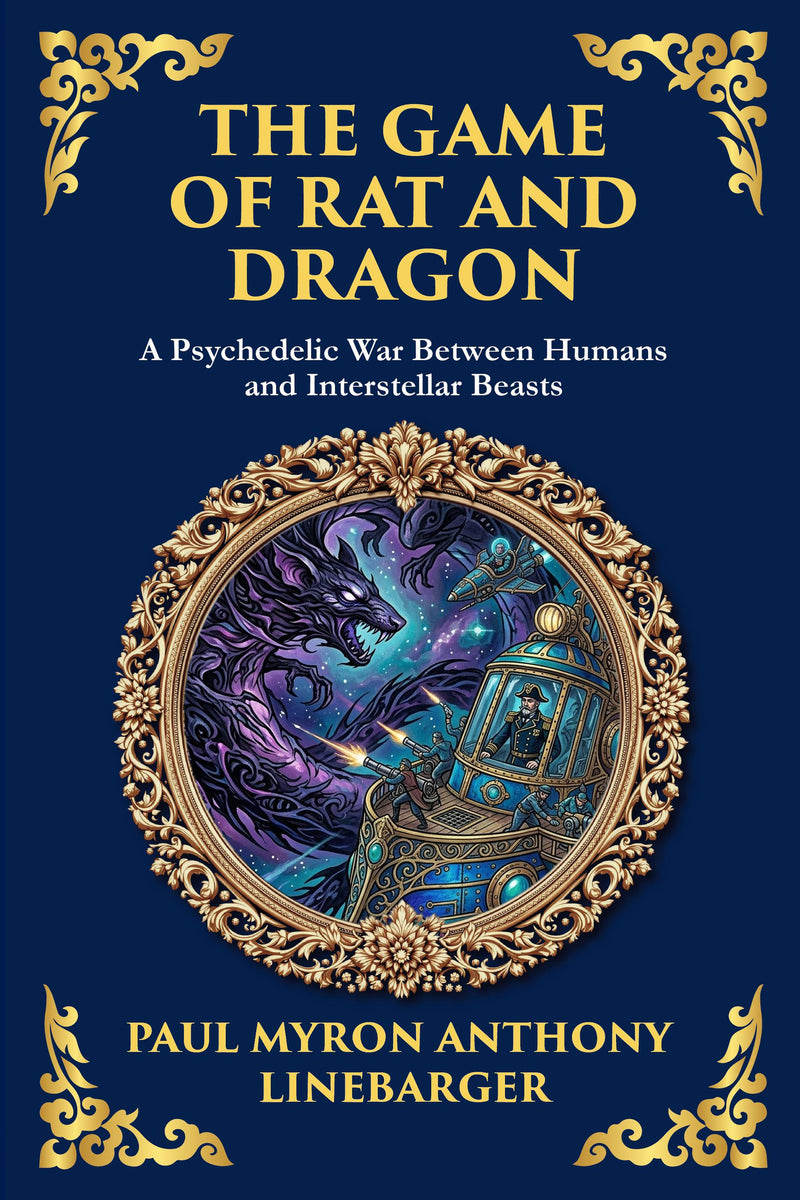
The Game of Rat and Dragon
Cordwainer Smith (P.M.A. Linebarger) In the deep reaches of space, where lightyears separate colonies and minds stretch across dimensions, a deadly war is being fought—not with weapons, but with perception.
or free app
10,000+ hrs library
30-day guarantee
The complete The Game of Rat and Dragon appears in modern English through Library of Alexandria Press, available online with audiobook narration included for members.
Have you ever wondered why the most dangerous battles aren’t fought with guns—but with the mind itself? Paul Myron Anthony Linebarger, known to science fiction readers as Cordwainer Smith, delivers a mind-altering masterwork in The Game of Rat and Dragon, a story where telepathy becomes the greatest weapon and survival depends on the bond between man and cat. Set in a future where humanity uses instantaneous “pinlighting” to travel between star systems, ships and minds are vulnerable to the deadly psychic presence of the Dragons—creatures so incomprehensible that they can only be perceived as madness.
The only defense? Elite telepaths paired with telepathic cats, beings quick enough to destroy the Dragons before they devour the human psyche. In this psychedelic tale, Linebarger—a real-life psychological warfare expert—combines scientific rigor with mythic allegory to create a futuristic fable unlike anything else in the genre.
What you’ll discover in this modern edition
- A Futuristic War of the Mind Witness interstellar combat that transcends physical weapons and enters the realm of telepathy and perception.
| Formats | eBook (EPUB + PDF) · Audiobook · Paperback · Hardcover · Large Print |
| Language | English |
| Trim size (print) | 6 × 9 in |
| Binding | Paperback — perfect-bound · Hardcover — casewrap |
| Large Print edition | Same text in a larger, easy-read type — a larger font, not a larger trim |
| Print pricing | Every physical book at our true cost — at-cost, no profit (members) |
| Library | 873 restored titles, always growing |
| Length | 8,687 words · ~35 min reading |
| Reading level | Grade 10 · a comfortable read (this modern-English edition) |
| Edition | Modern English translation · 2026 |
Member reviews for this edition are collected as readers finish it — be the first. Across the library: 12,000+ books shipped, every plan covered by a 365-day print guarantee.
About this edition
A faithful, unabridged modern-English edition by The Library of Alexandria — carefully rendered for today's reader and verified paragraph-by-paragraph against the public-domain source. Available as eBook, audiobook, paperback, hardcover, and large print.
- Complete & unabridgedVerified paragraph by paragraph against the source — never a scan, never abridged.
- Modern English, faithfulReadable today, with the author’s meaning kept intact. Readable — not simplified.
- Every format, one membershipRead in your browser or the free app, or listen to the full audiobook.
Included free with your membership
Cancel anytime, one click · 30-day money-back guarantee
Edition last updated July 2026
What’s inside
The Game of Rat and Dragon — complete and unabridged: all 6 sections included with membership, plus the full audiobook.
Begin reading The Game of Rat and Dragon
In clear modern English — the complete text is included with membership.
Introduction
There are stories that arrive quietly and then refuse to leave. They lodge somewhere behind the eyes, in that dim chamber where a reader keeps the images that have become part of how they see the world. The tale you are about to read is one of these. It is short—deceptively short, almost defiantly short—and yet it carries within its compact frame an entire cosmology, a theory of fear, a meditation on loneliness, and a love story unlike any you have encountered before. To open this book is to step into a vision of the future that feels at once strange and intimate, mechanical and tender, terrifying and warm. Few works of science fiction have managed to compress so much wonder into so few pages, and fewer still have done so while leaving the reader changed.
The author who created this world wrote under a name that became, in its own right, a kind of legend within the literature of the imagination. Behind that name stood a man of astonishing accomplishment, a person whose life seemed to belong to several centuries at once. He was a scholar of psychological warfare, an advisor to governments, a traveler fluent in the textures of cultures across the globe, and a thinker who understood, perhaps better than any of his contemporaries, how the human mind responds to terror and to comfort. When such a man turns his attention to the writing of fiction, the result is not mere entertainment. It is something closer to a transmission from a deeper place—a story that draws upon hard-won knowledge of how people break, how they endure, and how they reach across impossible distances to find one another.
This particular story occupies a singular position in the body of work he left behind. It is one of his most beloved creations, the kind of piece that readers return to again and again, recommending it to friends with a peculiar urgency, as if passing along a secret. It belongs to a vast and intricate future history he constructed over many years, a tapestry of interlinked tales spanning thousands of years of human and posthuman civilization. Yet you need bring no prior knowledge to your reading. The story stands entirely on its own, complete and self-contained, a perfect jewel that catches the light from every angle regardless of the setting in which you first discover it.
To understand what makes this story so remarkable, it helps to understand a little about the imaginative universe from which it springs—though, again, none of this is required to be moved by what you are about to read. The author spent decades building an enormous and richly textured vision of humanity’s far future, a sprawling chronicle that traced the species across millennia of expansion, transformation, decline, and rebirth among the stars. This future was not the clean, chrome-plated optimism that dominated so much of the science fiction of his era. Nor was it the bleak nihilism that would come to dominate later. It was something altogether stranger and more profound: a future haunted by mythology, shaped by ritual, suffused with a sense of the sacred and the uncanny. In his cosmos, the machinery of advanced technology coexisted with deep human emotion, with longing and grief and devotion. He understood that no matter how far we travel, no matter how thoroughly we reshape our bodies and our societies, we will carry with us the oldest parts of ourselves—our capacity for fear, our hunger for connection, our need to love and to be loved in return.
The story before you takes place during humanity’s first great push into the depths of interstellar space, and it concerns a peril that the early travelers could scarcely have anticipated. As ships learned to leap across the immense gulfs between stars, they discovered that the void was not empty. Something waited there, in the spaces between the lights, something that could not be detected by any instrument or fought by any conventional weapon. This is the dragon of the title—though to say more about its nature would be to rob you of the slow, mounting dread and astonishment with which the author unveils it. Suffice it to say that he conceived of a danger that strikes not at the body but at the mind, a horror that operates in the realm of perception and madness. To survive it, humanity must find an unlikely defense, must forge a partnership of the most surprising and touching kind.
What elevates this from clever premise to genuine art is the author’s refusal to treat his characters as mere vehicles for ideas. He cared, deeply and visibly, about the people who inhabited his stories. He understood that the most advanced technology in the universe means nothing without a beating heart somewhere at its center. And so the cosmic battle he describes—the war waged in flashing instants across light-years, fought with weapons that exist at the very edge of comprehension—is ultimately a story about a particular individual, about what that person feels, fears, sacrifices, and yearns for. The grand scale and the intimate scale are woven together so tightly that they become inseparable. You will find yourself caught up in the sweep of an interstellar conflict and, in the very same breath, aching over the private sorrows of a single soul.
There is a quality to the prose here that deserves special mention, because it is part of what makes the experience of reading this story so distinctive. The author wrote in a manner unlike anyone else of his generation. His sentences carry a strange music, a rhythm that seems borrowed from folklore and oral tradition, from the storytelling of cultures far removed from the technological West. He had absorbed the literatures and the linguistic patterns of many peoples, and that breadth of experience flows into his style, giving it an incantatory, almost hypnotic power. When he describes the terror of the deep, you feel it as a physical sensation. When he describes the bond between his characters, you feel that too, as something warm and aching and real. The language itself seems to vibrate at a frequency tuned to the emotions it conveys. This is why the word “psychedelic” in the subtitle is no idle marketing flourish. The story genuinely alters the texture of your perception while you read it. It places you inside states of consciousness that ordinary fiction rarely attempts to reach.
The present edition has been prepared as a modern translation and adaptation for the contemporary reader. This requires a word of explanation, because the phrase might raise questions in a thoughtful reader’s mind. The original was written in English, but it was written in a particular moment, with the idioms, assumptions, and stylistic conventions of its time. Language drifts. Phrasings that once felt natural can come to feel stilted or obscure; references that once landed instantly can now require a footnote; rhythms that once sang can now stumble against the modern ear. The goal of this edition is to carry the story across that gulf of time intact, to preserve everything that makes it powerful while smoothing the small frictions that might otherwise stand between you and the author’s vision. Think of it less as a rewriting and more as a careful restoration, the way conservators clean and stabilize an old painting so that its colors blaze again as the artist intended. The aim throughout has been fidelity—fidelity to the meaning, to the emotion, and above all to that strange and beautiful music that is the author’s signature. Nothing essential has been lost. What you hold is the story as its creator dreamed it, made freshly available to readers living in a different century than the one in which it was born.
It is worth lingering a moment on the extraordinary person who wrote this tale, because his biography illuminates the fiction in surprising ways. He lived a life that reads almost like fiction itself—a life of unusual breadth and intensity, shaped by forces that most writers can only imagine. He was raised partly abroad, immersed from childhood in cultures far from his birthplace, learning to move between worlds and languages with a fluency that few ever achieve. His godfather, by some accounts, was a figure of immense historical significance, and the young man grew up surrounded by the great currents of twentieth-century geopolitics. He became an expert in matters of the mind and its manipulation—in the science and art of how beliefs are formed, how fears are spread, how morale is broken or sustained. He understood propaganda not as a dirty word but as a phenomenon to be studied with rigor, and he wrote influential works on the subject that were read and consulted by serious people in serious institutions.
What does all of this have to do with a science fiction story about a war against monsters in the dark between the stars? Everything, as it turns out. A man who has spent his professional life studying how the human mind responds to terror is uniquely equipped to write about terror. A man who has thought deeply about the mechanics of fear—about what it does to perception, to judgment, to the very fabric of the self—brings an authority to that subject that no amount of pure invention could supply. The horror at the center of this story is a psychological horror, a horror of the mind, and it was written by one of the foremost experts on the psychology of fear who ever lived. This is why the dread it evokes feels so authentic, so unsettlingly precise. The author knew exactly which strings to pull and exactly how hard to pull them.
But there is another dimension to his life and his thought that matters just as much, and it concerns not fear but its opposite. For all his expertise in the dark arts of psychological pressure, this was a man who believed profoundly in human dignity, in compassion, in the bonds that hold us together against the chaos. His fiction is shot through with tenderness, with an almost religious reverence for love and loyalty and sacrifice. He was, by many accounts, a person of deep spiritual feeling, and his stories often carry an undertone of the sacred—a sense that the universe, however vast and terrifying, is also charged with meaning, with grace, with the possibility of redemption. In this story, the partnership at its heart is portrayed not as a mere tactical arrangement but as something approaching the holy: a meeting of two very different forms of consciousness, a reaching across an unbridgeable divide, a love that transcends the boundaries of species and self. The author’s twin preoccupations—the science of fear and the spirituality of love—are both fully present here, held in perfect tension, and it is this tension that gives the story its almost unbearable emotional charge.
He chose to publish his fiction under a pseudonym, partly to keep his literary life separate from his professional one. This act of concealment, this assumption of a mask, feels strangely appropriate for a writer so concerned with hidden identities, with the gap between surface and depth, with the secret selves we carry within us. The name he wrote under became, over time, a byword for a particular kind of science fiction: visionary, humane, mythic, and utterly unlike anything else. Readers who discovered his work tended to become devotees, evangelists who could not rest until they had pressed his stories into the hands of everyone they knew. There was, and remains, something cultlike about the devotion he inspires—not in any sinister sense, but in the sense that those who love his work love it with a fervor that transcends mere literary appreciation. They speak of it as one might speak of a revelation, of an encounter that altered the course of their inner life.
This story is, for many of those devotees, the very best place to begin. It distills everything that makes his work extraordinary into a form so compact and so perfectly realized that it can be read in a single sitting—and yet it lingers for a lifetime. If you have never encountered this author before, you could not ask for a better introduction. And if you are returning to this tale after years away, you will likely find that it has lost none of its power, that the dragon still terrifies and the bond at its heart still moves you to the edge of tears.
Cancel anytime, one click · 30-day money-back guarantee
Founding annual rate available now — your price locks for life when you join.
Not ready? Get this free chapter by email — read it anytime.
✓ Sent — check your inbox for The Game of Rat and Dragon.
Questions about The Game of Rat and Dragon
What is The Game of Rat and Dragon about?
Cordwainer Smith (P.M.A. Linebarger) In the deep reaches of space, where lightyears separate colonies and minds stretch across dimensions, a deadly war is being fought—not with weapons, but with perception. Humans, aided by telepathic cats, engage in a hallucinatory battle against an invisible alien threat known only as the Dragons. To survive, they must surrender their consciousness to speed-of-thought combat and rely on the feline instinct of their mysterious partners.
Who wrote The Game of Rat and Dragon?
The Game of Rat and Dragon was written by Paul Myron Anthony Linebarger. This edition presents the complete work in clear modern English, faithfully rendered from the public-domain original by Library of Alexandria Press.
Is The Game of Rat and Dragon free to read?
The opening chapter is free to read on this page. Members read and listen to the complete work — and the entire library — free, and can order any physical book at our true print cost.
How long is The Game of Rat and Dragon?
6 chapters (~8,687 words) — about 35 min of reading in this modern-English edition.
Is this an abridged version of The Game of Rat and Dragon?
No. This is the complete, unabridged The Game of Rat and Dragon, carefully rendered into clear modern English and verified paragraph-by-paragraph against the public-domain source — nothing is cut or summarised.
What formats does The Game of Rat and Dragon come in?
The Game of Rat and Dragon is available as eBook, paperback, hardcover and large print. eBook and audiobook are included with membership; printed editions ship at our true print cost.
Shipping & returns
Billing & membership
More from the library


Explore Free eBooks
- Kant's Prolegomena to Any Future Metaphysics · Immanuel Kant
- The Advancement of Learning · Francis Bacon
- The Dawn of Day · Friedrich Nietzsche
- Peter and Wendy · J. M. Barrie
- Meditations · Marcus Aurelius
- The Confessions of St. Augustine · Saint Augustine of Hippo
- Resurrection · Leo Tolstoy
- Dialogues Concerning Natural Religion · David Hume
- As You Like It · William Shakespeare
- Jack and Jill · Louisa May Alcott
- Dream Psychology: Psychoanalysis for Beginners · Sigmund Freud
- The Raven · Edgar Allan Poe
- Considerations on Representative Government · John Stuart Mill
- The Will to Power: An Attempted Transvaluation of All Values. Book III and IV · Friedrich Nietzsche
- Tarzan of the Apes · Edgar Rice Burroughs
- Fundamental Principles of the Metaphysic of Morals · Immanuel Kant
- The Confessions of Jean Jacques Rousseau — Complete · Jean-Jacques Rousseau
- The Merchant of Venice · William Shakespeare
- Democracy in America — Volume 2 · Alexis de Tocqueville
- Ecce Homo · Friedrich Wilhelm Nietzsche
- Second Treatise of Government · John Locke
- The Wonderful Wizard of Oz · L. Frank Baum
- The Prince · Niccolò Machiavelli
- Anne of Green Gables · L. M. Montgomery
- De Profundis · Oscar Wilde
- Thus Spake Zarathustra: A Book for All and None · Friedrich Nietzsche
- Anna Karenina · Leo Tolstoy
- Great Expectations · Charles Dickens
- The Island of Doctor Moreau · H. G. Wells
- A Midsummer Night's Dream · William Shakespeare
The Game of Rat and Dragon
The Game of Rat and Dragon
A Psychedelic War Between Humans and Interstellar Beasts
Paul Myron Anthony Linebarger
Contents
- Introduction
- Chapter 1
- Chapter 2
- Chapter 3
- Chapter 4
- Chapter 5
Introduction
There are stories that arrive quietly and then refuse to leave. They lodge somewhere behind the eyes, in that dim chamber where a reader keeps the images that have become part of how they see the world. The tale you are about to read is one of these. It is short—deceptively short, almost defiantly short—and yet it carries within its compact frame an entire cosmology, a theory of fear, a meditation on loneliness, and a love story unlike any you have encountered before. To open this book is to step into a vision of the future that feels at once strange and intimate, mechanical and tender, terrifying and warm. Few works of science fiction have managed to compress so much wonder into so few pages, and fewer still have done so while leaving the reader changed.
The author who created this world wrote under a name that became, in its own right, a kind of legend within the literature of the imagination. Behind that name stood a man of astonishing accomplishment, a person whose life seemed to belong to several centuries at once. He was a scholar of psychological warfare, an advisor to governments, a traveler fluent in the textures of cultures across the globe, and a thinker who understood, perhaps better than any of his contemporaries, how the human mind responds to terror and to comfort. When such a man turns his attention to the writing of fiction, the result is not mere entertainment. It is something closer to a transmission from a deeper place—a story that draws upon hard-won knowledge of how people break, how they endure, and how they reach across impossible distances to find one another.
This particular story occupies a singular position in the body of work he left behind. It is one of his most beloved creations, the kind of piece that readers return to again and again, recommending it to friends with a peculiar urgency, as if passing along a secret. It belongs to a vast and intricate future history he constructed over many years, a tapestry of interlinked tales spanning thousands of years of human and posthuman civilization. Yet you need bring no prior knowledge to your reading. The story stands entirely on its own, complete and self-contained, a perfect jewel that catches the light from every angle regardless of the setting in which you first discover it.
To understand what makes this story so remarkable, it helps to understand a little about the imaginative universe from which it springs—though, again, none of this is required to be moved by what you are about to read. The author spent decades building an enormous and richly textured vision of humanity’s far future, a sprawling chronicle that traced the species across millennia of expansion, transformation, decline, and rebirth among the stars. This future was not the clean, chrome-plated optimism that dominated so much of the science fiction of his era. Nor was it the bleak nihilism that would come to dominate later. It was something altogether stranger and more profound: a future haunted by mythology, shaped by ritual, suffused with a sense of the sacred and the uncanny. In his cosmos, the machinery of advanced technology coexisted with deep human emotion, with longing and grief and devotion. He understood that no matter how far we travel, no matter how thoroughly we reshape our bodies and our societies, we will carry with us the oldest parts of ourselves—our capacity for fear, our hunger for connection, our need to love and to be loved in return.
The story before you takes place during humanity’s first great push into the depths of interstellar space, and it concerns a peril that the early travelers could scarcely have anticipated. As ships learned to leap across the immense gulfs between stars, they discovered that the void was not empty. Something waited there, in the spaces between the lights, something that could not be detected by any instrument or fought by any conventional weapon. This is the dragon of the title—though to say more about its nature would be to rob you of the slow, mounting dread and astonishment with which the author unveils it. Suffice it to say that he conceived of a danger that strikes not at the body but at the mind, a horror that operates in the realm of perception and madness. To survive it, humanity must find an unlikely defense, must forge a partnership of the most surprising and touching kind.
What elevates this from clever premise to genuine art is the author’s refusal to treat his characters as mere vehicles for ideas. He cared, deeply and visibly, about the people who inhabited his stories. He understood that the most advanced technology in the universe means nothing without a beating heart somewhere at its center. And so the cosmic battle he describes—the war waged in flashing instants across light-years, fought with weapons that exist at the very edge of comprehension—is ultimately a story about a particular individual, about what that person feels, fears, sacrifices, and yearns for. The grand scale and the intimate scale are woven together so tightly that they become inseparable. You will find yourself caught up in the sweep of an interstellar conflict and, in the very same breath, aching over the private sorrows of a single soul.
There is a quality to the prose here that deserves special mention, because it is part of what makes the experience of reading this story so distinctive. The author wrote in a manner unlike anyone else of his generation. His sentences carry a strange music, a rhythm that seems borrowed from folklore and oral tradition, from the storytelling of cultures far removed from the technological West. He had absorbed the literatures and the linguistic patterns of many peoples, and that breadth of experience flows into his style, giving it an incantatory, almost hypnotic power. When he describes the terror of the deep, you feel it as a physical sensation. When he describes the bond between his characters, you feel that too, as something warm and aching and real. The language itself seems to vibrate at a frequency tuned to the emotions it conveys. This is why the word “psychedelic” in the subtitle is no idle marketing flourish. The story genuinely alters the texture of your perception while you read it. It places you inside states of consciousness that ordinary fiction rarely attempts to reach.
The present edition has been prepared as a modern translation and adaptation for the contemporary reader. This requires a word of explanation, because the phrase might raise questions in a thoughtful reader’s mind. The original was written in English, but it was written in a particular moment, with the idioms, assumptions, and stylistic conventions of its time. Language drifts. Phrasings that once felt natural can come to feel stilted or obscure; references that once landed instantly can now require a footnote; rhythms that once sang can now stumble against the modern ear. The goal of this edition is to carry the story across that gulf of time intact, to preserve everything that makes it powerful while smoothing the small frictions that might otherwise stand between you and the author’s vision. Think of it less as a rewriting and more as a careful restoration, the way conservators clean and stabilize an old painting so that its colors blaze again as the artist intended. The aim throughout has been fidelity—fidelity to the meaning, to the emotion, and above all to that strange and beautiful music that is the author’s signature. Nothing essential has been lost. What you hold is the story as its creator dreamed it, made freshly available to readers living in a different century than the one in which it was born.
It is worth lingering a moment on the extraordinary person who wrote this tale, because his biography illuminates the fiction in surprising ways. He lived a life that reads almost like fiction itself—a life of unusual breadth and intensity, shaped by forces that most writers can only imagine. He was raised partly abroad, immersed from childhood in cultures far from his birthplace, learning to move between worlds and languages with a fluency that few ever achieve. His godfather, by some accounts, was a figure of immense historical significance, and the young man grew up surrounded by the great currents of twentieth-century geopolitics. He became an expert in matters of the mind and its manipulation—in the science and art of how beliefs are formed, how fears are spread, how morale is broken or sustained. He understood propaganda not as a dirty word but as a phenomenon to be studied with rigor, and he wrote influential works on the subject that were read and consulted by serious people in serious institutions.
What does all of this have to do with a science fiction story about a war against monsters in the dark between the stars? Everything, as it turns out. A man who has spent his professional life studying how the human mind responds to terror is uniquely equipped to write about terror. A man who has thought deeply about the mechanics of fear—about what it does to perception, to judgment, to the very fabric of the self—brings an authority to that subject that no amount of pure invention could supply. The horror at the center of this story is a psychological horror, a horror of the mind, and it was written by one of the foremost experts on the psychology of fear who ever lived. This is why the dread it evokes feels so authentic, so unsettlingly precise. The author knew exactly which strings to pull and exactly how hard to pull them.
But there is another dimension to his life and his thought that matters just as much, and it concerns not fear but its opposite. For all his expertise in the dark arts of psychological pressure, this was a man who believed profoundly in human dignity, in compassion, in the bonds that hold us together against the chaos. His fiction is shot through with tenderness, with an almost religious reverence for love and loyalty and sacrifice. He was, by many accounts, a person of deep spiritual feeling, and his stories often carry an undertone of the sacred—a sense that the universe, however vast and terrifying, is also charged with meaning, with grace, with the possibility of redemption. In this story, the partnership at its heart is portrayed not as a mere tactical arrangement but as something approaching the holy: a meeting of two very different forms of consciousness, a reaching across an unbridgeable divide, a love that transcends the boundaries of species and self. The author’s twin preoccupations—the science of fear and the spirituality of love—are both fully present here, held in perfect tension, and it is this tension that gives the story its almost unbearable emotional charge.
He chose to publish his fiction under a pseudonym, partly to keep his literary life separate from his professional one. This act of concealment, this assumption of a mask, feels strangely appropriate for a writer so concerned with hidden identities, with the gap between surface and depth, with the secret selves we carry within us. The name he wrote under became, over time, a byword for a particular kind of science fiction: visionary, humane, mythic, and utterly unlike anything else. Readers who discovered his work tended to become devotees, evangelists who could not rest until they had pressed his stories into the hands of everyone they knew. There was, and remains, something cultlike about the devotion he inspires—not in any sinister sense, but in the sense that those who love his work love it with a fervor that transcends mere literary appreciation. They speak of it as one might speak of a revelation, of an encounter that altered the course of their inner life.
This story is, for many of those devotees, the very best place to begin. It distills everything that makes his work extraordinary into a form so compact and so perfectly realized that it can be read in a single sitting—and yet it lingers for a lifetime. If you have never encountered this author before, you could not ask for a better introduction. And if you are returning to this tale after years away, you will likely find that it has lost none of its power, that the dragon still terrifies and the bond at its heart still moves you to the edge of tears.
Pinlighting is a miserable way to make a living. Underhill was livid as he shut the door behind him. It felt pointless to wear a uniform and look like a soldier if people didn’t respect the work he did.
He sat in his chair, leaned his head back against the rest, and pulled the helmet down over his brow.
While waiting for the pin-set to warm up, he thought about the girl in the outer hallway. She had glanced at the equipment and then looked at him with contempt.
“Meow.” That was all she had said, but the remark stung him deeply.
What did she take him for—a joke, a lazy bum, or just some nameless face in a uniform? Did she not realize that for every thirty minutes of pinlighting, he earned at least two months of recovery time in the hospital?
The set was finally warm. He felt the blocks of space surrounding him and sensed himself at the center of a massive, empty cubic grid. In that void, he could feel the hollow, aching horror of space itself and the intense anxiety that hit his mind whenever it touched even the smallest speck of dead dust.
As he relaxed, he felt the comforting stability of the Sun and the predictable movements of the familiar planets and the Moon. Our solar system felt as charming and simple as an old cuckoo clock, filled with a reassuring, steady ticking. The strange little moons of Mars zipped around their planet like frantic mice, yet their regularity proved that everything was fine. Far above the main orbital plane, he could sense about half a ton of dust drifting outside the usual human travel lanes.
Here, there was nothing to fight and nothing to challenge the mind—nothing to rip a living soul from a body, leaving it dripping with a residue as real as blood.
End of the free sample
Keep reading, free
Members read and listen to the complete book — and the entire library. Cancel anytime, one click · 30-day money-back guarantee.