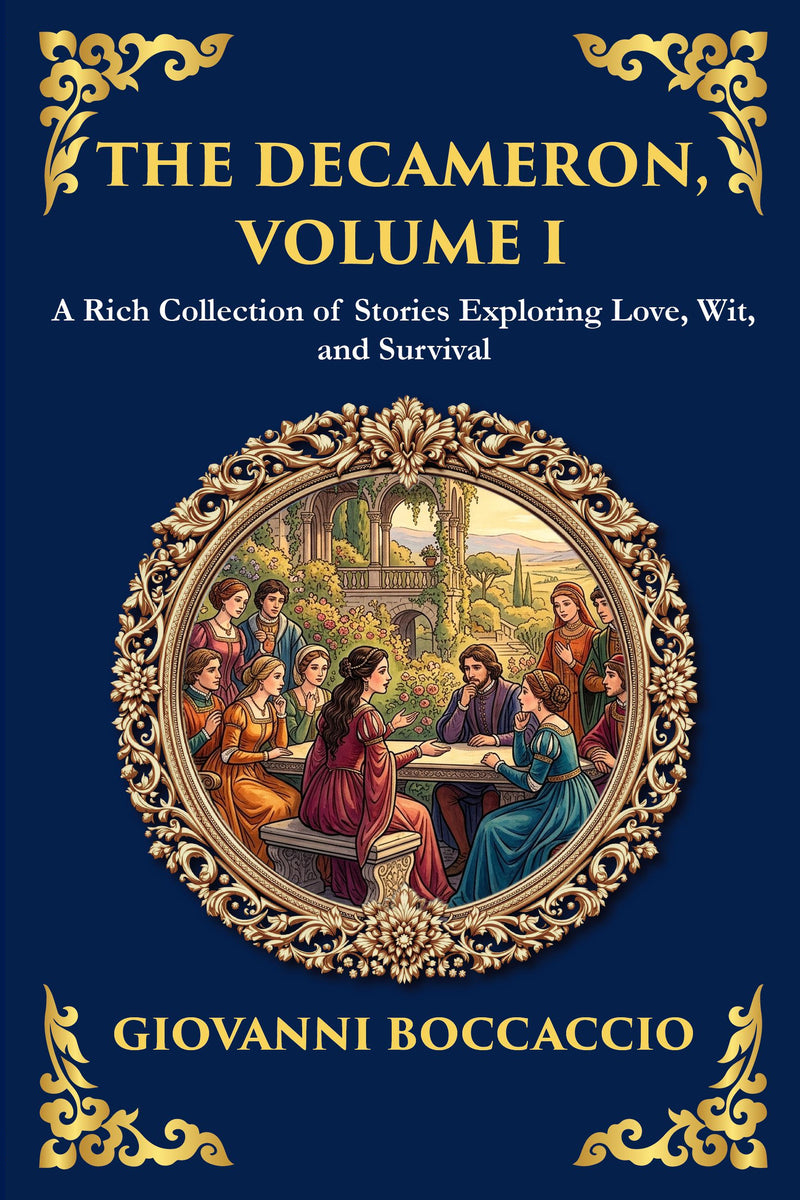
The Decameron, Volume 1
As the Black Death ravages 14th-century Florence, ten young people flee to the countryside— bringing with them not just provisions, but a powerful need for joy, connection, and storytelling.
or free app
10,000+ hrs library
30-day guarantee
The complete The Decameron, Volume I appears in modern English through Library of Alexandria Press, available online with audiobook narration included for members.
Have you ever wondered why we turn to stories when the world around us begins to fall apart? The Decameron, Volume I by Giovanni Boccaccio is one of the most influential works of Western literature—an early Renaissance masterpiece that redefined storytelling. Written during the devastating plague that swept across Europe in the 14th century, this first volume introduces the premise and the first group of captivating stories told by ten Florentine nobles escaping the horrors of the city.
Sheltering in a secluded villa, each day the group selects a new ruler who sets the theme for a round of storytelling. The result? A dazzling variety of tales—some romantic, others tragic, comical, or cautionary—all steeped in the values, contradictions, and complexities of the time.
But more than just entertainment, The Decameron offers a profound meditation on mortality, virtue, cleverness, and the social mores that define human behavior. Its modern translation makes Boccaccio's wit and wisdom feel as alive today as it was in 1350.
What you’ll discover in this modern edition
- A Timeless Literary Structure – The frame narrative of ten storytellers over ten days creates a dynamic and ever-evolving reading experience.
- Vivid Characters and Plots – From noble lovers and wise women to cunning tricksters and scheming merchants, the cast of tales is as varied as life itself.
- Themes That Resonate Today – Explore love in all its forms, the tension between desire and duty, and the power of laughter during crisis.
- A Masterclass in Storytelling – Witness how Boccaccio’s prose paved the way for future giants like Chaucer and Shakespeare.
- A Human Response to Catastrophe – See how community, creativity, and storytelling become lifelines during the darkest of times.
| Formats | eBook (EPUB + PDF) · Audiobook · Paperback · Hardcover · Large Print |
| Language | English |
| Trim size (print) | 6 × 9 in |
| Binding | Paperback — perfect-bound · Hardcover — casewrap |
| Large Print edition | Same text in a larger, easy-read type — a larger font, not a larger trim |
| Print pricing | Every physical book at our true cost — at-cost, no profit (members) |
| Library | 873 restored titles, always growing |
| Length | 115,251 words · ~7 hr 41 min reading |
| Reading level | Grade 8 · an easy, flowing read (this modern-English edition) |
| Edition | Modern English translation · 2026 |
Member reviews for this edition are collected as readers finish it — be the first. Across the library: 12,000+ books shipped, every plan covered by a 365-day print guarantee.
About this edition
A faithful, unabridged modern-English edition by The Library of Alexandria — carefully rendered for today's reader and verified paragraph-by-paragraph against the public-domain source. Available as eBook, audiobook, paperback, hardcover, and large print.
- Complete & unabridgedVerified paragraph by paragraph against the source — never a scan, never abridged.
- Modern English, faithfulReadable today, with the author’s meaning kept intact. Readable — not simplified.
- Every format, one membershipRead in your browser or the free app, or listen to the full audiobook.
Included free with your membership
Cancel anytime, one click · 30-day money-back guarantee
Edition last updated July 2026
What’s inside
The Decameron, Volume 1 — complete and unabridged: all 15 sections included with membership, plus the full audiobook.
Begin reading The Decameron, Volume 1
In clear modern English — the complete text is included with membership.
Introduction
There are books that entertain, and there are books that endure. Every so often, a single work manages to do both so completely that it reshapes the very landscape of storytelling for the centuries that follow. The collection you are about to enter belongs firmly in that rarest of categories. Composed in the years immediately following one of the most devastating catastrophes in human history, it is a monument not to despair but to the unkillable human appetite for laughter, intimacy, cleverness, and the consolations of a well-told tale. To open these pages is to step into a sunlit Italian villa where ten young people, having fled the horrors of a plague-stricken city, set about reclaiming joy through the simple, ancient ritual of telling one another stories.
What makes this work so astonishing—and so durable—is that it refuses to flinch from darkness even as it celebrates delight. The frame in which these tales are nestled is born from genuine catastrophe. Yet from that grim beginning springs an outpouring of comedy, romance, mischief, eroticism, ingenuity, and moral complexity so abundant that readers have been returning to it for nearly seven hundred years. The voices in these stories are merchants and monks, queens and servants, lovers and tricksters, fools and philosophers. They scheme and seduce, they suffer and triumph, they outwit one another with breathtaking audacity and occasionally pay dearly for their cunning. Above all, they are recognizably, vividly human—as alive on the page today as they were when the ink first dried.
This volume presents that experience in a modern translation, carefully adapted for the contemporary reader. The intention behind such an adaptation is not to diminish the original but to remove the unnecessary barriers that can stand between a modern audience and a medieval masterpiece. The result is a reading experience that preserves the wit, the warmth, the sly humor, and the emotional intensity of the source material while allowing it to breathe naturally in the language we speak today. You will find that the stories move briskly, that the jokes still land, and that the characters’ desires and follies feel startlingly familiar. That sense of recognition—of seeing ourselves reflected in people who lived in a world so unlike our own—is one of the great pleasures awaiting you in the pages ahead.
To appreciate fully the spirit of these tales, it helps to understand the extraordinary circumstances of their birth. The author lived through an event that, in its scale and terror, has few parallels in recorded history. A pestilence swept across the known world, and when it reached the great cities of the Italian peninsula, it did so with a ferocity that defied comprehension. Families dissolved overnight. Neighbors abandoned neighbors. The social fabric that held communities together—the obligations of kinship, the rituals of mourning, the bonds of friendship and faith—frayed and in many places snapped entirely. People watched the familiar order of their lives collapse, and in the wake of that collapse came a profound and disorienting question: how does one go on living when the world itself seems to be ending?
It is from precisely this question that the frame of the collection emerges. A small company of young men and women, finding themselves amid the chaos and grief of the stricken city, make a deliberate and almost defiant choice. Rather than surrender to fear, they withdraw to the countryside, to gardens and villas where the air is clean and the horrors of the city feel, however briefly, far away. And there, in that fragile sanctuary, they decide to fill their days not with lamentation but with storytelling. Each member of the company takes a turn presiding over the gathering, and each day brings a fresh round of tales, often organized around a chosen theme.
This is a structure of remarkable elegance and significance. The act of telling stories becomes, in the hands of these characters, an act of survival—a way of asserting that human creativity, humor, and connection can persist even in the shadow of death. There is something deeply moving in this premise that no amount of intervening centuries can dull. We, too, know what it is to seek comfort in narrative when the larger world feels frightening and uncertain. We turn to stories to escape, yes, but also to make sense of things, to feel less alone, to remember that joy and beauty have not entirely vanished from the earth. The young storytellers of this collection are doing exactly that, and in joining them, we participate in one of the oldest and most human of all activities.
What may surprise the first-time reader is how little the tales themselves dwell on misery. The frame establishes the darkness, but the stories that follow are overwhelmingly concerned with life in all its vigor and variety. There is romance both tender and scandalous. There are clever servants who outsmart their masters and foolish husbands who are outwitted by clever wives. There are adventures on the high seas, encounters with bandits and kings, schemes that go gloriously right and others that go disastrously wrong. The contrast between the grim frame and the exuberant content is itself a kind of statement: that the response to catastrophe is not silence, but speech; not paralysis, but the irrepressible flow of imagination.
The author was not merely chronicling his own era; he was, whether he fully realized it or not, helping to usher in a new way of thinking about human experience. This was a period in which the medieval world was beginning to give way to something new—a renewed fascination with the individual, with earthly pleasures, with the dignity and complexity of ordinary people going about their ordinary and extraordinary lives. The stories in this collection brim with that fresh, humanistic energy. They take an enormous interest in how people actually behave: how they love, how they deceive, how they negotiate the gap between what they desire and what society permits them. There is little moralizing for its own sake. Instead, there is a generous, clear-eyed, and often very funny curiosity about the full range of human conduct.
This is part of why the work feels so modern even now. The author refuses to reduce his characters to simple types or to flatten them into vehicles for tidy lessons. A character who behaves badly may nonetheless be charming; a character who is virtuous may also be ridiculous; a clever scheme may earn our admiration even as it scandalizes our sense of propriety. The moral universe of these tales is rich and ambiguous, much like life itself. The author trusts his readers to navigate that complexity, to laugh where laughter is warranted and to feel where feeling is called for, without insisting on a single correct interpretation. That trust is a gift, and it is one of the qualities that makes reading these stories so engaging.
It is worth pausing to note the central role that women play throughout the collection. The company of storytellers includes both men and women, and the author makes clear from the outset that he intends his work in part as a comfort and a delight for female readers—an audience he describes with unusual sympathy and attentiveness. Many of the tales feature women as their protagonists, and these women are not passive ornaments but active agents: witty, resourceful, passionate, and frequently the cleverest figures in the room. They scheme and triumph, they suffer injustice and find ways to assert themselves, they pursue their own desires with a candor that can still feel bracing. For a work of its time, this attentiveness to women’s inner lives and to their intelligence is genuinely striking, and it gives the collection a warmth and a breadth that have helped it speak to readers across the generations.
Reading this collection is unlike reading a single, continuous novel. It is closer to settling into a long, leisurely gathering where one extraordinary tale follows another, each complete in itself, each offering its own particular satisfaction. This structure was carefully designed, and it carries certain pleasures that a modern reader will do well to anticipate and savor.
First among these is variety. Because the tales range across so many themes, tones, and settings, the experience of reading them is one of constant, delightful surprise. A story of heartbreaking romantic devotion may be followed by a piece of broad, bawdy comedy. A tale of high adventure and reversal of fortune may give way to a sly little anecdote about a quick-witted reply that turns the tables on a powerful antagonist. The collection moves nimbly between registers, never lingering too long in any single mood. This means you can read in whatever way suits you best: cover to cover, allowing the rhythm of the days to carry you along, or in smaller portions, dipping in to enjoy a single tale or a single day’s worth of stories whenever the mood strikes. The work rewards both approaches.
There is also the considerable pleasure of the frame itself. Between the tales, we return to the company of storytellers in their garden retreat, and these interludes are not mere connective tissue. They allow us to come to know the ten young people, to observe their personalities and their relationships, to enjoy their songs and their banter and the gentle competition that grows up among them as each tries to tell a tale worthy of the day’s theme. The frame gives the whole collection a satisfying shape and a sense of intimacy. We are not simply reading anonymous stories; we are guests at a particular gathering, in a particular place, sharing in a particular act of communal joy. This adds a layer of depth and resonance that elevates the individual tales beyond what they would be on their own.
Then there is the sheer craft of the storytelling. The author was a master of pacing, of the well-placed detail, of the satisfying twist. Many of these tales operate like finely tuned machines, setting up situations with deceptive simplicity and then springing their surprises with impeccable timing. The comedies in particular display a structural ingenuity that any modern writer of farce or romantic comedy would recognize and admire. Misunderstandings compound, identities are mistaken, secrets are nearly revealed and then narrowly concealed, and the resolution arrives with a snap of satisfaction. The author understood, centuries before the formal study of such things, exactly how a story builds tension and exactly how to release it for maximum effect.
A word should be said here about the famous frankness of these tales. The collection has long enjoyed—or, in some quarters, endured—a reputation for ribaldry, and it is true that a number of the stories deal openly with matters of desire, seduction, and bodily appetite. A reader coming to the work for the first time should know what to expect: there is earthy humor here, and there is sensuality, and the author does not pretend that human beings are anything other than the desiring creatures they are. But it would be a great mistake to think of the work as merely titillating. The frankness is in service of a larger vision—a vision of human nature in its entirety, with nothing essential left out. The author treats physical love as one of the great motivating forces of human life, alongside ambition and faith and friendship and grief, and he writes about it with a directness that is by turns hilarious, tender, satirical, and surprisingly humane.
This honesty extends to the author’s portrayal of the institutions and authorities of his day. The clergy, the merchant class, the nobility—all come in for their share of gentle mockery and, occasionally, sharp criticism. Hypocrites are exposed, the pompous are deflated, the greedy and the lecherous are held up to ridicule. There is a democratic, leveling quality to the author’s satire: foolishness and vice are foolishness and vice no matter how exalted the position of those who indulge in them. This irreverence is part of the collection’s enduring charm. It reflects a mind unwilling to take received pieties at face value, a sensibility that prizes intelligence, wit, and authentic feeling over empty show and hollow authority.
Cancel anytime, one click · 30-day money-back guarantee
Founding annual rate available now — your price locks for life when you join.
Not ready? Get this free chapter by email — read it anytime.
✓ Sent — check your inbox for The Decameron, Volume 1.
Questions about The Decameron, Volume 1
What is The Decameron, Volume I about?
As the Black Death ravages 14th-century Florence, ten young people flee to the countryside— bringing with them not just provisions, but a powerful need for joy, connection, and storytelling. Over ten days, they share one hundred tales of love, loss, cunning, and redemption, weaving together a vibrant tapestry of medieval life and timeless human emotions. The Decameron, Volume I begins this extraordinary literary journey, capturing the very essence of survival through the power of story.
Who wrote The Decameron, Volume I?
The Decameron, Volume I was written by Giovanni Boccaccio. This edition presents the complete work in clear modern English, faithfully rendered from the public-domain original by Library of Alexandria Press.
Is The Decameron, Volume I free to read?
The opening chapter is free to read on this page. Members read and listen to the complete work — and the entire library — free, and can order any physical book at our true print cost.
How long is The Decameron, Volume I?
15 chapters (~115,251 words) — about 7 hr 41 min of reading in this modern-English edition.
Is this an abridged version of The Decameron, Volume I?
No. This is the complete, unabridged The Decameron, Volume I, carefully rendered into clear modern English and verified paragraph-by-paragraph against the public-domain source — nothing is cut or summarised.
What formats does The Decameron, Volume I come in?
The Decameron, Volume I is available as eBook, paperback, hardcover and large print. eBook and audiobook are included with membership; printed editions ship at our true print cost.
Shipping & returns
Billing & membership
More from the library


Explore Short Stories
- My Man Jeeves · P. G. Wodehouse
- Men without women · Ernest Hemingway
- Four Short Stories by Emile Zola · Émile Zola
- The Wisdom of Father Brown · G. K. Chesterton
- The Cask of Amontillado · Edgar Allan Poe
- Tales of Unrest · Joseph Conrad
- The Man with Two Left Feet, and Other Stories · P. G. Wodehouse
- The Book of Dragons · E. Nesbit
- The Four Million · O. Henry
- Ghost Stories of an Antiquary · M. R. James
- Carry On, Jeeves · P. G. Wodehouse
- Wild Animals I Have Known · Ernest Thompson Seton
- The Queen of Spades and Other Stories · Aleksandr Sergeevich Pushkin
- The Man Who Would Be King · Rudyard Kipling
- The Monkey’s Paw · W. W. Jacobs
- The Adventures of Heine · Edgar Wallace
- The Life-Eater · Harold Ward
- What Men Live By, and Other Tales · graf Leo Tolstoy
- The Innocence of Father Brown · G. K. Chesterton
- The Black Kiss
- The Beasts in the Void · Paul W. Fairman
- John Jones’s Dollar · Harry Stephen Keeler
- Subversive · Mack Reynolds
- The Mississippi Saucer · Frank Belknap Long
- Man of Distinction · Michael Shaara
- The Golden Judge · Nathaniel Gordon
- The Big Fix · George O. Smith
- Time and Time Again · H. Beam Piper
- Missing Link · Frank Herbert
- We're Civilized!
The Decameron, Volume 1
The Decameron, Volume 1
A Rich Collection of Stories Exploring Love, Wit, and Survival
Giovanni Boccaccio
Contents
- Introduction
- Day 1
- Chapter 1
- Chapter 2
- Chapter 3
- Chapter 4
- Chapter 5
- Chapter 6
- Chapter 7
- Chapter 8
- Chapter 9
- Chapter 10
- Day 2
- Day 3
- Day 4
Introduction
There are books that entertain, and there are books that endure. Every so often, a single work manages to do both so completely that it reshapes the very landscape of storytelling for the centuries that follow. The collection you are about to enter belongs firmly in that rarest of categories. Composed in the years immediately following one of the most devastating catastrophes in human history, it is a monument not to despair but to the unkillable human appetite for laughter, intimacy, cleverness, and the consolations of a well-told tale. To open these pages is to step into a sunlit Italian villa where ten young people, having fled the horrors of a plague-stricken city, set about reclaiming joy through the simple, ancient ritual of telling one another stories.
What makes this work so astonishing—and so durable—is that it refuses to flinch from darkness even as it celebrates delight. The frame in which these tales are nestled is born from genuine catastrophe. Yet from that grim beginning springs an outpouring of comedy, romance, mischief, eroticism, ingenuity, and moral complexity so abundant that readers have been returning to it for nearly seven hundred years. The voices in these stories are merchants and monks, queens and servants, lovers and tricksters, fools and philosophers. They scheme and seduce, they suffer and triumph, they outwit one another with breathtaking audacity and occasionally pay dearly for their cunning. Above all, they are recognizably, vividly human—as alive on the page today as they were when the ink first dried.
This volume presents that experience in a modern translation, carefully adapted for the contemporary reader. The intention behind such an adaptation is not to diminish the original but to remove the unnecessary barriers that can stand between a modern audience and a medieval masterpiece. The result is a reading experience that preserves the wit, the warmth, the sly humor, and the emotional intensity of the source material while allowing it to breathe naturally in the language we speak today. You will find that the stories move briskly, that the jokes still land, and that the characters’ desires and follies feel startlingly familiar. That sense of recognition—of seeing ourselves reflected in people who lived in a world so unlike our own—is one of the great pleasures awaiting you in the pages ahead.
To appreciate fully the spirit of these tales, it helps to understand the extraordinary circumstances of their birth. The author lived through an event that, in its scale and terror, has few parallels in recorded history. A pestilence swept across the known world, and when it reached the great cities of the Italian peninsula, it did so with a ferocity that defied comprehension. Families dissolved overnight. Neighbors abandoned neighbors. The social fabric that held communities together—the obligations of kinship, the rituals of mourning, the bonds of friendship and faith—frayed and in many places snapped entirely. People watched the familiar order of their lives collapse, and in the wake of that collapse came a profound and disorienting question: how does one go on living when the world itself seems to be ending?
It is from precisely this question that the frame of the collection emerges. A small company of young men and women, finding themselves amid the chaos and grief of the stricken city, make a deliberate and almost defiant choice. Rather than surrender to fear, they withdraw to the countryside, to gardens and villas where the air is clean and the horrors of the city feel, however briefly, far away. And there, in that fragile sanctuary, they decide to fill their days not with lamentation but with storytelling. Each member of the company takes a turn presiding over the gathering, and each day brings a fresh round of tales, often organized around a chosen theme.
This is a structure of remarkable elegance and significance. The act of telling stories becomes, in the hands of these characters, an act of survival—a way of asserting that human creativity, humor, and connection can persist even in the shadow of death. There is something deeply moving in this premise that no amount of intervening centuries can dull. We, too, know what it is to seek comfort in narrative when the larger world feels frightening and uncertain. We turn to stories to escape, yes, but also to make sense of things, to feel less alone, to remember that joy and beauty have not entirely vanished from the earth. The young storytellers of this collection are doing exactly that, and in joining them, we participate in one of the oldest and most human of all activities.
What may surprise the first-time reader is how little the tales themselves dwell on misery. The frame establishes the darkness, but the stories that follow are overwhelmingly concerned with life in all its vigor and variety. There is romance both tender and scandalous. There are clever servants who outsmart their masters and foolish husbands who are outwitted by clever wives. There are adventures on the high seas, encounters with bandits and kings, schemes that go gloriously right and others that go disastrously wrong. The contrast between the grim frame and the exuberant content is itself a kind of statement: that the response to catastrophe is not silence, but speech; not paralysis, but the irrepressible flow of imagination.
The author was not merely chronicling his own era; he was, whether he fully realized it or not, helping to usher in a new way of thinking about human experience. This was a period in which the medieval world was beginning to give way to something new—a renewed fascination with the individual, with earthly pleasures, with the dignity and complexity of ordinary people going about their ordinary and extraordinary lives. The stories in this collection brim with that fresh, humanistic energy. They take an enormous interest in how people actually behave: how they love, how they deceive, how they negotiate the gap between what they desire and what society permits them. There is little moralizing for its own sake. Instead, there is a generous, clear-eyed, and often very funny curiosity about the full range of human conduct.
This is part of why the work feels so modern even now. The author refuses to reduce his characters to simple types or to flatten them into vehicles for tidy lessons. A character who behaves badly may nonetheless be charming; a character who is virtuous may also be ridiculous; a clever scheme may earn our admiration even as it scandalizes our sense of propriety. The moral universe of these tales is rich and ambiguous, much like life itself. The author trusts his readers to navigate that complexity, to laugh where laughter is warranted and to feel where feeling is called for, without insisting on a single correct interpretation. That trust is a gift, and it is one of the qualities that makes reading these stories so engaging.
It is worth pausing to note the central role that women play throughout the collection. The company of storytellers includes both men and women, and the author makes clear from the outset that he intends his work in part as a comfort and a delight for female readers—an audience he describes with unusual sympathy and attentiveness. Many of the tales feature women as their protagonists, and these women are not passive ornaments but active agents: witty, resourceful, passionate, and frequently the cleverest figures in the room. They scheme and triumph, they suffer injustice and find ways to assert themselves, they pursue their own desires with a candor that can still feel bracing. For a work of its time, this attentiveness to women’s inner lives and to their intelligence is genuinely striking, and it gives the collection a warmth and a breadth that have helped it speak to readers across the generations.
Reading this collection is unlike reading a single, continuous novel. It is closer to settling into a long, leisurely gathering where one extraordinary tale follows another, each complete in itself, each offering its own particular satisfaction. This structure was carefully designed, and it carries certain pleasures that a modern reader will do well to anticipate and savor.
First among these is variety. Because the tales range across so many themes, tones, and settings, the experience of reading them is one of constant, delightful surprise. A story of heartbreaking romantic devotion may be followed by a piece of broad, bawdy comedy. A tale of high adventure and reversal of fortune may give way to a sly little anecdote about a quick-witted reply that turns the tables on a powerful antagonist. The collection moves nimbly between registers, never lingering too long in any single mood. This means you can read in whatever way suits you best: cover to cover, allowing the rhythm of the days to carry you along, or in smaller portions, dipping in to enjoy a single tale or a single day’s worth of stories whenever the mood strikes. The work rewards both approaches.
There is also the considerable pleasure of the frame itself. Between the tales, we return to the company of storytellers in their garden retreat, and these interludes are not mere connective tissue. They allow us to come to know the ten young people, to observe their personalities and their relationships, to enjoy their songs and their banter and the gentle competition that grows up among them as each tries to tell a tale worthy of the day’s theme. The frame gives the whole collection a satisfying shape and a sense of intimacy. We are not simply reading anonymous stories; we are guests at a particular gathering, in a particular place, sharing in a particular act of communal joy. This adds a layer of depth and resonance that elevates the individual tales beyond what they would be on their own.
Then there is the sheer craft of the storytelling. The author was a master of pacing, of the well-placed detail, of the satisfying twist. Many of these tales operate like finely tuned machines, setting up situations with deceptive simplicity and then springing their surprises with impeccable timing. The comedies in particular display a structural ingenuity that any modern writer of farce or romantic comedy would recognize and admire. Misunderstandings compound, identities are mistaken, secrets are nearly revealed and then narrowly concealed, and the resolution arrives with a snap of satisfaction. The author understood, centuries before the formal study of such things, exactly how a story builds tension and exactly how to release it for maximum effect.
A word should be said here about the famous frankness of these tales. The collection has long enjoyed—or, in some quarters, endured—a reputation for ribaldry, and it is true that a number of the stories deal openly with matters of desire, seduction, and bodily appetite. A reader coming to the work for the first time should know what to expect: there is earthy humor here, and there is sensuality, and the author does not pretend that human beings are anything other than the desiring creatures they are. But it would be a great mistake to think of the work as merely titillating. The frankness is in service of a larger vision—a vision of human nature in its entirety, with nothing essential left out. The author treats physical love as one of the great motivating forces of human life, alongside ambition and faith and friendship and grief, and he writes about it with a directness that is by turns hilarious, tender, satirical, and surprisingly humane.
This honesty extends to the author’s portrayal of the institutions and authorities of his day. The clergy, the merchant class, the nobility—all come in for their share of gentle mockery and, occasionally, sharp criticism. Hypocrites are exposed, the pompous are deflated, the greedy and the lecherous are held up to ridicule. There is a democratic, leveling quality to the author’s satire: foolishness and vice are foolishness and vice no matter how exalted the position of those who indulge in them. This irreverence is part of the collection’s enduring charm. It reflects a mind unwilling to take received pieties at face value, a sensibility that prizes intelligence, wit, and authentic feeling over empty show and hollow authority.
It is only human to feel compassion for those who are suffering. This is true for everyone, but it is especially expected of those who once needed comfort themselves and found it in others. I am certainly one of those people. From my early youth until now, I have been consumed by an intense and noble love—perhaps more so, if I were to go into detail, than my humble social standing would suggest. Because of this, I was highly praised and respected by people of discernment who knew of my passion. However, I also suffered extreme distress. This wasn’t because the lady I loved was cruel, but because of the overwhelming passion created by an uncontrolled desire. Since this feeling gave me no peace, it often caused me immense pain. During those dark times, the wonderful conversations and kind consolations of a friend gave me so much relief that I firmly believe I owe my life to them.
But as it happened, according to the laws of the infinite Creator who decrees an end to all earthly things, my love—which was more fervent than any other and could not be broken by willpower, practical advice, or the fear of shame and danger—eventually faded on its own. Now, nothing remains in my mind except the kind of pleasure one feels when they don’t venture too deep into those dangerous waters. What used to be painful is now, with all the distress gone, actually delightful. Yet, the end of the pain has not erased the memory of the kindness shown to me by those who sympathized with my grief; I believe those memories will stay with me until I die. In my opinion, gratitude is the most commendable of all virtues, and ingratitude is equally shameful. Therefore, to prove I am not ungrateful, I have decided to try to pay back what I received. As best as I can, I want to offer some comfort—perhaps not to those who helped me, as they may be too wise or fortunate to need it, but at least to those who might benefit from it.
End of the free sample
Keep reading, free
Members read and listen to the complete book — and the entire library. Cancel anytime, one click · 30-day money-back guarantee.