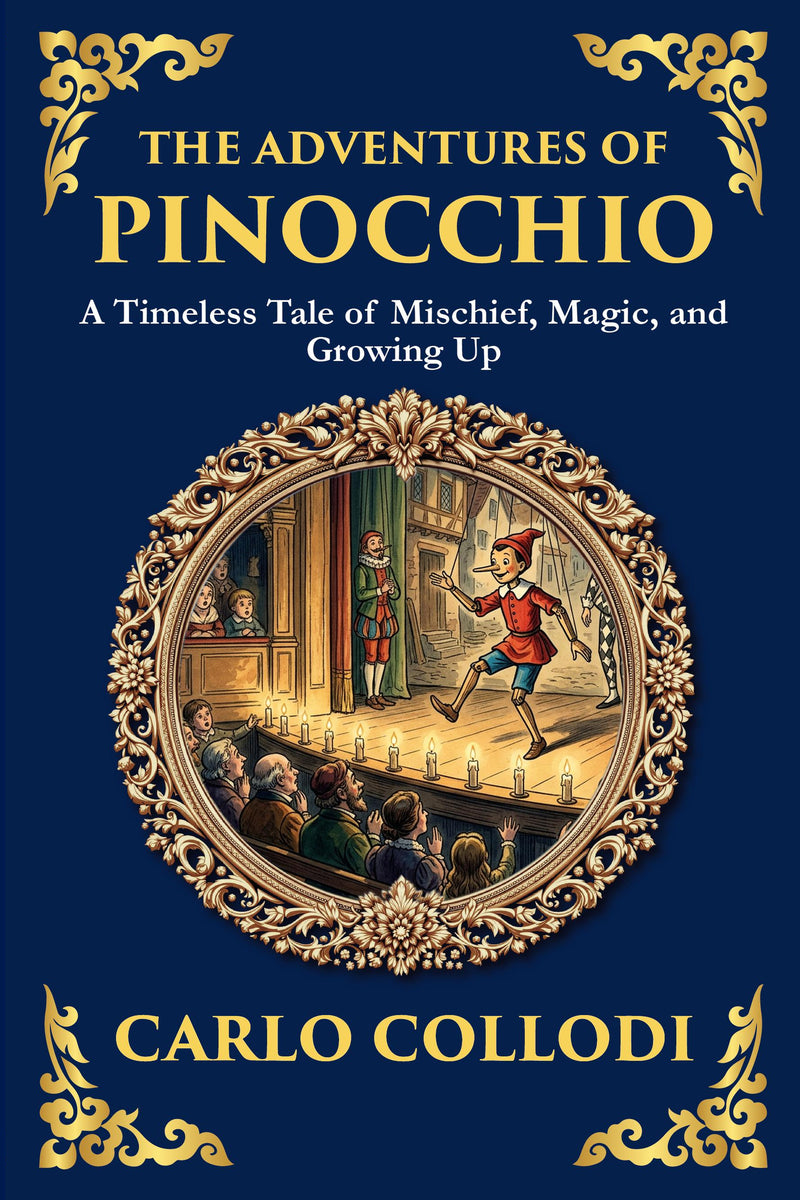
The Adventures of Pinocchio
From wooden puppet to living boy, Pinocchio’s journey is one of mischief, magic, and moral lessons. Created by the kind-hearted Geppetto, Pinocchio yearns for freedom but often finds himself entangled in trouble.
or free app
10,000+ hrs library
30-day guarantee
The complete The Adventures of Pinocchio appears in modern English through Library of Alexandria Press, available online with audiobook narration included for members.
Have you ever wondered why growing up is both magical and painful? Carlo Collodi’s The Adventures of Pinocchio remains one of the most enduring and beloved children’s stories ever written—a tale that is far more than just a fable about a mischievous puppet. It is a profound exploration of childhood, temptation, and the struggle to discover one’s place in the world.
Born from a block of wood and the hands of the kindly Geppetto, Pinocchio is a puppet with a restless heart. He dreams of independence, fun, and adventure—but his eagerness to live freely often leads him into danger. Along the way, he encounters sly foxes, greedy cats, talking crickets, and the enchanting Blue Fairy, who guides him toward truth and responsibility.
Each misstep brings Pinocchio closer to understanding that honesty, love, and perseverance are the keys to becoming “real.”
What you’ll discover in this modern edition
- The Timeless Journey of Pinocchio – Follow the puppet’s misadventures and triumphs as he struggles between selfish impulses and moral growth.
- The Blue Fairy’s Guiding Hand – Explore one of literature’s most iconic symbols of hope, transformation, and redemption.
- Lessons in Honesty and Responsibility – See how Pinocchio’s mistakes teach him the value of truth and trust.
- A Celebration of Childhood and Growth – Relive the joys and struggles of growing up in a magical world where every choice shapes destiny.
- A Story for All Ages – Whether read as a children’s fairy tale or as a deeper allegory, Pinocchio’s story resonates with universal truths.
| Formats | eBook (EPUB + PDF) · Audiobook · Paperback · Hardcover · Large Print |
| Language | English |
| Trim size (print) | 6 × 9 in |
| Binding | Paperback — perfect-bound · Hardcover — casewrap |
| Large Print edition | Same text in a larger, easy-read type — a larger font, not a larger trim |
| Print pricing | Every physical book at our true cost — at-cost, no profit (members) |
| Library | 873 restored titles, always growing |
| Length | 38,492 words · ~2 hr 34 min reading |
| Reading level | Grade 6 · an easy, flowing read (this modern-English edition) |
| Edition | Modern English translation · 2026 |
Member reviews for this edition are collected as readers finish it — be the first. Across the library: 12,000+ books shipped, every plan covered by a 365-day print guarantee.
About this edition
A faithful, unabridged modern-English edition by The Library of Alexandria — carefully rendered for today's reader and verified paragraph-by-paragraph against the public-domain source. Available as eBook, audiobook, paperback, hardcover, and large print.
- Complete & unabridgedVerified paragraph by paragraph against the source — never a scan, never abridged.
- Modern English, faithfulReadable today, with the author’s meaning kept intact. Readable — not simplified.
- Every format, one membershipRead in your browser or the free app, or listen to the full audiobook.
Included free with your membership
Cancel anytime, one click · 30-day money-back guarantee
Edition last updated July 2026
What’s inside
The Adventures of Pinocchio — complete and unabridged: all 37 sections included with membership, plus the full audiobook.
Begin reading The Adventures of Pinocchio
In clear modern English — the complete text is included with membership.
Introduction
There are few characters in the entire history of literature who have escaped the pages of their own book quite so thoroughly as the little wooden boy with the long nose. Say his name in nearly any corner of the world, and an image leaps instantly to mind — a marionette dancing on strings he longs to break, a nose that betrays every fib, a creature carved from a humble block of firewood who dreams, against all odds and all logic, of becoming a real boy. He has been animated, illustrated, parodied, philosophized over, and reinvented so many times that many readers feel they already know him before they have read a single line. Yet the puppet who lives in these pages is, in many ways, a stranger to the one who has wandered through popular imagination. He is stranger, wilder, funnier, and considerably more troublesome than the sanitized figure who often takes his name. To open this book is to meet the original — sharp-edged, mischievous, and astonishingly alive — and to discover that the story you thought you knew is far richer and far more surprising than memory suggests.
This is a tale that arrived into the world almost by accident. Carlo Collodi, the Florentine writer and journalist who gave the puppet life, did not set out to compose a masterpiece destined to outlast empires. He was a working man of letters, a translator, a satirist, a man who turned his pen to whatever the day required, and when he began writing the episodes that would eventually become this book, he was producing them piecemeal for a children’s newspaper. The story unspooled in installments, week by week, each one written under deadline, each one expected to delight and then to vanish like so much disposable amusement. There is a famous moment in the history of the tale when Collodi, weary of his creation, attempted to end the whole affair in a manner so abrupt and so dark that his young readers protested. Their letters poured in. They would not let the puppet go. And so, prodded by the demands of children who refused to accept that this was the end, the author was compelled to continue, to revive his hero, to send him stumbling onward through new misadventures toward a destiny he had not originally imagined. The book you hold is therefore something rare: a story shaped not only by the vision of its author but by the love and stubbornness of its first audience. It grew because children willed it to grow.
That origin story matters, because it explains much of what makes this work so peculiar and so durable. Episodic by nature, it moves with the restless energy of a serialized adventure, each chapter a small self-contained burst of incident, peril, and consequence. There is no slow buildup, no patient establishment of mood; from the very first pages, when a simple piece of wood begins to speak and laugh before any tool has touched it, the reader is thrust into a world where the impossible is treated with the matter-of-fact briskness of a folktale. Things happen quickly. The puppet acts, regrets, repents, and then promptly forgets his repentance to act again. He makes promises he cannot keep. He encounters dangers that would frighten any grown reader, let alone a child. And through it all, Collodi maintains a tone that flickers between the comic and the genuinely menacing, between the tender and the harshly moral, in a way that no modern committee of cautious editors would ever permit. This is a book unafraid of darkness, unafraid of consequence, and unafraid to let its hero suffer for his foolishness in ways that feel startlingly real.
A Story Older and Stranger Than You Remember
It is worth pausing on just how different this original tale is from the gentle, twinkling fable that later adaptations have made familiar. The puppet of these pages is not, at the outset, a sweet and innocent creature longing only to do good. He is, frankly, a brat. He is selfish, impulsive, ungrateful, and quick to abandon his promises the moment temptation appears. He runs away. He lies. He squanders the kindness shown to him. He repeatedly chooses pleasure over duty, idleness over effort, the easy road over the hard one — and he pays for these choices with a steady accumulation of misery that the author refuses to soften. There is something bracing, even thrilling, about a children’s book that takes its young protagonist’s flaws so seriously. Collodi does not pretend that mischief is harmless or that bad choices come without cost. His puppet is hungry, frightened, cheated, imprisoned, and pursued; he weeps real tears and feels real remorse, and the remorse does not always save him.
And yet — and this is the genius of the thing — the book never becomes a dreary sermon. For all its moral seriousness, it is buoyant, fast, and frequently hilarious. The world the puppet inhabits is populated by an extraordinary gallery of grotesques and wonders: talking animals who dispense advice both wise and self-serving, con artists who prey upon the gullible, a marvelous fairy with hair the color of the sky, a fearsome marionette master, a great beast of the sea, and an entire country devoted to nothing but play and pleasure that conceals a terrible secret. Collodi’s imagination runs gloriously, almost feverishly free. He borrows from the rich tradition of Tuscan folktale, from the commedia dell’arte with its stock characters and slapstick, from fable and fairy tale and the moral instruction manuals of his era, and he fuses them all into something that belongs to no single category. The result is a narrative that feels both ancient and utterly original, rooted in the cobbled streets and country roads of nineteenth-century Italy yet somehow floating free of any particular time or place.
The famous nose, of course, deserves mention, because it has become so emblematic that it threatens to overshadow everything else. The detail of the lengthening nose — that the puppet’s untruths announce themselves physically, that his very body betrays his dishonesty — is one of those inventions so perfect that it has passed into the common language of nearly every culture on earth. To “have a Pinocchio nose” needs no explanation anywhere. But readers who come to the book expecting the nose to dominate may be surprised to find that it appears in only a handful of moments, and that its significance is woven into a much larger tapestry of transformation, deception, and consequence. The nose is not the point; it is a single brilliant symptom of the book’s deeper concern, which is the slow, painful, deeply human process by which a creature learns to govern himself. The lengthening nose is funny, yes, but it is also a small mercy — a visible reminder, offered to a child who keeps forgetting, that actions have shapes and that lies leave marks.
Beneath the slapstick and the spectacle, there beats a question that has occupied philosophers and theologians for centuries, dressed here in the clothing of a children’s adventure. What does it mean to be real? What separates a thing that merely moves and talks from a being that genuinely lives? The puppet is animated from the first — he can walk, speak, feel pain and pleasure — and so the longing that drives the entire narrative is not for animation but for something far more elusive. He wants to become a real boy, and the book understands, with surprising sophistication, that this transformation cannot be granted as a gift or stumbled upon by luck. It must be earned, and the earning of it is nothing less than the work of growing up: learning to be honest, to be diligent, to think of others, to delay gratification, to bear hardship without giving in to despair or temptation. The wooden body is a metaphor so flexible that readers have found in it everything from religious allegory to a parable of moral education to a meditation on the very nature of the soul. That a story written in weekly installments for a children’s paper should carry such depth is one of the small miracles of literary history.
It would be a mistake, though, to approach this book as though it were primarily a vehicle for its lessons. Collodi was a satirist and a humorist before he was anything else, and the prose — even at its most instructive — crackles with wit and irony. He casts a sardonic eye over the adult world the puppet stumbles through: the corrupt judges who punish the innocent, the doctors who argue learnedly while their patient suffers, the swindlers who cloak their greed in honeyed words, the institutions that fail the vulnerable. There is a streak of genuine social commentary running through the adventures, a recognition that the world is often unjust and that the powerful frequently abuse the weak. The puppet’s hunger is not invented for moral effect; it reflects the very real poverty of the Italy in which Collodi lived, a land of struggling laborers and hungry children where bread was not guaranteed and a kind heart could not always feed an empty stomach. To read this book attentively is to glimpse a whole world — its kitchens and its courtrooms, its fairs and its schoolrooms, its roadside inns and its rolling countryside — rendered with the precision of a writer who knew that world intimately.
On This Translation and the Reader's Experience
A word, now, about the particular edition you are about to read, for it has been prepared with a specific kind of reader in mind. Any translation of a beloved work carries a heavy responsibility, and the translation of a children’s classic perhaps most of all, because such a book lives or dies by its readability — by whether the words flow easily enough to carry a young or impatient reader along, while still preserving the flavor, the music, and the meaning of the original. The Italian of Collodi is lively, colloquial, peppered with the rhythms of spoken Tuscan, full of exclamations and asides and the kind of direct address that makes a story feel as though it is being told aloud rather than read silently. Much of the book’s charm lies in this conversational immediacy, this sense of a storyteller leaning close, raising an eyebrow, pausing for effect, scolding the puppet one moment and pitying him the next.
This modern adaptation has been crafted to bring that vitality across the gulf of language and time without sacrificing the texture that makes the tale what it is. Older translations, however faithful and however cherished, can sometimes feel stiff or remote to contemporary readers, weighed down by archaic phrasing or sentence structures that no longer match the way we read today. The aim here has been to clear away that accumulated dust while leaving the substance entirely intact — to render the prose in language that feels natural and immediate to a reader of the present day, so that the humor lands, the suspense grips, and the emotional moments strike home as forcefully as they were meant to. Nothing essential has been smoothed away. The darkness remains dark; the perils remain perilous; the moral weight remains genuine. What has changed is the ease of access, the removal of the small frictions that can stand between a modern reader and a story written more than a century ago in another tongue. The intention throughout has been to honor the spirit of the original while ensuring that nothing about its presentation gets in the way of the pure pleasure of reading it.
For readers approaching the book for the first time, a few gentle suggestions may enhance the experience. First, surrender to the episodic rhythm rather than fighting it. This is not a tightly plotted novel in the modern sense, with every thread carefully planted and resolved; it is an adventure that tumbles forward, one incident sparking the next, with all the breathless momentum of a story being invented week by week to keep an audience clamoring for more. Read it as it was first received — as a serial of marvels and mishaps — and you will find that its very looseness becomes a kind of freedom. The puppet might be anywhere, might meet anyone, might fall into any sort of trouble, and the not-knowing is part of the delight.
Cancel anytime, one click · 30-day money-back guarantee
Founding annual rate available now — your price locks for life when you join.
Not ready? Get this free chapter by email — read it anytime.
✓ Sent — check your inbox for The Adventures of Pinocchio.
Questions about The Adventures of Pinocchio
What is The Adventures of Pinocchio about?
From wooden puppet to living boy, Pinocchio’s journey is one of mischief, magic, and moral lessons. Created by the kind-hearted Geppetto, Pinocchio yearns for freedom but often finds himself entangled in trouble. Tempted by deceitful characters and reckless adventures, he must learn hard truths about honesty, responsibility, and love.
Who wrote The Adventures of Pinocchio?
The Adventures of Pinocchio was written by Carlo Collodi. This edition presents the complete work in clear modern English, faithfully rendered from the public-domain original by Library of Alexandria Press.
Is The Adventures of Pinocchio free to read?
The opening chapter is free to read on this page. Members read and listen to the complete work — and the entire library — free, and can order any physical book at our true print cost.
How long is The Adventures of Pinocchio?
37 chapters (~38,492 words) — about 2 hr 34 min of reading in this modern-English edition.
Is this an abridged version of The Adventures of Pinocchio?
No. This is the complete, unabridged The Adventures of Pinocchio, carefully rendered into clear modern English and verified paragraph-by-paragraph against the public-domain source — nothing is cut or summarised.
What formats does The Adventures of Pinocchio come in?
The Adventures of Pinocchio is available as eBook, paperback, hardcover and large print. eBook and audiobook are included with membership; printed editions ship at our true print cost.
Shipping & returns
Billing & membership
More from the library


Explore Children's Classics
- Jack and Jill · Louisa May Alcott
- The Wonderful Wizard of Oz · L. Frank Baum
- Peter Pan · J. M. Barrie
- The Prince and the Pauper · Mark Twain
- The Red Fairy Book · Andrew Lang
- Old Christmas: from the Sketch Book of Washington Irving · Washington Irving
- A Houseful of Girls · Sarah Tytler
- In the hollow of His hand · Hesba Stretton
- Miss Primrose · Agnes Giberne
- Five Little Peppers and How They Grew · Margaret Sidney
- The Loss of the Swansea: A Story of the Florida Coast · W. L. Alden
- Sky Island · L. Frank Baum
- The Book of Dragons · E. Nesbit
- Wild Animals I Have Known · Ernest Thompson Seton
- Skinny McCord · Percy Keese Fitzhugh
- The Hunniwell Boys and the Platinum Mystery · L. P. Wyman
- Rainbow Valley · L. M. Montgomery
- "Us and Our Donkey" · Amy Le Feuvre
- Dorothy and the Wizard in Oz · L. Frank Baum
- The Home Book of Verse — Volume 4 · Burton Egbert Stevenson
- The Story of Doctor Dolittle · Hugh Lofting
- The Tale of Benjamin Bunny · Beatrix Potter
- Fifty Famous Stories Retold · James Baldwin
- Rilla of Ingleside · L. M. Montgomery
- The House at Pooh Corner · A. A. Milne
- Rich and Humble: A Story for Young People · Oliver Optic
- The Three Bears · A. E. Kennedy
- Peter and Wendy · J. M. Barrie
- The Marvelous Land of Oz · L. Frank Baum
- Andersen’s Fairy Tales · H. C. Andersen
The Adventures of Pinocchio
The Adventures of Pinocchio
A Timeless Tale of Mischief, Magic, and Growing Up
Carlo Collodi
Contents
- Introduction
- Chapter 1
- Chapter 2
- Chapter 3
- Chapter 4
- Chapter 5
- Chapter 6
- Chapter 7
- Chapter 8
- Chapter 9
- Chapter 10
- Chapter 11
- Chapter 12
- Chapter 13
- Chapter 14
- Chapter 15
- Chapter 16
- Chapter 17
- Chapter 18
- Chapter 19
- Chapter 20
- Chapter 21
- Chapter 22
- Chapter 23
- Chapter 24
- Chapter 25
- Chapter 26
- Chapter 27
- Chapter 28
- Chapter 29
- Chapter 30
- Chapter 31
- Chapter 32
- Chapter 33
- Chapter 34
- Chapter 35
- Chapter 36
Introduction
There are few characters in the entire history of literature who have escaped the pages of their own book quite so thoroughly as the little wooden boy with the long nose. Say his name in nearly any corner of the world, and an image leaps instantly to mind — a marionette dancing on strings he longs to break, a nose that betrays every fib, a creature carved from a humble block of firewood who dreams, against all odds and all logic, of becoming a real boy. He has been animated, illustrated, parodied, philosophized over, and reinvented so many times that many readers feel they already know him before they have read a single line. Yet the puppet who lives in these pages is, in many ways, a stranger to the one who has wandered through popular imagination. He is stranger, wilder, funnier, and considerably more troublesome than the sanitized figure who often takes his name. To open this book is to meet the original — sharp-edged, mischievous, and astonishingly alive — and to discover that the story you thought you knew is far richer and far more surprising than memory suggests.
This is a tale that arrived into the world almost by accident. Carlo Collodi, the Florentine writer and journalist who gave the puppet life, did not set out to compose a masterpiece destined to outlast empires. He was a working man of letters, a translator, a satirist, a man who turned his pen to whatever the day required, and when he began writing the episodes that would eventually become this book, he was producing them piecemeal for a children’s newspaper. The story unspooled in installments, week by week, each one written under deadline, each one expected to delight and then to vanish like so much disposable amusement. There is a famous moment in the history of the tale when Collodi, weary of his creation, attempted to end the whole affair in a manner so abrupt and so dark that his young readers protested. Their letters poured in. They would not let the puppet go. And so, prodded by the demands of children who refused to accept that this was the end, the author was compelled to continue, to revive his hero, to send him stumbling onward through new misadventures toward a destiny he had not originally imagined. The book you hold is therefore something rare: a story shaped not only by the vision of its author but by the love and stubbornness of its first audience. It grew because children willed it to grow.
That origin story matters, because it explains much of what makes this work so peculiar and so durable. Episodic by nature, it moves with the restless energy of a serialized adventure, each chapter a small self-contained burst of incident, peril, and consequence. There is no slow buildup, no patient establishment of mood; from the very first pages, when a simple piece of wood begins to speak and laugh before any tool has touched it, the reader is thrust into a world where the impossible is treated with the matter-of-fact briskness of a folktale. Things happen quickly. The puppet acts, regrets, repents, and then promptly forgets his repentance to act again. He makes promises he cannot keep. He encounters dangers that would frighten any grown reader, let alone a child. And through it all, Collodi maintains a tone that flickers between the comic and the genuinely menacing, between the tender and the harshly moral, in a way that no modern committee of cautious editors would ever permit. This is a book unafraid of darkness, unafraid of consequence, and unafraid to let its hero suffer for his foolishness in ways that feel startlingly real.
A Story Older and Stranger Than You Remember
It is worth pausing on just how different this original tale is from the gentle, twinkling fable that later adaptations have made familiar. The puppet of these pages is not, at the outset, a sweet and innocent creature longing only to do good. He is, frankly, a brat. He is selfish, impulsive, ungrateful, and quick to abandon his promises the moment temptation appears. He runs away. He lies. He squanders the kindness shown to him. He repeatedly chooses pleasure over duty, idleness over effort, the easy road over the hard one — and he pays for these choices with a steady accumulation of misery that the author refuses to soften. There is something bracing, even thrilling, about a children’s book that takes its young protagonist’s flaws so seriously. Collodi does not pretend that mischief is harmless or that bad choices come without cost. His puppet is hungry, frightened, cheated, imprisoned, and pursued; he weeps real tears and feels real remorse, and the remorse does not always save him.
And yet — and this is the genius of the thing — the book never becomes a dreary sermon. For all its moral seriousness, it is buoyant, fast, and frequently hilarious. The world the puppet inhabits is populated by an extraordinary gallery of grotesques and wonders: talking animals who dispense advice both wise and self-serving, con artists who prey upon the gullible, a marvelous fairy with hair the color of the sky, a fearsome marionette master, a great beast of the sea, and an entire country devoted to nothing but play and pleasure that conceals a terrible secret. Collodi’s imagination runs gloriously, almost feverishly free. He borrows from the rich tradition of Tuscan folktale, from the commedia dell’arte with its stock characters and slapstick, from fable and fairy tale and the moral instruction manuals of his era, and he fuses them all into something that belongs to no single category. The result is a narrative that feels both ancient and utterly original, rooted in the cobbled streets and country roads of nineteenth-century Italy yet somehow floating free of any particular time or place.
The famous nose, of course, deserves mention, because it has become so emblematic that it threatens to overshadow everything else. The detail of the lengthening nose — that the puppet’s untruths announce themselves physically, that his very body betrays his dishonesty — is one of those inventions so perfect that it has passed into the common language of nearly every culture on earth. To “have a Pinocchio nose” needs no explanation anywhere. But readers who come to the book expecting the nose to dominate may be surprised to find that it appears in only a handful of moments, and that its significance is woven into a much larger tapestry of transformation, deception, and consequence. The nose is not the point; it is a single brilliant symptom of the book’s deeper concern, which is the slow, painful, deeply human process by which a creature learns to govern himself. The lengthening nose is funny, yes, but it is also a small mercy — a visible reminder, offered to a child who keeps forgetting, that actions have shapes and that lies leave marks.
Beneath the slapstick and the spectacle, there beats a question that has occupied philosophers and theologians for centuries, dressed here in the clothing of a children’s adventure. What does it mean to be real? What separates a thing that merely moves and talks from a being that genuinely lives? The puppet is animated from the first — he can walk, speak, feel pain and pleasure — and so the longing that drives the entire narrative is not for animation but for something far more elusive. He wants to become a real boy, and the book understands, with surprising sophistication, that this transformation cannot be granted as a gift or stumbled upon by luck. It must be earned, and the earning of it is nothing less than the work of growing up: learning to be honest, to be diligent, to think of others, to delay gratification, to bear hardship without giving in to despair or temptation. The wooden body is a metaphor so flexible that readers have found in it everything from religious allegory to a parable of moral education to a meditation on the very nature of the soul. That a story written in weekly installments for a children’s paper should carry such depth is one of the small miracles of literary history.
It would be a mistake, though, to approach this book as though it were primarily a vehicle for its lessons. Collodi was a satirist and a humorist before he was anything else, and the prose — even at its most instructive — crackles with wit and irony. He casts a sardonic eye over the adult world the puppet stumbles through: the corrupt judges who punish the innocent, the doctors who argue learnedly while their patient suffers, the swindlers who cloak their greed in honeyed words, the institutions that fail the vulnerable. There is a streak of genuine social commentary running through the adventures, a recognition that the world is often unjust and that the powerful frequently abuse the weak. The puppet’s hunger is not invented for moral effect; it reflects the very real poverty of the Italy in which Collodi lived, a land of struggling laborers and hungry children where bread was not guaranteed and a kind heart could not always feed an empty stomach. To read this book attentively is to glimpse a whole world — its kitchens and its courtrooms, its fairs and its schoolrooms, its roadside inns and its rolling countryside — rendered with the precision of a writer who knew that world intimately.
On This Translation and the Reader's Experience
A word, now, about the particular edition you are about to read, for it has been prepared with a specific kind of reader in mind. Any translation of a beloved work carries a heavy responsibility, and the translation of a children’s classic perhaps most of all, because such a book lives or dies by its readability — by whether the words flow easily enough to carry a young or impatient reader along, while still preserving the flavor, the music, and the meaning of the original. The Italian of Collodi is lively, colloquial, peppered with the rhythms of spoken Tuscan, full of exclamations and asides and the kind of direct address that makes a story feel as though it is being told aloud rather than read silently. Much of the book’s charm lies in this conversational immediacy, this sense of a storyteller leaning close, raising an eyebrow, pausing for effect, scolding the puppet one moment and pitying him the next.
This modern adaptation has been crafted to bring that vitality across the gulf of language and time without sacrificing the texture that makes the tale what it is. Older translations, however faithful and however cherished, can sometimes feel stiff or remote to contemporary readers, weighed down by archaic phrasing or sentence structures that no longer match the way we read today. The aim here has been to clear away that accumulated dust while leaving the substance entirely intact — to render the prose in language that feels natural and immediate to a reader of the present day, so that the humor lands, the suspense grips, and the emotional moments strike home as forcefully as they were meant to. Nothing essential has been smoothed away. The darkness remains dark; the perils remain perilous; the moral weight remains genuine. What has changed is the ease of access, the removal of the small frictions that can stand between a modern reader and a story written more than a century ago in another tongue. The intention throughout has been to honor the spirit of the original while ensuring that nothing about its presentation gets in the way of the pure pleasure of reading it.
For readers approaching the book for the first time, a few gentle suggestions may enhance the experience. First, surrender to the episodic rhythm rather than fighting it. This is not a tightly plotted novel in the modern sense, with every thread carefully planted and resolved; it is an adventure that tumbles forward, one incident sparking the next, with all the breathless momentum of a story being invented week by week to keep an audience clamoring for more. Read it as it was first received — as a serial of marvels and mishaps — and you will find that its very looseness becomes a kind of freedom. The puppet might be anywhere, might meet anyone, might fall into any sort of trouble, and the not-knowing is part of the delight.
How Mastro Cherry, the carpenter, found a piece of wood that cried and laughed like a child.
“A king!” my young readers will probably guess.
No, children, you’re wrong. Once upon a time, there was a piece of wood. It wasn’t an expensive piece of wood—not at all. It was just an ordinary block of firewood, one of those thick, heavy logs used in the winter to make cold rooms warm and cozy.
I don’t know exactly how it happened, but one fine day, this piece of wood ended up in the shop of an old carpenter. His real name was Mastro Antonio, but everyone called him Mastro Cherry because the tip of his nose was so round, red, and shiny that it looked like a ripe cherry.
As soon as Mastro Cherry saw the wood, he was delighted. Rubbing his hands together happily, he muttered to himself:
“This is perfect timing. I’ll use this to make a table leg.”
He quickly grabbed his hatchet to strip the bark and shape the wood. But just as he was about to strike the first blow, he froze with his arm in the air. He had heard a tiny, little voice plead, “Please be careful! Don’t hit me so hard!”
Mastro Cherry looked completely shocked! His funny face looked even funnier than usual.
Terrified, he looked around the room to find where that tiny voice had come from, but he saw no one. He looked under the bench—no one. He peeked inside the closet—no one. He searched through the wood shavings—no one. He opened the door to look up and down the street—and still, no one!
“Oh, I see!” he said, laughing and scratching his wig. “I must have just imagined I heard a voice! Well, back to work.”
He delivered a firm, decisive blow to the piece of wood.
End of the free sample
Keep reading, free
Members read and listen to the complete book — and the entire library. Cancel anytime, one click · 30-day money-back guarantee.