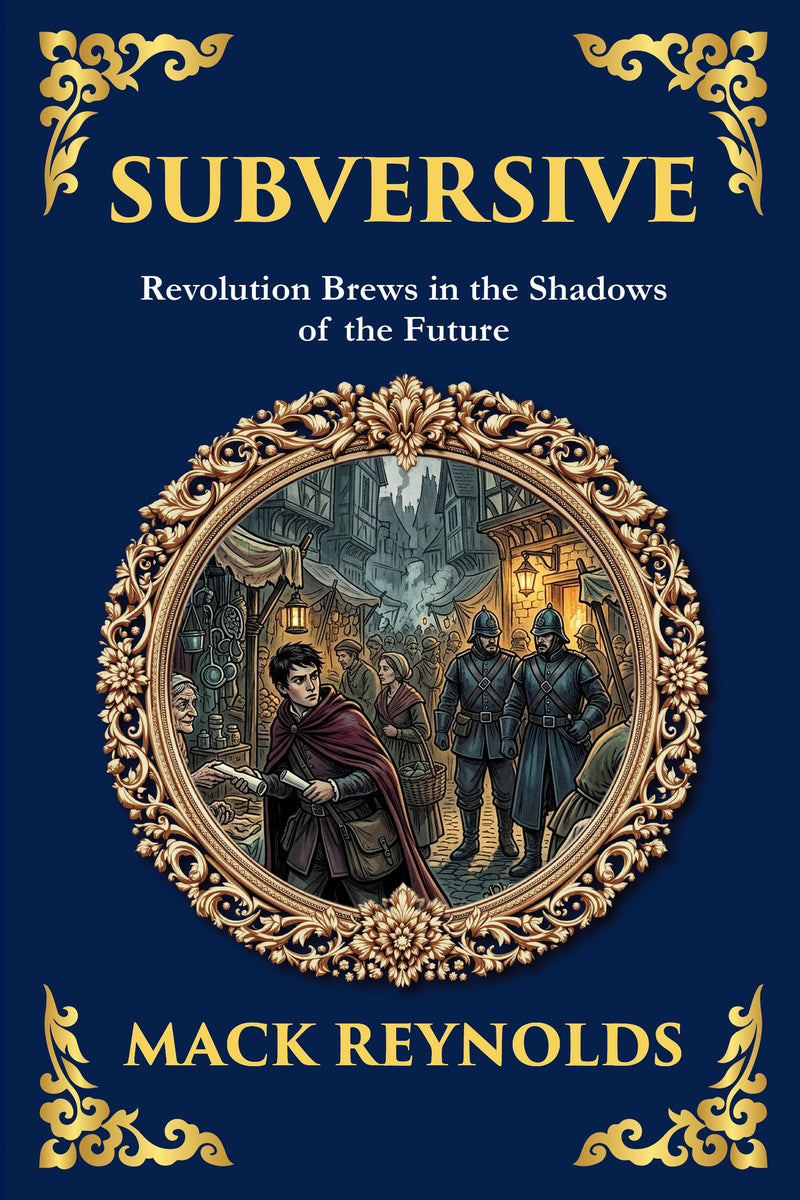
Subversive — Large Print
In a world where conformity is law and progress is managed by the elite, a quiet rebellion simmers beneath the surface. Subversive is a bold tale of espionage, infiltration, and the unstoppable power of free thought.
or free app
10,000+ hrs library
30-day guarantee
The complete Subversive appears in modern English through Library of Alexandria Press, available online with audiobook narration included for members.
Have you ever wondered why the greatest threat to a system is an awakened mind? In Subversive, acclaimed futurist Mack Reynolds paints a razor-sharp vision of a dystopia ruled not by tyranny, but by perfection. Here, the world is safe, managed, and meticulously planned.
Poverty is eliminated. War is history. Yet beneath this flawless exterior lurks a darker reality— freedom has vanished, and rebellion has gone digital.
As society praises stability and efficiency, a hidden network of radicals refuses to accept a life without autonomy. Posing as loyal citizens, they embed themselves in the very institutions they aim to dismantle. But as surveillance tightens and informants multiply, the line between subversive and pawn becomes perilously thin.
What you’ll discover in this modern edition
- A Chilling Portrait of a “Perfect” Future Gone Wrong Explore a utopia where control masquerades as progress—and independence is the ultimate crime.
| Formats | eBook (EPUB + PDF) · Audiobook · Paperback · Hardcover · Large Print |
| Language | English |
| Trim size (print) | 6 × 9 in |
| Binding | Paperback — perfect-bound · Hardcover — casewrap |
| Large Print edition | Same text in a larger, easy-read type — a larger font, not a larger trim |
| Print pricing | Every physical book at our true cost — at-cost, no profit (members) |
| Library | 873 restored titles, always growing |
| Length | 10,342 words · ~41 min reading |
| Reading level | Grade 4 · an easy, flowing read (this modern-English edition) |
| Edition | Modern English translation · 2026 |
Member reviews for this edition are collected as readers finish it — be the first. Across the library: 12,000+ books shipped, every plan covered by a 365-day print guarantee.
About this edition
A faithful, unabridged modern-English edition by The Library of Alexandria — carefully rendered for today's reader and verified paragraph-by-paragraph against the public-domain source. Available as eBook, audiobook, paperback, hardcover, and large print.
- Complete & unabridgedVerified paragraph by paragraph against the source — never a scan, never abridged.
- Modern English, faithfulReadable today, with the author’s meaning kept intact. Readable — not simplified.
- Every format, one membershipRead in your browser or the free app, or listen to the full audiobook.
Included free with your membership
Cancel anytime, one click · 30-day money-back guarantee
Edition last updated July 2026
What’s inside
Subversive — Large Print — complete and unabridged, included in full with membership, plus the full audiobook.
Begin reading Subversive — Large Print
In clear modern English — the complete text is included with membership.
Introduction
There is a particular kind of writer who seems to slip through the cracks of literary history—too commercial for the academics, too thoughtful for the pulp purists, too political for the escapists, and too entertaining for the ideologues. Mack Reynolds was precisely that kind of writer, and the work you now hold in your hands is a vivid example of why his fiction deserves a fresh look from contemporary readers. Subversive is a story about revolution, but it is also a story about the machinery beneath revolution: the espionage, the rhetoric, the propaganda, the bureaucracies, and the human beings caught in the gears of historical change. It is, in short, a book that takes seriously the questions that most science fiction of its era preferred to dodge.
To read Reynolds today is to encounter a mind that was unusually well-traveled, unusually well-read in political and economic theory, and unusually comfortable poking at the assumptions of his own readership. Where many of his contemporaries imagined the future as a stage for ray guns and galactic empires, Reynolds imagined the future as a place where societies still had to figure out how to govern themselves, how to distribute resources, how to handle dissent, and how to live with the consequences of their own ideologies. He was fascinated by systems—political systems, economic systems, social systems—and by the way those systems shaped, constrained, and occasionally crushed the individuals living within them. That fascination animates every page of this story.
This edition presents the work in a modern translation, adapted for the contemporary reader. That phrase deserves a word of explanation, because it tells you something important about how to approach the text. The story was written in an era with its own idioms, its own pacing conventions, and its own assumptions about what a reader already knew. Some of those conventions have aged gracefully; others have not. The goal of this adaptation is to clear away the incidental friction—the dated turns of phrase, the references that have lost their resonance, the stylistic tics that can make mid-century prose feel more distant than it needs to—so that the genuine intelligence and energy of the story can reach you directly. What remains is Reynolds: his ideas, his characters, his sly humor, and his restless engagement with the great political debates of his time. What has been smoothed away is the dust.
It is impossible to understand Mack Reynolds without understanding the life he led, because few science fiction writers ever lived as fully outside the office and the typewriter as he did. Born Dallas McCord Reynolds in 1917, he grew up in a household steeped in radical politics. His father was a prominent figure in American socialist circles, and the young Reynolds absorbed political theory the way other children absorbed nursery rhymes. This was not the abstract, textbook socialism of a graduate seminar; it was the lived, argued-over, deeply felt politics of a movement that believed the world could be remade. That upbringing gave Reynolds something most writers never acquire: a genuine, granular familiarity with the language of revolution, the psychology of the true believer, and the internal contradictions of every political faction that has ever claimed to speak for the people.
But Reynolds was no armchair theorist. He served in the military during the Second World War, and afterward he became something of a professional wanderer. As a travel writer and foreign correspondent, he visited dozens of countries across Europe, North Africa, the Middle East, and beyond—often the kinds of places that ordinary American tourists never saw. He spent time in nations undergoing upheaval, in societies experimenting with different economic models, in cultures whose assumptions about life and government differed radically from his own. He watched real revolutions, real bureaucracies, real propaganda operations, and real ideological conflicts up close. This is the crucial fact about Reynolds as a science fiction writer: when he wrote about a society organized along unfamiliar principles, he was not guessing. He was extrapolating from things he had actually witnessed.
That direct experience of the wider world infuses his fiction with a texture that distinguishes it from the work of writers who spent their lives within a single cultural bubble. When Reynolds describes the workings of an intelligence apparatus, the maneuvering of competing power blocs, or the way a charismatic ideologue can sway a crowd, he writes with the authority of someone who has seen these dynamics in action. Subversive draws heavily on this well of experience. The novel’s interest in espionage, in the murky border between subversion and reform, and in the way states defend themselves against internal threats all reflect a writer who understood that politics is not a clean abstraction but a messy, human, often dangerous business.
Reynolds came into his own as a science fiction writer during the field’s mid-century boom, becoming an especially prolific contributor to the magazines that defined the genre in that era. He was, for a stretch, one of the most popular writers in the science fiction periodicals, the kind of name whose appearance on a cover reliably moved copies. Yet his popularity rested on something different from the usual sources. Readers did not come to Reynolds for swashbuckling adventure or for technological wonder, though he could deliver both when the story called for it. They came to him for ideas—specifically, for his willingness to use the science fiction story as a laboratory for testing political and economic propositions. What would happen if a society were organized this way? What would happen if a particular ideology were carried to its logical conclusion? What would happen if the assumptions we take for granted turned out to be wrong?
This made Reynolds something of an anomaly in American science fiction, a field that during the Cold War tended toward a reflexive celebration of free-market individualism and a suspicion of anything that smacked of collectivism. Reynolds did not share that reflex. He was perfectly willing to imagine futures in which capitalism had been transcended, in which the welfare state had evolved into something unrecognizable, in which the old categories of left and right had dissolved into new configurations. He was not a propagandist for any single system—if anything, he was a skeptic of all of them—but he took seriously the possibility that the social arrangements of his own day were neither permanent nor optimal. That intellectual honesty gives his fiction a freshness that has, in many ways, outlasted the work of his more conventional peers.
Subversive belongs to the strand of Reynolds’s work that is most concerned with the dynamics of political change—with how societies transform, who drives that transformation, and what it costs. The title itself is a clue to the territory the novel explores. To be subversive is to work against an established order, to undermine it from within, to plant ideas and actions that will eventually destabilize the structure they grow inside. But the word carries a deliberate ambiguity, and Reynolds knew it. One society’s subversive is another society’s liberator. One generation’s dangerous radical is another generation’s honored founder. The label depends entirely on where you stand and which side eventually writes the history. Reynolds was endlessly interested in this ambiguity, and the novel uses it as a lens through which to examine the nature of dissent, loyalty, and revolution.
Without revealing the turns the story takes—because part of the pleasure of Reynolds is watching his ideas unfold in the unfolding of the plot—it is fair to say that the novel concerns itself with the shadowy work of those who seek to change a society from beneath its surface. It is a book about agents and ideologues, about the institutions that defend the status quo and the forces that gather against them, about the strange psychological and moral landscape inhabited by people who have committed themselves to undermining the world they live in. Reynolds approaches this material with his characteristic blend of narrative momentum and intellectual seriousness. The story moves; there is intrigue and danger and the constant pressure of competing interests. But beneath the surface excitement runs a steady current of inquiry into the deeper questions of how power is held, how it is challenged, and how it changes hands.
What makes Reynolds’s treatment of these themes distinctive is his refusal to flatten them into simple morality. In lesser hands, a story about subversion becomes a tale of heroic rebels versus wicked authorities, or of noble guardians versus treacherous infiltrators. Reynolds was too honest and too experienced for such easy oppositions. He understood that the people who staff the security apparatus of a state usually believe themselves to be the good guys, and that the people working to overthrow that state usually believe the same thing about themselves. He understood that ideologies look very different from the inside than from the outside, and that the gap between a movement’s stated ideals and its actual behavior is one of the great recurring tragedies of human history. The novel is alive to these complications. It invites you to question, alongside its characters, who is really subverting whom, and toward what end.
There is also, throughout the book, the distinctively Reynoldsian quality of economic and sociological imagination. Reynolds was perhaps the most economically literate of the major science fiction writers of his generation. He had read his Marx, his Veblen, his Galbraith, and a great deal more besides, and he never lost sight of the fact that politics is downstream of economics—that questions of who owns what, who produces what, and who benefits from the arrangement are the questions that ultimately drive social conflict. When his characters scheme and maneuver, they do so within a richly imagined social and economic context that gives their actions weight and consequence. This grounding in material reality is one of the things that makes his futures feel plausible. They are not arbitrary fantasy worlds; they are extrapolations, worked out with the rigor of someone who genuinely cared whether the pieces fit together.
For the contemporary reader, this aspect of the novel may prove unexpectedly resonant. We live in an age preoccupied with questions of inequality, automation, the future of work, the manipulation of information, and the fragility of political institutions. These are precisely the questions Reynolds was wrestling with decades ago, often with a prescience that can be startling. His speculations about how societies might respond to technological abundance, how propaganda and information control might evolve, and how the boundaries between economic systems might blur or break down read, in places, like commentary on our own moment. He did not get everything right—no futurist does—but he got enough right, and asked the right questions often enough, that returning to his work feels less like an exercise in nostalgia than like a conversation with a thoughtful contemporary who happened to be writing from the past.
It is worth pausing here to address the question of pacing and tone, because Reynolds’s storytelling style differs in important ways from much of what readers encounter today. He came up through the magazine markets, where economy of expression and forward momentum were prized above all. His prose is lean, direct, and functional; he does not linger over lyrical description or interior rumination for its own sake. Instead, he drives the story forward through dialogue, action, and the steady accumulation of consequence. Much of the novel’s intellectual content is delivered through conversation—characters arguing, explaining, persuading, and deceiving one another. This is a deliberate technique, not a limitation. Reynolds believed that ideas come alive when they are embodied in people who hold them passionately, and his dialogue crackles with the energy of genuine disagreement. The modern reader who settles into the rhythm of his storytelling will find that the pages turn quickly, and that the ideas arrive not as lectures but as the natural product of characters in conflict.
Cancel anytime, one click · 30-day money-back guarantee
Founding annual rate available now — your price locks for life when you join.
Not ready? Get this free chapter by email — read it anytime.
✓ Sent — check your inbox for Subversive — Large Print.
Questions about Subversive — Large Print
What is Subversive about?
In a world where conformity is law and progress is managed by the elite, a quiet rebellion simmers beneath the surface. Subversive is a bold tale of espionage, infiltration, and the unstoppable power of free thought. When an underground movement seeks to awaken a complacent society, the real war isn’t fought with weapons—but with ideology.
Who wrote Subversive?
Subversive was written by Mack Reynolds. This edition presents the complete work in clear modern English, faithfully rendered from the public-domain original by Library of Alexandria Press.
Is Subversive free to read?
The opening chapter is free to read on this page. Members read and listen to the complete work — and the entire library — free, and can order any physical book at our true print cost.
How long is Subversive?
2 chapters (~10,342 words) — about 41 min of reading in this modern-English edition.
Is this an abridged version of Subversive?
No. This is the complete, unabridged Subversive, carefully rendered into clear modern English and verified paragraph-by-paragraph against the public-domain source — nothing is cut or summarised.
What formats does Subversive come in?
Subversive is available as eBook, paperback, hardcover and large print. eBook and audiobook are included with membership; printed editions ship at our true print cost.
Shipping & returns
Billing & membership
More from the library


Explore Free eBooks
- Kant's Prolegomena to Any Future Metaphysics · Immanuel Kant
- The Advancement of Learning · Francis Bacon
- The Dawn of Day · Friedrich Nietzsche
- Peter and Wendy · J. M. Barrie
- Meditations · Marcus Aurelius
- The Confessions of St. Augustine · Saint Augustine of Hippo
- Resurrection · Leo Tolstoy
- Dialogues Concerning Natural Religion · David Hume
- As You Like It · William Shakespeare
- Jack and Jill · Louisa May Alcott
- Dream Psychology: Psychoanalysis for Beginners · Sigmund Freud
- The Raven · Edgar Allan Poe
- Considerations on Representative Government · John Stuart Mill
- The Will to Power: An Attempted Transvaluation of All Values. Book III and IV · Friedrich Nietzsche
- Tarzan of the Apes · Edgar Rice Burroughs
- Fundamental Principles of the Metaphysic of Morals · Immanuel Kant
- The Confessions of Jean Jacques Rousseau — Complete · Jean-Jacques Rousseau
- The Merchant of Venice · William Shakespeare
- Democracy in America — Volume 2 · Alexis de Tocqueville
- Ecce Homo · Friedrich Wilhelm Nietzsche
- Second Treatise of Government · John Locke
- The Wonderful Wizard of Oz · L. Frank Baum
- The Prince · Niccolò Machiavelli
- Anne of Green Gables · L. M. Montgomery
- De Profundis · Oscar Wilde
- Thus Spake Zarathustra: A Book for All and None · Friedrich Nietzsche
- Anna Karenina · Leo Tolstoy
- Great Expectations · Charles Dickens
- The Island of Doctor Moreau · H. G. Wells
- A Midsummer Night's Dream · William Shakespeare
Subversive — Large Print
Subversive — Large Print
Revolution Brews in the Shadows of the Future
Mack Reynolds
Contents
- Introduction
- Subversive
Introduction
There is a particular kind of writer who seems to slip through the cracks of literary history—too commercial for the academics, too thoughtful for the pulp purists, too political for the escapists, and too entertaining for the ideologues. Mack Reynolds was precisely that kind of writer, and the work you now hold in your hands is a vivid example of why his fiction deserves a fresh look from contemporary readers. Subversive is a story about revolution, but it is also a story about the machinery beneath revolution: the espionage, the rhetoric, the propaganda, the bureaucracies, and the human beings caught in the gears of historical change. It is, in short, a book that takes seriously the questions that most science fiction of its era preferred to dodge.
To read Reynolds today is to encounter a mind that was unusually well-traveled, unusually well-read in political and economic theory, and unusually comfortable poking at the assumptions of his own readership. Where many of his contemporaries imagined the future as a stage for ray guns and galactic empires, Reynolds imagined the future as a place where societies still had to figure out how to govern themselves, how to distribute resources, how to handle dissent, and how to live with the consequences of their own ideologies. He was fascinated by systems—political systems, economic systems, social systems—and by the way those systems shaped, constrained, and occasionally crushed the individuals living within them. That fascination animates every page of this story.
This edition presents the work in a modern translation, adapted for the contemporary reader. That phrase deserves a word of explanation, because it tells you something important about how to approach the text. The story was written in an era with its own idioms, its own pacing conventions, and its own assumptions about what a reader already knew. Some of those conventions have aged gracefully; others have not. The goal of this adaptation is to clear away the incidental friction—the dated turns of phrase, the references that have lost their resonance, the stylistic tics that can make mid-century prose feel more distant than it needs to—so that the genuine intelligence and energy of the story can reach you directly. What remains is Reynolds: his ideas, his characters, his sly humor, and his restless engagement with the great political debates of his time. What has been smoothed away is the dust.
It is impossible to understand Mack Reynolds without understanding the life he led, because few science fiction writers ever lived as fully outside the office and the typewriter as he did. Born Dallas McCord Reynolds in 1917, he grew up in a household steeped in radical politics. His father was a prominent figure in American socialist circles, and the young Reynolds absorbed political theory the way other children absorbed nursery rhymes. This was not the abstract, textbook socialism of a graduate seminar; it was the lived, argued-over, deeply felt politics of a movement that believed the world could be remade. That upbringing gave Reynolds something most writers never acquire: a genuine, granular familiarity with the language of revolution, the psychology of the true believer, and the internal contradictions of every political faction that has ever claimed to speak for the people.
But Reynolds was no armchair theorist. He served in the military during the Second World War, and afterward he became something of a professional wanderer. As a travel writer and foreign correspondent, he visited dozens of countries across Europe, North Africa, the Middle East, and beyond—often the kinds of places that ordinary American tourists never saw. He spent time in nations undergoing upheaval, in societies experimenting with different economic models, in cultures whose assumptions about life and government differed radically from his own. He watched real revolutions, real bureaucracies, real propaganda operations, and real ideological conflicts up close. This is the crucial fact about Reynolds as a science fiction writer: when he wrote about a society organized along unfamiliar principles, he was not guessing. He was extrapolating from things he had actually witnessed.
That direct experience of the wider world infuses his fiction with a texture that distinguishes it from the work of writers who spent their lives within a single cultural bubble. When Reynolds describes the workings of an intelligence apparatus, the maneuvering of competing power blocs, or the way a charismatic ideologue can sway a crowd, he writes with the authority of someone who has seen these dynamics in action. Subversive draws heavily on this well of experience. The novel’s interest in espionage, in the murky border between subversion and reform, and in the way states defend themselves against internal threats all reflect a writer who understood that politics is not a clean abstraction but a messy, human, often dangerous business.
Reynolds came into his own as a science fiction writer during the field’s mid-century boom, becoming an especially prolific contributor to the magazines that defined the genre in that era. He was, for a stretch, one of the most popular writers in the science fiction periodicals, the kind of name whose appearance on a cover reliably moved copies. Yet his popularity rested on something different from the usual sources. Readers did not come to Reynolds for swashbuckling adventure or for technological wonder, though he could deliver both when the story called for it. They came to him for ideas—specifically, for his willingness to use the science fiction story as a laboratory for testing political and economic propositions. What would happen if a society were organized this way? What would happen if a particular ideology were carried to its logical conclusion? What would happen if the assumptions we take for granted turned out to be wrong?
This made Reynolds something of an anomaly in American science fiction, a field that during the Cold War tended toward a reflexive celebration of free-market individualism and a suspicion of anything that smacked of collectivism. Reynolds did not share that reflex. He was perfectly willing to imagine futures in which capitalism had been transcended, in which the welfare state had evolved into something unrecognizable, in which the old categories of left and right had dissolved into new configurations. He was not a propagandist for any single system—if anything, he was a skeptic of all of them—but he took seriously the possibility that the social arrangements of his own day were neither permanent nor optimal. That intellectual honesty gives his fiction a freshness that has, in many ways, outlasted the work of his more conventional peers.
Subversive belongs to the strand of Reynolds’s work that is most concerned with the dynamics of political change—with how societies transform, who drives that transformation, and what it costs. The title itself is a clue to the territory the novel explores. To be subversive is to work against an established order, to undermine it from within, to plant ideas and actions that will eventually destabilize the structure they grow inside. But the word carries a deliberate ambiguity, and Reynolds knew it. One society’s subversive is another society’s liberator. One generation’s dangerous radical is another generation’s honored founder. The label depends entirely on where you stand and which side eventually writes the history. Reynolds was endlessly interested in this ambiguity, and the novel uses it as a lens through which to examine the nature of dissent, loyalty, and revolution.
Without revealing the turns the story takes—because part of the pleasure of Reynolds is watching his ideas unfold in the unfolding of the plot—it is fair to say that the novel concerns itself with the shadowy work of those who seek to change a society from beneath its surface. It is a book about agents and ideologues, about the institutions that defend the status quo and the forces that gather against them, about the strange psychological and moral landscape inhabited by people who have committed themselves to undermining the world they live in. Reynolds approaches this material with his characteristic blend of narrative momentum and intellectual seriousness. The story moves; there is intrigue and danger and the constant pressure of competing interests. But beneath the surface excitement runs a steady current of inquiry into the deeper questions of how power is held, how it is challenged, and how it changes hands.
What makes Reynolds’s treatment of these themes distinctive is his refusal to flatten them into simple morality. In lesser hands, a story about subversion becomes a tale of heroic rebels versus wicked authorities, or of noble guardians versus treacherous infiltrators. Reynolds was too honest and too experienced for such easy oppositions. He understood that the people who staff the security apparatus of a state usually believe themselves to be the good guys, and that the people working to overthrow that state usually believe the same thing about themselves. He understood that ideologies look very different from the inside than from the outside, and that the gap between a movement’s stated ideals and its actual behavior is one of the great recurring tragedies of human history. The novel is alive to these complications. It invites you to question, alongside its characters, who is really subverting whom, and toward what end.
There is also, throughout the book, the distinctively Reynoldsian quality of economic and sociological imagination. Reynolds was perhaps the most economically literate of the major science fiction writers of his generation. He had read his Marx, his Veblen, his Galbraith, and a great deal more besides, and he never lost sight of the fact that politics is downstream of economics—that questions of who owns what, who produces what, and who benefits from the arrangement are the questions that ultimately drive social conflict. When his characters scheme and maneuver, they do so within a richly imagined social and economic context that gives their actions weight and consequence. This grounding in material reality is one of the things that makes his futures feel plausible. They are not arbitrary fantasy worlds; they are extrapolations, worked out with the rigor of someone who genuinely cared whether the pieces fit together.
For the contemporary reader, this aspect of the novel may prove unexpectedly resonant. We live in an age preoccupied with questions of inequality, automation, the future of work, the manipulation of information, and the fragility of political institutions. These are precisely the questions Reynolds was wrestling with decades ago, often with a prescience that can be startling. His speculations about how societies might respond to technological abundance, how propaganda and information control might evolve, and how the boundaries between economic systems might blur or break down read, in places, like commentary on our own moment. He did not get everything right—no futurist does—but he got enough right, and asked the right questions often enough, that returning to his work feels less like an exercise in nostalgia than like a conversation with a thoughtful contemporary who happened to be writing from the past.
It is worth pausing here to address the question of pacing and tone, because Reynolds’s storytelling style differs in important ways from much of what readers encounter today. He came up through the magazine markets, where economy of expression and forward momentum were prized above all. His prose is lean, direct, and functional; he does not linger over lyrical description or interior rumination for its own sake. Instead, he drives the story forward through dialogue, action, and the steady accumulation of consequence. Much of the novel’s intellectual content is delivered through conversation—characters arguing, explaining, persuading, and deceiving one another. This is a deliberate technique, not a limitation. Reynolds believed that ideas come alive when they are embodied in people who hold them passionately, and his dialogue crackles with the energy of genuine disagreement. The modern reader who settles into the rhythm of his storytelling will find that the pages turn quickly, and that the ideas arrive not as lectures but as the natural product of characters in conflict.
“Subversive” is basically a negative word—it simply means being “against the current system.” It doesn’t mean that all subversives agree...
The young man holding a brown paper bag asked, “Is Mrs. Coty home?”
“I’m afraid she isn’t. Can I help you with something?”
“Are you Mr. Coty? I’m here about the soap.” He lifted the paper bag.
“Soap?” Mr. Coty asked, looking confused. He was the perfect image of a middle-aged husband, complete with a pipe, slippers, and a slouching posture from years of office work.
“That’s right. I’m sure she mentioned it to you. My name is Dickens—Warren Dickens. I sold her—”
“Listen, are you telling me that in this day and age you actually go door-to-door selling soap? Good grief, kid, you’d be better off on unemployment insurance. It’s a permanent thing now.”
Warren Dickens looked upset. “Mr. Coty, could I come inside and explain? If I can make the first delivery to you instead of Mrs. Coty, it would save me a trip back.”
Coty led him into the living room, pointed to a chair, and sat down in his own favorite spot, which was conveniently located right in front of the TV. Coty asked patiently, “Alright, what’s this about selling soap? What kind of soap is it? What brand?”
“Oh, it doesn’t have a brand name, sir. That’s the whole point.”
“That’s how we can sell it for three cents a bar instead of twenty-five.” Dickens opened the paper bag, pulled out a plain-looking bar of soap, and handed it to the man.
Mr. Coty took it, stared at it, and turned it over in his hands. He still looked puzzled. “Well, what’s so different about it?”
“There’s nothing special about it. It’s just like any other soap.”
End of the free sample
Keep reading, free
Members read and listen to the complete book — and the entire library. Cancel anytime, one click · 30-day money-back guarantee.