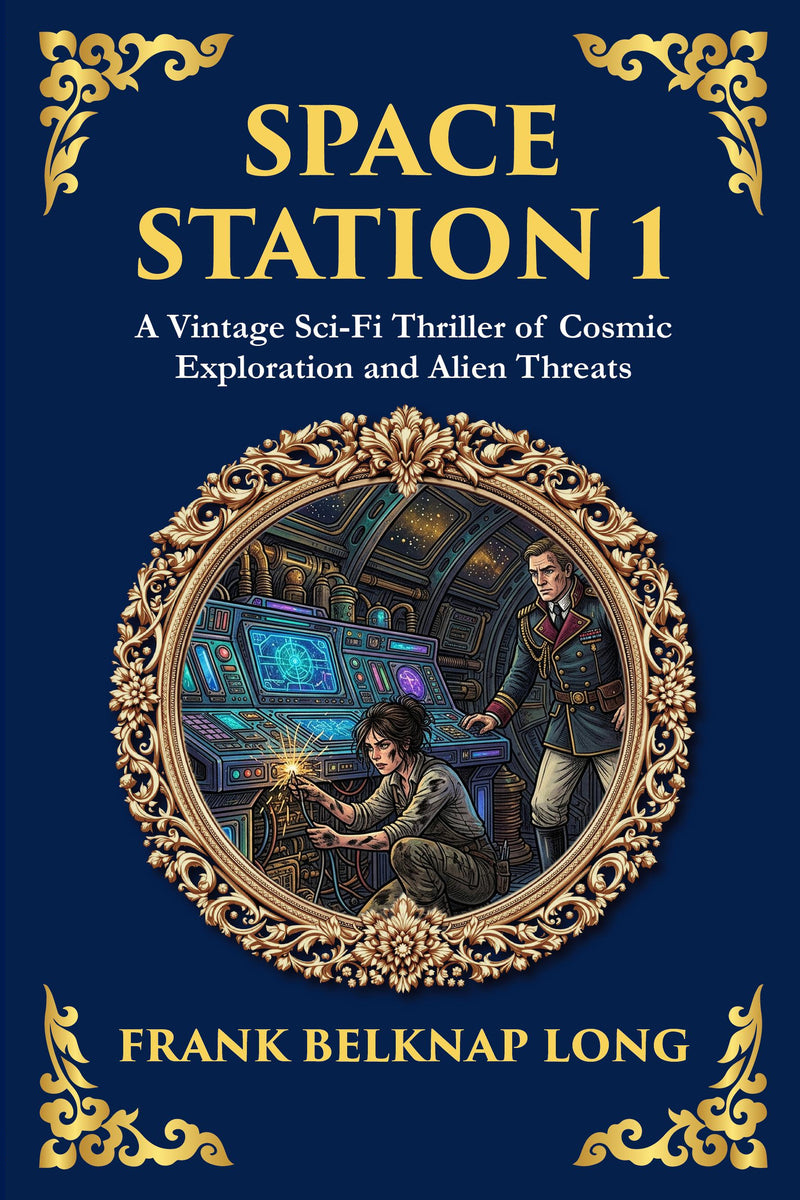
Space Station 1
Orbiting on the edge of the unknown, Space Station 1 stands as humanity’s bold leap into the cosmos—and possibly its last.
or free app
10,000+ hrs library
30-day guarantee
The complete Space Station 1 appears in modern English through Library of Alexandria Press, available online with audiobook narration included for members.
Have you ever wondered why humanity fears the silence of space more than the noise of war? Space Station 1 by Frank Belknap Long is a tense, atmospheric sci-fi thriller that captures the paranoia, danger, and wonder of deep space exploration. First published in the golden age of pulp fiction, this vintage classic weaves a suspenseful narrative of isolation, cosmic dread, and first contact gone wrong.
Set aboard Earth’s first permanent outpost among the stars, the novel follows a crew of astronauts, scientists, and military personnel who find themselves grappling with forces beyond human comprehension. As inexplicable phenomena begin to haunt the station, alliances fracture, reason fades, and a sinister presence reveals itself—one that may have been watching humanity all along. Long combines his signature flair for creeping horror with classic science fiction tropes—space madness, alien intelligences, and technological dread—to deliver a tale that still resonates in our age of interplanetary dreams and digital uncertainty.
This modern edition preserves the chilling suspense and retro-futurist atmosphere of the original, while bringing its themes into sharp contemporary focus.
What you’ll discover in this modern edition
- A Suspenseful Tale of First Contact Gone Wrong – Encounter the unknown at the edges of human knowledge
- Vintage Space Horror at Its Best – Relive the golden age of speculative fiction with Cold War undertones and eerie alien mystery
- Psychological and Existential Terror – Explore the mental strain of isolation, paranoia, and confronting the cosmic abyss
- An Allegory of Discovery and Hubris – A warning against humanity’s belief that it can master the stars without consequence
| Formats | eBook (EPUB + PDF) · Audiobook · Paperback · Hardcover · Large Print |
| Language | English |
| Trim size (print) | 6 × 9 in |
| Binding | Paperback — perfect-bound · Hardcover — casewrap |
| Large Print edition | Same text in a larger, easy-read type — a larger font, not a larger trim |
| Print pricing | Every physical book at our true cost — at-cost, no profit (members) |
| Library | 873 restored titles, always growing |
| Length | 48,849 words · ~3 hr 15 min reading |
| Reading level | Grade 5 · an easy, flowing read (this modern-English edition) |
| Edition | Modern English translation · 2026 |
Member reviews for this edition are collected as readers finish it — be the first. Across the library: 12,000+ books shipped, every plan covered by a 365-day print guarantee.
About this edition
A faithful, unabridged modern-English edition by The Library of Alexandria — carefully rendered for today's reader and verified paragraph-by-paragraph against the public-domain source. Available as eBook, audiobook, paperback, hardcover, and large print.
- Complete & unabridgedVerified paragraph by paragraph against the source — never a scan, never abridged.
- Modern English, faithfulReadable today, with the author’s meaning kept intact. Readable — not simplified.
- Every format, one membershipRead in your browser or the free app, or listen to the full audiobook.
Included free with your membership
Cancel anytime, one click · 30-day money-back guarantee
Edition last updated July 2026
What’s inside
Space Station 1 — complete and unabridged: all 21 sections included with membership, plus the full audiobook.
Begin reading Space Station 1
In clear modern English — the complete text is included with membership.
Introduction
There are certain writers whose names form the connective tissue of an entire literary movement, figures who appear again and again at the intersections of correspondence, friendship, and creative collaboration that defined the golden age of speculative fiction. Frank Belknap Long was one of these essential figures—a man whose career stretched across more than six decades, who knew and corresponded with the titans of the weird and the fantastic, and who quietly produced a body of work that ranged from cosmic horror to hard science fiction with equal facility. The book you now hold represents one of his ventures into the wide-open frontier of outer space, a tale of human beings hurled into the void and forced to confront the unknown that waits beyond the thin shell of our atmosphere. It is a story written in an era when the dream of leaving Earth had only just begun to feel possible, when the first artificial satellites were still rising into orbit and the imagination of the public was electrified by the prospect of what might be found out there among the stars.
To approach this novel today is to step into a particular moment in the cultural history of the twentieth century, a moment when the future seemed to be arriving faster than anyone could fully comprehend. The orbiting station of the title was, for the readers of Long’s generation, not a relic of the past but a vision of an imminent tomorrow—a way station between the cradle of our planet and the limitless expanse beyond. Long understood, as the best science fiction writers always have, that the technology was never truly the point. The hardware, the rockets, the airlocks and pressure suits, the vast wheeling structures suspended in the blackness—these were the stage upon which the eternal human drama would play out. What happens to people when they are removed from everything familiar? How do courage and fear, loyalty and suspicion, love and ambition behave when the ordinary rules of gravity and society no longer apply? These are the questions that beat at the heart of this thriller, and they remain as compelling now as they were when the words were first set down.
This edition has been prepared as a modern translation, carefully adapted for the contemporary reader. That phrase deserves a moment of explanation, because it speaks to the spirit in which this volume has been assembled. The language of mid-century pulp and paperback fiction, vivid and energetic as it was, carried with it certain habits and conventions that can place an unnecessary distance between today’s audience and the genuine pleasures of the story. Sentences sometimes grew dense with the idioms of their day; references that once needed no explanation have faded into obscurity; the rhythms of dialogue and narration occasionally feel mannered to ears accustomed to the brisk pacing of present-day prose. In adapting this work, the goal has been to clear away those incidental obstacles while preserving everything that gives the original its power and charm. The aim is not to rewrite Long or to impose a foreign sensibility upon his creation, but rather to act as a kind of careful restorer, brushing away the accumulated dust so that the colors beneath can shine as brightly as they did on the day the canvas was finished. The adventure, the suspense, the wonder, and the unmistakable voice of a master storyteller all remain intact. What changes is simply the ease with which a reader in our own century can slip into the current of the narrative and be carried along.
Frank Belknap Long was born in New York City in 1901, and the metropolis would remain his home and his backdrop for the better part of a long life. He came of age in an era when the boundaries between the literary mainstream and the so-called popular genres were being drawn and redrawn, when the pulp magazines were emerging as a vibrant marketplace for stories of adventure, mystery, horror, and the fantastic. Long entered this world early and never really left it. He began publishing while still a young man, and almost immediately he found himself drawn into the orbit of a circle of writers who would become legendary. Chief among these was Howard Phillips Lovecraft, the reclusive author of Providence whose tales of cosmic dread would, decades after his death, exert an outsized influence on the entire landscape of imaginative literature. Long and Lovecraft became close friends and prolific correspondents, exchanging letters that brimmed with ideas, debates, encouragements, and the kind of intellectual sparring that sharpens a young writer’s mind. Long was, in fact, one of the youngest members of the so-called Lovecraft Circle, and his early work bore the unmistakable stamp of that association.
Yet it would be a mistake to think of Long merely as a satellite of Lovecraft’s more famous star. He was a writer of remarkable range and longevity, and over the course of his career he moved fluidly between genres in a way that few of his contemporaries managed. He wrote weird tales and supernatural horror, certainly, including stories that have become touchstones of the form. But he also wrote crime fiction, gothic romance under various pen names, comic book scripts during the medium’s formative years, poetry, and—of particular relevance to the volume before you—science fiction of the most expansive and adventurous kind. As the pulp era gave way to the paperback boom of the postwar years, Long adapted and continued to produce, finding new markets and new readers for his tireless imagination. He was a professional in the truest sense, a man who lived by his pen and who understood the craft of holding a reader’s attention from the first page to the last.
His science fiction occupies a fascinating place within his larger body of work. Long brought to it the same cosmic sensibility that animated his weird tales—that abiding sense of the vastness and strangeness of the universe, of humanity’s smallness against the backdrop of infinite space and deep time. But where his horror fiction tended to find terror in that vastness, his science fiction often found something closer to exhilaration, a thrill of possibility tempered always by an awareness of danger. The void was not merely a place of monstrous threat; it was also a frontier to be explored, a challenge to be met, a proving ground for the human spirit. This dual sensibility—wonder and dread held in delicate balance—is one of the qualities that makes his space-faring fiction so satisfying. He never lets the reader forget that the universe is genuinely alien, that the things we might encounter out there could be beyond our comprehension and indifferent to our survival. And yet he also celebrates the audacity of those who would venture forth anyway, who would strap themselves into fragile vessels and hurl themselves into the dark in search of knowledge, adventure, and a future for their species.
By the time Long turned his attention to stories set aboard orbiting stations and amid the perils of space, the genre itself was undergoing a transformation. The crude space operas of the earliest pulps were giving way to a more sophisticated and scientifically informed style of storytelling, even as the appetite for thrills and spectacle remained undiminished. Long stood at this crossroads, drawing on the energy and momentum of the old tradition while reaching toward the heightened plausibility that postwar readers increasingly demanded. The result is fiction that feels both timeless and rooted in its moment—stories that crackle with the pulp-era love of incident and peril while gesturing toward the more contemplative concerns that would come to define the field in the decades ahead. He understood that a thriller must above all things thrill, that the reader’s pulse must quicken and the pages must turn, but he also understood that the deepest thrills arise not from spectacle alone but from our investment in the people caught up in the action.
It is worth dwelling for a moment on the historical context in which a book like this one was conceived and received. The middle decades of the twentieth century were a time of extraordinary ferment in humanity’s relationship with space. The terrible engines of war had given rise, almost paradoxically, to the rockets that would one day carry men beyond the atmosphere. The launch of the first artificial satellites sent a shock of wonder and anxiety around the globe. Suddenly the idea of a permanent human presence in orbit ceased to be pure fantasy and became something that scientists and engineers were seriously contemplating. The space station—that great wheeling structure turning slowly against the stars—became one of the defining images of the imagined future, appearing in magazines, films, and the pages of countless novels. For a writer of Long’s generation and inclination, this was irresistible material. Here was a setting that combined the romance of exploration with the cold realities of physics, a place where human ingenuity met the implacable hostility of the vacuum, where every breath of air and every degree of warmth had to be wrested from an environment that wanted to kill you. And into this setting, Long was free to introduce the element that has always distinguished the thriller from the mere technical exercise: the possibility that we are not alone, that the dark between the stars might hide intelligences we can scarcely imagine.
Without revealing the turns and surprises that await you in these pages—for a thriller depends above all on the reader’s discovery of its secrets in their proper order—it is worth speaking in a general way about what makes this kind of story endure, and what you might look forward to as you read. The orbiting station of the title is more than a setting; it is, in a sense, a character in its own right, a precarious island of human life suspended in an ocean of nothingness. Long uses the claustrophobic intensity of this environment to remarkable effect. There is something deeply primal about a tale set in an enclosed space surrounded by lethal danger, whether that space is a ship at sea, a fortress under siege, or a fragile metal shell orbiting the Earth at unimaginable speed. The walls that protect the characters are the same walls that trap them. There is no escape, no retreat to safety, no calling for help that can arrive in time. Everything must be faced and resolved within the confines of the station and the limits of the human beings who inhabit it. This is the stuff of pure suspense, and Long knew exactly how to wring tension from it.
The cosmic exploration promised by the subtitle is rendered here with the particular flavor that distinguishes the science fiction of this period. There is a tactile quality to the way the void is described, an attention to the physical sensations of weightlessness, of the cold and the silence, of the overwhelming scale of the heavens as seen from a vantage point no human had ever truly occupied. Long invites us to feel what it might be like to float in that immensity, to look down upon the curve of our own world and to look out upon the infinite dark. This sense of wonder—the genuine awe that comes from contemplating our place in the cosmos—is one of the most precious gifts that science fiction can offer, and it suffuses these pages. But Long never lets the wonder become complacent. Always there is the awareness that this beauty is also deadly, that the same vastness that fills us with awe is utterly indifferent to our fate, that one mistake, one failure of equipment or nerve, could mean the end of everything.
And then there is the matter of the alien threats that the subtitle promises. Here we touch upon one of the most enduring fascinations of the genre—the encounter with the truly other, with forms of life and intelligence that arose under different stars and obey different laws. The fear of the unknown, of what might be lurking in the darkness beyond the reach of our understanding, is one of the deepest currents in human storytelling, reaching back to the oldest myths and legends. Long, with his roots in the literature of cosmic horror, was uniquely equipped to give this fear a fresh and terrifying form. The alien in his fiction is never merely a man in a costume, never a simple monster to be defeated and forgotten. It carries with it a genuine sense of strangeness, a suggestion that we are dealing with something whose motives and nature lie beyond the limits of human comprehension. This is where Long’s background in the weird tale serves the science fiction so beautifully. He brings to the encounter a frisson of the uncanny, a chill that goes beyond mere physical danger and touches something deeper in the reader’s imagination.
Cancel anytime, one click · 30-day money-back guarantee
Founding annual rate available now — your price locks for life when you join.
Not ready? Get this free chapter by email — read it anytime.
✓ Sent — check your inbox for Space Station 1.
Questions about Space Station 1
What is Space Station 1 about?
Orbiting on the edge of the unknown, Space Station 1 stands as humanity’s bold leap into the cosmos—and possibly its last. When strange signals begin to emanate from deep space and crew members mysteriously vanish, fear spreads like fire through the corridors of the station. Frank Belknap Long, master of pulp horror and science fiction, delivers a gripping tale of isolation, cosmic terror, and interstellar mystery.
Who wrote Space Station 1?
Space Station 1 was written by Frank Belknap Long. This edition presents the complete work in clear modern English, faithfully rendered from the public-domain original by Library of Alexandria Press.
Is Space Station 1 free to read?
The opening chapter is free to read on this page. Members read and listen to the complete work — and the entire library — free, and can order any physical book at our true print cost.
How long is Space Station 1?
21 chapters (~48,849 words) — about 3 hr 15 min of reading in this modern-English edition.
Is this an abridged version of Space Station 1?
No. This is the complete, unabridged Space Station 1, carefully rendered into clear modern English and verified paragraph-by-paragraph against the public-domain source — nothing is cut or summarised.
What formats does Space Station 1 come in?
Space Station 1 is available as eBook, paperback, hardcover and large print. eBook and audiobook are included with membership; printed editions ship at our true print cost.
Shipping & returns
Billing & membership
More from the library


Explore Free eBooks
- Kant's Prolegomena to Any Future Metaphysics · Immanuel Kant
- The Advancement of Learning · Francis Bacon
- The Dawn of Day · Friedrich Nietzsche
- Peter and Wendy · J. M. Barrie
- Meditations · Marcus Aurelius
- The Confessions of St. Augustine · Saint Augustine of Hippo
- Resurrection · Leo Tolstoy
- Dialogues Concerning Natural Religion · David Hume
- As You Like It · William Shakespeare
- Jack and Jill · Louisa May Alcott
- Dream Psychology: Psychoanalysis for Beginners · Sigmund Freud
- The Raven · Edgar Allan Poe
- Considerations on Representative Government · John Stuart Mill
- The Will to Power: An Attempted Transvaluation of All Values. Book III and IV · Friedrich Nietzsche
- Tarzan of the Apes · Edgar Rice Burroughs
- Fundamental Principles of the Metaphysic of Morals · Immanuel Kant
- The Confessions of Jean Jacques Rousseau — Complete · Jean-Jacques Rousseau
- The Merchant of Venice · William Shakespeare
- Democracy in America — Volume 2 · Alexis de Tocqueville
- Ecce Homo · Friedrich Wilhelm Nietzsche
- Second Treatise of Government · John Locke
- The Wonderful Wizard of Oz · L. Frank Baum
- The Prince · Niccolò Machiavelli
- Anne of Green Gables · L. M. Montgomery
- De Profundis · Oscar Wilde
- Thus Spake Zarathustra: A Book for All and None · Friedrich Nietzsche
- Anna Karenina · Leo Tolstoy
- Great Expectations · Charles Dickens
- The Island of Doctor Moreau · H. G. Wells
- A Midsummer Night's Dream · William Shakespeare
Space Station 1
Space Station 1
A Classic Sci-Fi Thriller of Cosmic Exploration and Alien Threats
Frank Belknap Long
Contents
- Introduction
- Intrigue in Earth's Outer Orbit
- Cast of Characters
- Chapter 1
- Chapter 2
- Chapter 3
- Chapter 4
- Chapter 5
- Chapter 6
- Chapter 7
- Chapter 8
- Chapter 9
- Chapter 10
- Chapter 11
- Chapter 12
- Chapter 13
- Chapter 14
- Chapter 15
- Chapter 16
- Chapter 17
- Chapter 18
Introduction
There are certain writers whose names form the connective tissue of an entire literary movement, figures who appear again and again at the intersections of correspondence, friendship, and creative collaboration that defined the golden age of speculative fiction. Frank Belknap Long was one of these essential figures—a man whose career stretched across more than six decades, who knew and corresponded with the titans of the weird and the fantastic, and who quietly produced a body of work that ranged from cosmic horror to hard science fiction with equal facility. The book you now hold represents one of his ventures into the wide-open frontier of outer space, a tale of human beings hurled into the void and forced to confront the unknown that waits beyond the thin shell of our atmosphere. It is a story written in an era when the dream of leaving Earth had only just begun to feel possible, when the first artificial satellites were still rising into orbit and the imagination of the public was electrified by the prospect of what might be found out there among the stars.
To approach this novel today is to step into a particular moment in the cultural history of the twentieth century, a moment when the future seemed to be arriving faster than anyone could fully comprehend. The orbiting station of the title was, for the readers of Long’s generation, not a relic of the past but a vision of an imminent tomorrow—a way station between the cradle of our planet and the limitless expanse beyond. Long understood, as the best science fiction writers always have, that the technology was never truly the point. The hardware, the rockets, the airlocks and pressure suits, the vast wheeling structures suspended in the blackness—these were the stage upon which the eternal human drama would play out. What happens to people when they are removed from everything familiar? How do courage and fear, loyalty and suspicion, love and ambition behave when the ordinary rules of gravity and society no longer apply? These are the questions that beat at the heart of this thriller, and they remain as compelling now as they were when the words were first set down.
This edition has been prepared as a modern translation, carefully adapted for the contemporary reader. That phrase deserves a moment of explanation, because it speaks to the spirit in which this volume has been assembled. The language of mid-century pulp and paperback fiction, vivid and energetic as it was, carried with it certain habits and conventions that can place an unnecessary distance between today’s audience and the genuine pleasures of the story. Sentences sometimes grew dense with the idioms of their day; references that once needed no explanation have faded into obscurity; the rhythms of dialogue and narration occasionally feel mannered to ears accustomed to the brisk pacing of present-day prose. In adapting this work, the goal has been to clear away those incidental obstacles while preserving everything that gives the original its power and charm. The aim is not to rewrite Long or to impose a foreign sensibility upon his creation, but rather to act as a kind of careful restorer, brushing away the accumulated dust so that the colors beneath can shine as brightly as they did on the day the canvas was finished. The adventure, the suspense, the wonder, and the unmistakable voice of a master storyteller all remain intact. What changes is simply the ease with which a reader in our own century can slip into the current of the narrative and be carried along.
Frank Belknap Long was born in New York City in 1901, and the metropolis would remain his home and his backdrop for the better part of a long life. He came of age in an era when the boundaries between the literary mainstream and the so-called popular genres were being drawn and redrawn, when the pulp magazines were emerging as a vibrant marketplace for stories of adventure, mystery, horror, and the fantastic. Long entered this world early and never really left it. He began publishing while still a young man, and almost immediately he found himself drawn into the orbit of a circle of writers who would become legendary. Chief among these was Howard Phillips Lovecraft, the reclusive author of Providence whose tales of cosmic dread would, decades after his death, exert an outsized influence on the entire landscape of imaginative literature. Long and Lovecraft became close friends and prolific correspondents, exchanging letters that brimmed with ideas, debates, encouragements, and the kind of intellectual sparring that sharpens a young writer’s mind. Long was, in fact, one of the youngest members of the so-called Lovecraft Circle, and his early work bore the unmistakable stamp of that association.
Yet it would be a mistake to think of Long merely as a satellite of Lovecraft’s more famous star. He was a writer of remarkable range and longevity, and over the course of his career he moved fluidly between genres in a way that few of his contemporaries managed. He wrote weird tales and supernatural horror, certainly, including stories that have become touchstones of the form. But he also wrote crime fiction, gothic romance under various pen names, comic book scripts during the medium’s formative years, poetry, and—of particular relevance to the volume before you—science fiction of the most expansive and adventurous kind. As the pulp era gave way to the paperback boom of the postwar years, Long adapted and continued to produce, finding new markets and new readers for his tireless imagination. He was a professional in the truest sense, a man who lived by his pen and who understood the craft of holding a reader’s attention from the first page to the last.
His science fiction occupies a fascinating place within his larger body of work. Long brought to it the same cosmic sensibility that animated his weird tales—that abiding sense of the vastness and strangeness of the universe, of humanity’s smallness against the backdrop of infinite space and deep time. But where his horror fiction tended to find terror in that vastness, his science fiction often found something closer to exhilaration, a thrill of possibility tempered always by an awareness of danger. The void was not merely a place of monstrous threat; it was also a frontier to be explored, a challenge to be met, a proving ground for the human spirit. This dual sensibility—wonder and dread held in delicate balance—is one of the qualities that makes his space-faring fiction so satisfying. He never lets the reader forget that the universe is genuinely alien, that the things we might encounter out there could be beyond our comprehension and indifferent to our survival. And yet he also celebrates the audacity of those who would venture forth anyway, who would strap themselves into fragile vessels and hurl themselves into the dark in search of knowledge, adventure, and a future for their species.
By the time Long turned his attention to stories set aboard orbiting stations and amid the perils of space, the genre itself was undergoing a transformation. The crude space operas of the earliest pulps were giving way to a more sophisticated and scientifically informed style of storytelling, even as the appetite for thrills and spectacle remained undiminished. Long stood at this crossroads, drawing on the energy and momentum of the old tradition while reaching toward the heightened plausibility that postwar readers increasingly demanded. The result is fiction that feels both timeless and rooted in its moment—stories that crackle with the pulp-era love of incident and peril while gesturing toward the more contemplative concerns that would come to define the field in the decades ahead. He understood that a thriller must above all things thrill, that the reader’s pulse must quicken and the pages must turn, but he also understood that the deepest thrills arise not from spectacle alone but from our investment in the people caught up in the action.
It is worth dwelling for a moment on the historical context in which a book like this one was conceived and received. The middle decades of the twentieth century were a time of extraordinary ferment in humanity’s relationship with space. The terrible engines of war had given rise, almost paradoxically, to the rockets that would one day carry men beyond the atmosphere. The launch of the first artificial satellites sent a shock of wonder and anxiety around the globe. Suddenly the idea of a permanent human presence in orbit ceased to be pure fantasy and became something that scientists and engineers were seriously contemplating. The space station—that great wheeling structure turning slowly against the stars—became one of the defining images of the imagined future, appearing in magazines, films, and the pages of countless novels. For a writer of Long’s generation and inclination, this was irresistible material. Here was a setting that combined the romance of exploration with the cold realities of physics, a place where human ingenuity met the implacable hostility of the vacuum, where every breath of air and every degree of warmth had to be wrested from an environment that wanted to kill you. And into this setting, Long was free to introduce the element that has always distinguished the thriller from the mere technical exercise: the possibility that we are not alone, that the dark between the stars might hide intelligences we can scarcely imagine.
Without revealing the turns and surprises that await you in these pages—for a thriller depends above all on the reader’s discovery of its secrets in their proper order—it is worth speaking in a general way about what makes this kind of story endure, and what you might look forward to as you read. The orbiting station of the title is more than a setting; it is, in a sense, a character in its own right, a precarious island of human life suspended in an ocean of nothingness. Long uses the claustrophobic intensity of this environment to remarkable effect. There is something deeply primal about a tale set in an enclosed space surrounded by lethal danger, whether that space is a ship at sea, a fortress under siege, or a fragile metal shell orbiting the Earth at unimaginable speed. The walls that protect the characters are the same walls that trap them. There is no escape, no retreat to safety, no calling for help that can arrive in time. Everything must be faced and resolved within the confines of the station and the limits of the human beings who inhabit it. This is the stuff of pure suspense, and Long knew exactly how to wring tension from it.
The cosmic exploration promised by the subtitle is rendered here with the particular flavor that distinguishes the science fiction of this period. There is a tactile quality to the way the void is described, an attention to the physical sensations of weightlessness, of the cold and the silence, of the overwhelming scale of the heavens as seen from a vantage point no human had ever truly occupied. Long invites us to feel what it might be like to float in that immensity, to look down upon the curve of our own world and to look out upon the infinite dark. This sense of wonder—the genuine awe that comes from contemplating our place in the cosmos—is one of the most precious gifts that science fiction can offer, and it suffuses these pages. But Long never lets the wonder become complacent. Always there is the awareness that this beauty is also deadly, that the same vastness that fills us with awe is utterly indifferent to our fate, that one mistake, one failure of equipment or nerve, could mean the end of everything.
And then there is the matter of the alien threats that the subtitle promises. Here we touch upon one of the most enduring fascinations of the genre—the encounter with the truly other, with forms of life and intelligence that arose under different stars and obey different laws. The fear of the unknown, of what might be lurking in the darkness beyond the reach of our understanding, is one of the deepest currents in human storytelling, reaching back to the oldest myths and legends. Long, with his roots in the literature of cosmic horror, was uniquely equipped to give this fear a fresh and terrifying form. The alien in his fiction is never merely a man in a costume, never a simple monster to be defeated and forgotten. It carries with it a genuine sense of strangeness, a suggestion that we are dealing with something whose motives and nature lie beyond the limits of human comprehension. This is where Long’s background in the weird tale serves the science fiction so beautifully. He brings to the encounter a frisson of the uncanny, a chill that goes beyond mere physical danger and touches something deeper in the reader’s imagination.
It was a brutal, relentless, and one-sided fight for survival. Corriston breathed heavily, dodging a killer’s blows in total darkness. His opponent was muscular, dangerous, and as agile as a cat. The man used a knife to slash at Corriston whenever he got close, then leaped back to strike with a heavy fist.
Corriston could hear the swish of the man’s heels as he pivoted, allowing him to predict almost exactly when the next blow would land. He was bleeding from a cut on his right shoulder, his temples were throbbing, and he felt a sharp ache in his groin.
Being unarmed put him at a terrifying disadvantage. He had been close to death before, but never in such a cramped space or so close to a man who had clearly killed before and wouldn’t hesitate to do it again.
His will to survive was pitted against raw strength, cunning, and exceptional agility. He began to retreat slowly until a massive steel girder blocked his path. He was fighting off dizziness, and his heart was pounding wildly.
He slid sideways along the girder, feeling its smooth, cold surface. To his sweaty palms, the metal felt as cold as a coffin lid, but he refused to believe he was trapped. The girder had to end somewhere.
The killer was closing in again. His shoes scraped against the floor in the dark, and his breathing was barely audible. Corriston edged further along the girder, moving parallel to it inch by inch. He fought off a wave of dizziness, desperate not to fall. The wetness on his shoulder was unnerving, and it was strange that he felt no pain. How badly could a person be stabbed without feeling anything? He didn’t know, but at least his shoulder wasn’t paralyzed. He could still move his arm and flex his back muscles.
End of the free sample
Keep reading, free
Members read and listen to the complete book — and the entire library. Cancel anytime, one click · 30-day money-back guarantee.