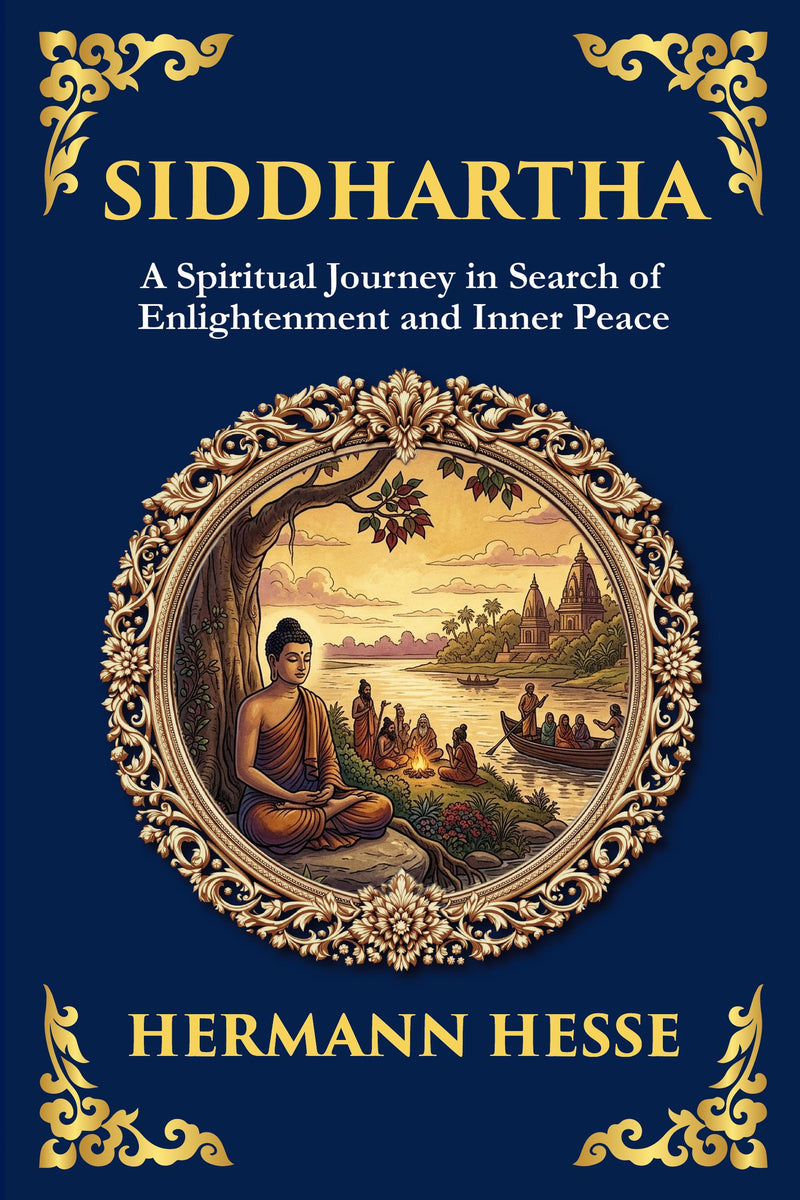
Siddhartha
The path to enlightenment is not found in teachings—it is lived. In Siddhartha, Hermann Hesse crafts a luminous tale of spiritual self-discovery, following one man’s quest for truth beyond doctrine, beyond possession, beyond self.
or free app
10,000+ hrs library
30-day guarantee
The complete Siddhartha appears in modern English through Library of Alexandria Press, available online with audiobook narration included for members.
Have you ever wondered why the answers you seek may already lie within you? One man. Many paths.
One truth. In Siddhartha, Nobel laureate Hermann Hesse presents one of the most enduring spiritual novels of all time—a poetic exploration of selfhood, enlightenment, and the delicate balance between wisdom and experience. The story follows Siddhartha, a Brahmin’s son who grows disillusioned with formal teachings and abandons his home in pursuit of deeper knowledge.
He joins ascetics, learns the silence of the forest, falls into the temptations of lust and wealth, and finally surrenders all ambitions beside a quiet river. Through joy, suffering, love, and loss, he begins to understand the unity of all things. Unlike other spiritual texts that offer answers, Siddhartha gently invites readers to sit with questions, to listen, and to feel their way toward truth.
It is not a guide—it is a mirror.
What you’ll discover in this modern edition
- A Timeless Journey Toward Enlightenment Follow Siddhartha as he explores paths of knowledge, desire, renunciation, and ultimate awakening.
- Profound Eastern Philosophy in a Western Voice Hesse bridges Eastern spirituality with Western narrative tradition, making deep insights beautifully accessible.
- An Introspective and Poetic Reading Experience Rich in metaphor and meditative prose, each chapter is a step closer to the soul’s still center.
- A Story That Honors Life’s Contradictions Discover how failure, indulgence, and even suffering can be part of the sacred path to understanding.
- A Book to Revisit at Every Stage of Life Whether read as a seeker, skeptic, or sage, Siddhartha resonates anew with each reading. From rivers to silence, from sorrow to bliss—Siddhartha’s path is not unlike our own.
| Formats | eBook (EPUB + PDF) · Audiobook · Paperback · Hardcover · Large Print |
| Language | English |
| Trim size (print) | 6 × 9 in |
| Binding | Paperback — perfect-bound · Hardcover — casewrap |
| Large Print edition | Same text in a larger, easy-read type — a larger font, not a larger trim |
| Print pricing | Every physical book at our true cost — at-cost, no profit (members) |
| Library | 873 restored titles, always growing |
| Length | 37,707 words · ~2 hr 31 min reading |
| Reading level | Grade 7 · an easy, flowing read (this modern-English edition) |
| Edition | Modern English translation · 2026 |
Member reviews for this edition are collected as readers finish it — be the first. Across the library: 12,000+ books shipped, every plan covered by a 365-day print guarantee.
About this edition
A faithful, unabridged modern-English edition by The Library of Alexandria — carefully rendered for today's reader and verified paragraph-by-paragraph against the public-domain source. Available as eBook, audiobook, paperback, hardcover, and large print.
- Complete & unabridgedVerified paragraph by paragraph against the source — never a scan, never abridged.
- Modern English, faithfulReadable today, with the author’s meaning kept intact. Readable — not simplified.
- Every format, one membershipRead in your browser or the free app, or listen to the full audiobook.
Included free with your membership
Cancel anytime, one click · 30-day money-back guarantee
Edition last updated July 2026
What’s inside
Siddhartha — complete and unabridged: all 10 sections included with membership, plus the full audiobook.
Begin reading Siddhartha
In clear modern English — the complete text is included with membership.
Introduction
There are books we read, and there are books that read us. Siddhartha belongs unmistakably to the second category. To open its pages is to embark on a journey that mirrors your own, no matter who you are, where you come from, or what you believe. First published in 1922, Hermann Hesse’s slender masterpiece has accompanied generations of seekers—the young and the old, the religious and the skeptical, the restless and the resigned—as they have wrestled with the oldest and most persistent questions of human existence: Who am I? What is the meaning of my life? How can I find peace in a world that seems designed to keep me searching for it forever?
This modern translation, adapted for the contemporary reader, seeks to honor the luminous simplicity of Hesse’s original German prose while removing the small barriers that century-old language can sometimes place between a reader and a text. The aim is not to modernize the story—it needs no such thing, for it remains as timeless as the river that runs through its heart—but to ensure that the wisdom contained within these pages reaches you as clearly and directly as it reached its first readers a hundred years ago. What you hold is an invitation to slow down, to breathe, and to walk alongside one of literature’s most beloved travelers as he makes his way toward understanding.
To appreciate the depth of what awaits you, it helps to understand the life of the man who wrote it. Hermann Hesse was born in 1877 in the small town of Calw, in the Black Forest region of southern Germany, into a family steeped in Christian missionary work. His parents and grandparents had spent years in India, and his childhood home was filled with the artifacts, languages, and spiritual atmosphere of a household that lived simultaneously in the West and in the imagined East. This dual inheritance—the rigorous Protestant pietism of his German upbringing and the magnetic pull of Indian thought and culture—would shape everything he would later write. From an early age, Hesse felt himself to be a person divided, drawn in multiple directions, uncomfortable with the rigid expectations placed upon him.
As a boy, he was sensitive, gifted, and rebellious. He fled from a seminary where he had been sent to train for the clergy, suffered through periods of profound depression, and even attempted to take his own life as a teenager. These early struggles were not mere youthful turbulence; they were the first stirrings of a lifelong inner conflict between the demands of society and the demands of the soul. Hesse would spend his entire literary career exploring this tension—the war between conformity and authenticity, between the safe path laid out by others and the dangerous, exhilarating, necessary path one must discover for oneself.
By the time he came to write Siddhartha, Hesse was a man in the midst of profound personal and historical upheaval. The First World War had devastated Europe, shattering the comfortable certainties of an entire civilization. Hesse, who had spoken out against the nationalistic fever that swept through Germany, found himself vilified by his own countrymen, branded a traitor for daring to question the war. At the same time, his personal life was collapsing: his marriage was failing, his father had died, and his youngest son had fallen seriously ill. Hesse himself suffered a nervous breakdown and entered psychotherapy, undergoing extensive treatment that introduced him to the ideas of Carl Jung and the depths of his own unconscious mind.
It was out of this crucible of suffering that Siddhartha was born. Hesse immersed himself in the study of Indian philosophy and Buddhist scripture, drawing on the spiritual inheritance of his family while also reaching beyond it toward something more universal. He began writing the book in 1919 but found himself unable to complete it. He reached a point in the narrative—roughly halfway through—where he simply could not continue. For nearly two years he set the manuscript aside, unable to write the second half because, by his own admission, he had not yet lived it. He had not yet found within himself the understanding that the latter portion of the story required. Only after a period of intense self-examination, meditation, and inner growth was Hesse able to return to the work and bring it to its luminous conclusion.
This is one of the most extraordinary facts about Siddhartha: that its author could not write its second half until he had personally arrived at the wisdom it describes. The book is not a clever invention or a borrowed parable. It is the distilled record of one man’s hard-won spiritual maturation, transmuted into a story of timeless beauty. When you sense, as you surely will, that the words on these pages carry a weight of genuine experience, you are not imagining it. Hesse paid for every insight in this book with the currency of his own life.
The setting Hesse chose was ancient India, in the time of the Buddha. But it would be a mistake to read this as a historical novel or as a strictly Buddhist text. Hesse drew freely from many wells—Hindu thought with its emphasis on the unity of all existence, Buddhist teaching with its analysis of suffering and desire, and the Western philosophical and psychological traditions in which he had been steeped. The result is something that belongs to no single tradition and to all of them at once. Siddhartha is a profoundly ecumenical work, a meeting place where Eastern and Western wisdom converse as equals. This is precisely why it has spoken so powerfully to readers across the globe, regardless of their cultural or religious background.
When the book first appeared in English translation in 1951, it found a modest audience. But something remarkable happened in the decades that followed. During the 1960s and 1970s, as a new generation of young people in the West grew disillusioned with materialism, conformity, and the spiritual emptiness they perceived in modern life, Siddhartha became a kind of sacred text for the counterculture. It spoke directly to those who felt that there must be more to existence than career, possessions, and the prescribed milestones of a conventional life. Millions of copies were sold. The book became, and remains, one of the most widely read works of German literature in the world, and Hesse himself was awarded the Nobel Prize in Literature in 1946 for a body of work that, in the words of the Nobel committee, exemplified “classical humanitarian ideals and high qualities of style.”
The Shape of the Journey and the Art of Reading It
What makes Siddhartha so enduring is not the complexity of its plot—the story is remarkably simple and direct—but the depth of its themes and the extraordinary beauty with which they are expressed. Without revealing the particulars of the journey that awaits you, it is worth preparing you for the kind of experience this book offers, so that you may receive it in the spirit in which it was written.
At its heart, this is a story about the search for truth and the impossibility of receiving it secondhand. The protagonist is a young man of great gifts—intelligent, admired, born into privilege and surrounded by those who love him. By every external measure, he has everything a person could want. And yet he is restless, dissatisfied, gnawed by a hunger that no amount of knowledge or comfort can satisfy. He senses that the wisdom he has been taught, however true it may be, has not become his own. He has heard about enlightenment, peace, and the divine; but hearing about them is not the same as knowing them. And so he sets out, abandoning safety and certainty, to seek the truth through his own direct experience, whatever the cost.
This is the central pulse of the book: the conviction that wisdom cannot be transmitted through words, that it cannot be inherited or imitated or memorized, but must be lived. One of the most striking and challenging ideas in Siddhartha is the notion that even the teaching of a perfect teacher—even the words of the wisest being who ever lived—cannot truly liberate another person. Each of us must walk our own path. Each of us must make our own mistakes, suffer our own sorrows, and arrive, in our own time and our own way, at the understanding that no one else can give us. This is at once a lonely and a liberating message. It tells us that we cannot outsource our salvation, but it also assures us that we possess within ourselves everything we need to find it.
You will notice as you read that the book moves in cycles and rhythms rather than in a straight line. The protagonist’s journey is not a steady ascent toward enlightenment but a series of phases, each of which seems to contradict the one before it. He embraces asceticism and then sensuality; he pursues spirit and then matter; he renounces the world and then plunges into it. To a reader expecting a simple morality tale, this can be confusing. But this is precisely Hesse’s point. The path to wisdom is not a tidy progression. It is full of detours, reversals, and apparent failures. What looks like a wrong turn may be exactly the experience the soul requires. What looks like a fall from grace may be the necessary descent that precedes a deeper rising. Hesse asks us to suspend our judgment about what counts as progress and to trust that every stage of the journey, even the darkest, has its purpose.
This brings us to one of the book’s most profound and consoling themes: the idea that nothing in our experience is ultimately wasted. Our errors, our excesses, our periods of confusion and despair—all of these are not obstacles to wisdom but ingredients of it. The person who has never suffered cannot truly understand the person who suffers. The one who has never lost themselves cannot fully know the joy of being found. Hesse offers us a vision of life in which even our worst moments are woven into a larger pattern of meaning, in which the very things we most regret may turn out to be the teachers we most needed. For anyone who has ever looked back on their life with shame or sorrow, this is a deeply healing message.
Running through the entire book, both literally and symbolically, is the image of the river. I will not say too much about the role the river comes to play, for it is one of the great pleasures of the reading experience to discover its significance gradually. But I encourage you to pay attention to it from the very beginning. The river is one of the most resonant symbols in all of literature—an image of time and timelessness, of constant motion and eternal presence, of unity amid endless change. The river teaches without speaking. It is always flowing and always the same. It is at the source, in the middle, and at the mouth simultaneously. As you read, allow the river to work on you as it works on the characters in the story. It carries within it the deepest secret the book has to offer.
The prose itself deserves a word. Hesse wrote Siddhartha in a style of extraordinary purity and musicality. The sentences have a meditative, incantatory quality, with repetitions and rhythms that resemble scripture or poetry more than conventional narrative. This is not a book to be rushed through. It is a book to be savored, read slowly, perhaps even read aloud. The very act of reading it can become a kind of meditation, the words washing over you like the sound of flowing water. In adapting this text for the contemporary reader, great care has been taken to preserve this quality—the gentle cadence, the contemplative pacing, the sense that each sentence has been weighed and chosen with deliberate care. Do not be in a hurry. Let the book set its own pace, and let yourself fall into step with it.
It is worth saying something, too, about how this book might speak to you personally, depending on where you find yourself in your own life. Siddhartha is a book that gives different gifts to different readers, and indeed gives different gifts to the same reader at different times. The young reader, full of energy and idealism, may identify most strongly with the protagonist’s rebellion, his refusal to accept the path laid out for him, his determination to find his own truth. The reader in midlife may recognize the seductions and disappointments of worldly success, the gradual numbing of the spirit that can accompany the acquisition of everything one once desired. The older reader may find the deepest resonance in the book’s later passages, with their hard-won serenity and their acceptance of life in all its fullness. This is a book to be returned to again and again across a lifetime. It will meet you wherever you are, and it will have something new to say to you each time you open it.
Cancel anytime, one click · 30-day money-back guarantee
Founding annual rate available now — your price locks for life when you join.
Not ready? Get this free chapter by email — read it anytime.
✓ Sent — check your inbox for Siddhartha.
Questions about Siddhartha
What is Siddhartha about?
The path to enlightenment is not found in teachings—it is lived. In Siddhartha, Hermann Hesse crafts a luminous tale of spiritual self-discovery, following one man’s quest for truth beyond doctrine, beyond possession, beyond self. Born into privilege, Siddhartha rejects conventional religion, wealth, and worldly pleasures in pursuit of a deeper meaning.
Who wrote Siddhartha?
Siddhartha was written by Hermann Hesse. This edition presents the complete work in clear modern English, faithfully rendered from the public-domain original by Library of Alexandria Press.
Is Siddhartha free to read?
The opening chapter is free to read on this page. Members read and listen to the complete work — and the entire library — free, and can order any physical book at our true print cost.
How long is Siddhartha?
10 chapters (~37,707 words) — about 2 hr 31 min of reading in this modern-English edition.
Is this an abridged version of Siddhartha?
No. This is the complete, unabridged Siddhartha, carefully rendered into clear modern English and verified paragraph-by-paragraph against the public-domain source — nothing is cut or summarised.
What formats does Siddhartha come in?
Siddhartha is available as eBook, paperback, hardcover and large print. eBook and audiobook are included with membership; printed editions ship at our true print cost.
Shipping & returns
Billing & membership
More from the library


Explore Free eBooks
- Kant's Prolegomena to Any Future Metaphysics · Immanuel Kant
- The Advancement of Learning · Francis Bacon
- The Dawn of Day · Friedrich Nietzsche
- Peter and Wendy · J. M. Barrie
- Meditations · Marcus Aurelius
- The Confessions of St. Augustine · Saint Augustine of Hippo
- Resurrection · Leo Tolstoy
- Dialogues Concerning Natural Religion · David Hume
- As You Like It · William Shakespeare
- Jack and Jill · Louisa May Alcott
- Dream Psychology: Psychoanalysis for Beginners · Sigmund Freud
- The Raven · Edgar Allan Poe
- Considerations on Representative Government · John Stuart Mill
- The Will to Power: An Attempted Transvaluation of All Values. Book III and IV · Friedrich Nietzsche
- Tarzan of the Apes · Edgar Rice Burroughs
- Fundamental Principles of the Metaphysic of Morals · Immanuel Kant
- The Confessions of Jean Jacques Rousseau — Complete · Jean-Jacques Rousseau
- The Merchant of Venice · William Shakespeare
- Democracy in America — Volume 2 · Alexis de Tocqueville
- Ecce Homo · Friedrich Wilhelm Nietzsche
- Second Treatise of Government · John Locke
- The Wonderful Wizard of Oz · L. Frank Baum
- The Prince · Niccolò Machiavelli
- Anne of Green Gables · L. M. Montgomery
- De Profundis · Oscar Wilde
- Thus Spake Zarathustra: A Book for All and None · Friedrich Nietzsche
- Anna Karenina · Leo Tolstoy
- Great Expectations · Charles Dickens
- The Island of Doctor Moreau · H. G. Wells
- A Midsummer Night's Dream · William Shakespeare
Siddhartha
Siddhartha
A Spiritual Journey in Search of Enlightenment and Inner Peace
Hermann Hesse
Contents
- Introduction
- Part 1
- Chapter 1
- Chapter 2
- Chapter 3
- Chapter 4
- Part 2
- Chapter 5
- Chapter 6
- Chapter 7
Introduction
There are books we read, and there are books that read us. Siddhartha belongs unmistakably to the second category. To open its pages is to embark on a journey that mirrors your own, no matter who you are, where you come from, or what you believe. First published in 1922, Hermann Hesse’s slender masterpiece has accompanied generations of seekers—the young and the old, the religious and the skeptical, the restless and the resigned—as they have wrestled with the oldest and most persistent questions of human existence: Who am I? What is the meaning of my life? How can I find peace in a world that seems designed to keep me searching for it forever?
This modern translation, adapted for the contemporary reader, seeks to honor the luminous simplicity of Hesse’s original German prose while removing the small barriers that century-old language can sometimes place between a reader and a text. The aim is not to modernize the story—it needs no such thing, for it remains as timeless as the river that runs through its heart—but to ensure that the wisdom contained within these pages reaches you as clearly and directly as it reached its first readers a hundred years ago. What you hold is an invitation to slow down, to breathe, and to walk alongside one of literature’s most beloved travelers as he makes his way toward understanding.
To appreciate the depth of what awaits you, it helps to understand the life of the man who wrote it. Hermann Hesse was born in 1877 in the small town of Calw, in the Black Forest region of southern Germany, into a family steeped in Christian missionary work. His parents and grandparents had spent years in India, and his childhood home was filled with the artifacts, languages, and spiritual atmosphere of a household that lived simultaneously in the West and in the imagined East. This dual inheritance—the rigorous Protestant pietism of his German upbringing and the magnetic pull of Indian thought and culture—would shape everything he would later write. From an early age, Hesse felt himself to be a person divided, drawn in multiple directions, uncomfortable with the rigid expectations placed upon him.
As a boy, he was sensitive, gifted, and rebellious. He fled from a seminary where he had been sent to train for the clergy, suffered through periods of profound depression, and even attempted to take his own life as a teenager. These early struggles were not mere youthful turbulence; they were the first stirrings of a lifelong inner conflict between the demands of society and the demands of the soul. Hesse would spend his entire literary career exploring this tension—the war between conformity and authenticity, between the safe path laid out by others and the dangerous, exhilarating, necessary path one must discover for oneself.
By the time he came to write Siddhartha, Hesse was a man in the midst of profound personal and historical upheaval. The First World War had devastated Europe, shattering the comfortable certainties of an entire civilization. Hesse, who had spoken out against the nationalistic fever that swept through Germany, found himself vilified by his own countrymen, branded a traitor for daring to question the war. At the same time, his personal life was collapsing: his marriage was failing, his father had died, and his youngest son had fallen seriously ill. Hesse himself suffered a nervous breakdown and entered psychotherapy, undergoing extensive treatment that introduced him to the ideas of Carl Jung and the depths of his own unconscious mind.
It was out of this crucible of suffering that Siddhartha was born. Hesse immersed himself in the study of Indian philosophy and Buddhist scripture, drawing on the spiritual inheritance of his family while also reaching beyond it toward something more universal. He began writing the book in 1919 but found himself unable to complete it. He reached a point in the narrative—roughly halfway through—where he simply could not continue. For nearly two years he set the manuscript aside, unable to write the second half because, by his own admission, he had not yet lived it. He had not yet found within himself the understanding that the latter portion of the story required. Only after a period of intense self-examination, meditation, and inner growth was Hesse able to return to the work and bring it to its luminous conclusion.
This is one of the most extraordinary facts about Siddhartha: that its author could not write its second half until he had personally arrived at the wisdom it describes. The book is not a clever invention or a borrowed parable. It is the distilled record of one man’s hard-won spiritual maturation, transmuted into a story of timeless beauty. When you sense, as you surely will, that the words on these pages carry a weight of genuine experience, you are not imagining it. Hesse paid for every insight in this book with the currency of his own life.
The setting Hesse chose was ancient India, in the time of the Buddha. But it would be a mistake to read this as a historical novel or as a strictly Buddhist text. Hesse drew freely from many wells—Hindu thought with its emphasis on the unity of all existence, Buddhist teaching with its analysis of suffering and desire, and the Western philosophical and psychological traditions in which he had been steeped. The result is something that belongs to no single tradition and to all of them at once. Siddhartha is a profoundly ecumenical work, a meeting place where Eastern and Western wisdom converse as equals. This is precisely why it has spoken so powerfully to readers across the globe, regardless of their cultural or religious background.
When the book first appeared in English translation in 1951, it found a modest audience. But something remarkable happened in the decades that followed. During the 1960s and 1970s, as a new generation of young people in the West grew disillusioned with materialism, conformity, and the spiritual emptiness they perceived in modern life, Siddhartha became a kind of sacred text for the counterculture. It spoke directly to those who felt that there must be more to existence than career, possessions, and the prescribed milestones of a conventional life. Millions of copies were sold. The book became, and remains, one of the most widely read works of German literature in the world, and Hesse himself was awarded the Nobel Prize in Literature in 1946 for a body of work that, in the words of the Nobel committee, exemplified “classical humanitarian ideals and high qualities of style.”
The Shape of the Journey and the Art of Reading It
What makes Siddhartha so enduring is not the complexity of its plot—the story is remarkably simple and direct—but the depth of its themes and the extraordinary beauty with which they are expressed. Without revealing the particulars of the journey that awaits you, it is worth preparing you for the kind of experience this book offers, so that you may receive it in the spirit in which it was written.
At its heart, this is a story about the search for truth and the impossibility of receiving it secondhand. The protagonist is a young man of great gifts—intelligent, admired, born into privilege and surrounded by those who love him. By every external measure, he has everything a person could want. And yet he is restless, dissatisfied, gnawed by a hunger that no amount of knowledge or comfort can satisfy. He senses that the wisdom he has been taught, however true it may be, has not become his own. He has heard about enlightenment, peace, and the divine; but hearing about them is not the same as knowing them. And so he sets out, abandoning safety and certainty, to seek the truth through his own direct experience, whatever the cost.
This is the central pulse of the book: the conviction that wisdom cannot be transmitted through words, that it cannot be inherited or imitated or memorized, but must be lived. One of the most striking and challenging ideas in Siddhartha is the notion that even the teaching of a perfect teacher—even the words of the wisest being who ever lived—cannot truly liberate another person. Each of us must walk our own path. Each of us must make our own mistakes, suffer our own sorrows, and arrive, in our own time and our own way, at the understanding that no one else can give us. This is at once a lonely and a liberating message. It tells us that we cannot outsource our salvation, but it also assures us that we possess within ourselves everything we need to find it.
You will notice as you read that the book moves in cycles and rhythms rather than in a straight line. The protagonist’s journey is not a steady ascent toward enlightenment but a series of phases, each of which seems to contradict the one before it. He embraces asceticism and then sensuality; he pursues spirit and then matter; he renounces the world and then plunges into it. To a reader expecting a simple morality tale, this can be confusing. But this is precisely Hesse’s point. The path to wisdom is not a tidy progression. It is full of detours, reversals, and apparent failures. What looks like a wrong turn may be exactly the experience the soul requires. What looks like a fall from grace may be the necessary descent that precedes a deeper rising. Hesse asks us to suspend our judgment about what counts as progress and to trust that every stage of the journey, even the darkest, has its purpose.
This brings us to one of the book’s most profound and consoling themes: the idea that nothing in our experience is ultimately wasted. Our errors, our excesses, our periods of confusion and despair—all of these are not obstacles to wisdom but ingredients of it. The person who has never suffered cannot truly understand the person who suffers. The one who has never lost themselves cannot fully know the joy of being found. Hesse offers us a vision of life in which even our worst moments are woven into a larger pattern of meaning, in which the very things we most regret may turn out to be the teachers we most needed. For anyone who has ever looked back on their life with shame or sorrow, this is a deeply healing message.
Running through the entire book, both literally and symbolically, is the image of the river. I will not say too much about the role the river comes to play, for it is one of the great pleasures of the reading experience to discover its significance gradually. But I encourage you to pay attention to it from the very beginning. The river is one of the most resonant symbols in all of literature—an image of time and timelessness, of constant motion and eternal presence, of unity amid endless change. The river teaches without speaking. It is always flowing and always the same. It is at the source, in the middle, and at the mouth simultaneously. As you read, allow the river to work on you as it works on the characters in the story. It carries within it the deepest secret the book has to offer.
The prose itself deserves a word. Hesse wrote Siddhartha in a style of extraordinary purity and musicality. The sentences have a meditative, incantatory quality, with repetitions and rhythms that resemble scripture or poetry more than conventional narrative. This is not a book to be rushed through. It is a book to be savored, read slowly, perhaps even read aloud. The very act of reading it can become a kind of meditation, the words washing over you like the sound of flowing water. In adapting this text for the contemporary reader, great care has been taken to preserve this quality—the gentle cadence, the contemplative pacing, the sense that each sentence has been weighed and chosen with deliberate care. Do not be in a hurry. Let the book set its own pace, and let yourself fall into step with it.
It is worth saying something, too, about how this book might speak to you personally, depending on where you find yourself in your own life. Siddhartha is a book that gives different gifts to different readers, and indeed gives different gifts to the same reader at different times. The young reader, full of energy and idealism, may identify most strongly with the protagonist’s rebellion, his refusal to accept the path laid out for him, his determination to find his own truth. The reader in midlife may recognize the seductions and disappointments of worldly success, the gradual numbing of the spirit that can accompany the acquisition of everything one once desired. The older reader may find the deepest resonance in the book’s later passages, with their hard-won serenity and their acceptance of life in all its fullness. This is a book to be returned to again and again across a lifetime. It will meet you wherever you are, and it will have something new to say to you each time you open it.
Siddhartha grew up in the shade of his home, in the sunlight of the riverbank by the boats, and under the canopy of the Sal-wood forest and the fig tree. He was the handsome son of a Brahman, a spirited young man who spent his days with his friend Govinda, also the son of a Brahman. While bathing and performing sacred rituals and offerings by the river, the sun tanned his fair shoulders. As a boy, he played in the mango groves, where the shade filled his dark eyes; he listened to his mother’s songs, watched the sacred offerings, and learned from his father, a scholar, and the other wise men. For a long time, Siddhartha had participated in the discussions of the elders, practicing the art of debate, reflection, and meditation with Govinda. He had already mastered the silent chanting of Om—the word of all words—breathing it in and out with total concentration, his mind clear and focused. He could already feel the Atman deep within himself: indestructible and one with the universe.
His father was proud of him; he saw that his son was a quick learner with an insatiable thirst for knowledge. He envisioned Siddhartha becoming a great priest and scholar, a leader among the Brahmans.
His mother felt a surge of happiness whenever she saw him—whether he was walking, sitting, or standing. Siddhartha was strong and handsome, moving with grace and treating her with perfect respect.
The young daughters of the Brahmans were captivated by him whenever he walked through the town’s lanes with his bright expression, royal gaze, and slender build.
But no one loved him more than his friend Govinda. Govinda admired Siddhartha’s eyes, his gentle voice, his graceful walk, and the poise of his every movement. He loved everything Siddhartha said and did, but most of all, he admired his spirit—his brilliant, passionate thoughts, his fierce determination, and his noble ambition. Govinda knew that Siddhartha would not become just another ordinary Brahman. He wouldn’t be a lazy official managing offerings, a greedy merchant selling magic spells, a vain and empty speaker, or a petty, dishonest priest. He certainly wouldn’t be just another mindless follower in the crowd. Govinda didn’t want that for himself, either; he had no desire to be just one of thousands of identical Brahmans. He wanted to follow the brilliant and beloved Siddhartha. He decided that in the future, when Siddhartha achieved greatness and joined the ranks of the enlightened, Govinda would be by his side as his friend, companion, assistant, and shadow.
End of the free sample
Keep reading, free
Members read and listen to the complete book — and the entire library. Cancel anytime, one click · 30-day money-back guarantee.