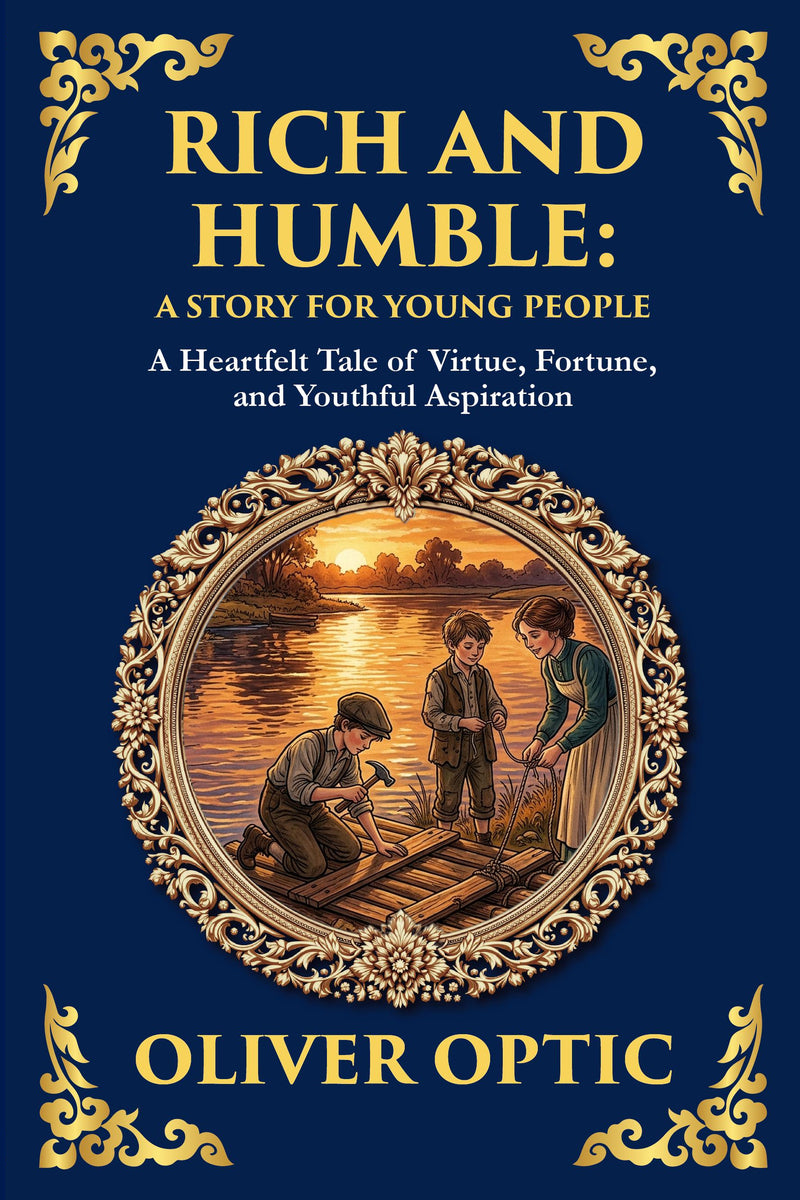
Rich and Humble: A Story for Young People — Large Print
In a world where wealth dazzles and ambition runs high, Rich and Humble tells the moving story of two boys—one born into privilege, the other into modest means.
or free app
10,000+ hrs library
30-day guarantee
The complete Rich and Humble: A Story for Young appears in modern English through Library of Alexandria Press, available online with audiobook narration included for members.
Have you ever wondered why some people rise through life with grace—while others fall despite every advantage? Rich and Humble: A Story for Young People by Oliver Optic is a classic coming-of-age novel that explores the contrasting paths of two boys—Charles, the wealthy son of a shipowner, and Frank, the hard-working child of humble background. As their fortunes shift and their fates become entwined, each must grapple with trials that test their values, friendships, and sense of purpose.
With stirring drama and moral clarity, Optic delivers an engaging tale of youthful ambition, the dangers of pride, and the quiet strength found in humility and perseverance. This modern edition brings the narrative to life for today’s readers, preserving its heartfelt message and enriching prose.
What you’ll discover in this modern edition
- A Tale of Two Paths Witness the parallel journeys of a rich boy and a humble one, and how their destinies unfold through choice and character.
- Moral Lessons With Lasting Impact Learn how kindness, honesty, and humility triumph over arrogance, deceit, and selfish ambition.
- Emotional Growth Through Adversity Experience how hardship can be the greatest teacher, especially in the formative years of life.
- A Window into 19th-Century Youth Culture Understand the societal pressures of the time and how young people navigated expectations, family, and fortune.
- An Inspiring Read for All Ages Though written for youth, the themes of this story—moral courage, integrity, and personal growth—resonate with adult readers as well.
| Formats | eBook (EPUB + PDF) · Audiobook · Paperback · Hardcover · Large Print |
| Language | English |
| Trim size (print) | 6 × 9 in |
| Binding | Paperback — perfect-bound · Hardcover — casewrap |
| Large Print edition | Same text in a larger, easy-read type — a larger font, not a larger trim |
| Print pricing | Every physical book at our true cost — at-cost, no profit (members) |
| Library | 873 restored titles, always growing |
| Length | 48,193 words · ~3 hr 13 min reading |
| Reading level | Grade 7 · an easy, flowing read (this modern-English edition) |
| Edition | Modern English translation · 2026 |
Member reviews for this edition are collected as readers finish it — be the first. Across the library: 12,000+ books shipped, every plan covered by a 365-day print guarantee.
About this edition
A faithful, unabridged modern-English edition by The Library of Alexandria — carefully rendered for today's reader and verified paragraph-by-paragraph against the public-domain source. Available as eBook, audiobook, paperback, hardcover, and large print.
- Complete & unabridgedVerified paragraph by paragraph against the source — never a scan, never abridged.
- Modern English, faithfulReadable today, with the author’s meaning kept intact. Readable — not simplified.
- Every format, one membershipRead in your browser or the free app, or listen to the full audiobook.
Included free with your membership
Cancel anytime, one click · 30-day money-back guarantee
Edition last updated July 2026
What’s inside
Rich and Humble: A Story for Young People — Large Print — complete and unabridged: all 21 sections included with membership, plus the full audiobook.
Begin reading Rich and Humble: A Story for Young People — Large Print
In clear modern English — the complete text is included with membership.
Introduction
There is a particular kind of book that seems to belong to a vanished world and yet, when you open it, speaks with surprising directness to the present moment. Rich and Humble is one of these. Written in the middle decades of the nineteenth century by one of America’s most beloved writers for the young, it carries within its pages the unmistakable scent of its era—the bustle of a growing republic, the hum of mercantile ambition, the firm moral architecture of a society that believed deeply in the power of character. And yet, for all its period flavor, the story at its heart is timeless. It asks the kinds of questions that every young person, in any century, eventually must face: What do I owe to others? What does it mean to fall from comfort into hardship, and to rise again on the strength of my own integrity? Is virtue truly its own reward, or does the world reward it in the end?
This edition presents the book in a modern translation, carefully adapted for the contemporary reader. That phrase deserves a word of explanation, because it shapes the experience you are about to have. The original text, like much writing of its time, was dense with the conventions of its day—long sentences that wound through clause after clause, vocabulary that has since faded from common use, and turns of phrase that, however charming, can slow a modern reader to a crawl. What you hold now is an attempt to preserve everything that made the story worth keeping while gently clearing away the obstacles that time has placed between the author and his audience. The voice remains. The moral seriousness remains. The warmth, the suspense, the gentle humor—all of it remains. What has changed is the ease with which it now reaches you.
The name Oliver Optic was, for several generations of American children, as familiar as any in the household. It was the pen name of William Taylor Adams, a Massachusetts schoolteacher turned author who became one of the most prolific and popular writers for young people in the nineteenth century. Over the course of his long career he produced well over a hundred books and edited magazines for the young, and his stories were devoured by boys and girls across the country with an enthusiasm that is difficult for us, in an age of endless entertainment, to fully imagine. To receive an Oliver Optic book as a gift was, for a child of that era, a genuine event.
Adams wrote out of a deep conviction that stories could shape the moral lives of the young. He was a teacher first, and he never quite stopped being one, even when he had laid down the chalk and taken up the pen full-time. But—and this is crucial to understanding why his books endured—he was not a dull moralist who buried his lessons in lectures. He understood, perhaps better than any of his contemporaries, that a child will absorb a thousand sermons hidden inside a single good adventure. His books move. Things happen in them. Fortunes shift, dangers appear, characters are tested in ways that keep the reader turning pages long past bedtime. The lessons are there, woven into the fabric of the story, but they arrive on the back of genuine narrative excitement.
This combination made him something of a phenomenon, and also, in his own day, a subject of debate. Some of the sterner literary authorities of the period worried that his books were too exciting, that they fed young minds with adventure when they ought to be fed with instruction. There is a famous episode in which a celebrated author of girls’ books made pointed criticisms of the Optic style, and Adams responded with characteristic good humor and confidence. He knew his audience. He knew that the children who loved his books were not being corrupted by them; they were being entertained and, in the process, quietly instructed in the virtues that the whole society held dear—honesty, perseverance, courage, kindness, and above all the conviction that a person’s worth is measured not by their possessions but by their conduct.
That last conviction is the beating heart of Rich and Humble, and indeed the title itself announces it. The pairing of those two words—rich, humble—is not accidental. It poses, right from the cover, the central tension of the book. Can one be rich and remain humble? Is humility forced upon us by circumstance, or is it a quality of soul that survives every change of fortune? What happens to a young person who has known comfort when comfort is suddenly taken away? These are the questions the story explores, and they were questions that resonated powerfully in nineteenth-century America, a society in which fortunes could be made and lost with bewildering speed, in which the line between the prosperous and the destitute was thinner than anyone liked to admit.
To understand the world from which this book emerged is to understand much of its emotional force. Adams wrote for a young nation in which the old aristocratic certainties of Europe had been deliberately swept away. America prided itself on being a land where birth did not determine destiny, where a child of humble origins might rise through hard work and good character to wealth and respectability—and where, conversely, the children of the wealthy enjoyed no guarantee of remaining so. This fluidity was both thrilling and terrifying. It opened the door to ambition, but it also haunted every comfortable family with the specter of sudden reversal. A failed business, a dishonest partner, an unexpected death—any of these could plunge a household from ease into struggle almost overnight.
Adams understood this anxiety intimately, and he addressed it directly in his fiction. His books are full of young people who must navigate the shifting ground of fortune, who must discover what they are made of when the props of wealth and position are knocked away. But he never treated these reversals as mere catastrophes. In his moral universe, the loss of fortune is also an opportunity—a chance to discover one’s true character, to develop the strength and self-reliance that comfort can never teach, and to prove that worth resides in the person, not in the purse. There is something deeply American in this vision, and deeply hopeful. It tells the young reader: whatever happens to you, you are not your circumstances. You are your choices.
Without revealing the turns of the plot—for half the pleasure of a story like this lies in discovering where it goes—it is worth saying something about the themes you will encounter and the spirit in which to approach them. This is, at its core, a story about a young person whose circumstances change, and about how that change tests and ultimately reveals their character. The contrast embedded in the title is not merely a clever pairing of opposites; it is the engine of the entire narrative. The reader is invited to watch how wealth and humility, comfort and hardship, fortune and misfortune, interact in the life of a young protagonist who must learn—as all of us must learn—that the truest riches are not the ones that can be counted.
One of the most rewarding aspects of reading Oliver Optic today is the way his books take the inner life of young people seriously. He never condescends. He treats the moral struggles of the young as genuinely important, worthy of the same careful attention an adult novelist might give to the dilemmas of grown men and women. When his characters face a temptation, the temptation is real and the cost of yielding to it is real. When they make a sacrifice, the sacrifice hurts. When they choose the harder, more honest path over the easier, more comfortable one, the reader feels the weight of that choice. This seriousness is part of what made Adams so trusted by the parents and teachers of his day, and it is part of what makes his work still meaningful now. Young readers are often more alert to the difference between condescension and respect than adults give them credit for, and Adams always errs on the side of respect.
The book also offers a vivid portrait of its time and place that no history textbook can match. Through the eyes of its characters, you will catch glimpses of the texture of nineteenth-century American life—the rhythms of work and family, the social customs that governed how people treated one another, the moral expectations that shaped every interaction. You will notice things that have changed almost beyond recognition, and you will notice, perhaps more strikingly, things that have not changed at all. The longing of the young for independence, the painful business of learning whom to trust, the discovery that the world is not always fair and that one must learn to act rightly even when right action goes unrewarded—these are constants of the human experience, and they animate this story as surely as they animate our own lives.
There is, too, a quality of plain moral clarity in this book that may strike the modern reader as either refreshing or surprising, depending on temperament. Adams wrote in an age that had less patience than ours for moral ambiguity, at least in books for the young. The good characters are recognizably good; the dishonest and selfish characters are recognizably so. But it would be a mistake to imagine that this clarity makes the book simplistic. The interest lies not in any uncertainty about what is right, but in the difficulty of doing it—and in the consequences, both immediate and long-term, that flow from each character’s choices. The reward of virtue in these pages is not always swift, and the punishment of vice is not always obvious. Part of the moral education the book offers is precisely the lesson that doing right may bring hardship before it brings happiness, and that one must do right anyway, for its own sake, without any guarantee of reward.
This is, in fact, the deepest message of Rich and Humble, and it is worth holding in mind as you read. The book does eventually reward its virtuous characters—Adams was, after all, writing for the young, and he wanted them to leave his books feeling that goodness pays. But the real lesson is subtler and more durable. It is that a person of good character carries within them a wealth that no misfortune can touch—a wealth of self-respect, of clear conscience, of the capacity to face hardship without bitterness and prosperity without arrogance. The humble person who remains humble in wealth, and dignified in poverty, possesses something that the merely rich can never buy. That is the riches the title finally points toward, and the discovery of it is the journey the reader takes alongside the protagonist.
It is also worth appreciating the sheer storytelling craft on display. Adams knew how to construct a narrative that pulls the reader forward. He understood pacing, suspense, and the satisfying resolution. He knew when to slow down for a quiet moment of feeling and when to speed up for a passage of action or danger. The plot of Rich and Humble is full of turns—some happy, some painful, all consequential—and the cumulative effect is a story that feels genuinely alive. You will find yourself caring about what happens, hoping for certain outcomes, fearing others. This emotional engagement is the mark of a true storyteller, and it is the reason Adams’s books outlasted the fashions of their moment and remain readable, and enjoyable, today.
A reasonable question hovers over any nineteenth-century book offered to a modern audience: Why read it now? We are not, after all, short of stories. The shelves and screens of our world overflow with entertainment, much of it dazzlingly produced and instantly accessible. What can a story written more than a century and a half ago, in a world so different from ours, offer the reader of today?
The answer is more than one might expect. To begin with, there is the simple pleasure of a well-told tale, which never goes out of date. Beneath the period setting, Rich and Humble offers the same satisfactions that good fiction has always offered: characters to care about, a situation full of tension and possibility, obstacles to be overcome, and an outcome worth waiting for. Stripped of its dated language by this modern adaptation, the narrative moves with a directness that contemporary readers will find easy to follow and surprisingly hard to put down.
Cancel anytime, one click · 30-day money-back guarantee
Founding annual rate available now — your price locks for life when you join.
Not ready? Get this free chapter by email — read it anytime.
✓ Sent — check your inbox for Rich and Humble: A Story for Young People — Large Print.
Questions about Rich and Humble: A Story for Young People — Large Print
What is Rich and Humble: A Story for Young about?
In a world where wealth dazzles and ambition runs high, Rich and Humble tells the moving story of two boys—one born into privilege, the other into modest means. Their lives intertwine in ways that test their character, reveal their inner strength, and force them to confront the true measure of success. Written by beloved 19th-century author Oliver Optic, this timeless tale explores the power of honesty, perseverance, and humility.
Who wrote Rich and Humble: A Story for Young?
Rich and Humble: A Story for Young was written by Oliver Optic. This edition presents the complete work in clear modern English, faithfully rendered from the public-domain original by Library of Alexandria Press.
Is Rich and Humble: A Story for Young free to read?
The opening chapter is free to read on this page. Members read and listen to the complete work — and the entire library — free, and can order any physical book at our true print cost.
How long is Rich and Humble: A Story for Young?
21 chapters (~48,193 words) — about 3 hr 13 min of reading in this modern-English edition.
Is this an abridged version of Rich and Humble: A Story for Young?
No. This is the complete, unabridged Rich and Humble: A Story for Young, carefully rendered into clear modern English and verified paragraph-by-paragraph against the public-domain source — nothing is cut or summarised.
What formats does Rich and Humble: A Story for Young come in?
Rich and Humble: A Story for Young is available as eBook, paperback, hardcover and large print. eBook and audiobook are included with membership; printed editions ship at our true print cost.
Shipping & returns
Billing & membership
More from the library


Explore Children's Classics
- Jack and Jill · Louisa May Alcott
- The Wonderful Wizard of Oz · L. Frank Baum
- Peter Pan · J. M. Barrie
- The Prince and the Pauper · Mark Twain
- The Red Fairy Book · Andrew Lang
- Old Christmas: from the Sketch Book of Washington Irving · Washington Irving
- A Houseful of Girls · Sarah Tytler
- In the hollow of His hand · Hesba Stretton
- Miss Primrose · Agnes Giberne
- Five Little Peppers and How They Grew · Margaret Sidney
- The Loss of the Swansea: A Story of the Florida Coast · W. L. Alden
- Sky Island · L. Frank Baum
- The Book of Dragons · E. Nesbit
- Wild Animals I Have Known · Ernest Thompson Seton
- Skinny McCord · Percy Keese Fitzhugh
- The Hunniwell Boys and the Platinum Mystery · L. P. Wyman
- Rainbow Valley · L. M. Montgomery
- "Us and Our Donkey" · Amy Le Feuvre
- Dorothy and the Wizard in Oz · L. Frank Baum
- The Home Book of Verse — Volume 4 · Burton Egbert Stevenson
- The Story of Doctor Dolittle · Hugh Lofting
- The Tale of Benjamin Bunny · Beatrix Potter
- Fifty Famous Stories Retold · James Baldwin
- Rilla of Ingleside · L. M. Montgomery
- The House at Pooh Corner · A. A. Milne
- Rich and Humble: A Story for Young People · Oliver Optic
- The Three Bears · A. E. Kennedy
- Peter and Wendy · J. M. Barrie
- The Marvelous Land of Oz · L. Frank Baum
- Andersen’s Fairy Tales · H. C. Andersen
Rich and Humble: A Story for Young People — Large Print
Rich and Humble: A Story for Young People — Large Print
A Sincere Story of Virtue, Luck, and Young Ambition
Oliver Optic
Contents
- Introduction
- Chapter 1
- Chapter 2
- Chapter 3
- Chapter 4
- Chapter 5
- Chapter 6
- Chapter 7
- Chapter 8
- Chapter 9
- Chapter 10
- Chapter 11
- Chapter 12
- Chapter 13
- Chapter 14
- Chapter 15
- Chapter 16
- Chapter 17
- Chapter 18
- Chapter 19
- Chapter 20
Introduction
There is a particular kind of book that seems to belong to a vanished world and yet, when you open it, speaks with surprising directness to the present moment. Rich and Humble is one of these. Written in the middle decades of the nineteenth century by one of America’s most beloved writers for the young, it carries within its pages the unmistakable scent of its era—the bustle of a growing republic, the hum of mercantile ambition, the firm moral architecture of a society that believed deeply in the power of character. And yet, for all its period flavor, the story at its heart is timeless. It asks the kinds of questions that every young person, in any century, eventually must face: What do I owe to others? What does it mean to fall from comfort into hardship, and to rise again on the strength of my own integrity? Is virtue truly its own reward, or does the world reward it in the end?
This edition presents the book in a modern translation, carefully adapted for the contemporary reader. That phrase deserves a word of explanation, because it shapes the experience you are about to have. The original text, like much writing of its time, was dense with the conventions of its day—long sentences that wound through clause after clause, vocabulary that has since faded from common use, and turns of phrase that, however charming, can slow a modern reader to a crawl. What you hold now is an attempt to preserve everything that made the story worth keeping while gently clearing away the obstacles that time has placed between the author and his audience. The voice remains. The moral seriousness remains. The warmth, the suspense, the gentle humor—all of it remains. What has changed is the ease with which it now reaches you.
The name Oliver Optic was, for several generations of American children, as familiar as any in the household. It was the pen name of William Taylor Adams, a Massachusetts schoolteacher turned author who became one of the most prolific and popular writers for young people in the nineteenth century. Over the course of his long career he produced well over a hundred books and edited magazines for the young, and his stories were devoured by boys and girls across the country with an enthusiasm that is difficult for us, in an age of endless entertainment, to fully imagine. To receive an Oliver Optic book as a gift was, for a child of that era, a genuine event.
Adams wrote out of a deep conviction that stories could shape the moral lives of the young. He was a teacher first, and he never quite stopped being one, even when he had laid down the chalk and taken up the pen full-time. But—and this is crucial to understanding why his books endured—he was not a dull moralist who buried his lessons in lectures. He understood, perhaps better than any of his contemporaries, that a child will absorb a thousand sermons hidden inside a single good adventure. His books move. Things happen in them. Fortunes shift, dangers appear, characters are tested in ways that keep the reader turning pages long past bedtime. The lessons are there, woven into the fabric of the story, but they arrive on the back of genuine narrative excitement.
This combination made him something of a phenomenon, and also, in his own day, a subject of debate. Some of the sterner literary authorities of the period worried that his books were too exciting, that they fed young minds with adventure when they ought to be fed with instruction. There is a famous episode in which a celebrated author of girls’ books made pointed criticisms of the Optic style, and Adams responded with characteristic good humor and confidence. He knew his audience. He knew that the children who loved his books were not being corrupted by them; they were being entertained and, in the process, quietly instructed in the virtues that the whole society held dear—honesty, perseverance, courage, kindness, and above all the conviction that a person’s worth is measured not by their possessions but by their conduct.
That last conviction is the beating heart of Rich and Humble, and indeed the title itself announces it. The pairing of those two words—rich, humble—is not accidental. It poses, right from the cover, the central tension of the book. Can one be rich and remain humble? Is humility forced upon us by circumstance, or is it a quality of soul that survives every change of fortune? What happens to a young person who has known comfort when comfort is suddenly taken away? These are the questions the story explores, and they were questions that resonated powerfully in nineteenth-century America, a society in which fortunes could be made and lost with bewildering speed, in which the line between the prosperous and the destitute was thinner than anyone liked to admit.
To understand the world from which this book emerged is to understand much of its emotional force. Adams wrote for a young nation in which the old aristocratic certainties of Europe had been deliberately swept away. America prided itself on being a land where birth did not determine destiny, where a child of humble origins might rise through hard work and good character to wealth and respectability—and where, conversely, the children of the wealthy enjoyed no guarantee of remaining so. This fluidity was both thrilling and terrifying. It opened the door to ambition, but it also haunted every comfortable family with the specter of sudden reversal. A failed business, a dishonest partner, an unexpected death—any of these could plunge a household from ease into struggle almost overnight.
Adams understood this anxiety intimately, and he addressed it directly in his fiction. His books are full of young people who must navigate the shifting ground of fortune, who must discover what they are made of when the props of wealth and position are knocked away. But he never treated these reversals as mere catastrophes. In his moral universe, the loss of fortune is also an opportunity—a chance to discover one’s true character, to develop the strength and self-reliance that comfort can never teach, and to prove that worth resides in the person, not in the purse. There is something deeply American in this vision, and deeply hopeful. It tells the young reader: whatever happens to you, you are not your circumstances. You are your choices.
Without revealing the turns of the plot—for half the pleasure of a story like this lies in discovering where it goes—it is worth saying something about the themes you will encounter and the spirit in which to approach them. This is, at its core, a story about a young person whose circumstances change, and about how that change tests and ultimately reveals their character. The contrast embedded in the title is not merely a clever pairing of opposites; it is the engine of the entire narrative. The reader is invited to watch how wealth and humility, comfort and hardship, fortune and misfortune, interact in the life of a young protagonist who must learn—as all of us must learn—that the truest riches are not the ones that can be counted.
One of the most rewarding aspects of reading Oliver Optic today is the way his books take the inner life of young people seriously. He never condescends. He treats the moral struggles of the young as genuinely important, worthy of the same careful attention an adult novelist might give to the dilemmas of grown men and women. When his characters face a temptation, the temptation is real and the cost of yielding to it is real. When they make a sacrifice, the sacrifice hurts. When they choose the harder, more honest path over the easier, more comfortable one, the reader feels the weight of that choice. This seriousness is part of what made Adams so trusted by the parents and teachers of his day, and it is part of what makes his work still meaningful now. Young readers are often more alert to the difference between condescension and respect than adults give them credit for, and Adams always errs on the side of respect.
The book also offers a vivid portrait of its time and place that no history textbook can match. Through the eyes of its characters, you will catch glimpses of the texture of nineteenth-century American life—the rhythms of work and family, the social customs that governed how people treated one another, the moral expectations that shaped every interaction. You will notice things that have changed almost beyond recognition, and you will notice, perhaps more strikingly, things that have not changed at all. The longing of the young for independence, the painful business of learning whom to trust, the discovery that the world is not always fair and that one must learn to act rightly even when right action goes unrewarded—these are constants of the human experience, and they animate this story as surely as they animate our own lives.
There is, too, a quality of plain moral clarity in this book that may strike the modern reader as either refreshing or surprising, depending on temperament. Adams wrote in an age that had less patience than ours for moral ambiguity, at least in books for the young. The good characters are recognizably good; the dishonest and selfish characters are recognizably so. But it would be a mistake to imagine that this clarity makes the book simplistic. The interest lies not in any uncertainty about what is right, but in the difficulty of doing it—and in the consequences, both immediate and long-term, that flow from each character’s choices. The reward of virtue in these pages is not always swift, and the punishment of vice is not always obvious. Part of the moral education the book offers is precisely the lesson that doing right may bring hardship before it brings happiness, and that one must do right anyway, for its own sake, without any guarantee of reward.
This is, in fact, the deepest message of Rich and Humble, and it is worth holding in mind as you read. The book does eventually reward its virtuous characters—Adams was, after all, writing for the young, and he wanted them to leave his books feeling that goodness pays. But the real lesson is subtler and more durable. It is that a person of good character carries within them a wealth that no misfortune can touch—a wealth of self-respect, of clear conscience, of the capacity to face hardship without bitterness and prosperity without arrogance. The humble person who remains humble in wealth, and dignified in poverty, possesses something that the merely rich can never buy. That is the riches the title finally points toward, and the discovery of it is the journey the reader takes alongside the protagonist.
It is also worth appreciating the sheer storytelling craft on display. Adams knew how to construct a narrative that pulls the reader forward. He understood pacing, suspense, and the satisfying resolution. He knew when to slow down for a quiet moment of feeling and when to speed up for a passage of action or danger. The plot of Rich and Humble is full of turns—some happy, some painful, all consequential—and the cumulative effect is a story that feels genuinely alive. You will find yourself caring about what happens, hoping for certain outcomes, fearing others. This emotional engagement is the mark of a true storyteller, and it is the reason Adams’s books outlasted the fashions of their moment and remain readable, and enjoyable, today.
A reasonable question hovers over any nineteenth-century book offered to a modern audience: Why read it now? We are not, after all, short of stories. The shelves and screens of our world overflow with entertainment, much of it dazzlingly produced and instantly accessible. What can a story written more than a century and a half ago, in a world so different from ours, offer the reader of today?
The answer is more than one might expect. To begin with, there is the simple pleasure of a well-told tale, which never goes out of date. Beneath the period setting, Rich and Humble offers the same satisfactions that good fiction has always offered: characters to care about, a situation full of tension and possibility, obstacles to be overcome, and an outcome worth waiting for. Stripped of its dated language by this modern adaptation, the narrative moves with a directness that contemporary readers will find easy to follow and surprisingly hard to put down.
“Dad, could you please give me ten dollars?” Bertha Grant asked.
“Ten dollars!” Mr. Grant exclaimed, smiling in a way that seemed very promising to his daughter. “What on earth do you need ten dollars for?”
“Well, I’m sure you do. I don’t doubt that for a second.”
“You’re in a rush right now, Father, so I’ll tell you everything later,” Bertha replied, glancing nervously at her brother, who seemed to be listening intently.
“Well, dear, here is ten dollars,” Mr. Grant added, handing her two gold coins.
“Now, Dad, just give me half that amount and I’ll be happy,” said Richard Grant, Bertha’s only brother.
“Not a single dollar, Richard. Where did you learn your manners, my son? ‘Dad!’ Do you really think that is an appropriate way to address your father?”
“I meant papa,” the boy whined, pretending to be humble.
“If you ever call me ‘dad’ again, I will send you to boarding school to fix your behavior. You should be ashamed of yourself.”
“I am, papa, and I promise I won’t call you that again, even though that is what all the other boys call their fathers.”
“That is enough. I will not have any slang spoken in my house. Do not call me ‘dad’ or ‘governor’ either, whether I am listening or not.”
“Neither will I. You don’t need to be a troublemaker or a fool.”
“I won’t, Father. Now give me five dollars,” the young man whined, holding out his hand for the money.
“Not a single cent, Richard!” Mr. Grant replied sternly. “Money doesn’t do you any favors.”
“I don’t think that’s fair, Dad,” Richard argued. “Whenever Bertha asks you for ten dollars, you give it to her. But when I only ask for five, you refuse. If she had asked for twenty or fifty, you would have given it to her.”
End of the free sample
Keep reading, free
Members read and listen to the complete book — and the entire library. Cancel anytime, one click · 30-day money-back guarantee.