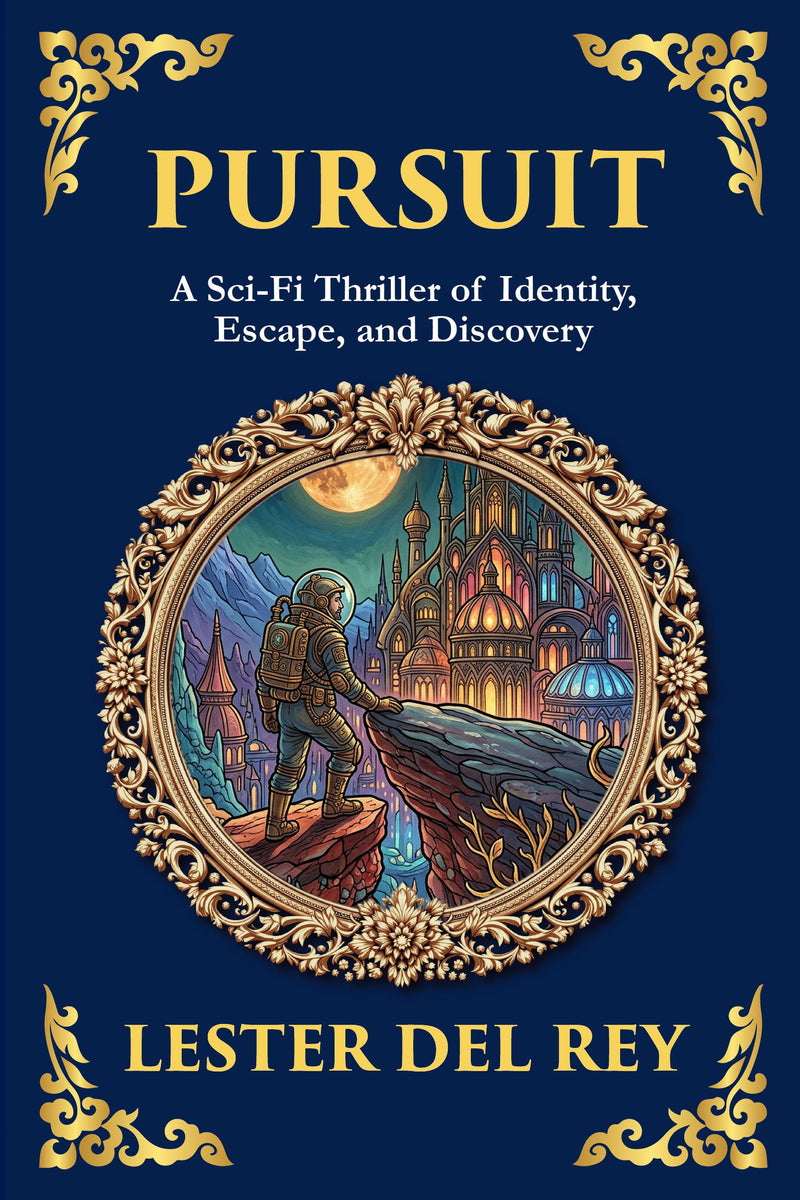
Pursuit
A man wakes up with no memory, no name, and no past—only a burning sense of danger. Something is chasing him. Something inhuman.
or free app
10,000+ hrs library
30-day guarantee
The complete Pursuit appears in modern English through Library of Alexandria Press, available online with audiobook narration included for members.
Have you ever wondered why the most dangerous enemy might be the truth about yourself? In Pursuit, science fiction master Lester Del Rey plunges readers into a relentless chase across a distorted future—where one man’s search for his past could change the fate of humankind. He has no name.
No memory. Just the certainty that he’s being hunted. Armed only with instinct and fragments of knowledge he doesn’t remember learning, he runs.
The world around him is strange, almost wrong—technologically advanced yet subtly askew. Everyone he meets seems to be hiding something. And the forces chasing him aren't human… or are they?
As the man unravels the mystery of his identity, a chilling truth begins to emerge. He may not be who—or what—he thinks he is. And if he stops running, the consequences could be catastrophic.
A masterclass in speculative suspense, Pursuit blends the taut intensity of a psychological thriller with the intellectual intrigue of classic science fiction.
What you’ll discover in this modern edition
- A Race Against Time and Memory – Experience a high-stakes chase where every step uncovers a deeper layer of mystery.
- A Mind-Bending Exploration of Identity – Who are we when our past is stripped away?
| Formats | eBook (EPUB + PDF) · Audiobook · Paperback · Hardcover · Large Print |
| Language | English |
| Trim size (print) | 6 × 9 in |
| Binding | Paperback — perfect-bound · Hardcover — casewrap |
| Large Print edition | Same text in a larger, easy-read type — a larger font, not a larger trim |
| Print pricing | Every physical book at our true cost — at-cost, no profit (members) |
| Library | 873 restored titles, always growing |
| Length | 22,097 words · ~1 hr 28 min reading |
| Reading level | Grade 8 · an easy, flowing read (this modern-English edition) |
| Edition | Modern English translation · 2026 |
Member reviews for this edition are collected as readers finish it — be the first. Across the library: 12,000+ books shipped, every plan covered by a 365-day print guarantee.
About this edition
A faithful, unabridged modern-English edition by The Library of Alexandria — carefully rendered for today's reader and verified paragraph-by-paragraph against the public-domain source. Available as eBook, audiobook, paperback, hardcover, and large print.
- Complete & unabridgedVerified paragraph by paragraph against the source — never a scan, never abridged.
- Modern English, faithfulReadable today, with the author’s meaning kept intact. Readable — not simplified.
- Every format, one membershipRead in your browser or the free app, or listen to the full audiobook.
Included free with your membership
Cancel anytime, one click · 30-day money-back guarantee
Edition last updated July 2026
What’s inside
Pursuit — complete and unabridged: all 9 sections included with membership, plus the full audiobook.
Begin reading Pursuit
In clear modern English — the complete text is included with membership.
Introduction
There are certain stories that seem to vibrate at a frequency just slightly ahead of their time, written by authors who possessed an uncanny ability to feel where the future was heading before the rest of the world had caught up. Pursuit is one of those stories. Written by Lester Del Rey, one of the foundational figures of mid-twentieth-century American science fiction, this taut and propulsive tale of a man caught in a desperate flight from forces he cannot fully comprehend offers something rare in genre fiction: a story that grips you by the collar on its first page and refuses to let go, while simultaneously asking questions about memory, selfhood, and human agency that linger long after the final line. This modern translation, carefully adapted for the contemporary reader, has been prepared with a single goal in mind — to give you, the reader of today, the most immersive, frictionless, and rewarding encounter possible with a work that deserves to be read and rediscovered by a new generation.
To approach Pursuit properly, it helps to understand the peculiar magic of the man who wrote it and the era that shaped his sensibilities. Lester Del Rey was not merely a writer of science fiction; he was, in many respects, one of its principal architects, a figure whose influence on the field extended far beyond the words he himself put to paper. To read his fiction is to encounter a mind that took the human element seriously even as it played among the stars, the laboratories, and the shadowy corridors of conspiracy. Pursuit belongs to a particular strain of his work — the suspense-driven, character-anchored thriller in which the speculative elements serve not as cold spectacle but as a pressure cooker for the human soul. What happens to a person when the ground beneath their feet, the certainties they have lived by, the very contents of their own mind, can no longer be trusted? That is the question at the beating heart of this book, and it is a question that feels more urgent now, in our age of surveillance, data, and manufactured realities, than it perhaps ever did when the story was first conceived.
Lester Del Rey was born in 1915 in rural Minnesota, and his path to becoming one of science fiction’s most respected names was anything but predetermined. He came of age during the Great Depression, an experience that gave his fiction a grounded, working-class pragmatism that distinguished it from some of the more abstract or aristocratic strains of speculative writing in his time. Del Rey understood ordinary people — their fears, their stubbornness, their capacity for both panic and unexpected courage — and he wrote about them with a sympathy that never tipped into sentimentality. When he placed an everyman protagonist into an extraordinary situation, as he does so memorably in this story, the reader believes in that character because Del Rey believed in him first.
Del Rey rose to prominence during what historians of the field call the Golden Age of science fiction, that extraordinary period stretching roughly from the late 1930s through the 1950s when the genre matured from pulp adventure into a literature capable of genuine intellectual and emotional weight. He published his earliest stories in the pages of the legendary magazines that defined the era, rubbing shoulders — in print and in person — with the giants who would become household names among devotees of the form. But Del Rey was never content merely to be one voice among many. He became an editor, an anthologist, a critic, and ultimately, alongside his wife Judy-Lynn del Rey, the namesake of one of the most important publishing imprints in the history of the genre. The Del Rey imprint would go on to shape the commercial and creative landscape of science fiction and fantasy for decades, bringing countless beloved works to a mass audience. In other words, the man who wrote Pursuit was not merely a storyteller but a steward of the entire tradition, someone who understood from the inside out what made these stories tick and why readers returned to them again and again.
This dual identity — creator and curator — gives Del Rey’s own fiction a distinctive quality. He knew the conventions of the thriller and the science fiction tale so intimately that he could deploy them with surgical precision, knowing exactly when to satisfy the reader’s expectations and exactly when to subvert them. Pursuit showcases this mastery on every page. It is a book written by someone who understood pacing not as an abstract concept but as a craft to be honed, a tool to be wielded. The result is a narrative engine that hums with relentless forward momentum, even as it pauses, in carefully chosen moments, to let larger ideas breathe.
It is worth dwelling for a moment on the historical context that produced this story, because that context is woven into its very DNA. Del Rey wrote during the height of the Cold War, an era saturated with paranoia, with the fear of hidden enemies, with the dawning recognition that science could be a force not only of liberation but of control. The atomic age had arrived, bringing with it both the promise of limitless power and the specter of annihilation. Psychology and psychiatry were entering the popular imagination, raising unsettling questions about the malleability of the human mind. The state, in both its democratic and totalitarian forms, was expanding its reach into the private lives of citizens in ways that would have seemed unimaginable a generation earlier. All of these anxieties — the fear of being watched, the fear of being manipulated, the fear that one’s own thoughts might not be entirely one’s own — pulse through the pages of Pursuit. Del Rey took the diffuse dread of his historical moment and concentrated it into the experience of a single man on the run, and in doing so he created something that transcends its era. The technologies have changed; the anxieties have not. If anything, they have intensified.
What makes Del Rey’s treatment of these themes so enduring is his refusal to lecture. He is not a writer who pauses the action to deliver a philosophical seminar. Instead, he embeds his ideas within the lived, breathless experience of his protagonist. We do not contemplate the fragility of identity in the abstract; we feel it, viscerally, as the character himself does, when the foundations of his self-knowledge begin to crack. This is the great gift of the thriller form when it is handled by a master: it makes abstract fears concrete, immediate, and impossible to ignore. By the time you finish Pursuit, you will have been thinking about some of the deepest questions a human being can ask — questions about who we are, how we know what we know, and what remains of us when everything external is stripped away — but you will have arrived at those questions not through dry argument but through the sheer adrenaline of the chase.
A Story of Identity, Escape, and Discovery
The subtitle of this edition — A Sci-Fi Thriller of Identity, Escape, and Discovery — names the three pillars upon which the narrative rests, and it is worth considering each of them, because together they form a structure that gives the story both its propulsive surface and its profound depths.
Begin with identity. There is perhaps no more potent or unsettling theme in all of literature than the instability of the self. We tend to move through life assuming that we know who we are — that our memories are reliable, that our sense of our own history is accurate, that the person we believe ourselves to be is the person we actually are. Pursuit takes this comfortable assumption and detonates it. What if you woke up one day and could not trust the story your own mind was telling you? What if the gaps in your memory were not mere forgetfulness but the deliberate work of forces with agendas you could not begin to fathom? Del Rey explores this terrain with extraordinary psychological acuity. He understands that the loss of identity is not merely an intellectual puzzle but an existential terror — that to be uncertain of who you are is to be uncertain of everything. The protagonist’s journey is, at its deepest level, a journey toward self-knowledge, conducted under the most extreme conditions imaginable. Every step forward in the physical chase is mirrored by a step inward, toward a truth that may be more frightening than anything pursuing him from without.
This theme of fractured and contested identity resonates with peculiar force in our own moment. We live in an age of curated online personas, of algorithmically shaped perceptions, of deepfakes and manufactured narratives, of psychological profiling conducted by entities we will never see. The question Del Rey posed decades ago — can you trust your own mind, your own memories, your own sense of self when powerful interests have reason to manipulate them? — is no longer the stuff of speculative fiction. It is the texture of contemporary life. Reading Pursuit today, you may find yourself startled by how prescient Del Rey was, how clearly he saw the shape of dilemmas that would only fully emerge in the decades after he wrote. This is part of what makes the book such a rewarding experience for the modern reader: it speaks to us, directly and urgently, across the gulf of time.
Then there is escape. At the level of pure narrative mechanics, Pursuit is a chase story, and chase stories are among the oldest and most universally compelling forms of storytelling in existence. There is something elemental, almost primal, about the experience of flight — the racing heart, the constant calculation of risk, the desperate improvisation, the moments of relief that curdle instantly back into dread. Del Rey is a virtuoso of this mode. He understands that the power of a chase lies not merely in its physical incidents but in its psychological texture — in the protagonist’s mounting exhaustion, his fraying nerves, his constant uncertainty about whom he can trust and where he can turn. The escape in Pursuit is not a simple matter of outrunning a pursuer; it is a labyrinth of feints and reversals, of allies who may be enemies and enemies who may, in unexpected ways, hold the key to survival. The reader is swept along in the protagonist’s flight, sharing his confusion, his fear, and his flashes of desperate hope. Few writers have understood as well as Del Rey that the best thrillers are not about the destination but about the relentless, white-knuckle experience of the journey itself.
And finally, discovery — the third pillar, and in some ways the most important, because it is what elevates Pursuit above the level of mere entertainment. The chase is not an end in itself. It is a vehicle for revelation. As the protagonist flees, he is also, inexorably, moving toward understanding — toward the truth about his situation, about the forces arrayed against him, and ultimately about himself. Del Rey structures the narrative so that information is doled out with exquisite care, each new revelation reframing what came before, deepening the mystery even as it brings clarity. The pleasure of reading Pursuit is in large part the pleasure of discovery, of watching the pieces of a puzzle gradually assemble themselves into a picture that is both more coherent and more astonishing than you anticipated. And because Del Rey was a science fiction writer of genuine intellectual ambition, the discoveries at the heart of his story are not merely plot mechanics; they open onto larger vistas of speculation about science, society, and the possibilities — both wondrous and terrifying — that the future may hold.
I will say nothing here about the specific nature of those discoveries, for to do so would be to rob you of one of the great pleasures the book has to offer. Part of what makes Pursuit so satisfying is the way it withholds and reveals, the way it keeps you guessing, the way it rewards your attention with twists that feel both surprising and, in retrospect, inevitable. Suffice it to say that the journey on which Del Rey is about to take you is one that builds toward genuine revelation — the kind of ending that recontextualizes everything that has come before and sends you back into your own life seeing it just a little differently. This is the mark of science fiction at its best: it uses the fantastic to illuminate the real, and it leaves you changed.
Cancel anytime, one click · 30-day money-back guarantee
Founding annual rate available now — your price locks for life when you join.
Not ready? Get this free chapter by email — read it anytime.
✓ Sent — check your inbox for Pursuit.
Questions about Pursuit
What is Pursuit about?
A man wakes up with no memory, no name, and no past—only a burning sense of danger. Something is chasing him. Something inhuman.
Who wrote Pursuit?
Pursuit was written by Lester Del Rey. This edition presents the complete work in clear modern English, faithfully rendered from the public-domain original by Library of Alexandria Press.
Is Pursuit free to read?
The opening chapter is free to read on this page. Members read and listen to the complete work — and the entire library — free, and can order any physical book at our true print cost.
How long is Pursuit?
9 chapters (~22,097 words) — about 1 hr 28 min of reading in this modern-English edition.
Is this an abridged version of Pursuit?
No. This is the complete, unabridged Pursuit, carefully rendered into clear modern English and verified paragraph-by-paragraph against the public-domain source — nothing is cut or summarised.
What formats does Pursuit come in?
Pursuit is available as eBook, paperback, hardcover and large print. eBook and audiobook are included with membership; printed editions ship at our true print cost.
Shipping & returns
Billing & membership
More from the library


Explore Free eBooks
- Kant's Prolegomena to Any Future Metaphysics · Immanuel Kant
- The Advancement of Learning · Francis Bacon
- The Dawn of Day · Friedrich Nietzsche
- Peter and Wendy · J. M. Barrie
- Meditations · Marcus Aurelius
- The Confessions of St. Augustine · Saint Augustine of Hippo
- Resurrection · Leo Tolstoy
- Dialogues Concerning Natural Religion · David Hume
- As You Like It · William Shakespeare
- Jack and Jill · Louisa May Alcott
- Dream Psychology: Psychoanalysis for Beginners · Sigmund Freud
- The Raven · Edgar Allan Poe
- Considerations on Representative Government · John Stuart Mill
- The Will to Power: An Attempted Transvaluation of All Values. Book III and IV · Friedrich Nietzsche
- Tarzan of the Apes · Edgar Rice Burroughs
- Fundamental Principles of the Metaphysic of Morals · Immanuel Kant
- The Confessions of Jean Jacques Rousseau — Complete · Jean-Jacques Rousseau
- The Merchant of Venice · William Shakespeare
- Democracy in America — Volume 2 · Alexis de Tocqueville
- Ecce Homo · Friedrich Wilhelm Nietzsche
- Second Treatise of Government · John Locke
- The Wonderful Wizard of Oz · L. Frank Baum
- The Prince · Niccolò Machiavelli
- Anne of Green Gables · L. M. Montgomery
- De Profundis · Oscar Wilde
- Thus Spake Zarathustra: A Book for All and None · Friedrich Nietzsche
- Anna Karenina · Leo Tolstoy
- Great Expectations · Charles Dickens
- The Island of Doctor Moreau · H. G. Wells
- A Midsummer Night's Dream · William Shakespeare
Pursuit
Pursuit
A Sci-Fi Thriller of Identity, Escape, and Discovery
Lester Del Rey
Contents
- Introduction
- Chapter 1
- Chapter 2
- Part 3
- Part 4
- Chapter 5
- Chapter 6
- Part 7
- Part 8
Introduction
There are certain stories that seem to vibrate at a frequency just slightly ahead of their time, written by authors who possessed an uncanny ability to feel where the future was heading before the rest of the world had caught up. Pursuit is one of those stories. Written by Lester Del Rey, one of the foundational figures of mid-twentieth-century American science fiction, this taut and propulsive tale of a man caught in a desperate flight from forces he cannot fully comprehend offers something rare in genre fiction: a story that grips you by the collar on its first page and refuses to let go, while simultaneously asking questions about memory, selfhood, and human agency that linger long after the final line. This modern translation, carefully adapted for the contemporary reader, has been prepared with a single goal in mind — to give you, the reader of today, the most immersive, frictionless, and rewarding encounter possible with a work that deserves to be read and rediscovered by a new generation.
To approach Pursuit properly, it helps to understand the peculiar magic of the man who wrote it and the era that shaped his sensibilities. Lester Del Rey was not merely a writer of science fiction; he was, in many respects, one of its principal architects, a figure whose influence on the field extended far beyond the words he himself put to paper. To read his fiction is to encounter a mind that took the human element seriously even as it played among the stars, the laboratories, and the shadowy corridors of conspiracy. Pursuit belongs to a particular strain of his work — the suspense-driven, character-anchored thriller in which the speculative elements serve not as cold spectacle but as a pressure cooker for the human soul. What happens to a person when the ground beneath their feet, the certainties they have lived by, the very contents of their own mind, can no longer be trusted? That is the question at the beating heart of this book, and it is a question that feels more urgent now, in our age of surveillance, data, and manufactured realities, than it perhaps ever did when the story was first conceived.
Lester Del Rey was born in 1915 in rural Minnesota, and his path to becoming one of science fiction’s most respected names was anything but predetermined. He came of age during the Great Depression, an experience that gave his fiction a grounded, working-class pragmatism that distinguished it from some of the more abstract or aristocratic strains of speculative writing in his time. Del Rey understood ordinary people — their fears, their stubbornness, their capacity for both panic and unexpected courage — and he wrote about them with a sympathy that never tipped into sentimentality. When he placed an everyman protagonist into an extraordinary situation, as he does so memorably in this story, the reader believes in that character because Del Rey believed in him first.
Del Rey rose to prominence during what historians of the field call the Golden Age of science fiction, that extraordinary period stretching roughly from the late 1930s through the 1950s when the genre matured from pulp adventure into a literature capable of genuine intellectual and emotional weight. He published his earliest stories in the pages of the legendary magazines that defined the era, rubbing shoulders — in print and in person — with the giants who would become household names among devotees of the form. But Del Rey was never content merely to be one voice among many. He became an editor, an anthologist, a critic, and ultimately, alongside his wife Judy-Lynn del Rey, the namesake of one of the most important publishing imprints in the history of the genre. The Del Rey imprint would go on to shape the commercial and creative landscape of science fiction and fantasy for decades, bringing countless beloved works to a mass audience. In other words, the man who wrote Pursuit was not merely a storyteller but a steward of the entire tradition, someone who understood from the inside out what made these stories tick and why readers returned to them again and again.
This dual identity — creator and curator — gives Del Rey’s own fiction a distinctive quality. He knew the conventions of the thriller and the science fiction tale so intimately that he could deploy them with surgical precision, knowing exactly when to satisfy the reader’s expectations and exactly when to subvert them. Pursuit showcases this mastery on every page. It is a book written by someone who understood pacing not as an abstract concept but as a craft to be honed, a tool to be wielded. The result is a narrative engine that hums with relentless forward momentum, even as it pauses, in carefully chosen moments, to let larger ideas breathe.
It is worth dwelling for a moment on the historical context that produced this story, because that context is woven into its very DNA. Del Rey wrote during the height of the Cold War, an era saturated with paranoia, with the fear of hidden enemies, with the dawning recognition that science could be a force not only of liberation but of control. The atomic age had arrived, bringing with it both the promise of limitless power and the specter of annihilation. Psychology and psychiatry were entering the popular imagination, raising unsettling questions about the malleability of the human mind. The state, in both its democratic and totalitarian forms, was expanding its reach into the private lives of citizens in ways that would have seemed unimaginable a generation earlier. All of these anxieties — the fear of being watched, the fear of being manipulated, the fear that one’s own thoughts might not be entirely one’s own — pulse through the pages of Pursuit. Del Rey took the diffuse dread of his historical moment and concentrated it into the experience of a single man on the run, and in doing so he created something that transcends its era. The technologies have changed; the anxieties have not. If anything, they have intensified.
What makes Del Rey’s treatment of these themes so enduring is his refusal to lecture. He is not a writer who pauses the action to deliver a philosophical seminar. Instead, he embeds his ideas within the lived, breathless experience of his protagonist. We do not contemplate the fragility of identity in the abstract; we feel it, viscerally, as the character himself does, when the foundations of his self-knowledge begin to crack. This is the great gift of the thriller form when it is handled by a master: it makes abstract fears concrete, immediate, and impossible to ignore. By the time you finish Pursuit, you will have been thinking about some of the deepest questions a human being can ask — questions about who we are, how we know what we know, and what remains of us when everything external is stripped away — but you will have arrived at those questions not through dry argument but through the sheer adrenaline of the chase.
A Story of Identity, Escape, and Discovery
The subtitle of this edition — A Sci-Fi Thriller of Identity, Escape, and Discovery — names the three pillars upon which the narrative rests, and it is worth considering each of them, because together they form a structure that gives the story both its propulsive surface and its profound depths.
Begin with identity. There is perhaps no more potent or unsettling theme in all of literature than the instability of the self. We tend to move through life assuming that we know who we are — that our memories are reliable, that our sense of our own history is accurate, that the person we believe ourselves to be is the person we actually are. Pursuit takes this comfortable assumption and detonates it. What if you woke up one day and could not trust the story your own mind was telling you? What if the gaps in your memory were not mere forgetfulness but the deliberate work of forces with agendas you could not begin to fathom? Del Rey explores this terrain with extraordinary psychological acuity. He understands that the loss of identity is not merely an intellectual puzzle but an existential terror — that to be uncertain of who you are is to be uncertain of everything. The protagonist’s journey is, at its deepest level, a journey toward self-knowledge, conducted under the most extreme conditions imaginable. Every step forward in the physical chase is mirrored by a step inward, toward a truth that may be more frightening than anything pursuing him from without.
This theme of fractured and contested identity resonates with peculiar force in our own moment. We live in an age of curated online personas, of algorithmically shaped perceptions, of deepfakes and manufactured narratives, of psychological profiling conducted by entities we will never see. The question Del Rey posed decades ago — can you trust your own mind, your own memories, your own sense of self when powerful interests have reason to manipulate them? — is no longer the stuff of speculative fiction. It is the texture of contemporary life. Reading Pursuit today, you may find yourself startled by how prescient Del Rey was, how clearly he saw the shape of dilemmas that would only fully emerge in the decades after he wrote. This is part of what makes the book such a rewarding experience for the modern reader: it speaks to us, directly and urgently, across the gulf of time.
Then there is escape. At the level of pure narrative mechanics, Pursuit is a chase story, and chase stories are among the oldest and most universally compelling forms of storytelling in existence. There is something elemental, almost primal, about the experience of flight — the racing heart, the constant calculation of risk, the desperate improvisation, the moments of relief that curdle instantly back into dread. Del Rey is a virtuoso of this mode. He understands that the power of a chase lies not merely in its physical incidents but in its psychological texture — in the protagonist’s mounting exhaustion, his fraying nerves, his constant uncertainty about whom he can trust and where he can turn. The escape in Pursuit is not a simple matter of outrunning a pursuer; it is a labyrinth of feints and reversals, of allies who may be enemies and enemies who may, in unexpected ways, hold the key to survival. The reader is swept along in the protagonist’s flight, sharing his confusion, his fear, and his flashes of desperate hope. Few writers have understood as well as Del Rey that the best thrillers are not about the destination but about the relentless, white-knuckle experience of the journey itself.
And finally, discovery — the third pillar, and in some ways the most important, because it is what elevates Pursuit above the level of mere entertainment. The chase is not an end in itself. It is a vehicle for revelation. As the protagonist flees, he is also, inexorably, moving toward understanding — toward the truth about his situation, about the forces arrayed against him, and ultimately about himself. Del Rey structures the narrative so that information is doled out with exquisite care, each new revelation reframing what came before, deepening the mystery even as it brings clarity. The pleasure of reading Pursuit is in large part the pleasure of discovery, of watching the pieces of a puzzle gradually assemble themselves into a picture that is both more coherent and more astonishing than you anticipated. And because Del Rey was a science fiction writer of genuine intellectual ambition, the discoveries at the heart of his story are not merely plot mechanics; they open onto larger vistas of speculation about science, society, and the possibilities — both wondrous and terrifying — that the future may hold.
I will say nothing here about the specific nature of those discoveries, for to do so would be to rob you of one of the great pleasures the book has to offer. Part of what makes Pursuit so satisfying is the way it withholds and reveals, the way it keeps you guessing, the way it rewards your attention with twists that feel both surprising and, in retrospect, inevitable. Suffice it to say that the journey on which Del Rey is about to take you is one that builds toward genuine revelation — the kind of ending that recontextualizes everything that has come before and sends you back into your own life seeing it just a little differently. This is the mark of science fiction at its best: it uses the fantastic to illuminate the real, and it leaves you changed.
Terror sliced through Wilbur Hawkes’s subconscious. It felt almost physically violent, tightening his throat and stabbing at his heart. It pierced his numb brain, screaming at him.
He felt like a fragile egg trapped inside a giant sphere of thick gel. Two menacing creatures swam through the resisting gel toward him. The substance fought against them, but they kept coming. One got close and made a mysterious gesture. He screamed at the creature, and the gel grew stronger, pushing them far away. Suddenly, the creatures retreated. A door opened, and they vanished. But he couldn’t let them escape. If they got away...
Hawkes bolted upright in bed with a hoarse cry, and the sound of his own voice fully woke him up. He opened his eyes to a dim darkness, barely lit by a small night-light. For a moment, the nightmare felt so real that he thought he saw two shadows beyond the door, rushing down the stairs. He fought the illusion and strained his senses, glancing quickly around the room. There was nothing there.
Sweat beaded on his forehead, and he could feel his heart racing. He had to get out—he had to leave—right now!
He pushed the thought aside. His mind felt foggy, but he forced himself to be rational and push away the heavy sense of dread. Automatically, his fingers found a cigarette and lit it. The first familiar breath of smoke helped calm him. He took another deep drag, and the small sounds in the room began to register. He heard the steady ticking of a clock and the soft whirring of a tape recorder. He stared at the machine, which was fast-rewinding, and switched it to play. However, the tape seemed to be blank or erased.
End of the free sample
Keep reading, free
Members read and listen to the complete book — and the entire library. Cancel anytime, one click · 30-day money-back guarantee.