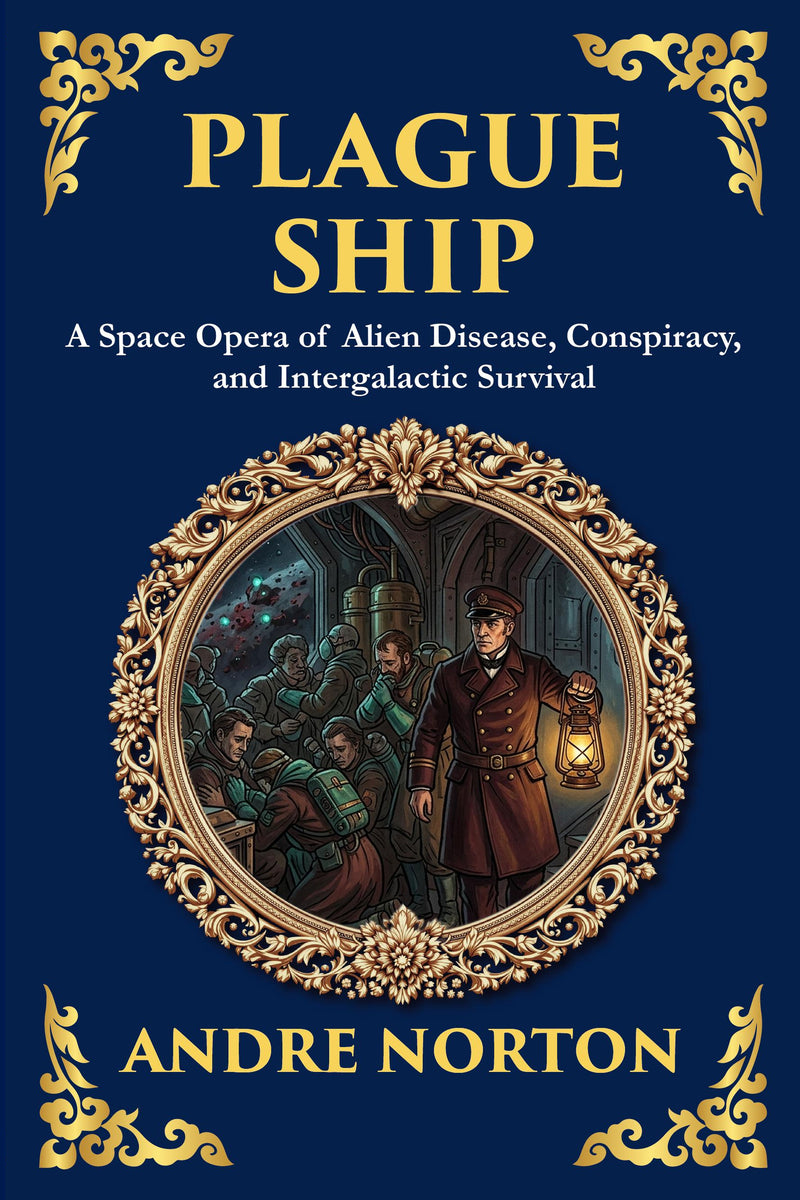
Plague Ship
The crew of the Solar Queen thought they were on a routine trade mission. What they found was a deadly contagion, a sinister conspiracy, and an intergalactic manhunt.
or free app
10,000+ hrs library
30-day guarantee
The complete Plague Ship appears in modern English through Library of Alexandria Press, available online with audiobook narration included for members.
Have you ever wondered why the most terrifying enemies are the ones no one believes exist? In Plague Ship, legendary science fiction author Andre Norton catapults readers into a thrilling interstellar saga of danger, betrayal, and survival. When the crew of the Solar Queen, a Free Trader starship, lands a rare trade contract on an uncharted planet, they think they've struck gold.
But when an unexplained illness begins to spread among them—and later, across their customers—they're immediately branded a threat to all inhabited worlds. Now labeled a carrier of plague and hunted by interstellar authorities, the crew must evade capture, survive quarantine, and uncover the truth behind the mysterious outbreak. With no one left to trust, they plunge into a web of deceit, corporate espionage, and alien secrets that threaten not only their lives, but the stability of the entire sector.
Blending space exploration with a noir-style conspiracy thriller, Plague Ship is a masterwork of classic sci-fi. This edition brings Norton’s gripping narrative to modern readers in a clean, accessible format that preserves the intensity and imagination of the original.
What you’ll discover in this modern edition
- A Gripping Tale of Interstellar Suspicion and Escape – Follow the Solar Queen on a high-stakes run across hostile star systems.
- Themes of Survival, Loyalty, and Truth – Explore what happens when law turns against the innocent.
- Alien Worlds and Cosmic Mystery – Venture into new frontiers with richly imagined cultures and strange dangers.
- A Story That Still Resonates Today – A prescient exploration of isolation, misinformation, and courage in crisis.
| Formats | eBook (EPUB + PDF) · Audiobook · Paperback · Hardcover · Large Print |
| Language | English |
| Trim size (print) | 6 × 9 in |
| Binding | Paperback — perfect-bound · Hardcover — casewrap |
| Large Print edition | Same text in a larger, easy-read type — a larger font, not a larger trim |
| Print pricing | Every physical book at our true cost — at-cost, no profit (members) |
| Library | 873 restored titles, always growing |
| Length | 58,927 words · ~3 hr 56 min reading |
| Reading level | Grade 8 · an easy, flowing read (this modern-English edition) |
| Edition | Modern English translation · 2026 |
Member reviews for this edition are collected as readers finish it — be the first. Across the library: 12,000+ books shipped, every plan covered by a 365-day print guarantee.
About this edition
A faithful, unabridged modern-English edition by The Library of Alexandria — carefully rendered for today's reader and verified paragraph-by-paragraph against the public-domain source. Available as eBook, audiobook, paperback, hardcover, and large print.
- Complete & unabridgedVerified paragraph by paragraph against the source — never a scan, never abridged.
- Modern English, faithfulReadable today, with the author’s meaning kept intact. Readable — not simplified.
- Every format, one membershipRead in your browser or the free app, or listen to the full audiobook.
Included free with your membership
Cancel anytime, one click · 30-day money-back guarantee
Edition last updated July 2026
What’s inside
Plague Ship — complete and unabridged: all 19 sections included with membership, plus the full audiobook.
Begin reading Plague Ship
In clear modern English — the complete text is included with membership.
Introduction
There is a particular thrill that comes from opening a book and feeling the deck of a starship shift beneath your feet. The hum of engines, the recycled air, the cramped corridors that smell faintly of machine oil and ozone—these are not the trappings of grand empires or gleaming utopias, but of working people who happen to make their living among the stars. This is the world you are about to enter, and it is one of the most beloved and enduring corners of twentieth-century science fiction. Written by an author who helped define what space adventure could be, this novel offers a journey that is at once breathless and intimate, vast in its scope yet grounded in the lives of a small crew of traders who simply want to survive long enough to see the next port.
The book you hold is part of a long tradition of stories about the men and women who travel the spaceways not as soldiers or scientists or kings, but as merchants—the free traders who scrape by on the margins of a galactic economy, taking risks that the great combines and corporations would never dream of touching. It is a story of suspicion and danger, of a vessel that becomes a sealed world unto itself, of loyalty tested under impossible pressure, and of the kind of courage that comes not from heroism but from sheer stubborn refusal to lie down and die. Before you begin, it is worth taking a moment to consider the remarkable author who created this world, the literary lineage from which this tale springs, and the qualities that have kept readers returning to it across the decades.
The name Andre Norton is one that generations of readers have spoken with affection, and yet many who first encounter her work are surprised to learn the story behind the name itself. Born Alice Mary Norton in Cleveland, Ohio, in 1912, she would go on to become one of the most prolific and influential writers of speculative fiction in the English language. In an era when the science fiction and fantasy fields were overwhelmingly dominated by men, and when editors and publishers harbored deep assumptions about what kinds of stories women could or should write, she made the practical decision to adopt a gender-neutral pen name. In 1934 she legally changed her name to Andre Alice Norton, ensuring that her byline would carry the authority and marketability that the publishing world of the time reserved for male authors. It was a decision born of pragmatism, but it became, over time, a name that stood for excellence, imagination, and an almost inexhaustible inventiveness.
Her path to becoming a full-time novelist was neither swift nor easy. For many years she worked as a librarian, a profession that suited her deep love of books and that gave her access to an enormous breadth of reading. She spent nearly two decades in the Cleveland Public Library system, and the influence of that work is visible throughout her fiction. Her stories are dense with the texture of researched detail—the customs of invented cultures, the histories of distant worlds, the workings of trade and law and ritual. She approached the building of imaginary societies with the meticulous care of a scholar, and yet she never let that scholarship weigh down the propulsive momentum of her plots. She understood, perhaps better than almost any of her contemporaries, that a reader wants to be carried forward, and that the richest world-building means nothing if the reader is not first hooked by the simple, urgent question of what happens next.
Over the course of a career that spanned more than seventy years, Norton produced an astonishing body of work. She wrote well over a hundred novels and numerous short stories, ranging across science fiction, fantasy, historical adventure, and even gothic romance. She created sprawling, interconnected universes that captivated readers and inspired countless imitators. Her Witch World series, begun in the 1960s, helped pioneer the blending of science fiction and fantasy into a seamless whole and became one of the most beloved fantasy sequences of its time. Her science fiction, meanwhile, was marked by a distinctive flavor: less concerned with the hard physics of space travel than with the human and alien drama of frontier life, with the moral choices of individuals caught in larger systems, and with the abiding theme of the outsider who must find a place in a world that does not welcome them.
That theme of the outsider runs like a bright thread through nearly everything Norton wrote, and it is no accident. She had a profound sympathy for the marginalized, the orphaned, the displaced, and the underestimated. Her protagonists are frequently young people without family or fortune, thrust into situations far larger than themselves, forced to rely on their wits, their integrity, and the bonds of comradeship they manage to forge along the way. This sensibility gave her work an emotional warmth that distinguished it from the colder, more cerebral strain of science fiction that flourished in the same period. Readers did not merely admire her characters; they cared about them, rooted for them, and felt the weight of their dangers and the relief of their triumphs.
Norton’s influence on the field can hardly be overstated. She was among the first women to gain real prominence in science fiction, and she opened doors for the many who followed. She was named a Grand Master by the Science Fiction Writers of America—the first woman to receive that highest honor. She was inducted into the Science Fiction Hall of Fame. The Andre Norton Award, established to recognize outstanding works of science fiction and fantasy written for young adults, bears her name as a permanent tribute to her contributions. Writers as varied and celebrated as Mercedes Lackey, C. J. Cherryh, and David Drake have acknowledged their debt to her, and countless readers who went on to become authors themselves first caught the spark of wonder from one of her books. She remained productive almost until her death in 2005, collaborating with younger writers and continuing to expand the worlds she had spent a lifetime imagining.
What makes her achievement all the more remarkable is the consistency of her vision across so many decades and so many volumes. She wrote during the so-called Golden Age of science fiction and continued writing through the New Wave, the cyberpunk era, and beyond, yet she never abandoned the core values that animated her earliest work: a belief in the dignity of ordinary people, a fascination with the unknown, a respect for the natural world and for the bonds between humans and animals, and an unwavering moral seriousness that never tipped into preachiness. To read Andre Norton is to be in the company of a storyteller who genuinely believed that adventure could be a vehicle for meaning, and who never condescended to her audience, whether that audience was young or old.
The World of the Free Traders and the Pull of the Spaceways
To fully appreciate the novel before you, it helps to understand the particular subgenre and setting in which it unfolds. This book belongs to one of Norton’s most cherished creations: a loosely connected universe of stories centered on the free traders, independent merchant crews who ply the routes between the stars in aging, hard-used vessels. These are not the heroes of military space opera, with their fleets and their medals and their grand strategic battles. Nor are they the cool, detached scientists of more clinical science fiction. They are working men—and the ethos of the working ship pervades every page. They take cargoes that the big combines disdain, gamble their meager profits on long-shot ventures, and live always on the knife’s edge between solvency and ruin.
This setting was, in its way, a quietly radical choice. Much of the science fiction of the mid-twentieth century was preoccupied with empire and conquest, with the projection of human power across the cosmos, with the establishment of order through force and authority. Norton’s free traders represent something different and far more humane. They are the small operators, the independents, the ones who survive not through dominance but through adaptability, cleverness, and an unshakable code of fairness and loyalty. Their world is one of competition rather than conquest, of negotiation rather than warfare, of the careful weighing of risk against reward. There is something deeply appealing in this vision—a frontier not of soldiers but of entrepreneurs, a galaxy explored not by armies but by curious, scrappy, resourceful individuals trying to make an honest living.
The trader’s life as Norton imagines it is one of constant tension between freedom and precariousness. To own a ship and choose one’s own routes is the ultimate liberty, but that liberty comes at a terrible price: there is no safety net, no powerful institution to fall back on, no guarantee that the next venture will not be the last. This precariousness is the engine of dramatic tension throughout the free trader stories. When something goes wrong—when a deal sours, when a planet proves more dangerous than expected, when the crew finds itself accused, hunted, or trapped—there is no cavalry coming over the hill. The traders must rely on themselves and on one another, and it is in these moments of extremity that Norton’s storytelling truly comes alive.
The young protagonist who anchors these stories is one of Norton’s most enduring creations. He is the very embodiment of the outsider theme that runs through all her work: a young man without family or fortune, trained for a profession but uncertain of his place, who must prove himself among a crew of older, more experienced spacers. His apprenticeship is not merely a matter of learning the technical skills of the trade; it is a moral education, a process of discovering what he is made of when tested by danger and injustice. Through his eyes, the reader experiences the wonder and terror of the spaceways anew, never quite at home, always observing, always learning. It is a brilliant narrative strategy, because the protagonist’s outsider status mirrors our own as readers encountering this strange and vivid universe for the first time.
There is also, woven through these stories, a genuine sense of the alien. Norton had a gift for imagining encounters with the truly other—not merely humans in costume, but beings, cultures, and phenomena that operate by logics foreign to our own. Her aliens are not always hostile, and they are rarely simple. Some are partners, some are mysteries, some are dangers, and the challenge for her human characters is always to read the situation correctly, to distinguish the trustworthy from the treacherous, to navigate a galaxy in which the unknown vastly outweighs the known. This sense of the alien gives her science fiction a particular charge of mystery and unease, and it elevates the trader stories above mere adventure into something closer to a meditation on contact, communication, and the limits of understanding.
The setting of a starship itself deserves special mention, because it is so central to the experience of reading this book. A trading vessel in deep space is a sealed environment, a tiny bubble of life and air suspended in an infinity of hostile vacuum. Everyone aboard is dependent on the ship’s systems and on one another for survival. There is nowhere to run, nowhere to hide, no escape from the consequences of a single mistake. This claustrophobic intensity makes the starship one of the great pressure cookers of dramatic fiction—a place where danger becomes inescapable and where the true character of every person aboard is inevitably revealed. When trouble strikes a ship in deep space, the crew cannot simply walk away. They must face it together, in close quarters, with no margin for error. Few settings in all of fiction are better suited to generating sustained, almost unbearable tension, and Norton wields this advantage with masterful skill.
This particular novel takes that intensity and concentrates it further still. As the subtitle suggests, the crew must contend not only with the ordinary perils of the trade and the machinations of those who would do them harm, but with a threat that turns their own vessel against them, that makes the very air they breathe a source of dread, and that places them at the mercy of forces and authorities far larger than themselves. It is a scenario that combines the survival-against-the-odds drama of the best adventure fiction with the paranoid claustrophobia of the finest suspense, all set against the limitless backdrop of an indifferent universe. The result is a story that grips from its opening pages and refuses to let go.
Cancel anytime, one click · 30-day money-back guarantee
Founding annual rate available now — your price locks for life when you join.
Not ready? Get this free chapter by email — read it anytime.
✓ Sent — check your inbox for Plague Ship.
Questions about Plague Ship
What is Plague Ship about?
The crew of the Solar Queen thought they were on a routine trade mission. What they found was a deadly contagion, a sinister conspiracy, and an intergalactic manhunt. Labeled a plague ship, the once-proud merchant vessel is forced into isolation, hunted across space and desperate to prove their innocence.
Who wrote Plague Ship?
Plague Ship was written by Andre Norton. This edition presents the complete work in clear modern English, faithfully rendered from the public-domain original by Library of Alexandria Press.
Is Plague Ship free to read?
The opening chapter is free to read on this page. Members read and listen to the complete work — and the entire library — free, and can order any physical book at our true print cost.
How long is Plague Ship?
19 chapters (~58,927 words) — about 3 hr 56 min of reading in this modern-English edition.
Is this an abridged version of Plague Ship?
No. This is the complete, unabridged Plague Ship, carefully rendered into clear modern English and verified paragraph-by-paragraph against the public-domain source — nothing is cut or summarised.
What formats does Plague Ship come in?
Plague Ship is available as eBook, paperback, hardcover and large print. eBook and audiobook are included with membership; printed editions ship at our true print cost.
Shipping & returns
Billing & membership
More from the library


Explore Free eBooks
- Kant's Prolegomena to Any Future Metaphysics · Immanuel Kant
- The Advancement of Learning · Francis Bacon
- The Dawn of Day · Friedrich Nietzsche
- Peter and Wendy · J. M. Barrie
- Meditations · Marcus Aurelius
- The Confessions of St. Augustine · Saint Augustine of Hippo
- Resurrection · Leo Tolstoy
- Dialogues Concerning Natural Religion · David Hume
- As You Like It · William Shakespeare
- Jack and Jill · Louisa May Alcott
- Dream Psychology: Psychoanalysis for Beginners · Sigmund Freud
- The Raven · Edgar Allan Poe
- Considerations on Representative Government · John Stuart Mill
- The Will to Power: An Attempted Transvaluation of All Values. Book III and IV · Friedrich Nietzsche
- Tarzan of the Apes · Edgar Rice Burroughs
- Fundamental Principles of the Metaphysic of Morals · Immanuel Kant
- The Confessions of Jean Jacques Rousseau — Complete · Jean-Jacques Rousseau
- The Merchant of Venice · William Shakespeare
- Democracy in America — Volume 2 · Alexis de Tocqueville
- Ecce Homo · Friedrich Wilhelm Nietzsche
- Second Treatise of Government · John Locke
- The Wonderful Wizard of Oz · L. Frank Baum
- The Prince · Niccolò Machiavelli
- Anne of Green Gables · L. M. Montgomery
- De Profundis · Oscar Wilde
- Thus Spake Zarathustra: A Book for All and None · Friedrich Nietzsche
- Anna Karenina · Leo Tolstoy
- Great Expectations · Charles Dickens
- The Island of Doctor Moreau · H. G. Wells
- A Midsummer Night's Dream · William Shakespeare
Plague Ship
Plague Ship
A Space Opera of Alien Disease, Conspiracy, and Intergalactic Survival
Andre Norton
Contents
- Introduction
- Chapter 1
- Chapter 2
- Chapter 3
- Chapter 4
- Chapter 5
- Chapter 6
- Chapter 7
- Chapter 8
- Chapter 9
- Chapter 10
- Chapter 11
- Chapter 12
- Chapter 13
- Chapter 14
- Chapter 15
- Chapter 16
- Chapter 17
- Chapter 18
Introduction
There is a particular thrill that comes from opening a book and feeling the deck of a starship shift beneath your feet. The hum of engines, the recycled air, the cramped corridors that smell faintly of machine oil and ozone—these are not the trappings of grand empires or gleaming utopias, but of working people who happen to make their living among the stars. This is the world you are about to enter, and it is one of the most beloved and enduring corners of twentieth-century science fiction. Written by an author who helped define what space adventure could be, this novel offers a journey that is at once breathless and intimate, vast in its scope yet grounded in the lives of a small crew of traders who simply want to survive long enough to see the next port.
The book you hold is part of a long tradition of stories about the men and women who travel the spaceways not as soldiers or scientists or kings, but as merchants—the free traders who scrape by on the margins of a galactic economy, taking risks that the great combines and corporations would never dream of touching. It is a story of suspicion and danger, of a vessel that becomes a sealed world unto itself, of loyalty tested under impossible pressure, and of the kind of courage that comes not from heroism but from sheer stubborn refusal to lie down and die. Before you begin, it is worth taking a moment to consider the remarkable author who created this world, the literary lineage from which this tale springs, and the qualities that have kept readers returning to it across the decades.
The name Andre Norton is one that generations of readers have spoken with affection, and yet many who first encounter her work are surprised to learn the story behind the name itself. Born Alice Mary Norton in Cleveland, Ohio, in 1912, she would go on to become one of the most prolific and influential writers of speculative fiction in the English language. In an era when the science fiction and fantasy fields were overwhelmingly dominated by men, and when editors and publishers harbored deep assumptions about what kinds of stories women could or should write, she made the practical decision to adopt a gender-neutral pen name. In 1934 she legally changed her name to Andre Alice Norton, ensuring that her byline would carry the authority and marketability that the publishing world of the time reserved for male authors. It was a decision born of pragmatism, but it became, over time, a name that stood for excellence, imagination, and an almost inexhaustible inventiveness.
Her path to becoming a full-time novelist was neither swift nor easy. For many years she worked as a librarian, a profession that suited her deep love of books and that gave her access to an enormous breadth of reading. She spent nearly two decades in the Cleveland Public Library system, and the influence of that work is visible throughout her fiction. Her stories are dense with the texture of researched detail—the customs of invented cultures, the histories of distant worlds, the workings of trade and law and ritual. She approached the building of imaginary societies with the meticulous care of a scholar, and yet she never let that scholarship weigh down the propulsive momentum of her plots. She understood, perhaps better than almost any of her contemporaries, that a reader wants to be carried forward, and that the richest world-building means nothing if the reader is not first hooked by the simple, urgent question of what happens next.
Over the course of a career that spanned more than seventy years, Norton produced an astonishing body of work. She wrote well over a hundred novels and numerous short stories, ranging across science fiction, fantasy, historical adventure, and even gothic romance. She created sprawling, interconnected universes that captivated readers and inspired countless imitators. Her Witch World series, begun in the 1960s, helped pioneer the blending of science fiction and fantasy into a seamless whole and became one of the most beloved fantasy sequences of its time. Her science fiction, meanwhile, was marked by a distinctive flavor: less concerned with the hard physics of space travel than with the human and alien drama of frontier life, with the moral choices of individuals caught in larger systems, and with the abiding theme of the outsider who must find a place in a world that does not welcome them.
That theme of the outsider runs like a bright thread through nearly everything Norton wrote, and it is no accident. She had a profound sympathy for the marginalized, the orphaned, the displaced, and the underestimated. Her protagonists are frequently young people without family or fortune, thrust into situations far larger than themselves, forced to rely on their wits, their integrity, and the bonds of comradeship they manage to forge along the way. This sensibility gave her work an emotional warmth that distinguished it from the colder, more cerebral strain of science fiction that flourished in the same period. Readers did not merely admire her characters; they cared about them, rooted for them, and felt the weight of their dangers and the relief of their triumphs.
Norton’s influence on the field can hardly be overstated. She was among the first women to gain real prominence in science fiction, and she opened doors for the many who followed. She was named a Grand Master by the Science Fiction Writers of America—the first woman to receive that highest honor. She was inducted into the Science Fiction Hall of Fame. The Andre Norton Award, established to recognize outstanding works of science fiction and fantasy written for young adults, bears her name as a permanent tribute to her contributions. Writers as varied and celebrated as Mercedes Lackey, C. J. Cherryh, and David Drake have acknowledged their debt to her, and countless readers who went on to become authors themselves first caught the spark of wonder from one of her books. She remained productive almost until her death in 2005, collaborating with younger writers and continuing to expand the worlds she had spent a lifetime imagining.
What makes her achievement all the more remarkable is the consistency of her vision across so many decades and so many volumes. She wrote during the so-called Golden Age of science fiction and continued writing through the New Wave, the cyberpunk era, and beyond, yet she never abandoned the core values that animated her earliest work: a belief in the dignity of ordinary people, a fascination with the unknown, a respect for the natural world and for the bonds between humans and animals, and an unwavering moral seriousness that never tipped into preachiness. To read Andre Norton is to be in the company of a storyteller who genuinely believed that adventure could be a vehicle for meaning, and who never condescended to her audience, whether that audience was young or old.
The World of the Free Traders and the Pull of the Spaceways
To fully appreciate the novel before you, it helps to understand the particular subgenre and setting in which it unfolds. This book belongs to one of Norton’s most cherished creations: a loosely connected universe of stories centered on the free traders, independent merchant crews who ply the routes between the stars in aging, hard-used vessels. These are not the heroes of military space opera, with their fleets and their medals and their grand strategic battles. Nor are they the cool, detached scientists of more clinical science fiction. They are working men—and the ethos of the working ship pervades every page. They take cargoes that the big combines disdain, gamble their meager profits on long-shot ventures, and live always on the knife’s edge between solvency and ruin.
This setting was, in its way, a quietly radical choice. Much of the science fiction of the mid-twentieth century was preoccupied with empire and conquest, with the projection of human power across the cosmos, with the establishment of order through force and authority. Norton’s free traders represent something different and far more humane. They are the small operators, the independents, the ones who survive not through dominance but through adaptability, cleverness, and an unshakable code of fairness and loyalty. Their world is one of competition rather than conquest, of negotiation rather than warfare, of the careful weighing of risk against reward. There is something deeply appealing in this vision—a frontier not of soldiers but of entrepreneurs, a galaxy explored not by armies but by curious, scrappy, resourceful individuals trying to make an honest living.
The trader’s life as Norton imagines it is one of constant tension between freedom and precariousness. To own a ship and choose one’s own routes is the ultimate liberty, but that liberty comes at a terrible price: there is no safety net, no powerful institution to fall back on, no guarantee that the next venture will not be the last. This precariousness is the engine of dramatic tension throughout the free trader stories. When something goes wrong—when a deal sours, when a planet proves more dangerous than expected, when the crew finds itself accused, hunted, or trapped—there is no cavalry coming over the hill. The traders must rely on themselves and on one another, and it is in these moments of extremity that Norton’s storytelling truly comes alive.
The young protagonist who anchors these stories is one of Norton’s most enduring creations. He is the very embodiment of the outsider theme that runs through all her work: a young man without family or fortune, trained for a profession but uncertain of his place, who must prove himself among a crew of older, more experienced spacers. His apprenticeship is not merely a matter of learning the technical skills of the trade; it is a moral education, a process of discovering what he is made of when tested by danger and injustice. Through his eyes, the reader experiences the wonder and terror of the spaceways anew, never quite at home, always observing, always learning. It is a brilliant narrative strategy, because the protagonist’s outsider status mirrors our own as readers encountering this strange and vivid universe for the first time.
There is also, woven through these stories, a genuine sense of the alien. Norton had a gift for imagining encounters with the truly other—not merely humans in costume, but beings, cultures, and phenomena that operate by logics foreign to our own. Her aliens are not always hostile, and they are rarely simple. Some are partners, some are mysteries, some are dangers, and the challenge for her human characters is always to read the situation correctly, to distinguish the trustworthy from the treacherous, to navigate a galaxy in which the unknown vastly outweighs the known. This sense of the alien gives her science fiction a particular charge of mystery and unease, and it elevates the trader stories above mere adventure into something closer to a meditation on contact, communication, and the limits of understanding.
The setting of a starship itself deserves special mention, because it is so central to the experience of reading this book. A trading vessel in deep space is a sealed environment, a tiny bubble of life and air suspended in an infinity of hostile vacuum. Everyone aboard is dependent on the ship’s systems and on one another for survival. There is nowhere to run, nowhere to hide, no escape from the consequences of a single mistake. This claustrophobic intensity makes the starship one of the great pressure cookers of dramatic fiction—a place where danger becomes inescapable and where the true character of every person aboard is inevitably revealed. When trouble strikes a ship in deep space, the crew cannot simply walk away. They must face it together, in close quarters, with no margin for error. Few settings in all of fiction are better suited to generating sustained, almost unbearable tension, and Norton wields this advantage with masterful skill.
This particular novel takes that intensity and concentrates it further still. As the subtitle suggests, the crew must contend not only with the ordinary perils of the trade and the machinations of those who would do them harm, but with a threat that turns their own vessel against them, that makes the very air they breathe a source of dread, and that places them at the mercy of forces and authorities far larger than themselves. It is a scenario that combines the survival-against-the-odds drama of the best adventure fiction with the paranoid claustrophobia of the finest suspense, all set against the limitless backdrop of an indifferent universe. The result is a story that grips from its opening pages and refuses to let go.
Dane Thorson, a cargo-master apprentice on the Solar Queen—a Terra-registered Galactic Free Trader—stood in the middle of the ship’s cramped washroom. Rip Shannon, an assistant astrogator and Dane’s senior in the Trade Service by about four years, was rubbing thick globs of highly scented paste into the skin between Dane’s prominent shoulder blades. The small room smelled strongly of spices, and Rip sniffed the air with approval.
“You’re definitely going to be the best-smelling human to ever step foot on Sargol,” Rip said, his soft voice ending in a rich chuckle.
Dane snorted and tried to look over his shoulder to see how it was going.
“The things we do for Trade!” Dane said, sounding a bit embarrassed. “Make sure you get it all in—this stuff is supposed to last for hours. It better. According to Van, those Salariki can talk your ear off without saying anything useful. And we have to sit there and listen until we get a straight answer. Phew!” He shook his head. In such a small space, the scent was pleasant but overwhelming. “Of all the worlds we could have picked—“
Rip stopped rubbing. “Dane,” he warned, “don’t start complaining about this job. It’s an easy gig, and we’re going to make a killing—if it works out.”
But Dane remained pessimistic about the immediate future. “If,” he repeated. “This whole Sargol deal is full of ‘ifs.’ It’s easy for you to relax—you’re not the one who has to smell like a spice factory just to get the time of day from the locals!”
Rip put down the jar of cream. “Different worlds, different customs,” he said, quoting the old Service motto. “Be glad this one is so easy to adapt to. I can think of some that are much worse.” He finished the massage with a sharp slap. “You’re all greased up. It’s a good thing you aren’t as big as Van. It takes him a full hour to get his cream on, even with Frank helping. Your clothes should be steamed and ready by now, too.”
End of the free sample
Keep reading, free
Members read and listen to the complete book — and the entire library. Cancel anytime, one click · 30-day money-back guarantee.