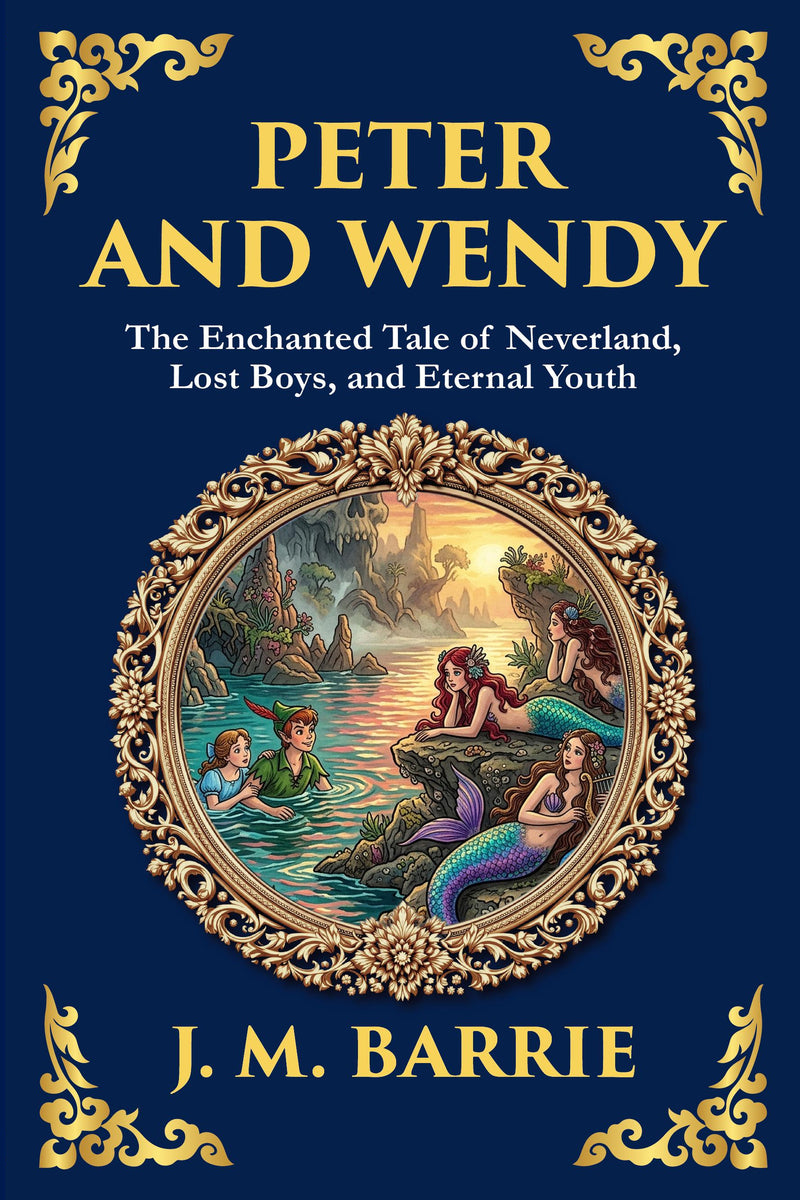
Peter and Wendy — Large Print
Enter the magical world of Neverland, where children never grow up, fairies exist, and pirates clash with flying boys. In Peter and Wendy, J. M. Barrie weaves a timeless story that explores the wonder of youth, the ache of growing older, and the bittersweet nature of memory.
or free app
10,000+ hrs library
30-day guarantee
The complete Peter and Wendy appears in modern English through Library of Alexandria Press, available online with audiobook narration included for members.
Have you ever wondered why growing up feels like leaving behind a world of magic? Peter and Wendy is more than just a children’s tale—it is a powerful allegory of freedom, imagination, and the fragile beauty of youth. First published in 1911, J. M. Barrie’s beloved novel captures the hearts of readers with its magical narrative and deeply emotional undertones.
The story begins with Peter Pan, a mysterious boy who refuses to grow up, arriving at the window of Wendy, John, and Michael Darling. With a sprinkle of fairy dust and a lot of belief, the children fly away to Neverland, a place full of pirates, Indians, crocodiles, and the ever-jealous Tinker Bell. But amidst all the adventure lies a question that lingers: can innocence truly last forever?
Barrie’s unforgettable characters—Peter, Wendy, Captain Hook, the Lost Boys—have lived in our cultural imagination for generations. This restored edition brings the full richness of the original text to new readers while preserving the lyrical charm and psychological depth of Barrie’s masterpiece.
What you’ll discover in this modern edition
- A Timeless Tale of Adventure and Escape – Follow Peter Pan and the Darling children on their magical journey through Neverland.
- Characters Who Embody Eternal Themes – Explore the eternal youth of Peter, the nurturing heart of Wendy, and the tragic villainy of Captain Hook.
- Reflections on Childhood and Identity – Witness the tension between the freedom of childhood and the pull of responsibility.
- The Power of Imagination – Discover how stories, play, and belief shape the world and the self.
- A Work That Grows With Its Reader – Return to this story at any age and find new meaning in its poetic and philosophical depth. Peter and Wendy is a classic not just of children’s literature, but of all literature.
| Formats | eBook (EPUB + PDF) · Audiobook · Paperback · Hardcover · Large Print |
| Language | English |
| Trim size (print) | 6 × 9 in |
| Binding | Paperback — perfect-bound · Hardcover — casewrap |
| Large Print edition | Same text in a larger, easy-read type — a larger font, not a larger trim |
| Print pricing | Every physical book at our true cost — at-cost, no profit (members) |
| Library | 873 restored titles, always growing |
| Length | 48,510 words · ~3 hr 14 min reading |
| Reading level | Grade 8 · an easy, flowing read (this modern-English edition) |
| Edition | Modern English translation · 2026 |
Member reviews for this edition are collected as readers finish it — be the first. Across the library: 12,000+ books shipped, every plan covered by a 365-day print guarantee.
About this edition
A faithful, unabridged modern-English edition by The Library of Alexandria — carefully rendered for today's reader and verified paragraph-by-paragraph against the public-domain source. Available as eBook, audiobook, paperback, hardcover, and large print.
- Complete & unabridgedVerified paragraph by paragraph against the source — never a scan, never abridged.
- Modern English, faithfulReadable today, with the author’s meaning kept intact. Readable — not simplified.
- Every format, one membershipRead in your browser or the free app, or listen to the full audiobook.
Included free with your membership
Cancel anytime, one click · 30-day money-back guarantee
Edition last updated July 2026
What’s inside
Peter and Wendy — Large Print — complete and unabridged: all 18 sections included with membership, plus the full audiobook.
Begin reading Peter and Wendy — Large Print
In clear modern English — the complete text is included with membership.
Introduction
There are some stories that do not merely entertain us; they enter our bloodstream. They lodge themselves in the architecture of our imaginations so completely that we can no longer remember a time when we did not know them. The tale of the boy who would not grow up is one of these. Before you ever turned a single page of this book, you almost certainly knew his name. You knew that he could fly, that he lived somewhere just beyond the reach of ordinary maps, that he had a fairy who glowed and glittered, and that there was a pirate captain with a hook for a hand and a crocodile with a clock in its belly. This is the strange and wonderful paradox of J. M. Barrie’s creation: it has become so woven into the fabric of our collective childhood that the original work itself often goes unread, eclipsed by the very fame it earned.
That is what makes the act of returning to the source so quietly thrilling. To open this volume is to meet the real thing — not the cartoon, not the pantomime, not the watered-down picture book, but the actual, complete, and astonishingly sophisticated novel that Barrie wrote. What you will find here may surprise you. It is funnier than you expect. It is sadder than you remember. It is sharper, stranger, more knowing, and infinitely more beautiful than any adaptation has ever managed to convey. Beneath the surface of a children’s adventure runs a current of melancholy so profound that adults often find themselves more moved than the children they are reading to. This is a book that wears the costume of a fairy tale while whispering the truest things imaginable about love, memory, mortality, and the unbearable swiftness with which childhood slips through our fingers.
This edition has been carefully prepared as a modern translation, adapted for the contemporary reader. A word about what that means, and what it does not mean, is worth offering before you begin. Barrie wrote in the first decade of the twentieth century, and his prose, glorious as it is, carries the cadences and conventions of its era. Certain turns of phrase, certain references, and certain rhythms of sentence construction can place small obstacles in the path of a reader encountering the book for the first time today. The aim of this adaptation is to clear those obstacles gently — to smooth the way without flattening the landscape. The wit, the wisdom, the sudden swerves between laughter and grief, the narrator’s mischievous and unforgettable voice: all of these have been preserved with care. What has been refreshed is the access, not the essence. You are still reading Barrie. You are simply reading him in a way that lets his magic reach you unimpeded.
To understand why this tale carries such an undertow of feeling, it helps to know a little about the heart from which it came. James Matthew Barrie was a small, shy, watchful Scotsman, born in 1860 in the weaving town of Kirriemuir. When he was six years old, his elder brother David — his mother’s clear favorite — died in a skating accident the day before his fourteenth birthday. The grief that fell upon the household was crushing, and young James grew up in its shadow, forever trying to comfort a mother who could not be comforted. There is a haunting detail in this story that anyone who reads the book should carry with them: because David died at thirteen, he never grew up. In his mother’s memory he remained, eternally, a boy. He would never disappoint her, never leave her, never become a man who walked out into the wide world. He was fixed forever in a kind of frozen, perfect, heartbreaking youth.
It does not take much imagination to feel the shape of that loss pressing against the pages you are about to read. The idea of a child who never ages, who stays luminous and untouched while everyone around him moves inevitably forward into adulthood and away — this was not an abstract fancy for Barrie. It was the central wound of his life, transmuted, decades later, into one of the most enduring myths in the English language. There is a profound difference between a writer who invents the notion of eternal childhood and a writer who has actually known a child who became eternal in the cruelest way. Barrie was the second kind. The lightness of his story floats upon a depth of sorrow, and it is precisely this combination — the joy and the ache held together in a single breath — that gives the book its uncanny power.
The more immediate origin of the tale was happier, and it involved a real family that Barrie came to love almost as if it were his own. In the gardens of London, the childless author befriended a group of young brothers — the Llewelyn Davies boys — and their parents. For these children Barrie became a beloved, inexhaustible companion, an inventor of games, a teller of tales, a grown man who seemed to possess a direct line into the country of the imagination. It was in the course of their play together, their make-believe adventures of pirates and shipwrecks and daring rescues, that the boy who would not grow up first took flight. The character was, in a sense, a collaboration between a lonely genius and the children who reminded him what wonder felt like. He drew their names, their personalities, and their make-believe into his work, and in return he gave them — and the world — something immortal.
This matters because it tells us what kind of book this is. It is not a calculated commercial product dreamed up to sell to children. It is a love letter, written by a man who understood loss intimately, to the fleeting paradise of childhood itself. Every reader, no matter their age, is implicated in its themes, because every reader was once a child and is now something else. The book knows this. It speaks directly to the part of us that remembers flying in dreams and being certain, in the dark, that the impossible was only a wish away. And it speaks, too, to the older part of us that has learned, with sorrow and with grace, that we cannot keep everything we love.
It is worth knowing that the story you hold reached the world by an unusual route. The boy first appeared as a character in an earlier book Barrie wrote for adults, then conquered the stage as a wildly successful play that delighted audiences and made theatrical history. Only afterward did Barrie expand that play into the full novel that became this book — a richer, deeper, more interior version of the tale, with a narrator who can wander wherever he pleases, dip into the private thoughts of his characters, comment slyly on the proceedings, and break your heart in a single sentence when you least expect it. The play gave the world its spectacle; the novel gives the world its soul. To read the novel is to receive the most complete and most personal version of Barrie’s vision.
The Strange and Wonderful Voice of the Storyteller
Perhaps the single greatest revelation awaiting readers who know the story only from its many adaptations is the voice of the narrator. Adaptations cannot easily reproduce a narrator, and so this — the most distinctive feature of the book — is precisely the thing that tends to get lost in translation to screen and stage. The narrator of this novel is a character in his own right, and getting to know him is one of the chief pleasures of the experience.
He is, by turns, tender and teasing, sentimental and cynical, playful and suddenly devastating. He addresses you directly. He confesses his own opinions, his own irritations, his own helpless affections for the people in his story. He sometimes seems to be making things up as he goes along, and sometimes seems to know everything that has ever happened and ever will. He can describe a domestic scene with such warmth that you ache with recognition, and then puncture that warmth with an observation so coolly knowing about human nature — particularly about the careless egotism of children and the wistful patience of adults — that you laugh out loud even as you wince. This narrator understands children with a clarity that is almost unsettling. He does not sentimentalize them. He sees their cruelty, their forgetfulness, their breathtaking self-absorption, and he loves them anyway, all the more truly for seeing them clearly.
The famous opening of the book — which I will not quote here, so that you may meet it fresh — establishes this voice instantly, and it is one of the most perfect openings in all of literature. In a handful of words, Barrie sets the entire emotional engine of the book running: the inevitability of growing up, the knowledge a child has of this fate, the small private moment in which that knowledge first arrives. It is gentle and it is merciless. From that first page, you understand that you are in the hands of a master who intends to entertain you completely while also telling you the truth.
The voice carries something else, too: a quality of genuine surprise. Barrie’s narrator never settles into the comfortable rhythm of a story that knows exactly where it is going. He digresses. He second-guesses. He withholds and reveals at unexpected moments. He will linger over a tiny detail — the way a mother tidies up her children’s minds at night, folding away the day’s stray thoughts like clothing — and that detail will turn out to contain the whole meaning of the book in miniature. This is writing of extraordinary delicacy, and it rewards slow, attentive reading. Do not rush. The plot moves quickly enough, but the real treasures are in the asides, the observations, the small perfect sentences that catch you off guard.
It must be acknowledged, as readers approaching this classic deserve to know, that Barrie was a man of his time, and the book contains elements — particularly in its portrayal of certain characters drawn from the adventure-story conventions of the early twentieth century — that reflect the prejudices and assumptions of that era. A thoughtful modern reader will notice these moments. They are part of the historical fabric of the work, and rather than pretending they do not exist, it is better to meet them with awareness and to read them in the context of the time that produced them. The enduring greatness of the book lies elsewhere: in its psychological truth, its emotional courage, and its unmatched understanding of what it means to be young and what it costs to stop being young. These are the things that have kept the story alive for more than a century, and these are the things that will keep it alive long after we are gone.
What makes the book so much more than a simple adventure is the way Barrie refuses to let his hero off easily. The boy who would not grow up is not a straightforward figure of joy. He is also, the narrator quietly insists, a figure of tragedy. To never grow up is to never deepen, never remember, never truly love in the way that requires continuity and memory and the willingness to change. The boy forgets. He forgets his adventures, forgets his friends, forgets even the people who have meant the most to him, because to hold onto memory is itself a kind of growing up, and he cannot do it. There is a coldness at the heart of his eternal warmth, and Barrie has the artistic honesty to show us both. This is what elevates the book from charming fantasy to lasting literature. It dares to suggest that the thing we most envy — eternal youth — might also be the thing we should most fear.
How to Read This Book, and What Awaits You
Let me offer a few thoughts on how to approach the reading itself, so that you may draw from it everything it has to give.
First, set aside whatever you think you already know. The cultural footprint of this story is enormous, and most of us carry a version of it assembled from fragments — a film here, a stage production there, a children’s edition read long ago and half-forgotten. Some of those fragments are faithful, and many are not. The book is its own thing, complete and self-contained, and it deserves to be met on its own terms. Try, as best you can, to read it as though for the first time, allowing Barrie’s actual words and his actual choices to surprise you. You will find that the original is both more familiar and more strange than your memory suggests.
Cancel anytime, one click · 30-day money-back guarantee
Founding annual rate available now — your price locks for life when you join.
Not ready? Get this free chapter by email — read it anytime.
✓ Sent — check your inbox for Peter and Wendy — Large Print.
Questions about Peter and Wendy — Large Print
What is Peter and Wendy about?
Enter the magical world of Neverland, where children never grow up, fairies exist, and pirates clash with flying boys. In Peter and Wendy, J. M. Barrie weaves a timeless story that explores the wonder of youth, the ache of growing older, and the bittersweet nature of memory. Follow Peter Pan—the boy who won’t grow up—as he whisks Wendy Darling and her brothers away from their London nursery to a far-off land of lost boys, mermaids, and mortal enemies.
Who wrote Peter and Wendy?
Peter and Wendy was written by J. M. Barrie. This edition presents the complete work in clear modern English, faithfully rendered from the public-domain original by Library of Alexandria Press.
Is Peter and Wendy free to read?
The opening chapter is free to read on this page. Members read and listen to the complete work — and the entire library — free, and can order any physical book at our true print cost.
How long is Peter and Wendy?
18 chapters (~48,510 words) — about 3 hr 14 min of reading in this modern-English edition.
Is this an abridged version of Peter and Wendy?
No. This is the complete, unabridged Peter and Wendy, carefully rendered into clear modern English and verified paragraph-by-paragraph against the public-domain source — nothing is cut or summarised.
What formats does Peter and Wendy come in?
Peter and Wendy is available as eBook, paperback, hardcover and large print. eBook and audiobook are included with membership; printed editions ship at our true print cost.
Shipping & returns
Billing & membership
More from the library


Explore Children's Classics
- Jack and Jill · Louisa May Alcott
- The Wonderful Wizard of Oz · L. Frank Baum
- Peter Pan · J. M. Barrie
- The Prince and the Pauper · Mark Twain
- The Red Fairy Book · Andrew Lang
- Old Christmas: from the Sketch Book of Washington Irving · Washington Irving
- A Houseful of Girls · Sarah Tytler
- In the hollow of His hand · Hesba Stretton
- Miss Primrose · Agnes Giberne
- Five Little Peppers and How They Grew · Margaret Sidney
- The Loss of the Swansea: A Story of the Florida Coast · W. L. Alden
- Sky Island · L. Frank Baum
- The Book of Dragons · E. Nesbit
- Wild Animals I Have Known · Ernest Thompson Seton
- Skinny McCord · Percy Keese Fitzhugh
- The Hunniwell Boys and the Platinum Mystery · L. P. Wyman
- Rainbow Valley · L. M. Montgomery
- "Us and Our Donkey" · Amy Le Feuvre
- Dorothy and the Wizard in Oz · L. Frank Baum
- The Home Book of Verse — Volume 4 · Burton Egbert Stevenson
- The Story of Doctor Dolittle · Hugh Lofting
- The Tale of Benjamin Bunny · Beatrix Potter
- Fifty Famous Stories Retold · James Baldwin
- Rilla of Ingleside · L. M. Montgomery
- The House at Pooh Corner · A. A. Milne
- Rich and Humble: A Story for Young People · Oliver Optic
- The Three Bears · A. E. Kennedy
- Peter and Wendy · J. M. Barrie
- The Marvelous Land of Oz · L. Frank Baum
- Andersen’s Fairy Tales · H. C. Andersen
Peter and Wendy — Large Print
Peter and Wendy — Large Print
The Magical Story of Neverland, the Lost Boys, and Forever Youth
J. M. Barrie
Contents
- Introduction
- Chapter 1
- Chapter 2
- Chapter 3
- Chapter 4
- Chapter 5
- Chapter 6
- Chapter 7
- Chapter 8
- Chapter 9
- Chapter 10
- Chapter 11
- Chapter 12
- Chapter 13
- Chapter 14
- Chapter 15
- Chapter 16
- Chapter 17
Introduction
There are some stories that do not merely entertain us; they enter our bloodstream. They lodge themselves in the architecture of our imaginations so completely that we can no longer remember a time when we did not know them. The tale of the boy who would not grow up is one of these. Before you ever turned a single page of this book, you almost certainly knew his name. You knew that he could fly, that he lived somewhere just beyond the reach of ordinary maps, that he had a fairy who glowed and glittered, and that there was a pirate captain with a hook for a hand and a crocodile with a clock in its belly. This is the strange and wonderful paradox of J. M. Barrie’s creation: it has become so woven into the fabric of our collective childhood that the original work itself often goes unread, eclipsed by the very fame it earned.
That is what makes the act of returning to the source so quietly thrilling. To open this volume is to meet the real thing — not the cartoon, not the pantomime, not the watered-down picture book, but the actual, complete, and astonishingly sophisticated novel that Barrie wrote. What you will find here may surprise you. It is funnier than you expect. It is sadder than you remember. It is sharper, stranger, more knowing, and infinitely more beautiful than any adaptation has ever managed to convey. Beneath the surface of a children’s adventure runs a current of melancholy so profound that adults often find themselves more moved than the children they are reading to. This is a book that wears the costume of a fairy tale while whispering the truest things imaginable about love, memory, mortality, and the unbearable swiftness with which childhood slips through our fingers.
This edition has been carefully prepared as a modern translation, adapted for the contemporary reader. A word about what that means, and what it does not mean, is worth offering before you begin. Barrie wrote in the first decade of the twentieth century, and his prose, glorious as it is, carries the cadences and conventions of its era. Certain turns of phrase, certain references, and certain rhythms of sentence construction can place small obstacles in the path of a reader encountering the book for the first time today. The aim of this adaptation is to clear those obstacles gently — to smooth the way without flattening the landscape. The wit, the wisdom, the sudden swerves between laughter and grief, the narrator’s mischievous and unforgettable voice: all of these have been preserved with care. What has been refreshed is the access, not the essence. You are still reading Barrie. You are simply reading him in a way that lets his magic reach you unimpeded.
To understand why this tale carries such an undertow of feeling, it helps to know a little about the heart from which it came. James Matthew Barrie was a small, shy, watchful Scotsman, born in 1860 in the weaving town of Kirriemuir. When he was six years old, his elder brother David — his mother’s clear favorite — died in a skating accident the day before his fourteenth birthday. The grief that fell upon the household was crushing, and young James grew up in its shadow, forever trying to comfort a mother who could not be comforted. There is a haunting detail in this story that anyone who reads the book should carry with them: because David died at thirteen, he never grew up. In his mother’s memory he remained, eternally, a boy. He would never disappoint her, never leave her, never become a man who walked out into the wide world. He was fixed forever in a kind of frozen, perfect, heartbreaking youth.
It does not take much imagination to feel the shape of that loss pressing against the pages you are about to read. The idea of a child who never ages, who stays luminous and untouched while everyone around him moves inevitably forward into adulthood and away — this was not an abstract fancy for Barrie. It was the central wound of his life, transmuted, decades later, into one of the most enduring myths in the English language. There is a profound difference between a writer who invents the notion of eternal childhood and a writer who has actually known a child who became eternal in the cruelest way. Barrie was the second kind. The lightness of his story floats upon a depth of sorrow, and it is precisely this combination — the joy and the ache held together in a single breath — that gives the book its uncanny power.
The more immediate origin of the tale was happier, and it involved a real family that Barrie came to love almost as if it were his own. In the gardens of London, the childless author befriended a group of young brothers — the Llewelyn Davies boys — and their parents. For these children Barrie became a beloved, inexhaustible companion, an inventor of games, a teller of tales, a grown man who seemed to possess a direct line into the country of the imagination. It was in the course of their play together, their make-believe adventures of pirates and shipwrecks and daring rescues, that the boy who would not grow up first took flight. The character was, in a sense, a collaboration between a lonely genius and the children who reminded him what wonder felt like. He drew their names, their personalities, and their make-believe into his work, and in return he gave them — and the world — something immortal.
This matters because it tells us what kind of book this is. It is not a calculated commercial product dreamed up to sell to children. It is a love letter, written by a man who understood loss intimately, to the fleeting paradise of childhood itself. Every reader, no matter their age, is implicated in its themes, because every reader was once a child and is now something else. The book knows this. It speaks directly to the part of us that remembers flying in dreams and being certain, in the dark, that the impossible was only a wish away. And it speaks, too, to the older part of us that has learned, with sorrow and with grace, that we cannot keep everything we love.
It is worth knowing that the story you hold reached the world by an unusual route. The boy first appeared as a character in an earlier book Barrie wrote for adults, then conquered the stage as a wildly successful play that delighted audiences and made theatrical history. Only afterward did Barrie expand that play into the full novel that became this book — a richer, deeper, more interior version of the tale, with a narrator who can wander wherever he pleases, dip into the private thoughts of his characters, comment slyly on the proceedings, and break your heart in a single sentence when you least expect it. The play gave the world its spectacle; the novel gives the world its soul. To read the novel is to receive the most complete and most personal version of Barrie’s vision.
The Strange and Wonderful Voice of the Storyteller
Perhaps the single greatest revelation awaiting readers who know the story only from its many adaptations is the voice of the narrator. Adaptations cannot easily reproduce a narrator, and so this — the most distinctive feature of the book — is precisely the thing that tends to get lost in translation to screen and stage. The narrator of this novel is a character in his own right, and getting to know him is one of the chief pleasures of the experience.
He is, by turns, tender and teasing, sentimental and cynical, playful and suddenly devastating. He addresses you directly. He confesses his own opinions, his own irritations, his own helpless affections for the people in his story. He sometimes seems to be making things up as he goes along, and sometimes seems to know everything that has ever happened and ever will. He can describe a domestic scene with such warmth that you ache with recognition, and then puncture that warmth with an observation so coolly knowing about human nature — particularly about the careless egotism of children and the wistful patience of adults — that you laugh out loud even as you wince. This narrator understands children with a clarity that is almost unsettling. He does not sentimentalize them. He sees their cruelty, their forgetfulness, their breathtaking self-absorption, and he loves them anyway, all the more truly for seeing them clearly.
The famous opening of the book — which I will not quote here, so that you may meet it fresh — establishes this voice instantly, and it is one of the most perfect openings in all of literature. In a handful of words, Barrie sets the entire emotional engine of the book running: the inevitability of growing up, the knowledge a child has of this fate, the small private moment in which that knowledge first arrives. It is gentle and it is merciless. From that first page, you understand that you are in the hands of a master who intends to entertain you completely while also telling you the truth.
The voice carries something else, too: a quality of genuine surprise. Barrie’s narrator never settles into the comfortable rhythm of a story that knows exactly where it is going. He digresses. He second-guesses. He withholds and reveals at unexpected moments. He will linger over a tiny detail — the way a mother tidies up her children’s minds at night, folding away the day’s stray thoughts like clothing — and that detail will turn out to contain the whole meaning of the book in miniature. This is writing of extraordinary delicacy, and it rewards slow, attentive reading. Do not rush. The plot moves quickly enough, but the real treasures are in the asides, the observations, the small perfect sentences that catch you off guard.
It must be acknowledged, as readers approaching this classic deserve to know, that Barrie was a man of his time, and the book contains elements — particularly in its portrayal of certain characters drawn from the adventure-story conventions of the early twentieth century — that reflect the prejudices and assumptions of that era. A thoughtful modern reader will notice these moments. They are part of the historical fabric of the work, and rather than pretending they do not exist, it is better to meet them with awareness and to read them in the context of the time that produced them. The enduring greatness of the book lies elsewhere: in its psychological truth, its emotional courage, and its unmatched understanding of what it means to be young and what it costs to stop being young. These are the things that have kept the story alive for more than a century, and these are the things that will keep it alive long after we are gone.
What makes the book so much more than a simple adventure is the way Barrie refuses to let his hero off easily. The boy who would not grow up is not a straightforward figure of joy. He is also, the narrator quietly insists, a figure of tragedy. To never grow up is to never deepen, never remember, never truly love in the way that requires continuity and memory and the willingness to change. The boy forgets. He forgets his adventures, forgets his friends, forgets even the people who have meant the most to him, because to hold onto memory is itself a kind of growing up, and he cannot do it. There is a coldness at the heart of his eternal warmth, and Barrie has the artistic honesty to show us both. This is what elevates the book from charming fantasy to lasting literature. It dares to suggest that the thing we most envy — eternal youth — might also be the thing we should most fear.
How to Read This Book, and What Awaits You
Let me offer a few thoughts on how to approach the reading itself, so that you may draw from it everything it has to give.
First, set aside whatever you think you already know. The cultural footprint of this story is enormous, and most of us carry a version of it assembled from fragments — a film here, a stage production there, a children’s edition read long ago and half-forgotten. Some of those fragments are faithful, and many are not. The book is its own thing, complete and self-contained, and it deserves to be met on its own terms. Try, as best you can, to read it as though for the first time, allowing Barrie’s actual words and his actual choices to surprise you. You will find that the original is both more familiar and more strange than your memory suggests.
Almost every child grows up. They eventually realize this will happen, and this is how Wendy found out. When she was two years old, she was playing in the garden, where she picked a flower and ran to give it to her mother. She must have looked adorable, because Mrs. Darling put her hand over her heart and exclaimed, “Oh, why can’t you stay like this forever!” That was the only time they ever spoke about it, but from then on, Wendy knew she was destined to grow up. You always realize it once you turn two. Two is where the end begins.
Naturally, they lived at number 14, and until Wendy arrived, her mother was the most important person in the house. She was a lovely woman with a romantic spirit and a sweet, playful smile. Her imagination was like those nesting boxes from the mysterious East; no matter how many you find, there is always another one inside. As for her playful smile, there was one particular kiss there that Wendy could never seem to reach, even though it was clearly visible right in the corner of her mouth.
This is how Mr. Darling won her heart: many men, who had been boys when she was a girl, suddenly realized at the same time that they loved her. They all rushed to her house to propose, except for Mr. Darling, who took a taxi and beat them all to the door, winning her hand. He won everything about her except for that innermost box and the kiss. He never knew the box existed, and over time, he stopped trying to get the kiss. Wendy believed that Napoleon might have succeeded, but I can imagine him trying and then leaving in a rage, slamming the door behind him.
Mr. Darling used to brag to Wendy that her mother not only loved him but also respected him. He was one of those serious men who understood stocks and shares. Of course, nobody truly understands them, but he sounded like he did, and he often spoke about stocks rising and shares falling in a way that would make any woman admire him.
End of the free sample
Keep reading, free
Members read and listen to the complete book — and the entire library. Cancel anytime, one click · 30-day money-back guarantee.