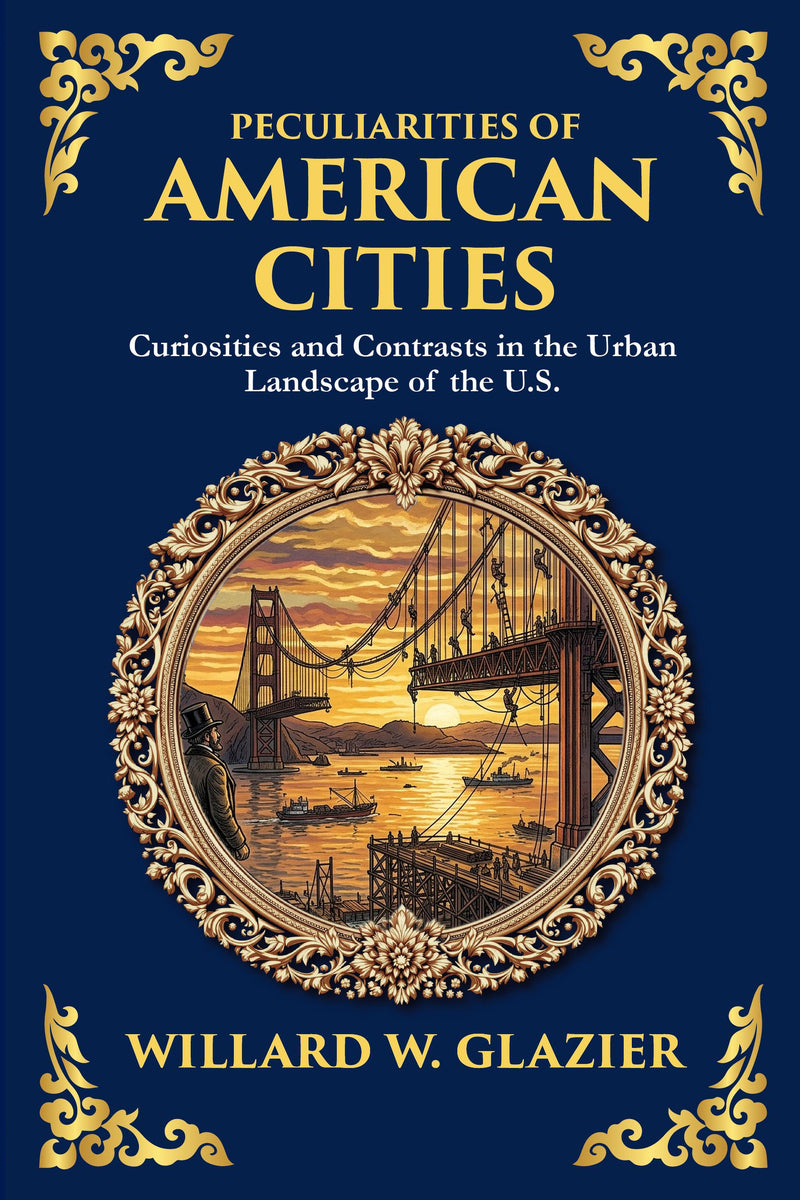
Peculiarities of American Cities — Large Print
Step into the bustling heart of 19th-century America, where cities rise in splendor and contradiction. Peculiarities of American Cities is Willard W. Glazier’s captivating exploration of the character, curiosities, and contrasts found across the United States’ major urban centers— from the marble halls of Washington to
or free app
10,000+ hrs library
30-day guarantee
The complete Peculiarities of American Cities appears in modern English through Library of Alexandria Press, available online with audiobook narration included for members.
Have you ever wondered why American cities evolved so differently—each with its own soul, structure, and strangeness? In Peculiarities of American Cities, 19th-century author and explorer Willard W. Glazier leads readers on a riveting urban odyssey across the United States. Far more than a travelogue, this work serves as a social, architectural, and cultural portrait of a young nation rapidly reinventing itself—one metropolis at a time.
With Glazier as your guide, discover the eccentricities of more than two dozen major cities, each revealing its own unique “personality” shaped by history, geography, and human ambition. From the intellectual corners of Boston to the feverish promise of Chicago, from New Orleans’ sultry mystique to the engineered grandeur of Washington D.C., this is a journey into the contrasts that define the American urban imagination.
What you’ll discover in this modern edition
- Striking City Portraits – Explore the defining features, quirks, and atmospheres of cities like Philadelphia, St. Louis, Charleston, and Cincinnati
- Fascinating Social Commentary – Encounter the ethnic communities, reform movements, and societal tensions that colored city life
- Architectural and Historical Insights – Glazier reflects on the buildings, boulevards, and civic dreams shaping America’s future
- Regional Contrasts – Learn how North, South, East, and West developed distinct urban characters and contradictions
- A Window into the 19th Century American Mind – See how cities were perceived and portrayed in the post-Civil War era
| Formats | eBook (EPUB + PDF) · Audiobook · Paperback · Hardcover · Large Print |
| Language | English |
| Trim size (print) | 6 × 9 in |
| Binding | Paperback — perfect-bound · Hardcover — casewrap |
| Large Print edition | Same text in a larger, easy-read type — a larger font, not a larger trim |
| Print pricing | Every physical book at our true cost — at-cost, no profit (members) |
| Library | 873 restored titles, always growing |
| Length | 144,027 words · ~9 hr 36 min reading |
| Reading level | Grade 8 · an easy, flowing read (this modern-English edition) |
| Edition | Modern English translation · 2026 |
Member reviews for this edition are collected as readers finish it — be the first. Across the library: 12,000+ books shipped, every plan covered by a 365-day print guarantee.
About this edition
A faithful, unabridged modern-English edition by The Library of Alexandria — carefully rendered for today's reader and verified paragraph-by-paragraph against the public-domain source. Available as eBook, audiobook, paperback, hardcover, and large print.
- Complete & unabridgedVerified paragraph by paragraph against the source — never a scan, never abridged.
- Modern English, faithfulReadable today, with the author’s meaning kept intact. Readable — not simplified.
- Every format, one membershipRead in your browser or the free app, or listen to the full audiobook.
Included free with your membership
Cancel anytime, one click · 30-day money-back guarantee
Edition last updated July 2026
What’s inside
Peculiarities of American Cities — Large Print — complete and unabridged: all 42 sections included with membership, plus the full audiobook.
Begin reading Peculiarities of American Cities — Large Print
In clear modern English — the complete text is included with membership.
Introduction
When Willard W. Glazier set out across the United States in the closing decades of the nineteenth century, he was traveling through a nation in the midst of one of the most dramatic transformations any country had ever undergone. The America he documented was neither the fledgling republic of the Founding Fathers nor the global superpower it would later become. It was something in between—a sprawling, restless, half-finished civilization stretching across a continent, its cities rising at astonishing speed from prairie, riverbank, and seacoast. To read his account today is to step into a world that is at once strangely familiar and almost unrecognizable, a portrait of urban America at the precise moment it was discovering what kind of nation it wanted to be.
This modern translation has been prepared with a single guiding purpose: to make Glazier’s remarkable survey of American cities accessible, vivid, and genuinely enjoyable for readers of the twenty-first century. The original text, written in the elaborate and sometimes ornate prose of its era, can present obstacles to the contemporary reader—long winding sentences, antiquated vocabulary, and rhetorical flourishes that were fashionable in the 1880s but that can slow and obscure the meaning for us now. In adapting the work, great care has been taken to preserve Glazier’s voice, his enthusiasm, his sharp eye for detail, and his genuine affection for the country he explored, while gently smoothing the language so that his observations come through with the clarity and immediacy they deserve. Nothing of substance has been removed; rather, the aim has been to clear away the underbrush so that the reader may walk freely through the landscape Glazier so lovingly described.
To appreciate what Glazier accomplished, it helps to understand the man and the moment. Willard Worcester Glazier was a soldier, an adventurer, and a writer of immense energy. Born in upstate New York in 1841, he served in the Union cavalry during the Civil War, was captured and imprisoned, and made a daring escape that became the subject of one of his earliest and most popular books. He was, in temperament, an explorer—a man who could not sit still, who was forever measuring distances, recording impressions, and seeking out the next horizon. He undertook ambitious journeys on horseback across the continent, and at one point claimed to have located the true source of the Mississippi River, a contention that embroiled him in considerable controversy. Whatever the merits of that particular claim, it tells us something essential about the author: he was a man who wanted to see things for himself, to plant his own feet on the ground and report back to his countrymen what he had witnessed.
This survey of American cities grew out of that same impulse. Glazier did not write as an armchair geographer assembling facts from secondhand sources. He traveled. He walked the streets, observed the people, noted the architecture, sampled the local industries, and listened to the boasts and complaints of the residents. The result is a book that is less a dry reference work than a kind of guided tour conducted by a knowledgeable and irrepressibly curious companion. He moves from one city to the next, pausing in each to point out what makes it distinctive—its peculiarities, as he calls them—the quirks of character and circumstance that set each urban center apart from its rivals.
The America through which he traveled was a country of extraordinary contrasts and contradictions. The wounds of the Civil War were still fresh, and the project of Reconstruction was giving way to a new era defined by industry, immigration, and breakneck expansion. The transcontinental railroad had been completed in 1869, knitting the coasts together and unleashing a flood of settlement, commerce, and ambition. Cities that had been muddy frontier outposts within living memory were now bustling metropolises with paved streets, gas lighting, grand hotels, and proud civic monuments. Chicago, which had been all but obliterated by the Great Fire of 1871, had risen from the ashes with breathtaking speed and was rapidly becoming one of the most important commercial hubs on earth. The cities of the Atlantic seaboard—Boston, New York, Philadelphia, Baltimore—carried the weight of colonial history and looked toward Europe for cultural validation, while the young cities of the West threw off such pretensions and reveled in their own raw vitality.
Glazier was acutely sensitive to these differences, and capturing them was his central project. He understood, perhaps better than many writers of his day, that the United States was not a single uniform thing but a federation of regions, each with its own climate, economy, ethnic makeup, and self-image. The reader who follows him from chapter to chapter will come away with a rich appreciation for just how varied the American urban experience truly was—how a city defined by shipping differed from one defined by manufacturing, how a settlement shaped by Spanish and French heritage felt entirely unlike one founded by English Puritans, how the rhythms of a Southern town diverged from those of a Northern industrial center.
What makes the book endure is precisely this attention to particularity. Glazier was not content to offer generic praise or to treat every city as interchangeable. He sought out the specific feature—the unusual industry, the striking landmark, the local custom, the geographic oddity—that gave each place its distinctive flavor. In one city he might dwell on the great stockyards and the staggering volume of commerce passing through them; in another, on the elegance of the residential boulevards or the grandeur of the public buildings; in yet another, on the natural wonders that surrounded the urban core. The cumulative effect is a mosaic, a portrait of a nation assembled city by city, each tile contributing its own color and texture to the whole.
It is worth pausing to consider the spirit in which Glazier wrote. This was an age of boundless American optimism, and Glazier shared in it fully. He believed in progress, in the civilizing power of commerce and industry, in the destiny of his country to grow ever larger and more magnificent. His enthusiasm can be infectious; there is a genuine wonder in his descriptions of soaring buildings, busy harbors, and teeming streets. He marveled at the ingenuity of American engineers and the energy of American businessmen. He took pride in the institutions of learning, the churches, the parks, and the cultural amenities that the cities had managed to establish in so short a time. To read him is to be transported to a moment when Americans were intoxicated by their own capacity for building, when the future seemed to stretch out in an unbroken line of upward advancement.
At the same time, the modern reader will inevitably notice that Glazier’s perspective is very much that of his time. The attitudes, assumptions, and language of the late nineteenth century differ in important ways from our own. Glazier wrote in an era before the social reforms that would later address the harsh conditions of industrial labor; before the full reckoning with the legacy of slavery and the long struggle for civil rights; before the environmental awareness that would temper our celebration of unchecked industrial growth. His descriptions of various peoples and regions reflect the prejudices and blind spots common among educated white Americans of his generation. In preparing this edition, the decision was made to preserve the integrity of Glazier’s observations and judgments rather than to sanitize them, for to do otherwise would be to falsify the historical record and to deprive the reader of an authentic encounter with the past. The reader is invited to approach these passages with a historian’s understanding—to recognize them as artifacts of their moment, valuable precisely because they reveal how an intelligent and well-meaning observer of the 1880s actually saw the world. Where Glazier celebrates, we may sometimes wish to question; where he overlooks, we may fill in the gaps with our own knowledge. This critical engagement is part of what makes reading a historical document so rewarding.
Perhaps the greatest gift this book offers the modern reader is the chance to see American cities as they were before so much of what we now take for granted came into being. The skylines Glazier described were dominated not by the steel-framed skyscrapers that would soon transform the urban landscape, but by church spires, courthouse domes, and the smokestacks of factories. The streets were filled with horses and carriages, with streetcars drawn by animals or powered by the new and somewhat alarming technology of electricity. The great waves of immigration that would reshape the ethnic composition of American cities were still building toward their peak. The automobile did not yet exist. The airplane was a fantasy. The telephone was a novelty, electric lighting a marvel, and the elevator a recent invention that was just beginning to make tall buildings practical.
In this sense, the book is a kind of time capsule—a snapshot of urban America at a particular and pivotal stage of its development. When Glazier describes the population of a city, the reader can compare those figures with the metropolises those same places have become and feel the dizzying scale of subsequent growth. When he praises a building as the tallest or grandest of its kind, we know that it would soon be dwarfed by structures he could scarcely have imagined. When he marvels at the volume of goods passing through a port or a railway terminal, we glimpse the foundations of the industrial colossus the United States was about to become. There is a poignancy in this, a sense of standing at the threshold of an enormous transformation, watching a young nation flex its muscles without yet knowing the shape it would ultimately take.
The book also serves as a fascinating window into the values and priorities of its age. What did a city of the 1880s consider worth boasting about? What were the markers of civic pride and accomplishment? Glazier’s choices tell us a great deal. He pays close attention to commerce and industry, to the volume of trade and the productivity of factories, reflecting an era in which economic might was the surest measure of a city’s importance. He notes the presence of educational institutions, libraries, and cultural societies, signs that a community had risen above mere money-making to embrace the finer things. He describes parks and public gardens, evidence of a growing recognition that crowded urban populations needed access to green space and fresh air. He admires fine hotels and well-appointed public buildings as symbols of refinement and prosperity. And he is keenly interested in the natural settings of the cities—the rivers, lakes, mountains, and harbors that shaped their development and contributed to their beauty.
Through all of this runs Glazier’s abiding interest in what he calls peculiarities—the features that distinguish one place from another. This is the organizing principle of the entire work, and it is what makes the book more than a mere gazetteer. Glazier understood that the soul of a city lies in its differences, in the particular combination of geography, history, economy, and character that no other place can quite replicate. He sought to capture that soul, to convey not just the facts about a city but the feeling of it, the impression it made upon a thoughtful visitor. In doing so, he created something that transcends the limitations of a simple reference work and becomes instead a genuine work of observation and reflection.
For the contemporary reader, there is a special pleasure in encountering familiar place names and discovering how those places appeared to a traveler of long ago. Anyone who has visited or lived in one of the cities Glazier describes will find a particular fascination in comparing their own knowledge of the place with his account. Some of what he describes will have vanished entirely; some will have changed beyond recognition; and some, surprisingly, will remain. The bones of these cities—their location, their relationship to rivers and coastlines, their early street patterns, their oldest surviving buildings—still underlie the modern metropolises we know today. To read Glazier is to understand how those cities came to be, to see the seeds from which the present grew. It is rather like looking at an old photograph of a person one knows well and recognizing, in the youthful face, the features that would later mature into familiarity.
Cancel anytime, one click · 30-day money-back guarantee
Founding annual rate available now — your price locks for life when you join.
Not ready? Get this free chapter by email — read it anytime.
✓ Sent — check your inbox for Peculiarities of American Cities — Large Print.
Questions about Peculiarities of American Cities — Large Print
What is Peculiarities of American Cities about?
Step into the bustling heart of 19th-century America, where cities rise in splendor and contradiction. Peculiarities of American Cities is Willard W. Glazier’s captivating exploration of the character, curiosities, and contrasts found across the United States’ major urban centers— from the marble halls of Washington to the energetic sprawl of San Francisco. With rich descriptions, sharp observations, and a traveler’s eye for detail, this book unveils how each city tells a different story about American ambition, in
Who wrote Peculiarities of American Cities?
Peculiarities of American Cities was written by Willard W. Glazier. This edition presents the complete work in clear modern English, faithfully rendered from the public-domain original by Library of Alexandria Press.
Is Peculiarities of American Cities free to read?
The opening chapter is free to read on this page. Members read and listen to the complete work — and the entire library — free, and can order any physical book at our true print cost.
How long is Peculiarities of American Cities?
42 chapters (~144,027 words) — about 9 hr 36 min of reading in this modern-English edition.
Is this an abridged version of Peculiarities of American Cities?
No. This is the complete, unabridged Peculiarities of American Cities, carefully rendered into clear modern English and verified paragraph-by-paragraph against the public-domain source — nothing is cut or summarised.
What formats does Peculiarities of American Cities come in?
Peculiarities of American Cities is available as eBook, paperback, hardcover and large print. eBook and audiobook are included with membership; printed editions ship at our true print cost.
Shipping & returns
Billing & membership
More from the library


Explore Free eBooks
- Kant's Prolegomena to Any Future Metaphysics · Immanuel Kant
- The Advancement of Learning · Francis Bacon
- The Dawn of Day · Friedrich Nietzsche
- Peter and Wendy · J. M. Barrie
- Meditations · Marcus Aurelius
- The Confessions of St. Augustine · Saint Augustine of Hippo
- Resurrection · Leo Tolstoy
- Dialogues Concerning Natural Religion · David Hume
- As You Like It · William Shakespeare
- Jack and Jill · Louisa May Alcott
- Dream Psychology: Psychoanalysis for Beginners · Sigmund Freud
- The Raven · Edgar Allan Poe
- Considerations on Representative Government · John Stuart Mill
- The Will to Power: An Attempted Transvaluation of All Values. Book III and IV · Friedrich Nietzsche
- Tarzan of the Apes · Edgar Rice Burroughs
- Fundamental Principles of the Metaphysic of Morals · Immanuel Kant
- The Confessions of Jean Jacques Rousseau — Complete · Jean-Jacques Rousseau
- The Merchant of Venice · William Shakespeare
- Democracy in America — Volume 2 · Alexis de Tocqueville
- Ecce Homo · Friedrich Wilhelm Nietzsche
- Second Treatise of Government · John Locke
- The Wonderful Wizard of Oz · L. Frank Baum
- The Prince · Niccolò Machiavelli
- Anne of Green Gables · L. M. Montgomery
- De Profundis · Oscar Wilde
- Thus Spake Zarathustra: A Book for All and None · Friedrich Nietzsche
- Anna Karenina · Leo Tolstoy
- Great Expectations · Charles Dickens
- The Island of Doctor Moreau · H. G. Wells
- A Midsummer Night's Dream · William Shakespeare
Peculiarities of American Cities — Large Print
Peculiarities of American Cities — Large Print
Strange Sights and Differences in the Urban Landscapes of the U.S.
Willard W. Glazier
Contents
- Introduction
- Preface by the Author
- Chapter 1
- Chapter 2
- Chapter 3
- Chapter 4
- Chapter 5
- Chapter 6
- Chapter 7
- Chapter 8
- Chapter 9
- Chapter 10
- Chapter 11
- Chapter 12
- Chapter 13
- Chapter 14
- Chapter 15
- Chapter 16
- Chapter 17
- Chapter 18
- Chapter 19
- Chapter 20
- Chapter 21
- Chapter 22
- Chapter 23
- Chapter 24
- Chapter 25
- Chapter 26
- Chapter 27
- Chapter 28
- Chapter 29
- Chapter 30
- Chapter 31
- Chapter 32
- Chapter 33
- Chapter 34
- Chapter 35
- Chapter 36
- Chapter 37
- Chapter 38
- … and 2 more chapters
Introduction
When Willard W. Glazier set out across the United States in the closing decades of the nineteenth century, he was traveling through a nation in the midst of one of the most dramatic transformations any country had ever undergone. The America he documented was neither the fledgling republic of the Founding Fathers nor the global superpower it would later become. It was something in between—a sprawling, restless, half-finished civilization stretching across a continent, its cities rising at astonishing speed from prairie, riverbank, and seacoast. To read his account today is to step into a world that is at once strangely familiar and almost unrecognizable, a portrait of urban America at the precise moment it was discovering what kind of nation it wanted to be.
This modern translation has been prepared with a single guiding purpose: to make Glazier’s remarkable survey of American cities accessible, vivid, and genuinely enjoyable for readers of the twenty-first century. The original text, written in the elaborate and sometimes ornate prose of its era, can present obstacles to the contemporary reader—long winding sentences, antiquated vocabulary, and rhetorical flourishes that were fashionable in the 1880s but that can slow and obscure the meaning for us now. In adapting the work, great care has been taken to preserve Glazier’s voice, his enthusiasm, his sharp eye for detail, and his genuine affection for the country he explored, while gently smoothing the language so that his observations come through with the clarity and immediacy they deserve. Nothing of substance has been removed; rather, the aim has been to clear away the underbrush so that the reader may walk freely through the landscape Glazier so lovingly described.
To appreciate what Glazier accomplished, it helps to understand the man and the moment. Willard Worcester Glazier was a soldier, an adventurer, and a writer of immense energy. Born in upstate New York in 1841, he served in the Union cavalry during the Civil War, was captured and imprisoned, and made a daring escape that became the subject of one of his earliest and most popular books. He was, in temperament, an explorer—a man who could not sit still, who was forever measuring distances, recording impressions, and seeking out the next horizon. He undertook ambitious journeys on horseback across the continent, and at one point claimed to have located the true source of the Mississippi River, a contention that embroiled him in considerable controversy. Whatever the merits of that particular claim, it tells us something essential about the author: he was a man who wanted to see things for himself, to plant his own feet on the ground and report back to his countrymen what he had witnessed.
This survey of American cities grew out of that same impulse. Glazier did not write as an armchair geographer assembling facts from secondhand sources. He traveled. He walked the streets, observed the people, noted the architecture, sampled the local industries, and listened to the boasts and complaints of the residents. The result is a book that is less a dry reference work than a kind of guided tour conducted by a knowledgeable and irrepressibly curious companion. He moves from one city to the next, pausing in each to point out what makes it distinctive—its peculiarities, as he calls them—the quirks of character and circumstance that set each urban center apart from its rivals.
The America through which he traveled was a country of extraordinary contrasts and contradictions. The wounds of the Civil War were still fresh, and the project of Reconstruction was giving way to a new era defined by industry, immigration, and breakneck expansion. The transcontinental railroad had been completed in 1869, knitting the coasts together and unleashing a flood of settlement, commerce, and ambition. Cities that had been muddy frontier outposts within living memory were now bustling metropolises with paved streets, gas lighting, grand hotels, and proud civic monuments. Chicago, which had been all but obliterated by the Great Fire of 1871, had risen from the ashes with breathtaking speed and was rapidly becoming one of the most important commercial hubs on earth. The cities of the Atlantic seaboard—Boston, New York, Philadelphia, Baltimore—carried the weight of colonial history and looked toward Europe for cultural validation, while the young cities of the West threw off such pretensions and reveled in their own raw vitality.
Glazier was acutely sensitive to these differences, and capturing them was his central project. He understood, perhaps better than many writers of his day, that the United States was not a single uniform thing but a federation of regions, each with its own climate, economy, ethnic makeup, and self-image. The reader who follows him from chapter to chapter will come away with a rich appreciation for just how varied the American urban experience truly was—how a city defined by shipping differed from one defined by manufacturing, how a settlement shaped by Spanish and French heritage felt entirely unlike one founded by English Puritans, how the rhythms of a Southern town diverged from those of a Northern industrial center.
What makes the book endure is precisely this attention to particularity. Glazier was not content to offer generic praise or to treat every city as interchangeable. He sought out the specific feature—the unusual industry, the striking landmark, the local custom, the geographic oddity—that gave each place its distinctive flavor. In one city he might dwell on the great stockyards and the staggering volume of commerce passing through them; in another, on the elegance of the residential boulevards or the grandeur of the public buildings; in yet another, on the natural wonders that surrounded the urban core. The cumulative effect is a mosaic, a portrait of a nation assembled city by city, each tile contributing its own color and texture to the whole.
It is worth pausing to consider the spirit in which Glazier wrote. This was an age of boundless American optimism, and Glazier shared in it fully. He believed in progress, in the civilizing power of commerce and industry, in the destiny of his country to grow ever larger and more magnificent. His enthusiasm can be infectious; there is a genuine wonder in his descriptions of soaring buildings, busy harbors, and teeming streets. He marveled at the ingenuity of American engineers and the energy of American businessmen. He took pride in the institutions of learning, the churches, the parks, and the cultural amenities that the cities had managed to establish in so short a time. To read him is to be transported to a moment when Americans were intoxicated by their own capacity for building, when the future seemed to stretch out in an unbroken line of upward advancement.
At the same time, the modern reader will inevitably notice that Glazier’s perspective is very much that of his time. The attitudes, assumptions, and language of the late nineteenth century differ in important ways from our own. Glazier wrote in an era before the social reforms that would later address the harsh conditions of industrial labor; before the full reckoning with the legacy of slavery and the long struggle for civil rights; before the environmental awareness that would temper our celebration of unchecked industrial growth. His descriptions of various peoples and regions reflect the prejudices and blind spots common among educated white Americans of his generation. In preparing this edition, the decision was made to preserve the integrity of Glazier’s observations and judgments rather than to sanitize them, for to do otherwise would be to falsify the historical record and to deprive the reader of an authentic encounter with the past. The reader is invited to approach these passages with a historian’s understanding—to recognize them as artifacts of their moment, valuable precisely because they reveal how an intelligent and well-meaning observer of the 1880s actually saw the world. Where Glazier celebrates, we may sometimes wish to question; where he overlooks, we may fill in the gaps with our own knowledge. This critical engagement is part of what makes reading a historical document so rewarding.
Perhaps the greatest gift this book offers the modern reader is the chance to see American cities as they were before so much of what we now take for granted came into being. The skylines Glazier described were dominated not by the steel-framed skyscrapers that would soon transform the urban landscape, but by church spires, courthouse domes, and the smokestacks of factories. The streets were filled with horses and carriages, with streetcars drawn by animals or powered by the new and somewhat alarming technology of electricity. The great waves of immigration that would reshape the ethnic composition of American cities were still building toward their peak. The automobile did not yet exist. The airplane was a fantasy. The telephone was a novelty, electric lighting a marvel, and the elevator a recent invention that was just beginning to make tall buildings practical.
In this sense, the book is a kind of time capsule—a snapshot of urban America at a particular and pivotal stage of its development. When Glazier describes the population of a city, the reader can compare those figures with the metropolises those same places have become and feel the dizzying scale of subsequent growth. When he praises a building as the tallest or grandest of its kind, we know that it would soon be dwarfed by structures he could scarcely have imagined. When he marvels at the volume of goods passing through a port or a railway terminal, we glimpse the foundations of the industrial colossus the United States was about to become. There is a poignancy in this, a sense of standing at the threshold of an enormous transformation, watching a young nation flex its muscles without yet knowing the shape it would ultimately take.
The book also serves as a fascinating window into the values and priorities of its age. What did a city of the 1880s consider worth boasting about? What were the markers of civic pride and accomplishment? Glazier’s choices tell us a great deal. He pays close attention to commerce and industry, to the volume of trade and the productivity of factories, reflecting an era in which economic might was the surest measure of a city’s importance. He notes the presence of educational institutions, libraries, and cultural societies, signs that a community had risen above mere money-making to embrace the finer things. He describes parks and public gardens, evidence of a growing recognition that crowded urban populations needed access to green space and fresh air. He admires fine hotels and well-appointed public buildings as symbols of refinement and prosperity. And he is keenly interested in the natural settings of the cities—the rivers, lakes, mountains, and harbors that shaped their development and contributed to their beauty.
Through all of this runs Glazier’s abiding interest in what he calls peculiarities—the features that distinguish one place from another. This is the organizing principle of the entire work, and it is what makes the book more than a mere gazetteer. Glazier understood that the soul of a city lies in its differences, in the particular combination of geography, history, economy, and character that no other place can quite replicate. He sought to capture that soul, to convey not just the facts about a city but the feeling of it, the impression it made upon a thoughtful visitor. In doing so, he created something that transcends the limitations of a simple reference work and becomes instead a genuine work of observation and reflection.
For the contemporary reader, there is a special pleasure in encountering familiar place names and discovering how those places appeared to a traveler of long ago. Anyone who has visited or lived in one of the cities Glazier describes will find a particular fascination in comparing their own knowledge of the place with his account. Some of what he describes will have vanished entirely; some will have changed beyond recognition; and some, surprisingly, will remain. The bones of these cities—their location, their relationship to rivers and coastlines, their early street patterns, their oldest surviving buildings—still underlie the modern metropolises we know today. To read Glazier is to understand how those cities came to be, to see the seeds from which the present grew. It is rather like looking at an old photograph of a person one knows well and recognizing, in the youthful face, the features that would later mature into familiarity.
From Boston to Albany.—Worcester and Pittsfield.—The Empire State and its Capital.—Old Memories.—State Street.—A Brief History.—Killian Van Rensselaer.—Dutch Migration.—Old Fort Orange.—The City Heights.—The Lumber District.—The Van Rensselaer Home.—The New Capitol.—Military Office.—War Relics.—A Letter from General Dix.—Ellsworth and Lincoln Memorials.—Geology Rooms.—The Cathedral.—Dudley Observatory.—Street Markets.—Troy and Cohoes.—Stove Factories.—Paper Mills.—Grand Army Rooms.—Down the Hudson.
February 4, 1875, was an incredibly cold day, and that was when we traveled from Boston to Albany. I wanted to step out of the train car to greet the familiar sights along the way, but a sudden blast of freezing, biting air stopped me. After traveling for nearly two hours, we arrived in Worcester, a lively town of about forty thousand people. Worcester is mostly known for its cotton mills and its role as a political hub in Eastern Massachusetts.
Next on the route through central and Western Massachusetts were Springfield, Westfield, and Pittsfield; I have dedicated a separate chapter in this book to the first of these. I mostly remember the last one as the place where I started a new business venture in the summer of 1866. Pittsfield has large cotton mills, serves as a summer vacation spot, and is the closest train stop to the Shaker community in Lebanon, which is five miles away. In Westfield, the Mount Holyoke Railroad connects to the main line, carrying students twice a year to the famous Holyoke Female Seminary.
After leaving Pittsfield, we soon crossed the border between Massachusetts and New York. I sometimes think that since I have lived in almost every state in the country, I shouldn’t feel more attracted to my home state than any other. However, I cannot hide the fact that I feel a deeper affection for the great, old state of New York than for any other in the union. The Empire State truly has a charm for me, and I imagine a welcoming breeze always greets me at the border.
End of the free sample
Keep reading, free
Members read and listen to the complete book — and the entire library. Cancel anytime, one click · 30-day money-back guarantee.