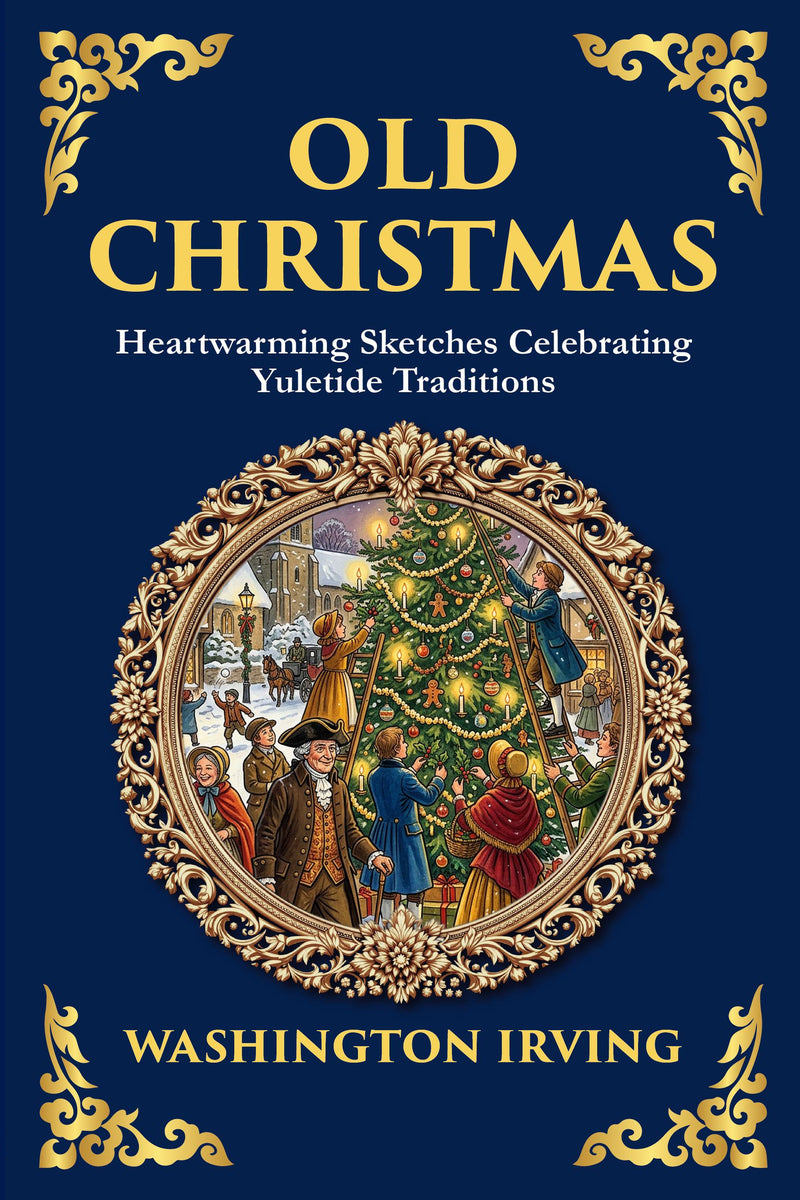
Old Christmas: from the Sketch Book of Washington Irving — Large Print
Step into a snow-dusted English countryside where roaring hearths, crackling laughter, and timeless traditions fill every corner of the manor house.
or free app
10,000+ hrs library
30-day guarantee
The complete Old Christmas appears in modern English through Library of Alexandria Press, available online with audiobook narration included for members.
Have you ever wondered why old Christmas traditions still warm the soul? Before the modern hustle of shopping malls and flashing lights, Christmas was a season of reflection, generosity, and quiet joy. In Old Christmas, Washington Irving guides us through the heartfelt customs of English Yuletide, wrapped in storytelling as cozy as a woolen blanket.
Published in the early 19th century, Old Christmas blends travel narrative with fiction, memory with imagination. The narrator journeys to a friend’s ancestral home in the English countryside to spend the holiday season immersed in time-honored traditions. Through a series of five beautifully written sketches—Christmas, The Stage Coach, Christmas Eve, Christmas Day, and The Christmas Dinner—Irving paints a tender portrait of a world where community, kindness, and reverence for the season matter more than any gift under the tree.
Perfectly paced and poetically written, Irving’s work rekindles the essence of a true Christmas— one rooted in joy, togetherness, and the enchantment of winter days gone by.
What you’ll discover in this modern edition
- A Nostalgic Glimpse into English Yuletide – From the bustle of the stagecoach to the hush of Christmas Eve, every scene glows with gentle charm
- A Literary Celebration of Holiday Traditions – Games, carols, feasts, and family in a country manor untouched by time
- A Reflection on the Spirit of Christmas – Irving’s sketches remind us of the generosity and unity that define the season
- Beautifully Evoked Rural Settings – Countryside snowscapes, roaring fires, and cozy interiors brought to life in timeless prose
| Formats | eBook (EPUB + PDF) · Audiobook · Paperback · Hardcover · Large Print |
| Language | English |
| Trim size (print) | 6 × 9 in |
| Binding | Paperback — perfect-bound · Hardcover — casewrap |
| Large Print edition | Same text in a larger, easy-read type — a larger font, not a larger trim |
| Print pricing | Every physical book at our true cost — at-cost, no profit (members) |
| Library | 873 restored titles, always growing |
| Length | 20,060 words · ~1 hr 20 min reading |
| Reading level | Grade 13 · a demanding, literary read (this modern-English edition) |
| Edition | Modern English translation · 2026 |
Member reviews for this edition are collected as readers finish it — be the first. Across the library: 12,000+ books shipped, every plan covered by a 365-day print guarantee.
About this edition
A faithful, unabridged modern-English edition by The Library of Alexandria — carefully rendered for today's reader and verified paragraph-by-paragraph against the public-domain source. Available as eBook, audiobook, paperback, hardcover, and large print.
- Complete & unabridgedVerified paragraph by paragraph against the source — never a scan, never abridged.
- Modern English, faithfulReadable today, with the author’s meaning kept intact. Readable — not simplified.
- Every format, one membershipRead in your browser or the free app, or listen to the full audiobook.
Included free with your membership
Cancel anytime, one click · 30-day money-back guarantee
Edition last updated July 2026
What’s inside
Old Christmas: from the Sketch Book of Washington Irving — Large Print — complete and unabridged: all 12 sections included with membership, plus the full audiobook.
Begin reading Old Christmas: from the Sketch Book of Washington Irving — Large Print
In clear modern English — the complete text is included with membership.
Introduction
Washington Irving arrived in England in 1815 as a man in quiet crisis. The family hardware business had collapsed, his health was uncertain, and the literary reputation he had built in America with his early satirical work felt distant and provisional. He was thirty-two years old, without fixed employment, and possessed of a sensibility that had always been more drawn to the past than the present, more comfortable in the amber light of memory than in the cold glare of commercial necessity. What followed over the next several years was one of the more remarkable acts of literary self-reinvention in the history of American letters. Wandering through England, absorbing its landscapes and its customs, its coaching inns and its country houses, its churchyards and its village greens, Irving began assembling the loosely connected sketches and essays that would eventually appear between 1819 and 1820 as The Sketch Book of Geoffrey Crayon, Gent. The book made him famous on both sides of the Atlantic. It also gave the world, tucked within its larger miscellany of travel impressions and adapted folk tales, a sequence of five essays about the English Christmas that would prove, in the long run, to be among the most consequential pieces of holiday writing ever composed.
Those five essays — gathered here under the title by which they have long been known separately from the larger Sketch Book — are what you now hold in your hands. They are short. They are, in the best sense of that word, slight: intimate rather than monumental, observational rather than argumentative, suffused with a gentle melancholy that never tips into self-pity. And yet their influence on how the English-speaking world imagines, celebrates, and emotionally inhabits the Christmas season is almost impossible to overstate. To read them carefully, with some awareness of what Irving was doing and why, is to understand something important not only about a particular literary moment but about the strange, persistent power of nostalgia as a creative force — and about the way a single writer, working in a rented room far from home, can reach forward through two centuries and still touch something alive in a contemporary reader.
It is worth pausing for a moment on the historical situation Irving was observing, because the essays themselves are so warmly atmospheric that it is easy to miss the elegiac undertow running through every page. Irving was writing about English Christmas customs at a moment when those customs were genuinely under pressure. The industrialization of England was accelerating. The old agricultural rhythms that had structured rural life for centuries — and with them the communal festivals, the lord-of-the-manor hospitalities, the wassailing and the carol-singing and the great open-hearted feasts that Irving describes with such evident longing — were being disrupted by the movement of population toward cities, by the enclosure of common lands, by the gradual erosion of the paternalistic social structures that had, whatever their many injustices, at least produced a certain kind of festive community. The Christmas that Irving describes, in which the squire throws open his ancestral hall to tenants and neighbors alike, in which the poor are welcomed at the gate rather than turned away, in which rank and station are temporarily dissolved in shared warmth and good cheer, was already, even as he wrote, more ideal than reality. He knew this. He says so, with characteristic gentleness, in the opening essay, noting that the old customs are “daily growing more and more faint, being gradually worn away by time, but still more obliterated by modern fashion.”
This is not mere rhetorical throat-clearing. Irving was genuinely mourning something, and the mourning gives the writing its particular emotional texture. He was also, it should be said, an American — a visitor, an outsider, someone encountering English traditions with the heightened receptivity of a man who had not grown up taking them for granted. There is a quality of almost childlike wonder in his descriptions of the country house Christmas, a quality that English readers of his own time found charming and that readers today may find either enchanting or faintly sentimental, depending on their temperament. What is certain is that the outsider’s perspective sharpens his attention. He notices things that a native might pass over. He invests ordinary details — the Yule log being dragged in, the mistletoe hanging in the hall, the old harper playing in the corner — with a significance that comes from recognizing them as fragile, as things that might not last.
The fictional frame Irving employs is worth understanding before you begin reading. The narrator of the Sketch Book is not Irving himself but a persona he calls Geoffrey Crayon, a gentle, somewhat dreamy American traveler of artistic inclinations. Within the Christmas essays, Crayon is invited to spend the holiday at Bracebridge Hall, the ancestral home of a genial English squire, having made the acquaintance of the squire’s son on a stagecoach journey. The squire himself is a magnificent creation: a man so devoted to the old customs that he has made it his life’s work to revive and preserve them, insisting on the boar’s head and the wassail bowl and the ancient carols not out of mere eccentricity but out of a deep conviction that these rituals carry something essential about human community and human happiness. He is, in a sense, Irving’s idealized version of himself — a man who believes that the past is worth saving, that ceremony and tradition are not empty formalities but the vessels in which a culture carries its warmest feelings about itself.
Whether Bracebridge Hall was based on any specific real place has been a matter of some discussion among Irving scholars, and the question need not detain us here. What matters is that it functions, in the essays, as a kind of dream-England, a place where everything Irving most admired about the old country has been preserved in amber, presided over by a benevolent patriarch who understands that hospitality is not merely a social grace but a moral act. The hall is real enough in its details — the great fireplace, the gallery hung with family portraits, the long table groaning with traditional dishes — to feel inhabited rather than invented. But it is also clearly a place of the imagination, a Christmas that exists, as Irving himself half-acknowledges, more in the realm of what we wish the world were like than in the realm of what it actually is.
The five essays gathered here are best approached not as a continuous narrative with the forward momentum of a novel but as a sequence of moods, each one deepening and enriching the others. Think of them less like chapters and more like movements in a piece of music — each with its own tempo and emotional register, but all contributing to a single sustained experience.
The opening essay, simply titled “Christmas,” is the most essayistic of the five, the most explicitly reflective. Irving is here at his most directly personal, meditating on what Christmas means, on why it matters, on what is being lost as the old customs fade. It is the essay that establishes the emotional key of everything that follows, and it rewards slow reading. Do not rush through it to get to the narrative. The ideas Irving is working with here — about the relationship between winter and human warmth, about the way cold and darkness make us more keenly aware of one another, about the moral significance of hospitality — are ideas that will resonate through every subsequent page, and the more fully you absorb them at the outset, the richer the rest of your reading will be.
“The Stage Coach” is where the narrative proper begins, and it is one of the most purely pleasurable pieces of travel writing in the language. Irving’s eye for character and his gift for comic observation are both fully on display here, and the essay has an energy and forward momentum that the more reflective opening piece deliberately withholds. Let yourself enjoy it as the entertainment it is, while also noticing how carefully Irving is building his cast of characters and establishing the social world into which his narrator is about to be welcomed.
“Christmas Eve,” “Christmas Day,” and “The Christmas Dinner” form the heart of the collection, and they should ideally be read in a single sitting if your circumstances allow it. Together they constitute something close to a complete imaginative experience of the old English Christmas — its sights and sounds and smells, its rituals and its characters, its moments of genuine feeling and its moments of gentle comedy. The pacing is leisurely by contemporary standards, and this is entirely intentional. Irving is not trying to drive you toward a destination. He is trying to make you feel that you are there, in the hall, by the fire, part of the company. Surrender to that pace rather than fighting it, and you will find that the essays create a remarkably immersive experience.
A word about the language: this edition presents Irving’s prose in contemporary English, with modernized spelling and punctuation, but the essential character of his style has been preserved. That style is worth a moment’s attention. Irving writes long, beautifully balanced sentences that accumulate detail and feeling in the manner of the eighteenth-century essayists he admired — Addison and Steele and Goldsmith are all audible in his rhythms. He is fond of lists, of catalogs of sensory detail that build to a kind of warm crescendo. He is also, beneath the geniality, a precise and careful observer, and the precision is part of what makes the warmth trustworthy. When he describes the old squire’s face, or the behavior of the village choir, or the particular quality of firelight in a stone hall, he is not reaching for vague atmospheric effect but rendering something specific and true. Read him with the attention you would give to good poetry, and you will find that the sentences reward that attention.
There is a question that any honest introduction to these essays must eventually address, and it is this: are they merely sentimental? Is Irving simply indulging in a comfortable fantasy of a better past that never quite existed, offering his readers the literary equivalent of a warm bath — pleasant, relaxing, and ultimately without nutritional value?
It is a fair question, and it deserves a serious answer. The charge of sentimentality is one that has been leveled at Irving since his own lifetime, and there is enough truth in it to make it worth taking seriously. The Christmas he describes is idealized. The squire’s benevolence is perhaps too perfect, the harmony between classes too easily achieved, the ancient customs too picturesque in their revival to be entirely convincing as social history. Irving is not writing documentary realism. He knows he is not writing documentary realism. The epigraph from the old song that opens the collection — with its image of the poor welcomed at the gate, of neighbors friendly bidden, of good fires and meat for great and small — is presented as a vision from a vanished past, not as a description of the present. Irving is not naive about the gap between the ideal and the actual.
What he is doing, and what distinguishes the best of these essays from mere nostalgic indulgence, is something more interesting and more useful than simple escapism. He is making an argument — not a polemical argument, not a political argument, but an argument conducted through the imagination — about what human beings need from one another, and about what kinds of social arrangements and rituals best serve those needs. The Christmas he describes is valuable not because it is historically accurate but because it embodies a set of genuine human goods: warmth, generosity, the suspension of hierarchy in the name of shared celebration, the gathering of scattered family members back to a common hearth, the acknowledgment that even in the depths of winter — perhaps especially in the depths of winter — life is worth celebrating and other people are worth cherishing.
Cancel anytime, one click · 30-day money-back guarantee
Founding annual rate available now — your price locks for life when you join.
Not ready? Get this free chapter by email — read it anytime.
✓ Sent — check your inbox for Old Christmas: from the Sketch Book of Washington Irving — Large Print.
Questions about Old Christmas: from the Sketch Book of Washington Irving — Large Print
What is Old Christmas about?
Step into a snow-dusted English countryside where roaring hearths, crackling laughter, and timeless traditions fill every corner of the manor house. In Old Christmas, Washington Irving— the beloved author of The Legend of Sleepy Hollow—offers a series of nostalgic sketches that capture the warmth, whimsy, and quiet beauty of an old-fashioned Yuletide. Whether it’s the festive games, generous feasts, or the sacred stillness of Christmas Eve, this literary journey through holiday customs is a timeless celebration of
Who wrote Old Christmas?
Old Christmas was written by Washington Irving. This edition presents the complete work in clear modern English, faithfully rendered from the public-domain original by Library of Alexandria Press.
Is Old Christmas free to read?
The opening chapter is free to read on this page. Members read and listen to the complete work — and the entire library — free, and can order any physical book at our true print cost.
How long is Old Christmas?
12 chapters (~20,060 words) — about 1 hr 20 min of reading in this modern-English edition.
Is this an abridged version of Old Christmas?
No. This is the complete, unabridged Old Christmas, carefully rendered into clear modern English and verified paragraph-by-paragraph against the public-domain source — nothing is cut or summarised.
What formats does Old Christmas come in?
Old Christmas is available as eBook, paperback, hardcover and large print. eBook and audiobook are included with membership; printed editions ship at our true print cost.
Shipping & returns
Billing & membership
More from the library


Explore Children's Classics
- Jack and Jill · Louisa May Alcott
- The Wonderful Wizard of Oz · L. Frank Baum
- Peter Pan · J. M. Barrie
- The Prince and the Pauper · Mark Twain
- The Red Fairy Book · Andrew Lang
- Old Christmas: from the Sketch Book of Washington Irving · Washington Irving
- A Houseful of Girls · Sarah Tytler
- In the hollow of His hand · Hesba Stretton
- Miss Primrose · Agnes Giberne
- Five Little Peppers and How They Grew · Margaret Sidney
- The Loss of the Swansea: A Story of the Florida Coast · W. L. Alden
- Sky Island · L. Frank Baum
- The Book of Dragons · E. Nesbit
- Wild Animals I Have Known · Ernest Thompson Seton
- Skinny McCord · Percy Keese Fitzhugh
- The Hunniwell Boys and the Platinum Mystery · L. P. Wyman
- Rainbow Valley · L. M. Montgomery
- "Us and Our Donkey" · Amy Le Feuvre
- Dorothy and the Wizard in Oz · L. Frank Baum
- The Home Book of Verse — Volume 4 · Burton Egbert Stevenson
- The Story of Doctor Dolittle · Hugh Lofting
- The Tale of Benjamin Bunny · Beatrix Potter
- Fifty Famous Stories Retold · James Baldwin
- Rilla of Ingleside · L. M. Montgomery
- The House at Pooh Corner · A. A. Milne
- Rich and Humble: A Story for Young People · Oliver Optic
- The Three Bears · A. E. Kennedy
- Peter and Wendy · J. M. Barrie
- The Marvelous Land of Oz · L. Frank Baum
- Andersen’s Fairy Tales · H. C. Andersen
Old Christmas: from the Sketch Book of Washington Irving — Large Print
Old Christmas: from the Sketch Book of Washington Irving — Large Print
A Modern Translation
Washington Irving
Contents
- Introduction
- Chapter 1
- Chapter 2
- Chapter 3
- Chapter 4
- Chapter 5
- Chapter 6
- Chapter 7
- Chapter 8
- Chapter 9
- Chapter 10
- Chapter 11
Introduction
Washington Irving arrived in England in 1815 as a man in quiet crisis. The family hardware business had collapsed, his health was uncertain, and the literary reputation he had built in America with his early satirical work felt distant and provisional. He was thirty-two years old, without fixed employment, and possessed of a sensibility that had always been more drawn to the past than the present, more comfortable in the amber light of memory than in the cold glare of commercial necessity. What followed over the next several years was one of the more remarkable acts of literary self-reinvention in the history of American letters. Wandering through England, absorbing its landscapes and its customs, its coaching inns and its country houses, its churchyards and its village greens, Irving began assembling the loosely connected sketches and essays that would eventually appear between 1819 and 1820 as The Sketch Book of Geoffrey Crayon, Gent. The book made him famous on both sides of the Atlantic. It also gave the world, tucked within its larger miscellany of travel impressions and adapted folk tales, a sequence of five essays about the English Christmas that would prove, in the long run, to be among the most consequential pieces of holiday writing ever composed.
Those five essays — gathered here under the title by which they have long been known separately from the larger Sketch Book — are what you now hold in your hands. They are short. They are, in the best sense of that word, slight: intimate rather than monumental, observational rather than argumentative, suffused with a gentle melancholy that never tips into self-pity. And yet their influence on how the English-speaking world imagines, celebrates, and emotionally inhabits the Christmas season is almost impossible to overstate. To read them carefully, with some awareness of what Irving was doing and why, is to understand something important not only about a particular literary moment but about the strange, persistent power of nostalgia as a creative force — and about the way a single writer, working in a rented room far from home, can reach forward through two centuries and still touch something alive in a contemporary reader.
It is worth pausing for a moment on the historical situation Irving was observing, because the essays themselves are so warmly atmospheric that it is easy to miss the elegiac undertow running through every page. Irving was writing about English Christmas customs at a moment when those customs were genuinely under pressure. The industrialization of England was accelerating. The old agricultural rhythms that had structured rural life for centuries — and with them the communal festivals, the lord-of-the-manor hospitalities, the wassailing and the carol-singing and the great open-hearted feasts that Irving describes with such evident longing — were being disrupted by the movement of population toward cities, by the enclosure of common lands, by the gradual erosion of the paternalistic social structures that had, whatever their many injustices, at least produced a certain kind of festive community. The Christmas that Irving describes, in which the squire throws open his ancestral hall to tenants and neighbors alike, in which the poor are welcomed at the gate rather than turned away, in which rank and station are temporarily dissolved in shared warmth and good cheer, was already, even as he wrote, more ideal than reality. He knew this. He says so, with characteristic gentleness, in the opening essay, noting that the old customs are “daily growing more and more faint, being gradually worn away by time, but still more obliterated by modern fashion.”
This is not mere rhetorical throat-clearing. Irving was genuinely mourning something, and the mourning gives the writing its particular emotional texture. He was also, it should be said, an American — a visitor, an outsider, someone encountering English traditions with the heightened receptivity of a man who had not grown up taking them for granted. There is a quality of almost childlike wonder in his descriptions of the country house Christmas, a quality that English readers of his own time found charming and that readers today may find either enchanting or faintly sentimental, depending on their temperament. What is certain is that the outsider’s perspective sharpens his attention. He notices things that a native might pass over. He invests ordinary details — the Yule log being dragged in, the mistletoe hanging in the hall, the old harper playing in the corner — with a significance that comes from recognizing them as fragile, as things that might not last.
The fictional frame Irving employs is worth understanding before you begin reading. The narrator of the Sketch Book is not Irving himself but a persona he calls Geoffrey Crayon, a gentle, somewhat dreamy American traveler of artistic inclinations. Within the Christmas essays, Crayon is invited to spend the holiday at Bracebridge Hall, the ancestral home of a genial English squire, having made the acquaintance of the squire’s son on a stagecoach journey. The squire himself is a magnificent creation: a man so devoted to the old customs that he has made it his life’s work to revive and preserve them, insisting on the boar’s head and the wassail bowl and the ancient carols not out of mere eccentricity but out of a deep conviction that these rituals carry something essential about human community and human happiness. He is, in a sense, Irving’s idealized version of himself — a man who believes that the past is worth saving, that ceremony and tradition are not empty formalities but the vessels in which a culture carries its warmest feelings about itself.
Whether Bracebridge Hall was based on any specific real place has been a matter of some discussion among Irving scholars, and the question need not detain us here. What matters is that it functions, in the essays, as a kind of dream-England, a place where everything Irving most admired about the old country has been preserved in amber, presided over by a benevolent patriarch who understands that hospitality is not merely a social grace but a moral act. The hall is real enough in its details — the great fireplace, the gallery hung with family portraits, the long table groaning with traditional dishes — to feel inhabited rather than invented. But it is also clearly a place of the imagination, a Christmas that exists, as Irving himself half-acknowledges, more in the realm of what we wish the world were like than in the realm of what it actually is.
The five essays gathered here are best approached not as a continuous narrative with the forward momentum of a novel but as a sequence of moods, each one deepening and enriching the others. Think of them less like chapters and more like movements in a piece of music — each with its own tempo and emotional register, but all contributing to a single sustained experience.
The opening essay, simply titled “Christmas,” is the most essayistic of the five, the most explicitly reflective. Irving is here at his most directly personal, meditating on what Christmas means, on why it matters, on what is being lost as the old customs fade. It is the essay that establishes the emotional key of everything that follows, and it rewards slow reading. Do not rush through it to get to the narrative. The ideas Irving is working with here — about the relationship between winter and human warmth, about the way cold and darkness make us more keenly aware of one another, about the moral significance of hospitality — are ideas that will resonate through every subsequent page, and the more fully you absorb them at the outset, the richer the rest of your reading will be.
“The Stage Coach” is where the narrative proper begins, and it is one of the most purely pleasurable pieces of travel writing in the language. Irving’s eye for character and his gift for comic observation are both fully on display here, and the essay has an energy and forward momentum that the more reflective opening piece deliberately withholds. Let yourself enjoy it as the entertainment it is, while also noticing how carefully Irving is building his cast of characters and establishing the social world into which his narrator is about to be welcomed.
“Christmas Eve,” “Christmas Day,” and “The Christmas Dinner” form the heart of the collection, and they should ideally be read in a single sitting if your circumstances allow it. Together they constitute something close to a complete imaginative experience of the old English Christmas — its sights and sounds and smells, its rituals and its characters, its moments of genuine feeling and its moments of gentle comedy. The pacing is leisurely by contemporary standards, and this is entirely intentional. Irving is not trying to drive you toward a destination. He is trying to make you feel that you are there, in the hall, by the fire, part of the company. Surrender to that pace rather than fighting it, and you will find that the essays create a remarkably immersive experience.
A word about the language: this edition presents Irving’s prose in contemporary English, with modernized spelling and punctuation, but the essential character of his style has been preserved. That style is worth a moment’s attention. Irving writes long, beautifully balanced sentences that accumulate detail and feeling in the manner of the eighteenth-century essayists he admired — Addison and Steele and Goldsmith are all audible in his rhythms. He is fond of lists, of catalogs of sensory detail that build to a kind of warm crescendo. He is also, beneath the geniality, a precise and careful observer, and the precision is part of what makes the warmth trustworthy. When he describes the old squire’s face, or the behavior of the village choir, or the particular quality of firelight in a stone hall, he is not reaching for vague atmospheric effect but rendering something specific and true. Read him with the attention you would give to good poetry, and you will find that the sentences reward that attention.
There is a question that any honest introduction to these essays must eventually address, and it is this: are they merely sentimental? Is Irving simply indulging in a comfortable fantasy of a better past that never quite existed, offering his readers the literary equivalent of a warm bath — pleasant, relaxing, and ultimately without nutritional value?
It is a fair question, and it deserves a serious answer. The charge of sentimentality is one that has been leveled at Irving since his own lifetime, and there is enough truth in it to make it worth taking seriously. The Christmas he describes is idealized. The squire’s benevolence is perhaps too perfect, the harmony between classes too easily achieved, the ancient customs too picturesque in their revival to be entirely convincing as social history. Irving is not writing documentary realism. He knows he is not writing documentary realism. The epigraph from the old song that opens the collection — with its image of the poor welcomed at the gate, of neighbors friendly bidden, of good fires and meat for great and small — is presented as a vision from a vanished past, not as a description of the present. Irving is not naive about the gap between the ideal and the actual.
What he is doing, and what distinguishes the best of these essays from mere nostalgic indulgence, is something more interesting and more useful than simple escapism. He is making an argument — not a polemical argument, not a political argument, but an argument conducted through the imagination — about what human beings need from one another, and about what kinds of social arrangements and rituals best serve those needs. The Christmas he describes is valuable not because it is historically accurate but because it embodies a set of genuine human goods: warmth, generosity, the suspension of hierarchy in the name of shared celebration, the gathering of scattered family members back to a common hearth, the acknowledgment that even in the depths of winter — perhaps especially in the depths of winter — life is worth celebrating and other people are worth cherishing.
But is good old Christmas really gone? Is nothing left but the gray hair of his head and beard? Well, I’ll take that, since I can’t have any more of him.
Before the memories of the good old days—which are fading so quickly—disappear entirely, the artist R. Caldecott and the engraver James D. Cooper decided to illustrate Washington Irving’s “Old Christmas” in this way. Their main goal was to follow the principle of the Sketch Book by integrating the artwork with the text. They worked together throughout the process with love. The public must decide how successful they were.
Designed by Randolph Caldecott, and arranged and engraved by J. D. Cooper.
THE OLD MANSION BY MOONLIGHT--Frontispiece.
“THE POOR FROM THE GATES WERE NOT CHIDDEN” xvi
“He throws down the reins with something of an air” 25
“Flagons, cans, cups, beakers, goblets, basins, and ewers” 122
Roast Beef, Plum Pudding, and Misrule 153
“Echoing back the joviality of long-departed years” 157
The poor were not chased away from the gates,
Nothing in England captures my imagination more than the remnants of old holiday customs and country games. They remind me of the images I used to imagine in the early days of my life, when I only knew the world through books and believed it was exactly as poets described it. They bring back the feeling of those honest old days, which I might mistakenly believe were more home-grown, social, and joyful than today. I regret that these customs are fading every day, gradually worn away by time and even more erased by modern fashion. They are like those picturesque pieces of Gothic architecture crumbling across the country—partly ruined by age and partly lost to modern additions and changes. However, poetry clings fondly to these country games and holiday celebrations, from which it has taken so many themes—just as ivy wraps its rich leaves around a Gothic arch or a decaying tower, gratefully paying back their support by holding their shaking remains together and essentially preserving them in greenery.
End of the free sample
Keep reading, free
Members read and listen to the complete book — and the entire library. Cancel anytime, one click · 30-day money-back guarantee.