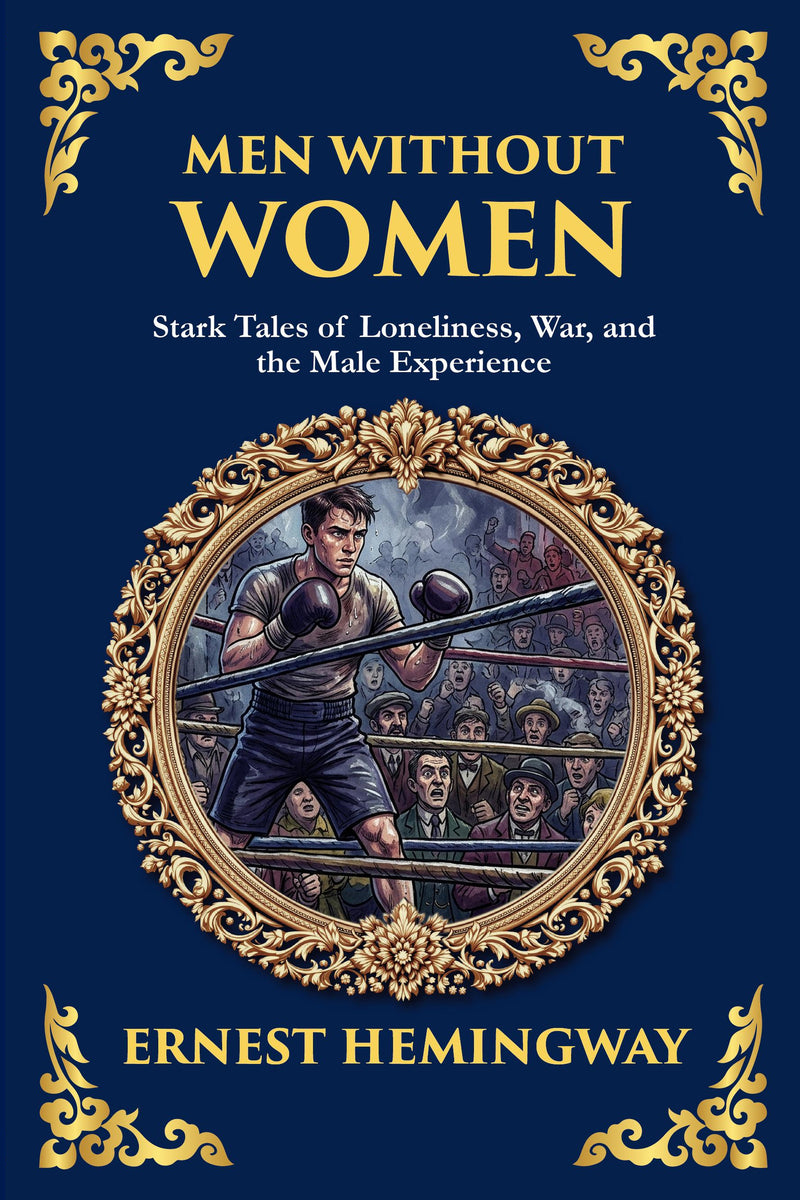
Men without women — Large Print
In Men Without Women, Ernest Hemingway delivers some of his most haunting and profound short stories—unfiltered glimpses into masculinity, solitude, and the emotional aftermath of war.
or free app
10,000+ hrs library
30-day guarantee
The complete Men Without Women appears in modern English through Library of Alexandria Press, available online with audiobook narration included for members.
Have you ever wondered why silence speaks louder than words in the lives of broken men? Men Without Women is one of Hemingway’s defining works—a collection of stories that encapsulate his signature style and thematic brilliance. With his unmatched economy of language and emotional restraint, Hemingway crafts portraits of men caught in moments of great vulnerability and quiet strength.
This modern edition brings timeless stories into sharper focus for contemporary readers. Each narrative—concise yet profound—illuminates what it means to live without love, to struggle with memory, and to confront mortality. Set in landscapes ranging from Europe to the American South, these stories challenge the conventions of masculinity, portraying complex emotional terrain beneath seemingly stoic exteriors.
What you’ll discover in this modern edition
- Stories of Quiet Devastation and Inner Turmoil Explore how Hemingway captures the unspeakable in stories like The Killers, Hills Like White Elephants, and In Another Country.
- The Brutality and Banality of War See war’s lingering shadow through the eyes of soldiers and veterans who carry its scars in silence.
- The Fragile Masks of Masculinity Witness men wrestling with identity, weakness, pride, and power in a changing world.
- A Masterclass in Minimalist Prose Hemingway’s style shows how less can reveal more—every word chosen with surgical precision.
- A Window Into the Human Soul Whether it’s love lost or dignity reclaimed, these stories resonate with raw, unfiltered emotion.
| Formats | eBook (EPUB + PDF) · Audiobook · Paperback · Hardcover · Large Print |
| Language | English |
| Trim size (print) | 6 × 9 in |
| Binding | Paperback — perfect-bound · Hardcover — casewrap |
| Large Print edition | Same text in a larger, easy-read type — a larger font, not a larger trim |
| Print pricing | Every physical book at our true cost — at-cost, no profit (members) |
| Library | 873 restored titles, always growing |
| Length | 39,603 words · ~2 hr 38 min reading |
| Reading level | Grade 5 · an easy, flowing read (this modern-English edition) |
| Edition | Modern English translation · 2026 |
Member reviews for this edition are collected as readers finish it — be the first. Across the library: 12,000+ books shipped, every plan covered by a 365-day print guarantee.
About this edition
A faithful, unabridged modern-English edition by The Library of Alexandria — carefully rendered for today's reader and verified paragraph-by-paragraph against the public-domain source. Available as eBook, audiobook, paperback, hardcover, and large print.
- Complete & unabridgedVerified paragraph by paragraph against the source — never a scan, never abridged.
- Modern English, faithfulReadable today, with the author’s meaning kept intact. Readable — not simplified.
- Every format, one membershipRead in your browser or the free app, or listen to the full audiobook.
Included free with your membership
Cancel anytime, one click · 30-day money-back guarantee
Edition last updated July 2026
What’s inside
Men without women — Large Print — complete and unabridged: all 22 sections included with membership, plus the full audiobook.
Begin reading Men without women — Large Print
In clear modern English — the complete text is included with membership.
Introduction
Ernest Hemingway published this collection in 1927, the same year he turned twenty-eight years old. He had already written The Sun Also Rises, already survived the First World War as an ambulance driver on the Italian front, already buried a marriage and begun another, already lived in Paris among the painters and poets and expatriates who were remaking what literature could do. He was, by any reasonable measure, a young man. And yet the fourteen stories gathered in this volume read like dispatches from a consciousness that has already seen everything it needs to see, that has already taken the full measure of human endurance and found it both heroic and heartbreaking in roughly equal proportion. There is no bitterness in these pages, but there is no innocence either. What there is, instead, is something rarer and more difficult to achieve: a prose style so perfectly calibrated to its subject matter that the two become inseparable, so that the way the sentences move — their rhythm, their silences, their deliberate refusals — becomes itself a form of meaning.
To read this book carefully is to receive an education in what fiction can accomplish when a writer trusts his reader completely.
The fourteen pieces collected here range across a geography that was, in the mid-1920s, Hemingway’s own lived world: the cafés and bullrings of Spain, the hospitals and mountain passes of northern Italy, the train compartments and ski lodges of Switzerland and Austria, the boxing gyms and hotel rooms of an America that feels simultaneously familiar and deeply strange. The characters who move through these landscapes are fighters, soldiers, jockeys, gamblers, waiters, soldiers, and men whose professions are never quite named but whose relationship to physical danger is always somehow present. They are men who have been hurt, or who are about to be hurt, or who are watching someone else get hurt and trying to decide what that means. They are men who have lost things — women, certainty, the use of a limb, the ability to sleep without dreaming — and who are attempting, with varying degrees of success, to continue functioning in the absence of those things.
The title itself deserves a moment’s attention before you turn to the first story. Hemingway borrowed it from a musical term: in counterpoint, “men without women” refers to a composition stripped of certain voices, a harmonic arrangement from which something has been deliberately removed. The phrase does not mean, as a careless reading might suggest, that women are absent from these stories. Women appear throughout — as wives, lovers, strangers on trains, nurses, the subjects of conversation between men who cannot quite bring themselves to say what they mean. What the title points toward is something more atmospheric, more tonal: a quality of isolation, of emotional exposure, of men who find themselves in situations where the usual consolations and complications of intimate life have been stripped away, leaving them to face something alone. Whether that something is physical danger, moral ambiguity, the approach of death, or simply the ordinary terror of being a conscious creature in an indifferent world, the stripping-away is the point. These are stories about what remains when the softening context is removed.
The collection opens with “The Undefeated,” a long, dense, magnificently sustained story about a bullfighter named Manuel Garcia who has recently been released from the hospital after a goring and is trying to get back into the ring. The opening pages, in which Manuel negotiates with a promoter named Retana for a spot in a minor nocturnal corrida, establish immediately the emotional and moral territory the entire collection will explore. Manuel is not a great bullfighter. He may once have had the potential to be one, but that moment has passed, and everyone in the story except Manuel seems to know it. Retana knows it. The picadors know it. The crowd, when it comes, will know it. And yet Manuel’s insistence on his own identity — “I am a bull-fighter,” he says, flatly, when Retana suggests he find other work — is not presented as delusion or as pathos, exactly, but as something more complicated and more dignified. It is a form of self-knowledge so complete that it has become indistinguishable from stubbornness, and Hemingway renders it without condescension and without false elevation. Manuel is what he is. The question the story asks is not whether he will succeed but what it means to continue in the face of everything that argues against continuation.
This is the question, in one form or another, that every story in the collection asks.
There is a famous formulation, which Hemingway articulated in various ways throughout his life, about the relationship between what a story says and what it withholds. He compared it to an iceberg: the dignity of movement of an iceberg is due to only one-eighth of it being above water. The writer who knows what he has omitted, Hemingway argued, strengthens the story through that omission; the reader feels what is there even without knowing consciously what has been left out. This is not a theory about obscurity or deliberate mystification. It is a theory about trust — trust in the reader’s intelligence and emotional responsiveness, trust in the capacity of concrete, specific, accurately observed detail to carry emotional weight without being told to do so.
Reading these stories well means learning to pay attention to what is not said. It means noticing when a character changes the subject, when a conversation stops just before it reaches the thing it has been circling, when a description of a physical action — a man lighting a cigarette, a woman looking out a train window, a fighter adjusting his grip on a sword — carries more emotional information than any direct statement of feeling could. Hemingway’s characters rarely tell each other, or us, what they feel. They act. They speak in short declarative sentences that seem to be about practical matters and are almost always about something else entirely. The gap between what is said and what is meant is where the stories live.
Take “Hills Like White Elephants,” which is among the most discussed short stories in the English language and which earns that attention completely. It consists almost entirely of dialogue between a man and a woman waiting for a train at a station in Spain. They are drinking. They are looking at the landscape. They are talking about something that is never named directly, using a vocabulary of indirection and euphemism that tells you everything about the power dynamics of their relationship and the nature of what is at stake. Nothing is resolved. Nothing is explained. The story ends where it began, in a sense, except that everything has shifted. If you read it quickly, looking for plot, you will find almost nothing. If you read it slowly, attending to the rhythm of the exchanges, to who speaks and who falls silent and what each silence costs, you will find one of the most precise and devastating accounts of a particular kind of human cruelty ever written.
The same principle applies throughout the collection, though the stories vary enormously in length, setting, and emotional register. “The Killers” is a story about two professional hitmen who arrive at a small-town diner looking for a man named Ole Andreson. It reads, on the surface, like a crime story, and it has the clean, hard-edged dialogue of one. But what the story is actually about — what it is doing beneath the surface of its genre conventions — is something more unsettling: a young man named Nick Adams encountering, for what may be the first time, a form of evil that is entirely indifferent to him, and discovering that there is nothing he can do about it. The story’s final image, of Nick deciding he needs to get out of town, is not a resolution. It is a recognition. The reader who understands what Nick has understood will feel the weight of it; the reader who is waiting for something to happen will feel cheated. Hemingway is not interested in cheating you. He is interested in giving you something real.
This is worth saying plainly: these stories reward patience and rereading. The first time through, you may feel that certain pieces end too abruptly, that certain conversations go nowhere, that certain characters remain opaque. This is not a failure of the writing. It is the writing. Return to those moments. Ask what the character is not saying. Ask what the story is not telling you, and why, and what that withholding feels like in your body as a reader. The answers will come, and when they do, they will feel earned in a way that more explicit fiction rarely achieves.
It would be a mistake — a common one — to confuse Hemingway’s prose style with simplicity. The sentences are short, yes. The vocabulary is largely Anglo-Saxon, largely concrete, largely free of the Latinate abstractions that fill so much literary prose. The dialogue sounds like people actually talk, which is to say it is full of repetition and non sequitur and the kind of verbal circling that happens when people are trying to say something they cannot quite bring themselves to say directly. None of this is simple. All of it is the product of extraordinary craft, of a writer who had read enormously and thought deeply about what he had read, who had worked as a journalist and learned the discipline of the exact word in the exact place, who had spent years in Paris in conversation with Gertrude Stein and Ezra Pound and F. Scott Fitzgerald and others who were collectively reinventing what prose fiction could do.
The apparent simplicity is, in fact, a form of extreme sophistication. Consider the opening of “The Undefeated,” which you will encounter on the first page of the stories themselves. Manuel Garcia climbs the stairs to an office, sets down his suitcase, knocks on the door. There is no answer. He knocks again. A voice asks who is there. He says his name. He says he wants to work. In six exchanges of dialogue, Hemingway has established the entire emotional situation of the story: the power differential between Manuel and Retana, Manuel’s vulnerability and his refusal to acknowledge it, the quality of his stubbornness, the indifference of the world he is trying to re-enter. No adjectives have been deployed to tell you how to feel. No authorial voice has intervened to explain the significance of what you are reading. The scene simply is, and it is completely alive.
This quality of aliveness — of scenes and characters that seem to exist independently of the author’s management of them — is what distinguishes Hemingway’s best work from the work of writers who have imitated his style without understanding its sources. The style is not a set of rules about sentence length or vocabulary. It is the outward form of a particular way of seeing: precise, unsentimental, deeply attentive to the physical world, and committed to the belief that emotional truth can only be conveyed obliquely, through the accumulation of accurate detail rather than through direct statement.
The stories in this collection were written at a moment when Hemingway was at the height of his early powers, before the style had hardened into self-parody, before the public persona had begun to overwhelm the private writer. Several of them — “The Killers,” “Hills Like White Elephants,” “In Another Country,” “Now I Lay Me” — are among the finest short stories written in English in the twentieth century, and that is not a claim made lightly. They have been read, taught, argued over, and imitated for nearly a century, and they have not worn out. They remain surprising. They remain capable of doing something to you that you did not expect.
The Nick Adams stories scattered through the collection — “The Killers,” “Ten Indians,” “Now I Lay Me” — deserve particular mention for readers who come to this volume without having read Hemingway’s earlier collection, In Our Time. Nick is a recurring character across Hemingway’s early work, a young man from Michigan who serves as a kind of autobiographical surrogate, moving through experiences of violence, loss, and disillusionment that are clearly drawn from Hemingway’s own life. You do not need to have read the earlier stories to understand these ones; each stands completely on its own. But knowing that Nick carries a history, that the young man lying awake in “Now I Lay Me” and the young man watching the killers in the diner are versions of the same consciousness at different stages of its education, adds a dimension of resonance that enriches the reading experience.
Cancel anytime, one click · 30-day money-back guarantee
Founding annual rate available now — your price locks for life when you join.
Not ready? Get this free chapter by email — read it anytime.
✓ Sent — check your inbox for Men without women — Large Print.
Questions about Men without women — Large Print
What is Men Without Women about?
In Men Without Women, Ernest Hemingway delivers some of his most haunting and profound short stories—unfiltered glimpses into masculinity, solitude, and the emotional aftermath of war. First published in 1927, this collection of fourteen stories explores the vulnerability, stoicism, and often unspoken pain of men who live on the edge of emotional and physical endurance. From bullfighters in Spain to soldiers grappling with trauma, from failed boxers to lonely lovers, these stories strip human experience down to its
Who wrote Men Without Women?
Men Without Women was written by Ernest Hemingway. This edition presents the complete work in clear modern English, faithfully rendered from the public-domain original by Library of Alexandria Press.
Is Men Without Women free to read?
The opening chapter is free to read on this page. Members read and listen to the complete work — and the entire library — free, and can order any physical book at our true print cost.
How long is Men Without Women?
22 chapters (~39,603 words) — about 2 hr 38 min of reading in this modern-English edition.
Is this an abridged version of Men Without Women?
No. This is the complete, unabridged Men Without Women, carefully rendered into clear modern English and verified paragraph-by-paragraph against the public-domain source — nothing is cut or summarised.
What formats does Men Without Women come in?
Men Without Women is available as eBook, paperback, hardcover and large print. eBook and audiobook are included with membership; printed editions ship at our true print cost.
Shipping & returns
Billing & membership
More from the library


Explore Short Stories
- My Man Jeeves · P. G. Wodehouse
- Men without women · Ernest Hemingway
- Four Short Stories by Emile Zola · Émile Zola
- The Wisdom of Father Brown · G. K. Chesterton
- The Cask of Amontillado · Edgar Allan Poe
- Tales of Unrest · Joseph Conrad
- The Man with Two Left Feet, and Other Stories · P. G. Wodehouse
- The Book of Dragons · E. Nesbit
- The Four Million · O. Henry
- Ghost Stories of an Antiquary · M. R. James
- Carry On, Jeeves · P. G. Wodehouse
- Wild Animals I Have Known · Ernest Thompson Seton
- The Queen of Spades and Other Stories · Aleksandr Sergeevich Pushkin
- The Man Who Would Be King · Rudyard Kipling
- The Monkey’s Paw · W. W. Jacobs
- The Adventures of Heine · Edgar Wallace
- The Life-Eater · Harold Ward
- What Men Live By, and Other Tales · graf Leo Tolstoy
- The Innocence of Father Brown · G. K. Chesterton
- The Black Kiss
- The Beasts in the Void · Paul W. Fairman
- John Jones’s Dollar · Harry Stephen Keeler
- Subversive · Mack Reynolds
- The Mississippi Saucer · Frank Belknap Long
- Man of Distinction · Michael Shaara
- The Golden Judge · Nathaniel Gordon
- The Big Fix · George O. Smith
- Time and Time Again · H. Beam Piper
- Missing Link · Frank Herbert
- We're Civilized!
Men without women — Large Print
Men without women — Large Print
A Modern Translation
Ernest Hemingway
Contents
- Introduction
- Chapter 1
- Chapter 2
- Chapter 3
- Chapter 4
- Chapter 5
- Chapter 6
- Chapter 7
- Chapter 8
- Chapter 9
- Chapter 10
- Chapter 11
- Chapter 12
- Chapter 13
- Chapter 14
- Chapter 15
- Chapter 16
- Chapter 17
- Chapter 18
- Chapter 19
- Chapter 20
- Chapter 21
Introduction
Ernest Hemingway published this collection in 1927, the same year he turned twenty-eight years old. He had already written The Sun Also Rises, already survived the First World War as an ambulance driver on the Italian front, already buried a marriage and begun another, already lived in Paris among the painters and poets and expatriates who were remaking what literature could do. He was, by any reasonable measure, a young man. And yet the fourteen stories gathered in this volume read like dispatches from a consciousness that has already seen everything it needs to see, that has already taken the full measure of human endurance and found it both heroic and heartbreaking in roughly equal proportion. There is no bitterness in these pages, but there is no innocence either. What there is, instead, is something rarer and more difficult to achieve: a prose style so perfectly calibrated to its subject matter that the two become inseparable, so that the way the sentences move — their rhythm, their silences, their deliberate refusals — becomes itself a form of meaning.
To read this book carefully is to receive an education in what fiction can accomplish when a writer trusts his reader completely.
The fourteen pieces collected here range across a geography that was, in the mid-1920s, Hemingway’s own lived world: the cafés and bullrings of Spain, the hospitals and mountain passes of northern Italy, the train compartments and ski lodges of Switzerland and Austria, the boxing gyms and hotel rooms of an America that feels simultaneously familiar and deeply strange. The characters who move through these landscapes are fighters, soldiers, jockeys, gamblers, waiters, soldiers, and men whose professions are never quite named but whose relationship to physical danger is always somehow present. They are men who have been hurt, or who are about to be hurt, or who are watching someone else get hurt and trying to decide what that means. They are men who have lost things — women, certainty, the use of a limb, the ability to sleep without dreaming — and who are attempting, with varying degrees of success, to continue functioning in the absence of those things.
The title itself deserves a moment’s attention before you turn to the first story. Hemingway borrowed it from a musical term: in counterpoint, “men without women” refers to a composition stripped of certain voices, a harmonic arrangement from which something has been deliberately removed. The phrase does not mean, as a careless reading might suggest, that women are absent from these stories. Women appear throughout — as wives, lovers, strangers on trains, nurses, the subjects of conversation between men who cannot quite bring themselves to say what they mean. What the title points toward is something more atmospheric, more tonal: a quality of isolation, of emotional exposure, of men who find themselves in situations where the usual consolations and complications of intimate life have been stripped away, leaving them to face something alone. Whether that something is physical danger, moral ambiguity, the approach of death, or simply the ordinary terror of being a conscious creature in an indifferent world, the stripping-away is the point. These are stories about what remains when the softening context is removed.
The collection opens with “The Undefeated,” a long, dense, magnificently sustained story about a bullfighter named Manuel Garcia who has recently been released from the hospital after a goring and is trying to get back into the ring. The opening pages, in which Manuel negotiates with a promoter named Retana for a spot in a minor nocturnal corrida, establish immediately the emotional and moral territory the entire collection will explore. Manuel is not a great bullfighter. He may once have had the potential to be one, but that moment has passed, and everyone in the story except Manuel seems to know it. Retana knows it. The picadors know it. The crowd, when it comes, will know it. And yet Manuel’s insistence on his own identity — “I am a bull-fighter,” he says, flatly, when Retana suggests he find other work — is not presented as delusion or as pathos, exactly, but as something more complicated and more dignified. It is a form of self-knowledge so complete that it has become indistinguishable from stubbornness, and Hemingway renders it without condescension and without false elevation. Manuel is what he is. The question the story asks is not whether he will succeed but what it means to continue in the face of everything that argues against continuation.
This is the question, in one form or another, that every story in the collection asks.
There is a famous formulation, which Hemingway articulated in various ways throughout his life, about the relationship between what a story says and what it withholds. He compared it to an iceberg: the dignity of movement of an iceberg is due to only one-eighth of it being above water. The writer who knows what he has omitted, Hemingway argued, strengthens the story through that omission; the reader feels what is there even without knowing consciously what has been left out. This is not a theory about obscurity or deliberate mystification. It is a theory about trust — trust in the reader’s intelligence and emotional responsiveness, trust in the capacity of concrete, specific, accurately observed detail to carry emotional weight without being told to do so.
Reading these stories well means learning to pay attention to what is not said. It means noticing when a character changes the subject, when a conversation stops just before it reaches the thing it has been circling, when a description of a physical action — a man lighting a cigarette, a woman looking out a train window, a fighter adjusting his grip on a sword — carries more emotional information than any direct statement of feeling could. Hemingway’s characters rarely tell each other, or us, what they feel. They act. They speak in short declarative sentences that seem to be about practical matters and are almost always about something else entirely. The gap between what is said and what is meant is where the stories live.
Take “Hills Like White Elephants,” which is among the most discussed short stories in the English language and which earns that attention completely. It consists almost entirely of dialogue between a man and a woman waiting for a train at a station in Spain. They are drinking. They are looking at the landscape. They are talking about something that is never named directly, using a vocabulary of indirection and euphemism that tells you everything about the power dynamics of their relationship and the nature of what is at stake. Nothing is resolved. Nothing is explained. The story ends where it began, in a sense, except that everything has shifted. If you read it quickly, looking for plot, you will find almost nothing. If you read it slowly, attending to the rhythm of the exchanges, to who speaks and who falls silent and what each silence costs, you will find one of the most precise and devastating accounts of a particular kind of human cruelty ever written.
The same principle applies throughout the collection, though the stories vary enormously in length, setting, and emotional register. “The Killers” is a story about two professional hitmen who arrive at a small-town diner looking for a man named Ole Andreson. It reads, on the surface, like a crime story, and it has the clean, hard-edged dialogue of one. But what the story is actually about — what it is doing beneath the surface of its genre conventions — is something more unsettling: a young man named Nick Adams encountering, for what may be the first time, a form of evil that is entirely indifferent to him, and discovering that there is nothing he can do about it. The story’s final image, of Nick deciding he needs to get out of town, is not a resolution. It is a recognition. The reader who understands what Nick has understood will feel the weight of it; the reader who is waiting for something to happen will feel cheated. Hemingway is not interested in cheating you. He is interested in giving you something real.
This is worth saying plainly: these stories reward patience and rereading. The first time through, you may feel that certain pieces end too abruptly, that certain conversations go nowhere, that certain characters remain opaque. This is not a failure of the writing. It is the writing. Return to those moments. Ask what the character is not saying. Ask what the story is not telling you, and why, and what that withholding feels like in your body as a reader. The answers will come, and when they do, they will feel earned in a way that more explicit fiction rarely achieves.
It would be a mistake — a common one — to confuse Hemingway’s prose style with simplicity. The sentences are short, yes. The vocabulary is largely Anglo-Saxon, largely concrete, largely free of the Latinate abstractions that fill so much literary prose. The dialogue sounds like people actually talk, which is to say it is full of repetition and non sequitur and the kind of verbal circling that happens when people are trying to say something they cannot quite bring themselves to say directly. None of this is simple. All of it is the product of extraordinary craft, of a writer who had read enormously and thought deeply about what he had read, who had worked as a journalist and learned the discipline of the exact word in the exact place, who had spent years in Paris in conversation with Gertrude Stein and Ezra Pound and F. Scott Fitzgerald and others who were collectively reinventing what prose fiction could do.
The apparent simplicity is, in fact, a form of extreme sophistication. Consider the opening of “The Undefeated,” which you will encounter on the first page of the stories themselves. Manuel Garcia climbs the stairs to an office, sets down his suitcase, knocks on the door. There is no answer. He knocks again. A voice asks who is there. He says his name. He says he wants to work. In six exchanges of dialogue, Hemingway has established the entire emotional situation of the story: the power differential between Manuel and Retana, Manuel’s vulnerability and his refusal to acknowledge it, the quality of his stubbornness, the indifference of the world he is trying to re-enter. No adjectives have been deployed to tell you how to feel. No authorial voice has intervened to explain the significance of what you are reading. The scene simply is, and it is completely alive.
This quality of aliveness — of scenes and characters that seem to exist independently of the author’s management of them — is what distinguishes Hemingway’s best work from the work of writers who have imitated his style without understanding its sources. The style is not a set of rules about sentence length or vocabulary. It is the outward form of a particular way of seeing: precise, unsentimental, deeply attentive to the physical world, and committed to the belief that emotional truth can only be conveyed obliquely, through the accumulation of accurate detail rather than through direct statement.
The stories in this collection were written at a moment when Hemingway was at the height of his early powers, before the style had hardened into self-parody, before the public persona had begun to overwhelm the private writer. Several of them — “The Killers,” “Hills Like White Elephants,” “In Another Country,” “Now I Lay Me” — are among the finest short stories written in English in the twentieth century, and that is not a claim made lightly. They have been read, taught, argued over, and imitated for nearly a century, and they have not worn out. They remain surprising. They remain capable of doing something to you that you did not expect.
The Nick Adams stories scattered through the collection — “The Killers,” “Ten Indians,” “Now I Lay Me” — deserve particular mention for readers who come to this volume without having read Hemingway’s earlier collection, In Our Time. Nick is a recurring character across Hemingway’s early work, a young man from Michigan who serves as a kind of autobiographical surrogate, moving through experiences of violence, loss, and disillusionment that are clearly drawn from Hemingway’s own life. You do not need to have read the earlier stories to understand these ones; each stands completely on its own. But knowing that Nick carries a history, that the young man lying awake in “Now I Lay Me” and the young man watching the killers in the diner are versions of the same consciousness at different stages of its education, adds a dimension of resonance that enriches the reading experience.
Manuel drank his brandy. He felt sleepy. It was too hot to go into town, and besides, there was nothing to do. He wanted to see Zurito, so he decided to nap while he waited. He kicked his suitcase under the table to make sure it was still there. Then he decided it would be better to put it back under the seat against the wall. He leaned down, shoved it under, and then leaned forward on the table and fell asleep.
When he woke up, someone was sitting across from him. It was a large man with a heavy, brown face, resembling an Indian. He had been there for a while. He had waved the waiter away and spent the time reading the newspaper, occasionally glancing down at Manuel, who was asleep with his head on the table. He read the paper with effort, moving his lips as he formed the words. When he got tired, he looked at Manuel. He sat heavily in the chair, his black Cordoba hat tipped forward.
“I was asleep.” Manuel rubbed his forehead with the back of his fist.
They both went silent. Zurito, the picador, looked at Manuel’s pale face. Manuel looked down at the picador’s massive hands as he folded the newspaper to put it in his pocket.
“I have a favor to ask you, Manos,” Manuel said.
Manosduros was Zurito’s nickname. Whenever Manuel heard it, he thought of those huge hands. Zurito consciously placed his hands on the table.
The waiter came and went several times. As he left the room, he looked back at the two men at the table.
“What’s the problem, Manolo?” Zurito asked, setting down his glass.
“Would you pic two bulls for me tomorrow night?” Manuel asked, looking up at Zurito.
Manuel looked down at his glass. He had expected that answer; now he had it. Well, he had it.
End of the free sample
Keep reading, free
Members read and listen to the complete book — and the entire library. Cancel anytime, one click · 30-day money-back guarantee.